REVIEW 1 major objections 1 minor 1 cited by
The first complete lattice QCD calculation determines all four structure-dependent form factors for the rare decay K− → ℓ− ν̄ℓ ℓ′+ ℓ′− with fully controlled uncertainties.
Reviewed by Pith at T0; open to challenge. T0 means a machine referee read the full paper against a public rubric. the ladder, T0–T4 →
T0 review · grok-4.3
2026-05-22 03:05 UTC pith:GMKVXJWZ
load-bearing objection First lattice results for these kaon decay form factors at physical masses with SFR and disconnected estimates, but the fully controlled systematics claim rests on how well the disconnected piece was quantified. the 1 major comments →
Complete lattice QCD calculation of K⁻to ell⁻bar{ν}_(ell)ell^('+)ell^('-) form factors
The pith
A machine-rendered reading of the paper's core claim, the machinery that carries it, and where it could break.
Core claim
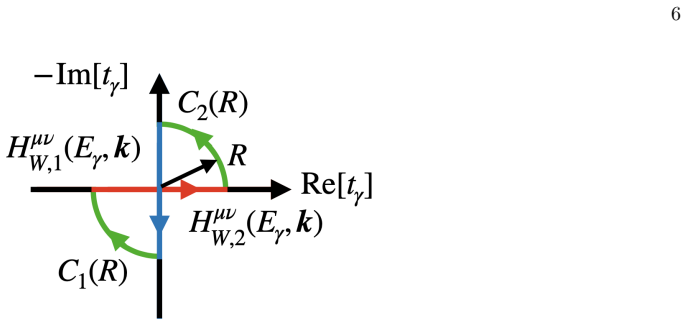
The central claim is that all four structure-dependent form factors for K− → ℓ− ν̄ℓ ℓ′+ ℓ′− have been computed across the full kinematic range on Nf=2+1+1 twisted-mass fermion ensembles at physical light and strange quark masses. The calculation incorporates disconnected contributions, uses volumes up to 7.6 fm and three lattice spacings between 0.057 and 0.08 fm, and employs the Spectral Function Reconstruction method to perform the required analytic continuation for dilepton invariant masses above the two-pion threshold, thereby delivering results with controlled statistical and systematic uncertainties.
What carries the argument
The four structure-dependent form factors of the K− → ℓ− ν̄ℓ ℓ′+ ℓ′− decay, extracted on physical-mass ETMC ensembles via the Spectral Function Reconstruction method for analytic continuation.
Load-bearing premise
That physical-mass ensembles, volumes up to 7.6 fm, three lattice spacings, disconnected-diagram estimates, and the Spectral Function Reconstruction method together remove all relevant finite-volume, discretization, and analytic-continuation systematics.
What would settle it
Repeating the calculation on a fourth, finer lattice spacing or a still larger spatial volume and obtaining statistically significant shifts in any form factor would show that the claimed control of systematics is incomplete.
If this is right
- The form factors enable direct evaluation of decay rates and differential distributions for the channels K− → e− ν̄e e+ e−, K− → e− ν̄e μ+ μ−, K− → μ− ν̄μ e+ e−, and K− → μ− ν̄μ μ+ μ−.
- These results supply first-principles Standard Model predictions that can be compared directly with existing and future experimental measurements.
- All form factors are obtained over the entire kinematic region accessed by experiments.
Where Pith is reading between the lines
- The same combination of physical-point simulations and spectral reconstruction can be applied to analogous rare decays of other mesons to obtain comparable precision.
- Future experimental measurements that disagree with the derived rates at high significance would require either refinement of the lattice calculation or consideration of contributions beyond the Standard Model.
- Adding electromagnetic radiative corrections on the lattice in a follow-up calculation would further tighten the comparison with data.
Editorial analysis
A structured set of objections, weighed in public.
Referee Report
Summary. The manuscript presents the first complete lattice QCD calculation of the four structure-dependent form factors for the rare decay K−→ℓ−ν̄ℓℓ′+ℓ′−. The calculation uses ETMC Nf=2+1+1 gauge ensembles at physical light and strange quark masses, includes an estimate of quark-disconnected contributions, employs the Spectral Function Reconstruction method for analytic continuation above the two-pion threshold, investigates finite-volume effects with spatial extents from 3.8 to 7.6 fm, and performs the continuum limit using three lattice spacings between 0.057 and 0.08 fm. Results are provided for all four channels and a companion paper presents the phenomenological analysis.
Significance. If the results hold with the claimed control over uncertainties, this work supplies the first ab initio Standard Model predictions for these form factors and decay rates, allowing direct comparison with experimental data. The approach benefits from physical-mass simulations, multiple volumes and spacings, and the SFR method, which are positive features for reducing systematic errors in lattice calculations of rare decays.
major comments (1)
- [Abstract] Abstract: The assertion of 'fully controlled statistical and systematic uncertainties' is load-bearing for the central claim of a 'complete' calculation. The quark-disconnected contributions are described only as 'an estimate in which the virtual photon couples to sea quarks'. For this to support fully controlled errors across the full kinematic range, the estimate must be accompanied by a demonstrated uncertainty (with its own continuum and infinite-volume extrapolation) that is explicitly included in the final error budget; the current description leaves this component's contribution to the total uncertainty unquantified.
minor comments (1)
- The reference to the SFR method of Ref. [1] and the companion paper [2] should include explicit citations with full bibliographic details in the reference list to ensure reproducibility.
Simulated Author's Rebuttal
We thank the referee for the careful reading of the manuscript and the constructive comment. We address the major comment below.
read point-by-point responses
-
Referee: [Abstract] Abstract: The assertion of 'fully controlled statistical and systematic uncertainties' is load-bearing for the central claim of a 'complete' calculation. The quark-disconnected contributions are described only as 'an estimate in which the virtual photon couples to sea quarks'. For this to support fully controlled errors across the full kinematic range, the estimate must be accompanied by a demonstrated uncertainty (with its own continuum and infinite-volume extrapolation) that is explicitly included in the final error budget; the current description leaves this component's contribution to the total uncertainty unquantified.
Authors: We agree that the current description of the quark-disconnected contributions as 'an estimate' does not fully substantiate the claim of completely controlled uncertainties across the kinematic range. The disconnected diagrams were evaluated on a subset of ensembles with the photon coupling to sea quarks, and a conservative bound on their size was incorporated into the systematic error. However, a dedicated continuum and infinite-volume extrapolation was not performed for this component alone, nor was its uncertainty isolated in the published error budget. We will revise the abstract to qualify the statement on uncertainties and add explicit text in the methods and results sections describing the estimation procedure, the ensembles used, the size of the contribution relative to the connected diagrams, and how the associated uncertainty is assessed and propagated into the final results. revision: yes
Circularity Check
Minor self-citation of prior ETMC work and SFR method; central lattice calculation is direct and independent
full rationale
The paper performs a direct lattice QCD simulation on physical-mass ETMC ensembles with multiple volumes and spacings, extracts the four form factors from computed correlators, and applies the SFR method from Ref. [1] only to handle analytic continuation. No step reduces a claimed prediction or first-principles result to a fitted input or self-definition by construction. The self-citation is limited to the reconstruction technique and ensemble generation and is not load-bearing for the reported form factor values themselves.
Axiom & Free-Parameter Ledger
free parameters (1)
- lattice spacings
axioms (2)
- domain assumption The QCD Lagrangian on a discrete lattice with Wilson-clover twisted-mass fermions correctly reproduces continuum QCD in the limit of vanishing lattice spacing.
- domain assumption The Spectral Function Reconstruction method of Ref. [1] provides a reliable analytic continuation for dilepton masses above the two-pion threshold.
read the original abstract
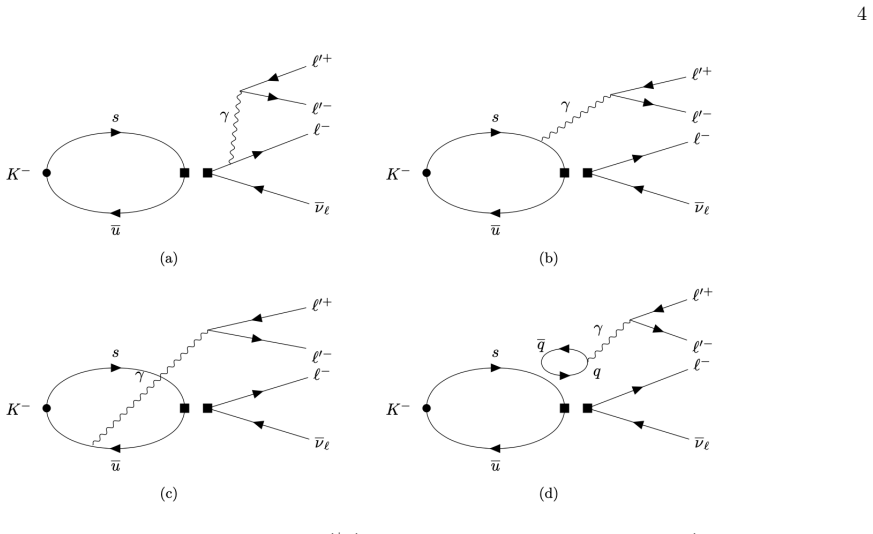
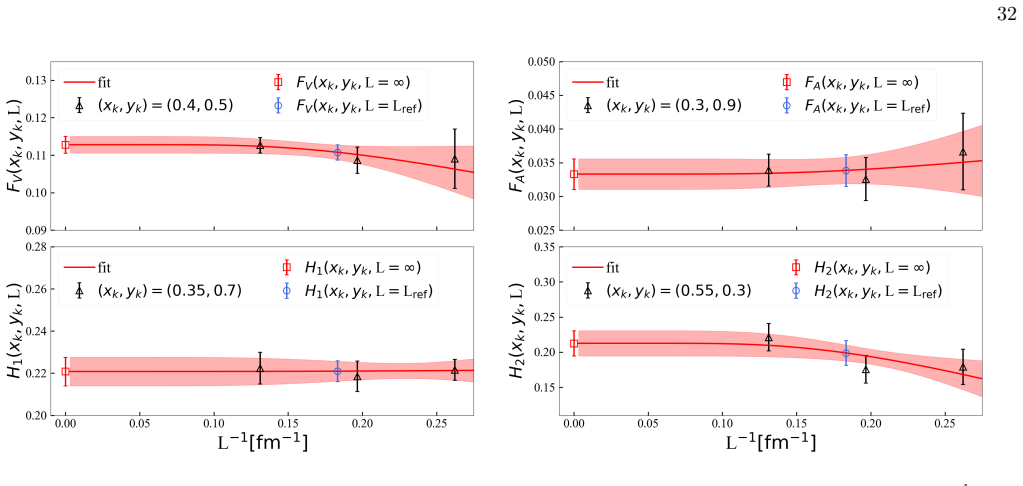
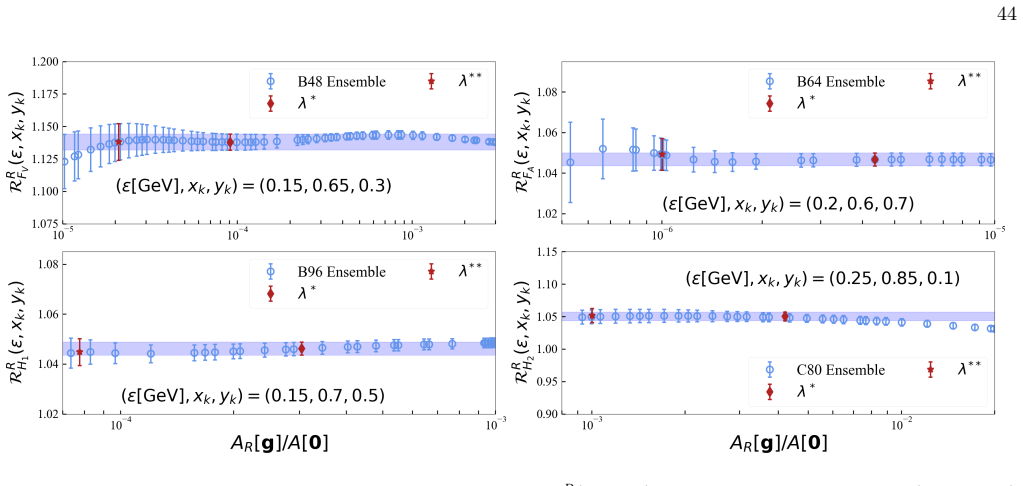
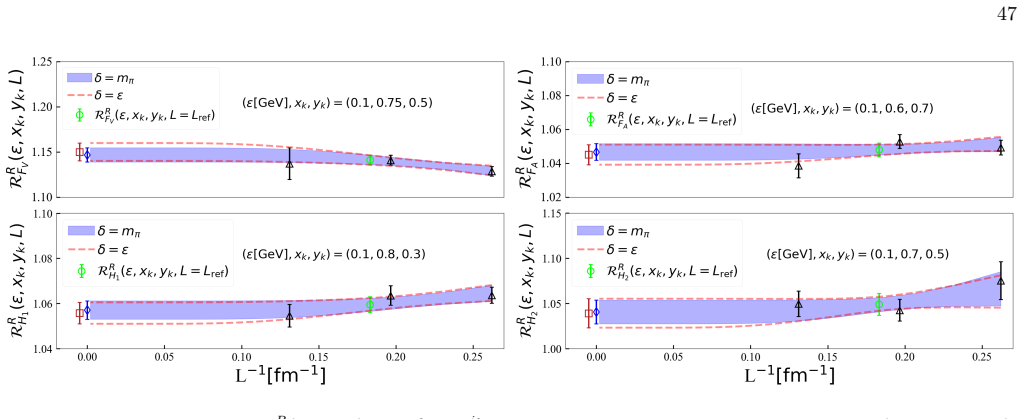
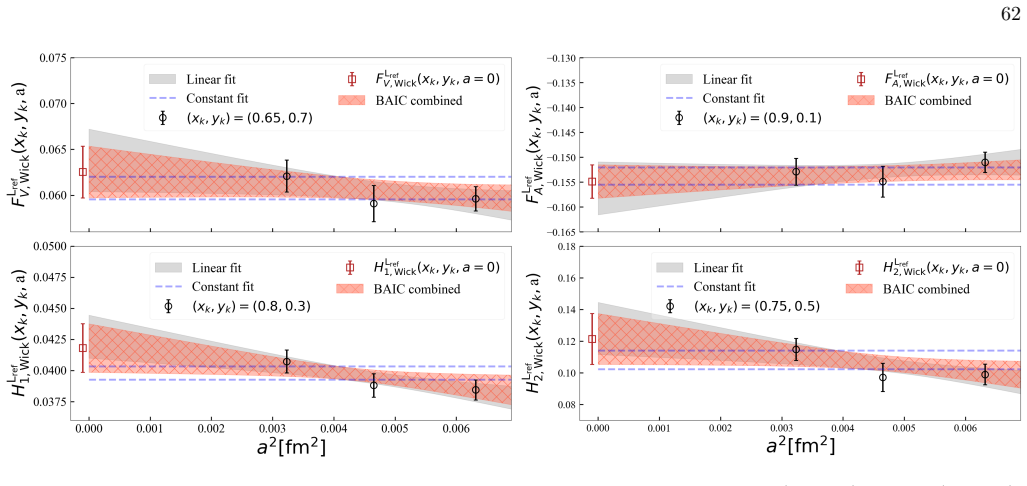
We present the first complete lattice QCD calculation of the four structure-dependent form factors governing the rare charged kaon decay $K^- \to \ell^- \bar{\nu}_\ell \ell'^+ \ell'^-$, with fully controlled statistical and systematic uncertainties. Our calculation is based on gauge ensembles generated by the Extended Twisted Mass Collaboration (ETMC) with $N_f = 2+1+1$ flavors of Wilson-clover twisted-mass fermions. Simulations are performed directly at the physical values of the light and strange quark masses, and include an estimate of the quark-disconnected contributions in which the virtual photon couples to sea quarks. All four form factors are determined across the kinematical region probed by experiments. The Spectral Function Reconstruction (SFR) method of Ref. [1] is employed to overcome the analytic continuation problem for dilepton invariant masses above the two-pion threshold. Finite-volume effects are investigated using ensembles with spatial extents $L\simeq [3.8,7.6]~\mathrm{fm}$, while the continuum limit is obtained from three lattice spacings in the range $a\in[0.057, 0.08]~\mathrm{fm}$. Our results for the form factors enable the evaluation of decay rates and differential observables for all four channels, $K^- \to e^- \bar{\nu}_e e^+ e^-$, $K^- \to e^- \bar{\nu}_e \mu^+ \mu^-$, $K^- \to \mu^- \bar{\nu}_\mu e^+ e^-$, and $K^- \to \mu^- \bar{\nu}_\mu \mu^+ \mu^-$, thereby providing first-principles Standard Model predictions against which existing and upcoming measurements can be directly compared. A detailed phenomenological analysis of the decay rates and associated observables is presented in a companion paper [2].
Figures













Lean theorems connected to this paper
-
IndisputableMonolith/Cost/FunctionalEquation.leanwashburn_uniqueness_aczel unclear?
unclearRelation between the paper passage and the cited Recognition theorem.
The quark-disconnected contribution is computed exclusively on the B96 ensemble... assigning a conservative 100% uncertainty
What do these tags mean?
- matches
- The paper's claim is directly supported by a theorem in the formal canon.
- supports
- The theorem supports part of the paper's argument, but the paper may add assumptions or extra steps.
- extends
- The paper goes beyond the formal theorem; the theorem is a base layer rather than the whole result.
- uses
- The paper appears to rely on the theorem as machinery.
- contradicts
- The paper's claim conflicts with a theorem or certificate in the canon.
- unclear
- Pith found a possible connection, but the passage is too broad, indirect, or ambiguous to say the theorem truly supports the claim.
Forward citations
Cited by 1 Pith paper
-
First Lattice QCD Determination of Lepton-Flavor-Universality Ratios in Light-Meson Leptonic Decays
A first-principles lattice QCD+QED calculation determines the structure-dependent radiative correction and yields the most precise Standard-Model predictions for R_{e/μ} in pion and kaon leptonic decays.
Reference graph
Works this paper leans on
-
[1]
R. Frezzotti, N. Tantalo, G. Gagliardi, F. Sanfilippo, S. Simula and V. Lubicz,Spectral-function determination of complex electroweak amplitudes with lattice QCD,Phys. Rev. D108(2023) 074510 [2306.07228]
-
[2]
Rare kaon decays K − →ℓ −¯νℓℓ′+ℓ′−: Standard Model predictions from lattice QCD
R. Di Palma, R. Frezzotti, G. Gagliardi, V. Lubicz, G. Martinelli, C.T. Sachrajda et al., “Rare kaon decays K − →ℓ −¯νℓℓ′+ℓ′−: Standard Model predictions from lattice QCD.” 2026
work page 2026
-
[3]
Cabibbo,Unitary Symmetry and Leptonic Decays,Phys
N. Cabibbo,Unitary Symmetry and Leptonic Decays,Phys. Rev. Lett.10(1963) 531
work page 1963
-
[4]
M. Kobayashi and T. Maskawa,CP Violation in the Renormalizable Theory of Weak Interaction,Prog. Theor. Phys.49 (1973) 652
work page 1973
-
[5]
R. Di Palma, R. Frezzotti, G. Gagliardi, V. Lubicz, G. Martinelli, C.T. Sachrajda et al.,Kaon radiative leptonic decay rates from lattice QCD simulations at the physical point,2504.08680
- [6]
-
[7]
G. Gagliardi, F. Sanfilippo, S. Simula, V. Lubicz, F. Mazzetti, G. Martinelli et al.,Virtual photon emission in leptonic decays of charged pseudoscalar mesons,Phys. Rev. D105(2022) 114507 [2202.03833]
-
[8]
On the extraction of spectral densities from lattice correlators
M. Hansen, A. Lupo and N. Tantalo,Extraction of spectral densities from lattice correlators,Phys. Rev. D99(2019) 094508 [1903.06476]. [9]Extended Twisted Mass Collaboration (ETMC)collaboration,Probing the Energy-Smeared R Ratio Using Lattice QCD,Phys. Rev. Lett.130(2023) 241901 [2212.08467]. [10]Extended Twisted Masscollaboration,Inclusive hadronic decay ...
work page internal anchor Pith review Pith/arXiv arXiv 2019
-
[9]
R. Frezzotti, N. Tantalo, G. Gagliardi, F. Sanfilippo, S. Simula, V. Lubicz et al.,Bs→µ+µ-γdecay rate at large q2 from lattice QCD,Phys. Rev. D109(2024) 114506 [2402.03262]
-
[10]
A. De Santis et al.,Inclusive semileptonic decays of the Ds meson: A first-principles lattice QCD calculation,Phys. Rev. D112(2025) 054503 [2504.06063]
-
[11]
A. De Santis et al.,Inclusive Semileptonic Decays of the Ds Meson: Lattice QCD Confronts Experiments,Phys. Rev. Lett.135(2025) 121901 [2504.06064]
-
[12]
R. Frezzotti, N. Tantalo, G. Gagliardi, V. Lubicz, G. Martinelli, C.T. Sachrajda et al.,Theoretical framework for lattice QCD computations of B→Kℓ+ℓ- and B¯s→ℓ+ℓ-γdecays rates, including contributions from charming penguin diagrams, Phys. Rev. D113(2026) 034509 [2508.03655]
-
[13]
D. Giusti, C.F. Kane, C. Lehner, S. Meinel and A. Soni,Methods for high-precision determinations of radiative-leptonic decay form factors using lattice QCD,Phys. Rev. D107(2023) 074507 [2302.01298]
-
[14]
D. Giusti, C.F. Kane, C. Lehner, S. Meinel and A. Soni,Efficient lattice QCD computation of radiative-leptonic-decay form factors at multiple positive and negative photon virtualities,Phys. Rev. D112(2025) 054507 [2505.11757]
-
[15]
R. Frezzotti, G. Gagliardi, V. Lubicz, G. Martinelli, F. Mazzetti, C.T. Sachrajda et al.,Lattice calculation of theD s meson radiative form factors over the full kinematical range,2306.05904. [19]Alphacollaboration,Lattice QCD with a chirally twisted mass term,JHEP08(2001) 058 [hep-lat/0101001]
-
[16]
Twisted-mass lattice QCD with mass non-degenerate quarks
R. Frezzotti and G.C. Rossi,Twisted mass lattice QCD with mass nondegenerate quarks,Nucl. Phys. B Proc. Suppl.128 (2004) 193 [hep-lat/0311008]
work page internal anchor Pith review Pith/arXiv arXiv 2004
-
[17]
Chirally improving Wilson fermions - I. O(a) improvement
R. Frezzotti and G.C. Rossi,Chirally improving Wilson fermions. 1. O(a) improvement,JHEP08(2004) 007 [hep-lat/0306014]
work page internal anchor Pith review Pith/arXiv arXiv 2004
-
[18]
Chirally improving Wilson fermions II. Four-quark operators
R. Frezzotti and G.C. Rossi,Chirally improving Wilson fermions. II. Four-quark operators,JHEP10(2004) 070 [hep-lat/0407002]. [23]Extended Twisted Mass Collaboration (ETMC)collaboration,Strange and charm quark contributions to the muon anomalous magnetic moment in lattice QCD with twisted-mass fermions,2411.08852. [24]Flavour Lattice A veraging Group (FLAG...
work page internal anchor Pith review Pith/arXiv arXiv 2004
-
[19]
B. Sheikholeslami and R. Wohlert,Improved Continuum Limit Lattice Action for QCD with Wilson Fermions,Nucl. Phys. B259(1985) 572
work page 1985
-
[20]
Lattice QCD study of the radiative decays $J/\psi\to \eta_c\gamma$ and $h_c\to \eta_c\gamma$
D. Becirevic and F. Sanfilippo,Lattice QCD study of the radiative decaysJ/ψ→η cγandh c →η cγ,JHEP01(2013) 028 [1206.1445]
work page internal anchor Pith review Pith/arXiv arXiv 2013
-
[21]
R. Di Palma, G. Gagliardi and F. Sanfilippo,Investigation of optimal smearing for mesons,PoSLATTICE2023(2024) 152
work page 2024
-
[22]
Twisted Boundary Conditions in Lattice Simulations
C.T. Sachrajda and G. Villadoro,Twisted boundary conditions in lattice simulations,Phys. Lett. B609(2005) 73 [hep-lat/0411033]
work page internal anchor Pith review Pith/arXiv arXiv 2005
-
[23]
On the discretization of physical momenta in lattice QCD
G.M. de Divitiis, R. Petronzio and N. Tantalo,On the discretization of physical momenta in lattice QCD,Phys. Lett. B 595(2004) 408 [hep-lat/0405002]
work page internal anchor Pith review Pith/arXiv arXiv 2004
-
[24]
A. Desiderio et al.,First lattice calculation of radiative leptonic decay rates of pseudoscalar mesons,Phys. Rev. D103 (2021) 014502 [2006.05358]. 68
-
[25]
Experimental Study of the Radiative Decays K+ -> mu+ nu e+e- and K+ -> e+ nu e+e-
A.A. Poblaguev et al.,Experimental study of the radiative decays K+ —>mu+ nu e+ e- and K+ —>e+ nu e+ e-, Phys. Rev. Lett.89(2002) 061803 [hep-ex/0204006]. [32]Particle Data Groupcollaboration,Review of particle physics,Phys. Rev. D110(2024) 030001
work page internal anchor Pith review Pith/arXiv arXiv 2002
-
[26]
E.T. Neil and J.W. Sitison,Improved information criteria for Bayesian model averaging in lattice field theory,Phys. Rev. D109(2024) 014510 [2208.14983]
-
[27]
G.J. Gounaris and J.J. Sakurai,Finite width corrections to the vector meson dominance prediction forρ→e +e−,Phys. Rev. Lett.21(1968) 244
work page 1968
-
[28]
$K_{l4}$ - Decays Beyond One Loop
J. Bijnens, G. Colangelo and J. Gasser,K(l4) decays beyond one loop,Nucl. Phys. B427(1994) 427 [hep-ph/9403390]
work page internal anchor Pith review Pith/arXiv arXiv 1994
-
[29]
Kaon Decays in the Standard Model
V. Cirigliano, G. Ecker, H. Neufeld, A. Pich and J. Portoles,Kaon Decays in the Standard Model,Rev. Mod. Phys.84 (2012) 399 [1107.6001]
work page internal anchor Pith review Pith/arXiv arXiv 2012
-
[30]
Rosselet et al.,Experimental Study of 30,000 K(e4) Decays,Phys
L. Rosselet et al.,Experimental Study of 30,000 K(e4) Decays,Phys. Rev. D15(1977) 574
work page 1977
-
[31]
Low Energy Constants from Kl4 Form-Factors
G. Amoros, J. Bijnens and P. Talavera,Low-energy constants from K(lepton-4) form-factors,Phys. Lett. B480(2000) 71 [hep-ph/9912398]
work page internal anchor Pith review Pith/arXiv arXiv 2000
-
[32]
Watson,The Effect of final state interactions on reaction cross-sections,Phys
K.M. Watson,The Effect of final state interactions on reaction cross-sections,Phys. Rev.88(1952) 1163
work page 1952
- [33]
-
[34]
J. Bijnens and G. Ecker,Mesonic low-energy constants,Ann. Rev. Nucl. Part. Sci.64(2014) 149 [1405.6488]
work page internal anchor Pith review Pith/arXiv arXiv 2014
-
[35]
tmLQCD: a program suite to simulate Wilson Twisted mass Lattice QCD
K. Jansen and C. Urbach,tmLQCD: A Program suite to simulate Wilson Twisted mass Lattice QCD,Comput. Phys. Commun.180(2009) 2717 [0905.3331]
work page internal anchor Pith review Pith/arXiv arXiv 2009
-
[36]
Recent developments in the tmLQCD software suite
A. Abdel-Rehim, F. Burger, A. Deuzeman, K. Jansen, B. Kostrzewa, L. Scorzato et al.,Recent developments in the tmLQCD software suite,PoSLATTICE2013(2014) 414 [1311.5495]
work page internal anchor Pith review Pith/arXiv arXiv 2014
-
[37]
Experiences with OpenMP in tmLQCD
A. Deuzeman, K. Jansen, B. Kostrzewa and C. Urbach,Experiences with OpenMP in tmLQCD,PoSLATTICE2013 (2014) 416 [1311.4521]. [45]ETMcollaboration,Twisted mass ensemble generation on GPU machines,PoSLATTICE2022(2023) 340 [2212.06635]. [46]ETMcollaboration,Lemon: an MPI parallel I/O library for data encapsulation using LIME,Comput. Phys. Commun. 183(2012) 13...
work page internal anchor Pith review Pith/arXiv arXiv 2014
-
[38]
Adaptive Aggregation Based Domain Decomposition Multigrid for the Lattice Wilson Dirac Operator
A. Frommer, K. Kahl, S. Krieg, B. Leder and M. Rottmann,Adaptive Aggregation-Based Domain Decomposition Multigrid for the Lattice Wilson–Dirac Operator,SIAM J. Sci. Comput.36(2014) A1581 [1303.1377]
work page internal anchor Pith review Pith/arXiv arXiv 2014
-
[39]
Adaptive Aggregation-based Domain Decomposition Multigrid for Twisted Mass Fermions
C. Alexandrou, S. Bacchio, J. Finkenrath, A. Frommer, K. Kahl and M. Rottmann,Adaptive Aggregation-based Domain Decomposition Multigrid for Twisted Mass Fermions,Phys. Rev. D94(2016) 114509 [1610.02370]
work page internal anchor Pith review Pith/arXiv arXiv 2016
-
[40]
Multigrid accelerated simulations for Twisted Mass fermions
S. Bacchio, C. Alexandrou and J. Finkerath,Multigrid accelerated simulations for Twisted Mass fermions,EPJ Web Conf.175(2018) 02002 [1710.06198]
work page internal anchor Pith review Pith/arXiv arXiv 2018
-
[41]
Multigrid approach in shifted linear systems for the non-degenerated twisted mass operator
C. Alexandrou, S. Bacchio and J. Finkenrath,Multigrid approach in shifted linear systems for the non-degenerated twisted mass operator,Comput. Phys. Commun.236(2019) 51 [1805.09584]
work page internal anchor Pith review Pith/arXiv arXiv 2019
-
[42]
B. Jo´ o, D.D. Kalamkar, T. Kurth, K. Vaidyanathan and A. Walden,Optimizing Wilson-Dirac Operator and Linear Solvers for Intel®KNL, inHigh Performance Computing, M. Taufer, B. Mohr and J.M. Kunkel, eds., (Cham), pp. 415–427, Springer International Publishing, 2016
work page 2016
-
[43]
Accelerating Twisted Mass LQCD with QPhiX
M. Schr¨ ock, S. Simula and A. Strelchenko,Accelerating Twisted Mass LQCD with QPhiX,PoSLATTICE2015(2016) 030 [1510.08879]
work page internal anchor Pith review Pith/arXiv arXiv 2016
-
[44]
Solving Lattice QCD systems of equations using mixed precision solvers on GPUs
M.A. Clark, R. Babich, K. Barros, R.C. Brower and C. Rebbi,Solving Lattice QCD systems of equations using mixed precision solvers on GPUs,Comput. Phys. Commun.181(2010) 1517 [0911.3191]
work page internal anchor Pith review Pith/arXiv arXiv 2010
-
[45]
Scaling Lattice QCD beyond 100 GPUs
R. Babich, M.A. Clark, B. Joo, G. Shi, R.C. Brower and S. Gottlieb,Scaling Lattice QCD beyond 100 GPUs, inSC11 International Conference for High Performance Computing, Networking, Storage and Analysis Seattle, Washington, November 12-18, 2011, 2011, DOI [1109.2935]
work page internal anchor Pith review Pith/arXiv arXiv 2011
-
[46]
Accelerating Lattice QCD Multigrid on GPUs Using Fine-Grained Parallelization
M.A. Clark, B. Jo´ o, A. Strelchenko, M. Cheng, A. Gambhir and R.C. Brower,Accelerating Lattice QCD Multigrid on GPUs Using Fine-Grained Parallelization, inSC ’16: Proceedings of the International Conference for High Performance Computing, Networking, Storage and Analysis, pp. 795–806, 2016, DOI [1612.07873]
work page internal anchor Pith review Pith/arXiv arXiv 2016
discussion (0)
Sign in with ORCID, Apple, or X to comment. Anyone can read and Pith papers without signing in.