REVIEW 3 major objections 3 minor 12 references
Designing weight regularizations based on Lefschetz thimbles to stabilize complex Langevin
T0 review · 3 major / 3 minor · reviewed 2026-08-11 · deepseek-v4-flash
Pith's one-line read The paper proposes that complex Langevin converges correctly whenever a weight regularization forces a single compact Lefschetz thimble, and shows how to subtract the induced bias with a Dyson-Schwinger constraint.
desk verdict A fresh thimble-inspired regularization idea for complex Langevin, with the correctness-criterion diagnostics in place but the bias correction—the load-bearing step—left to the companion paper. read the letter →
The pith
A machine-rendered reading of the paper's core claim, the machinery that carries it, and where it could break.
The reading
What carries the argument
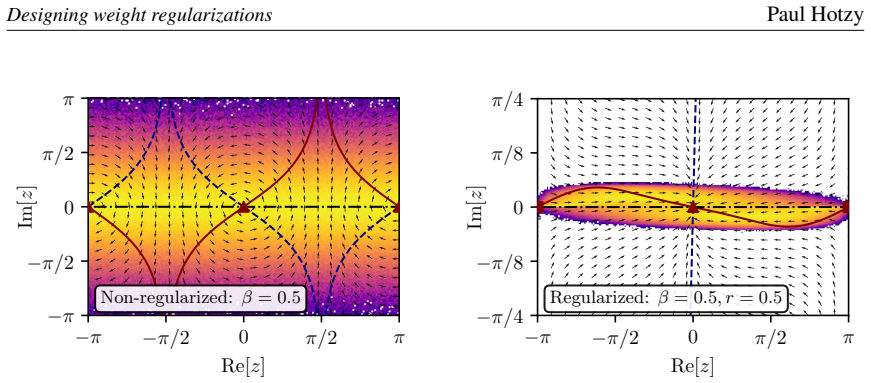
The central object is the additive weight regularization $\tilde{\rho}(z)=\rho(z)+R(z;r)$, which changes the effective action to $\tilde S(z)=S(z)-\ln[1+R(z;r)e^{S(z)}]$. The regularization is engineered so that, for large $|r|$, the relevant thimble connects to zeros of $\tilde\rho$ at the integration boundaries, leaving a single compact thimble (collecting point-symmetric or periodic copies). Two supporting mechanisms carry the argument: the drift-magnitude criterion $p(u;\theta\to\infty)\sim e^{-\alpha u}$ for correct CL convergence, and the bias-correction equation (12) with $Q$ fixed by a Dyson-Schwinger constraint (13). The thimble flow equations define the relevant contours $J_\sigma$ and anti-thimbles $K_\sigma$ used to identify the structure.
What would settle it
Find a model with exactly one relevant, compact thimble (verified by explicit thimble integration) whose complex Langevin drift-magnitude density decays exponentially, yet whose CL expectation values disagree with the exact thimble result; alternatively, run the regularized Polyakov or cosine model at a coupling where the bias correction should work and observe a discrepancy with exact results beyond numerical error.
Extended reading notes
Core claim
The central claim is that weight regularizations can be designed so that the regularized theory has a single relevant, compact Lefschetz thimble (up to model symmetries), and that under this condition complex Langevin converges to the correct result. The bias introduced by the regularization is not a dead end: an exact correction formula expresses the original expectation value as the regularized one plus a term proportional to the ratio of partition functions $Q=Z_R/Z_\rho$, and $Q$ can be obtained from any observable with known zero expectation value via a Dyson-Schwinger equation. Applying this to the complex cosine model and the SU(2) Polyakov chain model—with extensions to SU(3) in the companion paper—the authors report that the drift-magnitude criterion is satisfied and expectation values agree with the exact thimble or known results after bias correction.
Load-bearing premise
The load-bearing premise is the conjecture, cited from the literature, that complex Langevin gives unbiased results whenever the theory has exactly one relevant, compact Lefschetz thimble (counting symmetric copies as one); if this conjecture is false or needs extra conditions, the regularized process could converge to a different theory and the bias correction would not recover the original expectation values.
Editorial extensions
If this is right
- For any model where a single relevant compact thimble can be enforced by a suitable additive term, complex Langevin can be made to converge correctly, with the original theory recovered by bias correction.
- The drift-magnitude density $p(u;\theta\to\infty)$ provides a practical, numerically checkable signal that the regularization has achieved the right thimble structure.
- The same recipe extends from SU(2) to SU(3) Polyakov chains in the companion study, suggesting applicability to larger gauge groups.
- Because the correction uses only observables with known zero expectation value from Dyson-Schwinger equations, the method is not limited to the specific models tested.
- The paper anticipates that kernel transformations, which avoid bias correction entirely, are the natural next step toward gauge theories and real-time/finite-density applications.
Reading between the lines
- If the single-thimble conjecture is true in general, the single-compact-thimble condition is not merely sufficient but a systematic design target: any stabilization that enforces it will produce correct CL, and any failure of CL can be attributed to multiple or non-compact relevant thimbles.
- The bias-correction formula suggests a general debiasing scheme for any controlled modification of the weight: as long as the modified weight is simulable by CL and an observable with a known zero expectation value exists, the original partition-function ratio can be measured and the bias removed.
- A testable extension would be to apply the same regularization design to theories with continuous degrees of freedom in higher dimensions, where the compact-thimble condition is harder to visualize; success there would indicate that the method scales beyond the toy models.
- The use of non-holomorphic regularization points at $x=\pm\pi$ (restored periodically) hints that mild non-holomorphicity in the drift may be harmless, which could be probed by constructing regularizations with different singularity placements.
Editorial analysis
A structured set of objections, weighed in public.
Referee Report
Summary. This proceedings paper proposes a weight-regularization strategy inspired by Lefschetz thimbles to stabilize complex Langevin (CL) simulations. The authors add a regularization term R to the complex weight, design R so that the regularized theory has a single compact relevant thimble, and use a bias-correction identity (Eqs. (12)-(13)) to recover original observables. They present drift-magnitude densities p(u) from Fokker-Planck solutions for the complex cosine model and the reduced SU(2) Polyakov chain model, showing power-law decay for the original failing cases and exponential decay for the regularized cases, together with CL histograms. Actual corrected expectation values and several implementation details are deferred to the companion paper [5].
Significance. The proposal is potentially valuable: if the single-compact-thimble condition plus bias correction works in practice, it gives a concrete recipe for stabilizing CL in sign-problematic models and connects the thimble picture to CL correctness. The paper's strongest in-manuscript evidence is the independent Fokker-Planck check of the drift-magnitude criterion (Figs. 1 and 3), which goes beyond plotting histograms, and the algebraic derivation of the bias-correction identity in Eq. (12). However, as a standalone paper it does not yet establish the headline claim of accurate expectation values after bias correction, because no bias-corrected observables are reported and the R-only simulation needed in Eq. (13) is not checked against the correctness criterion.
major comments (3)
- [Section 2.4 (Eqs. (12)-(13)) and Section 5] The bias-correction identity is algebraically correct, but the paper never demonstrates the practical step. The only statements are that the numerical robustness is shown in [5] and that 'successful bias correction is discussed in detail in [5]'. Without a table or figure of corrected expectation values against exact or conventional results for at least one model, the conclusion that the approach 'yields accurate expectation values after a bias correction' is unsupported in this manuscript. Please include such results, or explicitly soften the claim to a recipe proposed and validated in the companion paper.
- [Section 3 (Eqs. (13) and (15))] The evaluation of Q requires a second CL simulation with the weight R alone. For the cosine model, R(z)=r(z^2-pi^2)-e^{i beta} is not periodic and is rendered periodic by a non-holomorphic identification at x=+/-pi; the paper does not analyze the thimble structure or the drift-magnitude density p(u) for the R-only process. If CL with R alone does not satisfy the correctness criterion of Eq. (4), then <O*>_R is biased and Eq. (13) cannot produce a valid Q. Please add a p(u) check, or equivalent evidence, for the R-only process for each model studied.
- [Section 2.4 (Eq. (13))] Even if the CL estimators for the numerator and denominator in Eq. (13) are individually unbiased, Q is a ratio of stochastic estimates and therefore carries an O(1/N) bias; if the denominator <O*>_R - <O*>_tilde is small, the relative error is amplified. The manuscript gives no estimate of this bias or of the typical size of the denominator for the tested couplings. Please quantify this effect, for example by reporting Q with statistical errors and by checking stability of the corrected observables across independent subsamples.
minor comments (3)
- [Abstract] The abstract says the method solves the SU(N) Polyakov chain model, but the body only reports SU(2) results and refers to SU(3) in the companion paper; please adjust the wording to match the presented content.
- [Figure 1 caption and text] The caption says the original model shows power-law decay (green dashed line), while the text says the blue curve is the power-law decay; please make the color references consistent.
- [Section 3, Eq. (15)] The sentence 'The resulting non-holomorphic points at x=+/-pi do not affect the CL algorithm' is asserted without demonstration in this paper; if this is established in [5], please cite the specific result there, and otherwise add a short justification.
Circularity Check
No significant circularity: the bias-correction identity is exact and no target values are fitted; reliance on companion [5] for numerics is a completeness concern, not a circular step.
full rationale
Walked the derivation chain. The only candidate for circularity is the bias-correction step, Eqs. (12)-(13). It is not circular: Eq. (12) is an exact algebraic identity following from \tilde rho = rho + R and Q = Z_R/Z_rho, namely <O>_rho = <O>_tilde + Q(<O>_tilde - <O>_R). Eq. (13) determines Q using an observable whose original expectation value vanishes by the unregularized Dyson-Schwinger equation, which is an independent constraint rather than a fitted target. The regularization strength r is a tunable regulator chosen to enforce a compact single-thimble structure, and the corrected observable is supposed to be r-independent; no parameter is fitted to reproduce the desired expectation values. The single-thimble correctness condition is imported from Salcedo's conjecture [4] and checked using the independent Nagata drift-magnitude criterion in Figs. 1 and 3 via Fokker-Planck solutions, which is a nontrivial numerical test rather than a definitional equivalence. The self-citations to companion paper [5] for the actual bias-corrected expectation values are load-bearing for the empirical demonstration but not for the logical derivation: the identity is stated in this paper, and [5] is cited as separate computational evidence. The paper's limitation remarks, e.g., that additive regularization faces challenges in higher dimensions, are honest scope statements and do not introduce circularity. The absence of bias-corrected expectation values in this proceedings, with numerical checks deferred to [5], is a missing-evidence or omitted-proof concern, not a circularity. Therefore no step reduces by construction to its input, and the circularity score is 0.
Assumptions & free parameters
free parameters (1)
- regularization strength r =
r=0.5 (cosine model), r=-5 (SU(2) chain)
assumptions (3)
- domain assumption Correctness criterion: CL is correct if the stationary density of the drift magnitude p(u;θ→∞) decays at least exponentially (Eq. 4).
- domain assumption Single-relevant-compact-thimble conjecture (Salcedo [4]): CL gives unbiased results when exactly one relevant compact thimble (up to symmetries) contributes.
- domain assumption A Dyson-Schwinger observable O* exists for the unregularized theory with ⟨O*⟩ρ=0 and can be constructed explicitly.
Cite this review
Pith. "Pith review of Designing weight regularizations based on Lefschetz thimbles to stabilize complex Langevin." pith.science (2026). https://pith.science/paper/GPPIAM7A
@misc{pith2026241210729,
  author       = {Pith},
  title        = {Pith review of: Designing weight regularizations based on Lefschetz thimbles to stabilize complex Langevin},
  year         = {2026},
  howpublished = {\url{https://pith.science/paper/GPPIAM7A}},
  note         = {Machine review of arXiv:2412.10729}
}
read the original abstract
The complex Langevin (CL) method shows significant potential in addressing the numerical sign problem. Nonetheless, it often produces incorrect results when used without any stabilization techniques. Leveraging insights from previous research that links Lefschetz thimbles and CL, we explore a strategy to regularize the CL method to address this issue of incorrect convergence. Specifically, we implement weight regularizations inspired by the associated Lefschetz thimble structure and correct the bias to retrieve the correct results of the original theory. We demonstrate the effectiveness of this approach by solving the SU(N) Polyakov chain model and various scalar models, including the cosine model and the one-link model, across a broad range of couplings where the CL method previously failed. We also discuss the potential application of these insights to gauge theories in practical scenarios.
Figures


Figures from the paper (1 more)

Reference graph
Works this paper leans on
-
[5]
L.L. Salcedo, Does the complex Langevin method give unbiased results? , https://doi.org/10.1103/PhysRevD.94.114505 Phys. Rev. D 94 (2016) 114505 [ https://arxiv.org/abs/1611.06390 1611.06390 ]
arXiv 2016
-
[1]
write newline
" write newline "" before.all 'output.state := FUNCTION blank.sep after.quote 'output.state := FUNCTION fin.entry output.state after.quoted.block = 'skip 'add.period if write newline FUNCTION new.block output.state before.all = 'skip output.state after.quote = after.quoted.block 'output.state := after.block 'output.state := if if FUNCTION new.sentence out...
-
[2]
Parisi, On complex probabilities , https://doi.org/10.1016/0370-2693(83)90525-7 Phys
G. Parisi, On complex probabilities , https://doi.org/10.1016/0370-2693(83)90525-7 Phys. Lett. B 131 (1983) 393
-
[3]
AuroraScience collaboration, New approach to the sign problem in quantum field theories: High density QCD on a Lefschetz thimble , https://doi.org/10.1103/PhysRevD.86.074506 Phys. Rev. D 86 (2012) 074506 [ https://arxiv.org/abs/1205.3996 1205.3996 ]
arXiv 2012
- [4]
-
[6]
K. Boguslavski, P. Hotzy and D.I. M\"uller, Lefschetz thimble-inspired weight regularizations for complex Langevin simulations , https://arxiv.org/abs/2412.02396 2412.02396
- [7]
-
[8]
M. Scherzer, E. Seiler, D. Sexty and I.-O. Stamatescu, Complex Langevin and boundary terms , https://doi.org/10.1103/PhysRevD.99.014512 Phys. Rev. D 99 (2019) 014512 [ https://arxiv.org/abs/1808.05187 1808.05187 ]
arXiv 2019
Show all 12 references
-
[9]
Seiler, D
E. Seiler, D. Sexty and I.-O. Stamatescu, Gauge cooling in complex Langevin for QCD with heavy quarks , https://doi.org/10.1016/j.physletb.2013.04.062 Phys. Lett. B 723 (2013) 213 [ https://arxiv.org/abs/1211.3709 1211.3709 ]
2013 arXiv
-
[10]
Alvestad, A
D. Alvestad, A. Rothkopf and D. Sexty, Lattice real-time simulations with learned optimal kernels , https://doi.org/10.1103/PhysRevD.109.L031502 Phys. Rev. D 109 (2024) L031502 [ https://arxiv.org/abs/2310.08053 2310.08053 ]
2024 arXiv
-
[11]
Boguslavski, P
K. Boguslavski, P. Hotzy and D.I. M\"uller, Stabilizing complex Langevin for real-time gauge theories with an anisotropic kernel , https://doi.org/10.1007/JHEP06(2023)011 JHEP 06 (2023) 011 [ https://arxiv.org/abs/2212.08602 2212.08602 ]
2023 arXiv
-
[12]
Boguslavski, P
K. Boguslavski, P. Hotzy and D.I. M\"uller, Real-time correlators in 3+1D thermal lattice gauge theory , https://doi.org/10.1103/PhysRevD.109.094518 Phys. Rev. D 109 (2024) 094518 [ https://arxiv.org/abs/2312.03063 2312.03063 ]
2024 arXiv
Reviewed August 11, 2026 · model on record in the stance chip above.
Discussion (0). Continue with ORCID to comment.