REVIEW 3 major objections 5 minor 48 references
Clusters of tribocharged dust aggregates as pebbles in protoplanetary disks
T0 review · 3 major / 5 minor · reviewed 2026-08-08 · deepseek-v4-flash
Pith's one-line read Dust aggregates become triboelectrically charged and grow into centimeter-size clusters.
desk verdict Porous dust aggregates tribocharge and form cm-clusters in microgravity—first such observation—but the causal role of charge rests on cross-experiment comparisons, not a same-setup control. read the letter →
The pith
A machine-rendered reading of the paper's core claim, the machinery that carries it, and where it could break.
The reading
What carries the argument
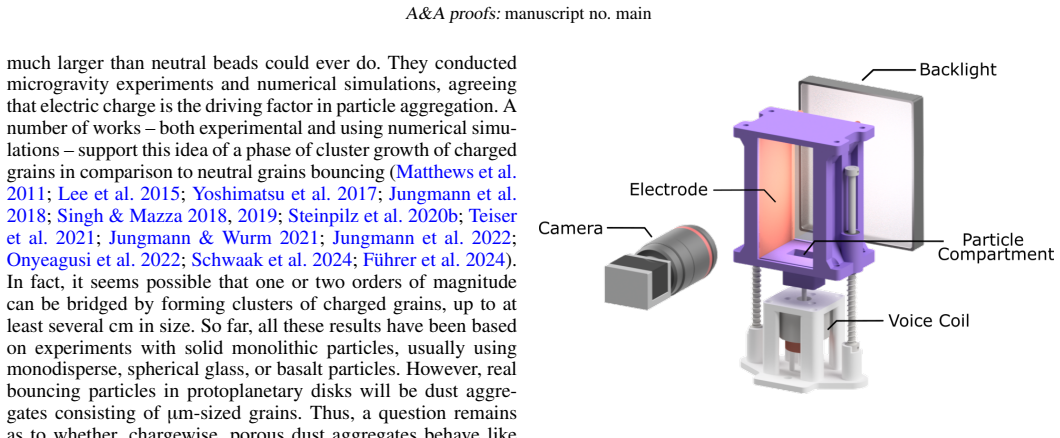
The load-bearing mechanism is triboelectric charging in low-speed collisions: when aggregates touch and separate, they exchange charge, and the resulting electrostatic attraction allows them to stick into compact clusters instead of bouncing. The experimental machinery is a drop-tower chamber with a plate capacitor; one run measures the charge of individual aggregates by observing their acceleration in a known electric field, and the clustering run records aggregate motion and cluster growth in microgravity. A key preparative step is drying the aggregates at 120 degrees Celsius and running the experiment in vacuum, which removes conductive water layers so the tribocharge is retained and can act.
What would settle it
Run the identical dried dust aggregates through the same drop-tower sequence after actively neutralizing their surface charge, and check whether 2 cm clusters still form; if they do, the clustering is not caused by tribocharging. A complementary check is computing whether the measured charge densities can bind two 0.4 mm aggregates colliding at 1 cm/s against their kinetic energy.
Extended reading notes
Core claim
The central claim is that tribocharging operates on real dust aggregates at the bouncing barrier and drives the formation of compact, centimeter-sized clusters. The evidence is a drop-tower run in which roughly 0.4 mm aggregates collide at about 1 cm/s and continuously grow into clusters up to 2 cm, with no sign of bouncing; a separate electric-field run measures individual aggregate charges up to $10^{-7}$ C/m$^2$ of surface. Since earlier experiments with uncharged or conductive aggregates showed little or only fractal clustering, the paper attributes the compact growth to electrostatic charge. On the paper's own terms, this extends the charged-cluster-growth mechanism from idealized monolithic beads to the kind of porous, aggregate dust expected in protoplanetary disks.
Load-bearing premise
The clusters are attributed to triboelectric charge, but the experiments do not include an uncharged control of the same dried aggregates; the decisive assumption is that charge, rather than some other property of these porous aggregates, is what makes them stick.
Editorial extensions
If this is right
- If the claim is right, the bouncing barrier is not a hard stop for porous dust: charged aggregates can keep growing to centimeter sizes at collision speeds where neutral aggregates would bounce.
- The observed clusters have masses near $10^{-2}$ g, an order of magnitude larger than the uncharged fractal aggregates studied in earlier reference experiments, putting them in a size regime that responds to hydrodynamic trapping.
- Because the experiment only sets lower limits on size and sticking speed, the mechanism may support growth beyond 2 cm and beyond 1 cm/s collisions.
- Charge-stabilized clusters are compact, which should make them more resistant to fragmentation than fractal aggregates, extending their lifetime in the disk.
- This creates a plausible, continuous path from micron grains to centimeter pebbles without relying on a finely tuned size window between collisional growth and hydrodynamic instabilities.
Reading between the lines
- The paper's attribution to tribocharging leans on comparisons to earlier runs with basalt beads and with conductive, water-covered aggregates rather than an in-situ uncharged control; a direct neutralization experiment with the same sample would tighten the causal link.
- The charge distribution was measured in a separate run under an applied electric field; if the colliding aggregates in the clustering run carry different charges, the quantitative link between charge and cluster stability is less direct.
- Because tribocharging depends on surface chemistry and moisture, the result may not transfer unchanged to icy or metallic dust; repeating the experiment with other compositions would bound the mechanism's scope.
- The compactness of the clusters implies that electrostatic binding also raises the energy needed to fragment them, a testable prediction for dedicated cluster-collision experiments.
Editorial analysis
A structured set of objections, weighed in public.
Referee Report
Summary. This short experimental paper reports drop-tower microgravity experiments in which porous dust aggregates (150–500 µm, made from µm-sized MGS grains) are vibrated, released into a vacuum chamber, and observed to form compact clusters up to 2 cm in size at collision velocities on the order of 1 cm/s. In a separate run with an applied electric field, the authors measure net charges up to about 10^5 e, corresponding to surface charge densities up to 10^-7 C/m^2, and conclude that tribocharging allows these aggregates to overcome the bouncing barrier and grow to pebble sizes. The paper is framed as the first demonstration of tribocharging-driven cluster growth for real dust aggregates rather than monolithic spherical particles.
Significance. If the causal interpretation is correct, this is a valuable and significant step: it extends tribocharging-driven cluster formation from idealized monodisperse spheres to porous aggregates that more closely resemble particles in protoplanetary disks. The direct observation of cm-sized clusters of sub-mm aggregates in microgravity, together with the charge measurements, is a useful new dataset. The strengths of the paper are that it uses actual aggregates, conducts experiments under vacuum after drying, and provides explicit quantitative charge estimates. The main weakness is that the central attribution of the observed clustering to triboelectric charge is supported by comparisons with previous experiments rather than by an in-situ control, so the causal claim is less secure than the abstract suggests.
major comments (3)
- [§3.1 and §4] The causal claim that tribocharging enables the observed cluster growth is not tested by an in-situ uncharged control. The comparison samples cited in §3.1 (Teiser et al. 2021, monolithic basalt beads; Onyeagusi et al. 2024, larger, non-dried, conductive MGS aggregates) differ from the present dried 150–500 µm aggregates in size, porosity, surface roughness, and water content, so the comparison does not isolate electrostatic charge. The sentence 'Thus, we can conclude that electric charges on dusty aggregates amplify the stability of such clusters' overstates the evidence. The authors should either add a same-setup control (e.g., a conductive or humidified version of the same aggregates) or explicitly reframe the claim as 'consistent with' a charging effect and discuss possible mechanical contributions (e.g., asperity interlocking or shape effects).
- [§3.2] The charge distribution (up to 10^5 e) is measured in a separate experiment run in which a 400 V field is applied, but the clustering run itself has no charge measurement. The inference that the clusters formed because the aggregates carried the measured charges assumes that the charge state is reproducible across runs and that the field used for charge measurement does not alter the charging process. This assumption should be stated explicitly, and ideally the charging should be verified in the clustering geometry (e.g., by repeating with a field-free charge probe or by charging characterization in the same run). Without this, the quantitative link between the measured charge density (10^-7 C/m^2) and the observed clustering is not fully established.
- [§3.1] The collision velocity of ~1 cm/s, later used as a 'lower limit for the maximum sticking velocity', is derived from tracking brightness fronts of the bulk particle cloud (Fig. 4c), not from resolved individual aggregate-aggregate collisions. The authors state that only a small sample of clusters could be tracked directly. To support the quoted velocity and its use in the sticking-velocity argument, the paper should report the direct cluster collision velocities and the uncertainty of the front-velocity method, or explicitly identify the front speed as an upper/lower bound on individual collision speeds.
minor comments (5)
- [Throughout] There are multiple spacing errors in words such as 'di fferent', 'e ffective', and 'di fferent' in the Introduction and Discussion; these should be corrected.
- [Fig. 6] The charge distribution is shown without error bars or a statement of the uncertainty in the mass and density assumptions; please add an estimate of the uncertainty in the charge determination.
- [Conclusion] The sentence 'whereas neutral aggregates do not' should be qualified as 'in the previous experiments cited', because no neutral control of the same aggregates was run in this study.
- [Abstract] In the abstract, '10−7 C/m2' should use proper superscript notation (10^{-7} C/m^2) for consistency with the main text.
- [Fig. 1 caption] The caption states 'taken from Onyeagusi et al. 2024'; if the figure is copied verbatim, the source should be formally acknowledged with a citation and, if necessary, permission, or the caption should say 'adapted from' if changes were made.
Circularity Check
No significant circularity: the central claim is a direct experimental measurement, and the supporting comparisons are independent external benchmarks rather than fitted inputs or definitional equivalences.
full rationale
The paper's central assertion is an experimental observation: dust aggregates of roughly 0.4 mm consisting of micrometer grains tribocharge and form compact clusters up to 2 cm in size in microgravity. The charge density is measured in a separate experiment run with an applied electric field, and the clustering is observed in video data; neither quantity is fitted to the other, and no parameter is extracted from a subset of data and then renamed a prediction. The causal attribution of clustering to tribocharging is supported by comparisons to Teiser et al. (2021) and Onyeagusi et al. (2024), which are prior published experiments with overlapping authorship. These are not circular supports in the sense of the present paper's equations: they are external empirical results, including Teiser et al.'s direct charged-versus-uncharged comparison with basalt beads, and Onyeagusi et al.'s conductive, water-covered MGS aggregates that showed little clustering. The absence of an identical uncharged control in the same chamber is a legitimate scientific weakness regarding causal isolation, but it is not a circularity because the paper's conclusion does not reduce by construction to its inputs. The paper also honestly states in the conclusion that support comes 'from comparisons to previous experiments,' which further confirms that no fitted input is being relabeled as a prediction. Therefore the derivation chain is self-contained in the sense relevant to the circularity analysis, and the appropriate score is 0.
Assumptions & free parameters
free parameters (1)
- Reduced aggregate density =
0.43 g/cm3
assumptions (3)
- domain assumption Dried, vacuum-exposed aggregates retain only about a monolayer of water and are sufficiently non-conductive for tribocharging to persist.
- domain assumption Uncharged aggregates of this size would not form centimeter clusters at collision speeds near 1 cm/s.
- domain assumption Charge measurements from the separate electric-field run are representative of the charges present during the clustering run.
Cite this review
Pith. "Pith review of Clusters of tribocharged dust aggregates as pebbles in protoplanetary disks." pith.science (2026). https://pith.science/paper/GXEBWIAZ
@misc{pith2026250204926,
  author       = {Pith},
  title        = {Pith review of: Clusters of tribocharged dust aggregates as pebbles in protoplanetary disks},
  year         = {2026},
  howpublished = {\url{https://pith.science/paper/GXEBWIAZ}},
  note         = {Machine review of arXiv:2502.04926}
}
abstract
In recent years, the tribocharging of colliding and bouncing submillimeter (submm) particles has been studied as a possible mechanism promoting the formation of large pebbles on centimeter (cm) to decimeter (dm) scales in protoplanetary disks. Here, we observe, for the first time, that it is not only monolithic, spherical particles, but also real dust aggregates, that become tribocharged and end up forming large clusters. For aggregates of $\sim 0.4$ mm consisting of $\rm \sim$ 1 $\rm \mu m$ sized dust, we determined net charge densities up to $10^{-7}$ C/$\rm m^2$ during our drop tower experiments. These charged aggregates form compact clusters up to 2 cm in size via collisions with other clusters and aggregates at collision velocities on the order of 1 cm/s. Size and speed are the only lower limits for growth, currently set by the limits of the experiment. However, these clusters already form under conditions that are well beyond the expected transition to bouncing for uncharged aggregates and clusters. Our findings further support the idea that collisional charging can leapfrog the traditional bouncing barrier and form larger clusters that then serve as large pebbles. These cm-sized clusters are more susceptible to further evolutionary steps via particle trapping, concentration, and planetesimal formation.
Figures


Figures from the paper (2 more)


Reference graph
Works this paper leans on
-
[1]
V ., Caselli, P., Gong, M., & Silsbee, K
Akimkin, V ., Ivlev, A. V ., Caselli, P., Gong, M., & Silsbee, K. 2023, ApJ, 953, 72
2023
-
[2]
Arakawa, S., Okuzumi, S., Tatsuuma, M., et al. 2023, ApJ, 951, L16
work page 2023
-
[3]
Becker, T., Steinpilz, T., Teiser, J., & Wurm, G. 2022, MNRAS, 513, 5814
work page 2022
-
[4]
Becker, T., Völke, G., Steinpilz, T., et al. 2024, MNRAS, 533, 413
work page 2024
-
[5]
2024, Annual Review of Astronomy and Astrophysics, 62, 157
Birnstiel, T. 2024, Annual Review of Astronomy and Astrophysics, 62, 157
2024
-
[6]
Blum, J. & Wurm, G. 2000, Icarus, 143, 138 Article number, page 4 of 6 F. C. Onyeagusi et al.: Clusters of tribocharged dust aggregates as pebbles in protoplanetary disks Fig. 5: Contrast enhanced image of one of the largest clusters. The constituent aggregates are visible on a submm scale. Fig. 6: Charge distribution of dust aggregates
work page 2000
- [7]
-
[8]
Brisset, J., Heißelmann, D., Kothe, S., Weidling, R., & Blum, J. 2016, A&A, 593, A3
work page 2016
Show all 48 references
-
[9]
2017, A&A, 603, A66
Brisset, J., Heißelmann, D., Kothe, S., Weidling, R., & Blum, J. 2017, A&A, 603, A66
2017
-
[10]
M., Britt, D
Cannon, K. M., Britt, D. T., Smith, T. M., Fritsche, R. F., & Batcheldor, D. 2019, Icarus, 317, 470
2019
-
[11]
& Simon, J
Carrera, D. & Simon, J. B. 2022, ApJ, 933, L10
2022
-
[12]
2017, ApJ, 846, 48
Demirci, T., Teiser, J., Steinpilz, T., et al. 2017, ApJ, 846, 48
2017
-
[13]
& Dullemond, C
Drazkowska, J. & Dullemond, C. P. 2014, A&A, 572, A78 Führer, F., Schwaak, J., Brendel, L., Wurm, G., & Wolf, D. E. 2024, A&A
2014
-
[14]
& Goertz, C
Horanyi, M. & Goertz, C. K. 1990, ApJ, 361, 155
1990
-
[15]
2021, Icarus, 355, 114127
Jungmann, F., Bila, T., Kleinert, L., et al. 2021, Icarus, 355, 114127
2021
-
[16]
2022, Icarus, 373, 114766
Jungmann, F., Kruss, M., Teiser, J., & Wurm, G. 2022, Icarus, 373, 114766
2022
-
[17]
2018, Journal of Physics Communications, 2, 095009
Jungmann, F., Steinpilz, T., Teiser, J., & Wurm, G. 2018, Journal of Physics Communications, 2, 095009
2018
-
[18]
& Wurm, G
Jungmann, F. & Wurm, G. 2021, A&A, 650, A77
2021
-
[19]
2014, ApJ, 783, 111
Kelling, T., Wurm, G., & Köster, M. 2014, ApJ, 783, 111
2014
-
[20]
2015, ApJ, 812, 67
Kimura, H., Wada, K., Senshu, H., & Kobayashi, H. 2015, ApJ, 812, 67
2015
-
[21]
2013, Icarus, 225, 75
Kothe, S., Blum, J., Weidling, R., & Güttler, C. 2013, Icarus, 225, 75
2013
-
[22]
2020, Icarus, 337, 113438
Kruss, M., Musiolik, G., Demirci, T., Wurm, G., & Teiser, J. 2020, Icarus, 337, 113438
2020
-
[23]
Lacks, D. J. & Shinbrot, T. 2019, Nature Reviews Chemistry, 3, 465
2019
-
[24]
R., Miskin, M
Lee, V ., Waitukaitis, S. R., Miskin, M. Z., & Jaeger, H. M. 2015, Nature Physics, 11, 733
2015
-
[25]
S., Land, V ., & Hyde, T
Ma, Q., Matthews, L. S., Land, V ., & Hyde, T. W. 2013, The Astrophysical Jour- nal, 763, 77
2013
-
[26]
S., Land, V ., Ma, Q., et al
Matthews, L. S., Land, V ., Ma, Q., et al. 2011, in AIP Conference Proceedings (AIP), 60–65
2011
-
[27]
2012, A&A, 544, A138
Meisner, T., Wurm, G., & Teiser, J. 2012, A&A, 544, A138
2012
-
[28]
1982, A&A, 105, 98
Meyer-Vernet, N. 1982, A&A, 105, 98
1982
-
[29]
2009, ApJ, 698, 1122
Okuzumi, S. 2009, ApJ, 698, 1122
2009
-
[30]
C., Meyer, C., Teiser, J., Becker, T., & Wurm, G
Onyeagusi, F. C., Meyer, C., Teiser, J., Becker, T., & Wurm, G. 2023, Atmo- sphere, 14, 1065
2023
-
[31]
C., Teiser, J., Becker, T., & Wurm, G
Onyeagusi, F. C., Teiser, J., Becker, T., & Wurm, G. 2024, Monthly Notices of the Royal Astronomical Society, 529, 1989
2024
-
[32]
C., Teiser, J., Schneider, N., & Wurm, G
Onyeagusi, F. C., Teiser, J., Schneider, N., & Wurm, G. 2022, Journal of Elec- trostatics, 115, 103637
2022
-
[33]
& Dominik, C
Paszun, D. & Dominik, C. 2006, Icarus, 182, 274
2006
-
[34]
2021, A&A, 652, A106
Pillich, C., Bogdan, T., Landers, J., Wurm, G., & Wende, H. 2021, A&A, 652, A106
2021
-
[35]
2015, ApJ, 804, 35
Raettig, N., Klahr, H., & Lyra, W. 2015, ApJ, 804, 35
2015
-
[36]
A., Rasband, W
Schneider, C. A., Rasband, W. S., & Eliceiri, K. W. 2012, Nature Methods, 9, 671 Schönau, L., Teiser, J., Demirci, T., et al. 2023, A&A, 672, A169
2012
-
[37]
2024, EPL (Europhysics Letters), 145, 30001
Schubert, B., Blum, J., Isensee, M., et al. 2024, EPL (Europhysics Letters), 145, 30001
2024
-
[38]
E., et al
Schwaak, J., Führer, F., Wolf, D. E., et al. 2024, A&A, 691, A127
2024
-
[39]
& Mazza, M
Singh, C. & Mazza, M. G. 2018, Physical Review E, 97, 022904
2018
-
[40]
& Mazza, M
Singh, C. & Mazza, M. G. 2019, Scientific Reports, 9
2019
-
[41]
& Hopkins, P
Squire, J. & Hopkins, P. F. 2018, MNRAS, 477, 5011
2018
-
[42]
2019, ApJ, 874, 60
Steinpilz, T., Teiser, J., & Wurm, G. 2019, ApJ, 874, 60
2019
-
[43]
2021, ApJ, 908, L22 Article number, page 5 of 6 A&A proofs: manuscript no
Teiser, J., Kruss, M., Jungmann, F., & Wurm, G. 2021, ApJ, 908, L22 Article number, page 5 of 6 A&A proofs: manuscript no. main van der Marel, N. & Pinilla, P. 2023, arXiv e-prints, arXiv:2310.09077
2021 arXiv
-
[44]
2009, ApJ, 696, 2036
Weidling, R., Güttler, C., Blum, J., & Brauer, F. 2009, ApJ, 696, 2036
2009
-
[45]
& Blum, J
Wurm, G. & Blum, J. 1998, Icarus, 132, 125
1998
-
[46]
& Teiser, J
Wurm, G. & Teiser, J. 2021, Nature Reviews Physics, 3, 405
2021
-
[47]
Yoshimatsu, R., Araújo, N. A. M., Wurm, G., Herrmann, H. J., & Shinbrot, T. 2017, Scientific Reports, 7
2017
-
[48]
W., Güttler, C., Blum, J., & Dullemond, C
Zsom, A., Ormel, C. W., Güttler, C., Blum, J., & Dullemond, C. P. 2010, A&A, 513, A57 Article number, page 6 of 6
2010
Reviewed August 8, 2026 · model on record in the stance chip above.
Discussion (0). Continue with ORCID to comment.