REVIEW 2 major objections 5 minor 45 references
Passive Body-Area Electrostatic Field (Human Body Capacitance) for Ubiquitous Computing
T0 review · 2 major / 5 minor · reviewed 2026-08-06 · deepseek-v4-flash
Pith's one-line read Passive body-area electrostatic sensing: an energy-efficient alternative to motion sensors for ubiquitous computing
desk verdict A useful, compact primer on passive HBC sensing with real editorial sloppiness and a mildly overclaimed 'position-free' advantage that its own limitations section undercuts. read the letter →
The pith
A machine-rendered reading of the paper's core claim, the machinery that carries it, and where it could break.
The reading
What carries the argument
The central mechanism is the body-area electrostatic field, which arises from the quasi-static electric field between the human body—treated as a floating conductive capacitor plate—and its surroundings, particularly ground. Movement changes the body's capacitance $C$ relative to the environment, inducing surface charge $Q$ redistribution and weak charge flows that can be sensed with high-impedance amplifier frontends, high-resolution ADCs, or timing-based circuits. This mechanism turns any body motion into a measurable electrical signal using purely passive sensing.
What would settle it
A head-to-head experiment under varying footwear, clothing, and ambient humidity (e.g., indoor vs. outdoor, different flooring) that measures HBC classification accuracy for a fixed set of activities from a single wrist sensor would directly test the generality of the 'position-free' and 'reliable complement' claims; if accuracy collapses in dry, high-static conditions or when users wear different shoes, the core advantage weakens.
Extended reading notes
Core claim
The paper's central claim is that passive HBC sensing captures body motion by detecting subtle charge redistributions on the skin surface that occur when the body, modeled as a floating conductor, moves relative to its environment and thereby changes its capacitance. This mechanism enables cross-body-part sensing from a single sensor location, such as a wristband or earbud, without needing sensors on every moving limb, and it works in a non-contact, low-power manner. The paper consolidates evidence from a range of studies showing that HBC can outperform or complement IMU-based sensing in tasks like step counting, gesture recognition, activity classification, and collaborative activity detection, and it frames HBC as a practical alternative to traditional motion sensors for human activity recognition and human-computer interaction.
Load-bearing premise
The claim that HBC enables position-free deployment and reliable cross-body-part sensing from a single electrode rests on the assumption that movement-induced charge redistribution on the body surface is consistently captured regardless of grounding, clothing, and environmental conditions.
Editorial extensions
If this is right
- If HBC's core advantages hold, wearable devices could reliably detect whole-body motion and even non-instrumented limb movements from a single wristband or earbud, reducing the need for multiple attached sensors.
- HBC could serve as a low-power, privacy-preserving complement to cameras and IMUs in human activity recognition, especially in scenarios where IMUs suffer from placement sensitivity or where vision-based systems raise privacy concerns.
- The reported performance boosts—e.g., 16% improvement over accelerometer-only collaborative activity recognition and better step-count accuracy in contexts like pushing a shopping trolley—suggest HBC can add value beyond what inertial sensors alone provide.
- The paper's open-source hardware designs and working guidelines could accelerate reproducibility and standardization, allowing more research groups to adopt HBC sensing without reinventing frontend circuitry.
- If environmental robustness improves through shielding, differential acquisition, and sensor fusion, HBC could become a standard modality in ambient intelligence, including indoor localization, occupancy detection, and social/health monitoring.
Reading between the lines
- A testable extension of the paper's claims is that a single HBC sensor placed on a non-major limb (e.g., an ankle) could still classify upper-body gestures because charge redistribution propagates across the body surface; the paper's cited cross-body-part sensing results suggest this but do not systematically compare all sensor placements.
- Because the paper's own Section 6 concedes environmental sensitivity and context-dependent performance, a likely real-world boundary is that HBC's 'position-free deployment' advantage holds only under reasonably consistent grounding, clothing, and ambient conditions; in uncontrolled settings, recalibration or sensor fusion may be required.
- The paper's characterization of HBC as 'compelling' relative to IMUs could be sharpened by a direct head-to-head benchmarking study across identical tasks and deployment conditions, which the field currently lacks.
- The biological parallel drawn to electrosensitive fish hints that distributed, multi-electrode HBC arrays—rather than single-electrode setups—might emulate the fish's localization capabilities and improve spatial resolution, an idea the paper leaves implicit.
Editorial analysis
A structured set of objections, weighed in public.
Referee Report
Summary. The paper is a focused survey of passive body-area electrostatic field sensing, commonly called human body capacitance (HBC). It introduces the physical principle that body movement modulates the body's capacitance to ground and nearby objects, producing measurable surface charge redistribution. It then gives a historical background, describes hardware frontends (high-impedance amplifiers, high-resolution ADCs, timing-based circuits) and two signal domains (current-based and frequency-based), reviews representative applications in step counting, gesture recognition, HCI, activity recognition, and social/environmental awareness, and closes with limitations and future directions. The central claim is that passive HBC is an energy-efficient, non-intrusive modality whose unique properties, notably cross-body-part sensing and position-free deployment, make it a compelling alternative or complement to conventional motion sensing technologies.
Significance. If the claimed advantages are borne out, this survey will be a useful primer for a small but active research area, consolidating scattered results and providing hardware guidance. The paper clearly creditable strengths include a well-organized structure, a concise hardware taxonomy, a comparative table of representative studies, explicit discussion of environmental sensitivity and generalization limits, and pointers to open-source resources, which support reproducibility. The survey's central claim, however, rests on limited evidence for single-point cross-limb sensing, and the performance figures quoted from prior work lack measurement context. The paper would be considerably strengthened by a more cautious framing of the 'position-free deployment' advantage and by transparent reporting of the conditions under which the reported performance numbers were obtained.
major comments (2)
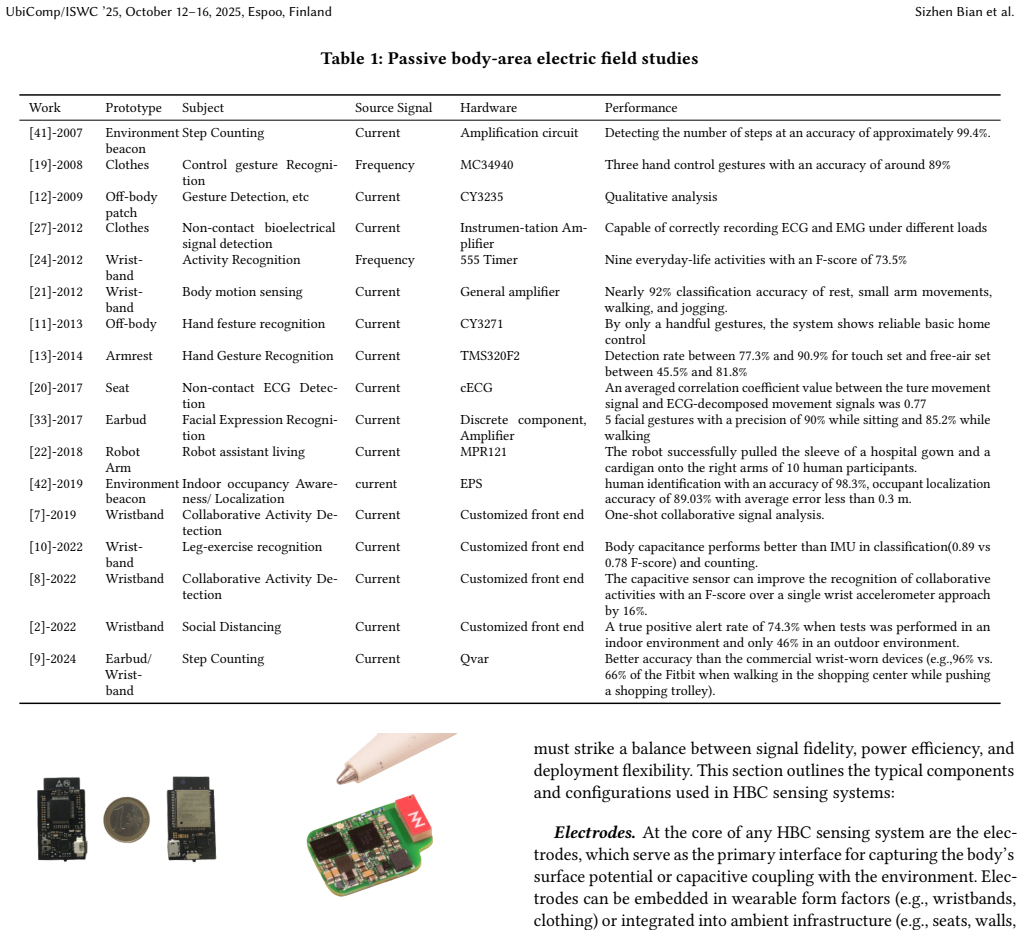
- [§1, §2, Table 1] The paper's central advantage of 'position-free deployment' (Section 1) and the claim that 'sensors can often detect full-body motion even when placed at a single point (e.g., wrist or ankle)' (Section 2) are supported in Table 1 by only one study, [10], a wrist-worn leg-exercise recognition result reporting an F-score of 0.89. Section 6 itself concedes that footwear, clothing, environmental surfaces, and ambient fields can alter the body's capacitive properties and that models may fail to generalize to new users, poses, or contexts [5, 29]. Because the paper neither quantifies how much single-point cross-limb signal survives grounding, clothing, and humidity variations nor delimits the conditions under which the advantage holds, the generality of the claim is not established. The authors should either provide a quantitative synthesis of the available evidence or temper the claim to reflect the conditions actually demonstrated.
- [§4, Table 1] Performance numbers in Table 1 are reported as isolated point values (e.g., 99.4% for [41], 89% for [19], 90%/85.2% for [33], 74.3%/46% for [2]) without dataset sizes, numbers of participants, cross-validation protocols, or confidence intervals. Since these numbers are invoked in the Introduction and Conclusion as evidence of HBC's advantages, the survey should either provide the measurement context for each result or explicitly note that the original sources report these values under particular, possibly narrow conditions. As written, the table overstates the certainty of the evidence and makes it difficult for readers to assess the robustness of the modality.
minor comments (5)
- [§1] The citation placeholder '[4, 32?]' in the sentence about active capacitance sensing should be resolved to the intended references; as it stands, it is an unresolved artifact.
- [§6] The sentence 'introducing drift or inconsistency in measurements []' contains an empty citation bracket; the missing reference(s) for environmental sensitivity should be supplied.
- [Author list] The author name 'Paul Lucowicz' in the header does not match 'Paul Lukowicz' used in the email address and in the reference list; the spelling should be corrected consistently.
- [CCS Concepts] The CCS Concepts line repeats 'Embedded hardware;' twice; the duplicate should be removed.
- [§4] References '[ 13]' and '[ 27]' contain stray spaces inside the brackets; they should be normalized to '[13]' and '[27]'.
Circularity Check
No significant circularity found: the paper is a descriptive survey whose claims are supported by cited empirical studies, not by fitting parameters or by importing self-cited uniqueness theorems.
full rationale
This paper is a focused overview of passive human body capacitance (HBC) sensing. It does not present a derivation chain, fitted model, or prediction; instead, it synthesizes prior work on sensing principles, hardware, applications, and limitations. The central claims—such as cross-body-part sensing from a single sensor location and position-free deployment—are supported by citations to empirical studies, including some by the authors (e.g., [10], [8], [9]). Those citations function as literature summaries rather than as unverified premises on which a new derivation depends. No equation in the paper reduces to its own input, no fitted parameter is renamed as a prediction, and no uniqueness theorem is imported from the authors' prior work. The paper's Section 6 limitations, such as environmental sensitivity and context-dependent performance, weaken the generality of the claimed advantages, but that is a correctness or evidence-strength concern, not a circularity. Under the stated rules, heavy self-citation in a survey is not circular unless the load-bearing argument reduces to a self-citation chain that is itself unverified; here the survey's contribution is organization, hardware overview, and open-source resources, and the cited empirical results are externally reported studies rather than internally derived conclusions. Therefore no circularity is identified.
Assumptions & free parameters
assumptions (2)
- domain assumption The human body can be modeled as a floating conductor, with its capacitance to the environment defined by U, Q, and C (Section 2).
- domain assumption Body movement causes capacitance variation that induces charge flows measurable at the skin surface (Section 2).
Cite this review
Pith. "Pith review of Passive Body-Area Electrostatic Field (Human Body Capacitance) for Ubiquitous Computing." pith.science (2026). https://pith.science/paper/GZNGMPMP
@misc{pith2026250713520,
  author       = {Pith},
  title        = {Pith review of: Passive Body-Area Electrostatic Field (Human Body Capacitance) for Ubiquitous Computing},
  year         = {2026},
  howpublished = {\url{https://pith.science/paper/GZNGMPMP}},
  note         = {Machine review of arXiv:2507.13520}
}
read the original abstract
Passive body-area electrostatic field sensing, also referred to as human body capacitance (HBC), is an energy-efficient and non-intrusive sensing modality that exploits the human body's inherent electrostatic properties to perceive human behaviors. This paper presents a focused overview of passive HBC sensing, including its underlying principles, historical evolution, hardware architectures, and applications across research domains. Key challenges, such as susceptibility to environmental variation, are discussed to trigger mitigation techniques. Future research opportunities in sensor fusion and hardware enhancement are highlighted. To support continued innovation, this work provides open-source resources and aims to empower researchers and developers to leverage passive electrostatic sensing for next-generation wearable and ambient intelligence systems.
Figures


Figures from the paper (1 more)

Reference graph
Works this paper leans on
-
[3]
Sizhen Bian, Mengxi Liu, Bo Zhou, Paul Lukowicz, and Michele Magno. 2024. Body-Area Capacitive or Electric Field Sensing for Human Activity Recognition and Human-Computer Interaction: A Comprehensive Survey. Proceedings of the ACM on Interactive, Mobile, Wearable and Ubiquitous Technologies 8, 1 (2024), 1–49
work page 2024
-
[10]
Sizhen Bian, Siyu Yuan, Vitor Fortes Rey, and Paul Lukowicz. 2022. Using human body capacitance sensing to monitor leg motion dominated activities with a wrist worn device. In Sensor-and Video-Based Activity and Behavior Computing . Springer, 81–94
work page 2022
-
[41]
Kiyoaki Takiguchi, Takayuki Wada, and Shigeki Toyama. 2007. Human body detection that uses electric field by walking. Journal of Advanced Mechanical Design, Systems, and Manufacturing 1, 3 (2007), 294–305
work page 2007
-
[19]
Jingyuan Cheng, David Bannach, and Paul Lukowicz. 2008. On body capacitive sensing for a simple touchless user interface. In 2008 5th International Summer School and Symposium on Medical Devices and Biosensors . IEEE, 113–116
work page 2008
-
[33]
Denys JC Matthies, Bernhard A Strecker, and Bodo Urban. 2017. Earfieldsensing: A novel in-ear electric field sensing to enrich wearable gesture input through facial expressions. In Proceedings of the 2017 CHI Conference on Human Factors in Computing Systems. 1911–1922
work page 2017
-
[2]
Sizhen Bian. 2022. Human Activity Recognition with Field Sensing Technique . Ph. D. Dissertation. Technische Universität Kaiserslautern
work page 2022
-
[1]
High Resolution ADC with two divider resistors for HBC
2022. High Resolution ADC with two divider resistors for HBC. https://github. com/zhaxidele/Toolkit-for-HBC-sensing/tree/main. Accessed: 2025-04-30
work page 2022
-
[4]
Sizhen Bian and Paul Lukowicz. 2021. Capacitive sensing based on-board hand gesture recognition with TinyML. In Adjunct Proceedings of the 2021 ACM Inter- national Joint Conference on Pervasive and Ubiquitous Computing and Proceedings of the 2021 ACM International Symposium on Wearable Computers . 4–5
work page 2021
Show all 45 references
-
[5]
Sizhen Bian and Paul Lukowicz. 2021. A systematic study of the influence of various user specific and environmental factors on wearable human body capacitance sensing. In EAI International Conference on Body Area Networks . Springer, 247–274
2021
-
[6]
Sizhen Bian, Vitor F Rey, Peter Hevesi, and Paul Lukowicz. 2019. Passive capacitive based approach for full body gym workout recognition and counting. In2019 IEEE International Conference on Pervasive Computing and Communications (PerCom . IEEE, 1–10
2019
-
[7]
Sizhen Bian, Vitor F Rey, Junaid Younas, and Paul Lukowicz. 2019. Wrist-worn capacitive sensor for activity and physical collaboration recognition. In2019 IEEE International Conference on Pervasive Computing and Communications Workshops (PerCom Workshops). IEEE, 261–266
2019
-
[8]
Sizhen Bian, Vitor Fortes Rey, Siyu Yuan, and Paul Lukowicz. 2022. The Contri- bution of Human Body Capacitance/Body-Area Electric Field To Individual and Collaborative Activity Recognition. arXiv preprint arXiv:2210.14794 (2022)
2022 arXiv
-
[9]
Sizhen Bian, Rakita Strahinja, Philipp Schilk, Clénin Marc-André, Silvano Cortesi, Kanika Dheman, Elio Reinschmidt, and Michele Magno. 2024. Earable and Wrist- worn Setup for Accurate Step Counting Utilizing Body-Area Electrostatic Sensing. In Companion of the 2024 on ACM Inte...
2024
-
[11]
Andreas Braun, Tim Dutz, and Felix Kamieth. 2013. Capacitive sensor-based hand gesture recognition in ambient intelligence scenarios. In Proceedings of Passive Body-Area Electrostatic Field (Human Body Capacitance) for Ubiquitous Computing UbiComp/ISWC ’25, October 12–16, 2025...
2013
-
[12]
Andreas Braun and Pascal Hamisu. 2009. Using the human body field as a medium for natural interaction. In Proceedings of the 2nd International Conference on PErvasive Technologies Related to Assistive Environments . 1–7
2009
-
[13]
Andreas Braun, Stephan Neumann, Sönke Schmidt, Reiner Wichert, and Arjan Kuijper. 2014. Towards interactive car interiors: the active armrest. InProceedings of the 8th Nordic Conference on Human-Computer Interaction: Fun, Fast, Founda- tional. 911–914
2014
-
[14]
Andreas Braun, Reiner Wichert, Arjan Kuijper, and Dieter W Fellner. 2015. Ca- pacitive proximity sensing in smart environments.Journal of Ambient Intelligence and Smart Environments 7, 4 (2015), 483–510
2015
-
[15]
Theodore H Bullock. 1982. Electroreception. Annual review of neuroscience (1982)
1982
-
[16]
Alejandro Cartas, Petia Radeva, and Mariella Dimiccoli. 2020. Activities of daily living monitoring via a wearable camera: Toward real-world applications. IEEE access 8 (2020), 77344–77363
2020
-
[17]
Alexander J Casson. 2019. Wearable EEG and beyond. Biomedical engineering letters 9, 1 (2019), 53–71
2019
-
[18]
Jingyuan Cheng, Oliver Amft, and Paul Lukowicz. 2010. Active capacitive sens- ing: Exploring a new wearable sensing modality for activity recognition. In International conference on pervasive computing . Springer, 319–336
2010
-
[20]
Minho Choi and Sang Woo Kim. 2017. Driver’s movement monitoring system using capacitive ECG sensors. In 2017 IEEE 6th Global Conference on Consumer Electronics (GCCE). IEEE, 1–2
2017
-
[21]
Gabe Cohn, Sidhant Gupta, Tien-Jui Lee, Dan Morris, Joshua R Smith, Matthew S Reynolds, Desney S Tan, and Shwetak N Patel. 2012. An ultra-low-power human body motion sensor using static electric field sensing. In Proceedings of the 2012 ACM conference on ubiquitous computing . 99–102
2012
-
[22]
Zackory Erickson, Maggie Collier, Ariel Kapusta, and Charles C Kemp. 2018. Tracking human pose during robot-assisted dressing using single-axis capacitive proximity sensing. IEEE Robotics and Automation Letters 3, 3 (2018), 2245–2252
2018
-
[23]
IC Forster. 1974. Measurement of patient body capacitance and a method of patient isolation in mains environments. Medical and biological engineering 12, 5 (1974), 730–732
1974
-
[24]
Tobias Grosse-Puppendahl, Eugen Berlin, and Marko Borazio. 2012. Enhancing accelerometer-based activity recognition with capacitive proximity sensing. In International Joint Conference on Ambient Intelligence . Springer, 17–32
2012
-
[25]
Tobias Grosse-Puppendahl, Christian Holz, Gabe Cohn, Raphael Wimmer, Oskar Bechtold, Steve Hodges, Matthew S Reynolds, and Joshua R Smith. 2017. Finding common ground: A survey of capacitive sensing in human-computer interaction. In Proceedings of the 2017 CHI conference on hu...
2017
-
[26]
John L Heilbron. 1966. GM Bose: The Prime Mover in the Invention of the Leyden Jar? Isis 57, 2 (1966), 264–267
1966
-
[27]
Alexsandr Igorevitch Ianov, Hiroaki Kawamoto, and Yoshiyuki Sankai. 2012. Development of a capacitive coupling electrode for bioelectrical signal measure- ments and assistive device use. In2012 ICME International Conference on Complex Medical Engineering (CME). IEEE, 593–598
2012
-
[28]
Niels Jonassen. 1998. Human body capacitance: static or dynamic concept?[ESD]. In Electrical Overstress/Electrostatic Discharge Symposium Proceedings. 1998 (Cat. No. 98TH8347). IEEE, 111–117
1998
-
[29]
Pixi Kang, Julian Moosmann, Sizhen Bian, and Michele Magno. 2024. On-Device Training Empowered Transfer Learning For Human Activity Recognition. arXiv preprint arXiv:2407.03644 (2024)
2024 arXiv
-
[30]
Sel-Vin Kuik. 2004. A Digital Theremin
2004
-
[31]
Hans W Lissmann and Ken E Machin. 1958. The mechanism of object location in Gymnarchus niloticus and similar fish. Journal of Experimental Biology 35, 2 (1958), 451–486
1958
-
[32]
Mengxi Liu, Sizhen Bian, and Paul Lukowicz. 2022. Non-contact, real-time eye blink detection with capacitive sensing. In Proceedings of the 2022 ACM International Symposium on Wearable Computers . 49–53
2022
-
[34]
Pavel Nikitin. 2012. Leon theremin (lev termen). IEEE Antennas and Propagation Magazine 54, 5 (2012), 252–257
2012
-
[35]
Bryce Osoinach. 2007. Proximity capacitive sensor technology for touch sensing applications. Freescale White Paper 12 (2007)
2007
-
[36]
Philipp Schilk, Kanika Dheman, and Michele Magno. 2022. VitalPod: A Low Power In-Ear Vital Parameter Monitoring System. In 2022 18th International Conference on Wireless and Mobile Computing, Networking and Communications (WiMob). 94–99. https://doi.org/10.1109/WiMob55322.2022.9941646
2022
-
[37]
Mitsuru Shinagawa, Masaaki Fukumoto, Katsuyuki Ochiai, and Hakaru Kyuragi
-
[38]
Kenneth D Skeldon, Lindsay M Reid, Viviene McInally, Brendan Dougan, and Craig Fulton. 1998. Physics of the Theremin. American Journal of Physics 66, 11 (1998), 945–955
1998
-
[39]
Joshua R. Smith. 1996. Field mice: Extracting hand geometry from electric field measurements. IBM systems journal 35, 3.4 (1996), 587–608
1996
-
[40]
Sungho Suh, Vitor Fortes Rey, Sizhen Bian, Yu-Chi Huang, Jože M Rožanec, Hooman Tavakoli Ghinani, Bo Zhou, and Paul Lukowicz. 2023. Worker activity recognition in manufacturing line using near-body electric field. IEEE Internet of Things Journal 11, 7 (2023), 11554–11565
2023
-
[42]
Xinyao Tang and Soumyajit Mandal. 2019. Indoor occupancy awareness and local- ization using passive electric field sensing. IEEE Transactions on Instrumentation and Measurement 68, 11 (2019), 4535–4549
2019
-
[43]
Yoshihiro Yama, Akinori Ueno, and Yoshinori Uchikawa. 2007. Development of a wireless capacitive sensor for ambulatory ECG monitoring over clothes. In 2007 29th Annual International Conference of the IEEE Engineering in Medicine and Biology Society. IEEE, 5727–5730
2007
-
[44]
Jingdong Zhao. 2018. A review of wearable IMU (inertial-measurement-unit)- based pose estimation and drift reduction technologies. In Journal of Physics: Conference Series, Vol. 1087. IOP Publishing, 042003
2018
-
[2004]
IEEE Transactions on instrumentation and measurement 53, 6 (2004), 1533–1538
A near-field-sensing transceiver for intrabody communication based on the electrooptic effect. IEEE Transactions on instrumentation and measurement 53, 6 (2004), 1533–1538
2004
Reviewed August 6, 2026 · model on record in the stance chip above.
Discussion (0). Continue with ORCID to comment.