REVIEW 3 major objections 5 minor 2 cited by
The fate of $p$-wave spin polarization in helimagnets with Rashba spin-orbit coupling
T0 review · 3 major / 5 minor · reviewed 2026-08-11 · deepseek-v4-flash
Pith's one-line read The paper claims that antiferromagnetically coupled helimagnetic chains guarantee a perfectly antisymmetric p-wave spin polarization for any helix period and any Rashba spin-orbit strength, removing the need to fine-tune the magnetic…
desk verdict The AFM-chain construction is genuinely new, but the helix angle definition breaks the periodicity the band-structure calculation assumes. read the letter →
The pith
A machine-rendered reading of the paper's core claim, the machinery that carries it, and where it could break.
The reading
What carries the argument
The load-bearing object is the composite symmetry $\hat{T}\hat{\tau}_{1/2}$: time reversal $\hat{T}$ followed by a lattice translation $\hat{\tau}_{1/2}$ by half a magnetic unit cell. A magnetic texture invariant under this operation forces the band-resolved spin polarization to be odd under $\mathbf{k}\to-\mathbf{k}$, the defining p-wave property. In a single chain with an even-numbered period this symmetry exists along the chain; with an odd period it does not. In the antiferromagnetically stacked bilayer, the time-reversal relation between the two rows creates a translation $\hat{\tau}^y_{1/2}$ along the stacking direction, restoring the symmetry for every chain period. The paper also uses two diagnostics: $P$, the texture-induced polarization after summing over $k_y$ to cancel the Rashba-only contribution, and $\Delta_p$, the maximum deviation from antisymmetry, with a p-wave magnet defined by $P\neq 0$ and $\Delta_p=0$.
What would settle it
Measure $\Delta_p$ from Eq. (13) on an antiferromagnetically coupled helimagnetic film such as Mn/W(110) using spin-resolved photoemission; if $\Delta_p$ differs from zero at any helix period and Rashba strength, the robustness claim is wrong. A cheaper numerical test: add a small canting angle to the interchain antiferromagnetic order in the model and check that $\Delta_p$ grows continuously from zero as the canting increases, as the symmetry argument predicts.
Extended reading notes
Core claim
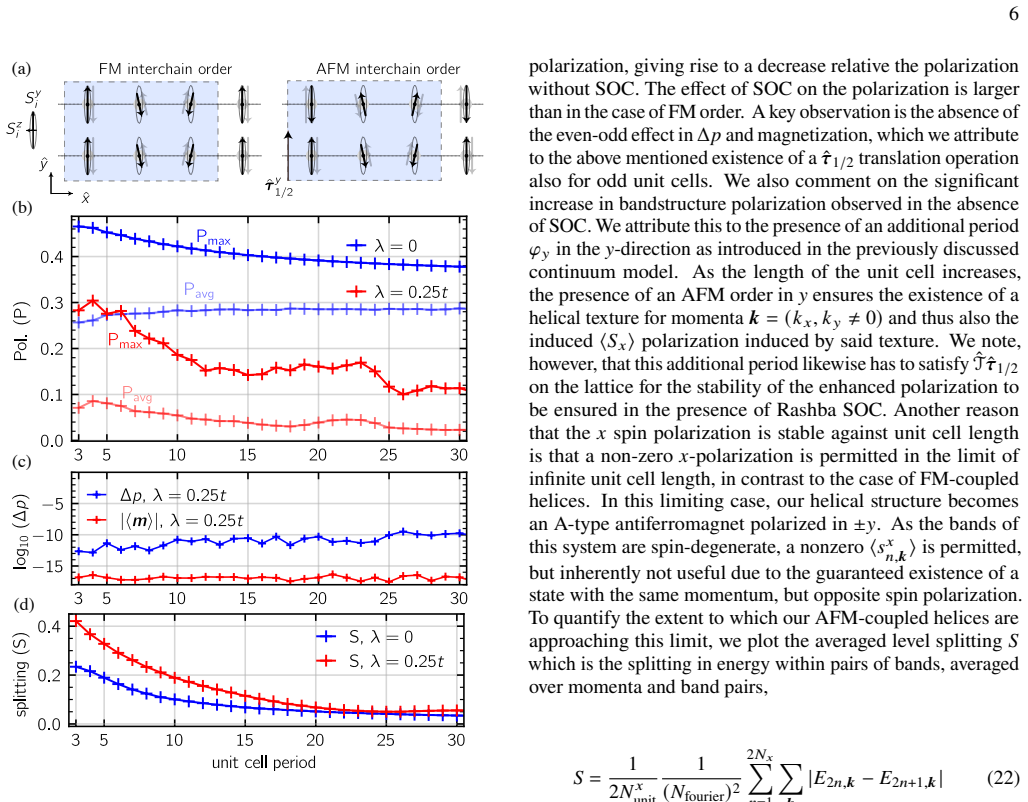
The central discovery is a symmetry-based resolution of the even-odd problem. In a ferromagnetically stacked single helimagnetic chain, p-wave spin polarization is protected by the composite operation $\hat{T}\hat{\tau}_{1/2}$ — time reversal followed by a translation of half the magnetic unit cell — only when the period contains an even number of sites. With an odd period, no such translation exists along the chain, so Rashba spin-orbit coupling lifts the protection, producing $\Delta_p \neq 0$ and a small net magnetization. When two chains are stacked antiferromagnetically, the two rows are time-reversal partners, which guarantees a translation vector along the stacking direction; the $\hat{T}\hat{\tau}_{1/2}$ symmetry therefore exists for all periods. The paper verifies numerically that the deviation from antisymmetric spin polarization vanishes, and that the polarization remains nonzero for all studied periods and Rashba strengths, approaching an A-type antiferromagnet with spin-split bands in the long-period limit.
Load-bearing premise
The argument assumes the helimagnetic texture is fixed exactly as written and that the two chains are exact antiferromagnetic partners; any mechanism that deforms the texture or breaks the exact antiferromagnetic relation (disorder, canting, electronic feedback, or the spin-orbit coupling itself) could remove the protecting symmetry.
Editorial extensions
If this is right
- Antiferromagnetically coupled helimagnetic chains, such as the cycloidal Mn chains on W(110) studied in the literature, should display p-wave spin polarization that survives Rashba spin-orbit coupling of any strength, so thin-film geometry need not destroy the effect.
- For ferromagnetically stacked single chains, the even-odd effect means that only even-site periods are exact p-wave magnets once Rashba coupling is present; odd-site periods show a small net magnetization whose magnitude decays rapidly as the period grows.
- In the AFM-stacked case, the long-period limit approaches an A-type antiferromagnet with spin-degenerate bands; for the finite periods studied, the average level splitting remains nonzero, so the p-wave polarization remains usable.
- The AFM-stacked helices also develop a uniform out-of-plane electric polarization while remaining metallic in the plane, which could allow simultaneous electrical and magnetic functionality.
- The protection mechanism is independent of the microscopic origin of the helical order, as long as the texture and the AFM interchain relation satisfy $\hat{T}\hat{\tau}^y_{1/2}$.
Reading between the lines
- Extension: the symmetry argument suggests a much broader design rule: any collinear stacking of two non-collinear magnetic chains that makes the chains exact time-reversal partners should protect p-wave polarization against Rashba coupling, not just sinusoidal helices; cycloids, spin spirals, or antiferromagnetically coupled skyrmion strings could behave the same.
- Extension: the rapid decay of $\Delta_p$ with period in the FM-stacked case implies that many real helimagnets with long periods will look almost perfectly p-wave in experiment even though symmetry says they are not; detecting the loss of p-wave order requires measuring the odd-in-$k_y$ Rashba component or the tiny net magnetization, not just the band polarization.
- Extension: a direct experimental test would be to compare spin-resolved photoemission on Mn/W(110) with and without a small magnetic field that cants the nominally antiferromagnetic coupling between chains; the field should break $\hat{T}\hat{\tau}^y_{1/2}$ and make $\Delta_p$ nonzero while leaving the helix period essentially unchanged.
- Extension: the same half-unit-cell translation logic can be applied to other symmetry-protected band features, suggesting that stacking antiferromagnetically may be a general strategy to immunize magnetic-texture-induced spin splittings against spin-orbit perturbations.
Editorial analysis
A structured set of objections, weighed in public.
Referee Report
Summary. The manuscript studies a two-dimensional tight-binding model of helimagnetic chains with Rashba spin-orbit coupling. The authors report two main results: (i) for ferromagnetically stacked helical chains, Rashba SOC lifts the p-wave spin polarization when the magnetic unit cell contains an odd number of sites, while the polarization survives for even unit cells, with the deviation decaying rapidly as the unit cell length grows; and (ii) for antiferromagnetically stacked helical chains, the p-wave spin polarization becomes robust against both the helix period and the Rashba strength, protected by a combined time-reversal and half-cell translation symmetry. The claims are supported by numerical band-structure calculations (Figs. 1-3) and a continuum model that provides intuition for the transverse spin polarization.
Significance. The proposed AFM-coupled helimagnetic chain is an attractive platform for robust p-wave spin polarization free of fine-tuning, which would be of direct relevance to spintronics. The symmetry-based reasoning connecting T-tau_1/2 symmetry to p-wave magnetism is physically insightful, and the continuum-model calculation gives a useful heuristic for why the transverse polarization can survive in the limit of long helix periods. The paper also explicitly identifies a limitation of its magnetic-texture model in Section II, which is commendable. If the central claims hold, the work would extend recent advances in p-wave magnets to systems with prominent Rashba spin-orbit coupling. However, the internal consistency of the lattice model must first be established.
major comments (3)
- [Section II, after Eq. (2), and Eqs. (3)-(5)] The definition phi = 2*pi/(N_x^u.c. + 1) is inconsistent with the assumed N_x-site periodicity. With this angle, the texture in Eq. (2) satisfies S_{i+N_x} != S_i, so the Hamiltonian is not invariant under translation by N_x sites. Consequently, the Bloch decomposition in Eq. (5) with k_x in [-pi/N_x, pi/N_x] is invalid unless the true period is N_x, which would require phi = 2*pi/N_x. The calculations in Figs. 1-3 therefore rest on an inconsistent premise as written. The authors must either correct the definition of phi to 2*pi/N_x (if that was what was used numerically) or specify the correct unit-cell size and Brillouin zone for the actual period. As it stands, the central claims cannot be assessed.
- [Section III, Fig. 3 and surrounding text] The claim that the p-wave polarization in AFM-coupled chains appears 'regardless of the strength of the spin-orbit interactions' is not supported by the numerical evidence provided, which only shows lambda = 0.25 t. The verbal symmetry argument is plausible, but an explicit proof that the Rashba term in Eq. (1) commutes with the T tau_1/2 operation for arbitrary lambda should be included, or a lambda-scan should be presented. Since this robustness claim is a central advertised result, the justification must be made explicit.
- [Section III, Figs. 1 and 3] The numerical results rely on a fixed Fourier truncation N_Fourier = 50 in both directions, yet no convergence study is reported. The quantity Delta_p is a symmetry-breaking measure evaluated on a logarithmic scale, and its vanishing (or non-vanishing) may be sensitive to the k-mesh resolution. Please provide a convergence check or quantitative statement of numerical precision so that the small values of Delta_p in Figs. 1(c) and 3(c) can be trusted.
minor comments (5)
- [Abstract and Section III] The abstract and concluding sections use the word 'prove' for results that are primarily demonstrated numerically. Please soften this wording or provide an analytical derivation.
- [Eq. (13)] The norm notation in Delta_p is ambiguous: the double brackets and missing bars make it unclear what norm is being taken. Use a clear notation such as max_{n,k} ||<s_{n,k}> + <s_{n,-k}>||.
- [Fig. 3 caption] The caption does not specify the value of lambda used for the SOC curves. State the parameters in the caption, as is done for Fig. 1.
- [Section IV] The sentence 'These results provide a route to provide robust p-wave spin polarization' is redundant; consider rewording.
- [Section II, after Eq. (2)] The statement that the relative angle between adjacent moments is 2*pi/(N_x^u.c.+1) is not only numerically odd but also conceptually confusing; if a full rotation occurs over N_x+1 sites, the unit cell should be defined accordingly.
Circularity Check
No significant circularity: the p-wave results are computed from the Hamiltonian, and the symmetry argument is a legitimate derivation rather than a fitted or self-referential reduction.
full rationale
The paper contains no fitted parameters: the polarization P and the p-wave deviation Δ_p, defined in Eqs. (8)–(13), are computed by exact diagonalization of the Hamiltonian in Eqs. (1)–(2), and no parameter is adjusted to force the outcome. The central even-odd effect and the AFM robustness claim are supported by numerical band-structure calculations (Figs. 1 and 3) combined with an explicitly stated symmetry argument. For AFM interchain order, adjacent chains are time-reversal partners by construction, so a T τ_{1/2} translation exists for any period; the known theorem from Ref. [27] (whose authors do not overlap with the present paper) then implies antisymmetric spin polarization. This is a derivation from stated assumptions, not a circular reduction: the AFM texture is not defined in terms of p-wave order, and the nonzero magnitude of P remains a nontrivial numerical result. The only self-citation (Ref. [28], sharing author Linder) is background about minimal models of p-wave magnets and is not load-bearing for the new claims. The manuscript's explicit assumption of a rigid helimagnetic ground state in Sec. II is a stated modeling premise, not a hidden input. One internal consistency issue—the choice φ=2π/(N_x^u.c.+1) with an N_x-site unit cell appears incompatible with strict Bloch periodicity in Eq. (5)—is a correctness concern, not a circularity, and is therefore not scored here.
Assumptions & free parameters
free parameters (4)
- Exchange coupling strength J_sd =
J_sd = t
- Rashba strength lambda =
lambda = 0.25t
- Chemical potential mu =
mu = -2t
- Fourier truncation N_Fourier =
50 modes in x and y
assumptions (5)
- domain assumption Rigid helimagnetic texture S_i per Eq. (2), assumed rather than self-consistently derived
- domain assumption Itinerant electrons described by a single-orbital tight-binding model with s-d coupling and Rashba SOC, no electron-electron interactions
- domain assumption Rashba SOC has the specific form -i lambda/2 sum c^dagger (sigma_y delta_x - sigma_x delta_y) c
- standard math Time reversal combined with half-unit-cell translation protects antisymmetric spin polarization
- domain assumption Continuum model of a free electron in a rotating magnetic field
Cite this review
Pith. "Pith review of The fate of $p$-wave spin polarization in helimagnets with Rashba spin-orbit coupling." pith.science (2026). https://pith.science/paper/H2KQPSB2
@misc{pith2026241212246,
  author       = {Pith},
  title        = {Pith review of: The fate of $p$-wave spin polarization in helimagnets with Rashba spin-orbit coupling},
  year         = {2026},
  howpublished = {\url{https://pith.science/paper/H2KQPSB2}},
  note         = {Machine review of arXiv:2412.12246}
}
abstract
It has recently been realized that magnetic systems with coplanar magnetic order that are invariant under the combined operation of time-reversal and translation with half a unit cell feature energy bands with a symmetry-protected p-wave spin polarization. Such $p$-wave magnets are a sought-after spin analogy of unconventional triplet superconducting pairing and show promise for use in spintronics. Metallic helimagnets provide a realization of $p$-wave magnetism, but such order often occurs in systems lacking inversion symmetry so that Rashba spin-orbit interactions can be prominent. An important question is therefore how the magnitude and the existence of $p$-wave spin polarization is affected by Rashba spin-orbit interaction. Here, we prove that while the $p$-wave symmetry of the spin-polarized bands is strictly speaking removed by such spin-orbit interactions in helimagnets unless the period of the helix is fine-tuned, the actual quantitative deviation from $p$-wave symmetry is extremely weak unless the period of the helix is only a few lattice sites. Thereafter, we show that the $p$-wave magnetism becomes completely robust in pairs of antiferromagnetically coupled helices. More precisely, the $p$-wave spin-polarization of the bands then appears regardless of the periodicity and regardless of the strength of the spin-orbit interactions. This shows that antiferromagnetically coupled helimagnetic chains produce robust $p$-wave spin polarization free of fine-tuning requirements, making them attractive for potential spintronic applications.
Figures


Forward citations
Cited by 2 Pith papers
-
Dynamical Polarization from Hidden Spin and Orbital Textures in p-Wave Magnets
Optically driven p-wave magnets develop a resonantly enhanced ac spin polarization at the 2J_sd exchange gap and a rectified, polarization-controlled dc orbital polarization invisible to period-averaged treatments.
-
Coexistence of $p$-wave magnetism and superconductivity
p-wave magnets can coexist with conventional s-wave superconductivity, and the superconducting state strongly enhances the transverse spin current these magnets generate.
Reference graph
Works this paper leans on
-
[26]
E. I. Kiselev, M. S. Scheurer, P. W¨olfle, and J. Schmalian, Limits on dynamically generated spin-orbit coupling: Absence of𝑙= 1 pomeranchuk instabilities in metals, Phys. Rev. B 95, 125122 (2017)
work page 2017
-
[1]
For a system with helical chains with collinear spins in y, 𝜑𝑦 = 0 and⟨𝑆𝑥⟩ should vanish as the length of the unit cell increases (𝜑𝑥→ 0). 2) In the presence of a spatial dependence in the texture along y (𝜑𝑦 ≠ 0), for instance realized through an antiferromagnetic coupling along y, we predict a contribution to the x-polarization which is independent of 𝑁...
-
[2]
In the limit of an infinite unit cell, our system should behave as a ferromagnet polarized in y. With spin-split bands, a polarization in x is not permitted and it thus has to vanish as the system gradually becomes more ferromagnetic like. By introducing a relatively strong SOC, we observe a small change in the polarization measure itself (P), but the pri...
-
[3]
Nagaosa and Y
N. Nagaosa and Y. Tokura, Topological properties and dynamics of magnetic skyrmions, Nat. Nanotech. 8, 899 (2013)
2013
-
[4]
A. Fert, N. Reyren, and V. Cros, Magnetic skyrmions: advances in physics and potential applications, Nature Reviews Materials 2, 17031 (2017)
2017
-
[5]
Castelnovo, R
C. Castelnovo, R. Moessner, and S. Sondhi, Spin ice, fraction- alization, and topological order, Annual Review of Condensed Matter Physics 3, 35 (2012)
2012
-
[6]
S. H. Skjærvø, C. H. Marrows, R. L. Stamps, and L. J. Heyderman, Advances in artifical spin ice, Nat. Rev. Phys.2, 13 (2020)
work page 2020
-
[7]
A. Hirohata, K. Yamada, Y. Nakatani, I.-L. Prejbeanu, B. Di´eny, P. Pirro, and B. Hillebrands, Review on spintronics: Principles and device applications, Journal of Magnetism and Magnetic Materials 509, 166711 (2020)
work page 2020
Show all 39 references
-
[8]
Y. Noda, K. Ohno, and S. Nakamura, Momentum-dependent band spin splitting in semiconducting mno2: a density functional calculation, Phys. Chem. Chem. Phys. 18, 13294 (2016)
2016
-
[9]
K.-H. Ahn, A. Hariki, K.-W. Lee, and J. Kunes, Antiferromag- netism in ruo2 as𝑑-wave pomeranchuk instability, Phys. Rev. B 99, 184432 (2019)
2019
-
[10]
Hayami, Y
S. Hayami, Y. Yanagi, and H. Kusunose, Momentum-Dependent Spin Splitting by Collinear Antiferromagnetic Ordering, J. Phys. Soc. Jpn. 88, 123702 (2019)
2019
-
[11]
L.-D. Yuan, Z. Wang, J.-W. Luo, E. I. Rashba, and A. Zunger, Giant momentum-dependent spin splitting in centrosymmetric low-𝑍 antiferromagnets, Phys. Rev. B102, 014422 (2020)
2020
-
[12]
ˇSmejkal, R
L. ˇSmejkal, R. Gonz´alez-Hern´andez, T. Jungwirth, and J. Sinova, Crystal time-reversal symmetry breaking and spontaneous Hall ef- fect in collinear antiferromagnets, Science advances 6, eaaz8809 (2020)
2020
-
[13]
ˇSmejkal, J
L. ˇSmejkal, J. Sinova, and T. Jungwirth, Emerging Research Landscape of Altermagnetism, Phys. Rev. X 12, 040501 (2022)
2022
-
[14]
ˇSmejkal, J
L. ˇSmejkal, J. Sinova, and T. Jungwirth, Beyond Conventional Ferromagnetism and Antiferromagnetism: A Phase with Nonrel- ativistic Spin and Crystal Rotation Symmetry, Phys. Rev. X12, 031042 (2022)
2022
-
[15]
L. Bai, W. Feng, S. Liu, L. ˇSmejkal, Y. Mokrousov, and Y. Yao, Altermagnetism: Exploring new frontiers in magnetism and spintronics, Advanced Functional Materials 34, 2409327 (2024)
2024
-
[16]
Keimer, S
B. Keimer, S. A. Kivelson, M. R. Norman, S. Uchida, and J. Zaa- nen, From quantum matter to high-temperature superconductivity in copper oxides, Nature 518, 179 (2015)
2015
-
[17]
A. J. Leggett, A theoretical description of the new phases of liquid 3He, Rev. Mod. Phys.47, 331 (1975)
1975
-
[18]
Martin and A
I. Martin and A. F. Morpurgo, Majorana fermions in supercon- ducting helical magnets, Phys. Rev. B85, 144505 (2012)
2012
-
[19]
G. Chen, M. Khosravian, J. L. Lado, and A. Ramires, Designing spin-textured flat bands in twisted graphene multilayers via helimagnet encapsulation, 2D Mater. 9, 024002 (2022)
2022
-
[20]
A. H. Mayo, D.-A. Deaconu, H. Masuda, Y. Nii, H. Takahashi, R. V. Belosludov, S. Ishiwata, M. S. Bahramy, and Y. Onose, Band-asymmetry-driven nonreciprocal electronic transport in a helimagnetic semimetal 𝛼-EuP3 (2024), arxiv:2404.13856 [cond-mat]
2024 arXiv
-
[21]
Hayami, Y
S. Hayami, Y. Yanagi, and H. Kusunose, Spontaneous antisym- metric spin splitting in noncollinear antiferromagnets without spin-orbit coupling, Phys. Rev. B101, 220403 (2020)
2020
-
[22]
Hayami, Y
S. Hayami, Y. Yanagi, and H. Kusunose, Bottom-up design of spin-split and reshaped electronic band structures in antiferro- magnets without spin-orbit coupling: Procedure on the basis of augmented multipoles, Phys. Rev. B102, 144441 (2020)
2020
-
[23]
Hayami, Mechanism of antisymmetric spin polarization in centrosymmetric multiple-𝑞 magnets based on effective chiral bilinear and biquadratic spin cross products, Phys
S. Hayami, Mechanism of antisymmetric spin polarization in centrosymmetric multiple-𝑞 magnets based on effective chiral bilinear and biquadratic spin cross products, Phys. Rev. B105, 024413 (2022)
2022
-
[24]
C. Wu, K. Sun, E. Fradkin, and S.-C. Zhang, Fermi liquid instabilities in the spin channel, Phys. Rev. B75, 115103 (2007)
2007
-
[25]
J. Jung, M. Polini, and A. H. MacDonald, Persistent current states in bilayer graphene, Phys. Rev. B91, 155423 (2015)
2015
-
[27]
Y.-M. Wu, A. Klein, and A. V. Chubukov, Conditions for𝑙= 1 pomeranchuk instability in a fermi liquid, Phys. Rev. B 97, 165101 (2018)
2018
-
[28]
Y. B. Kudasov, Topological band structure due to modified kramers degeneracy for electrons in a helical magnetic field, Phys. Rev. B109, L140402 (2024)
2024
-
[29]
Hellenes, T
A. Hellenes, T. Jungwirth, R. Jaeschke-Ubiergo, A. Chakraborty, J. Sinova, and L. Smejkal,𝑝-wave magnets, arXiv:2309.01607 (2023). 8
2023 arXiv
-
[30]
Brekke, P
B. Brekke, P. Sukhachov, H. Giil, A. Brataas, and J. Linder, Minimal models and transport properties of unconventional 𝑝-wave magnets, arXiv:2405.15823 (to appear in PRL) (2024)
2024 arXiv
-
[31]
Y. Yu, M. B. Lyngby, T. Shishidou, M. Roig, A. Kreisel, M. Wein- ert, B. M. Andersen, and D. F. Agterberg, Odd-parity magnetism driven by antiferromagnetic exchange (2025), arXiv:2501.02057 [cond-mat.str-el]
2025 arXiv
-
[32]
Chakraborty, A
A. Chakraborty, A. B. Hellenes, R. Jaeschke-Ubiergo, T. Jung- wirth, L. ˇSmejkal, and J. Sinova, Highly efficient non-relativistic edelstein effect in p-wave magnets (2024), arXiv:2411.16378 [cond-mat.mes-hall]
2024 arXiv
-
[33]
Kokkeler, I
T. Kokkeler, I. Tokatly, and F. S. Bergeret, Quantum trans- port theory for unconventional magnets; interplay of altermag- netism and p-wave magnetism with superconductivity (2025), arXiv:2412.10236 [cond-mat.supr-con]
2025 arXiv
-
[34]
M. Bode, M. Heide, K. von Bergmann, P. Ferriani, S. Heinze, G. Bihlmayer, A. Kubetzka, O. Pietzsch, S. Blugel, and R. Wiesen- danger, Chiral magnetic order at surfaces driven by inversion asymmetry, Nature 447, 190 (2007)
2007
-
[35]
Calvo, Quantum theory of neutrons in helical magnetic fields, Phys
M. Calvo, Quantum theory of neutrons in helical magnetic fields, Phys. Rev. B18, 5073 (1978)
1978
-
[36]
Cheong and M
S.-W. Cheong and M. Mostovoy, Multiferroics: a magnetic twist for ferroelectricity, Nature Materials 6, 13 (2007)
2007
-
[37]
Fiebig, T
M. Fiebig, T. Lottermoser, D. Meier, and M. Trassin, The evolution of multiferroics, Nat. Rev. Mater.1, 16046 (2016)
2016
-
[38]
Mostovoy, Ferroelectricity in spiral magnets, Phys
M. Mostovoy, Ferroelectricity in spiral magnets, Phys. Rev. Lett. 96, 067601 (2006)
2006
-
[39]
Z. Fei, W. Zhao, T. Palomaki, B. Sun, M. Miller, Z. Zhao, J. Yan, X. Xu, and D. Cobden, Ferroelectric switching of a two-dimensional metal, Nature 560, 336 (2018)
2018
Reviewed August 11, 2026 · model on record in the stance chip above.
Discussion (0). Continue with ORCID to comment.