REVIEW 2 major objections 2 minor 1 cited by
Parity supervision enables quantum Born machines to generalize from finite samples to unseen states by transferring evidence through parity moments.
Reviewed by Pith at T0; open to challenge. T0 means a machine referee read the full paper against a public rubric. the ladder, T0–T4 →
T0 review · grok-4.3
2026-05-12 05:22 UTC pith:HCANONXA
load-bearing objection Parity supervision gives IQP Born machines a generalization edge over MSE training and max-entropy in aligned enumerable cases, shown through direct controls and a spectral diagnostic. the 2 major comments →
Parity Supervision as a Driver of Generalization in Quantum Generative Modeling
The pith
A machine-rendered reading of the paper's core claim, the machinery that carries it, and where it could break.
Core claim
Parity supervision functions as both a tractable training signal and a generalization mechanism for IQP Born machines. When the target distribution, the parity objective, and the circuit architecture share structural alignment, parity moments transfer evidence from observed samples to unseen but compatible states. This transfer is visible in a parameter-free spectral reconstruction and is further sharpened by the IQP circuit, yielding improved exact forward Kullback-Leibler fit and higher recovery rates for unseen high-value states relative to mean-squared-error training or classical maximum-entropy reconstruction on the same moments.
What carries the argument
Parity supervision, which supplies an inductive bias through parity moments that a parameter-free spectral reconstruction uses to transfer evidence from observed samples to structurally compatible unseen states.
Load-bearing premise
The distribution to be learned must share structural alignment with both the parity objective and the IQP circuit architecture.
What would settle it
A controlled distribution in which parity supervision on an IQP circuit produces no improvement in exact forward KL fit or unseen high-value-state recovery compared with the MSE-trained circuit.
If this is right
- Exact forward Kullback-Leibler divergence to the target distribution decreases.
- Recovery rates for high-value states absent from the training set increase.
- The generalization gain exceeds that achieved by a classical maximum-entropy model given identical parity moments.
- The IQP circuit further refines the evidence transfer already present in the parity-moment spectral reconstruction.
Where Pith is reading between the lines
- Moment-based supervision derived from other symmetries could supply comparable generalization benefits in different quantum generative architectures.
- Classical discrete models might achieve analogous extrapolation gains by incorporating parity or other low-order moment objectives during training.
- Systematic variation of circuit depth or target-distribution type could map the boundary of the required structural alignment.
Editorial analysis
A structured set of objections, weighed in public.
Referee Report
Summary. The paper investigates whether parity supervision, used for training Instantaneous Quantum Polynomial-time (IQP) Born machines, also serves as an inductive bias for generalization in discrete generative modeling. In a controlled, exactly enumerable setting, the authors compare an IQP circuit trained with parity losses against the same circuit trained with mean-squared-error (MSE) and a classical maximum-entropy model using the same parity moments. They report improved forward KL divergence fit and better recovery of unseen high-value states with parity supervision. A parameter-free spectral reconstruction is presented to show how parity moments transfer evidence to structurally compatible unseen states, which the IQP circuit refines further. The claims are scoped to cases where the target distribution, parity objective, and circuit architecture are structurally aligned.
Significance. If substantiated, this identifies parity supervision as both a tractable training objective and a generalization driver for quantum generative models under structural alignment. The inclusion of a classical control and the parameter-free spectral method strengthens the argument by providing an explicit mechanism for the observed benefits, distinguishing it from mere training artifacts. This could guide the development of inductive biases in quantum machine learning for combinatorial and discrete data problems.
major comments (2)
- Abstract: The abstract states clear comparative improvements in exact forward KL fit and unseen high-value-state recovery but provides no numerical effect sizes, error bars, or statistical details on the magnitude of gains, which are load-bearing for assessing whether the generalization benefit is practically meaningful.
- Experimental setting description: The construction of the exactly enumerable setting (target distribution, qubit count, sample generation, and enumeration procedure) is not specified with sufficient detail to allow independent verification or assessment of how the structural alignment between distribution, parity objective, and IQP architecture was ensured.
minor comments (2)
- The acronym IQP should be expanded on first use in the main text even if defined in the abstract.
- Figure captions or legends for any spectral reconstruction plots should explicitly note that the method is parameter-free to highlight this strength.
Simulated Author's Rebuttal
We thank the referee for their careful reading of the manuscript and for the constructive feedback. We address each major comment below and outline the revisions we will make to improve clarity, reproducibility, and the strength of the presentation.
read point-by-point responses
-
Referee: Abstract: The abstract states clear comparative improvements in exact forward KL fit and unseen high-value-state recovery but provides no numerical effect sizes, error bars, or statistical details on the magnitude of gains, which are load-bearing for assessing whether the generalization benefit is practically meaningful.
Authors: We agree that the abstract would be strengthened by the inclusion of quantitative effect sizes and statistical details. While the main text and figures report these values (including KL reductions and recovery improvements with variability across runs), the abstract was intentionally kept high-level. In the revised manuscript we will add concise numerical summaries of the key gains (e.g., average forward KL improvement and high-value-state recovery rates with standard deviations) directly into the abstract so that readers can immediately gauge practical significance. revision: yes
-
Referee: Experimental setting description: The construction of the exactly enumerable setting (target distribution, qubit count, sample generation, and enumeration procedure) is not specified with sufficient detail to allow independent verification or assessment of how the structural alignment between distribution, parity objective, and IQP architecture was ensured.
Authors: We acknowledge that additional detail is needed for full reproducibility and to make the structural-alignment conditions explicit. The current manuscript describes the setting at a high level; we will expand the experimental-methods section to include: (i) the precise construction of the target distribution and how its parity structure was chosen, (ii) the qubit count, (iii) the sample-generation and exact-enumeration procedures, and (iv) an explicit discussion of the alignment criteria between the distribution, the parity objective, and the IQP circuit. These additions will allow independent verification and clarify the scope of the reported generalization benefits. revision: yes
Circularity Check
No significant circularity detected
full rationale
The paper's claims are supported by explicit empirical comparisons to two independent controls (MSE training on the identical IQP circuit and a classical maximum-entropy model supplied with the same parity moments) together with a parameter-free spectral reconstruction that isolates the moment-based transfer mechanism. These elements are external to the training procedure itself and do not reduce any reported prediction or generalization benefit to a fitted input or self-referential definition. The argument is further scoped to the case of structural alignment between target, objective, and architecture, with no load-bearing self-citations or ansatz smuggling required for the central results.
Axiom & Free-Parameter Ledger
axioms (2)
- domain assumption IQP circuits admit tractable training under parity losses
- domain assumption The experimental setting is exactly enumerable so that all states and KL values can be computed exactly
read the original abstract
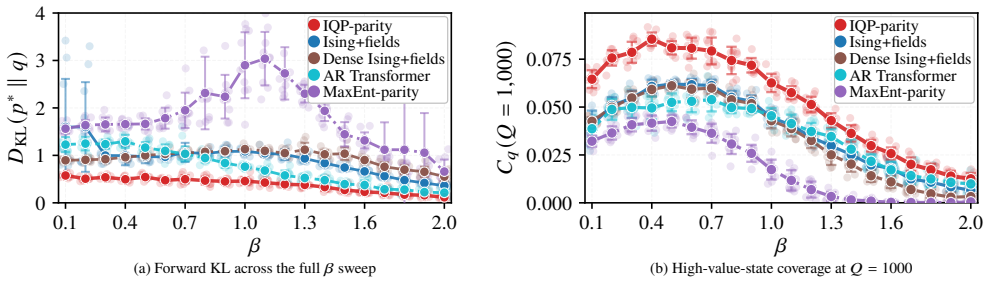
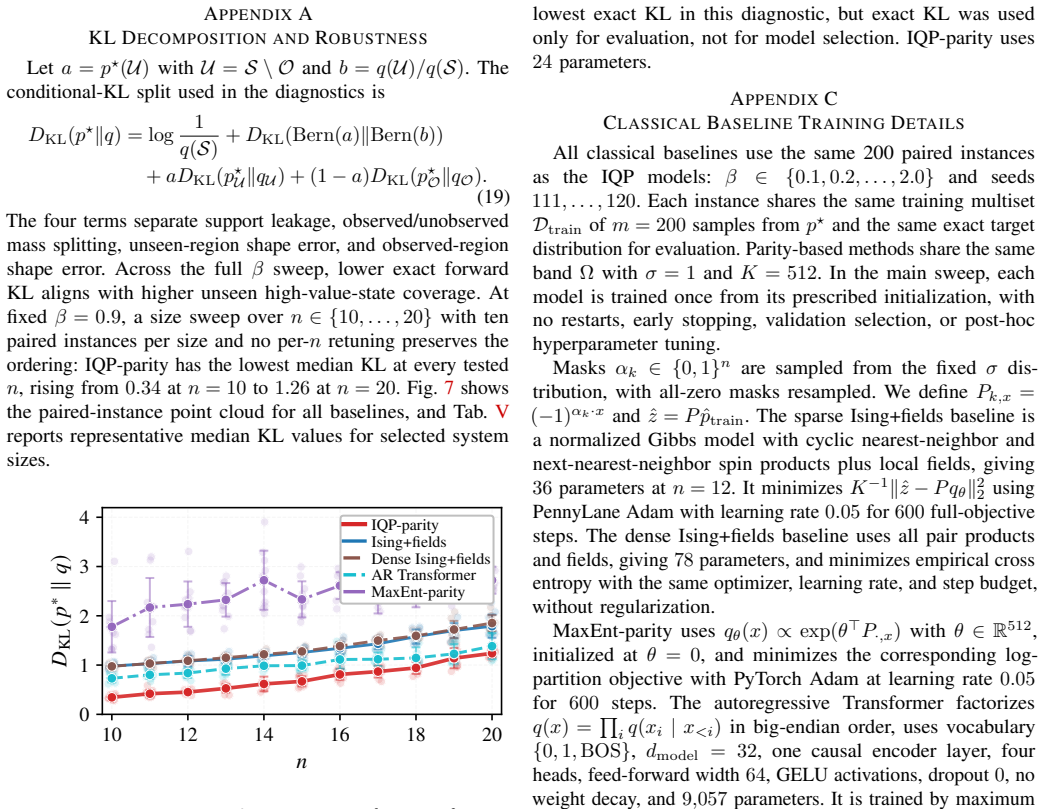
Generative models learn probability distributions in order to produce new samples beyond a finite training set. Their usefulness therefore depends on assigning probability to valid but previously unseen states. In a controlled benchmark, we test whether parity-based training provides an inductive bias for this kind of generalization in instantaneous quantum polynomial-time (IQP) circuit Born machines. We compare the same IQP circuit trained with parity supervision and coordinate-wise mean-squared error (MSE), together with classical controls. Parity supervision improves exact distributional fit and recovery of unseen high-value states over IQP-MSE. A circuit-free spectral reconstruction shows that the matched parity moments already transfer evidence from observed samples to structurally compatible unseen states, while the IQP circuit further refines this structure. These results identify parity supervision as both a tractable training signal and a generalization mechanism when the target distribution, training objective, and circuit architecture are spectrally aligned.
Figures



Forward citations
Cited by 1 Pith paper
-
Spectral Born machines: classically trainable quantum generative models for discrete data
Spectral Born machines are Fourier-phase quantum generative models over Z_d^n that train classically via graph-spectral MMD and show reduced parameters plus apparent overfitting resistance on integer data.
discussion (0)
Sign in with ORCID, Apple, or X to comment. Anyone can read and Pith papers without signing in.