REVIEW 4 major objections 5 minor 110 references
Nonrelativistic meson masses from the Curci-Ferrari model
T0 review · 4 major / 5 minor · reviewed 2026-08-05 · deepseek-v4-flash
Pith's one-line read A Yukawa-plus-Cornell potential from the Curci-Ferrari model, with a running gluon mass, reproduces charmonium, bottomonium, and B_c masses to about 70 MeV—and the fit prefers a nonzero gluon mass.
desk verdict A transparent first application of the Curci-Ferrari model to heavy-quark spectra; the claim that a nonzero gluon mass is preferred is plausible but not established, and the authors know it. read the letter →
The pith
A machine-rendered reading of the paper's core claim, the machinery that carries it, and where it could break.
The reading
What carries the argument
The central object is the Curci-Ferrari model in Landau gauge, a renormalizable extension of the Faddeev-Popov action with a gluon mass term; its tree-level gluon propagator is that of a massive vector field. The calculation's engine is the nonrelativistic reduction of the one-gluon exchange amplitude: applying Born's approximation to the tree-level quark-antiquark scattering amplitude with q0=0 yields the Hamiltonian, whose leading piece is the Yukawa potential plus a linear Cornell confining term. The Schrödinger equation for the dominant Hamiltonian is solved numerically, and the subleading spin-dependent terms are treated as first-order perturbations. The scale dependence enters through
What would settle it
A direct way to settle the claim is to compute the omitted O(λ²) term M2 in the mass expansion (38) explicitly, or to propagate the scan uncertainties through the error χ: if any parameter set with m→0 yields χ ≤ λ² = (g²N_c/16π²)² ≈ 0.0064 after that correction, the massless-gluon case is not excluded, and the paper's central preference for a massive gluon would fail.
Extended reading notes
Core claim
The central claim is that the Curci-Ferrari model, treated as a nonrelativistic potential model, reproduces the low-lying spectra of charmonium, bottomonium, and B_c mesons, and that the experimental and lattice masses favor a nonvanishing gluon mass over the massless limit. The Hamiltonian is built from the Fourier transform of the one-massive-gluon exchange amplitude in the static q0=0 limit, giving a Yukawa term plus relativistic Breit-type corrections; a linear Cornell term supplies confinement. Solving the Schrödinger equation for the dominant kinetic-plus-Yukawa-plus-linear Hamiltonian and treating the remaining terms perturbatively, the authors scan the parameters (string tension, cha
Load-bearing premise
The claim that the data rule out a massless gluon rests on an order-of-magnitude estimate of the omitted next-order term (Eq. (39)) rather than on propagated parameter uncertainties, and the authors note that small parameter shifts move their contour plots; under a different or more conservative error model, the massless point could become acceptable.
Editorial extensions
If this is right
- If the central claim holds, heavy-quark spectroscopy provides an independent, low-energy observable that constrains the gluon mass, complementing lattice and functional-method determinations.
- The same Hamiltonian can be applied to higher radial and angular excitations or to other heavy-flavor combinations; the n=1, ℓ=0,1 restriction is a practical limit, not an obstacle of principle.
- Because the best fit yields a string tension at the high end of the usual range while quark masses stay standard, the model implies that part of what other potential models call confinement is being absorbed by the massive-exchange term.
- A nonzero gluon mass suppresses the short-distance Yukawa attraction relative to a massless Coulomb exchange; the successful fit of hyperfine and spin-orbit splittings means the Breit corrections are consistent with that suppression.
- The paper's error criterion, χ ≲ λ², provides a template for judging when a parameter region is excluded; applying the same criterion to other observables could sharpen or overturn the massless-gluon exclusion.
Reading between the lines
- The massless-versus-massive comparison is only as strong as the λ² threshold: if a next-order calculation shows the omitted term M2 is suppressed relative to the measured masses, the massless point could move inside the allowed region, weakening the headline claim while leaving the spectrum fit intact.
- A cleaner discriminator would be to fit the same data with the gluon mass fixed to zero and let the string tension, quark masses, and coupling float freely; if the massless fit reaches a comparable error, the data alone do not single out a gluon mass, and the preference would come from the model's running.
- Because the running depends only on the ratio of scales, the choice of initialization scale is effectively arbitrary for the fit; testing different schemes would show how much of the preferred m(μc)=370 MeV is scheme-dependent.
- The charmonium squared velocity estimate (roughly 0.26–0.32) is not deeply nonrelativistic, so a relativistic Bethe-Salpeter calculation in the Curci-Ferrari model, which the authors flag as future work, would be a sharper test of whether the gluon mass really improves the charmonium states.
Editorial analysis
A structured set of objections, weighed in public.
Referee Report
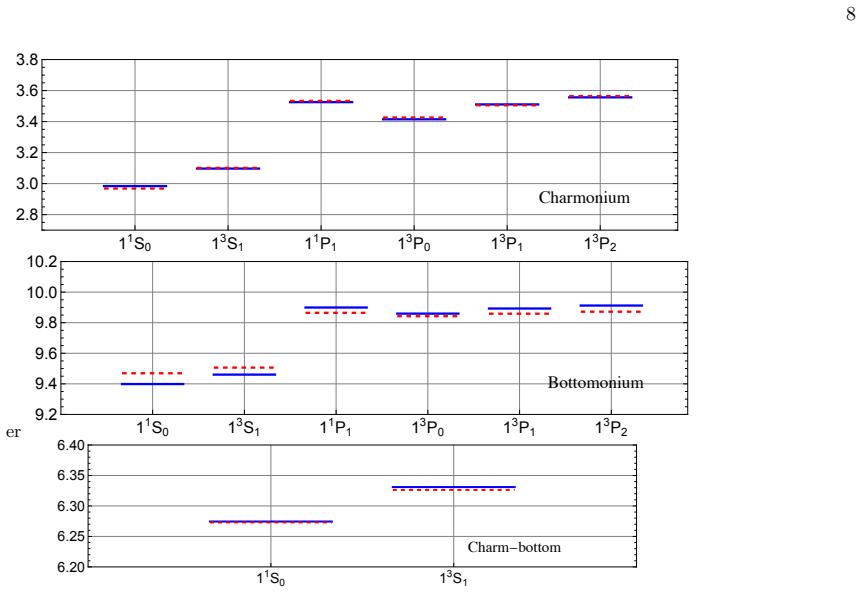
Summary. The paper develops a nonrelativistic potential model for heavy quarkonia starting from the Curci-Ferrari (CF) model in Landau gauge. From the one-massive-gluon-exchange Born amplitude, the authors derive a Hamiltonian containing a Yukawa potential plus relativistic and spin-dependent corrections, add a Cornell linear confining term, solve the Schrödinger equation numerically for n=1, ℓ=0,1 states, and treat the remaining terms perturbatively. Using one-loop UV beta functions for the gauge coupling and gluon mass taken from earlier CF-model work, and evaluating parameters at the scale μ=M/2, they scan five parameters (string tension b, quark masses Mc and Mb, coupling g(μc), gluon mass m(μc)) and fit 14 states of charmonium, bottomonium, and Bc mesons. The reported fit agrees with data at the level of tens of MeV, with a largest discrepancy around 70 MeV, and the authors conclude that a nonvanishing gluon mass is preferred over the massless case because a vanishing m lies outside the region χ≲λ², where λ=g²Nc/(16π²). The paper is exploratory and explicitly flags several limitations of its own analysis.
Significance. If the central preference claim were robust, this work would meaningfully extend the Curci-Ferrari model to a new observable—heavy quarkonium spectroscopy—and would support the massive-gluon picture with a transparent, mostly analytic Hamiltonian. The paper has real strengths: the derivation from the Born amplitude is explicit, the perturbative corrections are listed and evaluated, the parameter scans are described, and the authors clearly acknowledge that additional studies are needed. However, the headline claim that the massless gluon case is excluded is not yet established. The massless limit is never actually computed, the χ<λ² criterion is a dimensional estimate without propagated uncertainties, and the fit is presented without a statistical error model. These issues are load-bearing for the paper’s main conclusion, so the manuscript requires major revision rather than being ready for acceptance.
major comments (4)
- [Sec. VI, Eqs. (38)-(39) and Fig. 2] The central conclusion that a vanishing gluon mass is excluded is not supported by the presented evidence. The scans for the full fit start at m(μc)=0.02 GeV with step 0.01 GeV; no m=0 point is computed. The threshold χ≲λ² is obtained by assuming, in Eq. (39), that the omitted second-order term M2 is of the same order as the experimental masses; this is a dimensional estimate, not an uncertainty propagation, and the global minimum value of χ for the combined fit is never quoted. The text itself concedes that 'relatively small changes in the values of the parameters can lead to modifications on the contour plots.' A direct m=0 run, a more conservative error band, and at least a sensitivity study over scan grids are needed before one can say the massless case is 'safely outside' the allowed region.
- [Sec. III, Eqs. (14)-(15)] The m→0 limit is not taken in the Hamiltonian. H5 and H6 carry explicit 1/m² factors; individually they are singular as m→0. For m=0, H6 reduces to -H5, so the combination H5+H6 is regular only through a cancellation between inverse-power terms. The paper does not perform this analytic limit before forming expectation values, and the numerical evaluation of T5 and T6 in Appendix B also uses m in denominators. Thus the massless-gluon case is not actually evaluated, even approximately, and the claim that the data disfavors m=0 rests on an extrapolation. The authors should either compute the m=0 limit of H2-H9 (or of the combined T5+T6) and solve the corresponding Schrödinger equation, or clearly restrict the claim to the scanned m>0 region.
- [Sec. VI, Tables I-III] The fit is presented as a five-parameter point estimate of 14 masses with no statistical model. No uncertainties are given for the fitted parameters, the global χ minimum for the combined fit is not reported, and the parenthetical uncertainties on the calculated masses in Tables I-III are never defined. The quality of the agreement is therefore difficult to assess. In particular, the bottomonium residuals are much larger than the experimental errors (ηb differs by about 70 MeV), and the text after Fig. 3 explicitly states that the error of the procedure is underestimated for bottomonium. This weakens the claim of 'very good agreement' and makes the χ contours hard to interpret as confidence statements.
- [Sec. VII and Abstract] The abstract and Section VII state that a nonvanishing gluon mass 'provides a better description' and that the data favor massive gluons, but the body of the paper concludes only that further studies are needed before reaching a robust conclusion. Given the two issues above, the strong wording in the abstract overstates what the analysis establishes. The abstract should be softened to match the conditional nature of the result, e.g., 'suggests' with the explicit caveat that the massless case has not been directly computed.
minor comments (5)
- [Sec. IV, after Eq. (22)] The text lists ℓ = 0, 1/2, 1, 3/2, 2... as angular momentum eigenvalues of spherical harmonics. Orbital angular momentum in a central potential takes integer values; the half-integer entries appear to be a typo or confusion with total spin. This should be corrected.
- [Fig. 2 caption] The caption does not identify the axes or the fixed parameter values for both panels unambiguously. It should state which parameters are plotted on each axis and list all parameter values used for the contours, including the gluon mass and coupling grids.
- [Sec. VI] The global fit minimum χ is not given numerically, only the bottomonium-specific χb=0.0004895. Since the contours are central to the paper’s argument, the authors should quote the minimum χ for the full 14-state fit and the corresponding parameter values.
- [Tables I-III] The uncertainties shown in parentheses for the calculated masses are not defined. If they come from parameter scan ranges or numerical error, this should be explained; otherwise remove them or replace with a clearly defined error estimate.
- [Introduction, paragraph 3] The sentence 'preceding the confirmation through numerical simulations, such solutions had already been observed' is grammatically awkward. Rephrase for clarity.
Circularity Check
No significant circularity: the meson agreement is explicitly a fit, and the self-cited running couplings are external lattice-calibrated inputs.
full rationale
The paper does not present the meson spectra as a prediction: the abstract and Sec. VI state that the experimental/lattice masses are fitted, e.g. "By studying the parameter space of the model we fit the experimental mass spectrum" and "To fit the data we minimized the error χ". Agreement after a five-parameter fit is therefore a fit-quality statement, not a claimed derivation of the data, and the paper is transparent about this. The running of g and m is imported from Ref. [1], which shares an author, but those beta functions were determined in prior work from lattice correlation functions, not from meson masses; hence this self-citation is independent support rather than a circular input. The massless-vs-massive conclusion is based on a scan over m starting at 0.02 GeV together with a heuristic dimensional threshold λ² in Eqs. (38)-(39); the massless point is not directly computed and the threshold is an order-of-magnitude estimate. These are legitimate limitations or statistical overclaims, but they are not cases where a conclusion reduces to its own input by definition or where a fitted parameter is renamed a prediction. The Hamiltonian is derived from the tree-level one-gluon amplitude plus a Cornell confining term, and the perturbative corrections are computed from that Hamiltonian without assuming the target spectra. No circular step satisfying the quoted-reduction criterion is present.
Assumptions & free parameters
free parameters (5)
- b (string tension) =
0.26 GeV^2 (global fit); 0.33 GeV^2 in bottomonium-only fit
- Mc (charm quark mass) =
1.20 GeV
- Mb (bottom quark mass) =
4.575 GeV
- g(mu_c) (gauge coupling) =
2.05 at mu_c=600 MeV
- m(mu_c) (gluon mass) =
370 MeV at mu_c=600 MeV
assumptions (6)
- domain assumption The Curci-Ferrari Lagrangian (Eq. 1) with a bare gluon mass is a valid phenomenological starting point for infrared QCD.
- domain assumption The one-loop ultraviolet beta functions in Eqs. (33)-(34), taken from [1], govern the running of g and m in the 3-10 GeV range.
- ad hoc to paper Confinement is modeled by adding the Cornell linear potential br by hand to the one-gluon-exchange Hamiltonian.
- standard math The static approximation q0=0 for the exchanged gluon momentum is valid for bound states.
- standard math The corrections H1-H9 can be treated as first-order perturbations in the basis of HS eigenstates.
- ad hoc to paper The running parameters g(mu) and m(mu) are evaluated at the scale mu = M/2 for each meson family.
Cite this review
Pith. "Pith review of Nonrelativistic meson masses from the Curci-Ferrari model." pith.science (2026). https://pith.science/paper/HCTDBJTY
@misc{pith2026250904365,
  author       = {Pith},
  title        = {Pith review of: Nonrelativistic meson masses from the Curci-Ferrari model},
  year         = {2026},
  howpublished = {\url{https://pith.science/paper/HCTDBJTY}},
  note         = {Machine review of arXiv:2509.04365}
}
read the original abstract
We study the mass spectrum of nonrelativistic mesons composed of charm and bottom quarks within the framework of the Curci-Ferrari model in the Landau gauge, focusing on the influence of the gluon mass on our results. We derive the Hamiltonian from the scattering amplitude of a single massive gluon exchange. By incorporating a confining Cornell potential we solve the Schr\"odinger equation for the dominant terms of the Hamiltonian, which include the kinetic energy and a Yukawa-type potential. Corrections to the energy are then introduced perturbatively. By studying the parameter space of the model we fit the experimental mass spectrum of charmonium, bottomonium and charm-bottom mesons. From the five parameters of our approach, we allow the gluon mass and the gauge coupling to run with the energy scale according to the ultraviolet one-loop renormalization flows, computed in [1]. Our results show very good agreement with the data, suggesting that a nonvanishing gluon mass provides a better description of the spectrum of heavy mesons than the massless case.
Figures


Reference graph
Works this paper leans on
-
[1]
= p 2M1 w′† 1 1 − p′2 1 8M 2 1 −w′† 1 σ1·p′ 1 2M1 , (5) are the Dirac spinors associated with quarks, and v(p′
-
[2]
Due to momentum conservation the initial and final quantities are related by p′ 1 = p1 − q and p′ 2 = p2 + q
= p 2M2 σ2·p′ 2 2M2 w′ 2 1 − p′ 2 2 8M 2 2 w′2 , ¯v(p2) = p 2M2 w† 2 σ2·p2 2M2 −w† 2 1 − p2 2 8M 2 2 , (6) are those associated with antiquarks. Due to momentum conservation the initial and final quantities are related by p′ 1 = p1 − q and p′ 2 = p2 + q. There are several ways to determine the component q0 of the gluon momentum. One of them is to ...
-
[3]
In this work, we focus on three distinct energy scales, each associated with char- monium, charm-bottom mesons and bottomonium
, (35) and m2(˜µ) = m2 0 g(˜µ) g0 κ , (36) where κ = 35Nc−8Nf 2(11Nc−2Nf ) , m0 ≡ m( ˜µ0), g0 = g( ˜µ0) and ˜µ0 is some initialization scale. In this work, we focus on three distinct energy scales, each associated with char- monium, charm-bottom mesons and bottomonium. In principle, we could consider a similar dependence on the energy scale for the quark ...
-
[4]
I. L. Bogolubsky, E. M. Ilgenfritz, M. Muller-Preussker, and A. Sternbeck, Phys. Lett. B 676, 69 (2009), arXiv:0901.0736 [hep-lat]
arXiv 2009
-
[5]
M. Pel´ aez, M. Tissier, and N. Wschebor, Phys. Rev. D 90, 065031 (2014), arXiv:1407.2005 [hep-th]
arXiv 2014
-
[6]
6 It is clear from Eqs
We performed the following scans: for the string tension, b, the same scan as the one implemented for the bottomonium spectrum; for the charm mass, Mc, a scan from 1 .1 GeV to 1 .3 GeV, with a step size of dMc = 0.05 GeV; for the coupling, g(µc), a scan from 1.4 to 2.3, with a step size of dg = 0.05; for the gluon mass, 5 Of course, Mc depends only on the...
2023
-
[7]
A. Cucchieri and T. Mendes, Phys. Rev. Lett. 100, 241601 (2008), arXiv:0712.3517 [hep-lat]
arXiv 2008
-
[8]
V. G. Bornyakov, V. K. Mitrjushkin, and M. Muller- Preussker, Phys. Rev. D 81, 054503 (2010), arXiv:0912.4475 [hep-lat]
arXiv 2010
Show all 110 references
- [9]
-
[10]
Oliveira and P
O. Oliveira and P. J. Silva, Phys. Rev. D 86, 114513 (2012), arXiv:1207.3029 [hep-lat]
2012 arXiv
-
[11]
A. G. Duarte, O. Oliveira, and P. J. Silva, Phys. Rev. D 94, 014502 (2016), arXiv:1605.00594 [hep-lat]
2016 arXiv
-
[12]
A. C. Aguilar, D. Binosi, and J. Papavassiliou, Phys. Rev. D 78, 025010 (2008), arXiv:0802.1870 [hep-ph]
2008 arXiv
-
[13]
A. C. Aguilar, D. Binosi, and J. Papavassiliou, Phys. Rev. D 86, 014032 (2012), arXiv:1204.3868 [hep-ph]
2012 arXiv
-
[14]
M. Q. Huber, Phys. Rept. 879, 1 (2020), arXiv:1808.05227 [hep-ph]
2020 arXiv
-
[15]
M. Q. Huber, Phys. Rev. D 101, 114009 (2020), arXiv:2003.13703 [hep-ph]
2020 arXiv
-
[16]
C. S. Fischer, A. Maas, and J. M. Pawlowski, Annals Phys. 324, 2408 (2009), arXiv:0810.1987 [hep-ph]
2009 arXiv
-
[17]
A. K. Cyrol, L. Fister, M. Mitter, J. M. Pawlowski, and N. Strodthoff, Phys. Rev. D 94, 054005 (2016), arXiv:1605.01856 [hep-ph]
2016 arXiv
-
[18]
A. K. Cyrol, M. Mitter, J. M. Pawlowski, and N. Strodthoff, Phys. Rev. D 97, 054006 (2018), arXiv:1706.06326 [hep-ph]. 13
2018 arXiv
-
[19]
Dupuis, L
N. Dupuis, L. Canet, A. Eichhorn, W. Metzner, J. M. Pawlowski, M. Tissier, and N. Wschebor, Phys. Rept. 910, 1 (2021), arXiv:2006.04853 [cond-mat.stat-mech]
2021 arXiv
-
[20]
A. C. Aguilar and A. A. Natale, JHEP 08, 057 (2004), arXiv:hep-ph/0408254
2004 arXiv
-
[21]
Cucchieri, A
A. Cucchieri, A. Maas, and T. Mendes, Phys. Rev. D 77, 094510 (2008), arXiv:0803.1798 [hep-lat]
2008 arXiv
-
[22]
Boucaud, J
P. Boucaud, J. P. Leroy, A. L. Yaouanc, J. Micheli, O. Pene, and J. Rodriguez-Quintero, Few Body Syst. 53, 387 (2012), arXiv:1109.1936 [hep-ph]
2012 arXiv
-
[23]
V. N. Gribov, Nucl. Phys. B 139, 1 (1978)
1978
-
[24]
Zwanziger, Nucl
D. Zwanziger, Nucl. Phys. B 323, 513 (1989)
1989
-
[25]
Dudal, J
D. Dudal, J. A. Gracey, S. P. Sorella, N. Vandersickel, and H. Verschelde, Phys. Rev. D 78, 065047 (2008), arXiv:0806.4348 [hep-th]
2008 arXiv
-
[26]
Dudal, O
D. Dudal, O. Oliveira, and N. Vandersickel, Phys. Rev. D 81, 074505 (2010), arXiv:1002.2374 [hep-lat]
2010 arXiv
-
[27]
Curci and R
G. Curci and R. Ferrari, Nuovo Cim. A 32, 151 (1976)
1976
-
[28]
Curci and R
G. Curci and R. Ferrari, Nuovo Cim. A 35, 1 (1976), [Erratum: Nuovo Cim.A 47, 555 (1978)]
1976
-
[29]
Tissier and N
M. Tissier and N. Wschebor, Phys. Rev. D 82, 101701 (2010), arXiv:1004.1607 [hep-ph]
2010 arXiv
-
[30]
Tissier and N
M. Tissier and N. Wschebor, Phys. Rev. D 84, 045018 (2011), arXiv:1105.2475 [hep-th]
2011 arXiv
-
[31]
Reinosa, J
U. Reinosa, J. Serreau, M. Tissier, and N. Wschebor, Phys. Rev. D 96, 014005 (2017), arXiv:1703.04041 [hep- th]
2017 arXiv
-
[32]
Pelaez, M
M. Pelaez, M. Tissier, and N. Wschebor, Phys. Rev. D 88, 125003 (2013), arXiv:1310.2594 [hep-th]
2013 arXiv
-
[33]
Pel´ aez, M
M. Pel´ aez, M. Tissier, and N. Wschebor, Phys. Rev. D 92, 045012 (2015), arXiv:1504.05157 [hep-th]
2015 arXiv
-
[34]
Figueroa and M
F. Figueroa and M. Pel´ aez, Phys. Rev. D 105, 094005 (2022), arXiv:2110.09561 [hep-th]
2022 arXiv
-
[35]
Barrios, P
N. Barrios, P. De Fabritiis, and M. Pel´ aez, Phys. Rev. D 109, L091502 (2024), arXiv:2403.17056 [hep-th]
2024 arXiv
-
[36]
J. A. Gracey, M. Pel´ aez, U. Reinosa, and M. Tissier, Phys. Rev. D 100, 034023 (2019), arXiv:1905.07262 [hep-th]
2019 arXiv
-
[37]
Barrios, M
N. Barrios, M. Pel´ aez, U. Reinosa, and N. Wsche- bor, Phys. Rev. D 102, 114016 (2020), arXiv:2009.00875 [hep-th]
2020 arXiv
-
[38]
Barrios, J
N. Barrios, J. A. Gracey, M. Pel´ aez, and U. Reinosa, Phys. Rev. D 104, 094019 (2021), arXiv:2103.16218 [hep-th]
2021 arXiv
-
[39]
Barrios, M
N. Barrios, M. Pel´ aez, and U. Reinosa, Phys. Rev. D 106, 114039 (2022), arXiv:2207.10704 [hep-ph]
2022 arXiv
-
[40]
Pel´ aez, U
M. Pel´ aez, U. Reinosa, J. Serreau, M. Tissier, and N. Wschebor, Phys. Rev. D 96, 114011 (2017), arXiv:1703.10288 [hep-th]
2017 arXiv
-
[41]
Pel´ aez, U
M. Pel´ aez, U. Reinosa, J. Serreau, M. Tissier, and N. Wschebor, Phys. Rev. D 103, 094035 (2021), arXiv:2010.13689 [hep-ph]
2021 arXiv
-
[42]
Maelger, U
J. Maelger, U. Reinosa, and J. Serreau, Phys. Rev. D 97, 074027 (2018), arXiv:1710.01930 [hep-ph]
2018 arXiv
-
[43]
Maelger, U
J. Maelger, U. Reinosa, and J. Serreau, Phys. Rev. D 98, 094020 (2018), arXiv:1805.10015 [hep-th]
2018 arXiv
-
[44]
Maelger, U
J. Maelger, U. Reinosa, and J. Serreau, Phys. Rev. D 101, 014028 (2020), arXiv:1903.04184 [hep-th]
2020 arXiv
-
[45]
Suenaga and T
D. Suenaga and T. Kojo, Phys. Rev. D 100, 076017 (2019), arXiv:1905.08751 [hep-ph]
2019 arXiv
-
[46]
Reinosa, (2019), 10.1007/978-3-031-11375-8, arXiv:2009.04933 [hep-th]
U. Reinosa, (2019), 10.1007/978-3-031-11375-8, arXiv:2009.04933 [hep-th]
2019 arXiv
-
[47]
Y. Song, G. Baym, T. Hatsuda, and T. Kojo, Phys. Rev. D 100, 034018 (2019), arXiv:1905.01005 [astro- ph.HE]
2019 arXiv
-
[48]
D. M. van Egmond, U. Reinosa, J. Serreau, and M. Tissier, SciPost Phys. 12, 087 (2022), arXiv:2104.08974 [hep-ph]
2022 arXiv
-
[49]
V. T. M. Surkau and U. Reinosa, (2024), arXiv:2401.17869 [hep-ph]
2024
- [50]
-
[51]
Pel´ aez, U
M. Pel´ aez, U. Reinosa, J. Serreau, M. Tissier, and N. Wschebor, (2024), arXiv:2405.20532 [hep-th]
2024
-
[52]
G. B. Bopsin, B. El-Bennich, G. Krein, F. E. Serna, and R. C. da Silveira, (2025), arXiv:2507.12544 [hep-ph]
2025
-
[53]
Pel´ aez, U
M. Pel´ aez, U. Reinosa, J. Serreau, M. Tissier, and N. Wschebor, Rept. Prog. Phys. 84, 124202 (2021), arXiv:2106.04526 [hep-th]
2021 arXiv
-
[54]
Brambilla et al
N. Brambilla et al. , Eur. Phys. J. C 74, 2981 (2014), arXiv:1404.3723 [hep-ph]
2014 arXiv
-
[55]
W. E. Caswell and G. P. Lepage, Phys. Lett. B 167, 437 (1986)
1986
-
[56]
G. T. Bodwin, E. Braaten, and G. P. Lepage, Phys. Rev. D 51, 1125 (1995), [Erratum: Phys.Rev.D 55, 5853 (1997)], arXiv:hep-ph/9407339
1995 arXiv
-
[57]
Pineda and J
A. Pineda and J. Soto, Nucl. Phys. B Proc. Suppl. 64, 428 (1998), arXiv:hep-ph/9707481
1998 arXiv
-
[58]
Brambilla, A
N. Brambilla, A. Pineda, J. Soto, and A. Vairo, Nucl. Phys. B 566, 275 (2000), arXiv:hep-ph/9907240
2000 arXiv
-
[59]
Brambilla, A
N. Brambilla, A. Pineda, J. Soto, and A. Vairo, Rev. Mod. Phys. 77, 1423 (2005), arXiv:hep-ph/0410047
2005 arXiv
-
[60]
J. J. Dudek, R. G. Edwards, N. Mathur, and D. G. Richards, Phys. Rev. D 77, 034501 (2008), arXiv:0707.4162 [hep-lat]
2008 arXiv
-
[61]
B. A. Thacker and G. P. Lepage, Phys. Rev. D 43, 196 (1991)
1991
-
[62]
G. P. Lepage, L. Magnea, C. Nakhleh, U. Magnea, and K. Hornbostel, Phys. Rev. D 46, 4052 (1992), arXiv:hep-lat/9205007
1992 arXiv
-
[63]
Blank and A
M. Blank and A. Krassnigg, Phys. Rev. D 84, 096014 (2011), arXiv:1109.6509 [hep-ph]
2011 arXiv
-
[64]
C. S. Fischer, S. Kubrak, and R. Williams, Eur. Phys. J. A 51, 10 (2015), arXiv:1409.5076 [hep-ph]
2015 arXiv
-
[65]
Hilger, C
T. Hilger, C. Popovici, M. Gomez-Rocha, and A. Krass- nigg, Phys. Rev. D 91, 034013 (2015), arXiv:1409.3205 [hep-ph]
2015 arXiv
-
[66]
Appelquist and H
T. Appelquist and H. D. Politzer, Phys. Rev. Lett. 34, 43 (1975)
1975
-
[67]
Eichten, K
E. Eichten, K. Gottfried, T. Kinoshita, K. D. Lane, and T.-M. Yan, Phys. Rev. D 17, 3090 (1978), [Erratum: Phys.Rev.D 21, 313 (1980)]
1978
-
[68]
Godfrey and N
S. Godfrey and N. Isgur, Phys. Rev. D 32, 189 (1985)
1985
-
[69]
S. N. Gupta, J. M. Johnson, W. W. Repko, and C. J. Suchyta, III, Phys. Rev. D 49, 1551 (1994), arXiv:hep- ph/9312205
1994
-
[70]
J. Zeng, J. W. Van Orden, and W. Roberts, Phys. Rev. D 52, 5229 (1995), arXiv:hep-ph/9412269
1995 arXiv
-
[71]
Ebert, R
D. Ebert, R. N. Faustov, and V. O. Galkin, Phys. Rev. D 67, 014027 (2003), arXiv:hep-ph/0210381
2003 arXiv
-
[72]
A. E. Bernardini and C. Dobrigkeit, J. Phys. G 29, 1439 (2003), arXiv:hep-ph/0611336
2003 arXiv
-
[73]
Cucchieri, T
A. Cucchieri, T. Mendes, and W. M. Serenone, Braz. J. Phys. 49, 548 (2019), arXiv:1704.08288 [hep-lat]
2019 arXiv
-
[74]
Mutuk, Adv
H. Mutuk, Adv. High Energy Phys. 2018, 5961031 (2018), arXiv:1803.10603 [hep-ph]
2018 arXiv
-
[75]
L. X. Gutierrez-Guerrero, J. Alfaro, and A. Raya, Int. J. Mod. Phys. A 36, 2150171 (2021), arXiv:2108.12532 14 [hep-ph]
2021 arXiv
-
[76]
Eichten, K
E. Eichten, K. Gottfried, T. Kinoshita, K. D. Lane, and T.-M. Yan, Phys. Rev. D 21, 203 (1980)
1980
-
[77]
E. J. Eichten, K. Lane, and C. Quigg, Phys. Rev. Lett. 89, 162002 (2002), arXiv:hep-ph/0206018
2002 arXiv
-
[78]
Eichten and F
E. Eichten and F. Feinberg, Phys. Rev. D 23, 2724 (1981)
1981
-
[79]
Gromes, Z
D. Gromes, Z. Phys. C 26, 401 (1984)
1984
-
[80]
Brambilla et al
N. Brambilla et al. (Quarkonium Working Group), (2004), 10.5170/CERN-2005-005, arXiv:hep- ph/0412158
2004
-
[81]
Brambilla et al
N. Brambilla et al. , Eur. Phys. J. C 71, 1534 (2011), arXiv:1010.5827 [hep-ph]
2011 arXiv
-
[82]
Parisi and R
G. Parisi and R. Petronzio, Phys. Lett. B 94, 51 (1980)
1980
-
[83]
Consoli and J
M. Consoli and J. H. Field, Phys. Rev. D 49, 1293 (1994)
1994
-
[84]
Consoli and J
M. Consoli and J. H. Field, J. Phys. G 23, 41 (1997)
1997
-
[85]
Mihara and A
A. Mihara and A. A. Natale, Phys. Lett. B 482, 378 (2000), arXiv:hep-ph/0004236
2000 arXiv
-
[86]
J. H. Field, Phys. Rev. D 66, 013013 (2002), arXiv:hep- ph/0101158
2002
-
[87]
E. E. Salpeter and H. A. Bethe, Phys. Rev. 84, 1232 (1951)
1951
-
[88]
P. O. Bowman, U. M. Heller, D. B. Leinweber, M. B. Parappilly, A. Sternbeck, L. von Smekal, A. G. Williams, and J.-b. Zhang, Phys. Rev. D 76, 094505 (2007), arXiv:hep-lat/0703022
2007 arXiv
-
[89]
Oliveira, P
O. Oliveira, P. J. Silva, J.-I. Skullerud, and A. Stern- beck, Phys. Rev. D 99, 094506 (2019), arXiv:1809.02541 [hep-lat]
2019 arXiv
-
[90]
Serreau and M
J. Serreau and M. Tissier, Phys. Lett. B 712, 97 (2012), arXiv:1202.3432 [hep-th]
2012 arXiv
-
[91]
Lucha and F
W. Lucha and F. F. Schoberl, in International Summer School for Students on Development in Nuclear Theory and Particle Physics (1995) arXiv:hep-ph/9601263
1995 arXiv
-
[92]
W. E. Caswell and G. P. Lepage, Phys. Rev. A 18, 810 (1978)
1978
-
[93]
Gromes, Nucl
D. Gromes, Nucl. Phys. B 131, 80 (1977)
1977
-
[94]
Breit, Phys
G. Breit, Phys. Rev. 34, 553 (1929)
1929
-
[95]
Breit, Phys
G. Breit, Phys. Rev. 36, 383 (1930)
1930
-
[96]
Breit, Phys
G. Breit, Phys. Rev. 39, 616 (1932)
1932
-
[97]
Eiglsperger, Quarkonium Spectroscopy: Beyond One- Gluon Exchange , Master’s thesis, Munich, Tech
J. Eiglsperger, Quarkonium Spectroscopy: Beyond One- Gluon Exchange , Master’s thesis, Munich, Tech. U. (2007), arXiv:0707.1269 [hep-ph]
2007 arXiv
-
[98]
Eichten, S
E. Eichten, S. Godfrey, H. Mahlke, and J. L. Ros- ner, Rev. Mod. Phys. 80, 1161 (2008), arXiv:hep- ph/0701208
2008
-
[99]
Lucha, F
W. Lucha, F. F. Schoberl, and D. Gromes, Phys. Rept. 200, 127 (1991)
1991
-
[100]
R. N. Cahn and J. D. Jackson, Phys. Rev. D 68, 037502 (2003), arXiv:hep-ph/0305012
2003 arXiv
-
[101]
Navas et al
S. Navas et al. (Particle Data Group), Phys. Rev. D 110, 030001 (2024)
2024
-
[102]
Mathur, M
N. Mathur, M. Padmanath, and S. Mondal, Phys. Rev. Lett. 121, 202002 (2018), arXiv:1806.04151 [hep-lat]
2018 arXiv
-
[103]
A. Deur, S. J. Brodsky, and G. F. de Teramond, Nucl. Phys. 90, 1 (2016), arXiv:1604.08082 [hep-ph]
2016 arXiv
-
[104]
Ding, K.-T
Y.-B. Ding, K.-T. Chao, and D.-H. Qin, Phys. Rev. D 51, 5064 (1995), arXiv:hep-ph/9502409
1995 arXiv
-
[105]
Domenech-Garret and M.-A
J.-L. Domenech-Garret and M.-A. Sanchis-Lozano, Comput. Phys. Commun. 180, 768 (2009), arXiv:0805.2704 [hep-ph]
2009 arXiv
-
[106]
V. R. Debastiani and F. S. Navarra, Chin. Phys. C 43, 013105 (2019), arXiv:1706.07553 [hep-ph]
2019 arXiv
-
[107]
D. A. Fagundes, E. G. S. Luna, M. J. Menon, and A. A. Natale, Nucl. Phys. A 886, 48 (2012), arXiv:1112.4680 [hep-ph]
2012 arXiv
-
[108]
L. X. Guti´ errez-Guerrero, A. Bashir, M. A. Bedolla, and E. Santopinto, Phys. Rev. D 100, 114032 (2019), arXiv:1911.09213 [nucl-th]
2019 arXiv
-
[109]
Paredes-Torres, L
G. Paredes-Torres, L. X. Guti´ errez-Guerrero, A. Bashir, and A. S. Miramontes, Phys. Rev. D 109, 114006 (2024), arXiv:2405.06101 [hep-ph]
2024 arXiv
-
[110]
L. X. Guti´ errez-Guerrero, A. Raya, L. Albino, and R. J. Hern´ andez-Pinto, Phys. Rev. D 110, 074015 (2024), arXiv:2409.06057 [hep-ph]
2024 arXiv
Reviewed August 5, 2026 · model on record in the stance chip above.
Discussion (0). Sign in to comment.