REVIEW 3 major objections 4 minor 2 cited by
HyperIMTS: Hypergraph Neural Network for Irregular Multivariate Time Series Forecasting
T0 review · 3 major / 4 minor · reviewed 2026-08-07 · deepseek-v4-flash
Pith's one-line read Irregular time series forecasting can skip padding by treating every observation as a hypergraph node and passing messages along time and variable hyperedges.
desk verdict A serious empirical benchmark with a clean non-padding model, but the paper's central claim that hypergraph incidence drives the results is not supported by the equations: the incidence matrices are defined and never used again. read the letter →
The pith
A machine-rendered reading of the paper's core claim, the machinery that carries it, and where it could break.
The reading
What carries the argument
The load-bearing object is the irregularity-aware similarity blend that drives inter-variable message passing. For each pair of variables, a time-aware similarity $S_{obs}$ is computed from dot products of observation nodes that share timestamps, and an overall similarity $S_{var}$ from the variable hyperedge embeddings; the two are combined as $\mathrm{S}_{IMTS} = \alpha S_{obs} + (1-\alpha)S_{var}$ with $\alpha = T_{shared}/T_{total}$ when $S_{var} > \delta$ and $S_{obs} \neq 0$, and $\alpha = 0$ otherwise, with $\delta$ a learnable threshold initialized to 0.5. This lets the model use fine-grained aligned comparisons when variables are largely aligned and fall back to whole-series comparisons when they are not, a choice that is only possible because the hypergraph gives observation nodes a unified place where temporal and variable hyperedge messages can meet.
What would settle it
Retune the strongest baselines per dataset, especially GraFITi and tPatchGNN, with a full hyperparameter search and end-to-end training of the classification-derived baselines on the same five benchmarks; if HyperIMTS no longer holds the lowest MSE on at least two datasets, the reported up-to-11.4% margin rests on the particular baseline configuration rather than the model.
Extended reading notes
Core claim
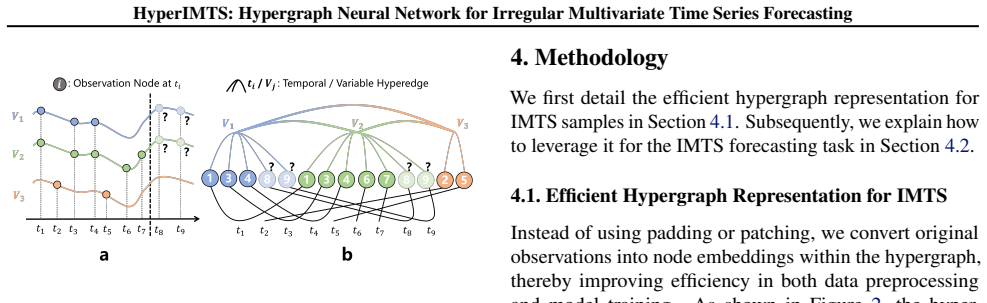
HyperIMTS converts an irregular multivariate time series into a hypergraph where each observation is a node, temporal hyperedges connect observations sharing a timestamp, and variable hyperedges connect observations of the same variable. Forecasting becomes node prediction: the nodes to be forecast are zero-initialized and updated by three message-passing stages—node-to-hyperedge attention that refreshes temporal and variable hyperedge embeddings, hyperedge-to-hyperedge attention that passes messages between variables, and hyperedge-to-node updates that propagate both kinds of information back to observations. The distinctive mechanism is the irregularity-aware variable similarity, which blends a time-aware similarity computed only on time-aligned observation pairs with an overall series-level similarity between variable hyperedges, choosing the mix by the fraction of shared timestamps with a learnable threshold. The paper reports the lowest MSE on all five datasets in Table 1 (the text counts four, attributing the exception to USHCN's high variance) and up to 11.4% improvement over GraFITi.
Load-bearing premise
The superiority over the twenty-seven baselines assumes those baselines are run close to their best settings under the paper's policy of reusing original hyperparameters and adapting classification models by replacing the final softmax layer with a linear layer.
Editorial extensions
If this is right
- Padding becomes unnecessary: HyperIMTS operates only on observed values, avoiding the data-volume growth that canonical and patch-aligned padding introduce.
- Both temporal and variable dependencies are learned inside one hypergraph, so irregular forecasting reduces to a node prediction problem on that hypergraph.
- The irregularity-aware similarity lets the model adaptively weight time-aligned versus whole-series comparisons, addressing partial alignment between variables.
- On the five benchmarks the model reports the lowest MSE, up to 11.4% better than the next-best irregular-series model GraFITi, with lower computational cost than padding-based alternatives.
- Because non-padding models keep efficiency roughly constant as lookback length grows, the approach scales better to long irregular windows than padding-based models.
Reading between the lines
- The time-aware/overall similarity blend could be lifted out of the hypergraph and inserted into set-based or bipartite-graph forecasters, potentially giving those models a cheap way to handle partially aligned variables.
- The node-prediction framing may transfer to imputation and classification tasks, since any masked node is already treated as a prediction target by zero-initialization.
- The efficiency argument depends on observation count being much smaller than the padded grid; on nearly dense irregular series the attention costs would rise quadratically and the practical gap over padding methods would shrink.
- A synthetic dataset with controlled alignment ratios (from fully shared to fully disjoint timestamps) could isolate exactly when the time-aware term pays off and when the fallback to overall similarity is what preserves performance.
Editorial analysis
A structured set of objections, weighed in public.
Referee Report
Summary. This paper proposes HyperIMTS, a hypergraph neural network for forecasting irregular multivariate time series without padding. Observations are represented as nodes, and temporal and variable hyperedges connect them; the model alternates node-to-hyperedge attention, irregularity-aware hyperedge-to-hyperedge attention among variables, and hyperedge-to-node updates, followed by a linear decoder. The method is evaluated on five IMTS datasets in a unified benchmark against 27 baselines, reporting the lowest MSE on four datasets and up to 11.4% improvement over GraFITi, with additional ablations and efficiency analyses.
Significance. The paper's strengths are the breadth of the benchmark (27 baselines, five datasets, five seeds), the public code release, and the careful ablation isolating temporal/variable hyperedges and irregularity-aware dependencies. If the architecture is corrected to enforce the claimed hypergraph incidence structure, the hypergraph formulation is an appealing way to avoid padding and to model cross-variable dependencies without shared timestamps. The significance is conditional on the structural issue discussed below, since the equations as written do not enforce the claimed hypergraph topology.
major comments (3)
- [§4.1–§4.2, Eqs. (2), (6), (12), (14), (15)] The incidence matrices H_T and H_U defined in Eq. (2) are never used after their definition. Eq. (6) computes the updated temporal hyperedge with unmasked softmax attention over all M observation nodes, so a temporal hyperedge at time t receives messages from observations at every other timestamp; the analogous variable-hyperedge update is also unmasked over all nodes. Eq. (12) builds a complete attention graph among all U variable hyperedges, and Eqs. (14)–(15) concatenate the full hyperedge embeddings to every node rather than gathering only the hyperedges incident to that node. As written, the model is therefore a global set-attention network with timestamp and variable tokens, and the central claim that irregularity-aware hypergraph topology drives the empirical gains is not supported. Please either reintroduce masks/gathers based on H_T and H_U in Eqs. (6), (12), (14), and (15), or explicitly present and defend the global-attention interpretation.
- [§A.4 (baseline details)] The statement 'For all classification models, we replace the final softmax layer with a linear layer to enable forecasting' is a substantial architectural modification for SeFT, mTAN, Raindrop, and Warpformer, whose original training objectives and hyperparameters are classification-oriented. No validation is provided that this linear-head adaptation is a strong or fair forecasting baseline, and the paper's conclusion of superiority over 27 state-of-the-art models depends on this protocol. Please justify the adaptation, report any tuning performed for the forecasting head, and consider comparing against published forecasting results or a tuned forecasting version of the strongest classification baselines.
- [§4.2.2, Eqs. (10)–(11)] The text states that α 'prioritize[s] Sobs over Svar if there are more aligned observations than unaligned ones,' but Eq. (11) sets α = Tshared/Ttotal for any Svar > δ and Sobs != 0, without requiring Tshared/Ttotal > 0.5. For a pair with Tshared/Ttotal = 0.2, α = 0.2 and Svar still dominates, contradicting the stated logic. Either add the condition Tshared/Ttotal > 0.5 to Eq. (11) or revise the explanation to reflect the actual weighting.
minor comments (4)
- [§4.1] The hypergraph definition 'E := ET ∩ EU' should presumably be a union, not an intersection, since temporal and variable hyperedges are disjoint sets; as written the notation is inconsistent with the subsequent text.
- [§5.2] 'MIMIC-VI' is a typo for MIMIC-IV; the text also calls GraFITi the 'overall next best model,' which is true on average across the four datasets where HyperIMTS leads, but not on USHCN, where Warpformer and GRU-D have lower MSE than GraFITi.
- [§A.4.2 and Appendix A.3] Appendix A.4.2 contains the typo 'numeber' for 'number'; Appendix A.3 contains the typos 'data volumn' for 'data volume' and 'grouth' for 'growth'.
- [§4.2.1] The phrase 'making them learnable' is imprecise: Eq. (4) fixes sinusoidal encoding and applies a learnable linear map FF_time, so the temporal hyperedge embeddings are learnable only through that map.
Circularity Check
No significant circularity: the evaluation is external and no fitted quantity is relabeled as a prediction; the incidence-matrix inconsistency is a consistency/correctness concern, not a circular derivation.
full rationale
HyperIMTS is an empirical forecasting architecture evaluated on held-out test splits against twenty-seven external baselines. The learnable quantities (node/hyperedge embeddings, projection layers, and the threshold δ initialized to 0.5) are trained by MSE on the lookback/forecast split and are not derived from test outcomes. No equation constructs a prediction from a quantity that was itself fit to that prediction, so the 'fitted input called prediction' pattern does not occur. The comparisons to GraFITi and other baselines are measured on independent test data, and no uniqueness theorem or first-principles claim depends on a self-citation. The self-citation to Luo et al. (2024) appears in related work and is not load-bearing for the method's validity. The one substantive concern raised by the architecture is that Eq. (2) defines incidence matrices H_T and H_U, but the update equations (6), (12), and (14) use unmasked attention over all observation nodes and concatenate hyperedge embeddings without referencing H_T or H_U. If the implementation follows the equations literally, the claimed hypergraph locality is not enforced. This is a consistency/correctness issue that could undercut the interpretation of the empirical gains, but it is not circularity: no result is assumed as its own input, and no fitted value is renamed as a prediction.
Assumptions & free parameters
free parameters (1)
- Threshold delta =
learned (initialized 0.5)
assumptions (4)
- domain assumption Hypergraph message passing over timestamp- and variable-defined hyperedges captures the temporal and cross-variable dependencies needed for IMTS forecasting.
- domain assumption Sinusoidal encoding of timestamps (Eq. 4) preserves enough temporal information for irregularly sampled data.
- ad hoc to paper The gating rule in Eqs. (10)-(11) with a learned threshold delta is an effective inductive bias for varying degrees of alignment.
- domain assumption Baselines in the unified benchmark are tuned adequately and adapted fairly for the forecasting task.
Cite this review
Pith. "Pith review of HyperIMTS: Hypergraph Neural Network for Irregular Multivariate Time Series Forecasting." pith.science (2026). https://pith.science/paper/HDXAJUOH
@misc{pith2026250517431,
  author       = {Pith},
  title        = {Pith review of: HyperIMTS: Hypergraph Neural Network for Irregular Multivariate Time Series Forecasting},
  year         = {2026},
  howpublished = {\url{https://pith.science/paper/HDXAJUOH}},
  note         = {Machine review of arXiv:2505.17431}
}
read the original abstract
Irregular multivariate time series (IMTS) are characterized by irregular time intervals within variables and unaligned observations across variables, posing challenges in learning temporal and variable dependencies. Many existing IMTS models either require padded samples to learn separately from temporal and variable dimensions, or represent original samples via bipartite graphs or sets. However, the former approaches often need to handle extra padding values affecting efficiency and disrupting original sampling patterns, while the latter ones have limitations in capturing dependencies among unaligned observations. To represent and learn both dependencies from original observations in a unified form, we propose HyperIMTS, a Hypergraph neural network for Irregular Multivariate Time Series forecasting. Observed values are converted as nodes in the hypergraph, interconnected by temporal and variable hyperedges to enable message passing among all observations. Through irregularity-aware message passing, HyperIMTS captures variable dependencies in a time-adaptive way to achieve accurate forecasting. Experiments demonstrate HyperIMTS's competitive performance among state-of-the-art models in IMTS forecasting with low computational cost.
Figures


Figures from the paper (4 more)


Forward citations
Cited by 2 Pith papers
-
A Cost-Effective Multimodal LLM Reasoning Framework for Question Answering over Irregular Clinical Time Series
ClinPRISM reaches 49.83% average accuracy on CLIR-Bench irregular clinical time-series QA using a 4B LLM, 16 temporal tokens, and 0.15 s/question.
-
Enhancing Irregular Time Series Forecasting with Continuous-Time Modeling Framework
WrapFlow combines continuous-time event/gap tokenization with simulation-free residual flow matching on a Transformer to improve irregular multivariate time-series forecasting.
Reference graph
Works this paper leans on
-
[1]
write newline
" write newline "" before.all 'output.state := FUNCTION n.dashify 't := "" t empty not t #1 #1 substring "-" = t #1 #2 substring "--" = not "--" * t #2 global.max substring 't := t #1 #1 substring "-" = "-" * t #2 global.max substring 't := while if t #1 #1 substring * t #2 global.max substring 't := if while FUNCTION format.date year duplicate empty "emp...
-
[2]
S., Januschowski, T., and Günnemann, S
Biloš, M., Sommer, J., Rangapuram, S. S., Januschowski, T., and Günnemann, S. Neural Flows : Efficient Alternative to Neural ODEs . In Advances in Neural Information Processing Systems , volume 34, pp.\ 21325--21337. Curran Associates, Inc. , 2021
work page 2021
-
[3]
Recurrent Neural Networks for Multivariate Time Series with Missing Values
Che, Z., Purushotham, S., Cho, K., Sontag, D., and Liu, Y. Recurrent Neural Networks for Multivariate Time Series with Missing Values . Scientific Reports, 8 0 (1): 0 6085, 2018. ISSN 2045-2322. doi:10.1038/s41598-018-24271-9
-
[4]
Chen, S.-A., Li, C.-L., Arik, S. O., Yoder, N. C., and Pfister, T. TSMixer : An All-MLP Architecture for Time Series Forecast-ing . Transactions on Machine Learning Research, 2023. ISSN 2835-8856
work page 2023
-
[5]
R., Li, J., Zhang, X., Hong, D., Gupta, R
Chowdhury, R. R., Li, J., Zhang, X., Hong, D., Gupta, R. K., and Shang, J. PrimeNet : Pre-training for Irregular Multivariate Time Series . Proceedings of the AAAI Conference on Artificial Intelligence, 37 0 (6): 0 7184--7192, 2023. ISSN 2374-3468. doi:10.1609/aaai.v37i6.25876
-
[6]
Filling the G \_ap\_s: Multivariate Time Series Imputation by Graph Neural Networks
Cini, A., Marisca, I., and Alippi, C. Filling the G \_ap\_s: Multivariate Time Series Imputation by Graph Neural Networks . In International Conference on Learning Representations , 2021
work page 2021
-
[7]
Graph-based Time Series Clustering for End-to-End Hierarchical Forecasting
Cini, A., Mandic, D., and Alippi, C. Graph-based Time Series Clustering for End-to-End Hierarchical Forecasting . In International Conference on Machine Learning , pp.\ 8985--8999. PMLR , 2024
work page 2024
-
[8]
GRU-ODE-Bayes : Continuous Modeling of Sporadically-Observed Time Series
De Brouwer, E., Simm, J., Arany, A., and Moreau, Y. GRU-ODE-Bayes : Continuous Modeling of Sporadically-Observed Time Series . In Advances in Neural Information Processing Systems , volume 32. Curran Associates, Inc. , 2019
work page 2019
Show all 50 references
-
[9]
HGNN +: General Hypergraph Neural Networks
Gao, Y., Feng, Y., Ji, S., and Ji, R. HGNN +: General Hypergraph Neural Networks . IEEE Transactions on Pattern Analysis and Machine Intelligence, 45 0 (3): 0 3181--3199, 2023. ISSN 1939-3539. doi:10.1109/TPAMI.2022.3182052
2023
-
[10]
and Dao, T
Gu, A. and Dao, T. Mamba: Linear-Time Sequence Modeling with Selective State Spaces . In First Conference on Language Modeling , 2024
2024
-
[11]
BigST : Linear Complexity Spatio-Temporal Graph Neural Network for Traffic Forecasting on Large-Scale Road Networks
Han, J., Zhang, W., Liu, H., Tao, T., Tan, N., and Xiong, H. BigST : Linear Complexity Spatio-Temporal Graph Neural Network for Traffic Forecasting on Large-Scale Road Networks . Proc. VLDB Endow., 17 0 (5): 0 1081--1090, 2024. ISSN 2150-8097. doi:10.14778/3641204.3641217
2024
-
[12]
Set Functions for Time Series
Horn, M., Moor, M., Bock, C., Rieck, B., and Borgwardt, K. Set Functions for Time Series . In International Conference on Machine Learning , pp.\ 4353--4363. PMLR , 2020
2020
-
[13]
Johnson, A. E. W., Pollard, T. J., Shen, L., Lehman, L.-w. H., Feng, M., Ghassemi, M., Moody, B., Szolovits, P., Anthony Celi, L., and Mark, R. G. MIMIC-III , a freely accessible critical care database. Scientific Data, 3 0 (1): 0 160035, 2016. ISSN 2052-4463. doi:10.1038/sdat...
2016 doi
-
[14]
Johnson, A. E. W., Bulgarelli, L., Shen, L., Gayles, A., Shammout, A., Horng, S., Pollard, T. J., Hao, S., Moody, B., Gow, B., Lehman, L.-w. H., Celi, L. A., and Mark, R. G. MIMIC-IV , a freely accessible electronic health record dataset. Scientific Data, 10 0 (1): 0 1, 2023. ...
2023 doi
-
[15]
Reformer: The Efficient Transformer
Kitaev, N., Kaiser, L., and Levskaya, A. Reformer: The Efficient Transformer . In International Conference on Learning Representations , 2019
2019
-
[16]
Spatial- Temporal Hypergraph Self-Supervised Learning for Crime Prediction
Li, Z., Huang, C., Xia, L., Xu, Y., and Pei, J. Spatial- Temporal Hypergraph Self-Supervised Learning for Crime Prediction . In 2022 IEEE 38th International Conference on Data Engineering ( ICDE ) , pp.\ 2984--2996. IEEE Computer Society , 2022. ISBN 978-1-66540-883-7. doi:10....
2022
-
[17]
iTransformer : Inverted Transformers Are Effective for Time Series Forecasting
Liu, Y., Hu, T., Zhang, H., Wu, H., Wang, S., Ma, L., and Long, M. iTransformer : Inverted Transformers Are Effective for Time Series Forecasting . In The Twelfth International Conference on Learning Representations , 2023
2023
-
[18]
Directed hypergraph attention network for traffic forecasting
Luo, X., Peng, J., and Liang, J. Directed hypergraph attention network for traffic forecasting. IET Intelligent Transport Systems, 16 0 (1): 0 85--98, 2022. doi:10.1049/itr2.12130
2022 doi
-
[19]
Knowledge- Empowered Dynamic Graph Network for Irregularly Sampled Medical Time Series
Luo, Y., Liu, Z., Wang, L., Wu, B., Zheng, J., and Ma, Q. Knowledge- Empowered Dynamic Graph Network for Irregularly Sampled Medical Time Series . In The Thirty-eighth Annual Conference on Neural Information Processing Systems , 2024
2024
-
[20]
Long-term daily and monthly climate records from stations across the contiguous united states (u.s
Menne, M., Williams, Jr., C., and Vose, R. Long-term daily and monthly climate records from stations across the contiguous united states (u.s. historical climatology network). 1 2016. doi:10.3334/CDIAC/CLI.NDP019
2016 doi
-
[21]
Graph Neural Flows for Unveiling Systemic Interactions Among Irregularly Sampled Time Series
Mercatali, G., Freitas, A., and Chen, J. Graph Neural Flows for Unveiling Systemic Interactions Among Irregularly Sampled Time Series . In The Thirty-eighth Annual Conference on Neural Information Processing Systems , 2024
2024
-
[22]
H., Sinthong, P., and Kalagnanam, J
Nie, Y., Nguyen, N. H., Sinthong, P., and Kalagnanam, J. A Time Series is Worth 64 Words : Long-term Forecasting with Transformers . In The Eleventh International Conference on Learning Representations , 2022
2022
-
[23]
Rubanova, Y., Chen, R. T. Q., and Duvenaud, D. K. Latent Ordinary Differential Equations for Irregularly-Sampled Time Series . In Advances in Neural Information Processing Systems , volume 32. Curran Associates, Inc. , 2019
2019
-
[24]
Sawhney, R., Agarwal, S., Wadhwa, A., Derr, T., and Shah, R. R. Stock Selection via Spatiotemporal Hypergraph Attention Network : A Learning to Rank Approach . Proceedings of the AAAI Conference on Artificial Intelligence, 35 0 (1): 0 497--504, 2021. ISSN 2374-3468. doi:10.160...
2021 doi
-
[25]
Modeling Irregular Time Series with Continuous Recurrent Units
Schirmer, M., Eltayeb, M., Lessmann, S., and Rudolph, M. Modeling Irregular Time Series with Continuous Recurrent Units . In International Conference on Machine Learning , pp.\ 19388--19405. PMLR , 2022
2022
-
[26]
Ada- MSHyper : Adaptive Multi-Scale Hypergraph Transformer for Time Series Forecasting
Shang, Z., Chen, L., Wu, B., and Cui, D. Ada- MSHyper : Adaptive Multi-Scale Hypergraph Transformer for Time Series Forecasting . In The Thirty-eighth Annual Conference on Neural Information Processing Systems , 2024
2024
-
[27]
Shukla, S. N. and Marlin, B. Interpolation- Prediction Networks for Irregularly Sampled Time Series . In International Conference on Learning Representations , 2018
2018
-
[28]
Shukla, S. N. and Marlin, B. Multi- Time Attention Networks for Irregularly Sampled Time Series . In International Conference on Learning Representations , 2020
2020
- [29]
-
[30]
J., Celi, L
Silva, I., Moody, G., Scott, D. J., Celi, L. A., and Mark, R. G. Predicting In-Hospital Mortality of ICU Patients : The PhysioNet / Computing in Cardiology Challenge 2012. Computing in cardiology, 39: 0 245--248, 2012
2012
-
[31]
CSDI : Conditional Score-based Diffusion Models for Probabilistic Time Series Imputation
Tashiro, Y., Song, J., Song, Y., and Ermon, S. CSDI : Conditional Score-based Diffusion Models for Probabilistic Time Series Imputation . In Advances in Neural Information Processing Systems , volume 34, pp.\ 24804--24816. Curran Associates, Inc. , 2021
2021
-
[32]
DiffSTG : Probabilistic Spatio-Temporal Graph Forecasting with Denoising Diffusion Models , 2023
Wen, H., Lin, Y., Xia, Y., Wan, H., Zimmermann, R., and Liang, Y. DiffSTG : Probabilistic Spatio-Temporal Graph Forecasting with Denoising Diffusion Models , 2023
2023
-
[33]
Unified Training of Universal Time Series Forecasting Transformers
Woo, G., Liu, C., Kumar, A., Xiong, C., Savarese, S., and Sahoo, D. Unified Training of Universal Time Series Forecasting Transformers . In International Conference on Machine Learning , pp.\ 53140--53164. PMLR , 2024
2024
-
[34]
Autoformer: Decomposition Transformers with Auto-Correlation for Long-Term Series Forecasting
Wu, H., Xu, J., Wang, J., and Long, M. Autoformer: Decomposition Transformers with Auto-Correlation for Long-Term Series Forecasting . In Advances in Neural Information Processing Systems , volume 34, pp.\ 22419--22430. Curran Associates, Inc. , 2021
2021
-
[35]
TimesNet : Temporal 2D-Variation Modeling for General Time Series Analysis
Wu, H., Hu, T., Liu, Y., Zhou, H., Wang, J., and Long, M. TimesNet : Temporal 2D-Variation Modeling for General Time Series Analysis . In The Eleventh International Conference on Learning Representations , 2022
2022
-
[36]
Connecting the Dots : Multivariate Time Series Forecasting with Graph Neural Networks
Wu, Z., Pan, S., Long, G., Jiang, J., Chang, X., and Zhang, C. Connecting the Dots : Multivariate Time Series Forecasting with Graph Neural Networks . In Proceedings of the 26th ACM SIGKDD International Conference on Knowledge Discovery & Data Mining , KDD '20, pp.\ 753--763. ...
2020
-
[37]
K., Madhusudhanan, K., Scholz, R., Ahmed, N., Burchert, J., Jawed, S., Born, S., and Schmidt-Thieme, L
Yalavarthi, V. K., Madhusudhanan, K., Scholz, R., Ahmed, N., Burchert, J., Jawed, S., Born, S., and Schmidt-Thieme, L. GraFITi : Graphs for Forecasting Irregularly Sampled Time Series . Proceedings of the AAAI Conference on Artificial Intelligence, 38 0 (15): 0 16255--16263, 2...
2024 doi
-
[38]
Learning Multi-Granular Hypergraphs for Video-Based Person Re-Identification
Yan, Y., Qin, J., Chen, J., Liu, L., Zhu, F., Tai, Y., and Shao, L. Learning Multi-Granular Hypergraphs for Video-Based Person Re-Identification . In Proceedings of the IEEE / CVF Conference on Computer Vision and Pattern Recognition , pp.\ 2899--2908, 2020
2020
-
[39]
FourierGNN : Rethinking Multivariate Time Series Forecasting from a Pure Graph Perspective
Yi, K., Zhang, Q., Fan, W., He, H., Hu, L., Wang, P., An, N., Cao, L., and Niu, Z. FourierGNN : Rethinking Multivariate Time Series Forecasting from a Pure Graph Perspective . In Thirty-Seventh Conference on Neural Information Processing Systems , 2023
2023
-
[40]
J., and Leskovec, J
You, J., Ma, X., Ding, Y., Kochenderfer, M. J., and Leskovec, J. Handling Missing Data with Graph Representation Learning . In Advances in Neural Information Processing Systems , volume 33, pp.\ 19075--19087. Curran Associates, Inc. , 2020
2020
-
[41]
I., Qin, J., and Wang, S
Yu, G., Zou, J., Hu, X., Aviles-Rivero, A. I., Qin, J., and Wang, S. Revitalizing Multivariate Time Series Forecasting : Learnable Decomposition with Inter-Series Dependencies and Intra-Series Variations Modeling . In Forty-First International Conference on Machine Learning , 2024
2024
-
[42]
Adaptive Hypergraph Learning and its Application in Image Classification
Yu, J., Tao, D., and Wang, M. Adaptive Hypergraph Learning and its Application in Image Classification . IEEE Transactions on Image Processing, 21 0 (7): 0 3262--3272, 2012. ISSN 1941-0042. doi:10.1109/TIP.2012.2190083
2012
-
[43]
Warpformer: A Multi-scale Modeling Approach for Irregular Clinical Time Series
Zhang, J., Zheng, S., Cao, W., Bian, J., and Li, J. Warpformer: A Multi-scale Modeling Approach for Irregular Clinical Time Series . In Proceedings of the 29th ACM SIGKDD Conference on Knowledge Discovery and Data Mining , pp.\ 3273--3285, 2023 a . doi:10.1145/3580305.3599543
2023
-
[44]
Self- Supervised Learning for Time Series Analysis : Taxonomy , Progress , and Prospects
Zhang, K., Wen, Q., Zhang, C., Cai, R., Jin, M., Liu, Y., Zhang, J., Liang, Y., Pang, G., Song, D., and Pan, S. Self- Supervised Learning for Time Series Analysis : Taxonomy , Progress , and Prospects . 2023 b . doi:10.48550/arXiv.2306.10125
-
[45]
Irregular Multivariate Time Series Forecasting : A Transformable Patching Graph Neural Networks Approach
Zhang, W., Yin, C., Liu, H., Zhou, X., and Xiong, H. Irregular Multivariate Time Series Forecasting : A Transformable Patching Graph Neural Networks Approach . In Forty-First International Conference on Machine Learning , 2024
2024
-
[46]
Graph- Guided Network for Irregularly Sampled Multivariate Time Series
Zhang, X., Zeman, M., Tsiligkaridis, T., and Zitnik, M. Graph- Guided Network for Irregularly Sampled Multivariate Time Series . In International Conference on Learning Representations , 2021
2021
-
[47]
and Yan, J
Zhang, Y. and Yan, J. Crossformer: Transformer Utilizing Cross-Dimension Dependency for Multivariate Time Series Forecasting . In The Eleventh International Conference on Learning Representations , 2022
2022
-
[48]
Learning with Hypergraphs : Clustering , Classification , and Embedding
Zhou, D., Huang, J., and Schölkopf, B. Learning with Hypergraphs : Clustering , Classification , and Embedding . In Advances in Neural Information Processing Systems , volume 19. MIT Press , 2006
2006
-
[49]
Informer: Beyond Efficient Transformer for Long Sequence Time-Series Forecasting
Zhou, H., Zhang, S., Peng, J., Zhang, S., Li, J., Xiong, H., and Zhang, W. Informer: Beyond Efficient Transformer for Long Sequence Time-Series Forecasting . Proceedings of the AAAI Conference on Artificial Intelligence, 35 0 (12): 0 11106--11115, 2021. ISSN 2374-3468. doi:10....
2021 doi
-
[50]
FEDformer : Frequency Enhanced Decomposed Transformer for Long-term Series Forecasting
Zhou, T., Ma, Z., Wen, Q., Wang, X., Sun, L., and Jin, R. FEDformer : Frequency Enhanced Decomposed Transformer for Long-term Series Forecasting . In International Conference on Machine Learning , pp.\ 27268--27286. PMLR , 2022
2022
Reviewed August 7, 2026 · model on record in the stance chip above.
Discussion (0). Continue with ORCID to comment.