REVIEW 3 major objections 5 minor 19 references
The hadronic decay of vector charmonium
T0 review · 3 major / 5 minor · reviewed 2026-08-11 · deepseek-v4-flash
Pith's one-line read The paper extracts the hadronic decay width of ψ(3770) to a D-meson pair from lattice QCD using a narrow-width ratio method, obtaining 24.2(6.4) MeV, compatible with experiment.
desk verdict The ratio-method application is promising, but the printed decay-width formula contradicts the paper's own table, so the headline agreement with experiment is currently unverifiable. read the letter →
The pith
A machine-rendered reading of the paper's core claim, the machinery that carries it, and where it could break.
The reading
What carries the argument
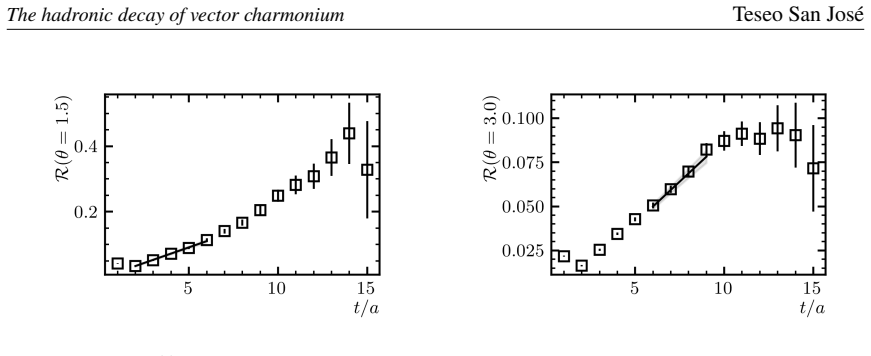
The central object is the hadronic mixing element $x_{31}\equiv \langle \bar D D | \psi(3770)\rangle$ in a finite box. It is isolated from the long-time behavior of the ratio $R(t)=|\bar T_3(t)|/\sqrt{\bar P^\psi_{33}(t) P_{DD}(t)}$, whose spectral decomposition at large $t$ is $|x_{31}|/\big(\Delta\sinh(t\Delta)+A e^{-t\Delta}\big)$, where $\Delta=(m_\psi-E_{DD})/2$ is half the energy gap. The conversion to the decay width assumes non-interacting plane-wave $D$ mesons and uses Fermi's golden rule, $\Gamma = \frac{L^3}{24\pi p_i m_\psi}|x_{31}|^2$, with $p_i^2=m_\psi^2/4-m_D^2$. Partially twisted boundary conditions on the charm quarks set the $D$-meson momenta so the on-shell condition $m_\psi=2E_D$ can be reached, and the $\bar D D$ operator is projected to a $p$-wave.
What would settle it
Compute the width on a third lattice volume at the same pion mass, keeping the on-shell momentum fixed: if the width from Eq (6) changes with $L$ beyond statistical error, the assumed $L^3$ compensation is wrong. A complementary test is a full finite-volume scattering analysis on the same ensembles, which would give an independent width to compare against.
Extended reading notes
Core claim
The central claim is that the finite-volume hadronic mixing between the $\psi(3770)$ charmonium state and a $D\bar D$ pair in a $p$-wave, extracted from the ratio $R(t)$ of Eq (4), is the same quantity that enters Fermi's golden rule for the physical decay, so the decay width can be written as $\Gamma = \frac{L^3}{24\pi p_i m_\psi} |x_{31}|^2$ at the on-shell momentum. Inserting the lattice-determined mixing, the paper obtains $\Gamma(\psi(3770)\to D\bar D) = 24.2(6.4)\,\mathrm{MeV}$ on the larger ensemble, consistent with the experimental value. This is presented as evidence that the narrow-width ratio method is a viable alternative to standard finite-volume scattering analyses for this decay. The paper also extracts the mixing for off-shell momenta and compares the resulting width function with the ${}^3P_0$ quark-model prediction, finding qualitative agreement, particularly on the larger volume.
Load-bearing premise
The method assumes that the finite-volume mixing extracted with non-interacting plane-wave $D$ mesons, divided by the $L^3$ factor in the golden-rule formula, is exactly the same coupling that drives the decay in infinite volume; the paper explicitly notes it never establishes this connection.
Editorial extensions
If this is right
- The narrow-width ratio method offers a computationally cheaper path to hadronic decay widths of narrow excited states, avoiding the need for several lattice volumes and group irreps required by standard scattering analyses.
- The extraction is not restricted to on-shell kinematics: the lattice provides the mixing as a function of $D$-meson momentum, enabling direct comparison with quark-model predictions over a range of momenta.
- Because the method works at unphysical pion mass ($m_\pi\sim 440\,\mathrm{MeV}$), a continuum extrapolation and a move to physical quark masses would test whether the agreement with experiment persists away from this single point.
- The ${}^3P_0$ quark model, with parameters fixed by the lattice spectroscopy, reproduces the momentum dependence of the mixing, supporting the quark-pair-creation picture as a useful effective description.
Reading between the lines
- The method's validity hinges on the narrow-width approximation; for broader resonances or decays further from threshold, the assumed two-level system would be a poorer approximation, and the extracted width would need to be cross-checked against a full finite-volume analysis.
- A natural next test is to apply the same ratio method to a decay with a known but wider resonance to see how the quality of the width degrades as the width-to-mass gap grows.
- The explicit caveat that no infinite-volume connection is established suggests a possible follow-up derivation: a rigorous relation between this ratio-extracted mixing and the infinite-volume coupling, analogous to the quantization condition for two-particle energies, would place the method on firmer theoretical ground.
- If the $L^3$ compensation is exact, the ratio method could also be used to extract decay couplings for states above multiple thresholds, where standard single-channel finite-volume analyses become complicated.
Editorial analysis
A structured set of objections, weighed in public.
Referee Report
Summary. The proceedings paper applies the Michael–Pennanen ratio method to extract the finite-volume hadronic mixing x31 = <DD|psi(3770)> on two Nf=2 CLS ensembles at a single lattice spacing (a ~ 0.066 fm) and an unphysical pion mass (m_pi ~ 440 MeV). Using partially twisted boundary conditions to tune the D-meson pair to near on-shell kinematics, the authors fit the ratio R(t) of Eq. (4) to a parabola in the D-meson momentum, evaluate the on-shell point, and convert the mixing to a decay width with Eq. (6). The main result is Gamma(psi(3770) -> DD) = 24.2(6.4) MeV on the larger E5 ensemble, quoted as compatible with the experimental width, and the paper also compares the lattice mixing with the ^3P_0 quark model.
Significance. If the method is quantitatively sound, it offers a computationally cheaper alternative to Lüscher-type finite-volume analyses for narrow hadronic resonances, and the paper is explicit about the practical ingredients: GEVP spectroscopy, PTBC kinematics, and the ratio estimators of Eqs. (4) and (5). The strength of the paper is its concrete presentation of the lattice setup and of the Wick contractions, which makes the numerical procedure reproducible in principle. The explicit admission that no connection to the infinite-volume decay is established (Section 2) is an honest statement of the main limitation. However, the central numerical claim is currently undermined by an apparent inconsistency between the printed conversion formula and the tabulated decay width, and the absence of continuum, chiral, and systematic uncertainties prevents the quoted compatibility with experiment from being conclusive.
major comments (3)
- [Section 2, Eq. (6), and Table 4] The printed formula Gamma = L^3/(24 pi p_i m_psi) |x31|^2 is dimensionally inconsistent (|x31| has mass dimension one, so the right-hand side has dimension E^-3) and does not reproduce the quoted width. With the E5 numbers L = 10.67 GeV^-1, p = 0.468 GeV, m_psi = 3.946 GeV, and x31 = 0.0284 GeV, Eq. (6) gives about 7 MeV, while Table 4 quotes Gamma = 24.2(6.4) MeV; in lattice units the same formula gives Gamma/a ~ 0.19 against the tabulated Gamma/a = 0.0081(21). The tabulated value is instead reproduced by Gamma = L^3 p_i m_psi/(24 pi) |x31|^2. The authors must correct Eq. (6) or, if x31 carries an undocumented normalization, must state that normalization explicitly. Because this conversion is the only bridge between the lattice extraction and the physical width, the manuscript as written does not allow the central claim to be checked.
- [Section 2, after Eq. (6)] The paper states that 'at no point we establish an explicit connection to the infinite volume decay'. This is a load-bearing gap: the method assumes that the finite-volume mixing extracted with non-interacting plane-wave D mesons is the coupling entering Fermi's golden rule, and that the L^3 factor provides the correct compensation. Since the key result is the decay width, the authors should either provide a derivation of Eq. (6) in the context of their non-relativistic two-level system, or perform a cross-check (for instance, comparing with a Lüscher-type analysis at the same lattice parameters or at least demonstrating volume independence with more than the two ensembles used here). Without such a check, the compatibility with experiment could be coincidental.
- [Sections 3 and 4, Table 4] The quoted result is obtained at a single lattice spacing and a single unphysical pion mass, and only statistical errors are reported. The central claim of compatibility with experiment would require an estimate of systematic uncertainties from, at minimum, the GEVP fit ranges, the smearing choices, the twist-angle interpolation, finite-volume effects, and the dependence on m_pi and a. As it stands, the agreement of the E5 central value with experiment is suggestive but not yet a quantitative validation of the method.
minor comments (5)
- [Section 4, Figure 5] The ^3P_0 quark-model comparison fits the coupling beta to the same lattice data (as stated in the text), so the 'remarkable agreement' is a fitted reproduction rather than an independent prediction; the wording should make this explicit.
- [Equation (8)] The notation is inconsistent: the text defines p = sqrt(3) theta/L, while Eq. (8) writes sqrt(3) a theta_0/L; the factors of the lattice spacing should be made uniform.
- [Figure 1] The text describing the figure refers to 'red lines' while the caption says 'solid line'; the color and line-style descriptions should be aligned.
- [Abstract and Conclusions] The phrase 'compatible with experiment' should be qualified by noting that the comparison is made at an unphysical pion mass, one lattice spacing, and with statistical errors only, so the compatibility does not yet establish a precision prediction.
- [Table 2] The level-2 mass, m_cc = 3859(52) MeV, is close to the DD threshold and has a large uncertainty; a comment on how the level-3 identification with psi(3770) is justified would help the reader assess the GEVP analysis.
Circularity Check
Fitted 3P0 β is called a prediction; the central lattice extraction is independent, though Eq. (6) as printed does not yield the tabulated width.
-
fitted input called prediction
[Section 4 (Analysis), 3P0 quark-model paragraph (page 6); echoed in Conclusions (page 7)]
"The remaining free parameter β, which gives the quark-pair creation strength, is fixed fitting the model to the lattice data, see [8] for more details. We observe that the quark model describes our data on a qualitative level, and the agreement is especially good on ensemble E5."
The quark-model curve shown in Fig. 5 is not an independent prediction: its only free parameter β is fitted to the same lattice mixing data against which the model is then said to agree. Calling the resulting qualitative match a “prediction by the 3P0 quark model” (Conclusions) is therefore a fitted reproduction renamed as a prediction. The central lattice extraction itself remains self-contained because x31 is obtained from correlator data and the final width is benchmarked against experiment, so this is a secondary, partial circularity rather than a collapse of the main derivation.
full rationale
The central derivation chain—GEVP spectroscopy, the ratio R(t) of Eq. (4), extraction of the hadronic mixing x31, and the final width compared with experiment—is self-contained in the sense that x31 is obtained from lattice correlator data and not from the experimental width it is meant to predict. The ratio method is attributed to the independent earlier work [9] and [15], with the authors' companion paper [8] used mainly for details of this project; that self-citation is descriptive rather than load-bearing. The paper's explicit limitation, “at no point we establish an explicit connection to the infinite volume decay” (Section 2), is an acknowledged assumption about the finite-volume-to-infinite-volume conversion, not a tautology. The one genuine circular step is the 3P0 comparison: β is fixed by fitting the model to the same lattice data that the comparison then “confirms,” so the claimed qualitative agreement is a fitted reproduction. This affects only the interpretive part of the paper, not the lattice extraction itself. Separately, there is a correctness defect that is not circularity: Eq. (6) as printed, Γ = L^3/(24π p_i m_ψ) |x31|^2, has inverse-energy dimension and, with the Table 4 values on E5, gives roughly 0.19/a rather than the quoted 0.0081/a; the tabulated value instead matches Γ = L^3 p_i m_ψ/(24π) |x31|^2. The paper's admission that no infinite-volume connection is established compounds this concern, but neither fact makes the central result equivalent to its own input. Overall, the main extraction is not circular; the 3P0 “prediction” is partially circular because it is fit to the data it claims to reproduce.
Assumptions & free parameters
free parameters (3)
- c1 (parabola coefficient) =
0.01869(32) (D5), 0.01276(56) (E5), in lattice units
- c2 (parabola curvature) =
c2/a = 1.169(44) (D5), 1.183(52) (E5)
- beta (3P0 quark-pair creation strength) =
Not quoted in this proceedings; fixed by fitting the 3P0 model to the lattice data in [8]
assumptions (5)
- domain assumption Narrow-width approximation holds for psi(3770).
- domain assumption The final-state D D pair is non-interacting and described by plane waves with PBCs.
- domain assumption Eq (4) and (5) give the correct spectral decomposition of the correlator ratios for alpha=3 and large t.
- domain assumption The finite-volume mixing x31 can be converted to the physical infinite-volume width via Fermi's golden rule, Eq (6), with an L^3 compensation.
- domain assumption The third GEVP level on the D5 ensemble is the psi(3770) state.
Cite this review
Pith. "Pith review of The hadronic decay of vector charmonium." pith.science (2026). https://pith.science/paper/HFSJN67X
@misc{pith2026241215915,
  author       = {Pith},
  title        = {Pith review of: The hadronic decay of vector charmonium},
  year         = {2026},
  howpublished = {\url{https://pith.science/paper/HFSJN67X}},
  note         = {Machine review of arXiv:2412.15915}
}
abstract
The extraction of decay parameters using lattice techniques is a computationally expensive task, requiring several volumes and group irreps to relate the spectrum on a lattice simulation to the infinite volume scattering. In this project we employ an alternative method based on a narrow-width approximation to extract the hadronic mixing $<\bar{D}D|\psi(3770)>$, which is needed to compute the decay $\Gamma(\psi(3770)\to\bar{D}D)$ between the second excited state of vector charmonium and a pair of $D$-mesons in a $p$-wave. We carry out our lattice simulations on two CLS ensembles at $m_\pi \sim 440~\text{MeV}$ and $a\sim 0.066~\text{fm}$ and obtain results compatible with experiment. Furthermore, we interpret our results analytically using the ${}^3P_0$ quark model.
Figures


Figures from the paper (2 more)


Reference graph
Works this paper leans on
-
[1]
Particle Data Groupcollaboration, Review of particle physics, Phys. Rev. D110 (2024) 030001
2024
-
[2]
Lüscher M.,Volume Dependence of the Energy Spectrum in Massive Quantum Field Theories. 1. Stable Particle States,Commun. Math. Phys.104 (1986) 177
work page 1986
-
[3]
Lüscher M.,Volume Dependence of the Energy Spectrum in Massive Quantum Field Theories. 2. Scattering States,Commun. Math. Phys.105(1986) 153
work page 1986
-
[4]
Lüscher Martin,Two particle states on a torus and their relation to the scattering matrix, Nucl. Phys. B354(1991) 531
work page 1991
-
[5]
Lüscher Martin,Signatures of unstable particles in finite volume, Nucl. Phys. B364 (1991) 237
work page 1991
-
[6]
C.B. Lang, L. Leskovec, D. Mohler and S. Prelovsek,Vector and scalar charmonium resonances with lattice QCD,JHEP 09 (2015) 089 [1503.05363]. 8 The hadronic decay of vector charmonium Teseo San José
work page Pith review arXiv 2015
-
[7]
S. Piemonte, S. Collins, D. Mohler, M. Padmanath and S. Prelovsek,Charmonium resonances with𝐽𝑃𝐶 = 1−− and 3−− from ¯𝐷𝐷 scattering on the lattice,Phys. Rev. D100 (2019) 074505 [1905.03506]
arXiv 2019
-
[8]
B. Blossier, J. Heitger, J. Neuendorf and T. San José,Hadronic decay of vector charmonium from the lattice, 2411.10123
Show all 19 references
-
[9]
Pennanen and C
P. Pennanen and C. Michael,String breaking in zero temperature lattice QCD, hep-lat/0001015
-
[10]
Chung, J
S.U. Chung, J. Brose, R. Hackmann, E. Klempt, S. Spanier and C. Strassburger,Partial wave analysis in k-matrix formalism,Annalen der Physik507 (1995) 404 [https://onlinelibrary.wiley.com/doi/pdf/10.1002/andp.19955070504]
1995 doi
-
[11]
Hanhart, S
C. Hanhart, S. Kürten, M. Reboud and D. van Dyk,Analysis of the𝜓(3770) resonance in line with unitarity and analyticity constraints,Eur. Phys. J. C84(2024) 483 [2312.00619]
2024 arXiv
-
[12]
Micu,Decay rates of meson resonances in a quark model,Nuclear Physics B10(1969) 521
L. Micu,Decay rates of meson resonances in a quark model,Nuclear Physics B10(1969) 521
1969
-
[13]
Le Yaouanc, L
A. Le Yaouanc, L. Oliver, O. Pene and J.C. Raynal,Naive quark pair creation model of strong interaction vertices, Phys. Rev. D8 (1973) 2223
1973
-
[14]
Weisskopf and E
V. Weisskopf and E. Wigner,Berechnung der natürlichen Linienbreite auf Grund der Diracschen Lichttheorie, Zeitschrift für Physik63 (1930) 54
1930
-
[15]
McNeile and C
C. McNeile and C. Michael,Hadronic decay of a vector meson from the lattice, Phys. Lett. B 556 (2003) 177 [hep-lat/0212020]
2003 arXiv
-
[16]
Tayduganov,Electroweak radiative B-decays as a test of the Standard Model and beyond, theses, Université Paris Sud - Paris XI, Oct., 2011
A. Tayduganov,Electroweak radiative B-decays as a test of the Standard Model and beyond, theses, Université Paris Sud - Paris XI, Oct., 2011
2011
-
[17]
Fritzsch, F
P. Fritzsch, F. Knechtli, B. Leder, M. Marinkovic, S. Schaefer, R. Sommer et al.,The strange quark mass and Lambda parameter of two flavor QCD, Nucl. Phys. B865 (2012) 397 [1205.5380]
2012 arXiv
-
[18]
Heitger, G.M
J. Heitger, G.M. von Hippel, S. Schaefer and F. Virotta,Charm quark mass and D-meson decay constants from two-flavour lattice QCD,PoS LATTICE2013(2014) 475 [1312.7693]
2014 arXiv
-
[19]
Sachrajda and G
C.T. Sachrajda and G. Villadoro,Twisted boundary conditions in lattice simulations, Phys. Lett. B609 (2005) 73 [hep-lat/0411033]. 9
2005 arXiv
Reviewed August 11, 2026 · model on record in the stance chip above.
Discussion (0). Continue with ORCID to comment.