REVIEW 3 major objections 5 minor 32 references
Programmable transport of rotating particles in obstacle arrays
T0 review · 3 major / 5 minor · reviewed 2026-08-01 · deepseek-v4-flash
Pith's one-line read A rotating colloid can be transported deterministically across a periodic obstacle array by slowly modulating only its rotation frequency, through the balance of Magnus-like lift and short-range attraction.
desk verdict Solid single-obstacle hydrodynamics, but the array-level transport claim rests on a screening cutoff that contradicts the paper's own measured screening lengths. read the letter →
The pith
A machine-rendered reading of the paper's core claim, the machinery that carries it, and where it could break.
The reading
What carries the argument
The load-bearing construct is the effective single-particle dynamics: a Langevin equation with a mobility tensor that mixes viscous drag with the Magnus-like lift (parameter ν≈Re/6), driven by the gradient of a scalar attraction and the curl of a hydrodynamic vector potential. Each post contributes a screened potential with an exponential cutoff whose length is set to the lattice spacing d. Superposing these contributions yields the stationary density and current. The two named steady states are the corner state (clockwise orbit around one post) and the inner state (counter-clockwise four-lobed orbit in the channel between four posts); the crucial structural feature is the r=d/2 plateau, whe
What would settle it
Run the fully resolved lattice-Boltzmann simulation in an actual square array with d/a≈6–7, using the screening length measured from the single-post pair (λ/a≈1–1.5) and no ad hoc cutoff, and check whether a counter-clockwise inner-state orbit and the r=d/2 density plateau appear for any frequency. If the most probable position never locks to the inter-post midpoint, or if the inner-state current is absent, the central transport claim is falsified.
Extended reading notes
Core claim
On the paper's own terms, the discovery is the existence of two frequency-selected orbital modes in a periodic obstacle array and a transition protocol between them. Fully resolved three-dimensional lattice-Boltzmann simulations show that a rotating sphere near a cylindrical obstacle experiences a tangential hydrodynamic force (decaying as 1/r^3) and, at finite Reynolds number, a radial inertial lift; balanced against a short-range attraction, the spinner settles onto a stable circular orbit whose radius grows as the square of the rotation frequency. In a square lattice, the superposition of screened per-obstacle potentials yields corner states at low frequency and inner states at high frequ
Load-bearing premise
The paper models the array by superposing single-obstacle potentials with an exponential cutoff length set equal to the lattice spacing d, even though the hydrodynamic screening lengths it measures from its own simulations are only about 1–1.5 particle radii while d is 6–7 radii; the inner state and the transport protocol depend on coupling between neighboring posts that this choice grants but the measured screening would suppress.
Editorial extensions
If this is right
- A single rotation-frequency modulation protocol can drive a spinner across a square obstacle lattice without changing the geometry or applying external field gradients.
- The two transport states have opposite chirality, so the direction of circulation (clockwise at corners, counter-clockwise in inner channels) is determined by which side of the crossover the spinner is on.
- Because the streamline topology is independent of rotation frequency, the shape of the frequency waveform ν(t) can program the transport direction and step size.
- The inner-state plateau at r=d/2 means that over a finite frequency window the particle's most probable position is locked to the lattice midpoint, making transport weakly sensitive to frequency noise within that window.
- The mechanism does not depend on the microscopic origin of the short-range attraction—only on the ratio of attractive to viscous forces—so it could be realized with electrostatic, depletion, or other attractions.
Reading between the lines
- Beyond the paper: if the effect holds in experiment, the same midpoint-locking mechanism should appear in triangular or honeycomb lattices, where the locking distance differs and could enable 2D routing.
- Beyond the paper: the plateau width could serve as a sensitive measurement of the array's hydrodynamic screening length, since a shorter true screening length should narrow or eliminate the plateau.
- Beyond the paper: in a suspension of many spinners, the inner-state channel currents are persistent vortices; they might be used to advect passive cargo without external flow.
- Beyond the paper: an asymmetrically patterned lattice (staggered post radii) could convert reversible frequency modulation into a ratchet with net one-way transport, a direct testable amplification of the protocol.
Editorial analysis
A structured set of objections, weighed in public.
Referee Report
Summary. The manuscript studies a rotating colloid near fixed obstacles. It combines single-obstacle lattice-Boltzmann (LB) simulations with a coarse-grained Langevin/Fokker-Planck model in which an inertial Magnus-like lift competes with a short-range attraction, producing frequency-dependent circular orbits. The model is then extended to periodic square arrays by superposing exponentially screened scalar and vector potentials. The authors predict two regimes—corner states localized around individual posts and inner states spanning four obstacles—and claim that slow frequency modulation toggles between them, producing deterministic, stepwise transport across the grid. Fully resolved LB simulations are used only for the single-obstacle configuration; the array-level predictions come from the screened-superposition model, with no full array LB simulation or experiment.
Significance. If the array-level predictions were correct, the paper would offer a remarkably simple, single-parameter mechanism for controlling active rotors in structured environments. The work has genuine strengths: the parameter-free prediction v_r/v_theta = Re/6, the compact Fokker-Planck solution with an explicit stationary density and current, and the careful LB measurement of single-obstacle hydrodynamic coupling. However, the central transport claim is not supported by a full array simulation or experiment, and the screening cutoff used in the array model contradicts the screening lengths measured in the same paper. The predicted inner state and d/2 plateau depend on inter-post coupling that the measured hydrodynamics would suppress; Fig. 3 thus undercuts the central claim as it stands.
major comments (3)
- [§V, Eq. (10), Fig. 3] The array-level model is internally inconsistent with the paper's own screening measurement. Fig. 3 reports screening lengths λ/a≈0.96–1.47 for lattice spacings d/a=6–7, and the text states λ<<d and that only the exponential cutoff e^{-r/λ} is retained. Yet Eq. (10) replaces λ by the lattice spacing d. With the measured λ, nearest-neighbor coupling at the midpoint is e^{-d/(2λ)}≈0.02–0.08; with the chosen d it is e^{-1/2}≈0.61, an order-of-magnitude overestimate. The corner-to-inner crossover, the four-obstacle inner orbit, and the r_max=d/2 plateau in Figs. 4–6 all require this inter-post coupling, so the central transport mechanism may be an artifact of the choice d. Fig. 4 only compares two solutions of the same coarse-grained model and does not validate the cutoff; no full LB array simulation or experiment is provided.
- [§VI, Figs. 5–6] The paper does not actually simulate or measure the claimed 'deterministic stepwise transport.' Fig. 5a shows r_max(t) obtained from stationary densities, and Fig. 5b is a schematic; no time-dependent trajectory, net displacement, or rectified current is shown. The conclusion's phrase 'deterministic stepwise transport across the grid' goes beyond the evidence. A full dynamical simulation of the frequency-modulation protocol, or an experiment, is needed to establish the transport claim.
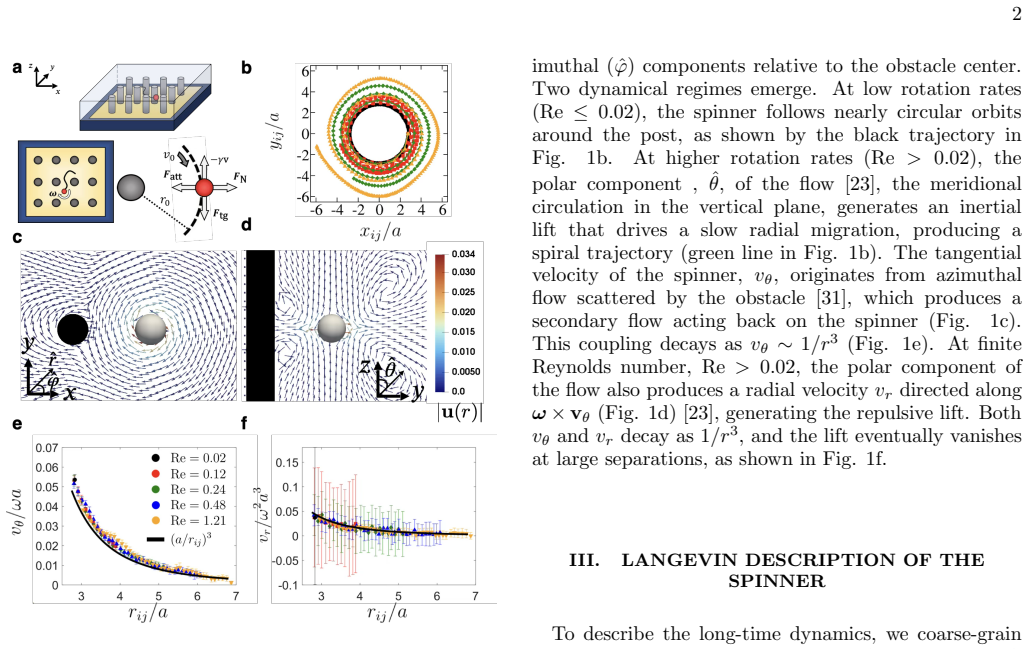
- [§III, Eq. (3), Fig. 1e–f] The coefficient β is extracted from the same single-obstacle LB data used to test Eq. (3), so the agreement for v_θ is partly by construction. The paper should state this explicitly and frame the parameter-free content as the ratio v_r/v_θ = Re/6 and the 1/r^3 scalings. This does not invalidate the single-obstacle analysis, but it should be presented as calibration rather than independent confirmation.
minor comments (5)
- [Notation] v_θ in Fig. 1e is the spinner's translational velocity, while v_θ in Fig. 3 is the fluid velocity; using distinct symbols would avoid confusion.
- [Eq. (9)] The formula for r_0 is formatted ambiguously; please rewrite with explicit parentheses and state the units so the ω² scaling is unambiguous.
- [§IV] The parameter Ga is introduced but not used in the array-level analysis; either connect it to the crossover predictions or remove it.
- [Fig. 4] The caption should state explicitly that both panels are solutions of the coarse-grained model, not LB simulations, to avoid implying independent validation.
- [§IV] There is a typo in the sentence 'the the current can be written as...'.
Circularity Check
Array transport is built from a screening cutoff set to d despite measured λ≈d/5; the d/2 locking plateau is a direct consequence of that choice, and the single-obstacle force amplitude is a fit to the LB data it is said to confirm.
-
fitted input called prediction
[Sec. III, Eq. (3), Fig. 1e-f]
"From our LB simulations in the low-Re regime (ν < 1), we find β ≈ γ_s, giving v_θ/(ωa) ≈ (a/r)^3 and v_r/(ω^2 a^3) ≈ (ρ_f/6η)(a/r)^3, as shown in Fig. 1e-f."
The coupling coefficient β in Eq. (1) is explicitly 'extracted from LB simulations.' Inserting the fitted value β ≈ γ_s into Eq. (3) then reproduces the same LB data in Fig. 1e-f. The tangential and radial velocity amplitudes are therefore forced by the fit, not predicted; only the r^{-3} scaling and the ratio ⟨v_r⟩/⟨v_θ⟩ = Re/6 are parameter-free.
-
other
[Sec. V, Eq. (10); Sec. VI, Figs. 5-6]
"Since the measured screening lengths are significantly smaller than the lattice spacing (λ << d) ... The cutoff length is chosen to be of the order of the lattice spacing, d ... The screened potentials are therefore written as ... e^{−|r−r_i|/d} ... the inner orbit is geometrically pinned by the obstacle arrangement, its radius remains fixed at d/2."
The central array-level prediction — the inner state and the r_max = d/2 plateau that enables 'deterministic stepwise transport' — follows from choosing the exponential screening range to be d, the lattice spacing. At the post–post midpoint this gives a coupling e^{−d/2d} = e^{−1/2} ≈ 0.61. The paper's own Fig. 3 measures λ/a ≈ 0.96–1.47 for d/a ≈ 6–7, i.e., λ ≈ d/5–d/7, which would suppress the midpoint coupling to e^{−d/2λ} ≈ 0.02–0.08. Thus the predicted d/2 locking and the existence of four-obstacle inner orbits are constructed by replacing the measured screening length with d, not derived from the measured hydrodynamics.
full rationale
The paper is not globally circular: the ratio v_r/v_θ = Re/6 is parameter-free, and the Fokker–Planck description is internally consistent. The self-citations ([18], [23], [25]) are not load-bearing in the sense of an imported uniqueness theorem or unverified ansatz; the authors do perform LB simulations. However, two steps reduce the claimed predictive content. First, the single-obstacle force amplitude β is fit to the LB data and then the same data are exhibited as agreement (Eq. (3), Fig. 1e-f). Second, and more importantly for the central claim, the array theory explicitly sets the screening cutoff to the lattice spacing d (Eq. (10)) even though the paper measures λ << d and states this fact. The inner states and the r_max = d/2 plateau — the mechanism behind 'deterministic stepwise transport' — require inter-post coupling that only exists for cutoff ≈ d. Using the measured λ would make that coupling negligible. Since no fully resolved LB simulation or experiment validates the array-level predictions, the transport protocol is substantially built from a hand-chosen input rather than being an independent prediction. I therefore assign a partial-circularity score of 6.
Assumptions & free parameters
free parameters (3)
- Hydrodynamic coupling β =
β ≈ γ_s (β/γ_s ≈ 1)
- Attractive force scale F_a =
not specified
- Screening cutoff length (set to d) =
d (lattice spacing)
assumptions (6)
- standard math Langevin dynamics with Stokes drag and white noise obeying fluctuation-dissipation (Eq. 2)
- domain assumption Magnus lift force has form F_N = M0 ω×v with M0 ~ πa^3ρf (Rubinow-Keller)
- domain assumption Short-range attraction is a central 1/r^2 force whose microscopic origin does not matter (Eq. 4)
- ad hoc to paper The lattice flow field is screened with an exponential cutoff length chosen to be the lattice spacing d (Eq. 10)
- standard math Steady-state Fokker-Planck density is the Boltzmann-like factor exp(-U/D_eff) with the Helmholtz decomposition (Eqs. 6-7)
- domain assumption Superposition of independent single-obstacle potentials is valid in the array (Eqs. 11-12)
Cite this review
Pith. "Pith review of Programmable transport of rotating particles in obstacle arrays." pith.science (2026). https://pith.science/paper/HWBCAVBY
@misc{pith2026260716091,
  author       = {Pith},
  title        = {Pith review of: Programmable transport of rotating particles in obstacle arrays},
  year         = {2026},
  howpublished = {\url{https://pith.science/paper/HWBCAVBY}},
  note         = {Machine review of arXiv:2607.16091}
}
read the original abstract
Rotating colloids, or spinners, in obstacle arrays exhibit frequency-set stationary orbits and currents set by the competition between an inertial, Magnus-like lift and short-range attraction. Fully resolved lattice-Boltzmann simulations reveal the hydrodynamic coupling and identify the lift mechanism, while a symmetry-based Langevin model captures the resulting balance. In periodic lattices, the superposition of scalar and vector potentials produces two robust orbital regimes: corner states, in which spinners orbit individual posts, and inner states, in which orbits couple across four neighboring obstacles. Slow frequency modulation toggles these states and produces directed, stepwise transport across the grid. This establishes a minimal hydrodynamic mechanism, controlled by a single driving parameter, for programmable guidance of active rotors in structured environments.
Figures


Figures from the paper (4 more)


Reference graph
Works this paper leans on
-
[1]
Berg and E
H. Berg and E. Purcell, Physics of chemoreception, Bio- physical Journal20, 193 (1977)
1977
-
[2]
I. C. Fortunato, D. B. Br¨ uckner, S. Grosser, L. Rossetti, M. Bosch-Padr´ os, J. Trebicka, P. Roca-Cusachs, R. Sun- yer, E. Hannezo, and X. Trepat, Single cell migration along and against confined haptotactic gradients (2024)
2024
-
[3]
C. T. Mierke, Mechanical Cues Affect Migration and In- vasion of Cells From Three Different Directions, Frontiers in Cell and Developmental Biology8, 583226 (2020)
2020
-
[4]
Lozano, B
C. Lozano, B. Ten Hagen, H. L¨ owen, and C. Bechinger, Phototaxis of synthetic microswimmers in optical land- scapes, Nature Communications7, 12828 (2016)
2016
-
[5]
Koley and K
S. Koley and K. K. Nanda, Algae-like Artificial Organic Photo-tactic Micro-swimmers,
-
[6]
M. B. Wan, C. J. Olson Reichhardt, Z. Nussinov, and C. Reichhardt, Rectification of Swimming Bacteria and Self-Driven Particle Systems by Arrays of Asymmetric Barriers, Physical Review Letters101, 018102 (2008)
2008
-
[7]
Nikola, A
N. Nikola, A. P. Solon, Y. Kafri, M. Kardar, J. Tailleur, and R. Voituriez, Active Particles with Soft and Curved Walls: Equation of State, Ratchets, and Instabilities, Physical Review Letters117, 098001 (2016)
2016
-
[8]
Lauga, Bacterial Hydrodynamics, Annual Review of Fluid Mechanics48, 105 (2016), arXiv:1509.02184
E. Lauga, Bacterial Hydrodynamics, Annual Review of Fluid Mechanics48, 105 (2016), arXiv:1509.02184
arXiv 2016
Show all 32 references
-
[9]
Brun-Cosme-Bruny, A
M. Brun-Cosme-Bruny, A. F¨ ortsch, W. Zimmermann, E. Bertin, P. Peyla, and S. Rafa ¨ ı, Deflection of photo- tactic microswimmers through obstacle arrays, Physical Review Fluids5, 093302 (2020)
2020
-
[10]
Reichhardt and C
C. Reichhardt and C. J. O. Reichhardt, Directional lock- ing effects for active matter particles coupled to a peri- odic substrate, Physical Review E102, 042616 (2020)
2020
-
[11]
S. E. Spagnolie, G. R. Moreno-Flores, D. Bartolo, and E. Lauga, Geometric capture and escape of a microswim- mer colliding with an obstacle, Soft Matter11, 3396 (2015)
2015
-
[12]
J. E. Avron, Odd viscosity, Journal of Statistical Physics 92, 543 (1998), arXiv:physics/9712050
1998 arXiv
-
[13]
Banerjee, A
D. Banerjee, A. Souslov, A. G. Abanov, and V. Vitelli, Odd viscosity in chiral active fluids, Nature Communica- tions8, 1 (2017), arXiv:1702.02393
2017 arXiv
-
[14]
B. A. Grzybowski and G. M. Whitesides, Dynamic ag- gregation of chiral spinners, Science296, 718 (2002)
2002
-
[15]
I. O. G¨ otze and G. Gompper, Dynamic self-assembly and directed flow of rotating colloids in microchannels, Phys- ical Review E - Statistical, Nonlinear, and Soft Matter Physics84, 031404 (2011)
2011
-
[16]
Climent, K
E. Climent, K. Yeo, M. R. Maxey, and G. E. Karniadakis, Dynamic Self-Assembly of Spinning Particles, Journal of Fluids Engineering129, 379 (2007)
2007
-
[17]
Goto and H
Y. Goto and H. Tanaka, Purely hydrodynamic ordering of rotating disks at a finite Reynolds number, Nature Communications6, 5994 (2015)
2015
-
[18]
J. L. Aragones, P. Steimel, and A. Alexander-katz, Ag- gregation dynamics of active rotating particles in dense passive media, Soft Matter 10.1039/c8sm02207k (2019)
2019 doi
-
[19]
Y. Fily, A. Baskaran, and M. C. Marchetti, Cooperative self-propulsion of active and passive rotors, Soft Matter 8, 3002 (2012)
2012
-
[20]
Gorce, K
J.-B. Gorce, K. Y. Bliokh, H. Xia, N. Francois, H. Punz- mann, and M. Shats, Rolling spinners on the water sur- face, Science Advances7, eabd4632 (2021)
2021
-
[21]
S. I. Rubinow and J. B. Keller, The transverse force on a spinning sphere moving in a viscous fluid, Journal of Fluid Mechanics11, 447 (1961)
1961
-
[22]
P. G. Saffman, The lift on a small sphere in a slow shear flow, Journal of Fluid Mechanics22, 385 (1965)
1965
-
[23]
J. L. Aragones, J. P. Steimel, and A. Alexander-Katz, Elasticity-induced force reversal between active spinning particles in dense passive media, Nature Communications 7, 11325 (2016)
2016
-
[24]
X. Cao, D. Das, N. Windbacher, F. Ginot, M. Kr¨ uger, and C. Bechinger, Memory-induced Magnus effect, Na- 9 ture Physics19, 1904 (2023)
1904
-
[25]
Yazdi, J
S. Yazdi, J. L. Aragones, J. Coulter, and A. Alexander- Katz, Metamaterials for Active Colloid Transport, , 1 (2020), arXiv:2002.06477
2020 arXiv
-
[26]
D¨ unweg and A
B. D¨ unweg and A. J. C. Ladd, Lattice Boltzmann Sim- ulations of Soft Matter Systems, Advances in Polymer Science 221, 89 (2008), arXiv:0808.2157
2008 arXiv
-
[27]
Y. H. Qian, D. D’Humi` eres, and P. Lallemand, Lattice BGK Models for Navier-Stokes Equation, Europhysics Letters (EPL)17, 479 (1992)
1992
-
[28]
d’Humi` eres, Multiple–relaxation–time lattice Boltz- mann models in three dimensions, Philosophical Trans- actions of the Royal Society of London
D. d’Humi` eres, Multiple–relaxation–time lattice Boltz- mann models in three dimensions, Philosophical Trans- actions of the Royal Society of London. Series A: Math- ematical, Physical and Engineering Sciences360, 437 (2002)
2002
-
[29]
A. J. C. Ladd and R. Verberg, Lattice-Boltzmann Simu- lations of Particle-Fluid Suspensions, Journal of Statisti- cal Physics104, 1191 (2001)
2001
-
[30]
E. J. Ding and C. K. Aidun, Extension of the Lattice- Boltzmann Method for Direct Simulation of Suspended Particles Near Contact, Journal of Statistical Physics 112, 685 (2003)
2003
-
[31]
J. R. Blake and A. T. Chwang, Fundamental singularities of viscous flow: Part I: The image systems in the vicinity of a stationary no-slip boundary, Journal of Engineering Mathematics8, 23 (1974)
1974
-
[32]
Cortez, B
R. Cortez, B. Cummins, K. Leiderman, and D. Varela, Computation of three-dimensional Brinkman flows using regularized methods, Journal of Computational Physics 229, 7609 (2010)
2010
Reviewed August 1, 2026 · model on record in the stance chip above.
Discussion (0). Continue with ORCID to comment.