REVIEW 3 major objections 5 minor 71 references
Production of doubly charmed tetraquark $T_{cc}$ via photon-photon fusion at electron-positron colliders
T0 review · 3 major / 5 minor · reviewed 2026-08-11 · deepseek-v4-flash
Pith's one-line read Under a diquark-fragmentation model, photon-photon fusion at future electron-positron colliders is predicted to produce the doubly charmed tetraquark Tcc in observable numbers.
desk verdict A new gamma-gamma fusion calculation for Tcc that is undercut by its own kinematic caveat: the quoted event rates are dominated by the small-pT region the model explicitly says it does not cover. read the letter →
The pith
A machine-rendered reading of the paper's core claim, the machinery that carries it, and where it could break.
The reading
What carries the argument
The machinery is the factored cross section $d\sigma=\int dx_1dx_2\, f_\gamma(x_1)f_\gamma(x_2)\,d\hat\sigma(\gamma\gamma\to T_{cc}[n]+\bar c+\bar c)$, with $d\hat\sigma(\gamma\gamma\to T_{cc}[n]+\bar c+\bar c)=d\hat\sigma(\gamma\gamma\to(cc)[n]+\bar c+\bar c)\,P((cc)[n]\to T_{cc}[n])$. The photon fluxes are the Weizsäcker-Williams spectrum for SuperKEKB and CEPC and the laser-backscattering spectrum for ILC. The short-distance part is computed by transforming known charmonium production amplitudes through a charge-conjugation relation and applying the NRQCD diquark projector of Eq. (13), which puts the two charm quarks into the spin-singlet or spin-triplet color state. The long-distance factor is either the Schrödinger wave function at the origin from a harmonic-oscillator potential, giving $P((cc)[{}^3S_1]_{\bar 3}\to T_{cc})=0.089\,\mathrm{GeV}^3$, or the heavy-diquark-antiquark-symmetry estimate $|\Psi_{cc}(0)|^2 f(c\to\Lambda_c^+)=0.00243\,\mathrm{GeV}^3$. These two hadronization probabilities are the main source of model dependence in the predicted yields.
What would settle it
A dedicated photon-photon run at SuperKEKB or CEPC/ILC that reconstructs $T_{cc}$ in the $D^0D^0\pi^+$ channel and measures $d\sigma/dp_t$ would settle the claim: the diquark-fragmentation model predicts a specific low-$p_t$ behavior, and a measured low-$p_t$ yield above that prediction would show that neglected direct hadronization contributes, invalidating the quoted rates as full predictions.
Extended reading notes
Core claim
The paper's central claim is that $T_{cc}$ production in $\gamma\gamma$ fusion is calculable as the product of a perturbative short-distance cross section for producing a $(cc)[n]$ diquark and a long-distance hadronization probability $P((cc)[n]\to T_{cc}[n])$, with the factorization written in Eqs. (1) and (5). The $(cc)[{}^3S_1]_{\bar 3}$ configuration dominates, and under the harmonic-oscillator-potential hadronization scheme its cross section reaches hundreds of femtobarns at CEPC and ILC, translating into thousands of events per year. The heavy-diquark-antiquark-symmetry scheme, which uses the measured $c\to\Lambda_c^+$ fragmentation fraction, suppresses the hadronization probability to about 2.7% of the harmonic-oscillator value and lowers the yields correspondingly. The authors emphasize that the cross sections are sensitive to the constituent charm mass in the diquark and to the choice of hadronization model.
Load-bearing premise
The calculation assumes that the factorized diquark-fragmentation formula of Eq. (5) is the only production mechanism that matters over the entire transverse-momentum ranges integrated, although the paper itself says other mechanisms dominate at small $p_t$ where the cross section is largest.
Editorial extensions
If this is right
- The $(cc)[{}^3S_1]_{\bar 3}$ diquark configuration dominates $T_{cc}$ production by more than an order of magnitude over $(cc)[{}^1S_0]_6$ in the same hadronization scheme, so spin-color selection is a clear prediction.
- Lowering the assumed constituent charm mass from 1.94 GeV to 1.5 GeV increases the cross section by factors of roughly 2 to 6, with the largest effect near threshold, so the mass scheme must be pinned down before precise rate predictions are possible.
- The HDAS hadronization scheme suppresses the $[{}^3S_1]_{\bar 3}$ contribution by about a factor of 37 relative to the harmonic-oscillator scheme, meaning an event-rate measurement would discriminate between hadronization models.
- The large-transverse-momentum spectrum scales as $1/p_t^6$ at CEPC and $1/p_t^4$ at ILC, indicating double-parton fragmentation in one case and single-parton fragmentation in the other; the turnover point is testable.
- Counting rates reach $(0.7\text{--}27.0)\times10^3$ events per year at CEPC and $(0.7\text{--}17.0)\times10^4$ events per year at ILC, enough for a first $\gamma\gamma$ search for $T_{cc}$.
Reading between the lines
- If the factorization survives comparison with data, the same $\gamma\gamma$ channel could be used to extract the $(cc)$-diquark wave function and the hadronization probability, turning $T_{cc}$ production into a quantitative probe of nonperturbative diquark dynamics.
- Because the paper integrates over transverse-momentum ranges whose low end is dominated by mechanisms it neglects, the quoted yields are best read as the diquark-fragmentation contribution; measurements that separate low- and high-$p_t$ could quantify the missing direct-production component.
- The same factorization machinery could be applied to other doubly heavy tetraquarks, such as $T_{bb}$, or to doubly heavy baryons in photon-photon collisions, giving a family of related predictions testable at future colliders.
Editorial analysis
A structured set of objections, weighed in public.
Referee Report
Summary. The manuscript calculates inclusive production of the doubly charmed tetraquark Tcc in photon-photon fusion at SuperKEKB, CEPC, and ILC. It uses a diquark-fragmentation factorization, Eq. (5), in which a perturbatively produced (cc) diquark in the [3S1]_3bar or [1S0]_6 configuration subsequently hadronizes into Tcc with a model-dependent probability. Two hadronization schemes are compared: a harmonic oscillator potential (HOP) and a heavy diquark-antiquark symmetry (HDAS) fragmentation estimate. The paper reports total cross sections, transverse-momentum and angular distributions, and estimates event yields, concluding that Tcc observation at CEPC and ILC is promising.
Significance. If the factorization were valid over the integration ranges used, the paper would provide useful phenomenological estimates for Tcc searches at current and future e+e- colliders, complementing LHC studies. The manuscript is transparent in presenting the factorization ansatz, the two hadronization schemes, and explicit differential distributions, and it correctly identifies the high-pT scaling behavior (1/pT^6 at CEPC and 1/pT^4 at ILC) in the tails of the distributions. However, the central numerical claim is undermined by the paper's own validity condition for Eq. (5): the integrated cross sections are dominated by the low-pT region that the authors state is outside the model. Because the headline event yields are therefore not predictions of this model, the paper does not currently support its 'promising' conclusion.
major comments (3)
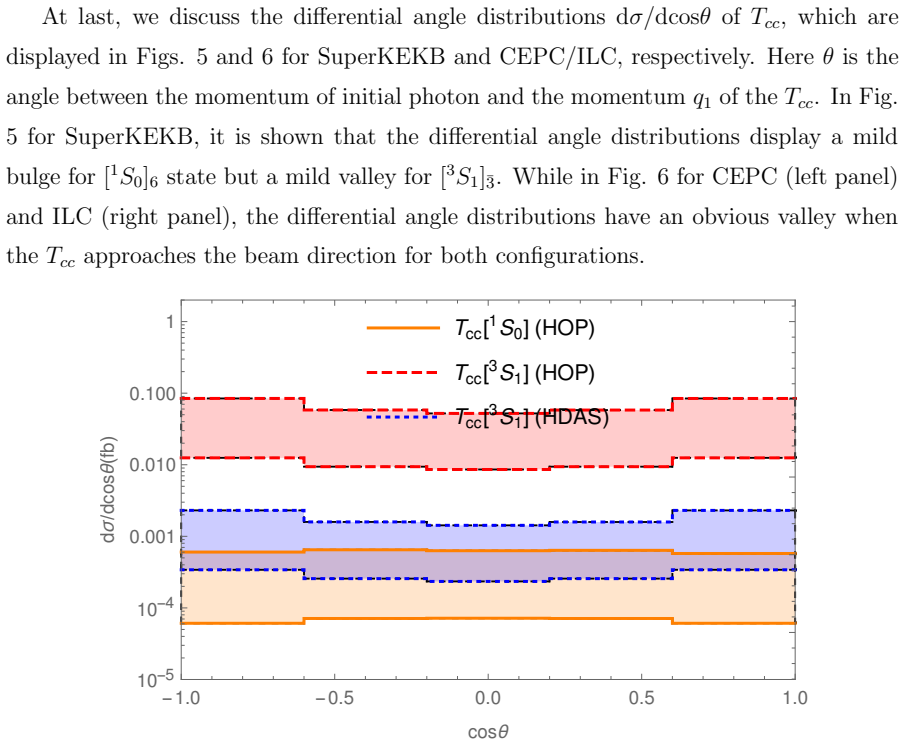
- The paper states that the diquark-fragmentation contribution of Eq. (5) 'becomes dominant only in the large transverse momentum pt region' and that other mechanisms 'would dominate in the relatively small pt region,' and that these other mechanisms are neglected. The total cross sections and event yields in Tables I-II and Sec. III are nevertheless obtained by integrating down to pT = 0.2 GeV at SuperKEKB and pT = 1 GeV at CEPC and ILC. The differential distributions in Figs. 3-4 fall monotonically from the lower end of the integration range, with only a mild bulge at 0.2-2 GeV at SuperKEKB, so the integrated rates are dominated by exactly the low-pT region that the model is claimed not to cover. At SuperKEKB the entire pT window 0.2-4 GeV lies in that region. Since the quoted yields of (0.7-27) x 10^3 at CEPC and (0.7-17) x 10^4 at ILC are therefore dominated by neglected mechanisms, the conclusion that 'the experimental study of Tcc at CEPC and ILC is promising' is not supported by the calculation; the authors need either to include the neglected mechanisms or to restrict the reported cross sections to the large-pT region and revise the conclusions accordingly.
- The event rates quoted in the text are not clearly tied to the cross sections and the stated D0 decay branching. For example, with a standard 10^7-s year, the CEPC luminosity of 10^34 cm^-2 s^-1 gives 100 fb^-1, so the largest CEPC cross section in Table II (261.52 fb) yields about 2.6 x 10^4 events before any decay branching; multiplying by Br(D0 -> K- pi+)^2 = (3.95%)^2 reduces this to about 40 events per year. The text quotes (0.7-27) x 10^3 events at CEPC and then mentions the D0 branching fraction without stating whether the quoted yields include it. This ambiguity changes the strength of the 'promising' conclusion by orders of magnitude and must be resolved by stating exactly which numbers include reconstruction and branching.
- The SuperKEKB yield estimate 'about 5 ~ 10^4 events of Tcc per year' is not reproducible from Table I. With L = 8 x 10^35 cm^-2 s^-1 and a 10^7-s year, the integrated luminosity is 8000 fb^-1; the cross sections in Table I range from 0.13 x 10^-3 fb to 134.94 x 10^-3 fb, giving roughly 1 to 1080 events per year. Even with a 3.15 x 10^7-s year the maximum is about 3400 events per year. The quoted upper value therefore appears to exceed the model's yield by an order of magnitude, and this discrepancy should be corrected and explained.
minor comments (5)
- There are several typographical errors: 'produciton' in the abstract, 'decompositron' in Sec. I, 'transver momentum' in Sec. III, 'Cornel potential' for Cornell potential, 'pow-low potential' for power-law potential, and 'The the long-distance' in Sec. II B.
- The phrase 'the reconstruction of Tcc by D0D0pi+ with approximated 100%' is unclear: it should specify whether 100% refers to the detection efficiency for that channel, the branching fraction of Tcc into D0D0pi+, or something else.
- The hadronization probabilities P in Eqs. (19)-(22) are written with units of GeV^3, while Eq. (5) presents them as multiplicative factors multiplying a differential cross section; the text should clarify the dimensional bookkeeping, i.e., how the GeV^3 factor is absorbed into the short-distance coefficient, so that the final cross section has standard units.
- The lower end of the quoted CEPC yield range appears to sum the [1S0]6 and [3S1] HDAS cross sections for mc = 1.94 GeV, while the upper end uses only the [3S1] HOP cross section for mc = 1.5 GeV; the text should state explicitly how the quoted ranges are constructed from the table entries.
- The labels '1/pt^6 line shape' and '1/pt^4 line shape' in Fig. 4 should state that these are fits to the last three data points of each curve, as described in the text; otherwise the reader may infer a global scaling behavior.
Circularity Check
No significant circularity: hadronization probabilities are external inputs, not fitted outputs; the central factorization and amplitude transformations are explicit and do not reduce to the predicted rates.
full rationale
The derivation chain is self-contained in the relevant sense. Eq. (1) factorizes the e+e- cross section into photon spectra and a partonic subprocess, and Eq. (5) further factorizes the subprocess into a perturbative (cc)[n] production cross section times a hadronization probability P((cc)[n]->Tcc[n]). This is a modeling assumption, but it is not circular: the target quantities (total cross sections and event yields in Tables I-II) are obtained by integrating the resulting dsigma/dpt over chosen pt ranges, not by imposing those yields back into the formulas. The hadronization probabilities in Eqs. (19)-(20) and (22) are adopted from published potential-model calculations and from the measured c->Lambda_c fragmentation fraction [38,60,62]; they are not fitted to Tcc production data in this paper, so the prediction is linearly proportional to, but not logically identical with, these inputs. Ref. [38] shares an author (Yan-Rui Liu), but it supplies an independent model estimate with stated assumptions (harmonic-oscillator potential with k=0.33 GeV^3 fixed to charmonia); under the review rules this counts as independent support rather than circular self-citation. The short-distance amplitude is related to charmonium amplitudes via explicit charge-conjugation identities in Eqs. (10)-(11), which is a derivation, not an invocation of the conclusion. The reader's concern that the integrated yields are dominated by small-pt regions where the diquark-fragmentation mechanism is stated not to dominate is a legitimate domain-of-validity/correctness caveat, but it is not a circularity: the paper acknowledges the limitation in Sec. II and nothing in the calculation is fitted to the quoted rates. No fitted parameter is renamed as a prediction, no uniqueness theorem is imported from the authors' prior work, and no ansatz is smuggled in by citation. Score 0.
Assumptions & free parameters
free parameters (6)
- mc, constituent charm quark mass in the (cc) diquark =
1.94, 1.7, 1.5 GeV (three ad hoc choices)
- P((cc)[3S1]_bar3 -> Tcc), hadronization probability in HOP scheme =
0.089 GeV^3
- P((cc)[3S1]_bar3 -> Tcc), hadronization probability in HDAS scheme =
0.00243 GeV^3 = |Psi_cc(0)|^2 * f(c -> Lambda_c+)
- P((cc)[1S0]_6 -> Tcc), hadronization probability in HOP scheme =
0.054 GeV^3
- k, strength of the harmonic oscillator potential =
0.33 GeV^3
- renormalization scale mu =
sqrt(4 mc^2 + pt^2)
assumptions (6)
- domain assumption Factorized form of Eq. (5): dσhat(γγ -> Tcc[n] + cbar + cbar) = dσhat(γγ -> (cc)[n] + cbar + cbar) x P((cc)[n] -> Tcc[n]).
- domain assumption Diquark fragmentation dominates over the adopted pT integration ranges despite the paper's statement that it dominates only at large pT.
- domain assumption NRQCD-style projectors and charge-conjugation matching, Eqs. (10)-(13), apply to a color-anti-triplet or color-sextet (cc) diquark.
- ad hoc to paper Heavy diquark-antiquark symmetry relation, Eq. (21), maps (cc)_bar3 -> Tcc to cbar -> Lambdacbar with f(c -> Lambda_c+) = 0.0623.
- standard math WWA and LBS photon spectra in Eqs. (2)-(3) describe the initial photon fluxes.
- domain assumption Wave-function-at-origin values from Refs. [38] and [62] are reliable inputs.
Cite this review
Pith. "Pith review of Production of doubly charmed tetraquark $T_{cc}$ via photon-photon fusion at electron-positron colliders." pith.science (2026). https://pith.science/paper/HYYRLI3E
@misc{pith2026241208045,
  author       = {Pith},
  title        = {Pith review of: Production of doubly charmed tetraquark $T_cc$ via photon-photon fusion at electron-positron colliders},
  year         = {2026},
  howpublished = {\url{https://pith.science/paper/HYYRLI3E}},
  note         = {Machine review of arXiv:2412.08045}
}
abstract
Within a phenomenological diquark fragmentation model, we study the production of doubly charmed tetraquark $T_{cc}$ via photon-photon fusion at electron-positron colliders. The production of $T_{cc}$ is divided into two steps: the perturbative production of heavy $(cc)$-diquark and its nonperturbative hadronization. Two diquark configurations of $(cc)[^3S_1]_{\bar{3}}$ and $(cc)[^1S_0]_{6}$ are considered, and the $(cc)[^3S_1]_{\bar{3}}$ state dominates the produciotn of $T_{cc}$. We discuss two hadronization models of $(cc)[^3S_1]_{\bar{3}}$ intermediate state into the tetraquark $T_{cc}$. It is found that it is promising to observe the tetraquark $T_{cc}$ via photon-photon fusion process both at the Circular Electron Positron Collider (CEPC) and the International Linear Collider (ILC). We find that the cross sections are sensitive to constituent charm quark mass of diquark, and they also have strong dependence on the hadronization models.
Figures


Figures from the paper (3 more)


Reference graph
Works this paper leans on
-
[1]
The method and the Mathematica code are described in Ref
And the radial wave functions at origin can be obtained by solving Sch¨ odinger equa- tion under the specified potentials. The method and the Mathematica code are described in Ref. [52]. In this manuscript, we adopt the harmonic oscillator potential (HOP) [38], V = P i<j(− 3 16 )λi · λj k 2 |rirj|2 , (18) where ri is the position of quark i, λi · λj is th...
-
[2]
Observation of a narrow charmonium-like state in exclusive B± → K±π+π−J/ψ decays,
S. K. Choi et al. [Belle], “Observation of a narrow charmonium-like state in exclusive B± → K±π+π−J/ψ decays,” Phys. Rev. Lett. 91 (2003), 262001 [arXiv:hep-ex/0309032 [hep-ex]]
arXiv 2003
-
[3]
Observation of a Charged Charmoniumlike Structure in e+e− → π+π−J/ψ at √s =4.26 GeV,
M. Ablikim et al. [BESIII], “Observation of a Charged Charmoniumlike Structure in e+e− → π+π−J/ψ at √s =4.26 GeV,” Phys. Rev. Lett. 110 (2013), 252001 [arXiv:1303.5949 [hep-ex]]
arXiv 2013
-
[4]
Observation of an exotic narrow doubly charmed tetraquark,
R. Aaij et al. [LHCb], “Observation of an exotic narrow doubly charmed tetraquark,” Nature Phys. 18 (2022) no.7, 751-754 [arXiv:2109.01038 [hep-ex]]
arXiv 2022
-
[5]
Study of the doubly charmed tetraquark T + cc ,
R. Aaij et al. [LHCb], “Study of the doubly charmed tetraquark T + cc ,” Nature Commun. 13 (2022) no.1, 3351 [arXiv:2109.01056 [hep-ex]]
arXiv 2022
-
[6]
Doubly Charmed Tetraquark Tcc+ from Lattice QCD near Physical Point,
Y. Lyu, S. Aoki, T. Doi, T. Hatsuda, Y. Ikeda and J. Meng, “Doubly Charmed Tetraquark Tcc+ from Lattice QCD near Physical Point,” Phys. Rev. Lett. 131 (2023) no.16, 161901 [arXiv:2302.04505 [hep-lat]]
arXiv 2023
-
[7]
Signature of a Doubly Charm Tetraquark Pole in DD∗ Scattering on the Lattice,
M. Padmanath and S. Prelovsek, “Signature of a Doubly Charm Tetraquark Pole in DD∗ Scattering on the Lattice,” Phys. Rev. Lett. 129 (2022) no.3, 032002 [arXiv:2202.10110 [hep-lat]]
arXiv 2022
-
[8]
Tcc+(3875) relevant DD∗ scattering from Nf=2 lattice QCD,
S. Chen, C. Shi, Y. Chen, M. Gong, Z. Liu, W. Sun and R. Zhang, “Tcc+(3875) relevant DD∗ scattering from Nf=2 lattice QCD,” Phys. Lett. B 833 (2022), 137391 [arXiv:2206.06185 [hep-lat]]
arXiv 2022
Show all 71 references
-
[9]
New insight into the exotic states strongly coupled with the D ¯D∗ from the T + cc ,
G. J. Wang, Z. Yang, J. J. Wu, M. Oka and S. L. Zhu, “New insight into the exotic states strongly coupled with the D ¯D∗ from the T + cc ,” [arXiv:2306.12406 [hep-ph]]
-
[10]
Probing the long-range structure of the 17 Tcc+ with the strong and electromagnetic decays,
L. Meng, G. J. Wang, B. Wang and S. L. Zhu, “Probing the long-range structure of the 17 Tcc+ with the strong and electromagnetic decays,” Phys. Rev. D 104 (2021) no.5, 051502 [arXiv:2107.14784 [hep-ph]]
2021 arXiv
-
[11]
Tcc+ coupled channel analysis and predictions,
M. Albaladejo, “Tcc+ coupled channel analysis and predictions,” Phys. Lett. B 829 (2022), 137052 [arXiv:2110.02944 [hep-ph]]
2022 arXiv
-
[12]
Properties of the Tcc(3875)+ and Tc¯c¯(3875)− and their heavy-quark spin partners in nuclear matter,
V. Montesinos, M. Albaladejo, J. Nieves and L. Tolos, “Properties of the Tcc(3875)+ and Tc¯c¯(3875)− and their heavy-quark spin partners in nuclear matter,” Phys. Rev. C 108 (2023) no.3, 035205 [arXiv:2306.17673 [hep-ph]]
2023 arXiv
-
[13]
Coupled-channel approach to Tcc+ including three-body effects,
M. L. Du, V. Baru, X. K. Dong, A. Filin, F. K. Guo, C. Hanhart, A. Nefediev, J. Nieves and Q. Wang, “Coupled-channel approach to Tcc+ including three-body effects,” Phys. Rev. D 105 (2022) no.1, 014024 [arXiv:2110.13765 [hep-ph]]
2022 arXiv
-
[14]
Triangle singularity in the production of Tcc+(3875) and a soft pion,
E. Braaten, L. P. He, K. Ingles and J. Jiang, “Triangle singularity in the production of Tcc+(3875) and a soft pion,” Phys. Rev. D 106, no.3, 034033 (2022) [arXiv:2202.03900 [hep-ph]]
2022 arXiv
-
[15]
Color and baryon number fluctuation of preconfinement system in production process and Tcc structure,
Y. Jin, S. Y. Li, Y. R. Liu, Q. Qin, Z. G. Si and F. S. Yu, “Color and baryon number fluctuation of preconfinement system in production process and Tcc structure,” Phys. Rev. D 104, no.11, 114009 (2021) [arXiv:2109.05678 [hep-ph]]
2021 arXiv
-
[16]
Discovery potentials of double-charm tetraquarks,
Q. Qin, Y. F. Shen and F. S. Yu, “Discovery potentials of double-charm tetraquarks,” Chin. Phys. C 45, no.10, 103106 (2021) [arXiv:2008.08026 [hep-ph]]
2021 arXiv
-
[17]
Doubly heavy tetraquarks in an extended chromomagnetic model *,
X. Z. Weng, W. Z. Deng and S. L. Zhu, “Doubly heavy tetraquarks in an extended chromomagnetic model *,” Chin. Phys. C 46, no.1, 013102 (2022) [arXiv:2108.07242 [hep- ph]]
2022 arXiv
-
[18]
Newly observed exotic doubly charmed meson Tcc+,
S. S. Agaev, K. Azizi and H. Sundu, “Newly observed exotic doubly charmed meson Tcc+,” Nucl. Phys. B 975, 115650 (2022) [arXiv:2108.00188 [hep-ph]]
2022 arXiv
-
[19]
Doubly heavy tetraquarks in a chiral-diquark picture,
Y. Kim, M. Oka and K. Suzuki, “Doubly heavy tetraquarks in a chiral-diquark picture,” Phys. Rev. D 105 (2022) no.7, 074021 [arXiv:2202.06520 [hep-ph]]
2022 arXiv
-
[20]
Nonrelativistic quark model analysis of Tcc,
S. Noh and W. Park, “Nonrelativistic quark model analysis of Tcc,” Phys. Rev. D 108, no.1, 014004 (2023) [arXiv:2303.03285 [hep-ph]]
2023 arXiv
-
[21]
Doubly heavy tetraquark multiplets as heavy antiquark- 18 diquark symmetry partners of heavy baryons,
T. W. Wu and Y. L. Ma, “Doubly heavy tetraquark multiplets as heavy antiquark- 18 diquark symmetry partners of heavy baryons,” Phys. Rev. D 107, no.7, L071501 (2023) [arXiv:2211.15094 [hep-ph]]
2023 arXiv
-
[22]
Doubly heavy tetraquark states in a mass splitting model,
S. Y. Li, Y. R. Liu, Z. L. Man, Z. G. Si and J. Wu, “Doubly heavy tetraquark states in a mass splitting model,” Phys. Rev. D 110, no.9, 094044 (2024) [arXiv:2401.00115 [hep-ph]]
2024 arXiv
-
[23]
Hunting for the prospective Tcc family based on the diquark-antidiquark configuration,
W. C. Dong and Z. G. Wang, “Hunting for the prospective Tcc family based on the diquark-antidiquark configuration,” [arXiv:2407.19383 [hep-ph]]
-
[24]
Factorization approach for inclusive production of doubly heavy baryon,
J. P. Ma and Z. G. Si, “Factorization approach for inclusive production of doubly heavy baryon,” Phys. Lett. B 568 (2003), 135-145 [arXiv:hep-ph/0305079 [hep-ph]]
2003 arXiv
-
[25]
Search for a doubly charmed hadron at B factories,
Y. Jin, S. Y. Li, Y. R. Liu, Z. G. Si and T. Yao, “Search for a doubly charmed hadron at B factories,” Phys. Rev. D 89 (2014) no.9, 094006 [arXiv:1401.6652 [hep-ph]]
2014 arXiv
-
[26]
Doubly heavy baryon Ξcc production in Υ(1S) decay,
S. Y. Li, Z. Y. Li, Z. G. Si, Z. J. Yang and X. Zhang, “Doubly heavy baryon Ξcc production in Υ(1S) decay,” Phys. Rev. D 104 (2021) no.11, 114003 [arXiv:2007.07706 [hep-ph]]
2021 arXiv
-
[27]
The production of the doubly charmed baryon in deeply inelasticep scattering at the Large Hadron Electron Collider,
Z. Sun and X. G. Wu, “The production of the doubly charmed baryon in deeply inelasticep scattering at the Large Hadron Electron Collider,” JHEP07, 034 (2020) [arXiv:2004.01012 [hep-ph]]
2020 arXiv
-
[28]
Further study on the production of P-wave doubly heavy baryons from Z-boson decays,
H. J. Tian, X. Luo and H. B. Fu, “Further study on the production of P-wave doubly heavy baryons from Z-boson decays,” Phys. Lett. B 847, 138302 (2023) [arXiv:2306.03388 [hep-ph]]
2023 arXiv
-
[29]
Photoproduction of doubly heavy baryons at future e+e- colliders,
X. J. Zhan, X. G. Wu and X. C. Zheng, “Photoproduction of doubly heavy baryons at future e+e- colliders,” Phys. Rev. D 108, no.7, 074030 (2023) [arXiv:2310.14315 [hep-ph]]
2023 arXiv
-
[30]
Doubly heavy hadron production in ultraperipheral collision,
H. Yang, J. Jiang and B. Long, “Doubly heavy hadron production in ultraperipheral collision,” Phys. Rev. D 109, no.11, 114034 (2024) [arXiv:2404.01633 [hep-ph]]
2024 arXiv
-
[31]
Indirect production of doubly charmed tetraquarks Tcc at high energy colliders,
J. J. Niu, B. B. Shi, Z. K. Tao and H. H. Ma, “Indirect production of doubly charmed tetraquarks Tcc at high energy colliders,” [arXiv:2410.09322 [hep-ph]]
-
[32]
FOUR QUARK BOUND STATES,
S. Zouzou, B. Silvestre-Brac, C. Gignoux and J. M. Richard, “FOUR QUARK BOUND STATES,” Z. Phys. C 30, 457 (1986)
1986
-
[33]
Exotic Q Q anti-q anti-q states in QCD,
A. V. Manohar and M. B. Wise, “Exotic Q Q anti-q anti-q states in QCD,” Nucl. Phys. 19 B 399, 17-33 (1993) [arXiv:hep-ph/9212236 [hep-ph]]
1993 arXiv
-
[34]
Double charm states in QCD sum rules,
F. S. Navarra and M. Nielsen, “Double charm states in QCD sum rules,” J. Phys. Conf. Ser. 348, 012008 (2012)
2012
-
[35]
Toward the quark mass depen- dence of Tcc+ from lattice QCD,
S. Collins, A. Nefediev, M. Padmanath and S. Prelovsek, “Toward the quark mass depen- dence of Tcc+ from lattice QCD,” Phys. Rev. D 109, no.9, 9 (2024) [arXiv:2402.14715 [hep-lat]]
2024 arXiv
-
[36]
Production of four-quark states with double heavy quarks at LHC,
Y. q. Chen and S. z. Wu, “Production of four-quark states with double heavy quarks at LHC,” Phys. Lett. B 705, 93-97 (2011) [arXiv:1101.4568 [hep-ph]]
2011 arXiv
-
[37]
Discovery potential of stable and near-threshold doubly heavy tetraquarks at the LHC,
A. Ali, Q. Qin and W. Wang, “Discovery potential of stable and near-threshold doubly heavy tetraquarks at the LHC,” Phys. Lett. B 785, 605-609 (2018) [arXiv:1806.09288 [hep-ph]]
2018 arXiv
-
[38]
Revealing the mystery of the double charm tetraquark in pp collision,
X. L. Hua, Y. Y. Li, Q. Wang, S. Yang, Q. Zhao and B. S. Zou, “Revealing the mystery of the double charm tetraquark in pp collision,” Eur. Phys. J. C 84, no.8, 800 (2024) [arXiv:2310.04258 [hep-ph]]
2024 arXiv
-
[39]
Production of doubly charmed tetraquarks with exotic color configurations in electron-positron collisions,
T. Hyodo, Y. R. Liu, M. Oka, K. Sudoh and S. Yasui, “Production of doubly charmed tetraquarks with exotic color configurations in electron-positron collisions,” Phys. Lett. B 721, 56-60 (2013) [arXiv:1209.6207 [hep-ph]]
2013 arXiv
-
[40]
CEPC Conceptual Design Report: Volume 1 - Accelerator,
[CEPC Study Group], “CEPC Conceptual Design Report: Volume 1 - Accelerator,” [arXiv:1809.00285 [physics.acc-ph]]
-
[41]
CEPC Conceptual Design Report: Volume 2 - Physics & Detector,
J. B. Guimar˜ aes da Costaet al.[CEPC Study Group], “CEPC Conceptual Design Report: Volume 2 - Physics & Detector,” [arXiv:1811.10545 [hep-ex]]
-
[42]
ILC Reference Design Report Volume 1 - Executive Summary,
J. Brau et al. [ILC], “ILC Reference Design Report Volume 1 - Executive Summary,” [arXiv:0712.1950 [physics.acc-ph]]
1950 arXiv
-
[43]
International Linear Collider Reference Design Report Volume 2: Physics at the ILC,
A. Djouadi et al. [ILC], “International Linear Collider Reference Design Report Volume 2: Physics at the ILC,” [arXiv:0709.1893 [hep-ph]]
-
[44]
Radiation emitted in collisions of very fast electrons,
C. F. von Weizsacker, “Radiation emitted in collisions of very fast electrons,” Z. Phys. 88, 612-625 (1934)
1934
-
[45]
Nature of the high-energy particles of penetrating radiation and status 20 of ionization and radiation formulae,
E. J. Williams, “Nature of the high-energy particles of penetrating radiation and status 20 of ionization and radiation formulae,” Phys. Rev. 45, 729-730 (1934)
1934
-
[46]
Improving the Weizsacker- Williams approximation in electron - proton collisions,
S. Frixione, M. L. Mangano, P. Nason and G. Ridolfi, “Improving the Weizsacker- Williams approximation in electron - proton collisions,” Phys. Lett. B319, 339-345 (1993) [arXiv:hep-ph/9310350 [hep-ph]]
1993 arXiv
-
[47]
Evidence for color octet mech- anism from CERN LEP-2 γγ → J/ψ + X data,
M. Klasen, B. A. Kniehl, L. Mihaila and M. Steinhauser, “Evidence for color octet mech- anism from CERN LEP-2 γγ → J/ψ + X data,” Phys. Rev. Lett. 89, 032001 (2002) [arXiv:hep-ph/0112259 [hep-ph]]
2002 arXiv
-
[48]
Colliding gamma e and gamma gamma Beams Based on the Single Pass Accelerators (of Vlepp Type),
I. Ginzburg, G. Kotkin, V. Serbo and V. I. Telnov, “Colliding gamma e and gamma gamma Beams Based on the Single Pass Accelerators (of Vlepp Type),” Nucl. Instrum. Meth. 205, 47-68 (1983)
1983
-
[49]
Problems of Obtaining γγ and γϵ Colliding Beams at Linear Colliders,
V. I. Telnov, “Problems of Obtaining γγ and γϵ Colliding Beams at Linear Colliders,” Nucl. Instrum. Meth. A 294, 72-92 (1990)
1990
-
[50]
Doubly Heavy Baryon Production at A High Luminosity e+e− Collider,
J. Jiang, X. G. Wu, Q. L. Liao, X. C. Zheng and Z. Y. Fang, “Doubly Heavy Baryon Production at A High Luminosity e+e− Collider,” Phys. Rev. D 86 (2012), 054021 [arXiv:1208.3051 [hep-ph]]
2012 arXiv
-
[51]
Rigorous QCD analysis of inclusive an- nihilation and production of heavy quarkonium,
G. T. Bodwin, E. Braaten and G. P. Lepage, “Rigorous QCD analysis of inclusive an- nihilation and production of heavy quarkonium,” Phys. Rev. D 51, 1125-1171 (1995), [erratum: Phys. Rev. D 55, 5853 (1997)], [arXiv:hep-ph/9407339 [hep-ph]]
1995 arXiv
-
[52]
NLO production and decay of quarkonium,
A. Petrelli, M. Cacciari, M. Greco, F. Maltoni and M. L. Mangano, “NLO production and decay of quarkonium,” Nucl. Phys. B 514, 245-309 (1998), [arXiv:hep-ph/9707223 [hep-ph]]
1998 arXiv
-
[53]
Solving the Schrodinger equation for bound states with Mathematica 3.0,
W. Lucha and F. F. Schoberl, “Solving the Schrodinger equation for bound states with Mathematica 3.0,” Int. J. Mod. Phys. C 10, 607-620 (1999) [arXiv:hep-ph/9811453 [hep- ph]]
1999 arXiv
-
[54]
Symmetry and Supersymmetry in Hadrons Containing Both Heavy and Light Quarks,
D. B. Lichtenberg, “Symmetry and Supersymmetry in Hadrons Containing Both Heavy and Light Quarks,” J. Phys. G 16 (1990), 1599-1606
1990
-
[55]
Diquarks,
M. Anselmino, E. Predazzi, S. Ekelin, S. Fredriksson and D. B. Lichtenberg, “Diquarks,” Rev. Mod. Phys. 65 (1993), 1199-1234 21
1993
-
[56]
Stability of Dimesons,
J. Carlson, L. Heller and J. A. Tjon, “Stability of Dimesons,” Phys. Rev. D 37 (1988), 744
1988
-
[57]
Spectrum of baryons with two heavy quarks,
M. J. Savage and M. B. Wise, “Spectrum of baryons with two heavy quarks,” Phys. Lett. B 248 (1990), 177-180
1990
-
[58]
Effective field theory Lagrangians for baryons with two and three heavy quarks,
N. Brambilla, A. Vairo and T. Rosch, “Effective field theory Lagrangians for baryons with two and three heavy quarks,” Phys. Rev. D 72 (2005), 034021 [arXiv:hep-ph/0506065 [hep-ph]]
2005 arXiv
-
[59]
Doubly heavy baryons, heavy quark-diquark symmetry and NRQCD,
S. Fleming and T. Mehen, “Doubly heavy baryons, heavy quark-diquark symmetry and NRQCD,” Phys. Rev. D 73 (2006), 034502 [arXiv:hep-ph/0509313 [hep-ph]]
2006 arXiv
-
[60]
Doubly heavy hadrons and the domain of validity of doubly heavy diquark-anti-quark symmetry,
T. D. Cohen and P. M. Hohler, “Doubly heavy hadrons and the domain of validity of doubly heavy diquark-anti-quark symmetry,” Phys. Rev. D 74 (2006), 094003 [arXiv:hep- ph/0606084 [hep-ph]]
2006
-
[61]
Combined analysis of charm-quark fragmentation-fraction measurements,
O. Zenaiev, M. Lisovyi and A. Verbytskyi, “Combined analysis of charm-quark fragmentation-fraction measurements,” PoS DIS2016 (2016), 138
2016
-
[62]
Hadrons with charm and beauty,
E. Bagan, H. G. Dosch, P. Gosdzinsky, S. Narison and J. M. Richard, “Hadrons with charm and beauty,” Z. Phys. C 64, 57-72 (1994) [arXiv:hep-ph/9403208 [hep-ph]]
1994 arXiv
-
[63]
On the production of doubly flavored baryons in p p, e p and gamma gamma collisions,
S. P. Baranov, “On the production of doubly flavored baryons in p p, e p and gamma gamma collisions,” Phys. Rev. D 54, 3228-3236 (1996)
1996
-
[64]
Hybrids, tetraquarks, pen- taquarks, doubly heavy baryons, and quarkonia in Born-Oppenheimer effective theory,
M. Berwein, N. Brambilla, A. Mohapatra and A. Vairo, “Hybrids, tetraquarks, pen- taquarks, doubly heavy baryons, and quarkonia in Born-Oppenheimer effective theory,” Phys. Rev. D 110 (2024) no.9, 094040 [arXiv:2408.04719 [hep-ph]]
2024 arXiv
-
[65]
Exotic Hidden-heavy Hadrons and Where to Find Them,
E. Braaten and R. Bruschini, “Exotic Hidden-heavy Hadrons and Where to Find Them,” [arXiv:2409.08002 [hep-ph]]
-
[66]
The nature of χc1 (3872) and T + cc (3875),
N. Brambilla, A. Mohapatra, T. Scirpa and A. Vairo, “The nature of χc1 (3872) and T + cc (3875),” [arXiv:2411.14306 [hep-ph]]
-
[67]
Luminosity performance of SuperKEKB,
D. Zhou, K. Ohmi, K. O. Y. Funakoshi and Y. Ohnishi, “Luminosity performance of SuperKEKB,” JINST 19, no.02, T02002 (2024) [arXiv:2306.02692 [physics.acc-ph]]
2024 arXiv
-
[68]
CEPC Technical Design Report: Accelerator,
W. Abdallah et al.[CEPC Study Group], “CEPC Technical Design Report: Accelerator,” 22 Radiat. Detect. Technol. Methods 8, no.1, 1-1105 (2024) [arXiv:2312.14363 [physics.acc- ph]]
2024
-
[69]
Review of particle physics,
S. Navas et al. [Particle Data Group], “Review of particle physics,” Phys. Rev. D 110, no.3, 030001 (2024)
2024
-
[70]
New Observables in Inclusive Production of Quarkonia,
J. P. Lansberg, “New Observables in Inclusive Production of Quarkonia,” Phys. Rept. 889, 1-106 (2020) [arXiv:1903.09185 [hep-ph]]
2020 arXiv
-
[71]
Heavy Quarkonium Production at Collider Energies: Factorization and Evolution,
Z. B. Kang, Y. Q. Ma, J. W. Qiu and G. Sterman, “Heavy Quarkonium Production at Collider Energies: Factorization and Evolution,” Phys. Rev. D 90, no.3, 034006 (2014) [arXiv:1401.0923 [hep-ph]]. 23
2014 arXiv
Reviewed August 11, 2026 · model on record in the stance chip above.
Discussion (0). Continue with ORCID to comment.