REVIEW 4 major objections 4 minor
On the Limits of Support-Preserving Alignment and Bounded Filtering
T0 review · 4 major / 4 minor · reviewed 2026-08-04 · deepseek-v4-flash
Pith's one-line read Bounded safety filters cannot eliminate all harmful outputs that a base model supports, the paper argues.
desk verdict Abstract promises a lower bound on filtering harmful outputs after support-preserving alignment, but the formal claim may collapse to a definitional existence result and the empirical 'floor' is measured on fixed benchmarks. read the letter →
The pith
A machine-rendered reading of the paper's core claim, the machinery that carries it, and where it could break.
The reading
What carries the argument
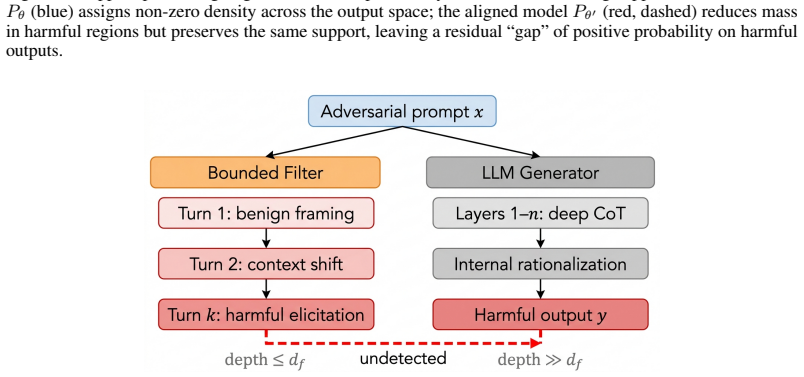
The key machinery is the formal pair of a support-preserving alignment operator — a transformation that reshapes output probabilities without changing the set of possible outputs — and a bounded filtering algorithm, defined by a finite query budget. The paper uses this formalization to define the 'ideal eliminator' as the unattainable target that removes all harmful probability mass, and then deploys computational and information-theoretic arguments to show that no bounded filter can approximate it. On the empirical side, the machinery is the estimation of harmful-output rate as a function of filter budget, which yields the observed plateau.
What would settle it
Extend the filter budget a hundredfold beyond the tested range on several models and measure the harmful-output rate; if it falls below the apparent plateau and approaches zero, the paper's empirical floor is falsified.
Extended reading notes
Core claim
The paper's central discovery is a formal and empirical case that support-preserving alignment plus bounded filtering cannot eliminate all harmful outputs supported by the base distribution. It defines an ideal eliminator as a filter that assigns zero probability to harmful outputs, and asks whether any bounded filtering algorithm — one with a finite query or compute budget — can approximate it under black-box, white-box, or statistical-query access to the model. The authors give computational and information-theoretic arguments that under these constraints, such filters will fail to remove every supported harmful output. They then test this prediction on a range of modern models, applying b
Load-bearing premise
The formal limit rests on assuming that practical alignment preserves the support of the output distribution and that filters have only a finite query budget; the empirical floor additionally assumes the adversarial prompt sets are representative of harmful outputs.
Editorial extensions
If this is right
- If support-preserving alignment is the norm, safety filters alone cannot bring harmful-output probability to zero; harm reduction is bounded from below by the base model's support.
- Increasing filter budgets yields diminishing returns, so deploying ever-more-compute filters will not close the gap; the floor persists across access models.
- Safety must be achieved at training time, by altering the support itself (e.g., removing harmful outputs from the distribution) rather than by post-hoc filtering.
- Evaluations that only measure a finite prompt set will see a plateau; that plateau is evidence of a floor, not a measurement artifact under the paper's assumptions.
Reading between the lines
- An implicit consequence the authors do not state: preference-based alignment methods that deliberately preserve support (e.g., KL-constrained RLHF) are unlikely to fully sanitize a model; the realistic objective is minimizing harmful mass, not eliminating it.
- The framework suggests a trade-off between capability preservation and safety: the only way around the floor is to shrink support, which may reduce the model's general utility — a cost that safety engineering must make explicit.
- A testable extension: measure whether support-shrinking interventions (unlearning, targeted fine-tuning, or inference-time constrained decoding) push the plateau to zero, whereas filtering-only pipelines do not.
- Another extension: the formal argument implies a rate — the minimal budget needed to bring harm below a given threshold — which could be estimated empirically and compared across models, offering a concrete safety metric.
Editorial analysis
A structured set of objections, weighed in public.
Referee Report
Summary. The paper studies whether alignment schemes that preserve the support of a base model's output distribution, combined with safety filters that are bounded by a finite query/compute budget, can reduce the probability of harmful outputs to zero in LLMs. It formalizes support-preserving alignment operators and bounded filtering under black-box, white-box, and statistical-query access, and claims computational and information-theoretic arguments indicating that, under these constraints, bounded filtering may fail to eliminate all harmful outputs supported by the base distribution. It also reports an empirical evaluation across open-weight and hosted LLMs accessed via OpenRouter, using adversarial prompts from cybersecurity scenarios and PKU-SafeRLHF, and observes that estimated harmful-output rates plateau above zero across models, filter classes, and query budgets. This review is based on the abstract only, as the full text was not available.
Significance. If the formal lower-bound result is nontrivial and the empirical plateau is robust to distribution shift and filter optimization, the paper would constitute a significant negative result for LLM safety: it would suggest a fundamental limit to support-preserving alignment plus bounded filtering as a harm-elimination strategy. The paper's methodological framing has clear strengths: it distinguishes black-box, white-box, and statistical-query access; it couples a formal framework with a multi-model empirical evaluation; and it addresses a practically important gap between worst-case hardness results and the behavior of real pipelines. However, the significance is conditional on the quantifier structure of the claimed theorem and on the external validity of the empirical benchmarks, neither of which can be assessed from the abstract alone.
major comments (4)
- [Abstract (formal claim)] The abstract states that 'bounded filtering may fail to eliminate all harmful outputs' under support-preserving alignment and bounded query budgets. This phrasing is existential and risks being tautological: if the support includes harmful outputs and the filter has a finite query budget, then any filter that does not inspect a particular harmful output will fail to eliminate it. To be substantive, the paper must prove a universal lower bound — i.e., that every filter in a natural bounded class (black-box, white-box, statistical-query) leaves a nonzero constant harm mass — and give an explicit lower bound that is independent of the benchmark or filter choice. The abstract does not indicate whether the theorem quantifies over all filters in the class or merely asserts existence of a failing filter. This distinction is load-bearing for the central claim.
- [Abstract (empirical evaluation)] The reported 'persistent empirical harm floor' is based on a finite, curated prompt set drawn from cybersecurity scenarios and PKU-SafeRLHF. A plateau on these benchmarks is consistent with the filters failing to generalize to those specific test items, not with a fundamental inability to eliminate novel harmful outputs. To support the strong interpretation of a 'floor,' the paper needs an adaptive or open-ended evaluation — for example, prompt generation that iterates against the filter — and/or a demonstration that the plateau persists under distribution shift. The abstract provides no sample sizes, confidence intervals, or statistical testing, so the plateau claim is currently not statistically grounded.
- [Abstract (modeling assumptions)] The formal impossibility result is conditional on two modeling choices: support-preserving alignment operators and bounded filtering with finite query/compute budgets. The abstract does not justify these as faithful models of real deployed alignment. If deployed alignment pipelines substantially shrink the support of harmful outputs, or if safety filtering is effectively unbounded (e.g., via scalable human review or iterative refinement), the impossibility need not apply. The paper should at least discuss evidence that support preservation is characteristic of actual alignment pipelines and that bounded query budgets are the correct formalization of practical filtering. Without this, the formal result may be correct but narrowly scoped.
- [Abstract (availability of technical content)] The central technical content is summarized only as 'computational and information-theoretic arguments indicating' the failure result. The abstract provides no theorem statements, proof sketches, or definitions of the operators and access models. Because the validity of the whole paper hinges on the quantifier structure and the tightness of the lower bound, the absence of these details in the available manuscript prevents verification. The referee report is necessarily provisional; if the full text contains the missing details, this concern may be resolved, but as presented, the formal claim cannot be evaluated.
minor comments (4)
- [Abstract] The phrase 'may fail' is weaker than the later statement of a 'persistent empirical harm floor.' Clarify whether the formal theorem asserts impossibility for all bounded filters or merely non-guarantee for some; the modal language obscures the logical strength.
- [Abstract] The terms 'support-preserving alignment operators,' 'bounded filtering algorithms,' and 'estimated harmful-output rate' are not defined in the abstract. Since the paper is targeting a broad ML audience, a one-sentence formal definition of each would help.
- [Abstract] The mention of 'hosted LLMs accessed via OpenRouter' raises questions about black-box versus white-box access: clarify how white-box and statistical-query access were implemented for hosted models, and whether API-side filtering or rate limits affected the results.
- [Abstract] The harmful-output classification threshold is a free parameter; its sensitivity should be reported. A floor at one threshold may disappear at another.
Circularity Check
No significant circularity found; conditional formal result and empirical plateau are not definitionally forced or fitted-as-prediction.
full rationale
The abstract-only text does not exhibit a circular derivation. The formal setup (support-preserving alignment, bounded filtering, black-box/white-box/statistical-query access) is a conditional modeling framework, not a conclusion smuggled into the assumptions. The conclusion that 'bounded filtering may fail to eliminate all harmful outputs supported by the base model's distribution' is not shown to be a restatement of the setup: a bounded filter could in principle implement a general harmful-output predicate without enumerating the entire support, so the finite query budget alone does not definitionally force failure. The abstract says the paper provides 'computational and information-theoretic arguments' for the failure, which is the substantive content; there are no equations in the abstract showing that the conclusion is assumed. The empirical claim that 'the estimated harmful-output rate decreases with additional filtering compute but consistently plateaus above zero' is a measurement over curated prompts, not a parameter fitted to those same data and then renamed as a prediction. A plateau on a fixed benchmark could be an artifact or a generalization failure, but that is an external-validity concern, not circularity. There are no self-citations in the abstract, and the strongest claim in the provided 'reader's take' upgrades the abstract's hedged 'may fail' to 'cannot,' but that overstatement is not a circularity defect in the paper itself. Therefore no circular step is identifiable from the available text.
Assumptions & free parameters
free parameters (2)
- Bounded filter query budget
- Harmful-output classification threshold
assumptions (3)
- domain assumption Practical alignment pipelines are adequately modeled by support-preserving operators (operators that do not shrink the support of the base output distribution).
- domain assumption Bounded filter algorithms under black-box, white-box, and statistical-query access capture the relevant practical filtering architectures.
- standard math Standard computational/information-theoretic lower-bound toolkit (e.g., query-complexity or information inequalities) is valid.
Cite this review
Pith. "Pith review of On the Limits of Support-Preserving Alignment and Bounded Filtering." pith.science (2026). https://pith.science/paper/HZE3I452
@misc{pith2026260718295,
  author       = {Pith},
  title        = {Pith review of: On the Limits of Support-Preserving Alignment and Bounded Filtering},
  year         = {2026},
  howpublished = {\url{https://pith.science/paper/HZE3I452}},
  note         = {Machine review of arXiv:2607.18295}
}
read the original abstract
We study whether alignment schemes that reshape a base model's output distribution, combined with bounded safety filters, can drive the probability of harmful behavior to zero in modern large language models. Recent research suggests that harmful behaviors can persist under preference-based alignment and that external filtering can be computationally hard in the worst case, but it remains unclear whether practical alignment pipelines that largely preserve internal representations can eliminate harmful behavior entirely rather than merely suppressing its most visible forms. We formalize this setting using support-preserving alignment operators together with bounded filtering algorithms under black-box, white-box, and statistical-query access, and analyze their ability to approximate an ideal eliminator that removes all harmful mass. Building on this framework, we provide computational and information-theoretic arguments indicating that, under these constraints, bounded filtering may fail to eliminate all harmful outputs supported by the base model's distribution. To evaluate these limits empirically, we analyze a range of state-of-the-art open-weight and hosted LLMs accessed via OpenRouter under bounded black-box, white-box, and statistical-query filters on adversarial prompts drawn from curated cybersecurity scenarios and PKU-SafeRLHF. Across models, filter classes, and query budgets, the estimated harmful-output rate decreases with additional filtering compute but consistently plateaus above zero, suggesting a persistent empirical harm floor.
Figures


Figures from the paper (3 more)


Reviewed August 4, 2026 · model on record in the stance chip above.
Discussion (0). Sign in to comment.