REVIEW 3 major objections 6 minor 126 references
A sound-horizon-free multiprobe large-scale structure analysis measures H0 to 3–4% precision, yielding h = 0.702 ± 0.02.
Reviewed by Pith at T0; open to challenge. T0 means a machine referee read the full paper against a public rubric. the ladder, T0–T4 →
T0 review · deepseek-v4-flash
2026-08-02 20:54 UTC pith:HZE5KXS7
load-bearing objection A careful, transparent multiprobe analysis with a plausible headline H0, but the sound-horizon-free label for the BOSS bispectrum is not yet fully secured. the 3 major comments →
A sound horizon independent measurement of H₀ from BOSS, DESI and DES Y3
The pith
A machine-rendered reading of the paper's core claim, the machinery that carries it, and where it could break.
Core claim
The paper claims that a sound-horizon-free multiprobe analysis of large-scale structure can determine H0, Omega_m, and sigma_8 at 3–4% precision. The key step is the wiggle-no-wiggle split of the linear matter power spectrum, P_lin(k) = P_nw(k) + P_w(alpha_rs k), with alpha_rs marginalized over so the BAO oscillation carries no weight. Combining the BOSS power spectrum and bispectrum (for the first time in this context) with the DESI angular power spectra, DES Y3 3x2pt, and Planck PR3 CMB lensing gives h = 0.702^{+0.022}_{-0.024}, Omega_m = 0.310 ± 0.013, sigma_8 = 0.799 ± 0.020. The paper also reports a 1.8σ deviation of alpha_rs from unity generated by bispectrum modes above k = 0.18 h/Mpc
What carries the argument
The wiggle-no-wiggle split: the linear matter power spectrum is decomposed into a smooth broadband component and an oscillatory BAO component, P_lin(k) = P_nw(k) + P_w(alpha_rs k). Marginalizing over alpha_rs removes the acoustic peaks that would otherwise calibrate the sound horizon. The method relies on the claim, from the literature, that sound-horizon information entering through the baryon suppression scale is negligible for current survey precision. This split is applied to the BOSS power spectrum and bispectrum, and the other probes are effectively sound-horizon-independent because their BAO signal is weak or projection-smeared.
Load-bearing premise
The analysis assumes that after marginalizing over alpha_rs, the remaining broadband shape of the power spectrum—in particular the baryon suppression scale proportional to the sound horizon—carries negligible sound-horizon information for current survey precision; if that residual is non-negligible, the 'sound-horizon-free' label on the H0 constraint fails.
What would settle it
A concrete test: vary the BBN prior on the baryon density omega_b (which sets the sound horizon) and see if the inferred H0 shifts by more than the quoted error. If shifting omega_b within its BBN uncertainty moves h by more than about 0.02, residual sound-horizon information is leaking through the broadband shape. Additionally, the alpha_rs deviation grows with the bispectrum scale cut; a measurement at higher k with larger survey volume would either confirm the deviation as real physics or reveal it as a modeling artifact.
If this is right
- A sound-horizon-free H0 from LSS alone at ~3–4% precision, h = 0.702, lies between Planck and SH0ES, with 1.2σ and 2.1σ tensions respectively.
- Adding Pantheon+ supernovae gives h = 0.686 ± 0.018 (2.6% precision), shifting the baseline toward lower H0 and higher Omega_m.
- The BOSS bispectrum improves the h–Omega_m figure of merit by a factor of ~2 and induces a 1.8σ deviation of alpha_rs from unity; this deviation disappears when the bispectrum is restricted to k_B^max = 0.18 h/Mpc.
- The sound-horizon-free analysis acts as a new-physics diagnostic: mock early-dark-energy cosmologies show no alpha_rs shift, while evolving-dark-energy mocks reproduce a ~1.9σ shift similar to the real data.
- The methodology is directly applicable to upcoming surveys such as Euclid and LSST, which should yield tighter sound-horizon-independent constraints.
Where Pith is reading between the lines
- If the wiggle-no-wiggle split fully removes sound-horizon information, the agreement between this H0 and Planck's sound-horizon-calibrated value is a nontrivial internal consistency check of Lambda CDM: the Hubble tension cannot be ascribed solely to sound-horizon systematics.
- The sensitivity of the alpha_rs deviation to the bispectrum scale cut suggests that the effect could be a modeling artifact; future surveys with higher signal-to-noise will determine whether it is real physics or a consequence of pushing one-loop effective field theory too far.
- The same principle could be used with the matter-radiation equality turnover as an independent standard ruler, providing an orthogonal check on the wiggle-no-wiggle results.
Editorial analysis
A structured set of objections, weighed in public.
Referee Report
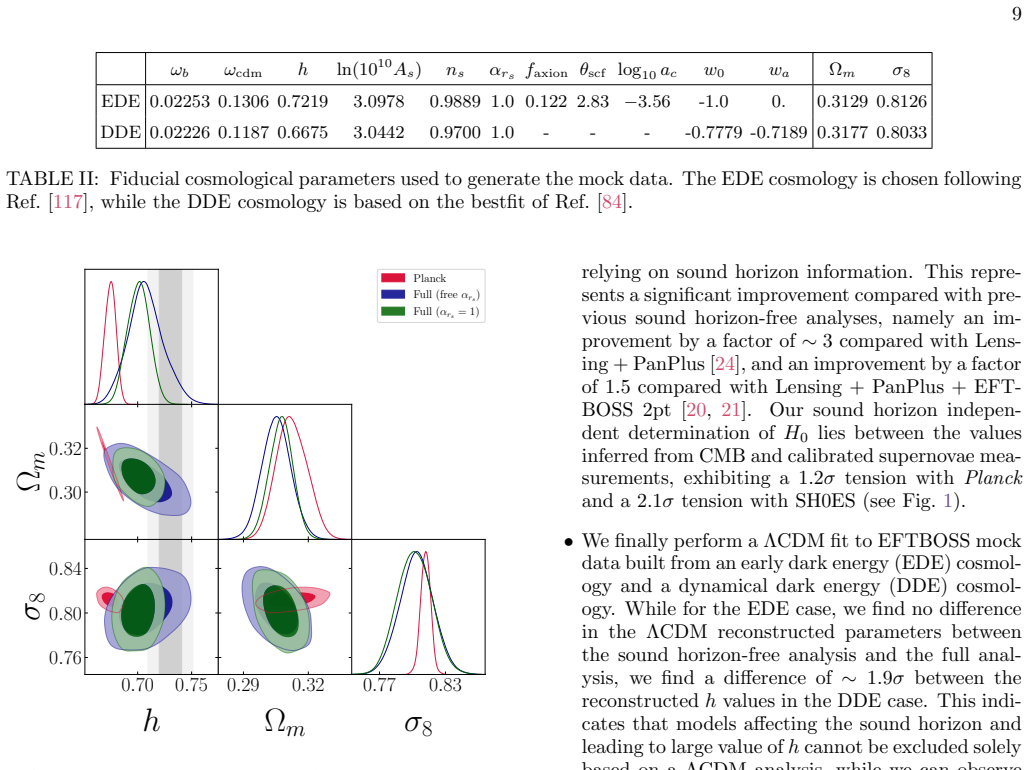
Summary. Using the wiggle/no-wiggle decomposition of the linear matter power spectrum (Eq. 1) and marginalizing over the BAO rescaling parameter α_rs, the authors construct a 'sound-horizon-free' EFTofLSS likelihood from BOSS power spectrum and bispectrum at one loop, and combine it with DESI Legacy Survey DR9 angular C_ℓ's, DES Y3 3×2pt constraints (entering through Gaussian priors on {h, Ω_m, σ8}), and Planck PR3 CMB lensing, plus BBN and Planck priors on ω_b and n_s. The baseline gives h = 0.702^{+0.022}_{-0.024}, Ω_m = 0.310 ± 0.013, σ8 = 0.799 ± 0.020. Inclusion of Pantheon+ lowers h to 0.686 ± 0.018; adding a DESI DR2 BAO-based Ω_m prior yields h = 0.708^{+0.015}_{-0.017}. The EFTBOSS bispectrum analysis yields α_rs = 1.063 ± 0.035 at k_Bmax = 0.23 h/Mpc (1.8σ from unity), which becomes consistent with unity at k_Bmax = 0.18. The authors also run ΛCDM fits on EDE and DDE mocks and interpret the real-data α_rs-free/α_rs-fixed difference as consistent with evolving dark energy.
Significance. If valid, the result is one of the tightest sound-horizon-free H0 determinations from LSS alone (~3–4% precision), and the first to incorporate the BOSS bispectrum in the α_rs-marginalized framework. The paper's strengths include the multiprobe combination, the explicit internal-consistency quantification, the scale-cut study, the PyBird/CLASS-PT cross-check for the 2pt case, and the EDE/DDE mock tests. These are useful and go beyond many previous analyses. However, the sound-horizon-free label and the quoted precision are not yet supported by the analysis as presented: the bispectrum at the baseline scale cut introduces a scale-cut-dependent shift, and the baseline combination includes two likelihoods with ~2.6σ internal tension. These issues require revision before the central claims can be accepted.
major comments (3)
- [Sec. II B, Eq. (1); Sec. III B, Fig. 3] The assertion that marginalizing α_rs fully removes sound-horizon information is borrowed from Ref. [19], which is a power-spectrum-only demonstration. The present paper extends this to the one-loop bispectrum with k_Bmax = 0.23 h/Mpc. Sec. III B and Fig. 3 show that this extension is not stable: at k_Bmax = 0.23, α_rs = 1.063 ± 0.035 (1.8σ from unity), and the α_rs-free vs α_rs=1 analyses differ by 1.8σ in h and 1.4σ in Ω_m; lowering k_Bmax to 0.18 reduces the discrepancy to 0.6σ and restores α_rs = 1. Since the small-scale bispectrum is exactly where broadband shape features (including the baryon-suppression scale β r_s) can re-enter P_nw after α_rs marginalization, the baseline EFTBOSS likelihood is not demonstrated to be sound-horizon-free. The quoted h error bars therefore miss a systematic that the scale-cut dependence reveals. Please make k_Bmax = 0.18 the baseline or propagate th
- [Sec. III A, Tab. I; Sec. III C] The baseline combination of EFTBOSS, DESICℓ and EFTDES contains internal tension: the paper reports a 2.6–2.7σ disagreement between EFTBOSS and EFTDES in the {h, Ω_m, σ8} space, using Eq. (2). These likelihoods are then multiplied as if statistically compatible. Combining two incompatible posteriors with different preferred regions (EFTBOSS h ≈ 0.63; EFTDES h ≈ 0.77) can shift the joint mode and artificially shrink uncertainties. The headline h = 0.702 ± 0.022 therefore depends on an unmodeled tension. The authors should either introduce a tension/shift parameter, report pairwise removals (e.g., baseline without EFTDES), or use a conservative hyperparameter combination. A robustness table showing that the central h and its error are stable under these choices is needed to support the claimed 3–4% precision.
- [Sec. II A (EFTDES entry)] The DES Y3 3×2pt contribution is not a full likelihood but Gaussian priors on {h, Ω_m, σ8} taken from Ref. [93]. This compression assumes a Gaussian posterior and discards correlations with other parameters such as ω_cdm and ln(10^10 A_s) that are free in the EFTBOSS analysis. Since EFTDES dominates the Ω_m constraint in the combination, a non-Gaussian or correlated tail could bias the final Ω_m and h. Please validate the Gaussian compression by comparing with the full likelihood in a common parameter space, or explicitly quantify the information loss; alternatively rerun the baseline with the full EFTDES likelihood.
minor comments (6)
- [Sec. II A] The redshift ranges for CMASS and LOWZ appear swapped: CMASS should be 0.43 < z < 0.7 (z_eff = 0.57) and LOWZ should be 0.2 < z < 0.43 (z_eff = 0.32). Please correct.
- [Sec. II A (DESICℓ)] The link for the public likelihood is incomplete ('here /github'). Provide the full URL.
- [Sec. III B / Fig. 3] The y-axis labels for k_Bmax are easy to misread because the tick order is non-monotonic; consider reordering and adding explicit units.
- [Sec. III C] The phrase '2.4% measurement on h free from sound horizon' should be 'free of'; also 'EFBOSS' appears as a typo in the bottom-left panel description.
- [Table II] Define the abbreviations 'scf' and 'log10 ac' in the EDE row; currently only experts will recognize these parameters.
- [Sec. III D] The DDE mock test shows a 1.9σ difference in one realization. The statement 'consistent with recent hints of DDE' is stronger than the evidence; please soften or provide multiple mock realizations / a p-value.
Circularity Check
No significant circularity: H0 is obtained by standard MCMC parameter estimation with alpha_rs marginalized; the sound-horizon-free assumption rests on an external result and is explicitly stress-tested, not derived from the paper's own outputs.
full rationale
The central h measurement is a conventional parameter fit to LSS angular, 3x2pt, and lensing likelihoods; alpha_rs is a free nuisance parameter that is marginalized over (Eq. 1), not a fitted quantity that is then relabeled as a prediction. The claim that residual r_s information via the baryon-suppression scale beta r_s is negligible is imported from Ref. [19] (Farren, Philcox & Sherwin), which is external to the present author set, and the paper explicitly flags this residual channel and tests it with k_Bmax variations (Sec. III B) and a PyBird/CLASS-PT cross-check (App. A). Self-citations, chiefly Ref. [84] for the DESIC_l likelihood and Ref. [21] for the wiggle-no-wiggle split, are not load-bearing circular supports: Ref. [21] is accompanied by external Refs. [19,26,27] for the same method, and Ref. [84] provides a standalone pre-existing likelihood used as an input dataset, not an output of the current fit. No parameter from the final posterior is fed back into any likelihood by definition, no uniqueness theorem from the authors' prior work is invoked to force the sound-horizon-free construction, and no known empirical result is merely renamed. The observed alpha_rs deviation and scale-cut sensitivity are honest systematic diagnostics rather than a reduction of the H0 result to its inputs. Consequently, there is no exhibitable circular step.
Axiom & Free-Parameter Ledger
free parameters (5)
- h =
0.702^{+0.022}_{-0.024} (baseline); 0.686±0.018 with Pantheon+
- ω_cdm =
not reported directly
- ln(10^10 A_s) =
not reported directly
- α_rs =
0.997±0.022 (full baseline); 1.063^{+0.034}_{-0.038} (EFTBOSS alone)
- EFT nuisance parameters (BOSS bias, counterterms, stochastic; DESI Cℓ bias) =
marginalized analytically or sampled
axioms (5)
- domain assumption The wiggle-no-wiggle split with marginalized α_rs removes all sound-horizon information; residual baryon suppression scale β r_s information is negligible
- domain assumption EFTofLSS at one loop accurately describes BOSS power spectrum and bispectrum up to k_max = 0.23/0.20 h/Mpc
- domain assumption The four probes (BOSS, DESI Cℓ, DES Y3, Planck lensing) are statistically independent after partial overlap removal; residual correlations are subdominant
- domain assumption DES Y3 constraints are fully captured by Gaussian priors on {h,Ωm,σ8} from Ref [93]
- domain assumption CMB lensing is approximately sound-horizon independent
read the original abstract
We present a sound horizon independent measurement of the Hubble parameter using a multiprobe large-scale structure analysis. Removing the dependency on the sound horizon with a rescaling procedure at the matter power spectrum level, we analyse the BOSS full-shape power spectrum and bispectrum (for the first time) using the effective field theory of large-scale structure up to one loop. We combine this analysis with the auto- and cross-angular power spectra from the DESI Legacy Imaging Survey DR9, the $3 \times 2$pt analysis from DES Y3, and the CMB gravitational lensing power spectrum from Planck PR3. Our baseline analysis, that does not rely on supernovae data, yields $h = 0.702^{+0.022}_{-0.024}$, $\Omega_m = 0.310 \pm 0.013$, and $\sigma_8 = 0.799 \pm 0.020$, corresponding to $3-4 \%$ precision measurements. When adding supernovae data from Pantheon+, we obtain a $2.6 \%$ measurement of $h$, with $h = 0.686 \pm 0.018$. We further note that our EFTBOSS analysis indicates a slight deviation of the BAO scale parameter (at $1.8 \sigma$) from its $\Lambda$CDM value, caused by the small scales of the bispectrum. We finally use the sound horizon-free EFTBOSS analysis as a diagnosis for the presence of new physics, finding that our results are consistent with the recent hints of evolving dark energy.
Figures




Reference graph
Works this paper leans on
-
[1]
N. Aghanimet al.(Planck), Astron. Astrophys.641, A6 (2020), [Erratum: Astron.Astrophys. 652, C4 (2021)], arXiv:1807.06209 [astro-ph.CO]
Pith/arXiv arXiv 2020
-
[2]
A. G. Riesset al., Astrophys. J. Lett.934, L7 (2022), arXiv:2112.04510 [astro-ph.CO]
Pith/arXiv arXiv 2022
-
[3]
Casertanoet al.(H0DN), (2025), arXiv:2510.23823 [astro-ph.CO]
S. Casertanoet al.(H0DN), (2025), arXiv:2510.23823 [astro-ph.CO]
Pith/arXiv arXiv 2025
-
[4]
Louiset al.(Atacama Cosmology Telescope), JCAP 11, 062 (2025), arXiv:2503.14452 [astro-ph.CO]
T. Louiset al.(Atacama Cosmology Telescope), JCAP 11, 062 (2025), arXiv:2503.14452 [astro-ph.CO]
Pith/arXiv arXiv 2025
-
[5]
Camphuiset al.(SPT-3G), (2025), arXiv:2506.20707 [astro-ph.CO]
E. Camphuiset al.(SPT-3G), (2025), arXiv:2506.20707 [astro-ph.CO]
Pith/arXiv arXiv 2025
-
[6]
M. Abdul Karimet al.(DESI), Phys. Rev. D112, 11 0.65 0.75 h 0.95 1.00 1.05 αrs 0.74 0.80 0.86 σ8 0.30 0.35 Ω m 0.3 Ω m 0.75 0.85 σ8 1 αrs Lensing + EFTBOSS + DESI Cℓ + EFTDES Lensing + EFTBOSS + DESI Cℓ + EFTDES (wide prior) 0.62 0.71 h 1.00 1.08 αrs 0.75 0.80 0.85 σ8 0.30 0.35 Ω m 0.31 0.37 Ω m 0.76 0.84 σ8 0.98 1.07 αrs Lensing + PanPlus + EFTBOSS 2pt (...
Pith/arXiv arXiv 2025
-
[7]
T. M. C. Abbottet al.(DES), (2026), arXiv:2601.14559 [astro-ph.CO]
arXiv 2026
-
[8]
T. M. C. Abbottet al.(Kilo-Degree Survey, DES), Open J. Astrophys.6, 2305.17173 (2023), arXiv:2305.17173 [astro-ph.CO]
Pith/arXiv arXiv 2023
-
[9]
M. Asgariet al.(KiDS), Astron. Astrophys.645, A104 (2021), arXiv:2007.15633 [astro-ph.CO]
Pith/arXiv arXiv 2021
- [10]
-
[11]
A. H. Wrightet al., Astron. Astrophys.703, A158 (2025), arXiv:2503.19441 [astro-ph.CO]
Pith/arXiv arXiv 2025
-
[12]
T. Simon, P. Zhang, and V. Poulin, JCAP07, 041 (2023), arXiv:2210.14931 [astro-ph.CO]
Pith/arXiv arXiv 2023
-
[13]
R. Neveuxet al.(eBOSS), Mon. Not. Roy. Astron. Soc. 499, 210 (2020), arXiv:2007.08999 [astro-ph.CO]
arXiv 2020
-
[14]
A. G. Adameet al.(DESI), JCAP07, 028 (2025), arXiv:2411.12022 [astro-ph.CO]
Pith/arXiv arXiv 2025
-
[15]
D. Broutet al., Astrophys. J.938, 110 (2022), arXiv:2202.04077 [astro-ph.CO]
Pith/arXiv arXiv 2022
-
[16]
D. Rubinet al., Astrophys. J.986, 231 (2025), arXiv:2311.12098 [astro-ph.CO]
Pith/arXiv arXiv 2025
-
[17]
T. M. C. Abbottet al.(DES), Astrophys. J. Lett.973, L14 (2024), arXiv:2401.02929 [astro-ph.CO]
Pith/arXiv arXiv 2024
-
[18]
Popovicet al.(DES), (2025), arXiv:2511.07517 [astro-ph.CO]
B. Popovicet al.(DES), (2025), arXiv:2511.07517 [astro-ph.CO]
Pith/arXiv arXiv 2025
-
[19]
G. S. Farren, O. H. E. Philcox, and B. D. Sherwin, Phys. Rev. D105, 063503 (2022), arXiv:2112.10749 [astro-ph.CO]
Pith/arXiv arXiv 2022
-
[20]
O. H. E. Philcox, G. S. Farren, B. D. Sherwin, E. J. Baxter, and D. J. Brout, Phys. Rev. D106, 063530 (2022), arXiv:2204.02984 [astro-ph.CO]
Pith/arXiv arXiv 2022
-
[21]
T. L. Smith, V. Poulin, and T. Simon, Phys. Rev. D 108, 103525 (2023), arXiv:2208.12992 [astro-ph.CO]
Pith/arXiv arXiv 2023
-
[22]
S. Alamet al.(BOSS), Mon. Not. Roy. Astron. Soc. 470, 2617 (2017), arXiv:1607.03155 [astro-ph.CO]
Pith/arXiv arXiv 2017
-
[23]
V. Poulin, T. L. Smith, R. Calder´ on, and T. Simon, Phys. Rev. D111, 083552 (2025), arXiv:2407.18292 [astro-ph.CO]
Pith/arXiv arXiv 2025
-
[24]
E. J. Baxter and B. D. Sherwin, Mon. Not. Roy. Astron. Soc.501, 1823 (2021), arXiv:2007.04007 [astro-ph.CO]
Pith/arXiv arXiv 2021
-
[25]
O. H. E. Philcox, B. D. Sherwin, G. S. Farren, and E. J. Baxter, Phys. Rev. D103, 023538 (2021), arXiv:2008.08084 [astro-ph.CO]
Pith/arXiv arXiv 2021
- [26]
-
[27]
E. A. Zaborowskiet al., JCAP06, 020 (2025), arXiv:2411.16677 [astro-ph.CO]
Pith/arXiv arXiv 2025
-
[28]
S. Brieden, H. Gil-Mar ´ ın, and L. Verde, JCAP12, 054 (2021), arXiv:2106.07641 [astro-ph.CO]
Pith/arXiv arXiv 2021
-
[29]
S. Brieden, H. Gil-Mar ´ ın, and L. Verde, JCAP04, 023 (2023), arXiv:2212.04522 [astro-ph.CO]
Pith/arXiv arXiv 2023
-
[30]
L. Pogosian, G.-B. Zhao, and K. Jedamzik, Astro- phys. J. Lett.904, L17 (2020), arXiv:2009.08455 [astro- ph.CO]
Pith/arXiv arXiv 2020
-
[31]
H. Garc ´ ıa Escudero, S. H. Mirpoorian, and L. Pogosian, Astrophys. J. Lett.998, L41 (2026), arXiv:2509.16202 [astro-ph.CO]
arXiv 2026
-
[32]
R. K. Sharma and J. Lesgourgues, (2025), arXiv:2510.15835 [astro-ph.CO]
arXiv 2025
-
[33]
E. A. Zaborowskiet al., (2025), arXiv:2510.19149 [astro-ph.CO]
Pith/arXiv arXiv 2025
-
[34]
S. Cunnington, Mon. Not. Roy. Astron. Soc.512, 2408 (2022), arXiv:2202.13828 [astro-ph.CO]
Pith/arXiv arXiv 2022
-
[35]
Y. Lai, C. Howlett, and T. Davis, JCAP10, 071 (2025), arXiv:2507.11823 [astro-ph.CO]. 12
Pith/arXiv arXiv 2025
-
[36]
B. Bahr-Kalus, D. Parkinson, and E.-M. Mueller, Mon. Not. Roy. Astron. Soc.524, 2463 (2023), [Erra- tum: Mon.Not.Roy.Astron.Soc. 526, 3248–3249 (2023)], arXiv:2302.07484 [astro-ph.CO]
Pith/arXiv arXiv 2023
-
[37]
A. Krolewski, W. J. Percival, and A. Woodfinden, (2024), arXiv:2403.19227 [astro-ph.CO]
Pith/arXiv arXiv 2024
-
[38]
A. Krolewski and W. J. Percival, (2024), arXiv:2403.19236 [astro-ph.CO]
Pith/arXiv arXiv 2024
- [39]
-
[40]
B. Audren, J. Lesgourgues, K. Benabed, and S. Prunet, JCAP1302, 001 (2013), arXiv:1210.7183 [astro-ph.CO]
Pith/arXiv arXiv 2013
-
[41]
MontePython 3: boosted MCMC sampler and other features,
T. Brinckmann and J. Lesgourgues, “MontePython 3: boosted MCMC sampler and other features,” (2018), arXiv:1804.07261 [astro-ph.CO]
Pith/arXiv arXiv 2018
-
[42]
D. Blas, J. Lesgourgues, and T. Tram, JCAP07, 034 (2011), arXiv:1104.2933 [astro-ph.CO]
Pith/arXiv arXiv 2011
-
[43]
N. Aghanimet al.(Planck), Astron. Astrophys.641, A8 (2020), arXiv:1807.06210 [astro-ph.CO]
Pith/arXiv arXiv 2020
-
[44]
J. J. M. Carrasco, M. P. Hertzberg, and L. Senatore, JHEP09, 082 (2012), arXiv:1206.2926 [astro-ph.CO]
Pith/arXiv arXiv 2012
-
[45]
D. Baumann, A. Nicolis, L. Senatore, and M. Zal- darriaga, JCAP07, 051 (2012), arXiv:1004.2488 [astro- ph.CO]
Pith/arXiv arXiv 2012
-
[46]
R. A. Porto, L. Senatore, and M. Zaldarriaga, JCAP 05, 022 (2014), arXiv:1311.2168 [astro-ph.CO]
Pith/arXiv arXiv 2014
-
[47]
E. Pajer and M. Zaldarriaga, JCAP08, 037 (2013), arXiv:1301.7182 [astro-ph.CO]
Pith/arXiv arXiv 2013
-
[48]
A. A. Abolhasani, M. Mirbabayi, and E. Pajer, JCAP 05, 063 (2016), arXiv:1509.07886 [hep-th]
Pith/arXiv arXiv 2016
-
[49]
L. Senatore and M. Zaldarriaga, (2014), arXiv:1409.1225 [astro-ph.CO]
Pith/arXiv arXiv 2014
-
[50]
T. Baldauf, M. Mirbabayi, M. Simonovi´ c, and M. Zaldarriaga, Phys. Rev. D92, 043514 (2015), arXiv:1504.04366 [astro-ph.CO]
Pith/arXiv arXiv 2015
-
[51]
L. Senatore and M. Zaldarriaga, JCAP02, 013 (2015), arXiv:1404.5954 [astro-ph.CO]
Pith/arXiv arXiv 2015
-
[52]
L. Senatore and G. Trevisan, JCAP05, 019 (2018), arXiv:1710.02178 [astro-ph.CO]
Pith/arXiv arXiv 2018
-
[53]
M. Lewandowski and L. Senatore, JCAP03, 018 (2020), arXiv:1810.11855 [astro-ph.CO]
Pith/arXiv arXiv 2020
-
[54]
D. Blas, M. Garny, M. M. Ivanov, and S. Sibiryakov, JCAP07, 028 (2016), arXiv:1605.02149 [astro-ph.CO]
Pith/arXiv arXiv 2016
-
[55]
J. J. M. Carrasco, S. Foreman, D. Green, and L. Sen- atore, JCAP07, 056 (2014), arXiv:1304.4946 [astro- ph.CO]
Pith/arXiv arXiv 2014
-
[56]
J. J. M. Carrasco, S. Foreman, D. Green, and L. Sen- atore, JCAP07, 057 (2014), arXiv:1310.0464 [astro- ph.CO]
Pith/arXiv arXiv 2014
-
[57]
P. McDonald and A. Roy, JCAP08, 020 (2009), arXiv:0902.0991 [astro-ph.CO]
Pith/arXiv arXiv 2009
-
[58]
Senatore, JCAP11, 007 (2015), arXiv:1406.7843 [astro-ph.CO]
L. Senatore, JCAP11, 007 (2015), arXiv:1406.7843 [astro-ph.CO]
Pith/arXiv arXiv 2015
-
[59]
M. Mirbabayi, F. Schmidt, and M. Zaldarriaga, JCAP 07, 030 (2015), arXiv:1412.5169 [astro-ph.CO]
Pith/arXiv arXiv 2015
-
[60]
R. Angulo, M. Fasiello, L. Senatore, and Z. Vlah, JCAP 09, 029 (2015), arXiv:1503.08826 [astro-ph.CO]
Pith/arXiv arXiv 2015
-
[61]
T. Fujita, V. Mauerhofer, L. Senatore, Z. Vlah, and R. Angulo, JCAP01, 009 (2020), arXiv:1609.00717 [astro-ph.CO]
Pith/arXiv arXiv 2020
-
[62]
A. Perko, L. Senatore, E. Jennings, and R. H. Wechsler, (2016), arXiv:1610.09321 [astro-ph.CO]
Pith/arXiv arXiv 2016
-
[63]
E. O. Nadler, A. Perko, and L. Senatore, JCAP02, 058 (2018), arXiv:1710.10308 [astro-ph.CO]
Pith/arXiv arXiv 2018
-
[64]
G. D’Amico, Y. Donath, M. Lewandowski, L. Senatore, and P. Zhang, JCAP07, 041 (2024), arXiv:2211.17130 [astro-ph.CO]
Pith/arXiv arXiv 2024
-
[65]
O. H. E. Philcox, M. M. Ivanov, G. Cabass, M. Si- monovi´ c, M. Zaldarriaga, and T. Nishimichi, Phys. Rev. D106, 043530 (2022), arXiv:2206.02800 [astro-ph.CO]
Pith/arXiv arXiv 2022
-
[66]
G. D’Amico, Y. Donath, M. Lewandowski, L. Senatore, and P. Zhang, JCAP05, 059 (2024), arXiv:2206.08327 [astro-ph.CO]
Pith/arXiv arXiv 2024
-
[67]
H. A. Feldman, N. Kaiser, and J. A. Peacock, Astro- phys. J.426, 23 (1994), arXiv:astro-ph/9304022
Pith/arXiv arXiv 1994
-
[68]
K. Yamamoto, M. Nakamichi, A. Kamino, B. A. Bas- sett, and H. Nishioka, Publ. Astron. Soc. Jap.58, 93 (2006), arXiv:astro-ph/0505115
Pith/arXiv arXiv 2006
-
[69]
N. Hand, Y. Li, Z. Slepian, and U. Seljak, JCAP07, 002 (2017), arXiv:1704.02357 [astro-ph.CO]
Pith/arXiv arXiv 2017
-
[70]
D. Bianchi, H. Gil-Mar ´ ın, R. Ruggeri, and W. J. Per- cival, Mon. Not. Roy. Astron. Soc.453, L11 (2015), arXiv:1505.05341 [astro-ph.CO]
Pith/arXiv arXiv 2015
-
[71]
F. Beutleret al.(BOSS), Mon. Not. Roy. Astron. Soc. 443, 1065 (2014), arXiv:1312.4611 [astro-ph.CO]
Pith/arXiv arXiv 2014
-
[72]
R. Scoccimarro, Phys. Rev. D92, 083532 (2015), arXiv:1506.02729 [astro-ph.CO]
Pith/arXiv arXiv 2015
-
[73]
H. Gil-Mar ´ ınet al.(BOSS), Mon. Not. Roy. Astron. Soc.460, 4188 (2016), arXiv:1509.06386 [astro-ph.CO]
Pith/arXiv arXiv 2016
-
[74]
H. Gil-Mar ´ ın, W. J. Percival, L. Verde, J. R. Brown- stein, C.-H. Chuang, F.-S. Kitaura, S. A. Rodr ´ ıguez- Torres, and M. D. Olmstead, Mon. Not. Roy. Astron. Soc.465, 1757 (2017), arXiv:1606.00439 [astro-ph.CO]
Pith/arXiv arXiv 2017
-
[75]
F.-S. Kitauraet al., Mon. Not. Roy. Astron. Soc.456, 4156 (2016), arXiv:1509.06400 [astro-ph.CO]
Pith/arXiv arXiv 2016
-
[76]
F. Beutler, E. Castorina, and P. Zhang, JCAP03, 040 (2019), arXiv:1810.05051 [astro-ph.CO]
Pith/arXiv arXiv 2019
-
[77]
B. Reidet al.(BOSS), Mon. Not. Roy. Astron. Soc.455, 1553 (2016), arXiv:1509.06529 [astro-ph.CO]
Pith/arXiv arXiv 2016
-
[78]
G. D’Amico, J. Gleyzes, N. Kokron, K. Markovic, L. Senatore, P. Zhang, F. Beutler, and H. Gil-Mar ´ ın, JCAP05, 005 (2020), arXiv:1909.05271 [astro-ph.CO]
Pith/arXiv arXiv 2020
-
[79]
G. D’Amico, L. Senatore, and P. Zhang, JCAP01, 006 (2021), arXiv:2003.07956 [astro-ph.CO]
Pith/arXiv arXiv 2021
-
[80]
A. Reeves, P. Zhang, and H. Zheng, (2025), arXiv:2507.20991 [astro-ph.CO]
Pith/arXiv arXiv 2025
discussion (0)
Sign in with ORCID, Apple, or X to comment. Anyone can read and Pith papers without signing in.