REVIEW 2 major objections 4 minor 34 references
Reduced-order non-self-consistent Monte Carlo simulation of a planar magnetron discharge: electron heating, recapture and racetrack formation
T0 review · 2 major / 4 minor · reviewed 2026-08-01 · deepseek-v4-flash
Pith's one-line read Resolving finite permanent-magnet geometry, not dipole approximations, is the dominant modeling choice for predicting racetrack erosion width in a reduced-order magnetron model.
desk verdict A candid, clearly-scoped reduced-order magnetron simulation whose headline claim—finite-magnet field predicts a sharper racetrack than dipole—is plausible but not yet statistically demonstrated; the paper itself defers the needed convergence study. read the letter →
The pith
A machine-rendered reading of the paper's core claim, the machinery that carries it, and where it could break.
The reading
What carries the argument
The central mechanism is the comparison between two magnetic-field representations: a superposition of point dipoles versus a numerically integrated field from the finite permanent-magnet volumes via the magnetic vector potential. This is embedded in a reduced-order Monte Carlo framework with a prescribed one-dimensional Gaussian-plus-cosh sheath–bulk potential, adaptive fourth-order Runge–Kutta orbit integration, a null-collision Monte Carlo collision operator, and a generation-cycle bookkeeping scheme that treats cathode-return events through a reflection probability RC. The geometric racetrack-width estimate ωRT ≈ 2√(2 r_e L R_c), based on the electron Larmor radius and magnetic-field-lin
What would settle it
Run the same racetrack calculation with an order of magnitude more seed electrons (e.g., 2×10^5 or 2×10^6) for both field representations; if the finite-magnet FWHM no longer stays close to the geometric estimate while the dipole profile broadens, the claim fails. Additionally, if a measured magnetic-field map for the experimental geometry becomes available and the finite-magnet simulation no longer matches the observed trench width, the inference about the magnetization would be overturned.
Extended reading notes
Core claim
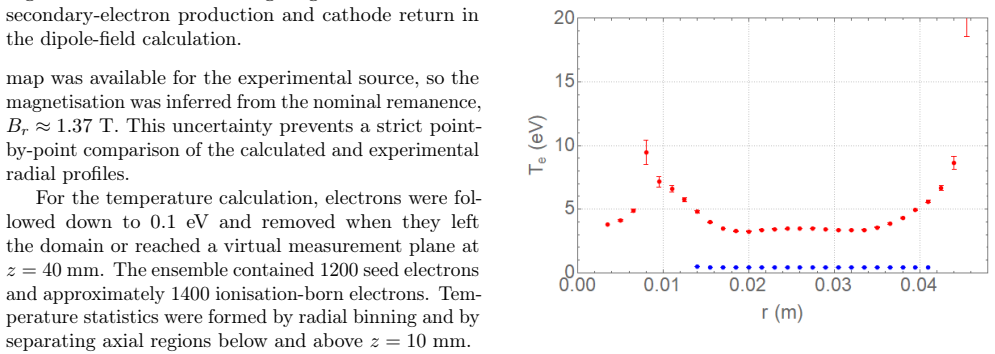
For racetrack calculations initiated with at least 2×10^4 cathode-emitted electrons and a reflection probability RC = 0.5, the finite-magnet field produces a more sharply localized erosion profile whose full width at half maximum is close to the geometric estimate ωRT ≈ 2√(2 r_e L R_c). The dipole approximation yields a broader profile. This identifies magnetic-field geometry, not the prescribed sheath potential or collision details, as the dominant modeling requirement for the predicted racetrack localization. Additionally, the reduced model demonstrates that a prescribed one-dimensional sheath–bulk potential, combined with the finite-magnet field, is sufficient to produce a hot near-cathod
Load-bearing premise
The racetrack comparison assumes that ensembles of at least 2×10^4 seed electrons yield statistically converged radial erosion profiles, but the paper contains no convergence study or variance analysis, so the claimed FWHM difference between dipole and finite-magnet fields could be Monte Carlo noise.
Editorial extensions
If this is right
- If the central claim holds, reduced-order magnetron models should resolve the finite magnet geometry rather than rely on point-dipole approximations when predicting racetrack width and localization.
- The finite-magnet calculation yields a racetrack FWHM close to the geometric estimate ωRT, suggesting that a simple geometric formula can serve as a rapid benchmark for erosion width once the field is resolved.
- The cathode reflection probability RC is a sensitive control on electron availability for ionizing collisions; conclusions derived from a single RC value should be read as sensitivity results, not as material constants.
- Because the drift velocity is overestimated by a factor of about 1.5, absolute transport predictions are not quantitative; the model's utility lies in comparative magnetic-configuration studies and mechanism identification.
- The model is not a replacement for self-consistent PIC-MCC simulations, but its low computational cost makes it suitable for scanning magnet designs and exploring cathode-interaction parameters.
Reading between the lines
- If the finite-magnet versus dipole difference persists under rigorous statistical convergence checks, then common dipole-based test-particle studies may systematically overestimate racetrack width, with direct consequences for target-utilization predictions in sputtering applications.
- The same reduced-order setup could be extended to test unbalanced or moving magnet configurations as a design sweep, because the finite-magnet integration cost remains workstation-scale and the model already isolates magnetic-field effects from sheath nonlinearity.
- The claim is conditional on the prescribed 1D sheath–bulk potential; a self-consistent or hybrid potential could alter radial confinement, so the identified dominance of magnetic-field geometry might be partly an artifact of freezing the potential.
- A testable extension would be to replace the inferred magnetization (from nominal remanence) with a measured field map for the experimental source; this would separate the error from magnetization uncertainty from the error due to the magnetic-field representation itself.
Signed reviews
Editorial analysis
A structured set of objections, weighed in public.
Referee Report
Summary. F. F. Locker and G. Strauß present a reduced-order, non-self-consistent Monte Carlo model of a circular planar magnetron discharge in argon. The model combines two magnetic-field representations (point-dipole superposition and numerically integrated finite-magnet fields) with a prescribed one-dimensional sheath–bulk potential, adaptive fourth-order Runge–Kutta orbit integration, and a null-collision treatment of electron–argon collisions. The collision module reproduces the reduced-field dependence of the electron drift velocity but overestimates its absolute value by about a factor of 1.5. Applied to a published magnetron geometry, the simulations yield a qualitatively two-temperature electron population and a racetrack erosion calculation in which the finite-magnet field produces a more sharply localised profile whose FWHM is 'close to' a geometric estimate, while the dipole approximation is broader. The paper explicitly frames results as semi-quantitative and lists convergence studies, measured field maps, and constrained cathode-interaction models as prerequisites for quantitative extension.
Significance. If substantiated, the paper would be a useful, computationally light tool for comparing magnetic-field representations in magnetron discharges. Its main potential contribution is identifying finite-magnet field resolution as the dominant modelling choice for racetrack localisation and showing that the dipole approximation broadens the predicted erosion profile. Strengths are the transparent disclosure of the failed drift test (§3.2), the clear discrimination-test framing, and the repeated, explicit caveats about the model's scope. The central racetrack claim, however, is not yet supported statistically: no FWHM values, confidence intervals, or particle-number convergence study are reported, and Eq. (5) is neither derived nor quantified. The paper is honest about these gaps, which makes the claims promising but not yet established.
major comments (2)
- [§3.7 and §4] The central claim—that the finite-magnet field yields an erosion FWHM close to Eq. (5) while the dipole approximation is broader—is not backed by statistical evidence. 'At least 2×10^4 seed electrons' is a floor, not a convergence criterion; no FWHM values, error bars, or multiple-seed variances are reported. Section 4 explicitly lists 'particle-number convergence studies' as a future requirement, an admission that the sufficiency of N_e was not established. Since the erosion profile is an energy-weighted sum of rare high-energy impacts, Monte Carlo noise could plausibly account for the reported broadening. Please add a convergence study (e.g., N_e from 2×10^4 upward, several independent seeds) and quantify the FWHM difference with confidence intervals.
- [§3.7, Eq. (5)] Equation (5), ω_RT ≈ 2√(2 r_L^e R_c), is introduced without derivation and without specifying how r_L^e and R_c are evaluated. No numerical value of ω_RT is given, and the comparison is only qualitative ('close to'). Because the geometric estimate is computed from the same nominal B_r ≈ 1.37 T field used in the simulation, it is not an independent check of the absolute width. Please state the definitions of all quantities, give the numerical value of ω_RT, and compare it quantitatively to the simulated FWHM for both field representations. Otherwise the 'close to' claim cannot be assessed.
minor comments (4)
- [§3.4] The temperature calculation uses only 1200 seed and approximately 1400 ionisation-born electrons; no statistical uncertainty is reported. This is acceptable for the qualitative two-temperature claim, but a sentence quantifying the bin-to-bin variance would strengthen the comparison.
- [§2.5 / §3.2] The initial seed-electron energy interval (4.36–4.95 eV) is stated as a numerical assumption, and the drift test overestimates the absolute drift velocity by a factor of 1.5. A brief sentence relating the emission-spectrum assumption to the drift overestimate would help readers judge whether the two issues are coupled.
- [Figure 9] The geometric racetrack-width estimate ω_RT is plotted or indicated, but the caption does not define the plotted quantity or specify units. Please add axis labels, units, and a short definition of the geometric estimate in the caption.
- [Abstract and §3.7] There are minor typographical inconsistencies: '2 × 10^4' appears without superscript formatting in the abstract, and R_C/RC is used inconsistently. These should be normalised.
Circularity Check
No significant circularity: the simulation predictions are not constructed from the quantities they purport to predict.
full rationale
The derivation chain is self-contained. The two magnetic-field representations are inputs; the erosion profile is accumulated from Monte Carlo trajectories using standard LXCat cross-sections and a Yamamura yield, with no parameter fitted to the racetrack or temperature outputs. The prescribed potential is selected by comparison with published sheath solutions (§2.2), not by fitting the two-temperature electron measurements used later as a qualitative check (§3.4), so the 'reproduction' is an independent validation rather than a tautology. The drift-velocity comparison is an external benchmark that overestimates by a factor 1.5 and is disclosed, which weakens precision but not circularity. The finite-magnet versus dipole comparison is computed from the same collision and potential model with only B changed; no term in Eq. (5) is adjusted to match the simulated FWHM. The only self-citation, Raggl et al. [9], supplies the experimental geometry and a qualitative IFM image; it is evidence, not a load-bearing argument. The outstanding limitations—missing particle-number convergence study, inferred magnetisation, qualitative FWHM comparison—are correctness/uncertainty concerns, not circular-construction concerns. No step in the paper defines an output in terms of its target or renames an empirical pattern as prediction.
Assumptions & free parameters
free parameters (4)
- RC (cathode reflection probability) =
0.5
- Seed electron initial energies =
4.36–4.95 eV
- Sheath–bulk potential coefficients (Gaussian + cosh join) =
not stated
- Br (nominal remanence) =
≈ 1.37 T
assumptions (7)
- standard math Null-collision Monte Carlo treatment (Vahedi–Surendra) correctly samples electron–neutral collisions in argon
- domain assumption Biagi LXCat argon cross-section data set is accurate for the simulated energy range
- domain assumption A prescribed 1D sheath–bulk potential with no radial structure is adequate for electron-heating and ionisation-localisation studies
- domain assumption Ions can be treated as unmagnetised with negligible ion–neutral collisions for the erosion mapping
- domain assumption Yamamura empirical sputter-yield formula applies to this target/gas combination
- ad hoc to paper Geometric racetrack-width estimate ωRT ≈ 2√(2 r_L R_c) governs the erosion width
- domain assumption Termination rules (energy below 15.7596 eV, domain exit, removal at the z = 40 mm measurement plane) do not bias the reported distributions
Cite this review
Pith. "Pith review of Reduced-order non-self-consistent Monte Carlo simulation of a planar magnetron discharge: electron heating, recapture and racetrack formation." pith.science (2026). https://pith.science/paper/I2VF5KBD
@misc{pith2026260719930,
  author       = {Pith},
  title        = {Pith review of: Reduced-order non-self-consistent Monte Carlo simulation of a planar magnetron discharge: electron heating, recapture and racetrack formation},
  year         = {2026},
  howpublished = {\url{https://pith.science/paper/I2VF5KBD}},
  note         = {Machine review of arXiv:2607.19930}
}
read the original abstract
A reduced-order non-self-consistent Monte Carlo model is presented for a circular planar magnetron discharge in argon. The model combines two magnetic-field representations, namely a superposition of magnetic dipoles and a numerically integrated field of the finite permanent magnets, with a prescribed one-dimensional sheath-bulk potential, adaptive fourth-order Runge-Kutta orbit integration, and a null-collision treatment of electron-argon collisions. The collision module reproduces the dependence of the electron drift velocity on the reduced electric field, but overestimates its absolute value by approximately a factor of 1.5. The resulting transport predictions are therefore interpreted semi-quantitatively. Applied to a magnetron geometry based on published Langmuir-probe measurements, the simulations reproduce the qualitative emergence of a cold electron population away from the cathode while retaining a hotter near-cathode component. Electrons returning to the cathode are reflected with a prescribed probability RC, which controls their availability for further ionising collisions. For racetrack calculations initiated with at least 2 x 10^4 cathode-emitted electrons and RC = 0.5, the finite-magnet field produces a more sharply localised erosion profile whose full width at half maximum is close to a geometric racetrack-width estimate. The dipole approximation yields a broader profile. The model is not a replacement for self-consistent PIC-MCC simulations, but is a computationally light tool for comparing magnetic-field representations and analysing electron heating, ionisation localisation, and racetrack formation.
Figures


Figures from the paper (4 more)


Reference graph
Works this paper leans on
-
[1]
Joseph E. Greene. Review article: Tracing the recorded history of thin-film sputter deposition: Fromthe1800sto2017.Journal of Vacuum Science & Technology A, 35(5):05C204, 2017
2017
-
[2]
Magnetron sputtering— milestones of 30 years.Vacuum, 84(12):1354–1359, 2010
Günter Bräuer, Bernd Szyszka, Michael Vergöhl, and Rainer Bandorf. Magnetron sputtering— milestones of 30 years.Vacuum, 84(12):1354–1359, 2010
2010
-
[3]
Khan.Handbook of Thin-Film Technology
Hartmut Frey and Hamid R. Khan.Handbook of Thin-Film Technology. Springer, Berlin, 2015
2015
-
[4]
Thornton
John A. Thornton. Magnetron sputtering: Ba- sic physics and application to cylindrical mag- netrons.Journal of Vacuum Science and Tech- nology, 15(2):171–177, 1978
1978
-
[5]
J. T. Gudmundsson. Physics and technology of magnetron sputtering discharges.Plasma Sources Science and Technology, 29(11):113001, 2020
2020
-
[6]
Czekaj, E
D. Czekaj, E. K. Hollmann, A. B. Kozirev, V. A. Volpyas, and A. G. Zaytsev. Ion energies at the cathode of the DC planar magnetron sputtering discharge.Applied Physics A: Solids and Surfaces, 49(3):269–272, 1989
1989
-
[7]
Rossnagel and Harold R
Stephen M. Rossnagel and Harold R. Kaufman. Langmuir probe characterization of magnetron op- eration.Journal of Vacuum Science & Technology A, 4(3):1822–1825, 1986
1986
-
[8]
Flat erosion magnetron sputter- ing with a moving unbalanced magnet.Vacuum, 80(7):662–666, 2006
Takayuki Iseki. Flat erosion magnetron sputter- ing with a moving unbalanced magnet.Vacuum, 80(7):662–666, 2006
2006
Show all 34 references
-
[9]
Raggl, J
S. Raggl, J. Postler, J. Winkler, G. Strauß, C. Feist, A. Plankensteiner, M. Eidenberger-Schober, and P. Scheier. Correlation of target properties and plasma parameters in DC magnetron sputtering with Langmuir probe measurements.Journal of Vacuum Science & Technology A, 35(6):...
2017
-
[10]
Evolution mechanism of sputtered film uni- formity with the erosion groove size: Integrated simulation and experiment.Molecules, 28(22):7660, 2023
Guo Zhu, Yutong Yang, Baijun Xiao, and Zhiyin Gan. Evolution mechanism of sputtered film uni- formity with the erosion groove size: Integrated simulation and experiment.Molecules, 28(22):7660, 2023
2023
-
[11]
Kondo and K
S. Kondo and K. Nanbu. A self-consistent numeri- cal analysis of a planar DC magnetron discharge by the particle-in-cell/Monte Carlo method.Journal of Physics D: Applied Physics, 32(10):1142–1152, 1999
1999
-
[12]
PIC–MCC numerical simulation of a DC planar magnetron
Ivan Kolev and Annemie Bogaerts. PIC–MCC numerical simulation of a DC planar magnetron. Plasma Processes and Polymers, 3(2):127–134, 2006
2006
-
[13]
Detailed nu- merical investigation of a DC sputter magnetron
Ivan Kolev and Annemie Bogaerts. Detailed nu- merical investigation of a DC sputter magnetron. IEEE Transactions on Plasma Science, 34(3):886– 894, 2006
2006
-
[14]
Computer modelling of mag- netron discharges.Journal of Physics D: Applied Physics, 42(19):194018, 2009
Annemie Bogaerts, Evi Bultinck, Ivan Kolev, Lau- rent Schwaederlé, Koen Van Aeken, Guy Buyle, and Diederik Depla. Computer modelling of mag- netron discharges.Journal of Physics D: Applied Physics, 42(19):194018, 2009
2009
-
[15]
Particle-in- cell simulations for the improvement of the target 7 erosion uniformity by the permanent magnet con- figuration of DC magnetron sputtering systems
Young Hyun Jo, Cheongbin Cheon, Heesung Park, Min Young Hur, and Hae June Lee. Particle-in- cell simulations for the improvement of the target 7 erosion uniformity by the permanent magnet con- figuration of DC magnetron sputtering systems. Coatings, 13(4):749, 2023
2023
-
[16]
Computer simulation of mag- netron sputtering—experience from the industry
Stanislav Kadlec. Computer simulation of mag- netron sputtering—experience from the industry. Surface and Coatings Technology, 202(4–7):895– 903, 2007
2007
-
[17]
Jimenez, Steven K
Francisco J. Jimenez, Steven K. Dew, and David J. Field. Comprehensive computer model for mag- netron sputtering. II. Charged particle trans- port.Journal of Vacuum Science & Technology A, 32(6):061301, 2014
2014
-
[18]
Theory and molecular simulations of plasma sputtering, transport and deposition pro- cesses.The European Physical Journal D, 77:19, 2023
Pascal Brault, Anne-Lise Thomann, and Marjorie Cavarroc. Theory and molecular simulations of plasma sputtering, transport and deposition pro- cesses.The European Physical Journal D, 77:19, 2023
2023
-
[19]
Biersack and L
Jochen P. Biersack and L. G. Haggmark. A Monte Carlo computer program for the transport of en- ergetic ions in amorphous targets.Nuclear Instru- ments and Methods, 174(1–2):257–269, 1980
1980
-
[20]
Modeling target erosion during reactive sputtering.Applied Surface Science, 331:185–192, 2015
Koen Strijckmans and Diederik Depla. Modeling target erosion during reactive sputtering.Applied Surface Science, 331:185–192, 2015
2015
-
[21]
Modeling reactive magnetron sputtering: Opportunities and challenges.Thin Solid Films, 688:137326, 2019
Diederik Depla, Koen Strijckmans, Dulmaa Altan- gerel, Florian Cougnon, Robin Dedoncker, Roeland Schelfhout, Isabella Schramm, Filip Moens, and Roger De Gryse. Modeling reactive magnetron sputtering: Opportunities and challenges.Thin Solid Films, 688:137326, 2019
2019
-
[22]
The characteristics of electrical dis- charges in magnetic fields
David Bohm. The characteristics of electrical dis- charges in magnetic fields. In A. Guthrie and R. K. Wakerling, editors,The Characteristics of Elec- trical Discharges in Magnetic Fields, pages 77–86. McGraw-Hill, New York, 1949
1949
-
[23]
R. Chodura. Plasma–wall transition in an oblique magnetic field.The Physics of Fluids, 25(9):1628– 1633, 1982
1982
-
[24]
Moritz, M
J. Moritz, M. Lesur, E. Faudot, S. Devaux, S. Heuraux, and J. Ledig. The plasma-wall transi- tion with collisions and an oblique magnetic field: Reversal of potential drops at grazing incidences. Physics of Plasmas, 26(1):013507, 2019
2019
-
[25]
J. W. Bradley and G. G. Lister. Model of the cath- ode fall region in magnetron discharges.Plasma Sources Science and Technology, 6(4):524–532, 1997
1997
-
[26]
The effect of the magnetic field strength on the sheath region of a DC magnetron discharge.Journal of Physics D: Applied Physics, 41(20):202007, 2008
Evi Bultinck and Annemie Bogaerts. The effect of the magnetic field strength on the sheath region of a DC magnetron discharge.Journal of Physics D: Applied Physics, 41(20):202007, 2008
2008
-
[27]
T. E. Sheridan and J. Goree. Analytic expres- sion for the electric potential in the plasma sheath. IEEE Transactions on Plasma Science, 17(6):884– 888, 1989
1989
-
[28]
Vahedi and M
V. Vahedi and M. Surendra. A Monte Carlo colli- sion model for the particle-in-cell method: Appli- cations to argon and oxygen discharges.Computer Physics Communications, 87(1–2):179–198, 1995
1995
-
[29]
Biagi-v7.1 electron collision cross sections for argon
Biagi database. Biagi-v7.1 electron collision cross sections for argon. LXCat database, 2020. Accessed 9 July 2020
2020
-
[30]
C. B. Opal, W. K. Peterson, and E. C. Beaty. Measurements of secondary-electron spectra pro- duced by electron impact ionization of a number of simple gases.The Journal of Chemical Physics, 55(8):4100–4106, 1971
1971
-
[31]
Yamamura, S
Y. Yamamura, S. Nakagawa, and S. Enoki. Empiri- cal formula for sputtering yield andZ2 dependence of its Q values. In A. Benninghoven, J. Okano, R. Shimizu, and H. W. Werner, editors,Secondary Ion Mass Spectrometry SIMS IV: Proceedings of the Fourth International Conference, O...
1983
-
[32]
Study electron transport coefficients for Ar, O2 and their mixtures by using an EEDF program.Journal of Physics: Conference Series, 1003:012116, 2018
Dhuha Sadi Abdul Majeed, Bushra Joudah Hus- sein, and Mustafa Kamel Jassim. Study electron transport coefficients for Ar, O2 and their mixtures by using an EEDF program.Journal of Physics: Conference Series, 1003:012116, 2018
2018
-
[33]
T. E. Sheridan, M. J. Goeckner, and J. Goree. Ob- servation of two-temperature electrons in a sputter- ing magnetron plasma.Journal of Vacuum Science & Technology A, 9(3):688–690, 1991
1991
-
[34]
Influence of electron recapture by the cathode upon the discharge characteristics in DC planar mag- netrons.Physical Review E, 72(5):056402, 2005
Ivan Kolev, Annemie Bogaerts, and Renaat Gijbels. Influence of electron recapture by the cathode upon the discharge characteristics in DC planar mag- netrons.Physical Review E, 72(5):056402, 2005. 8
2005
Reviewed August 1, 2026 · model on record in the stance chip above.
Discussion (0). Continue with ORCID to comment.