REVIEW 1 major objections 6 minor 63 references
Classical Self-Gravity Breaks Quantum State Tomography
Reviewed by Pith at T0; open to challenge. T0 means a machine referee read the full paper against a public rubric. the ladder, T0–T4 →
T0 review · glm-5.2
2026-07-09 00:49 UTC pith:IEUXXAPR
load-bearing objection Novel SN tomographic signatures (angle-set dependence, below-Heisenberg covariance) are real and cleanly derived within the CCSN framework; the framework itself is the load-bearing assumption. the 1 major comments →
Tomography of a Macroscopic Quantum State influenced by Classical Self-Gravity
The pith
A machine-rendered reading of the paper's core claim, the machinery that carries it, and where it could break.
Core claim
The paper's central discovery is that the Schrödinger-Newton self-gravity correction to continuous optomechanical tomography, denoted sigma^2_SN, depends on the conditional covariance trajectory V_c(t) which is itself shaped by the chosen homodyne measurement angle. Because this correction is a functional of the same state parameters being reconstructed and varies with the measurement setting, applying the standard quantum-mechanical reconstruction map to Schrödinger-Newton-generated data produces three diagnostic signatures: (1) the reconstructed covariance matrix changes when different sets of tomography angles are used, unlike in standard quantum mechanics where the result is angle-set-in
What carries the argument
The Schrödinger-Newton self-gravity term in the center-of-mass Hamiltonian, M*omega_SN^2*(x_hat - <x_hat>)^2, sourced by the conditional mean position x_c = <psi_c|x_hat|psi_c> during continuous homodyne measurement. The conditional covariance matrix V_c(t) evolves via a Riccati equation at the SN-modified frequency omega_q = sqrt(omega_m^2 + omega_SN^2), and the SN tomographic correction sigma^2_SN[g1,g2] = -omega_SN^2 * integral(j2(t) * [hxx(t|theta)*j1(t) + hxp(t|theta)*j2(t)]) inherits the angle-dependence of this trajectory.
Load-bearing premise
The entire analysis depends on the Causal Conditional Schrödinger-Newton prescription, where the classical gravitational potential sources the conditional mean position x_c = <psi_c|x_hat|psi_c> rather than the unconditional expectation value. If a different prescription for how classical gravity couples to the conditional quantum state were correct, the angle-dependence and below-Heisenberg-bound signatures could change qualitatively or disappear.
What would settle it
If the conditional mean prescription for the Schrödinger-Newton potential is replaced by one where gravity sources the unconditional density, the tomographic correction sigma^2_SN would no longer depend on the conditional covariance trajectory in the same way, and the angle-set dependence and below-bound signatures could vanish.
If this is right
- An experiment that reconstructs a macroscopic oscillator's quantum state at multiple angle sets and finds inconsistent covariance matrices would have evidence that the underlying dynamics are not purely standard quantum mechanics, potentially pointing to classical self-gravity or other nonlinear effects.
- The below-Heisenberg-bound or non-positive-definite reconstructed covariance is a model-mismatch diagnostic: it does not mean the uncertainty principle is violated, but rather that the assumed linear reconstruction map is incompatible with the actual dynamics that generated the data.
- Self-consistent tomography under Schrödinger-Newton dynamics cannot proceed by simply adding a correction term to the standard filter; it requires solving a nonlinear inverse problem where the unknown state parameters appear inside the reconstruction map itself.
- The angle-set consistency test could serve as a theory-agnostic diagnostic for nonlinear quantum dynamics beyond the specific Schrödinger-Newton case: any theory where the measurement process depends on the state being inferred will break Radon consistency.
Where Pith is reading between the lines
- The angle-set consistency test could be applied to other proposed nonlinear modifications of quantum mechanics—such as spontaneous collapse models or post-quantum theories of classical gravity—to check whether they produce analogous tomographic signatures without requiring knowledge of the specific nonlinear correction.
- If the Schrödinger-Newton frequency omega_SN is extremely small relative to the mechanical frequency, the tomographic signatures vanish, which means the test is complementary to spectral-based SN tests: tomography probes the conditional dynamics during measurement rather than steady-state oscillation frequencies.
- An adaptive or Bayesian tomography protocol that iteratively refines its estimate of the initial covariance and propagates the SN conditional equations for each candidate could in principle perform self-consistent SN tomography, but whether such a protocol is experimentally efficient at the required parameter regimes remains an open question.
Editorial analysis
A structured set of objections, weighed in public.
Referee Report
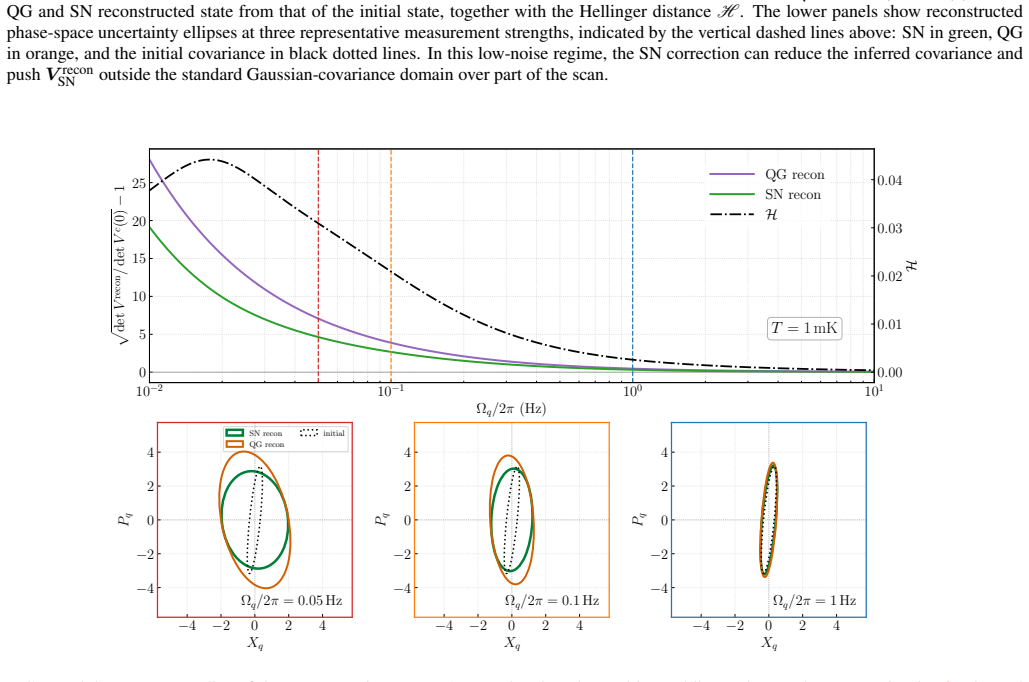
Summary. This manuscript investigates how classical self-gravity, described by the Schrödinger-Newton (SN) theory in its Causal Conditional (CCSN) formulation, affects continuous quantum state tomography of a macroscopic mechanical oscillator. The authors derive the tomographic error functional in a Schrödinger-picture framework, showing that when a standard quantum-gravity (QG) optimized reconstruction map is applied to measurement data generated by SN dynamics, an additional state-dependent correction arises. This correction depends on the conditional covariance trajectory, which is itself angle-dependent, leading to three signatures: (1) the reconstructed covariance depends on the chosen set of tomography angles, (2) the inferred covariance can be driven outside the standard Gaussian-covariance domain (below the Heisenberg bound or even non-positive-definite), and (3) the QG-SN distinguishability, quantified by the Hellinger distance, exhibits nontrivial dependence on measurement strength and temperature. The paper also frames these results as a concrete instance of a general obstruction in tomography of nonlinear quantum mechanics.
Significance. The paper addresses a timely question in the quantum-gravity phenomenology program: how to operationally distinguish semi-classical gravity from quantum gravity using macroscopic optomechanical systems. The derivation from the stochastic master equation through the Riccati equation to the explicit SN correction (Eq. 44) is careful and internally consistent, with a clean algebraic identity (Eq. 66) demonstrating the angle-independence of the QG reconstruction. The generalization to nonlinear quantum mechanics in Sec. V, connecting the SN result to a Radon-consistency obstruction, is a conceptual contribution that extends the reach of the paper beyond the specific SN setting. The falsifiable predictions (Figs. 3, 5) and the honest assessment of experimental feasibility are commendable. The key physical insight—that the SN correction is not positive-semidefinite and therefore cannot be absorbed as ordinary added noise—is the central novel result.
major comments (1)
- Sec. II.B, Eqs. (10) and (21): The CCSN prescription, where the SN self-gravity potential sources from the conditional mean x_c = ⟨ψ_c|x̂|ψ_c⟩, is the load-bearing assumption of the paper. Under this prescription, the conditional mean evolves at ω_m (Eq. 10, drift A_m) while the conditional covariance evolves at ω_q (Eq. 21, drift A_q), producing the frequency split A_SN = A_q - A_m (Eq. 32) that generates the entire σ²_SN correction. The paper acknowledges (citing Refs. 47-48) that alternative thermal-noise prescriptions exist, but it does not discuss whether the CCSN prescription itself is the consensus or a contested choice, nor how the central results would change under an alternative semi-classical gravity coupling (e.g., one where the gravitational potential sources the unconditional density). Since the angle-dependence and below-Heisenberg-bound signatures are structurally tied to
minor comments (6)
- Sec. II.C, Eq. (46): The approximation sign is used without a clear statement of what is being approximated. The text mentions performing an integral by parts, but the conditions under which the remaining terms are negligible should be specified.
- Table I: The parameters (M = 0.2 kg, ω_m/2π = 4×10⁻³ Hz, Q = 10⁷) are extremely challenging. The paper acknowledges this, but a brief quantitative estimate of the required measurement strength relative to the SN frequency would help the reader assess the regime of validity.
- Fig. 2: The two angle sets Θ_A = {0, π/4, π/2} and Θ_B = {π/3, 2π/3, π} differ by a common shift of π/3. It would be instructive to also show a case where the angle sets are not related by a simple rotation, to demonstrate that the angle-dependence is not an artifact of a particular symmetry.
- Sec. V, Eqs. (74)-(76): The general NLQM formulation is schematic. A brief comment on whether the SN nonlinearity satisfies the specific conditions discussed by Weinberg (Ref. 60) and Gisin (Ref. 61) would help situate the result.
- References: Ref. [21] is cited as a 2026 arXiv preprint; please verify the date and completion status.
- Typo in Acknowledgments: 'Y. M. W. Z. and Y. L. is supported' should read 'are supported'.
Simulated Author's Rebuttal
We thank the referee for a careful and constructive report. The referee correctly identifies the CCSN prescription as the load-bearing assumption of the paper and asks for a discussion of its status and of how the central results would change under alternative semi-classical gravity couplings. We agree this discussion should be added and explain below how we will revise the manuscript.
read point-by-point responses
-
Referee: Sec. II.B, Eqs. (10) and (21): The CCSN prescription, where the SN self-gravity potential sources from the conditional mean x_c = ⟨ψ_c|x̂|ψ_c⟩, is the load-bearing assumption of the paper. Under this prescription, the conditional mean evolves at ω_m (Eq. 10, drift A_m) while the conditional covariance evolves at ω_q (Eq. 21, drift A_q), producing the frequency split A_SN = A_q - A_m (Eq. 32) that generates the entire σ²_SN correction. The paper acknowledges (citing Refs. 47-48) that alternative thermal-noise prescriptions exist, but it does not discuss whether the CCSN prescription itself is the consensus or a contested choice, nor how the central results would change under an alternative semi-classical gravity coupling (e.g., one where the gravitational potential sources the unconditional density). Since the angle-dependence and below-Heisenberg-bound signatures are structurally tied to
Authors: The referee is correct that the CCSN prescription is the load-bearing assumption and that this point deserves explicit discussion. We will add a dedicated paragraph in Sec. II.B addressing the following points. revision: yes
-
Referee: [Continued from above — the comment was cut off, but the thrust is: how do the central results change under alternative semi-classical gravity couplings, and is CCSN consensus or contested?]
Authors: We address the two sub-questions in turn. (1) Status of CCSN: The CCSN prescription is not the unique formulation of semi-classical gravity; it is one of several prescriptions discussed in the literature (Refs. 20, 45–48). The key distinction is whether the gravitational source is the conditional state |ψ_c⟩⟨ψ_c| (as in CCSN) or the unconditional density matrix ρ = E[|ψ_c⟩⟨ψ_c|]. The CCSN choice is motivated by the requirement of causality: the gravitational field at time t should be sourced by the matter distribution at time t, not by a future ensemble average. This is the position taken in Refs. 20, 45–46 and further discussed in Ref. [46] (Miki et al., 2025). However, we agree that this is a contested choice, not a settled consensus, and the manuscript should say so explicitly. (2) How results change under alternative prescriptions: The frequency split A_SN = A_q − A_m arises specifically because, under CCSN, the conditional mean evolves at ω_m (the SN force vanishes on the mean trajectory) while the conditional covariance evolves at ω_q. Under a prescription where the gravitational potential sources the unconditional density, the situation is structurally different: the unconditional covariance would evolve at ω_q, but the conditional covariance evolution would not necessarily carry the same A_SN correction during the measurement process. In that case, the specific σ²_SN correction derived in Eq. (44) would take a different form, and the angle-dependence and below-Heisenberg-bound signatures may be weakened or absent. However, the general mechanism identified in Sec. V — that state-dependent nonlinear dynamics during readout introduces a model-dependent correction to the tomographic map — does not depend on the CCSN prescription specifically. Any semi-classical orhy revision: no
Circularity Check
No significant circularity: the SN tomographic correction is derived from the CCSN equations of motion without fitting to the target result; self-citations provide the model framework but are not load-bearing in a circular way.
full rationale
The paper's central result — that σ²_SN depends on tomography angles and can drive the QG-filtered reconstructed covariance outside the Gaussian domain — is derived from the CCSN equations of motion (Eq. 1, Eq. 10, Eq. 21) through a careful integration-by-parts calculation (Eqs. 28-44) without fitting any parameter to produce the target signature. The key structural ingredient, A_SN = A_q − A_m (Eq. 32), arises because under CCSN the SN force vanishes at the conditional mean, so the mean evolves at ω_m while the covariance evolves at ω_q. This is a physical consequence of the model choice, not a definition that presupposes the conclusion. The self-citations (Refs. 20, 45, 46, by overlapping authors) provide the CCSN framework, but the paper is transparent that this is a model prescription, explicitly acknowledges alternative prescriptions (Refs. 47-48), and states that excluding SN signatures 'would only rule out the SN description in the present setting.' The tomographic analysis (Eqs. 40-67), the Hellinger distance quantification (Eq. 73), and the general NLQM formulation (Sec. V) are new contributions. The parameters in Table I are set from physical considerations, not adjusted to produce below-Heisenberg-bound signatures. The one minor concern is that the CCSN prescription itself is load-bearing for the specific structure of σ²_SN, but this is a model-validity concern (correctness risk), not circularity — the paper does not claim CCSN is uniquely correct or derive it from itself. Score 1 reflects the presence of load-bearing self-citations for the framework, with the central derivation remaining independent.
Axiom & Free-Parameter Ledger
free parameters (4)
- ω_SN/(2π) =
7.8×10⁻² Hz
- ω_m/(2π) =
4×10⁻³ Hz
- Q =
10⁷
- V₀ (initial squeezed state) =
V_xx=0.2ℏ/2Mω_q, V_xp=ℏ/2, V_pp=10ℏMω_q/2
axioms (4)
- domain assumption The Causal Conditional Schrödinger-Newton (CCSN) prescription: the SN self-gravity potential sources the conditional mean x_c = ⟨ψ_c|x̂|ψ_c⟩ during measurement.
- domain assumption Classical thermal noise prescription: thermal Langevin force is treated as classical force noise affecting the quantum trajectory, while conditional covariance is only affected by quantum radiation pressure noise.
- standard math High-temperature limit k_BT/ℏω_m ≫ 1 for the thermal bath.
- domain assumption Quadratic SN Hamiltonian validity: Δx_c.m. ≪ Δx_zp (CoM uncertainty much smaller than atomic zero-point fluctuation).
read the original abstract
Macroscopic optomechanical systems offer a promising testbed for distinguishing whether gravity acts as a quantum interaction or as a classical field. Schrodinger-Newton (SN) theory is the nonrelativistic limit of semi-classical gravity where quantum matter couples to classical gravity. Based on SN theory, this work investigates how classical self-gravity affects continuous quantum state tomography of a macroscopic mechanical oscillator monitored by variable-angle homodyne detection. In the Schrodinger-Newton (SN) theory, the measurement record arises from a different conditional test mass dynamics from that in quantum-gravity (QG)/standard quantum mechanics, consequently, applying the QG-optimised reconstruction map introduces an additional state-dependent contribution. We show that this contribution makes the reconstructed covariance depend on the chosen set of tomography angles and can drive the SN covariance--after QG filtering--outside the standard Gaussian-covariance domain set by the Heisenberg uncertainty principle. We quantify the resulting QG-SN distinguishability via the Hellinger distance and analyse its dependence on measurement strength and temperature. We then formulate the same issue in the broader setting of nonlinear quantum mechanics: when the system's conditional dynamics during the readout process depends on the state being inferred, the tomographic map acquires nonlinear, model-dependent corrections to the usual Radon or Gaussian reconstruction map.
Figures


Reference graph
Works this paper leans on
-
[1]
Mueller C.Les The’ories Relativistes de la Gravitation (Collo- ques Internationaux CNRS), edited by A Lichnerowicz and M-A Tonnelat. Paris: CNRS, 1962
work page 1962
- [2]
-
[3]
Don N. Page and C. D. Geilker. Indirect evidence for quantum gravity.Phys. Rev. Lett., 47:979–982, Oct 1981
work page 1981
-
[4]
A possible experimental test of quantized gravity
Peter Jay Salzman and Steven Carlip. A possible experimental test of quantized gravity.arXiv preprint gr-qc/0606120, 2006
work page internal anchor Pith review Pith/arXiv arXiv 2006
-
[5]
Is quantum gravity necessary?Classical and Quan- tum Gravity, 25(15):154010, jul 2008
S Carlip. Is quantum gravity necessary?Classical and Quan- tum Gravity, 25(15):154010, jul 2008
work page 2008
-
[6]
Robert M. Wald. Quantum superposition of massive bodies. International Journal of Modern Physics D, 29(11):2041003, January 2020
work page 2020
-
[7]
André Großardt. Three little paradoxes: Making sense of semi- classical gravity.A VS Quantum Science, 4(1):010502, March 2022
work page 2022
-
[8]
Sourcing semiclassical gravity from spontaneously localized quantum matter.Phys
Antoine Tilloy and Lajos Diósi. Sourcing semiclassical gravity from spontaneously localized quantum matter.Phys. Rev. D, 93:024026, Jan 2016
work page 2016
-
[9]
General quantum-classical dynamics as mea- surement based feedback.SciPost Phys., 17:083, 2024
Antoine Tilloy. General quantum-classical dynamics as mea- surement based feedback.SciPost Phys., 17:083, 2024
work page 2024
-
[10]
A postquantum theory of classical grav- ity?Phys
Jonathan Oppenheim. A postquantum theory of classical grav- ity?Phys. Rev. X, 13:041040, Dec 2023
work page 2023
-
[11]
Mohammad Bahrami, André Großardt, Sandro Donadi, and Angelo Bassi. The schrödinger–newton equation and its foun- dations.New Journal of Physics, 16(11):115007, nov 2014
work page 2014
-
[12]
Problems with the newton–schrödinger equations.New Journal of Physics, 16(8):085007, aug 2014
C Anastopoulos and B L Hu. Problems with the newton–schrödinger equations.New Journal of Physics, 16(8):085007, aug 2014
work page 2014
-
[13]
L. Diósi. Models for universal reduction of macroscopic quan- tum fluctuations.Phys. Rev. A, 40:1165–1174, Aug 1989
work page 1989
-
[14]
On gravity’s role in quantum state reduction
Roger Penrose. On gravity’s role in quantum state reduction. General Relativity and Gravitation, 28(5):581–600, 1996
work page 1996
-
[15]
Domenico Giulini and André Großardt. Gravitationally induced inhibitions of dispersion according to the schrödinger–newton equation.Classical and Quantum Gravity, 28(19):195026, 2011
work page 2011
-
[16]
Macroscopic quantum mechanics in a classical spacetime.Phys
Huan Yang, Haixing Miao, Da-Shin Lee, Bassam Helou, and Yanbei Chen. Macroscopic quantum mechanics in a classical spacetime.Phys. Rev. Lett., 110:170401, Apr 2013
work page 2013
-
[17]
Domenico Giulini and André Großardt. Centre-of-mass motion in multi-particle schrödinger–newton dynamics.New Journal of Physics, 16(7):075005, 2014
work page 2014
-
[18]
Optomechanical test of the schrödinger-newton equa- tion.Phys
André Großardt, James Bateman, Hendrik Ulbricht, and Angelo Bassi. Optomechanical test of the schrödinger-newton equa- tion.Phys. Rev. D, 93:096003, May 2016
work page 2016
-
[19]
C. C. Gan, C. M. Savage, and S. Z. Scully. Optomechanical tests of a schrödinger-newton equation for gravitational quan- tum mechanics.Phys. Rev. D, 93:124049, Jun 2016
work page 2016
-
[20]
Yubao Liu, Haixing Miao, Yanbei Chen, and Yiqiu Ma. Semi- classical gravity phenomenology under the causal-conditional quantum measurement prescription.Phys. Rev. D, 107:024004, Jan 2023
work page 2023
-
[21]
Entanglement generation in a two-body Schr\"odinger--Newton model
Marcin Płodzie ´n, Julia Os˛ eka-Lenart, Maciej Lewenstein, and Michał Eckstein. Entanglement generation in a two- body Schrödinger–Newton model.arXiv e-prints, page arXiv:2605.06577, May 2026
work page internal anchor Pith review Pith/arXiv arXiv 2026
-
[22]
Tianfeng Feng and Vlatko Vedral. Amplification of gravitation- ally induced entanglement.Physical Review D, 106(6):066013, September 2022
work page 2022
-
[23]
Distinguishing quan- tum and classical gravity via nonstationary test mass dynamics
Wenjie Zhong, Yubao Liu, and Yiqiu Ma. Distinguishing quan- tum and classical gravity via nonstationary test mass dynamics. Phys. Rev. D, 112:044060, Aug 2025
work page 2025
-
[24]
Morley, Hendrik Ulbricht, Marko Toroš, Mauro Paternostro, Andrew A
Sougato Bose, Anupam Mazumdar, Gavin W. Morley, Hendrik Ulbricht, Marko Toroš, Mauro Paternostro, Andrew A. Geraci, Peter F. Barker, M. S. Kim, and Gerard Milburn. Spin entangle- ment witness for quantum gravity.Phys. Rev. Lett., 119:240401, Dec 2017
work page 2017
-
[25]
C. Marletto and V . Vedral. Gravitationally induced entangle- ment between two massive particles is sufficient evidence of quantum effects in gravity.Phys. Rev. Lett., 119:240402, Dec 2017
work page 2017
-
[26]
Locally me- diated entanglement in linearized quantum gravity.Phys
Marios Christodoulou, Andrea Di Biagio, Markus Aspelmeyer, ˇCaslav Brukner, Carlo Rovelli, and Richard Howl. Locally me- diated entanglement in linearized quantum gravity.Phys. Rev. Lett., 130:100202, Mar 2023
work page 2023
-
[27]
Observable quantum entanglement due to gravity.npj Quantum Information, 6(1):12, 2020
Tanjung Krisnanda, Guo Yao Tham, Mauro Paternostro, and Tomasz Paterek. Observable quantum entanglement due to gravity.npj Quantum Information, 6(1):12, 2020
work page 2020
-
[28]
Wald, Flaminia Giacomini, Es- teban Castro-Ruiz, ˇCaslav Brukner, and Markus Aspelmeyer
Alessio Belenchia, Robert M. Wald, Flaminia Giacomini, Es- teban Castro-Ruiz, ˇCaslav Brukner, and Markus Aspelmeyer. Quantum superposition of massive objects and the quantization of gravity.Phys. Rev. D, 98(12):126009, December 2018
work page 2018
-
[29]
Daniel Carney, Holger Müller, and Jacob M. Taylor. Using an atom interferometer to infer gravitational entanglement genera- tion.PRX Quantum, 2:030330, Aug 2021
work page 2021
-
[30]
Daniel Carney, Philip C E Stamp, and Jacob M Taylor. Tabletop experiments for quantum gravity: a user’s manual.Classical and Quantum Gravity, 36(3):034001, jan 2019
work page 2019
-
[31]
Snowmass 2021 White Paper: Tabletop experiments for infrared quantum gravity
Daniel Carney, Yanbei Chen, Andrew Geraci, Holger Müller, Cristian D. Panda, Philip C. E. Stamp, and Jacob M. Taylor. Snowmass 2021 White Paper: Tabletop experiments for in- frared quantum gravity.arXiv e-prints, page arXiv:2203.11846, March 2022
work page internal anchor Pith review Pith/arXiv arXiv 2021
-
[32]
Newton, entanglement, and the graviton.Phys
Daniel Carney. Newton, entanglement, and the graviton.Phys. Rev. D, 105:024029, Jan 2022
work page 2022
-
[33]
D Kafri, J M Taylor, and G J Milburn. A classical channel model for gravitational decoherence.New Journal of Physics, 16(6):065020, jun 2014
work page 2014
-
[34]
Quantum correlations of light mediated by gravity.Phys
Haixing Miao, Denis Martynov, Huan Yang, and Animesh Datta. Quantum correlations of light mediated by gravity.Phys. Rev. A, 101:063804, Jun 2020
work page 2020
-
[35]
Signatures of the quan- tum nature of gravity in the differential motion of two masses
Animesh Datta and Haixing Miao. Signatures of the quan- tum nature of gravity in the differential motion of two masses. Quantum Science and Technology, 6(4):045014, aug 2021
work page 2021
-
[36]
Sougato Bose, Ivette Fuentes, Andrew A. Geraci, Saba Mehsar Khan, Sofia Qvarfort, Markus Rademacher, Muddassar Rashid, Marko Toroš, Hendrik Ulbricht, and Clara C. Wanjura. Mas- sive quantum systems as interfaces of quantum mechanics and gravity.Rev. Mod. Phys., 97:015003, Feb 2025
work page 2025
-
[37]
Probing macroscopic quantum states with a sub-Heisenberg accuracy
Haixing Miao, Stefan Danilishin, Helge Müller-Ebhardt, Hen- ning Rehbein, Kentaro Somiya, and Yanbei Chen. Probing macroscopic quantum states with a sub-Heisenberg accuracy. Phys. Rev. A, 81(1):012114, January 2010
work page 2010
-
[38]
Yanbei Chen. Macroscopic quantum mechanics: theory and experimental concepts of optomechanics.Journal of Physics B: Atomic, Molecular and Optical Physics, 46(10):104001, may 2013
work page 2013
-
[39]
Hofer, Jason Hoelscher- Obermaier, Ralf Riedinger, Klemens Hammerer, and Markus 17 Aspelmeyer
Witlef Wieczorek, Sebastian G. Hofer, Jason Hoelscher- Obermaier, Ralf Riedinger, Klemens Hammerer, and Markus 17 Aspelmeyer. Optimal state estimation for cavity optomechani- cal systems.Phys. Rev. Lett., 114:223601, Jun 2015
work page 2015
-
[40]
Braginsky, Farid Ya Khalili, and Kip S
Vladimir B. Braginsky, Farid Ya Khalili, and Kip S. Thorne. Quantum Measurement. 1995
work page 1995
-
[41]
Kippenberg, and Florian Mar- quardt
Markus Aspelmeyer, Tobias J. Kippenberg, and Florian Mar- quardt. Cavity optomechanics.Reviews of Modern Physics, 86(4):1391–1452, October 2014
work page 2014
-
[42]
Observing and verifying the quantum trajectory of a mechanical resonator.Phys
Massimiliano Rossi, David Mason, Junxin Chen, and Albert Schliesser. Observing and verifying the quantum trajectory of a mechanical resonator.Phys. Rev. Lett., 123:163601, Oct 2019
work page 2019
-
[43]
Cole, Nergis Mavalvala, and Thomas Corbitt
Jonathan Cripe, Nancy Aggarwal, Robert Lanza, Adam Libson, Robinjeet Singh, Paula Heu, David Follman, Garrett D. Cole, Nergis Mavalvala, and Thomas Corbitt. Measurement of quan- tum back action in the audio band at room temperature.Nature (London), 568(7752):364–367, March 2019
work page 2019
-
[44]
Uroš Deli ´c, Manuel Reisenbauer, Kahan Dare, David Grass, Vladan Vuleti´c, Nikolai Kiesel, and Markus Aspelmeyer. Cool- ing of a levitated nanoparticle to the motional quantum ground state.Science, 367(6480):892–895, February 2020
work page 2020
-
[45]
Semi- classical gravity phenomenology under the causal-conditional quantum measurement prescription
Yubao Liu, Wenjie Zhong, Yanbei Chen, and Yiqiu Ma. Semi- classical gravity phenomenology under the causal-conditional quantum measurement prescription. ii. heisenberg picture and apparent optical entanglement.Phys. Rev. D, 111:062004, Mar 2025
work page 2025
-
[46]
The role of quantum measurements when testing the quantum nature of gravity.arXiv: 2503.11882, 2025
Daisuke Miki, Youka Kaku, Yubao Liu, Yiqiu Ma, and Yanbei Chen. The role of quantum measurements when testing the quantum nature of gravity.arXiv: 2503.11882, 2025
-
[47]
Bassam Helou, Jun Luo, Hsien-Chi Yeh, Cheng-gang Shao, B. J. J. Slagmolen, David E. McClelland, and Yanbei Chen. Measurable signatures of quantum mechanics in a classical spacetime.Phys. Rev. D, 96:044008, Aug 2017
work page 2017
-
[48]
Test- ing the quantum nature of gravity through interferometry.Phys
Yubao Liu, Yanbei Chen, Kentaro Somiya, and Yiqiu Ma. Test- ing the quantum nature of gravity through interferometry.Phys. Rev. D, 113:022002, Jan 2026
work page 2026
- [49]
-
[50]
First result for testing semiclassical gravity effect with a torsion bal- ance.Phys
Tianliang Yan, Leonid Prokhorov, Jiri Smetana, Vincent Boyer, Denis Martynov, Yubao Liu, Yiqiu Ma, and Haixing Miao. First result for testing semiclassical gravity effect with a torsion bal- ance.Phys. Rev. D, 111:082007, Apr 2025
work page 2025
-
[51]
Tobias Westphal, Hans Hepach, Jeremias Pfaff, and Markus Aspelmeyer. Measurement of gravitational coupling between millimetre-sized masses.Nature (London), 591(7849):225– 228, March 2021
work page 2021
-
[52]
Jiri Smetana, Tianliang Yan, Vincent Boyer, and Denis Mar- tynov. A high-finesse suspended interferometric sensor for macroscopic quantum mechanics with femtometre sensitivity. Sensors, 24(7), 2024
work page 2024
-
[53]
Seth B. Cataño Lopez, Jordy G. Santiago-Condori, Keiichi Edamatsu, and Nobuyuki Matsumoto. High-qmilligram-scale monolithic pendulum for quantum-limited gravity measure- ments.Phys. Rev. Lett., 124:221102, Jun 2020
work page 2020
-
[54]
Norbert Wiener.Extrapolation, Interpolation, and Smoothing of Stationary Time Series. The MIT Press, 1964
work page 1964
-
[55]
H. J. Kimble, Yuri Levin, Andrey B. Matsko, Kip S. Thorne, and Sergey P. Vyatchanin. Conversion of conventional gravitational-wave interferometers into quantum nondemolition interferometers by modifying their input and/or output optics. Phys. Rev. D, 65(2):022002, December 2001
work page 2001
-
[56]
S. P. Vyatchanin and A. B. Matsko. Quantum variational force measurement and the cancellation of nonlinear feedback.Soviet Journal of Experimental and Theoretical Physics, 82(6):1007– 1014, June 1996
work page 1996
-
[57]
N. S. Kampel, R. W. Peterson, R. Fischer, P.-L. Yu, K. Cicak, R. W. Simmonds, K. W. Lehnert, and C. A. Regal. Improving broadband displacement detection with quantum correlations. Phys. Rev. X, 7:021008, Apr 2017
work page 2017
-
[58]
Torsion-Bar Antenna for Low-Frequency Gravitational-Wave Observations.Phys
Masaki Ando, Koji Ishidoshiro, Kazuhiro Yamamoto, Kent Yagi, Wataru Kokuyama, Kimio Tsubono, and Akiteru Takamori. Torsion-Bar Antenna for Low-Frequency Gravitational-Wave Observations.Phys. Rev. Lett., 105:161101, 2010
work page 2010
-
[59]
I. Bialynicki-Birula and J. Mycielski. Nonlinear wave mechan- ics.Annals of Physics, 100(1-2):62–93, 1976
work page 1976
-
[60]
Testing quantum mechanics.Annals of Physics, 194(2):336–386, 1989
Steven Weinberg. Testing quantum mechanics.Annals of Physics, 194(2):336–386, 1989
work page 1989
-
[61]
Nicolas Gisin. Weinberg’s non-linear quantum mechanics and supraluminal communications.Physics Letters A, 143(1-2):1– 2, 1990
work page 1990
-
[62]
Joseph Polchinski. Weinberg’s nonlinear quantum mechanics and the einstein-podolsky-rosen paradox.Physical Review Let- ters, 66(4):397–400, 1991
work page 1991
-
[63]
Grav- itational decoherence.Classical and Quantum Gravity, 34(19):193002, sep 2017
Angelo Bassi, André Großardt, and Hendrik Ulbricht. Grav- itational decoherence.Classical and Quantum Gravity, 34(19):193002, sep 2017
work page 2017
discussion (0)
Sign in with ORCID, Apple, or X to comment. Anyone can read and Pith papers without signing in.