REVIEW 4 major objections 6 minor 36 references
FIRST-PL: Commissioning the first visible photonic lantern spectrograph for sub-diffraction-limit astronomy on Subaru/SCExAO
T0 review · 4 major / 6 minor · reviewed 2026-08-08 · deepseek-v4-flash
Pith's one-line read A photonic lantern spectrograph on Subaru/SCExAO reaches 35 microarcsecond astrometry, recovering Altair's spin axis and a beta CMi disk asymmetry.
desk verdict A credible commissioning report whose real advance is the hardware; the headline science numbers are re-reported and their calibration basis is deferred to companion papers, so referee it but demand the missing error budget. read the letter →
The pith
A machine-rendered reading of the paper's core claim, the machinery that carries it, and where it could break.
The reading
What carries the argument
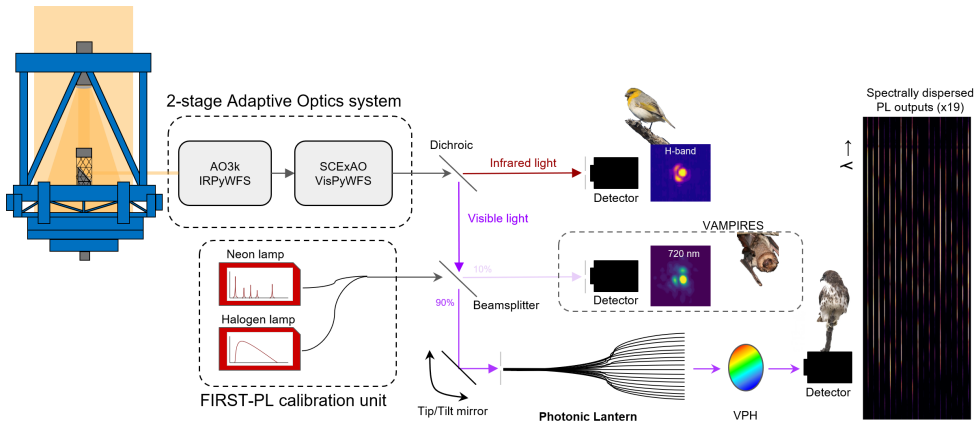
The central object is the 19-port photonic lantern: an adiabatic taper from a multimode input fiber to an array of single-mode output fibers that decomposes the incoming field into orthogonal spatial modes, one per port. Because the output port fluxes depend on where the source sits in the lantern's 80 mas field, the lantern acts simultaneously as a narrow-field integral-field unit and as a co-located focal-plane wavefront sensor; dispersing the ports turns that spatial encoding into wavelength-resolved spectro-astrometry. The key calibration step is inverting this spatial response, using either passive residual tip-tilt jitter in spectro-astrometry mode or a synchronised piezo tip-tilt mirror that actively scans the beam across the lantern input in image-reconstruction modes, with simultaneous visible and near-infrared focal-plane images providing real-time telemetry of the beam position.
What would settle it
A decisive check is to feed an unresolved calibration source through the same optics and tip-tilt dither pattern used on sky; if the pipeline returns nonzero photocenter shifts as a function of wavelength or dither position, those shifts define an instrument systematic floor that must be subtracted before the 35--50 microarcsecond astrophysical claims can stand.
Extended reading notes
Core claim
The paper establishes that a 19-port photonic lantern fed by the Subaru/SCExAO adaptive-optics system, with each port dispersed at $R\sim3{,}000$ over 620--780 nm, makes single-aperture spectro-astrometry precise enough to work far below $\lambda/D$. The lantern converts the multimode input beam into 19 single-mode outputs, so a source's position and phase are encoded in the relative flux of the ports; calibrating that encoding with residual tip-tilt jitter and simultaneous focal-plane PSF telemetry turns wavelength-resolved port spectra into photocenter displacements. Commissioning results show about 50 microarcsecond precision on the H$\alpha$ line of $\beta$ CMi, where the recovered Keplerian velocity pattern also reveals a 0.27 mas minor-axis brightness asymmetry, and about 35 microarcsecond precision on Altair, whose H$\alpha$ spectro-astrometry yields a spin-axis position angle of $-61.8^\circ \pm 2.8^\circ$ and $v\sin i = 220 \pm 16$ km/s. The authors argue these measurements, taken in tens to hundreds of seconds on a single 8.2 m telescope, reach the spatial precision of long-baseline optical interferometry without its operational cost.
Load-bearing premise
The method assumes that the mapping between a star's position on the lantern input and the brightness pattern across the 19 output spectra stays identical between the calibration observation and the science observation; any drift or change in optics in between turns the tiny measured position shifts into instrument artifacts rather than real celestial structure.
Editorial extensions
If this is right
- Stellar spin-axis orientations and $v\sin i$ values for rapidly rotating stars can be measured from a single telescope in about a minute of on-sky time, bypassing the scheduling and baseline coverage of interferometric arrays.
- Circumstellar disk structure, including near-far side opacity asymmetries at the sub-milliarcsecond level, becomes accessible through wavelength-resolved photocenter shifts across emission lines.
- The planned $R\sim63{,}000$ echelle upgrade would extend the technique from broad H$\alpha$ lines of fast rotators to narrow photospheric lines of slowly rotating stars, which is the regime needed for exoplanet-host obliquity work.
- Using the lantern as a chromatic wavefront sensor could mitigate the low-wind effect on large apertures, since broad wavelength coverage avoids phase-wrapping ambiguity at the telescope spiders.
- With FIRST-PL offered for open-time observations from semester 2026B, the three demonstrated modes—spectro-astrometry, on-axis image reconstruction, and off-axis high-contrast imaging—are available to external programs.
Reading between the lines
- If the $\sim$10 microarcsecond precision quoted for tip-tilt-modulated Altair data holds under routine observing, the practical limit of the method becomes the calibration stability of the lantern response, not photon noise; that is the number to watch as the instrument goes to open time.
- A decisive stress test, not reported here, would be to scan an internal calibration point source across the lantern input with the same piezo dither pattern used on sky and demand zero recovered photocenter shift; the residual would set the true systematic floor of the technique.
- The same response-matrix formalism that enables spectro-astrometry should also allow model-independent image reconstruction of sub-diffraction binaries, and the upcoming reconstruction of HIP 81126 will show whether the 70 mas binary is recovered at the expected position angle and separation.
Signed reviews
Editorial analysis
A structured set of objections, weighed in public.
Referee Report
Summary. The manuscript reports the commissioning of FIRST-PL, a 19-port visible photonic lantern spectrograph on Subaru/SCExAO. It describes the instrument architecture, three observing modes (spectro-astrometry, on-axis and off-axis image reconstruction), on-sky throughput performance, and early science demonstrations: β CMi Hα spectro-astrometry with 50 µas precision and a 0.27 mas minor-axis asymmetry, Altair spin-axis PA -61.8°±2.8° from 35 µas precision measurements, and a 5σ raw contrast limit of ~10^-3 at 100 mas for HIP 81126. The paper claims a 12× throughput improvement over single-mode fibers and announces open community access starting in Semester 2026B. Detailed data reduction and calibration theory are deferred to companion papers (Kim et al. 2025; Walk et al. in prep.; Sarrazin et al. in prep.).
Significance. If the spectro-astrometric precision figures hold up, FIRST-PL demonstrates that photonic-lantern-based single-aperture spectro-astrometry can reach tens of microarcseconds on bright stars, competing with long-baseline interferometry for selected measurements such as stellar spin axes and disk kinematics. The external consistency of the Altair position angle with VLTI/CHARA within 1σ provides an independent anchor for the method and is a genuine strength. The paper also documents a technically interesting instrument with real on-sky commissioning results, including injection efficiency measurements and a first contrast curve. However, because the calibration pipeline, null tests, and systematic error budget are not presented here, the quantitative science claims must be treated as preliminary until the companion papers provide the missing validation.
major comments (4)
- [§4.3 and §3.1] The central claim of 35–50 µas spectro-astrometry rests on the assumption that the PL response matrix is stable and linear between calibrator and science target, and that residual tip-tilt jitter provides sufficient spatial diversity to map it. The manuscript provides no on-sky null test on an unresolved star, no repeated calibrator measurements, and no error budget separating photon noise from response-model mismatch. The only external validation is the Altair PA agreement with interferometry; with a claimed uncertainty of ±2.8°, a few degrees of calibration systematics are not excluded by that single comparison. Please provide a null test, calibrator repeatability, and an explicit error budget, or clearly mark the science results as preliminary and dependent on the companion papers.
- [§5.1] Section 5.1 states that as AO performance improves, natural tip-tilt jitter decreases significantly, complicating spectro-astrometric calibration and requiring manual PSF dithering, and that a dedicated TT-modulation mode was recently implemented and validated on-sky. This directly undercuts the §3.1 operational principle that passive jitter provides 'inherent motion' sufficient to map the PL response without active modulation. If the static-mode calibration basis was fragile, the static data used for the β CMi and Altair results need to be re-analyzed with the new modulated mode to demonstrate that those results are robust, or the paper should explicitly state the limitation.
- [§4.1 and Abstract] The abstract claims a '12× throughput improvement over single-mode fibers,' but §4.1 reports only on-sky injection efficiency (21% and 40% mean at 642 nm and 680 nm) and an end-to-end throughput of ~1%; no direct comparison measurement against a single-mode fiber under the same conditions is shown. Please provide the measurement basis for the factor of 12, or remove the claim.
- [§4.2] The sensitivity and astrometric precision statements are not tied to a quantitative error budget. Equation (1) gives detector noise per pixel, and the text asserts σ_astro ∝ 1/SNR, but there is no derivation of how photon noise propagates through the PL modal response inversion to the final photocenter precision, nor any accounting for systematic terms (e.g., differential flexure or non-common-path aberrations between the 10% VAMPIRES path and the 90% FIRST-PL path). The reported 35–50 µas values therefore lack a demonstrated statistical foundation in this manuscript.
minor comments (6)
- [§4.1] There is a typo in the first sentence: 'Engineering bservations' should read 'Engineering observations.'
- [§3.1] The instrument name 'V AMPIRES' is written with an internal space; elsewhere and in the references it appears as 'VAMPIRES'. Please make the spelling consistent.
- [§4.3.2] The target Humu is introduced as 'Humu (Altair, α Aql)' but later abbreviated inconsistently as 'Humu'; please define the preferred name at first use and use it consistently.
- [Abstract and §4.3.1] The target is written as 'β-CMi' in the abstract and 'βCMi' in the text; please use a single notation throughout.
- [Table 1] The field-of-view entry '80 mas @ f/8' does not specify the wavelength at which this was measured; the FoV of a photonic lantern is wavelength dependent and should be qualified.
- [References] References [29] and [34] are SPIE proceedings with 2026 dates; please verify that they are publicly available or provide DOIs, since the manuscript relies on them for key claims.
Circularity Check
No circularity found: the spectro-astrometric calibration is referenced to independent focal-plane PSF telemetry, and the headline results are checked against external interferometric and literature values.
full rationale
The paper's central derivation maps 19-port photonic-lantern intensities to photocenter shifts. The calibration basis is residual tip-tilt jitter tracked by simultaneous VAMPIRES/NIR PSF telemetry (Sections 3.1 and 4.3), not the astrophysical signal being measured; the H-alpha line photocenter is extracted as a differential residual relative to the continuum PSF reference. This is not equivalent to the input by construction. The Altair spin-axis position angle of -61.8 degrees +/- 2.8 degrees is explicitly compared with independent VLTI and CHARA results (Section 4.3.2), and the beta CMi disk kinematics are said to be in strong agreement with previous studies (Section 4.3.1), providing external falsifiability. The paper defers detailed pipeline derivation to same-team companion papers (Kim et al. 2025; Walk et al. in prep.), but those citations are not used to define the result into existence or to forbid alternatives; they are backed by external comparisons. Section 5.1's admission that reduced jitter required manual dithering and active tip-tilt modulation is a calibration-stability concern, not a circularity. No equation in the paper reduces a prediction to a fitted parameter, and no uniqueness theorem is imported from the authors' prior work. Score 0.
Assumptions & free parameters
free parameters (1)
- Projected rotational velocity vsini =
220 +/- 16 km/s
assumptions (4)
- domain assumption The PL decomposes the input field into orthogonal spatial modes whose relative intensities linearly encode input spatial phase and amplitude.
- domain assumption The PL spatial response matrix calibrated on an unresolved calibrator (or via simultaneous focal-plane PSF telemetry) remains valid for the science target.
- domain assumption Residual atmospheric tip-tilt jitter provides sufficient spatial diversity to map the PL response without active scanning.
- standard math Photocenter precision scales inversely with signal-to-noise ratio (sigma_astro proportional to 1/SNR).
Cite this review
Pith. "Pith review of FIRST-PL: Commissioning the first visible photonic lantern spectrograph for sub-diffraction-limit astronomy on Subaru/SCExAO." pith.science (2026). https://pith.science/paper/IG3QKOOE
@misc{pith2026260804372,
  author       = {Pith},
  title        = {Pith review of: FIRST-PL: Commissioning the first visible photonic lantern spectrograph for sub-diffraction-limit astronomy on Subaru/SCExAO},
  year         = {2026},
  howpublished = {\url{https://pith.science/paper/IG3QKOOE}},
  note         = {Machine review of arXiv:2608.04372}
}
read the original abstract
FIRST-PL (Fibered Imager foR a Single Telescope - Photonic Lantern) is a newly commissioned visible-light instrument on Subaru/SCExAO achieving spectroscopy below the diffraction limit. The instrument uses a Photonic Lantern (PL)-converting multimode fiber into 19 single-mode outputs-feeding a mid-resolution spectrograph (R 3000, 630-790 nm). On-sky performance demonstrates 40% injection efficiency at 680 nm (Strehl 30%) and 12x throughput improvement over single-mode fibers. Three operational modes enable spectro-astrometry (50 microarcseconds precision demonstrated on beta-CMi), image reconstruction, and high-contrast imaging. FIRST-PL represents a significant advancement in high-throughput photonic instrumentation.
Figures


Figures from the paper (6 more)


Reference graph
Works this paper leans on
-
[1]
The orbital motion, absolute mass and high-altitude winds of exoplanet HD209458b,
Snellen, I. A. G., de Kok, R. J., de Mooij, E. J. W., and Albrecht, S., “The orbital motion, absolute mass and high-altitude winds of exoplanet HD209458b,”Nature465, 1049–1051 (June 2010)
work page 2010
-
[2]
The signature of orbital motion from the dayside of the planetτBo¨ otis b,
Brogi, M., Snellen, I. A. G., de Kok, R. J., Albrecht, S., Birkby, J., and de Mooij, E. J. W., “The signature of orbital motion from the dayside of the planetτBo¨ otis b,”Nature486, 502–504 (June 2012)
work page 2012
-
[3]
Direct Imaging and Spectroscopy of Extrasolar Planets,
Currie, T., Biller, B., Lagrange, A., Marois, C., Guyon, O., Nielsen, E. L., Bonnefoy, M., and De Rosa, R. J., “Direct Imaging and Spectroscopy of Extrasolar Planets,” in [Protostars and Planets VII], Inutsuka, S., Aikawa, Y., Muto, T., Tomida, K., and Tamura, M., eds.,Astronomical Society of the Pacific Conference Series534, 799 (July 2023)
work page 2023
-
[4]
Constraints on the spin evolution of young planetary-mass companions,
Bryan, M. L., Benneke, B., Knutson, H. A., Batygin, K., and Bowler, B. P., “Constraints on the spin evolution of young planetary-mass companions,”Nature Astronomy2, 138–144 (Dec. 2017)
work page 2017
-
[5]
Obliquity Constraints on an Extrasolar Planetary-mass Companion,
Bryan, M. L., Chiang, E., Bowler, B. P., Morley, C. V., Millholland, S., Blunt, S., Ashok, K. B., Nielsen, E., Ngo, H., Mawet, D., and Knutson, H. A., “Obliquity Constraints on an Extrasolar Planetary-mass Companion,”The Astronomical Journal159, 181 (Apr. 2020)
work page 2020
-
[6]
Lissauer, J. J., “Planet formation,”In: Annual review of astronomy and astrophysics. Vol. 31 (A94-12726 02-90), p. 129-174.31, 129–174 (1993)
work page 1993
-
[7]
Kotani, T., Kawahara, H., Ishizuka, M., Jovanovic, N., Guyon, O., Vievard, S., Lozi, J., Sahoo, A., Yoneta, K., and Tamura, M., “The reach project: combining extremely high-contrast and high spectral resolution at the subaru telescope,” in [Adaptive Optics Systems VII],11448, 1144878, International Society for Optics and Photonics (2020)
work page 2020
-
[8]
Delorme, J.-R., Jovanovic, N., Echeverri, D., Mawet, D., Kent Wallace, J., Bartos, R. D., Cetre, S., Wiz- inowich, P., Ragland, S., Lilley, S., et al., “Keck planet imager and characterizer: a dedicated single-mode fiber injection unit for high-resolution exoplanet spectroscopy,”Journal of Astronomical Telescopes, Instru- ments, and Systems7(3), 035006–03...
work page 2021
Show all 36 references
-
[9]
Scalable photonic-based nulling interferometry with the dispersed multi-baseline glint instrument,
Martinod, M.-A., Norris, B., Tuthill, P., Lagadec, T., Jovanovic, N., Cvetojevic, N., Gross, S., Arriola, A., Gretzinger, T., Withford, M. J., et al., “Scalable photonic-based nulling interferometry with the dispersed multi-baseline glint instrument,”Nature communications12(1)...
2021
-
[10]
Single-aperture spectro-interferometry in the visible at the subaru telescope with first: First on-sky demonstration on keho ‘oea (αlyrae) and hokulei (αaurigae),
Vievard, S., Huby, E., Lacour, S., Guyon, O., Cvetojevic, N., Jovanovic, N., Lozi, J., Barjot, K., Deo, V., Duchˆ ene, G., et al., “Single-aperture spectro-interferometry in the visible at the subaru telescope with first: First on-sky demonstration on keho ‘oea (αlyrae) and ho...
2023
-
[11]
First light of vlt/hirise: High-resolution spectroscopy of young giant exoplanets,
Vigan, A., El Morsy, M., Lopez, M., Otten, G., Garcia, J., Costes, J., Muslimov, E., Viret, A., Charles, Y., Zins, G., et al., “First light of vlt/hirise: High-resolution spectroscopy of young giant exoplanets,” Astronomy & Astrophysics682, A16 (2024)
2024
-
[12]
Fiber-fed high-resolution infrared spectroscopy at the diffraction limit with keck-hispec and tmt-modhis: status update,
Mawet, D., Fitzgerald, M. P., Konopacky, Q., Jovanovic, N., Baker, A., Andersen, D., Artigau, E., Bailey III, J. I., Beichman, C., Benneke, B., et al., “Fiber-fed high-resolution infrared spectroscopy at the diffraction limit with keck-hispec and tmt-modhis: status update,” in...
2024
-
[13]
The first images from optical aperture synthesis,
Haniff, C. A., Mackay, C., Titterington, D. J., Sivia, D., Baldwin, J., and Warner, P., “The first images from optical aperture synthesis,”Nature328(6132), 694–696 (1987)
1987
-
[14]
Sparse aperture masking at the vlt-ii. detection limits for the eight debris disks starsβpic, au mic, 49 cet, ηtel, fomalhaut, g lup, hd 181327 and hr 8799,
Gauchet, L., Lacour, S., Lagrange, A.-M., Ehrenreich, D., Bonnefoy, M., Girard, J., and Boccaletti, A., “Sparse aperture masking at the vlt-ii. detection limits for the eight debris disks starsβpic, au mic, 49 cet, ηtel, fomalhaut, g lup, hd 181327 and hr 8799,”Astronomy & Ast...
2016
-
[15]
High dynamic range imaging by pupil single-mode filtering and remapping,
Perrin, G., Lacour, S., Woillez, J., and Thiebaut, E., “High dynamic range imaging by pupil single-mode filtering and remapping,”Monthly Notices of the Royal Astronomical Society373, 747–751 (Dec. 2006)
2006
-
[16]
FIRST, a fibered aperture masking instrument: II. Spectroscopy of the Capella binary system at the diffraction limit,
Huby, E., Duchˆ ene, G., Marchis, F., Lacour, S., Perrin, G., Kotani, T., Choquet, A, Gates, E. L., Lai, O., and Allard, F., “FIRST, a fibered aperture masking instrument: II. Spectroscopy of the Capella binary system at the diffraction limit,”Astronomy & Astrophysics560, A113...
2013
-
[17]
The Subaru Coronagraphic Extreme Adaptive Optics System: Enabling High-Contrast Imaging on Solar-System Scales,
Jovanovic, N., Martinache, F., Guyon, O., Clergeon, C., Singh, G., Kudo, T., Garrel, V., Newman, K., Doughty, D., Lozi, J., Males, J., Minowa, Y., Hayano, Y., Takato, N., Morino, J., Kuhn, J., Serabyn, E., Norris, B., Tuthill, P., Schworer, G., Stewart, P., Close, L., Huby, E....
2015
-
[18]
The photonic lantern,
Birks, T. A., Gris-S´ anchez, I., Yerolatsitis, S., Leon-Saval, S. G., and Thomson, R. R., “The photonic lantern,”Adv. Opt. Photon.7, 107–167 (Jun 2015)
2015
-
[19]
Validation of strategies for coupling exoplanet psfs into single-mode fibres for high-dispersion coronagraphy,
El Morsy, M., Vigan, A., Lopez, M., Otten, G. P. P. L., Choquet, E., Madec, F., Costille, A., Sauvage, J.-F., Dohlen, K., Muslimov, E., Pourcelot, R., Floriot, J., Benedetti, J.-A., Blanchard, P., Balard, P., and Murray, G., “Validation of strategies for coupling exoplanet psf...
2022
-
[20]
Efficient injection from large telescopes into single-mode fibres: Enabling the era of ultra-precision astronomy,
Jovanovic, N., Schwab, C., Guyon, O., Lozi, J., Cvetojevic, N., Martinache, F., Leon-Saval, S., Norris, B., Gross, S., Doughty, D., Currie, T., and Takato, N., “Efficient injection from large telescopes into single-mode fibres: Enabling the era of ultra-precision astronomy,”As...
2017
-
[21]
Prime focus spectrograph (pfs) for the subaru telescope: overview, recent progress, and future perspectives,
Tamura, N., Takato, N., Shimono, A., Moritani, Y., Yabe, K., Ishizuka, Y., Ueda, A., Kamata, Y., Aghaz- arian, H., Arnouts, S., et al., “Prime focus spectrograph (pfs) for the subaru telescope: overview, recent progress, and future perspectives,”Ground-based and airborne instr...
2016
-
[22]
On the Potential of Spectroastrometry with Photonic Lanterns,
Kim, Y. J., Fitzgerald, M. P., Lin, J., Xin, Y., Levinstein, D., Sallum, S., Jovanovic, N., and Leon-Saval, S., “On the Potential of Spectroastrometry with Photonic Lanterns,” (Sept. 2024). arXiv:2409.09120 [astro-ph]
2024 arXiv
-
[23]
An all-photonic focal-plane wavefront sensor,
Norris, B. R., Wei, J., Betters, C. H., Wong, A., and Leon-Saval, S. G., “An all-photonic focal-plane wavefront sensor,”Nature Communications11(1), 5335 (2020)
2020
-
[24]
An all-photonic focal-plane wavefront sensor,
Norris, B. R. M., Wei, J., Betters, C. H., Wong, A., and Leon-Saval, S. G., “An all-photonic focal-plane wavefront sensor,”Nature Communications11, 5335 (Oct. 2020). arXiv:2003.05158 [astro-ph]
2020 arXiv
-
[25]
Spectroscopy using a visible photonic lantern at the Subaru Telescope: Laboratory characterization and the first on-sky demonstration on Ikiiki ( alpha Leo) and Aua (alpha Ori),
Vievard, S., Lallement, M., Leon-Saval, S., Guyon, O., Jovanovic, N., Huby, E., Lacour, S., Lozi, J., Deo, V., Ahn, K., Lucas, M., Sallum, S., Norris, B., Betters, C., Amezcua-Correa, R., Yerolatsitis, S., Fitzgerald, M. P., Lin, J., Kim, Y. J., Gatkine, P., Kotani, T., Tamura...
2024
-
[26]
Ao3k at subaru: first on-sky results of the facility extreme-ao,
Lozi, J., Ahn, K., Blue, H., Chun, A., Clergeon, C., Deo, V., Guyon, O., Hattori, T., Minowa, Y., Nishiyama, S., et al., “Ao3k at subaru: first on-sky results of the facility extreme-ao,” in [Adaptive Optics Systems IX], 13097, 1309703, SPIE (2024)
2024
-
[27]
Visible and near-infrared laboratory demonstration of a simplified pyramid wavefront sensor,
Lozi, J., Jovanovic, N., Guyon, O., Chun, M., Jacobson, S., Goebel, S., and Martinache, F., “Visible and near-infrared laboratory demonstration of a simplified pyramid wavefront sensor,”Publications of the Astronomical Society of the Pacific131, 044503 (mar 2019)
2019
-
[28]
Visible-light high-contrast imaging and polarimetry with scexao/vampires,
Lucas, M., Norris, B., Guyon, O., Bottom, M., Deo, V., Vievard, S., Lozi, J., Ahn, K., Ashcraft, J., Currie, T., et al., “Visible-light high-contrast imaging and polarimetry with scexao/vampires,”Publications of the Astronomical Society of the Pacific136(11), 114504 (2024)
2024
-
[29]
FIRST-PL: on-sky retrieval of Humu’s (Altair) spin axis using a photonic lantern on Subaru telescope,
Walk, A., Vievard, S., Guyon, O., Kim, Y. J., Huby, E., Lacour, S., Lallement, M., Nowak, M., Sarrazin, J., Lozi, J., Deo, V., Lucas, M., Fitzgerald, M., Leon-Saval, S., Norris, B., Sallum, S., Currie, T., Tamura, M., and Kotani, T., “FIRST-PL: on-sky retrieval of Humu’s (Alta...
2026
-
[30]
A realistic two- dimensional model of altair,
Bouchaud, K., Domiciano de Souza, A., Rieutord, M., Reese, D., and Kervella, P., “A realistic two- dimensional model of altair,”Astronomy & Astrophysics633, A78 (2020)
2020
-
[31]
Imaging the Surface of Altair,
Monnier, J. D., Zhao, M., Pedretti, E., Thureau, N., Ireland, M., Muirhead, P., Berger, J. P., Millan-Gabet, R., Van Belle, G., Brummelaar, T. t., McAlister, H., Ridgway, S., Turner, N., Sturmann, L., Sturmann, J., and Berger, D., “Imaging the Surface of Altair,” (2007). Versi...
2007
-
[32]
Sub-milliarcsecond precision spectro-astrometry of be stars,
Oudmaijer, R. D., Parr, A., Baines, D., and Porter, J., “Sub-milliarcsecond precision spectro-astrometry of be stars,”Astronomy & Astrophysics489(2), 627–631 (2008)
2008
-
[33]
The structure and dynamics of molecular gas in planet-forming zones: a crires spectro-astrometric survey,
Pontoppidan, K. M., Blake, G. A., and Smette, A., “The structure and dynamics of molecular gas in planet-forming zones: a crires spectro-astrometric survey,”The Astrophysical Journal733(2), 84 (2011)
2011
-
[34]
High resolution echelle spectrometer integrating 19 channel photonic lantern,
Hamner, C., Vievard, S., Gilbert, A., Walk, A., Huby, E., Lacour, S., Martin, G., Hirano, T., Tamura, M., Kotani, T., and Guyon, O., “High resolution echelle spectrometer integrating 19 channel photonic lantern,” in [Advances in Optical and Mechanical Technologies for Telescop...
2026
-
[35]
Low wind effect on VLT/SPHERE: impact, mitigation strategy, and results,
Milli, J., Mouillet, D., Beuzit, J.-L., Sauvage, J.-F., Fusco, T., Bourget, P., Kasper, M., Tristam, K., Reyes, C., Girard, J. H., Telle, A., Pannetier, C., Cantalloube, F., Wahhaj, Z., Mawet, D., Vigan, A., and N’Diaye, M., “Low wind effect on VLT/SPHERE: impact, mitigation s...
2018
-
[36]
Focal Plane Wavefront Sensing on SUBARU/SCExAO,
Vievard, S., Bos, S. P., Cassaing, F., Currie, T., Deo, V., Guyon, O., Jovanovic, N., Keller, C., Lamb, M., Lopez, C., Lozi, J., Martinache, F., Miller, K., Montmerle-Bonnefois, A., Mugnier, L. M., N’Diaye, M., Norris, B., Sahoo, A., Sauvage, J.-F., Skaf, N., Snik, F., Wilby, ...
2020 arXiv
Reviewed August 8, 2026 · model on record in the stance chip above.
Discussion (0). Continue with ORCID to comment.