REVIEW 3 major objections 6 minor 35 references
An Integrated Sensing and Communications System Based on Affine Frequency Division Multiplexing
T0 review · 3 major / 6 minor · reviewed 2026-08-09 · deepseek-v4-flash
Pith's one-line read The paper claims that an AFDM chirp waveform can more than quintuple the Doppler tolerance of an OFDM-based integrated sensing and communications system at equal spectral efficiency, and can estimate Doppler beyond the subcarrier-spacing…
desk verdict The AFDM-ISAC metric analysis is mostly sound and the 5.6x Doppler comparison is algebraically real, but the unambiguous-Doppler estimation claim rests on an unproven early-late heuristic and no simulation exercises it. read the letter →
The pith
A machine-rendered reading of the paper's core claim, the machinery that carries it, and where it could break.
The reading
What carries the argument
The central object is the AFDM chirp-periodic structure and the affine Fourier transform pair. The chirp parameter $c_1$ controls the cyclic shift $\mathrm{loc}_i = \langle 2N c_1 l_i - \alpha_i \rangle_N$ in the AFT domain, which couples delay with the integral part of the normalized Doppler. The receiver decouples them by applying delay-compensation matrices $\mathbf{L}_l = \mathrm{diag}(e^{j2\pi pl/N})$ and searching for peaks in the AFT-Doppler matrix $\mathbf{Z}_l^F$. The load-bearing identity is Eq. (57): when the compensated delay matches the true delay and the Doppler matches the grid, the periodic ambiguity function of the random symbols approximates a delta and a peak appears at $(l, \langle \alpha_i - 2N c_1 l_i \rangle_N, \langle N_{\mathrm{sym}} b_i \rangle_{N_{\mathrm{sym}}})$. That identity converts radar-image peak positions into delay and Doppler estimates and permits splicing integral and fractional Doppler across two different normalization grids.
What would settle it
Run the proposed estimator on a single simulated target whose true normalized Doppler sits exactly at a candidate-integer boundary (where $\hat{\beta}_{\mathrm{max}} = \hat{\beta}_{\mathrm{min}}+1$ and the early and late AFT-domain samples are comparable), and record the Doppler estimate; a bias of about $\Delta f' = B/(N+N_{\mathrm{cp}})$ in a nontrivial fraction of trials would show the Eq. (63) branch choice fails. A second check replaces random QAM symbols with a constant-modulus or short deterministic block and observes whether the peak in $\mathbf{Z}_l^F$ remains delta-like; if the peak spreads, the Eq. (57) approximation breaks.
Extended reading notes
Core claim
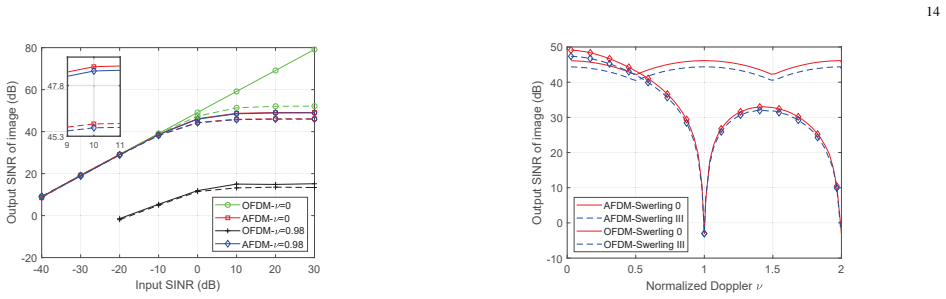
The paper claims that choosing the AFDM chirp parameter as $c_1 = 1/[2(N_{\mathrm{cp}}+1)]$ makes the maximum tolerable Doppler of AFDM-ISAC about 5.6 times that of OFDM-ISAC while keeping the same cyclic prefix length, the same communication spectral efficiency, and the same maximum tolerable delay. It further claims that in the affine Fourier transform (AFT)-Doppler domain the target delay and the integral and fractional parts of the normalized Doppler separate: the AFT-domain peak position carries the combination $\langle \alpha_i - 2N c_1 l_i \rangle_N$, the symbol-index DFT peak carries $\langle N_{\mathrm{sym}} b_i \rangle_{N_{\mathrm{sym}}}$, and the two are spliced through Eqs. (61)--(63) to give a Doppler estimate whose unambiguous range exceeds the subcarrier-spacing limit. Numerical results show AFDM-ISAC keeping image SNR above 40 dB for normalized Doppler up to 2, where the OFDM-ISAC image drops below 0 dB, while matching OFDM and OTFS velocity RMSE.
Load-bearing premise
The whole unambiguous-Doppler extension rests on the early-late rule in Eq. (63) choosing the correct candidate Doppler integer when two are possible, and on the periodic ambiguity function of the random symbol block being close to a delta; if the rule or the delta approximation fails, the estimated Doppler can jump by roughly one subcarrier spacing of the AFT-Doppler grid.
Editorial extensions
If this is right
- An AFDM-ISAC design with $c_1 = 1/[2(N_{\mathrm{cp}}+1)]$ achieves about 5.6 times the maximum tolerable Doppler of OFDM-ISAC at the same communication spectral efficiency and same maximum delay, and therefore roughly 5.6 times the sensing spectral efficiency.
- The proposed estimator measures Doppler beyond the subcarrier-spacing limit: the integral part comes from the AFT-domain peak via $\hat{\alpha}_i = \langle \bar{p}_i + 2N c_1 \hat{l}_i + N c_1 \rangle_N - N c_1$, the fractional part from the symbol-domain peak via Eq. (60), and the two are spliced using Eqs. (61)--(63).
- Under Swerling 0, AFDM-ISAC keeps image SNR above 40 dB for normalized Doppler up to 2, while OFDM-ISAC's image SNR drops below 0 dB near integral Doppler.
- The derived analytical trade-offs give a design guideline: choose $c_1$, $N_{\mathrm{cp}}$, and $N$ satisfying Eq. (47) to meet target delay/Doppler and spectral-efficiency requirements.
- Under identical time-frequency resources and an ML estimator, AFDM-ISAC matches OFDM and OTFS velocity RMSE while offering a wider unambiguous Doppler range.
Reading between the lines
- Because the unambiguous-Doppler gain comes from the chirp parameter $c_1$ rather than from the random data, the same decoupling idea should transfer to pilot-only or deterministic AFDM frames, provided the delta approximation for the periodic ambiguity function is replaced by a deterministic reference; this suggests the randomness of communication symbols is not essential to the sensing gain.
- The early-late criterion in Eq. (63) is the weakest link: an independent derivation or a maximum-likelihood branch test across the two candidate $\hat{\beta}_i$ values could replace it, and simulation at the branch boundary would establish the actual failure rate.
- The SSE/SOP formulation invites a unified optimization of AFDM parameters against both communication outage and sensing outage, for instance minimizing a weighted outage sum subject to an efficiency constraint, which the current paper only begins to map via trade-off curves.
- Comparing AFDM-ISAC with ODDM- or OTFS-ISAC under identical pilot overhead and mobility would test whether the fivefold Doppler advantage is specific to AFDM or shared by other chirp/delay-Doppler-domain waveforms.
Signed reviews
Editorial analysis
A structured set of objections, weighed in public.
Referee Report
Summary. The paper proposes an AFDM-based ISAC system, introduces two new sensing metrics (sensing spectral efficiency, SSE, and sensing outage probability, SOP), derives analytical relations between these metrics and the AFDM parameters c1, N, and Ncp, and claims that AFDM-ISAC can achieve more than five times the maximum tolerable Doppler of OFDM-ISAC at equal spectral efficiency and delay tolerance. It further proposes an estimation algorithm (Algorithm 1) that is claimed to estimate delay and the integral and fractional parts of normalized Doppler in the AFT-Doppler domain, with unambiguous Doppler extending beyond the subcarrier-spacing limit.
Significance. If the claims hold, the paper offers a practical waveform for high-mobility ISAC with substantially wider unambiguous velocity coverage, together with a metric framework that links sensing performance to communication-like metrics. The analytical relations in Eqs. (35)-(44) are derived in closed form without curve fitting, and the 5.6 times Doppler ratio follows algebraically from the derived fd,max expressions. The SSE/SOP metrics provide an intuitive way to discuss ISAC trade-offs, and the PSLR results under high Doppler are a concrete improvement over the OFDM-ISAC baseline. The weakest part is the parameter-estimation claim: the core early-late decision rule is unproven, and the proposed estimator is not validated in the simulation section for the regime in which the claimed unambiguous-Doppler extension matters.
major comments (3)
- [Section V-B, Eq. (63), Algorithm 1] The early-late criterion is introduced without derivation or analysis. When β_i has two candidate integers, a wrong choice changes the estimated Doppler by approximately Δf' = B/(N+Ncp) ≈ Δf·N/(N+Ncp), i.e., roughly one subcarrier spacing, which destroys the claimed unambiguous-Doppler extension. The criterion is a sign test on the asymmetry between |Z^l_i_F[ar{p}_i−1,\bar{k}_i]| and |Z^l_i_F[\bar{p}_i+1,\bar{k}_i]|, but no proof is given that this asymmetry is monotone in a_i or robust to noise. Moreover, the adjacent cells are exactly where the approximation µ_k[p,m] ≈ c0δ[p]δ[m] (Eq. (57)) is least reliable for random QAM symbols with finite N. This is a load-bearing gap for the central estimation claim.
- [Section III-B, Definition 1, Lemma 1, Eqs. (17) and (20)-(21)] SSE is defined as "how much interested information on targets can be actually obtained by sensing," but the formula in Eq. (21) is computed conditional on the correct sub-cell being determined. Lemma 1 explicitly assumes this, and no probability of incorrect sub-cell determination enters Eq. (21); the estimation-error probability appears only in SOP (Eq. (24)). Therefore Eq. (21) is an upper bound on the actual mutual information, not the actual information, and all SSE-based comparisons (Example 3, Figs. 4 and 5(a)) overstate the sensing efficiency. The definition and the interpretation of SSE should be revised, or the text should explicitly state that SSE is an optimistic bound.
- [Section VI, Figs. 6-8] The proposed estimation algorithm is not validated for the scenario that motivates it. Fig. 8 reports velocity RMSE for an ML estimator, not for Algorithm 1, and uses a different frame configuration (Nc=2560, Nsym=1) than the rest of the paper (Table II: N=2560, Nsym=32). No simulation in Section VI exercises Algorithm 1 for a target whose normalized Doppler ν_i leads to two candidate values of β_i in Eq. (62), so the claimed breaking of the subcarrier-spacing limit is not empirically supported.
minor comments (6)
- [Section III-A] The word "genaral" should be "general".
- [Algorithm 1] The text "Iuput" should be "Input", and "Extrate" should be "Extract".
- [Eq. (43)] The expression for k0 lacks parentheses and is ambiguous; it should read k0 = ((2ξv+2)ηcp − (2ξv+1))/(ηcp(1−ηcp)).
- [Section IV-B (2)] The word "contant" should be "constant".
- [Remark 1] The word "Sweiling" should be "Swerling".
- [Eq. (56)] The notation "ZlF = ZlF" is confusing; the left-hand side should be defined explicitly as the AFT-Doppler matrix.
Circularity Check
No significant circularity: the 5.6x Doppler ratio and the SSE curves are closed-form consequences of the stated metrics and AFDM parameter constraints, not fitted or self-imported results.
full rationale
The paper's central quantitative claims are algebraic consequences of its stated definitions and the prior AFDM channel model, not fitted or self-imported results. The 5.6x Doppler ratio follows from Eqs. (35)-(44), which combine the AFDM parameter constraint (36) with OFDM's relation fd,max_O = (1-eta_cp)/(2 tau_max_O); no parameter is fitted to the comparison target, and the claims hold for both Swerling 0 and Swerling 3 simulation settings. The SSE comparison is a direct substitution into Eq. (38) after noting that tau_max and Isen are equal, so the SSE ratio is definitionally proportional to the Doppler ratio rather than an independently fitted prediction. The estimation method in Algorithm 1 is not circular: it estimates (l_i, alpha_i, b_i) from peak indices and then resolves beta_i using Eq. (63); the early-late heuristic is unproved and the delta-approximation of the periodic ambiguity function in Eq. (57) is idealized, but these are correctness/robustness gaps, not reductions of the output to the input. The only self-citation (Ref. [1]) is a prior conference version and is not load-bearing: none of the derived trade-offs or the Doppler comparison depends on it. No step fits a parameter to a subset of data and then predicts a closely related quantity, and no external benchmark is claimed from fitted values. Accordingly, no significant circularity is present.
Assumptions & free parameters
assumptions (5)
- domain assumption The AFDM input-output relation and constraints on cyclic shifts from [6] hold, specifically 2Nc1(lmax+1) ≤ N and 2(αmax+ξv) ≤ 2Nc1-1.
- domain assumption The detection mutual information formula from [28, Eq. (11)] applies to each delay-Doppler cell.
- ad hoc to paper The periodic ambiguity function of random QAM symbol blocks is approximated by a delta, µk[p,m] ≈ c0 δ[p]δ[m].
- ad hoc to paper The early-late criterion in Eq. (63) correctly resolves the two-candidate β ambiguity.
- domain assumption Target delays are on the sampling grid and satisfy Ncp > lmax.
Cite this review
Pith. "Pith review of An Integrated Sensing and Communications System Based on Affine Frequency Division Multiplexing." pith.science (2026). https://pith.science/paper/IGN6CCR6
@misc{pith2026250119142,
  author       = {Pith},
  title        = {Pith review of: An Integrated Sensing and Communications System Based on Affine Frequency Division Multiplexing},
  year         = {2026},
  howpublished = {\url{https://pith.science/paper/IGN6CCR6}},
  note         = {Machine review of arXiv:2501.19142}
}
read the original abstract
This paper proposes an integrated sensing and communications (ISAC) system based on affine frequency division multiplexing (AFDM) waveform. To this end, a metric set is designed according to not only the maximum tolerable delay/Doppler, but also the weighted spectral efficiency as well as the outage/error probability of sensing and communications. This enables the analytical investigation of the performance trade-offs of AFDM-ISAC system using the derived analytical relation among metrics and AFDM waveform parameters. Moreover, by revealing that delay and the integral/fractional parts of normalized Doppler can be decoupled in the affine Fourier transform-Doppler domain, an efficient estimation method is proposed for our AFDM-ISAC system, whose unambiguous Doppler can break through the limitation of subcarrier spacing. Theoretical analyses and numerical results verify that our proposed AFDM-ISAC system may significantly enlarge unambiguous delay/Doppler while possessing good spectral efficiency and peak-to-sidelobe level ratio in high-mobility scenarios.
Figures


Figures from the paper (4 more)



Reference graph
Works this paper leans on
-
[6]
Affine frequenc y division multiplexing for next generation wireless communications ,
A. Bemani, N. Ksairi, and M. Kountouris, “Affine frequenc y division multiplexing for next generation wireless communications ,” IEEE Trans. Wireless Commun., vol. 22, no. 11, pp. 8214 – 8229, Nov. 2023
work page 2023
-
[16]
Integrated se nsing and communications with affine frequency division multiplexin g,
A. Bemani, N. Ksairi, and M. Kountouris, “Integrated se nsing and communications with affine frequency division multiplexin g,” IEEE Wireless Commun. Lett. , vol. 13, no. 5, pp. 1255 – 1259, Feb. 2024
work page 2024
-
[18]
AFD M- based bistatic integrated sensing and communication in sta tic scatterer environments,
J. Zhu, Y . Tang, F. Liu, X. Zhang, H. Yin, and Y . Zhou, “AFD M- based bistatic integrated sensing and communication in sta tic scatterer environments,” IEEE Wireless Commun. Lett. , vol. 13, no. 8, pp. 2245 – 2249, Aug. 2024
work page 2024
-
[1]
An AFDM-based integ rated sensing and communications,
Y . Ni, Z. Wang, P . Y uan, and Q. Huang, “An AFDM-based integ rated sensing and communications,” in Proc. 2022 Int. Symposium on Wireless Commun. Syst. (ISWCS) . IEEE, Oct. 2022, pp. 1–6
work page 2022
-
[2]
Joint radar and communication design: Applications, state-of-t he-art, and the road ahead,
F. Liu, C. Masouros, A. Petropulu, H. Griffiths, and L. Han zo, “Joint radar and communication design: Applications, state-of-t he-art, and the road ahead,” IEEE Trans. Commun. , vol. 68, no. 6, pp. 3834–3862, Jun. 2020
work page 2020
-
[3]
C. Sturm and W. Wiesbeck, “Waveform design and signal pro cessing aspects for fusion of wireless communications and radar sen sing,” Proc. IEEE, vol. 99, no. 7, pp. 1236–1259, Jul. 2011
work page 2011
-
[4]
Joint radar-communication wi th cyclic prefixed single carrier waveforms,
Y . Zeng, Y . Ma, and S. Sun, “Joint radar-communication wi th cyclic prefixed single carrier waveforms,” IEEE Trans. V eh. Technol., vol. 69, no. 4, pp. 4069–4079, Apr. 2020
work page 2020
-
[5]
Interfe rence cancellation and iterative detection for orthogonal time f requency space modulation,
P . Raviteja, K. T. Phan, Y . Hong, and E. Viterbo, “Interfe rence cancellation and iterative detection for orthogonal time f requency space modulation,” IEEE Trans. Wireless Commun., vol. 17, no. 10, pp. 6501– 6515, Oct. 2018
work page 2018
Show all 35 references
-
[7]
On the effectiveness of OTFS for joint radar parameter estimation and commu- nication,
L. Gaudio, M. Kobayashi, G. Caire, , and G. Colavolpe, “On the effectiveness of OTFS for joint radar parameter estimation and commu- nication,” IEEE Trans. Wireless Commun., vol. 19, no. 9, pp. 5951–5965, Sep. 2020
2020
-
[8]
Orthogonal time frequency space (OTFS ) modulation for millimeter-wave communications systems,
R. Hadani et al., “Orthogonal time frequency space (OTFS ) modulation for millimeter-wave communications systems,” in Proc. IEEE MTT-S Int. Microw. Symp. IEEE, Jun. 2017, pp. 681–683
2017
-
[9]
Orthogonal delay-doppler division m ultiplexing modulation,
H. Lin and J. Y uan, “Orthogonal delay-doppler division m ultiplexing modulation,” IEEE Trans. Wireless Commun., vol. 21, no. 12, pp. 11024– 11037, Dec. 2022
2022
-
[10]
Exploring channel estimation and signal det ection for ODDM-based ISAC systems,
D. Wang, C. Huang, L. Liu, X. Chen, W. Wang, Z. Zhang, C. Y u en, and M. Debbah, “Exploring channel estimation and signal det ection for ODDM-based ISAC systems,” IEEE Wireless Commun. Lett. , vol. 13, no. 8, pp. 2270 – 2274, Aug. 2024. 16 H ( τ n,k |U n,k , ˆU n,k ) = − ∑ U n...
2024
-
[11]
Multiuser association and localization over doubly dispersive multipath channel s for integrated sensing and communications,
H. Zhang, S. Chen, W. Meng, J. Y uan, and C. Li, “Multiuser association and localization over doubly dispersive multipath channel s for integrated sensing and communications,” IEEE J. Sel. Areas Commun. , vol. 42, no. 10, pp. 2847 – 2862, Oct. 2024
2024
-
[12]
Orthogonal chirp division multi plexing,
X. Ouyang and J. Zhao, “Orthogonal chirp division multi plexing,” IEEE Trans. Commun., vol. 64, no. 9, pp. 3946–3957, Sep. 2016
2016
-
[13]
An OCDM radarcommunication systemn,
L. G. de Oliveira and M. B. Alabd and B. Nuss and T. Zwick, “An OCDM radarcommunication systemn,” in Proc. 14th Eur . Conf. Antennas and Propag. (EuCAP) , Mar. 2020, pp. 1–5
2020
-
[14]
Pilot aided channel estimation for A FDM in doubly dispersive channels,
H. Yin and Y . Tang, “Pilot aided channel estimation for A FDM in doubly dispersive channels,” in Proc. 2022 IEEE/CIC Int. Conf. on Commun. in China (ICCC) . IEEE, Sep. 2022, pp. 308 – 313
2022
-
[15]
AFDM-SCMA: A promising waveform for massive connectivity over high mobility channels,
Q. Luo, P . Xiao, Z. Liu, Z. Wan, N. Thomos, Z. Gao, and Z. He , “AFDM-SCMA: A promising waveform for massive connectivity over high mobility channels,” IEEE Trans. Wireless Commun. , vol. 23, no. 10, pp. 14421–14436, Oct. 2024
2024
-
[17]
A low- complexity radar system based on affine frequency division m ultiplexing modulation,
J. Zhu, Y . Tang, X. Wei, H. Yin, J. Du, Z. Wang, and Y . Liu, “ A low- complexity radar system based on affine frequency division m ultiplexing modulation,” arXiv preprint arXiv:2312.11125 , 2023
2023 arXiv
-
[19]
Spectral efficiency evaluation of an NR-based 5G terrestrial broadca st system for fixed reception,
T. Shitomi, T. Nakatogawa, A. Sato, K. Furuya, and M. Oka no, “Spectral efficiency evaluation of an NR-based 5G terrestrial broadca st system for fixed reception,” IEEE Trans. Broadcast. , vol. 68, no. 2, pp. 487–500, Jun. 2022
2022
-
[20]
A Richards, J
M. A Richards, J. A Scheer, and W. A Holm, Principles of Modern Radar: Basic Principles , USA, NY , New Y ork: Scitech, 2010
2010
-
[21]
In- tegrated sensing and communications: Towards dual-functi onal wireless networks for 6G and beyond,
F. Liu, Y . Cui, C. Masouros, J. Xu, X. Han, Y . Eldar, and S. Buzzi, “In- tegrated sensing and communications: Towards dual-functi onal wireless networks for 6G and beyond,” IEEE J. Sel. Areas Commun. , vol. 40, no. 6, pp. 1728–1767, Jun. 2022
2022
-
[22]
Joint design and operation of shared spectrum access for radar and commu- nications,
J. R. Guerci, R. M. Guerci, A. Lackpour, and D. Moskowitz , “Joint design and operation of shared spectrum access for radar and commu- nications,” in Proc. 2015 IEEE Radar Conf. (RadarConf) . IEEE, May 2015, pp. 0761–0766
2015
-
[23]
I nner bounds on performance of radar and communications co-existence,
A. R. Chiriyath, B. Paul, G. M. Jacyna, and D. W. Bliss, “I nner bounds on performance of radar and communications co-existence,” IEEE Trans. Signal Process. , vol. 64, no. 2, pp. 464–474, Jan. 2015
2015
-
[24]
On the fundamental tradeoff of integrated sensing and communicat ions under gaussian channels,
Y . Xiong, F. Liu, Y . Cui, W. Y uan, T. X. Han, and G. Caire, “ On the fundamental tradeoff of integrated sensing and communicat ions under gaussian channels,” IEEE Trans. Info. Theory , vol. 69, no. 9, pp. 5723 – 5751, Sep. 2023
2023
-
[25]
Rethinking estimat ion rate for wireless sensing: A rate-distortion perspective,
F. Dong, F. Liu, S. Lu, and Y . Xiong, “Rethinking estimat ion rate for wireless sensing: A rate-distortion perspective,” IEEE Trans. V eh. Technol., vol. 72, no. 12, pp. 16876 – 16881, Jul. 2023
2023
-
[26]
Reshaping the ISAC tradeoff under OFDM signaling: A probabilistic con stellation shaping approach,
Z. Du, F. Liu, Y . Xiong, T. X. Han, Y . C. Eldar, and S. Jin, “ Reshaping the ISAC tradeoff under OFDM signaling: A probabilistic con stellation shaping approach,” IEEE Trans. Signal Process. , pp. 1 – 16, Sep. 2024
2024
-
[27]
Coverage and rate analysis for integra ted sensing and communication networks,
X. Gan, C. Huang, Z. Y ang, X. Chen, J. He, Z. Zhang, C. Y uen , Y . L. Guan, and M. Debbah, “Coverage and rate analysis for integra ted sensing and communication networks,” IEEE J. Sel. Areas Commun. , vol. 42, no. 9, pp. 2213 – 2227, Sep. 2024
2024
-
[28]
Information-theoretical approach to integrated pulse-Doppler radar and communication systems,
G. Choi and N. Lee, “Information-theoretical approach to integrated pulse-Doppler radar and communication systems,” in Proc. 2024 22nd Int. Symp. Modeling Optim. Mobile, Ad Hoc Wireless Netw. (Wi Opt). IEEE, Oct. 2024, pp. 138–145
2024
-
[29]
Integrating l ow- complexity and flexible sensing into communication systems ,
K. Wu, J. A. Zhang, X. Huang, and Y . J. Guo, “Integrating l ow- complexity and flexible sensing into communication systems ,” IEEE J. Sel. Areas Commun. , vol. 40, no. 6, pp. 1873–1889, Jun. 2022
2022
-
[30]
1024-QAM and 256-QAM coded modems for microw ave and cable system applications,
K. Feher, “1024-QAM and 256-QAM coded modems for microw ave and cable system applications,” IEEE J. Sel. Areas Commun. , vol. 5, no. 3, pp. 357–368, Apr. 1987
1987
-
[31]
Bar-Shalom and X
Y . Bar-Shalom and X. R. Li, Multitarget-Multisensor Tracking: Princi- ples and Techniques , vol. 19, YBS publishing Storrs, CT, 1995
1995
-
[32]
G I-Free pilot-aided channel estimation for affine frequency divisi on multiplexing systems,
Y . Zhou, H. Yin, N. Zhou, Y . Tang, X. Zhang, and W. Y uan, “G I-Free pilot-aided channel estimation for affine frequency divisi on multiplexing systems,” arXiv preprint arXiv:2404.01088 , 2024
2024 arXiv
-
[33]
MU-MIMO commu- nications with MIMO radar: From co-existence to joint trans mission,
F. Liu, C. Masouros, A. Li, H. Sun, and L. Hanzo, “MU-MIMO commu- nications with MIMO radar: From co-existence to joint trans mission,” IEEE Trans. Wireless Commun. , vol. 17, no. 4, pp. 2755–2770, Apr. 2018
2018
-
[34]
On the effective- ness of OTFS for joint radar parameter estimation and commun ication,
L. Gaudio, M. Kobayashi, G. Caire, and G. Colavolpe, “On the effective- ness of OTFS for joint radar parameter estimation and commun ication,” IEEE Trans. Wireless Commun. , vol. 19, no. 9, pp. 5951–5965, Sep. 2020
2020
-
[35]
5G NR cyclic prefix (CP) design,
Techplayon, “5G NR cyclic prefix (CP) design,” https://www.techplayon.com/5g-nr-cyclic-prefix-cp-de sign/#google vignette, 2020
2020
Reviewed August 9, 2026 · model on record in the stance chip above.
Discussion (0). Continue with ORCID to comment.