REVIEW 3 major objections 5 minor 24 references
Exo-MerCat v2.0.0: updates and open-source release of the Exoplanet Merged Catalog software
T0 review · 3 major / 5 minor · reviewed 2026-08-08 · deepseek-v4-flash
Pith's one-line read Exo-MerCat v2.0.0 merges five exoplanet catalogs into a single homogenized table, nearly doubling the sample and tightening host-star identification to one arcsecond.
desk verdict Useful, well-documented software update with real completeness gains; the accuracy claim is asserted, not demonstrated. read the letter →
The pith
A machine-rendered reading of the paper's core claim, the machinery that carries it, and where it could break.
The reading
What carries the argument
The load-bearing mechanism is the host-star main-identifier resolution combined with the physical-parameter merge. Each row's host name is first queried by name or alias in SIMBAD, then in TIC v8.2; unresolved rows get a 1-arcsec cone search in those two catalogs, and only if that fails does the script fall back to the identifier stored in the input catalog. Once every row has a main identifier, entries are grouped by main identifier, binary flag, and planet letter, then split into subgroups with consistent period or semi-major axis (within a 10% tolerance), so the best estimate for each parameter — chosen as the measurement with the lowest relative error — is taken per physical target rather than per name. The 1-arcsec tolerance is the specific design change meant to eliminate the old code's worst failure mode, in which a coordinate search with an expanding radius could attach a planet to a distant, unrelated star.
What would settle it
Run v2.0.0 and v1.1.0 on identical input snapshots, take the entries whose main identifier came from a coordinate search or from the input-catalog fallback (163 and 189 rows respectively), and cross-match their positions against an independent catalog such as Gaia DR3: if a substantial fraction of the 1-arcsec rejections have a real stellar counterpart just outside the tolerance, or if any fallback identifier points to the wrong star, the claimed accuracy gain shrinks. The single logged case of 2MASS J0441+2301 A b, whose two occurrences are separated by about 11 arcsec, is a ready-made test case.
Extended reading notes
Core claim
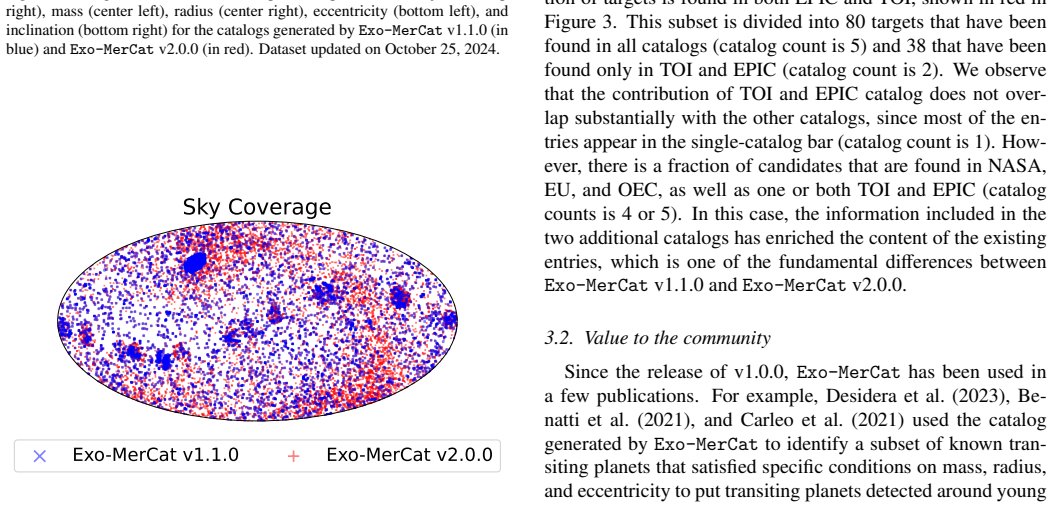
Exo-MerCat v2.0.0 is a modular rewrite of a script that blends five exoplanet source catalogs — the NASA Exoplanet Archive, the Exoplanet Encyclopaedia, the Open Exoplanet Catalogue, the TESS Project Candidates (TOI), and the EPIC/K2 table — with the Kepler Objects of Interest table used as a status lookup, into one homogenized table. The paper's central claim is that this version substantially improves both completeness and accuracy relative to Exo-MerCat v1.1.0. Completeness comes from promoting TOI and EPIC to full input sources: on the same run date, October 25, 2024, the merged table grew from 9,900 to 17,445 entries, with confirmed planets rising from 7,383 to 7,621, candidates from 2,402 to 7,632, false positives from 115 to 1,488, entries with a radius from 6,553 to 13,435, and entries with a period from 8,317 to 15,702. Accuracy is claimed to follow from the host-star identification: queries are now limited to SIMBAD and TIC v8.2, coordinate matching is tightened from 36 arcsec to 1 arcsec, and the old expanding-radius cone search is removed, so no star is adopted from an arbitrarily large separation. The merge itself groups by host identifier, binary flag, and planet letter, then subdivides by period or semi-major axis to avoid fusing distinct planets, and it records every heuristic decision in flags and ten log files.
Load-bearing premise
The claimed improvement in accuracy is inferred from design choices — a 1-arcsec coordinate tolerance, queries limited to SIMBAD and TIC, and period-based grouping — rather than demonstrated against a ground-truth or manually vetted sample of host-star assignments, so the whole accuracy benefit rests on those heuristics being right more often than the previous wider search.
Editorial extensions
If this is right
- Adding TOI and EPIC as input sources roughly doubles the size of the merged catalog, and most of the new rows are candidates and false positives rather than confirmed planets.
- Restricting stellar queries to SIMBAD and TIC and requiring a 1-arcsec coordinate match is claimed to remove the old practice of associating a planet with a star at an arbitrarily large separation, making host-star assignments more trustworthy.
- Grouping by period or semi-major axis before merging lets the catalog reconcile a confirmed planet's official letter with its older candidate ".0d" name, and flags any group whose period or semi-major axis disagrees.
- The new status labels, provenance columns, and ten log files make every merge decision traceable, so users can filter out rows that failed a check instead of silently inheriting them.
- A 20 Jupiter-mass cutoff separates brown dwarf candidates into a dedicated file, while the full catalog remains available for comparison.
Reading between the lines
- Editorial inference: the accuracy improvement is asserted from design changes rather than measured against a vetted sample, so users who care about precision should audit the flagged rows — coordinate mismatches, period mismatches, fallback merges — rather than assume every change is an improvement.
- Editorial inference: the near-doubling of rows could be misread as a doubling of known exoplanets; in fact the growth is mostly unconfirmed TESS candidates and false positives, so population studies should filter on status before drawing conclusions.
- Editorial inference: the 10% period tolerance in the merging step could in principle fuse two distinct planets in a compact or resonant system when letter information is missing, and the period_mismatch_flag with its log file gives a natural way to test how often that happens.
- Editorial inference: because the script is modular and open source, the cleanest validation of the whole release is a reproducibility test — running v2.0.0 with the October 25, 2024 input snapshots and checking that it reproduces the reported 17,445 entries and the 189 unresolved hosts.
Editorial analysis
A structured set of objections, weighed in public.
Referee Report
Summary. This paper describes Exo-MerCat v2.0.0, an open-source update to the Exoplanet Merged Catalog software. The new version adds the TESS Input Catalog and the K2/EPIC catalog as input sources, replaces the host-star identifier search with SIMBAD and TIC queries at a 1 arcsec tolerance, introduces period-based sub-grouping in the merge step, adds user-oriented flags and log files, and refactors the code into modules. The authors compare the catalog produced by v2.0.0 with an updated version of their previous release (v1.1.0) on the same date, and report a near-doubling of entries and improved completeness of radius and period measurements. The abstract and Section 3.1 also claim a 'substantial improvement in ... accuracy' due to the script optimizations.
Significance. The completeness improvement is convincingly documented in Table 3 and Figures 1–3, and the open-source release with unit tests, documentation, a TAP service, and detailed run logs is a genuinely useful community resource. If the accuracy claim were quantitatively supported, this would be a strong software paper with direct impact on PLATO, LIFE, and other target-selection efforts. However, the accuracy component of the headline claim is currently asserted from design changes rather than demonstrated against any external benchmark or ground-truth sample, and the paper's own run log in Appendix B reports non-trivial rates of fallback identifiers, coordinate mismatches, and period-split entries that are never evaluated.
major comments (3)
- [Abstract and §3.1] The claim of a 'substantial improvement in ... accuracy' is load-bearing and is not supported by the evidence presented. Table 3 and Figures 1–3 quantify completeness (entry counts and parameter coverage), but no accuracy metric is reported. The accuracy assertion rests on the design changes described in §2.3 and §2.4, without testing whether the new heuristics actually reduce host-star misidentifications or merge errors. Appendix B itself reports 189 fallback identifiers (0.6%), 370 binary systems with coordinate mismatches, 74 unresolved letter inconsistencies, and 399 entries from 197 period-mismatch groups. These are exactly the failure modes that the accuracy claim concerns, yet their rates are not compared with v1.1.0 and no external validation is provided. The paper should either add a quantitative accuracy evaluation (for example, on a manually vetted subset of the catalog or a cross-match against a trusted sample such as the NASA Exoplanet Archive confirmed-planet list) or soften the claim to restrict it to completeness.
- [§2.3 and Appendix B] The change from a 36 arcsec tolerance with increasing-radius cone search to a fixed 1 arcsec SIMBAD/TIC search is motivated by the earlier erroneous association of host stars for 'less than 100 identifiers' in v1.0.0. The paper does not quantify how many entries in v1.1.0 would be affected by that old behavior, nor does it show that the new 1 arcsec limit does not itself reject or misassign real hosts. The run log shows that 189 entries fall back to input-catalog identifiers, for which accuracy is not validated. A concrete test would be to take a sample of confirmed planets with known host stars and compare the host-star assignments produced by v1.1.0 and v2.0.0 against those known assignments.
- [§2.4 and §3.1] The period-based sub-grouping during merging can both over-split (creating duplicate entries for the same planet when period measurements disagree by more than 10%) and under-merge (failing to combine entries that are actually the same target). The run log reports 197 groups resulting in 399 final entries, about 2% of the catalog. The paper flags these cases with period_mismatch_flag but does not evaluate how often the split is correct (genuine multi-planet systems) versus incorrect (duplicates). A small manual review of a random sample of these groups, or a comparison against a knowledge base of known multi-planet systems, would substantially strengthen the accuracy claim and is needed to support the 'more accurate merge' statement in the Summary.
minor comments (5)
- [§1] The phrase 'at the forefront of contemporary astronomy recommendations' is unclear; 'recommendations' appears to be a word-choice error, perhaps 'research' or 'techniques' was intended.
- [§2.3] The text contains a duplicated phrase: 'The ConeSearch is a specific query that can be performed that can be performed by all Virtual Observatory aware services.' Please remove the repetition.
- [§3.2] The sentences 'the most challenging part, the comparison and merging of the data among various exoplanet catalog, has already been performed' contain a subject-verb agreement error ('catalog' should be 'catalogs').
- [Table B.4] The table header says 'Exo-MerCat v1.0.0' but the comparison in the paper is against v1.1.0; clarify whether the column names are those of v1.0.0 or v1.1.0.
- [§3.2] The reference to 'Nascimbeni et al. 2024, submitted' in Section 3.2 is incomplete; please provide a full citation or remove it.
Circularity Check
No circular reduction is present; the claimed accuracy improvement is an under-validated empirical comparison, not a fitted parameter or self-citation chain masquerading as a prediction.
full rationale
The paper's central claims are empirical statements about a software release: v2.0.0 improves completeness and accuracy relative to v1.1.0 (abstract; Section 3.1). Completeness is supported by Table 3 and Figures 1-3, and the paper explicitly attributes the factor-of-two growth to the addition of the TOI and EPIC input sources, i.e., to new external data rather than to a quantity fitted from the output. The accuracy claim rests on design choices in Section 2.3 (reducing coordinate match tolerance from 36 arcsec to 1 arcsec and querying only SIMBAD and TIC) and Section 2.4 (period/semi-major-axis grouping before merging). These are heuristics whose error rates are logged in Appendix B (189 fallback identifiers, 370 binary coordinate-mismatch systems, 74 unresolved letter inconsistencies, and 399 entries from 197 period disagreements), but the paper does not compare those rates with v1.1.0 or with a ground-truth sample. That is a validation gap, appropriately classified as a correctness/robustness concern rather than circularity: the claim is externally falsifiable and is not constructed so that the outcome is forced by definition. Citations to Alei et al. (2020) describe the prior implementation and are not load-bearing for the v2.0.0-specific changes. No self-definitional reduction, fitted-input prediction, imported uniqueness theorem, or ansatz-by-citation step can be quoted from the text. The low score reflects the absence of an external accuracy benchmark, not a circular derivation.
Assumptions & free parameters
free parameters (3)
- Brown dwarf mass cutoff =
20 MJup
- Coordinate matching tolerance =
1 arcsec
- Period disagreement tolerance =
10% of each period estimate
assumptions (4)
- domain assumption SIMBAD and TIC v8.2 provide the correct stellar identifiers and coordinates for exoplanet host stars.
- domain assumption The input catalogs (NASA, EU, OEC, TOI, EPIC) are internally consistent and up to date.
- domain assumption The KOI table is the most accurate source for the status of Kepler targets.
- domain assumption The lowest-relative-error rule yields the best parameter estimate for merged entries.
Cite this review
Pith. "Pith review of Exo-MerCat v2.0.0: updates and open-source release of the Exoplanet Merged Catalog software." pith.science (2026). https://pith.science/paper/IPD2RBML
@misc{pith2026250208473,
  author       = {Pith},
  title        = {Pith review of: Exo-MerCat v2.0.0: updates and open-source release of the Exoplanet Merged Catalog software},
  year         = {2026},
  howpublished = {\url{https://pith.science/paper/IPD2RBML}},
  note         = {Machine review of arXiv:2502.08473}
}
read the original abstract
Exoplanet research is at the forefront of contemporary astronomy recommendations. As more and more exoplanets are discovered and vetted, databases and catalogs are built to collect information. Various resources are available to scientists for this purpose, though every one of them has different scopes and notations. In Alei et al. (2020) we described Exo-MerCat, a script that collects information from multiple sources and creates a homogenized table. In this manuscript, we announce the release of the Exo-MerCat v2.0.0 script as an upgraded, tested, documented and open-source software to produce catalogs. The main upgrades on the script concern: 1) the addition of the TESS Input Catalog and the K2 Input Catalog as input sources; 2) the optimization of the main identifier queries; 3) a more complex merging of the entries from the input sources into the final catalog; 4) some quality-of-life improvements such as informative flags, more user-friendly column headers, and log files; 5) the refactoring of the code in modules. We compare the performance of Exo-MerCat v2.0.0 with the previous version and notice a substantial improvement in the completeness of the sample, thanks to the addition of new input sources, and its accuracy, because of the optimization of the script.
Figures


Reference graph
Works this paper leans on
-
[2]
Summary of the contents and sur- vey properties. A&A 616, A1. doi: 10.1051/0004-6361/201833051, arXiv:1804.09365. Gaia Collaboration, Prusti, T., de Bruijne, J.H.J., Brown, A.G.A., Vallenari, A., Babusiaux, C., Bailer-Jones, C.A.L., Bastian, U., Biermann, M., Evans, D.W., et al.,
-
[5]
The GAPS Programme at TNG. XXVIII. A pair of hot-Neptunes orbiting the young star TOI-942. Astronomy & Astrophysics 645, A71. doi: 10.1051/0004-6361/202039042, arXiv:2011.13795. Desidera, S., Damasso, M., Gratton, R., Benatti, S., Nardiello, D., D’Orazi, V ., Lanza, A.F., Locci, D., Marzari, F., Mesa, D., Messina, S., Pillitteri, I., Sozzetti, A., Girard,...
work page Pith review arXiv 2011
- [10]
-
[11]
mdpi.com/2076-3417/11/8/3322, doi:10.3390/app11083322
URL: https://www. mdpi.com/2076-3417/11/8/3322, doi:10.3390/app11083322. Carleo, I., Desidera, S., Nardiello, D., Malavolta, L., Lanza, A.F., Livingston, J., Locci, D., Marzari, F., Messina, S., Turrini, D., Baratella, M., Borsa, F., D’Orazi, V ., Nascimbeni, V ., Pinamonti, M., Rainer, M., Alei, E., Big- namini, A., Gratton, R., Micela, G., Montalto, M.,...
-
[13]
The all-sky PLATO input catalogue. A&A 653, A98. doi: 10.1051/0004-6361/202140717, arXiv:2108.13712. Nemiroff, R.J., Wallin, J.F.,
-
[14]
arXiv e-prints , arXiv:2108.04778doi: 10.48550/arXiv.2108
TESS Input Catalog ver- sions 8.1 and 8.2: Phantoms in the 8.0 Catalog and How to Handle Them. arXiv e-prints , arXiv:2108.04778doi: 10.48550/arXiv.2108. 04778, arXiv:2108.04778. Quanz, S.P., Ottiger, M., Fontanet, E., Kammerer, J., Menti, F., Dannert, F., Gheorghe, A., Absil, O., Airapetian, V .S., Alei, E., Allart, R., Anger- hausen, D., Blumenthal, S.,...
-
[139]
URL: https://dx.doi.org/10.3847/1538-3881/ad25ec, doi:10.3847/1538-3881/ad25ec. Turrini, D., Marzari, F., Polychroni, D., Claudi, R., Desidera, S., Mesa, D., Pinamonti, M., Sozzetti, A., Su ´arez Mascare ˜no, A., Damasso, M., Benatti, S., Malavolta, L., Micela, G., Zinzi, A., B ´ejar, V .J.S., Biazzo, K., Big- namini, A., Bonavita, M., Borsa, F., del Burg...
-
[185]
The Exoplanet Modeling and Analysis Center at NASA Goddard
doi: 10.3847/ 2515-5172/ac9060, arXiv:2209.04005. Schneider, J., Dedieu, C., Le Sidaner, P., Savalle, R., Zolotukhin, I.,
Show all 24 references
-
[246]
doi: 10.3847/ 1538-3881/abbc15, arXiv:2010.02589. Montalto, M., Piotto, G., Marrese, P.M., Nascimbeni, V ., Prisinzano, L., Granata, V ., Marinoni, S., Desidera, S., Ortolani, S., Aerts, C., Alei, E., Altavilla, G., Benatti, S., B ¨orner, A., Cabrera, J., Claudi, R., Deleuil, ...
2010 arXiv
- [412]
-
[605]
Zinzi, A., Turrini, D., Alei, E., Verrecchia, F.,
doi: 10.1051/0004-6361/ 201731595, arXiv:1709.00003. Zinzi, A., Turrini, D., Alei, E., Verrecchia, F.,
-
[636]
Wright, J.T., et al.,
doi:10.1051/0004-6361/ 201936301, arXiv:2003.05366. Wright, J.T., et al.,
2003 arXiv
-
[679]
Turrini, D., Zinzi, A., Belinchon, J.A.,
doi: 10.1051/0004-6361/202244752, arXiv:2307.08653. Turrini, D., Zinzi, A., Belinchon, J.A.,
-
[1995]
Nature 378, 355–359
A Jupiter-mass companion to a solar-type star. Nature 378, 355–359. doi: 10.1038/378355a0. Mettler, J.N., Quanz, S.P., Helled, R.,
-
[2009]
VizieR Online Data Catalog , V/133
VizieR Online Data Catalog: Kepler Input Catalog (Kepler Mission Team, 2009). VizieR Online Data Catalog , V/133. Mayor, M., Queloz, D.,
2009
-
[2011]
Astronomy & Astrophysics 532, A79
Defining and cataloging exoplanets: the exoplanet.eu database. Astronomy & Astrophysics 532, A79. URL: http://arxiv.org/abs/1106.0586, doi:10.1051/0004-6361/201116713. Tuchow, N.W., Stark, C.C., Mamajek, E.,
-
[2012]
arXiv e-prints , arXiv:1211.7121arXiv:1211.7121
A proposal for community driven and decentralized astro- nomical databases and the Open Exoplanet Catalogue. arXiv e-prints , arXiv:1211.7121arXiv:1211.7121. Renaud, J.P., Lopez, E., Brande, J., Cruz-Arce, C.E., Kelahan, C., Susemiehl, N., Cristy, D., Hostetter, C., Moore, M.D...
-
[2013]
Publications of the Astronomical Society of the Pacific 125, 989–999
The NASA Exoplanet Archive: Data and Tools for Exoplanet Research. Publications of the Astronomical Society of the Pacific 125, 989–999. URL: http://iopscience.iop.org/article/10.1086/672273/ pdfhttp://www.jstor.org/stable/info/10.1086/672273, doi:10.1086/672273. Alei, E., Cla...
-
[2016]
A&A 595, A1
The Gaia mission. A&A 595, A1. doi: 10.1051/ 0004-6361/201629272, arXiv:1609.04153. Huber, D., Bryson, S.T., et al.,
-
[2017]
VizieR Online Data Catalog , IV/34
VizieR Online Data Catalog: K2 Ecliptic Plane Input Catalog (EPIC) (Huber+, 2017). VizieR Online Data Catalog , IV/34. Kepler Mission Team,
2017
-
[2020]
Astron- omy and Computing 31, 100370
Exo-MerCat: A merged exoplanet catalog with Virtual Observatory connection. Astron- omy and Computing 31, 100370. doi: 10.1016/j.ascom.2020.100370, arXiv:2002.01834. Allen, A., Berriman, G.B., DuPrie, K., Mink, J., Nemiro ff, R., Ryan, P.W., Schmidt, J., Shamir, L., Shortridge...
2020
-
[2021]
Astron- omy & Astrophysics 650, A66
Constraints on the mass and on the atmospheric composition and evolution of the low-density young planet DS Tucanae A b. Astron- omy & Astrophysics 650, A66. doi: 10.1051/0004-6361/202140416, arXiv:2103.12922. Bravo-Medina, B., Strojnik, M., Mora-Nu ˜nez, A., Santiago-Hern ´andez, H.,
-
[2022]
Large Interferometer For Exo- planets (LIFE). I. Improved exoplanet detection yield estimates for a large mid-infrared space-interferometer mission. Astronomy & Astrophysics 664, A21. doi: 10.1051/0004-6361/202140366, arXiv:2101.07500. Rauer, H., Aerts, C., Cabrera, J., Deleui...
-
[2023]
Astronomy & Astrophysics 675, A158
TOI-179: A young system with a transiting compact Neptune-mass planet and a low- mass companion in outer orbit. Astronomy & Astrophysics 675, A158. doi:10.1051/0004-6361/202244611, arXiv:2210.07933. Gaia Collaboration, Brown, A.G.A., Vallenari, A., Prusti, T., de Bruijne, J.H....
Reviewed August 8, 2026 · model on record in the stance chip above.
Discussion (0). Continue with ORCID to comment.