REVIEW 3 major objections 4 minor 1 cited by
Entanglement Entropy of Mixed State in Thermal CFT$_2$
T0 review · 3 major / 4 minor · reviewed 2026-08-10 · deepseek-v4-flash
Pith's one-line read For a bipartite mixed state in a thermal CFT$_2$, the subtraction approach gives $S_{vN}(A:B)=\frac{c}{6}\log\left(1+2\zeta+2\sqrt{\zeta(\zeta+1)}\right)$, and the paper proves this equals the entanglement wedge cross section in planar…
desk verdict Thermal extension of the subtraction approach matches EWCS, but the CFT derivation rests on an unproved vacuum-dominance truncation. read the letter →
The pith
A machine-rendered reading of the paper's core claim, the machinery that carries it, and where it could break.
The reading
What carries the argument
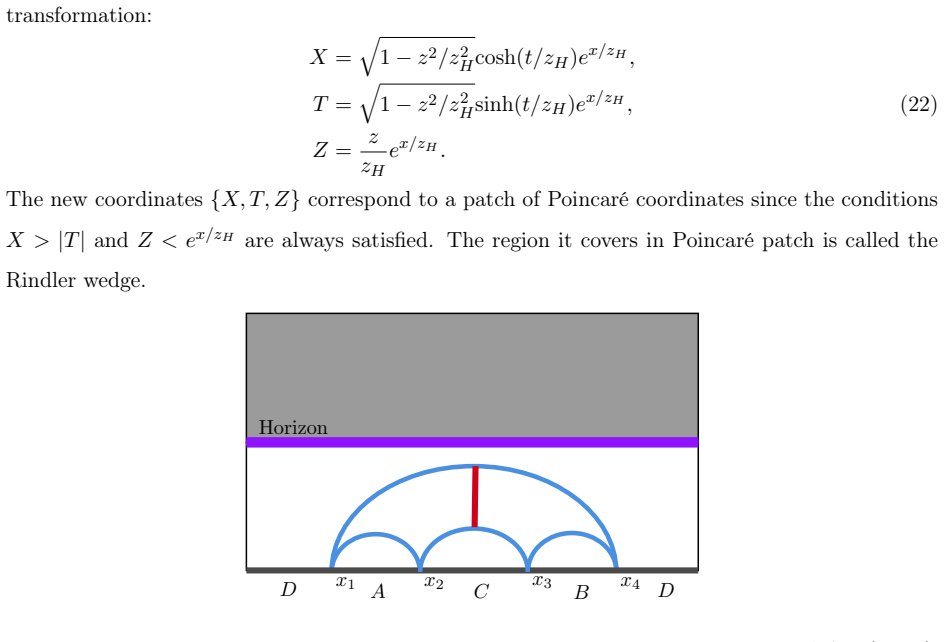
The mechanism is the subtraction map from the thermal cylinder to an annulus. One maps the cylinder to the plane with $w=e^{2\pi z/\beta}$, then removes the separating intervals $C$ and $D$ by cutting out discs whose boundaries carry conformal boundary states $|a\rangle$ and $|b\rangle$; the remaining surface is a pure-state annulus with slits for $A$ and $B$. The annulus partition function is $Z_1=e^{cW/12}\sum_k \langle a|k\rangle\langle k|b\rangle e^{-2\delta_k W}$, and the $n$-fold replica is again an annulus with conformal width $W/n$. Keeping only the vacuum term and subtracting the boundary-entropy term $\log(\langle a|0\rangle\langle 0|b\rangle)$ gives $S_{vN}(A:B)=cW/6$, which is rewritten in the conformally invariant cross ratio $\zeta$ through $e^W=1+2\zeta+2\sqrt{\zeta(\zeta+1)}$. On the gravity side, the same cross ratio enters the geodesic length in planar BTZ, and the horizon-crossing analysis is done by mapping BTZ to flat-slice coordinates and locating where an endpoint coordinate vanishes.
What would settle it
On an annulus with two slits representing $A$ and $B$, compute the exact Rényi entropy $S^{(n)}$ for a free compactified boson with general conformal boundary states, keeping the full boundary-state sum; if the $n\to1$ limit after subtracting the fixed boundary entropy is not $\frac{c}{6}\log\left(1+2\zeta+2\sqrt{\zeta(\zeta+1)}\right)$ for all annulus moduli, the central equality is false.
Extended reading notes
Core claim
The central claim is that for a thermal CFT$_2$ at inverse temperature $\beta$, the subtraction approach gives the static bipartite mixed-state entanglement entropy $S_{vN}(A:B)=\frac{c}{6}\log\left(1+2\zeta+2\sqrt{\zeta(\zeta+1)}\right)$, where $\zeta=\frac{\sinh(\pi(x_2-x_1)/\beta)\sinh(\pi(x_4-x_3)/\beta)}{\sinh(\pi(x_3-x_2)/\beta)\sinh(\pi(x_4-x_1)/\beta)}$ for intervals $A=(x_1,x_2)$ and $B=(x_3,x_4)$. The same expression with $\zeta\to1/\zeta$ gives the entropy of the complementary pair $C=(x_2,x_3)$ and $D=(-\infty,x_1)\cup(x_4,\infty)$. The paper shows, using the planar BTZ metric and the standard central-charge relation, that the entanglement wedge cross section for the same cross ratio is exactly this CFT answer, so $S_{vN}(A:B)=EW(A:B)$. For the thermofield double state, with the modified cross ratio of Eq. (30), the dual $EW(C:D)$ crosses the horizon when $\kappa<1$ and $EW(A:B)$ does so when $\bar{\kappa}<1$, with $\kappa$ and $\bar{\kappa}$ given explicitly in Eqs. (34) and (36).
Load-bearing premise
The load-bearing premise is that the boundary-entropy term left by removing the separating intervals is completely irrelevant to the entanglement between $A$ and $B$, so that dropping it after Eq. (13) leaves a universal result.
Editorial extensions
If this is right
- As a consequence of the claimed equality, the entanglement wedge cross section is the holographic dual of the subtraction-approach entropy in thermal states, extending the zero-temperature verification.
- The subtraction approach fixes the phase transition between $S_{vN}(A:B)$ and $S_{vN}(C:D)$ at $\zeta=1$ without an optimization procedure, so each boundary pair is matched to a definite bulk geodesic.
- In the thermofield double state, the dual surface for $C:D$ crosses the BTZ horizon when $\kappa<1$, so mixed-state entanglement in the TFD state is not always confined to one exterior.
- The covariant extension follows by replacing $x_i$ with $z_i=x_i+\tau_i$, so the same formula applies to time-dependent intervals.
- The pure-state single-interval entropy is recovered by taking the regulator limit in $S_{vN}(C:D)$, yielding the standard thermal result $\frac{c}{3}\log\left(\frac{\beta}{\pi\epsilon}\sinh\frac{\pi\ell}{\beta}\right)$.
Reading between the lines
- If the subtraction result is universal, it provides an optimization-free CFT definition of the entanglement wedge cross section that could extend to multipartite mixed states and to other holographic settings.
- The horizon-crossing transition at $\kappa=1$ and $\bar{\kappa}=1$ is a sharp prediction that could be compared with reflected entropy or negativity in the same thermofield double configuration; those quantities should show a qualitative change at the same parameter value if the geometric picture is complete.
- Because the final formula depends only on the cross ratio, a natural test is to evaluate the exact annulus Rényi entropy in free-boson or minimal-model boundary conditions; if the residual boundary contribution varies with the annulus moduli, the equality holds only for special boundary conditions.
Editorial analysis
A structured set of objections, weighed in public.
Referee Report
Summary. The manuscript extends a previously introduced 'subtraction approach' to mixed-state entanglement in a thermal CFT2 on a cylinder. After mapping the cylinder to the plane and removing the separating intervals C and D by cutting out two discs, the remaining subsystem A∪B is treated as living on an annulus. The authors compute the von Neumann entropy of this pure-state configuration from the annulus partition function, drop all excited-state contributions and the Affleck-Ludwig boundary entropy, and obtain S_vN(A:B) = (c/6) log(1 + 2ζ + 2√(ζ(ζ+1))) with ζ defined in Eq. (17). They compare this with the entanglement wedge cross section computed from geodesics in the planar BTZ black hole and claim equality in Eq. (25). They also study a two-sided thermofield double configuration and derive a horizon-crossing condition κ=1 in Eq. (34).
Significance. If established, the result would provide a simple finite-temperature check of the subtraction prescription and an unambiguous CFT-side characterization of the holographic entanglement wedge cross section, extending the zero-temperature results of Refs. [16,17]. The bulk calculation in Appendix A is explicit and self-contained, and the comparison involves no fitted parameters: the CFT expression and the geodesic computation are independent and agree in analytic form. The horizon-crossing feature in the thermofield double state, if correct, is an interesting qualitative prediction. However, the significance is currently limited by the lack of control over the CFT approximation, and the paper should not be accepted before that gap is addressed.
major comments (3)
- [II.A, Eq. (12)] The replacement of the full annulus partition functions (8) and (11) by their k=0 vacuum terms is the load-bearing step of the whole CFT computation, but it is only asserted. Suppression of excited states requires W = log(R2/R1) to be large compared with 1/δ_{k>0}; however, Eq. (15) implies W→0 as ζ→0, a regime explicitly covered by the final formula (16). In that regime the k-sum is not vacuum-dominated. The same issue affects the replicated partition function (11), whose effective width is W/n, so the n→1 limit does not restore vacuum dominance. No large-central-charge or sparse-spectrum limit is stated that would justify vacuum dominance in a holographic CFT. Since the bulk EWCS in Eq. (23) is exact for all ζ, the claimed equality (25) is not demonstrated. The authors should either prove that excited-state contributions cancel after the subtraction or state the precise domain of validity of Eq. (16) and explain how the comparison to the exact bulk result is meaningful.
- [II.A, Eqs. (13)-(14)] The Affleck-Ludwig boundary entropy log(⟨a|0⟩⟨0|b⟩) is removed with the statement that it is 'totally irrelevant' to the entanglement between A and B. This is a definitional choice, not a consequence of the replica computation: in Eq. (13) this term is independent of n, so it survives in the von Neumann limit and would affect the value of S_vN(A:B) unless cancelled by an additional prescription. If the overlap depends on the intervals that define the boundary conditions, or on the annulus modulus, Eq. (14) and therefore Eq. (16) contain an unremoved model-dependent contribution. The authors should derive the cancellation or state explicitly the normalization convention under which the boundary entropy is discarded.
- [III, Eq. (30)] The two-sided configuration is one of the advertised new results, but the modified cross ratio (30) is introduced without derivation. It is not immediate how Eqs. (16) and (19) 'can be directly read off' for points living on two different asymptotic boundaries of the thermofield double state, and the coordinate transformation (22) as presented covers one exterior patch of the BTZ geometry. The horizon-crossing analysis in Eqs. (33)-(34) therefore needs a self-contained calculation in the extended BTZ spacetime, including an explanation of how the geodesic endpoints are continued across the horizon and why that geodesic remains the minimal entanglement wedge cross section.
minor comments (4)
- [I] There are several typographical errors: 'statenth Rényi entropy', 'ER = EP Rhas', and the spacing in 'ρAA∗BB ∗' should be corrected.
- [Eq. (20)] The double limit x2-x1→ϵ and x4-x3→ϵ is written loosely, and the constant inside the logarithm after the limit is cutoff-dependent; please specify the regularization and comment on the factor 2π/β relative to the standard thermal interval entropy.
- [II.C] The term 'phase transition' for the crossing at ζ=1 is potentially misleading: the paper shows that the green geodesics belong to different bipartitions, so the crossing is a comparison of two different quantities rather than a phase transition in a single mixed-state measure; this should be stated more carefully.
- [Eqs. (31)-(34)] The symbol w is used both for the coordinate on the original w-plane and for the boundary coordinate in Eq. (32); please introduce separate notations to avoid confusion in the horizon-crossing formulas.
Circularity Check
The finite-temperature S_vN=EW result is obtained by dropping all excited states and subtracting the boundary entropy inside the self-cited subtraction approach; the CFT side of Eq. (25) is the vacuum term chosen to match the known EWCS formula.
-
ansatz smuggled in via citation
[Sec. II.A, Eqs. (12)-(14)]
"Since we are concerned with the vacuum entanglement, the contribution of excited states is irrelevant. We thus have Z1 = ecW/12 ⟨a|0⟩ ⟨0|b⟩, Zn = ecW/12n ⟨a|0⟩ ⟨0|b⟩. ... This boundary entropy is model dependent and are totally irrelevant to the entanglement between A and B. Therefore, the entanglement entropy of A and B is: SvN (A : B) = lim_{n→1} S(n)(A) − log(⟨a|0⟩ ⟨0|b⟩) = c/6 W."
The claimed CFT prediction Eq. (16) is obtained by truncating the exact annulus sum (8)/(11) to k=0 and by manually removing the boundary-entropy term log(⟨a|0⟩⟨0|b⟩). Neither operation follows from the replica calculation; the retained term c/6 W is exactly the function of the cross ratio that equals the EWCS formula (23). The discarded terms are not shown to vanish, and in the ζ→0 limit W→0 they are not suppressed. Thus the equality (25) is not an independent prediction but a restatement of the vacuum term selected by a self-cited ansatz rather than by a derived CFT result.
-
self citation load bearing
[Sec. I, Introduction (paragraphs around refs. [16,17])]
"In recent works [16, 17], the SUBTRACTION approach is introduced to calculate the mixed state entanglement entropy in CFT successfully. ... In [16, 17], the zero temperature infinite system is studied, for static and covariant scenarios. It is confirmed SvN(A : B) = EW (A : B). In this paper, we apply the subtraction approach to thermal CFT2."
The subtraction framework — including the vacuum-only reduction used in Eq. (12) — is imported from the authors' own refs. [16,17], whose 'confirmation' of S_vN=EW is the only prior establishment of the method. The present paper's finite-temperature verification uses that same method on the CFT side, so the central equality to the bulk EWCS leans on the authors' prior claim rather than on an independently derived or externally checkable theorem given in this manuscript. The bulk computation is independent, but the CFT side is not.
full rationale
The bulk EWCS computation in Appendix A (Eq. (23) and Eq. (A11)) is independent and standard, and the algebraic identities used in Eqs. (15), (24), and (34) are not circular. However, the CFT derivation of Eq. (16) is not a first-principles evaluation of the annulus partition function: Eq. (12) truncates to the k=0 vacuum without controlling the omitted excited states, and Eq. (14) subtracts the Affleck-Ludwig boundary entropy as 'totally irrelevant' rather than proving that it cancels. These two choices select exactly the term c/6 W that, through Eq. (15), reproduces the known EWCS formula, making the comparison in Eq. (25) partially a restatement of the retained term. The subtraction approach itself is introduced via the authors' own prior works [16,17], so the method's validity is partly a self-citation. No numerical data are fitted, and the mathematics of the annulus partition function and BTZ geodesics is standard; the circularity burden is therefore moderate rather than total.
Assumptions & free parameters
free parameters (1)
- Affleck-Ludwig boundary entropy log(<a|0><0|b>) =
dropped (assumed zero)
assumptions (6)
- standard math The replica trick relation Tr_A rho_A^n = Z_n / Z_1^n holds for the thermal density matrix on the cylinder (Eq. (3)).
- standard math The partition function on the annulus is Z_1 = e^{cW/12} sum_k <a|k><k|b> e^{-2 delta_k W} (Eq. (8)).
- domain assumption After replica, only the vacuum state contributes to Z_n (Section II.A: 'the contribution of excited states is irrelevant').
- ad hoc to paper The Affleck-Ludwig boundary entropy log(<a|0><0|b>) is irrelevant to the entanglement between A and B (after Eq. (13)).
- domain assumption The holographic dual of the subtraction-based mixed-state entanglement entropy is the entanglement wedge cross section (Section II.B, relying on ref. [11]).
- domain assumption The BTZ to Poincare coordinate transformation (22) faithfully maps the entanglement wedge and horizon, so horizon crossing can be read off by X_L = 0 in pure AdS3 (Section III).
Cite this review
Pith. "Pith review of Entanglement Entropy of Mixed State in Thermal CFT$_2$." pith.science (2026). https://pith.science/paper/IVAIW5O4
@misc{pith2026250111302,
  author       = {Pith},
  title        = {Pith review of: Entanglement Entropy of Mixed State in Thermal CFT$_2$},
  year         = {2026},
  howpublished = {\url{https://pith.science/paper/IVAIW5O4}},
  note         = {Machine review of arXiv:2501.11302}
}
abstract
Using the subtraction approach, we give the bipartite mixed state entanglement entropy in thermal $\text{CFT}_2$. With these entanglement entropies, we examine in detail the holographic duals of different entangling configurations unambiguously. In the thermofield double state, we show a horizon-crossing feature in two-sided entanglement configuration.
Figures


Figures from the paper (7 more)




Forward citations
Cited by 1 Pith paper
-
Exact and Finite de Sitter QFT from CFT
Constructs exact finite de Sitter QFT from CFT data using moduli space of oriented balls and Casimir completion of operators.
Reference graph
Works this paper leans on
-
[1]
The Large N limit of superconformal field theories and supergravity.Adv
Juan Martin Maldacena. The Large N limit of superconformal field theories and supergravity.Adv. Theor. Math. Phys. , 2:231–252, 1998. arXiv:hep-th/9711200, doi:10.1023/A:1026654312961
arXiv 1998
-
[2]
Anti-de Sitter space and holography
Edward Witten. Anti-de Sitter space and holography. Adv. Theor. Math. Phys. , 2:253–291, 1998. arXiv:hep-th/9802150, doi:10.4310/ATMP.1998.v2.n2.a2
arXiv 1998
-
[3]
S. S. Gubser, Igor R. Klebanov, and Alexander M. Polyakov. Gauge theory correlators from non- critical string theory. Phys. Lett. B , 428:105–114, 1998. arXiv:hep-th/9802109, doi:10.1016/ S0370-2693(98)00377-3
arXiv 1998
-
[4]
Holographic derivation of entanglement entropy from AdS/CFT
Shinsei Ryu and Tadashi Takayanagi. Holographic derivation of entanglement entropy from AdS/CFT. Phys. Rev. Lett., 96:181602, 2006. arXiv:hep-th/0603001, doi:10.1103/PhysRevLett.96.181602
arXiv 2006
-
[5]
Shinsei Ryu and Tadashi Takayanagi. Aspects of holographic entanglement entropy.Journal of High Energy Physics, 2006(08):045–045, aug 2006.doi:10.1088/1126-6708/2006/08/045
-
[6]
Hubeny, Mukund Rangamani, and Tadashi Takayanagi
Veronika E. Hubeny, Mukund Rangamani, and Tadashi Takayanagi. A Covariant holographic entan- glement entropy proposal. JHEP, 07:062, 2007. arXiv:0705.0016, doi:10.1088/1126-6708/2007/ 07/062. 15
arXiv 2007
-
[7]
Building up spacetime with quantum entanglement.Gen
Mark Van Raamsdonk. Building up spacetime with quantum entanglement.Gen. Rel. Grav., 42:2323– 2329, 2010. arXiv:1005.3035, doi:10.1142/S0218271810018529
arXiv 2010
-
[8]
Einstein Equation Governs the Dynamics of Entanglement Entropy in CFT
Xin Jiang, Peng Wang, Houwen Wu, and Haitang Yang. Einstein Equation Governs the Dynamics of Entanglement Entropy in CFT. 10 2024.arXiv:2410.19711
arXiv 2024
Show all 23 references
-
[9]
Realization of ”ER=EPR”
Xin Jiang, Peng Wang, Houwen Wu, and Haitang Yang. Realization of ”ER=EPR”. 11 2024.arXiv: 2411.18485
2024 arXiv
-
[10]
Entanglement negativity in extended systems: A field theoretical approach.J
Pasquale Calabrese, John Cardy, and Erik Tonni. Entanglement negativity in extended systems: A field theoretical approach.J. Stat. Mech., 1302:P02008, 2013.arXiv:1210.5359, doi:10.1088/1742-5468/ 2013/02/P02008
2013 arXiv
-
[11]
Entanglement of purification through holographic duality
Tadashi Takayanagi and Koji Umemoto. Entanglement of purification through holographic duality. Nature Phys., 14(6):573–577, 2018. arXiv:1708.09393, doi:10.1038/s41567-018-0075-2
2018 arXiv
-
[12]
Entanglement Wedge Cross Section from the Dual Density Matrix.Phys
Kotaro Tamaoka. Entanglement Wedge Cross Section from the Dual Density Matrix.Phys. Rev. Lett., 122(14):141601, 2019. arXiv:1809.09109, doi:10.1103/PhysRevLett.122.141601
2019 arXiv
-
[13]
A canonical purification for the entanglement wedge cross-section
Souvik Dutta and Thomas Faulkner. A canonical purification for the entanglement wedge cross-section. JHEP, 03:178, 2021. arXiv:1905.00577, doi:10.1007/JHEP03(2021)178
2021 arXiv
-
[14]
Balanced Partial Entanglement and the Entanglement Wedge Cross Section.JHEP, 04:301,
Qiang Wen. Balanced Partial Entanglement and the Entanglement Wedge Cross Section.JHEP, 04:301,
-
[15]
Does connected wedge imply distillable entanglement? 11 2024
Takato Mori and Beni Yoshida. Does connected wedge imply distillable entanglement? 11 2024. arXiv:2411.03426
2024
-
[16]
Alternative to purification in conformal field theory
Xin Jiang, Peng Wang, Houwen Wu, and Haitang Yang. Alternative to purification in conformal field theory. Phys. Rev. D , 111(2):L021902, 2025. arXiv:2406.09033, doi:10.1103/PhysRevD.111. L021902
2025 arXiv
-
[17]
Mixed State Entanglement Entropy in CFT
Xin Jiang, Houwen Wu, Peng Wang, and Haitang Yang. Mixed State Entanglement Entropy in CFT. 1 2025. arXiv:2501.08198
2025
-
[18]
John L. Cardy. Boundary Conditions, Fusion Rules and the Verlinde Formula.Nucl. Phys. B, 324:581– 596, 1989. doi:10.1016/0550-3213(89)90521-X
1989 doi
-
[19]
John L. Cardy. Boundary conformal field theory. 11 2004.arXiv:hep-th/0411189
2004 arXiv
-
[20]
Entanglement hamiltonians in two-dimensional conformal field theory.J
John Cardy and Erik Tonni. Entanglement hamiltonians in two-dimensional conformal field theory.J. Stat. Mech., 1612(12):123103, 2016. arXiv:1608.01283, doi:10.1088/1742-5468/2016/12/123103
2016 arXiv
-
[21]
Ian Affleck and Andreas W. W. Ludwig. Universal noninteger ’ground state degeneracy’ in critical quantum systems. Phys. Rev. Lett., 67:161–164, 1991. doi:10.1103/PhysRevLett.67.161
1991 doi
-
[22]
up” and “down
J. David Brown and M. Henneaux. Central charges in the canonical realization of asymptotic sym- metries: An example from three-dimensional gravity. Commun. Math. Phys. , 104:207–226, 1986. doi:10.1007/BF01211590. 16 Appendix A: Endpoints of EWCS in Pure AdS 3 We work in pure A...
1986 doi
-
[2021]
arXiv:2103.00415, doi:10.1007/JHEP04(2021)301
2021 arXiv
Reviewed August 10, 2026 · model on record in the stance chip above.
Discussion (0). Continue with ORCID to comment.