REVIEW 4 major objections 6 minor 2 cited by
The Cabibbo-favored hadronic weak decays of the $\Xi_c$ in the quark model
T0 review · 4 major / 6 minor · reviewed 2026-08-08 · deepseek-v4-flash
Pith's one-line read The paper shows that pole terms—virtual intermediate baryons linking the weak transition to strong meson emission—are essential for Cabibbo-favored hadronic weak decays of $\Xi_c$, bringing most calculated branching ratios into agreement…
desk verdict A solid quark-model calculation of six Xi_c hadronic decay channels with mostly good branching ratios, but the headline claim about pole terms rests on rates while the one measured asymmetry sign comes out wrong. read the letter →
The pith
A machine-rendered reading of the paper's core claim, the machinery that carries it, and where it could break.
The reading
What carries the argument
The machinery is the non-relativistic constituent quark model with three operator sets: the non-relativistic weak four-fermion Hamiltonian for the $cd\to su$ and $c\to u\bar d s$ transitions; the chiral quark model Hamiltonian for emission of $\pi$, $K$, $\eta$, and $\eta'$ from light quarks; and harmonic-oscillator spatial wave functions whose strengths $\alpha_\rho$, $\alpha_\lambda$, and $R$ are set by quark masses and spring constants $K$. Pole amplitudes are built as a quark-meson vertex, a baryon propagator $i/(\not p - m + i\Gamma/2)$, and a weak vertex, summed over intermediate light baryons (weak-then-strong) and intermediate charmed baryons (strong-then-weak). The propagator makes the results sensitive to the masses of the first excited charmed and strange baryons, which for most states are taken from quark model predictions rather than from experiment.
What would settle it
Measure the asymmetry parameter of $\Xi_c^0\to\Xi^-\pi^+$ to a precision better than 0.05 (the current quoted value is $-0.64\pm0.05$); if it remains negative while the model's positive prediction varies by less than 0.1 under the stated 10-20% parameter uncertainties, the implemented pole-term framework misses an essential contribution, whereas a positive value would implicate the spectroscopy inputs.
Extended reading notes
Core claim
The central claim is that pole terms—amplitudes of the form strong-emission vertex times baryon propagator times weak vertex, in both orders (weak-then-strong and strong-then-weak)—are essential for the $\Xi_c$ hadronic weak decays and not minor corrections to the direct meson emission and color suppressed processes. Evaluated in the non-relativistic constituent quark model, the full amplitudes give branching ratios for $\Xi_c^+\to\Xi^0\pi^+$, $\Xi_c^0\to\Xi^-\pi^+$, $\Xi_c^0\to\Xi^0\pi^0$, $\Xi_c^0\to\Xi^0\eta^{(')}$, and $\Xi_c^0\to\Sigma^+K^-$ that are mostly consistent with the measured values; the channel $\Xi_c^0\to\Sigma^+K^-$, where only pole terms are allowed, is presented as a particularly direct test. The paper asserts that most of its calculated branching ratios are consistent with the experimental measurements, indicating that non-factorizable diagrams play an essential role. The authors are explicit that the calculation fails to reproduce the sign of the asymmetry parameter of $\Xi_c^0\to\Xi^-\pi^+$ and gives too small a value for $\Xi_c^0\to\Xi^0\pi^0$, and they discuss excited-baryon spectroscopy and final-state interactions as the likely origins of these discrepancies.
Load-bearing premise
The calculation assumes that the unconfirmed masses and SU(6) quantum numbers of the first excited charmed and strange baryons appearing in the pole terms are the correct ones; if those assignments change, the pole contributions change and the predicted branching ratios and asymmetries shift, possibly removing the agreement with data.
Editorial extensions
If this is right
- If the pole terms are essential, any effective description of charmed-baryon two-body weak decays that keeps only factorizable diagrams will systematically miss part of the rate, particularly for neutral-meson channels and for $\Xi_c^0\to\Sigma^+K^-$.
- The five predicted asymmetry parameters (for $\Xi_c^+\to\Xi^0\pi^+$, $\Xi_c^0\to\Xi^0\pi^0$, $\Xi_c^0\to\Xi^0\eta$, $\Xi_c^0\to\Xi^0\eta'$, and $\Xi_c^0\to\Sigma^+K^-$) are direct experimental tests; a measured sign or magnitude away from the prediction would signal missing dynamics.
- Because the pole amplitudes are controlled by the propagator $i/(\not p - m + i\Gamma/2)$, improved measurements of these decays become a probe of the mass spectrum of first excited charmed baryons.
- The same framework previously identified pole terms as the key for the heavy-quark-conserving decay $\Xi_c^0\to\Lambda_c\pi^-$; the present results extend that conclusion to Cabibbo-favored decays with a strange baryon in the final state.
Reading between the lines
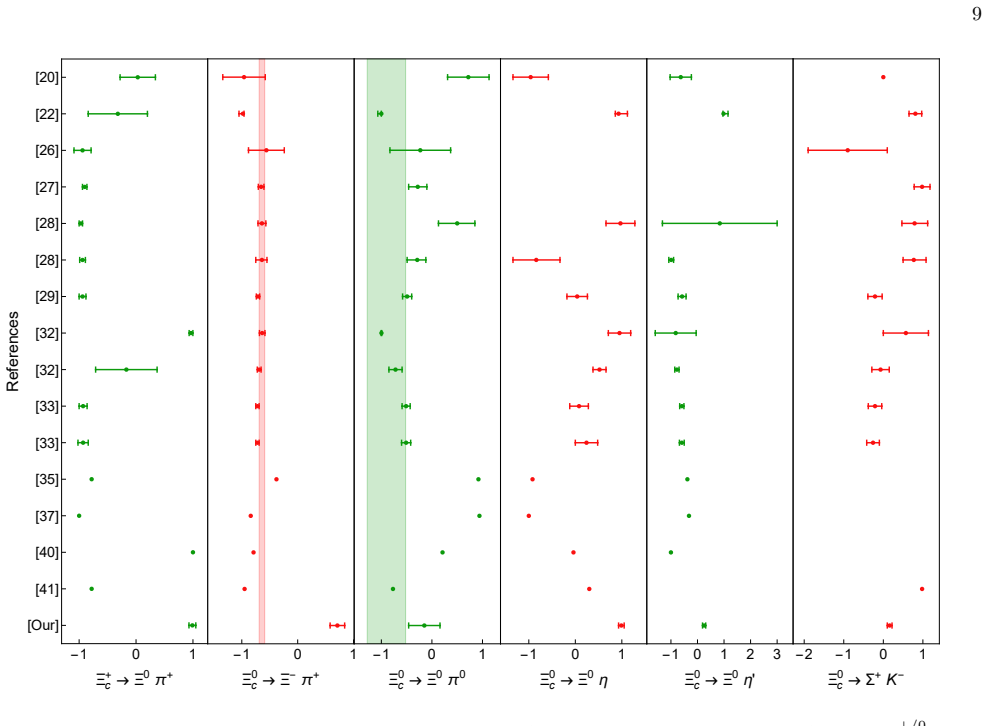
- A sharper test is the asymmetry of $\Xi_c^0\to\Xi^0\pi^0$: the model gives $-0.16\pm0.31$ while the current measured value is $-0.90\pm0.38$; if future data stay near $-0.9$, the missing parity-violating strength would point to the excited-baryon inputs or an unaccounted coupled-channel effect.
- Since the propagator enhances intermediate baryons closest in mass to the decaying $\Xi_c$, the $\Xi_c^0\to\Sigma^+K^-$ channel—where only pole terms contribute—could act as a spectroscopy discriminator, with its rate and asymmetry responding noticeably to the assumed masses and quantum numbers of $\Xi(1620)$ and $\Xi(1690)$.
- The $\eta$ and $\eta'$ channels inherit the assumed mixing angle $\phi=39.3^\circ$; a precise measurement of the ratio $\mathrm{Br}(\Xi_c^0\to\Xi^0\eta')/\mathrm{Br}(\Xi_c^0\to\Xi^0\eta)$ could, in principle, constrain the strangeness content of $\eta'$ once the quark-model uncertainties are controlled.
Editorial analysis
A structured set of objections, weighed in public.
Referee Report
Summary. This paper studies six Cabibbo-favored two-body hadronic weak decays of the Ξ_c in a non-relativistic constituent quark model, combining direct meson emission, color-suppressed, and pole-term amplitudes. The authors compute branching ratios and decay asymmetry parameters, compare with Belle/PDG data and a wide range of previous models, and argue that pole terms are essential for the transition dynamics. The branching ratios are mostly consistent with experiment, with the notable exception of Ξ_c^0 → Ξ^0 π^0, but the predicted asymmetry for Ξ_c^0 → Ξ^- π^+ has the wrong sign compared to the measured value, a discrepancy of roughly 10 standard deviations. The paper is transparent about this failure but does not resolve it.
Significance. If the central claim were established, the paper would provide a useful dynamical explanation of the non-factorizable contributions in charmed-baryon weak decays, with concrete predictions for several unmeasured asymmetry parameters. Strengths of the paper include the use of literature inputs rather than fits to the target data, a systematic uncertainty propagation over quark masses, spring constants, R, and excited-baryon masses, and an extensive comparison with other theoretical approaches. However, the wrong sign of α(Ξ_c^0 → Ξ^- π^+) is a direct failure in the parity-violating sector, where pole-term interference is most observable, and the paper does not provide the comparison without pole terms that would actually demonstrate their essentiality. The central claim is therefore not yet supported.
major comments (4)
- [Sec. IV and Table IX] The predicted asymmetry α(Ξ_c^0 → Ξ^- π^+) is +0.71 ± 0.13, whereas the measured PDG value is −0.64 ± 0.05. The combined discrepancy is about 10σ and the sign is wrong. This observable is the most direct probe of the interference between parity-conserving and parity-violating amplitudes, and the paper's central claim is that the pole terms are essential for understanding the transition dynamics. The manuscript acknowledges the failure in Sec. IV but does not provide a mechanism or an alternative calculation that repairs it. A claim that the dynamics are understood should at least accommodate this measured asymmetry.
- [Sec. III.B and Tables VIII–XV] The abstract states that pole terms are essential 'in addition to' the direct meson emission and color-suppressed processes, but no calculation with the pole terms omitted is presented. A controlled comparison of DME+CS versus DME+CS+pole for both branching ratios and asymmetries is missing. The conclusion that pole terms are essential currently rests on the magnitude of individual amplitudes in Tables X–XV rather than on a direct test of their necessity.
- [Sec. III.A and Tables IV–VII] The uncertainty analysis varies the first excited charmed-baryon masses by only 10%, but the quark-model predictions in Table V differ by more than 10% for the same nominal state (for example, the Ξ_c(2P_λ) mass ranges from about 2.76 to 2.80 GeV across the listed models), and the SU(6) assignments of Ξ(1620) and Ξ(1690) in Table IV are unconfirmed. These inputs directly control the pole contributions. The paper's own hypothesis in Sec. IV that missing or overestimated excited baryons are responsible for the wrong sign is therefore not tested by the quoted uncertainties; an explicit exploration of alternative masses or alternative SU(6) assignments is required before the pole-term claim can be accepted.
- [Sec. III.B] The statement that 'most of our calculated branching ratios are consistent with the experimental measurements' understates the Ξ_c^0 → Ξ^0 π^0 discrepancy. The central value is 1.4 × 10^-3 versus the Belle value 6.9 × 10^-3, a difference of about 2.5 combined standard deviations, not 'about two sigma'. This is not fatal by itself, but it compounds the asymmetry failure when the overall consistency of the model is assessed.
minor comments (6)
- [Table IX] The table header lists 'Bell[17]' but should be 'Belle[17]'.
- [Figure 3 caption] The caption says the vertical coordinate refers to Tab. VIII, but the asymmetry values are tabulated in Tab. IX.
- [Eq. (31)] The sentence following Eq. (31) contains a typo: 'sz_i = sz_i = 1/2' should read 'sz_i = sz_f = 1/2'.
- [References] References [43], [44], and [56] are incomplete; they give only author names without full titles, journals, or publication data.
- [Sec. III.A] The text says 20% uncertainties are assigned to all quark model parameters except the intermediate 1/2^- heavy baryons, while Tables VI and VII use 10% for the first excited charmed baryons. Please clarify the precise uncertainty used for each input.
- [Sec. IV] The phrase 'constitute quark model' should be 'constituent quark model'.
Circularity Check
No significant circularity: the derivation is a first-principles quark-model calculation with parameters taken from external literature and data, and its failure to reproduce the measured Xi_c^0 -> Xi^- pi+ asymmetry demonstrates that the predictions are not tuned to the target observables.
full rationale
The paper computes branching ratios and asymmetry parameters for six Xi_c weak decay channels from a non-relativistic constituent quark model. No parameter is fitted to the decay data being explained: quark masses, spring constants, meson wave function parameters, and baryon masses are taken from the PDG and from external quark-model calculations (Tabs. I-V), with uncertainties propagated rather than optimized. The central claim that pole terms are essential is supported by comparing the resulting branching ratios with Belle/PDG data, and the paper explicitly admits failure in one measured asymmetry ('We fail in obtaining the correct sign for the decay asymmetry parameter of Xi_c^0 -> Xi^- pi+'), which is strong evidence that the calculation is not constructed to reproduce the data. The framework is inherited from the authors' earlier papers [1,45], and Ref. [67] is cited for the SU(6) assignments of Xi(1620) and Xi(1690), but these self-citations provide inputs and methodology rather than a uniqueness theorem or a fitted result; the numerical amplitudes, interference pattern, and the sign/scale of the PV asymmetries are computed explicitly and are not defined by the target data. Thus there is at most a minor, non-load-bearing reuse of the authors' own previous framework, not a circular derivation.
Assumptions & free parameters
free parameters (6)
- Quark masses m_q, m_s, m_c =
0.30, 0.50, 1.80 GeV with 20% uncertainty
- Spring constants K =
0.02 to 0.06 GeV^3 depending on strangeness and charm
- Meson wave function size R =
R_pi=0.28, R_eta=0.4, R_eta'=0.9, R_K=0.5 GeV
- eta-eta' mixing angle phi =
39.3 degrees
- Masses of first excited charmed baryons (2P states) =
e.g., Xi_c(2P_lambda)=2.788 GeV, Xi_c(2P_rho)=2.935 GeV, unconfirmed
- Pseudoscalar decay constants f_pi, f_q, f_s =
92.4 MeV, 1.07 f_pi, 1.34 f_pi
assumptions (6)
- standard math Low-energy weak interaction described by the four-fermion Hamiltonian with CKM factors, Eqs. (6)-(10)
- domain assumption Non-relativistic reduction of weak operators keeping leading terms in 1/m and truncating at that order
- domain assumption Chiral quark model Hamiltonian H_chi, Eq. (17), for pseudoscalar meson emission
- domain assumption Harmonic oscillator spatial wave functions with parameters alpha_rho, alpha_lambda, and R
- ad hoc to paper Pole approximation with selected intermediate baryon states and assignment of Xi(1620) and Xi(1690) to [70,2^8] and [70,4^8] SU(6) states
- domain assumption Neglect of final-state interactions
Cite this review
Pith. "Pith review of The Cabibbo-favored hadronic weak decays of the $\Xi_c$ in the quark model." pith.science (2026). https://pith.science/paper/IVBSU3ZY
@misc{pith2026250204099,
  author       = {Pith},
  title        = {Pith review of: The Cabibbo-favored hadronic weak decays of the $\Xi_c$ in the quark model},
  year         = {2026},
  howpublished = {\url{https://pith.science/paper/IVBSU3ZY}},
  note         = {Machine review of arXiv:2502.04099}
}
abstract
The Cabibbo-favored hadronic weak decay of the $\Xi_c^+\to \Xi^0\pi^+$, $\Xi_c^0\to \Xi^-\pi^+$, $\Xi_c^0\to \Xi^0\pi^0$, $\Xi_c^0\to \Xi^0\eta^{(')}$ and $\Xi_c^0\to \Xi^+K^-$ are studied in the non-relativistic constituent quark model. By analyzing their decay mechanisms at the quark level we show that the pole terms are essential for understanding the transition dynamics in addition to the usually considered direct meson emission process and color suppressed process in the charmed baryon hadronic weak decays. The experimentally measurable asymmetry parameters are also predicted in order to further pin down the decay mechanism.
Figures


Figures from the paper (6 more)


Forward citations
Cited by 2 Pith papers
-
The nonleptonic decays $\Xi_{cc}^{++}\to\Xi_{c}^{(\prime)+}\pi^{+}$ within the nonrelativistic quark model
Fitting the Xi_c-Xi_c' mixing angle to the LHCb ratio R=1.41, the author predicts branching fractions (3.2-6.0)% and asymmetry parameters about -0.6 to -0.8 for Xi_cc++ -> Xi_c(')+ pi+, using Schrodinger-equation bary...
-
Revisit the diquark of $\Lambda_c$ in the $\Lambda_c\to \Lambda K^+$ and $\Lambda_c\to \Sigma^0 K^+$ processes
Constituent quark model fits to Λc→ΛK+ and Λc→Σ0K+ branching ratios place the charmed baryon's diquark size parameters in a narrow, non-compact region.
Reference graph
Works this paper leans on
-
[1]
The spin wave functions of hadrons The spin wave function is labeled as χσ s,sz , where σ = ρ, λ, s, ais used to label the symmetry type of the spin wave functions which are the representations of the dimension-3 permutation group ( S3). The spin wave functions for the three quark system are: χρ 1 2 , 1 2 = 1√ 2 (↑↓↑ − ↓↑↑) , χ λ 1 2 , 1 2 = − 1√ 6 (↑↓↑ +...
-
[2]
The Hamiltonian and more details can be found in [1, 44, 70]
The spatial wave functions of hadrons The spatial wave functions are obtained by solving the Schr¨ odinger equation with the harmonic oscillator potential. The Hamiltonian and more details can be found in [1, 44, 70]. In this appendix, only the spatial wave function are listed. In the momentum space, the spatial wave function of the three baryon system re...
-
[3]
light baryons The flavor wave functions for the light baryons, i.e
Flavor wave function and total wave function of hadrons a. light baryons The flavor wave functions for the light baryons, i.e. SU(3) flavor octet baryons [44], are: ϕλ Λ = − 1 2 (sud + usd − sdu − dsu), ϕ ρ Λ = 1 2 √ 3 (usd + sdu − sud − dsu − 2dus + 2uds), (A9) ϕλ Σ+ = 1√ 6 (2uus − suu − usu), ϕ ρ Σ+ = 1√ 2 (suu − usu), (A10) ϕλ Σ0 = 1 2 √ 3 (sdu + sud +...
-
[4]
P. Y. Niu, J. M. Richard, Q. Wang and Q. Zhao, Phys. Rev. D 102, no.7, 073005 (2020) doi:10.1103/PhysRevD.102.073005 [arXiv:2003.09323 [hep-ph]]
arXiv 2020
-
[5]
H. Y. Cheng, Chin. J. Phys. 78, 324-362 (2022) doi:10.1016/j.cjph.2022.06.021 [arXiv:2109.01216 [hep-ph]]
arXiv 2022
-
[6]
M. Ablikim et al. [BESIII], Phys. Rev. Lett. 128, no.14, 142001 (2022) doi:10.1103/PhysRevLett.128.142001 [arX- iv:2201.02056 [hep-ex]]
arXiv 2022
-
[7]
M. Ablikim et al. [BESIII], Phys. Rev. D 106, no.5, 052003 (2022) doi:10.1103/PhysRevD.106.052003 [arXiv:2207.10906 [hep-ex]]
arXiv 2022
-
[8]
M. Ablikim et al. [BESIII], Phys. Rev. D 106, no.7, 072002 (2022) doi:10.1103/PhysRevD.106.072002 [arXiv:2207.14461 [hep-ex]]
arXiv 2022
Show all 74 references
-
[9]
Ablikim et al.[BESIII], Phys
M. Ablikim et al.[BESIII], Phys. Rev. D 106, no.11, L111101 (2022) doi:10.1103/PhysRevD.106.L111101 [arXiv:2208.04001 [hep-ex]]
2022
-
[10]
Ablikim et al
M. Ablikim et al. [BESIII], JHEP 11, 137 (2023) doi:10.1007/JHEP11(2023)137 [arXiv:2307.09266 [hep-ex]]
2023
-
[11]
Ablikim et al
M. Ablikim et al. [BESIII], Phys. Rev. Lett. 132, no.3, 031801 (2024) doi:10.1103/PhysRevLett.132.031801 [arX- iv:2309.02774 [hep-ex]]
2024
-
[12]
Ablikim et al
M. Ablikim et al. [BESIII], [arXiv:2403.10877 [hep-ex]]
-
[13]
Ablikim et al
M. Ablikim et al. [BESIII], [arXiv:2410.13368 [hep-ex]]
-
[14]
Aaij et al
R. Aaij et al. [LHCb], JHEP 05, 038 (2022) doi:10.1007/JHEP05(2022)038 [arXiv:2202.05648 [hep-ex]]
2022
-
[15]
Aaij et al
R. Aaij et al. [LHCb], JHEP 07, 075 (2023) doi:10.1007/JHEP07(2023)075 [arXiv:2212.12574 [hep-ex]]
2023
-
[16]
Aaij et al
R. Aaij et al. [LHCb], Phys. Rev. D 108, no.7, 072002 (2023) doi:10.1103/PhysRevD.108.072002 [arXiv:2307.09427 [hep- ex]]
2023
-
[17]
Aaij et al
R. Aaij et al. [LHCb], Eur. Phys. J. C 84, no.3, 237 (2024) doi:10.1140/epjc/s10052-024-12443-z [arXiv:2310.13546 [hep- ex]]
2024
-
[18]
Aaij et al
R. Aaij et al. [LHCb], Eur. Phys. J. C 84, no.6, 575 (2024) doi:10.1140/epjc/s10052-024-12752-3 [arXiv:2311.14088 [hep- ex]]
2024
-
[19]
Aaij et al
R. Aaij et al. [LHCb], Phys. Rev. Lett. 133, no.26, 261804 (2024) doi:10.1103/PhysRevLett.133.261804 [arXiv:2409.02759 [hep-ex]]
2024
-
[20]
Adachi et al
I. Adachi et al. [Belle and Belle-II], JHEP 10, 045 (2024) doi:10.1007/JHEP10(2024)045 [arXiv:2406.04642 [hep-ex]]
2024 arXiv
- [21]
-
[22]
R. L. Workman et al. [Particle Data Group], PTEP 2022, 083C01 (2022) doi:10.1093/ptep/ptac097
2022 doi
-
[23]
K. K. Sharma and R. C. Verma, Phys. Rev. D 55, 7067-7074 (1997) doi:10.1103/PhysRevD.55.7067 [arXiv:hep-ph/9704391 [hep-ph]]
1997 arXiv
-
[24]
C. Q. Geng, Y. K. Hsiao, C. W. Liu and T. H. Tsai, Phys. Rev. D97, no.7, 073006 (2018) doi:10.1103/PhysRevD.97.073006 [arXiv:1801.03276 [hep-ph]]
2018 arXiv
-
[25]
C. Q. Geng, C. W. Liu and T. H. Tsai, Phys. Lett. B 794, 19-28 (2019) doi:10.1016/j.physletb.2019.05.024 [arX- iv:1902.06189 [hep-ph]]
2019 arXiv
-
[26]
C. P. Jia, D. Wang and F. S. Yu, Nucl. Phys. B 956, 115048 (2020) doi:10.1016/j.nuclphysb.2020.115048 [arXiv:1910.00876 [hep-ph]]
2020
-
[27]
H. J. Zhao, Y. L. Wang, Y. K. Hsiao and Y. Yu, JHEP 02, 165 (2020) doi:10.1007/JHEP02(2020)165 [arXiv:1811.07265 [hep-ph]]
2020 arXiv
-
[28]
Y. K. Hsiao, Y. L. Wang and H. J. Zhao, JHEP 09, 035 (2022) doi:10.1007/JHEP09(2022)035 [arXiv:2111.04124 [hep-ph]]
2022 arXiv
-
[29]
Huang, Z
F. Huang, Z. P. Xing and X. G. He, JHEP 03, 143 (2022) [erratum: JHEP 09, 087 (2022)] doi:10.1007/JHEP03(2022)143 [arXiv:2112.10556 [hep-ph]]
2022 arXiv
-
[30]
Z. P. Xing, X. G. He, F. Huang and C. Yang, Phys. Rev. D 108, no.5, 5 (2023) doi:10.1103/PhysRevD.108.053004 [arXiv:2305.14854 [hep-ph]]
2023 arXiv
-
[31]
Zhong, F
H. Zhong, F. Xu, Q. Wen and Y. Gu, JHEP 02, 235 (2023) doi:10.1007/JHEP02(2023)235 [arXiv:2210.12728 [hep-ph]]
2023 arXiv
-
[32]
C. Q. Geng, X. G. He, X. N. Jin, C. W. Liu and C. Yang, Phys. Rev. D 109, no.7, L071302 (2024) doi:10.1103/PhysRevD.109.L071302 [arXiv:2310.05491 [hep-ph]]
2024 arXiv
-
[33]
C. W. Liu, Phys. Rev. D 109, no.3, 033004 (2024) doi:10.1103/PhysRevD.109.033004 [arXiv:2308.07754 [hep-ph]]
2024 arXiv
-
[34]
Wang and J
D. Wang and J. F. Luo, Phys. Rev. D 110, no.9, 093001 (2024) doi:10.1103/PhysRevD.110.093001 [arXiv:2406.14061 [hep-ph]]
2024 arXiv
-
[35]
Z. P. Xing, Y. J. Shi, J. Sun and Y. Xing, Eur. Phys. J. C 84, no.10, 1014 (2024) doi:10.1140/epjc/s10052-024-13389-y [arXiv:2407.09234 [hep-ph]]
2024 arXiv
-
[36]
Zhong, F
H. Zhong, F. Xu and H. Y. Cheng, Phys. Rev. D 109, no.11, 114027 (2024) doi:10.1103/PhysRevD.109.114027 [arX- iv:2404.01350 [hep-ph]]
2024 arXiv
- [37]
-
[38]
J. G. Korner and M. Kramer, Z. Phys. C 55, 659-670 (1992) doi:10.1007/BF01561305
1992 doi
-
[39]
H. Y. Cheng and B. Tseng, Phys. Rev. D 48, 4188-4202 (1993) doi:10.1103/PhysRevD.48.4188 [arXiv:hep-ph/9304286 [hep-ph]]
1993 arXiv
-
[40]
M. A. Ivanov, J. G. Korner, V. E. Lyubovitskij and A. G. Rusetsky, Phys. Rev. D 57, 5632-5652 (1998) doi:10.1103/PhysRevD.57.5632 [arXiv:hep-ph/9709372 [hep-ph]]
1998 arXiv
-
[41]
Liu and C
H. Liu and C. Yang, Phys. Rev. D 108, no.9, 093011 (2023) doi:10.1103/PhysRevD.108.093011 [arXiv:2304.12128 [hep-ph]]. 21
2023 arXiv
-
[42]
Q. P. Xu and A. N. Kamal, Phys. Rev. D 46, 270-278 (1992) doi:10.1103/PhysRevD.46.270
1992 doi
-
[43]
Zenczykowski, Phys
P. Zenczykowski, Phys. Rev. D 50, 5787-5792 (1994) doi:10.1103/PhysRevD.50.5787
1994 doi
-
[44]
J. Zou, F. Xu, G. Meng and H. Y. Cheng, Phys. Rev. D 101, no.1, 014011 (2020) doi:10.1103/PhysRevD.101.014011 [arXiv:1910.13626 [hep-ph]]
2020 arXiv
-
[45]
K. K. Sharma and R. C. Verma, Eur. Phys. J. C 7, 217-224 (1999) doi:10.1007/s100529801008 [arXiv:hep-ph/9803302 [hep-ph]]
1999 arXiv
-
[46]
Le Yaouanc, L
A. Le Yaouanc, L. Oliver, O. Pene and J. C. Raynal,
-
[47]
P. Y. Niu, Q. Wang and Q. Zhao, Phys. Lett. B 826, 136916 (2022) doi:10.1016/j.physletb.2022.136916 [arXiv:2111.14111 [hep-ph]]
2022
-
[48]
Godfrey and N
S. Godfrey and N. Isgur, Phys. Rev. D 32, 189-231 (1985) doi:10.1103/PhysRevD.32.189
1985 doi
-
[49]
L. A. Copley, N. Isgur and G. Karl, Phys. Rev. D 20, 768 (1979) [erratum: Phys. Rev. D 23, 817 (1981)] doi:10.1103/PhysRevD.20.768
1979 doi
-
[50]
Capstick and N
S. Capstick and N. Isgur, Phys. Rev. D 34, no.9, 2809-2835 (1986) doi:10.1103/physrevd.34.2809
1986 doi
-
[51]
Manohar and H
A. Manohar and H. Georgi, Nucl. Phys. B 234, 189-212 (1984) doi:10.1016/0550-3213(84)90231-1
1984 doi
-
[52]
Q. Zhao, J. S. Al-Khalili, Z. P. Li and R. L. Workman, Phys. Rev. C 65, 065204 (2002) doi:10.1103/PhysRevC.65.065204 [arXiv:nucl-th/0202067 [nucl-th]]
2002 arXiv
-
[53]
X. H. Zhong and Q. Zhao, Phys. Rev. D 77, 074008 (2008) doi:10.1103/PhysRevD.77.074008 [arXiv:0711.4645 [hep-ph]]
2008 arXiv
-
[54]
Le Yaouanc, O
A. Le Yaouanc, O. Pene, J. C. Raynal and L. Oliver, Nucl. Phys. B 149, 321-342 (1979) doi:10.1016/0550-3213(79)90244-X
1979 doi
- [55]
-
[56]
Feldmann, P
T. Feldmann, P. Kroll and B. Stech, Phys. Rev. D 58, 114006 (1998) doi:10.1103/PhysRevD.58.114006 [arXiv:hep- ph/9802409 [hep-ph]]
1998
-
[57]
Feldmann, P
T. Feldmann, P. Kroll and B. Stech, Phys. Lett. B 449, 339-346 (1999) doi:10.1016/S0370-2693(99)00085-4 [arXiv:hep- ph/9812269 [hep-ph]]
1999
-
[58]
E. D. Commins and P. H. Bucksbaum,
-
[59]
T. D. Lee and C. N. Yang, Phys. Rev. 108, 1645-1647 (1957) doi:10.1103/PhysRev.108.1645
1957 doi
-
[60]
Yoshida, E
T. Yoshida, E. Hiyama, A. Hosaka, M. Oka and K. Sadato, Phys. Rev. D 92, no.11, 114029 (2015) doi:10.1103/PhysRevD.92.114029 [arXiv:1510.01067 [hep-ph]]
2015 arXiv
-
[61]
B. Chen, K. W. Wei, X. Liu and T. Matsuki, Eur. Phys. J. C 77, no.3, 154 (2017) doi:10.1140/epjc/s10052-017-4708-x [arXiv:1609.07967 [hep-ph]]
2017 arXiv
-
[62]
Roberts and M
W. Roberts and M. Pervin, Int. J. Mod. Phys. A 23, 2817-2860 (2008) doi:10.1142/S0217751X08041219 [arXiv:0711.2492 [nucl-th]]
2008 arXiv
-
[63]
Ebert, R
D. Ebert, R. N. Faustov and V. O. Galkin, Phys. Rev. D 84, 014025 (2011) doi:10.1103/PhysRevD.84.014025 [arX- iv:1105.0583 [hep-ph]]
2011 arXiv
-
[64]
Z. Shah, K. Thakkar, A. Kumar Rai and P. C. Vinodkumar, Eur. Phys. J. A 52, no.10, 313 (2016) doi:10.1140/epja/i2016- 16313-9 [arXiv:1602.06384 [hep-ph]]
2016 arXiv
-
[65]
Garcia-Tecocoatzi, A
H. Garcia-Tecocoatzi, A. Giachino, J. Li, A. Ramirez-Morales and E. Santopinto, Phys. Rev. D 107, no.3, 034031 (2023) doi:10.1103/PhysRevD.107.034031 [arXiv:2205.07049 [hep-ph]]
2023 arXiv
-
[66]
Ortiz-Pacheco and R
E. Ortiz-Pacheco and R. Bijker, Phys. Rev. D 108, no.5, 054014 (2023) doi:10.1103/PhysRevD.108.054014 [arX- iv:2307.04939 [hep-ph]]
2023 arXiv
-
[67]
Bijker, H
R. Bijker, H. Garc ´ ıa-Tecocoatzi, A. Giachino, E. Ortiz-Pacheco and E. Santopinto, Phys. Rev. D105, no.7, 074029 (2022) doi:10.1103/PhysRevD.105.074029 [arXiv:2010.12437 [hep-ph]]
2022 arXiv
-
[68]
L. Gan, B. Kubis, E. Passemar and S. Tulin, Phys. Rept. 945, 1-105 (2022) doi:10.1016/j.physrep.2021.11.001 [arX- iv:2007.00664 [hep-ph]]
2022 arXiv
-
[69]
P. Y. Niu, J. M. Richard, Q. Wang and Q. Zhao, Chin. Phys. C 45, no.1, 013101 (2021) doi:10.1088/1674-1137/abc067 [arXiv:2007.09621 [hep-ph]]
2021 arXiv
-
[70]
J. J. Han, H. Y. Jiang, W. Liu, Z. J. Xiao and F. S. Yu, Chin. Phys. C45, no.5, 053105 (2021) doi:10.1088/1674-1137/abec68 [arXiv:2101.12019 [hep-ph]]
2021 arXiv
-
[71]
C. P. Jia, H. Y. Jiang, J. P. Wang and F. S. Yu, JHEP 11, 072 (2024) doi:10.1007/JHEP11(2024)072 [arXiv:2408.14959 [hep-ph]]
2024 arXiv
-
[72]
Isgur and G
N. Isgur and G. Karl, Phys. Rev. D 18, 4187 (1978) doi:10.1103/PhysRevD.18.4187
1978 doi
-
[73]
Hussain and M
F. Hussain and M. Scadron, Nuovo Cim. A 79, 248 (1984) doi:10.1007/BF02813365
1984 doi
-
[74]
K. L. Wang, Y. X. Yao, X. H. Zhong and Q. Zhao, Phys. Rev. D96, no.11, 116016 (2017) doi:10.1103/PhysRevD.96.116016 [arXiv:1709.04268 [hep-ph]]
2017 arXiv
Reviewed August 8, 2026 · model on record in the stance chip above.
Discussion (0). Continue with ORCID to comment.