REVIEW 4 major objections 4 minor 1 cited by
Observation of Momentum-Band Topology in PT-Symmetric acoustic Floquet Lattices
T0 review · 4 major / 4 minor · reviewed 2026-08-06 · deepseek-v4-flash
Pith's one-line read This paper reports the first bulk experimental evidence of momentum-band topology, measured in a PT-symmetric acoustic Floquet lattice by reconstructing its effective Hamiltonian and detecting a quantized energy-Brillouin-zone Berry phase.
desk verdict A credible first bulk measurement of momentum-band topology, but the quantized Berry-phase claim needs the missing error analysis and the deferred Eq. (4) derivation. read the letter →
The pith
A machine-rendered reading of the paper's core claim, the machinery that carries it, and where it could break.
The reading
What carries the argument
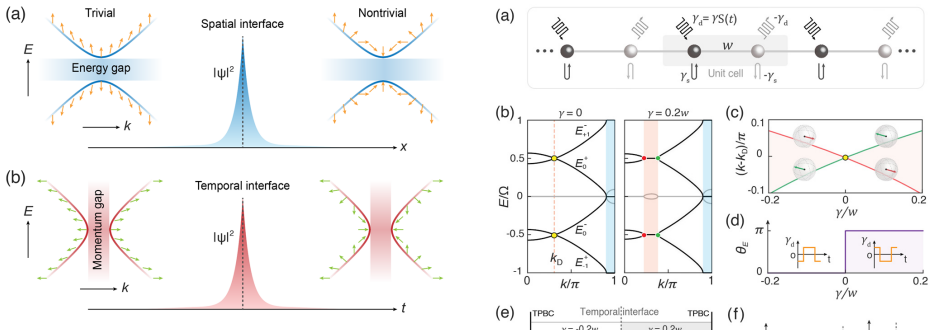
The load-bearing object is the effective Hamiltonian $H_{\mathrm{eff}}=(i2\pi T)^{-1}\ln U$ obtained from the Floquet operator $U$, with $U$ reconstructed experimentally from two measured wavefunctions via $U=[\psi_1(t_0+T),\psi_2(t_0+T)][\psi_1(t_0),\psi_2(t_0)]^{-1}$. The topological invariant is the energy-Brillouin-zone Berry phase $\theta_E=i\oint \langle\psi(E)|\partial_E|\psi(E)\rangle\,dE$, which the paper rewrites, in the PT-symmetric real-energy sector, as half the winding of the PT eigenvalue phase $\varphi(E)$ around the origin of the complex plane; that winding is what the experiment actually records. The momentum-band inversion appears as an exchange of the two Floquet exceptional-point momenta $k_1$ and $k_2$ as $\gamma$ crosses zero, and the temporal interface state is captured by a momentum-space Dirac model $M(\delta E)=v_D^{-1}(m\sigma_y-\delta E\,\sigma_z)$, with Dirac mass $m$ proportional to $\gamma$.
What would settle it
Detune the positive and negative feedback gains by about 10% while reconstructing the effective Hamiltonian; if the measured energy-Brillouin-zone Berry phase leaves the quantized set $\{0,\pi\}$ or the Floquet exceptional-point momenta stop swapping exactly with the sign of $\gamma$, the PT-balance assumption is the load-bearing condition that fails.
Extended reading notes
Core claim
The central claim is that in a PT-symmetric Floquet lattice with balanced static and dynamic gain/loss, periodically driving the gain/loss opens a momentum gap at the Floquet Dirac point, and the topology of that gap is carried by the eigenstates across the energy Brillouin zone. The paper reports direct experimental reconstruction of the $2\times 2$ effective Hamiltonian $H_{\mathrm{eff}}=(i2\pi T)^{-1}\ln U$ from two independent sound responses, extracts the eigenstates, and shows that the two Floquet exceptional-point states exchange their momenta when the sign of the dynamic gain/loss parameter $\gamma$ is reversed. It then evaluates the energy-Brillouin-zone Berry phase through the winding of the PT eigenvalue phase and finds $\theta_E=\pi$ for $\gamma>0$ and $\theta_E=0$ for $\gamma<0$, which it identifies as nontrivial versus trivial momentum-band topology. Finally, it creates a temporal interface between the two signs and observes sound intensity that first grows and then decays, localized at the interface in time, which is the temporal counterpart of an edge state.
Load-bearing premise
The load-bearing premise is that the gain on cavity 1 and the loss on cavity 2 are exactly balanced and remain PT-symmetric throughout the modulation; if the feedback amplitudes drift apart, the phase winding that produces the quantized Berry phase can smear, and the claimed topological invariant is no longer protected.
Editorial extensions
If this is right
- The energy-Brillouin-zone Berry phase can serve as a measurable bulk invariant for PT-symmetric Floquet momentum gaps, so momentum-band topology no longer has to be inferred only from temporal boundary states.
- Temporal bulk-boundary correspondence holds in this acoustic lattice: a time interface between opposite signs of $\gamma$ hosts a time-localized interface state, whereas an interface between two trivial configurations does not.
- Reversing the sign of the dynamic gain/loss parameter swaps the momenta of the two Floquet exceptional points, giving a clean experimental signature of momentum-band inversion.
- Reconstructing $H_{\mathrm{eff}}$ from two independent pulsed wavefunctions is a viable route to quasi-energy spectra and eigenstates in small Floquet systems.
- The same tunable acoustic platform can be extended to temporal quasicrystals, time-domain Anderson effects, and temporal Moiré superlattices.
Reading between the lines
- The Hamiltonian-reconstruction method should transfer to any Floquet system with a small Hilbert space and controllable inputs, such as photonic, mechanical, or electrical circuits, as long as two linearly independent initial states can be prepared and read out.
- The quantized Berry phase suggests a temporal Thouless pumping invariant; because time evolution is causal, temporal pumps may behave differently from spatial ones, a direction the paper flags but does not develop.
- A natural test is to replace the square-wave drive with a sinusoidal modulation and check whether $\theta_E$ stays quantized or a different invariant is needed.
- Because the degeneracies are exceptional points in the complex quasi-energy spectrum, the platform opens a route to observing exceptional-point braiding in the time domain.
Editorial analysis
A structured set of objections, weighed in public.
Referee Report
Summary. This manuscript reports an experimental study of momentum-band topology in a PT-symmetric acoustic Floquet lattice. The authors implement the lattice with coupled acoustic cavities and active feedback circuits, reconstruct the Floquet effective Hamiltonian from two measured time-domain wavefunctions, and extract quasi-energy spectra and eigenstates. They observe a dynamic gain/loss induced momentum gap, momentum-band inversion signaled by the exchange of Floquet exceptional-point momenta when the sign of the gain/loss amplitude γ is reversed, and a quantized Berry phase θ_E = π (γ>0) versus 0 (γ<0) obtained from the winding of the PT eigenvalue phase. They also observe temporally localized interface states at a temporal domain wall, as a boundary signature. The central claim is that this constitutes the first direct bulk experimental evidence of momentum-band topology.
Significance. If fully substantiated, this experiment would provide a genuine advance: direct bulk observation of a topological invariant in the energy Brillouin zone of a Floquet system, complementing earlier observations of temporal interface states. The technique of reconstructing the Floquet operator from two injected wavefunctions is elegant and transferable to other non-equilibrium systems. The theory is standard Floquet theory, clearly presented, and the bulk and boundary evidence are presented together, with a trivial-control experiment included. The paper would be strengthened by explicit error quantification and by making the derivation of the central identity used for the Berry-phase measurement fully transparent. The claim of 'first bulk evidence' is conditional on those points, but the experimental platform and reconstruction method are significant even apart from that claim.
major comments (4)
- [§4, Eq. (4)] The central topological measurement is based on the identity θ_E = (1/2)∮ ∂_E φ(E)dE with e^{iφ}=⟨ψ|PT|ψ⟩, which is stated in the main text and its derivation is entirely deferred to the Supplemental Material. Since the directly measured quantity is the winding of φ and not the integral in Eq. (2), the identification of a 2π winding with a quantized Berry phase θ_E=π depends on this nontrivial identity. The authors should provide the derivation in the main text or an extended appendix, specify the normalization of ψ, and state the conditions under which the identity holds (including the branch of the Floquet logarithm and the behavior near exceptional points).
- [§4, Fig. 4(c)] The experimental phase evolution φ(E) is plotted as circles with no error bars and no statistical analysis. The central quantitative claim—that the winding is exactly 2π for γ>0 and 0 for γ<0—needs an uncertainty estimate to be a convincing measurement of a topological invariant. The authors should report the number of independent measurements, the reproducibility of the winding, and the sensitivity of the extracted phase to noise in the measured wavefunctions.
- [Experimental setup, §3] The reconstruction of the Floquet operator in Eq. (3) requires that the two injected wavefunctions ψ1(t0) and ψ2(t0) are linearly independent and that the measured responses over one period faithfully represent the free Floquet evolution. The 2×2 matrix inversion in Eq. (3) has a condition number that depends on the angle between the two states and on the measurement noise. The authors should report the condition number (or an equivalent measure) and discuss how errors propagate from the measured time traces into the reconstructed eigenstates and phases. This directly affects the reliability of all subsequent eigenstate-based conclusions.
- [§2 and §3, PT balance] The theoretical model and the Berry-phase quantization rely on exact PT symmetry, i.e., gain +i(γ_s+γ_d(t)) on cavity 1 balanced by loss −i(γ_s+γ_d(t)) on cavity 2. The manuscript states the design intent of the positive and negative feedback circuits but does not report any measured value of the gain/loss imbalance or the calibration procedure. Since an unquantified imbalance can smear the PT eigenvalue phase and invalidate Eq. (4), the authors should provide a measured balance (e.g., from transmission or reflection calibration) and state the tolerance required by the size of the momentum gap.
minor comments (4)
- [§4, Fig. 4(b)] The caption refers to 'Floquet-EP states' rendered as thick arrows, but at an exceptional point the two eigenstates coalesce. Please clarify whether each arrow represents the single coalesced eigenvector at the EP momentum, or one of the two eigenstates on either side of the EP.
- [§3, Eq. (3)] The notation ψ† in Eq. (2) is the usual conjugate transpose, but for non-Hermitian systems one often needs biorthogonal left and right states. Please state explicitly the normalization adopted for the eigenstates used in Eq. (2) and in the experimental extraction.
- [Fig. 5(b)] The deviation between experiment and simulation for t > 25 ms is attributed to sensitivity to the synthesized momentum. Please provide a quantitative estimate of the momentum uncertainty and show, if possible, a comparison at a slightly different k to confirm this interpretation.
- [References] Reference [43] is given as 'See Supplemental Material [url]'; in the arXiv version the URL is a placeholder. Please ensure the supplemental material is accessible and that all equations cited there are available to the reader.
Circularity Check
No significant circularity: the central result is an experimental Hamiltonian reconstruction and eigenstate measurement, not a fitted or self-citational derivation.
full rationale
The paper's central derivation chain is experimental rather than definitional. The effective Hamiltonian is reconstructed from two measured, linearly independent time-evolved wavefunctions via Eq. (3), U = [psi1(t0+T), psi2(t0+T)][psi1(t0), psi2(t0)]^{-1}, and the eigenstates and Berry phase are then computed from this reconstructed operator. The model parameters (w, gamma_s, gamma, Omega) are set as experimental controls and are not tuned to reproduce the target topological invariant. The Berry phase in Eq. (2) is evaluated from the measured eigenstates, and Eq. (4) is presented as an equivalent reformulation whose derivation is deferred to the Supplemental Material; this is a mathematical identity whose validity conditions (PT balance) are an experimental condition, not a circular input. The prior self-citations (Refs. 46 and 49) concern acoustic cavity-tube coupling and square-wave modulation techniques, not the topological claim itself, and are therefore not load-bearing. The band inversion and temporal TIM observations are compared against independent theoretical simulations. While the reliance on the Supplemental Material for Eq. (4) and the unquantified gain/loss balance raise verification concerns, they are correctness risks rather than circularity. No step reduces by construction to its own input, so the circularity score is 0.
Assumptions & free parameters
free parameters (4)
- dynamic gain/loss amplitude gamma =
7 Hz (0.2w)
- static gain/loss gamma_s =
11 Hz (0.3w)
- hopping w =
36 Hz
- drive frequency Omega =
125 Hz
assumptions (4)
- standard math Floquet theory: the effective Hamiltonian is defined as H_eff = (i 2pi T)^{-1} ln U, and the Berry phase contours in the EBZ are evaluated on eigenstates of H_eff.
- domain assumption PT-symmetry of the Hamiltonian H(t) ensures real quasi-energies in the unbroken regions and quantization of the Berry phase to 0 or pi.
- domain assumption The reconstruction formula U = [psi1(t0+T), psi2(t0+T)][psi1(t0), psi2(t0)]^{-1} requires that the two injected pulses produce linearly independent initial states and that the dynamics is governed by the 2x2 Floquet operator.
- domain assumption Bulk-boundary correspondence for temporal interfaces: a non-trivial momentum-band Berry phase implies temporally localized interface states.
Cite this review
Pith. "Pith review of Observation of Momentum-Band Topology in PT-Symmetric acoustic Floquet Lattices." pith.science (2026). https://pith.science/paper/J447FGTV
@misc{pith2026250704068,
  author       = {Pith},
  title        = {Pith review of: Observation of Momentum-Band Topology in PT-Symmetric acoustic Floquet Lattices},
  year         = {2026},
  howpublished = {\url{https://pith.science/paper/J447FGTV}},
  note         = {Machine review of arXiv:2507.04068}
}
read the original abstract
Momentum-band topology, which transcends conventional topological band theory, unlocks new topological phases that host fascinating temporal interface states. However, direct bulk experimental evidence of such emerging band topology is still lacking due to the great challenges in resolving eigenstates and topological invariants of time-varying systems. Here, we present a comprehensive study on the momentum-band topology in a PT-symmetric Floquet lattice, where the drive-induced momentum gap can be characterized by a quantized Berry phase in the energy Brillouin zone. Experimentally, we synthesize the Floquet lattice model using an acoustic cavity-tube structure coupled to custom-designed external circuits. By reconstructing the effective Hamiltonian, we extract the system's eigenstates and provide the first bulk evidence of momentum-band topology from the perspectives of band inversion and topological invariants. This is accompanied by an unambiguous observation of time-localized interface states in real physical time, thereby providing the boundary signature of the bulk topology. Our work paves the way for further experimental studies on the burgeoning momentum-gap physics.
Figures


Figures from the paper (1 more)

Forward citations
Cited by 1 Pith paper
-
Topological Localisation in Time from PT Symmetry
PT-symmetric two-level systems have two topological phases, and switching between them in time makes wave intensity peak at the switch.
Reference graph
Works this paper leans on
-
[1]
M. Z. Hasan, and C. L. Kane, Colloquium: Topological insulators, Rev. Mod. Phys. 82, 3045 (2010)
work page 2010
-
[2]
X.-L. Qi and S.-C. Zhang, Topological in sulators and superconductors, Rev. Mod. Phys. 83, 1057 (2011)
work page 2011
-
[3]
N. P. Armi ta ge , E . J. Mele, and Ashvin Vishwanath, Weyl and Dirac semimetals in three-dimensional solids, Rev. Mod. Phys. 90, 015001 (2018)
work page 2018
-
[4]
M. Zahid Hasan, G. Chang, I. Belopolski, G. Bian, S.-Y . Xu, and J.-X. Yin, Weyl, Dirac and high-fold chiral fermions in topological quantum matter, Nat. Rev. Mater. 6, 784–803 (2021)
work page 2021
-
[5]
L. Lu, J. D. Joannopoulos, and M. Solja čić, Topological photonics. Nat. Photon. 8, 821–829 (2014)
work page 2014
-
[6]
Ozawa, H
T. Ozawa, H. M. Price, A. Amo, N. Goldman, M. Hafezi, L. Lu, M. C. Rechtsman, D. Schuster, J. Simon, O. Zilberberg, and I. Carusotto, Topological photonics, Rev. Mod. Phys. 91, 015006 (2019)
2019
-
[7]
H. He, C. Qiu, L. Ye, X. Cai, X. Fan, M. Ke, F. Zhang, and Z. Liu, Topological negative refraction of surface acoustic waves in a Weyl phononic crystal, Nature 560, 61–64 (2018)
work page 2018
- [8]
Show all 57 references
-
[9]
V . V . Albert, L. I. Glazman, and L. Jiang, Topological Properties of Linear Circuit Lattices, Phys. Rev. Lett. 114, 173902 (2015)
2015
-
[10]
Imhof, C
S. Imhof, C. Berger, F. Bayer, J. Brehm, L. W. Molenkamp, T. Kiessling, F. Schindler, C. H. Lee, M. Greiter, T. Neupert, and Ronny Thomale, Topolectrical-circuit realization of topological corner modes, Nat. Phys. 14, 925–929 (2018)
2018
-
[11]
A. M. Essin, and V . Gurarie, Bulk-boundary correspondence of topological insulators from their respective Green’s functions, Phys. Rev. B 84, 125132 (2011)
2011
-
[12]
Zak, Berry’s phase for energy bands in solids, Phys
J. Zak, Berry’s phase for energy bands in solids, Phys. Rev. Lett. 62, 2747 (1989)
1989
-
[13]
D. J. Thouless, M. Kohmoto, M. P . Nightingale, and M. den Nijs, Quantized Hall Conductance in a Two-Dimensional Periodic Potential, Phys. Rev. Lett. 49, 405 (1982)
1982
-
[14]
Simon, Holonomy, the Quantum Adiabatic Theorem, and Berry's Phase, Phys
B. Simon, Holonomy, the Quantum Adiabatic Theorem, and Berry's Phase, Phys. Rev. Lett. 51 , 2167 (1983)
1983
-
[15]
Lindner, G
N. Lindner, G. Refael, and V . Galitski, Floquet topological insulator in semiconductor quantum wells. Nat. Phys. 7, 490–495 (2011)
2011
-
[16]
M. C. Rechtsman, J. M. Zeuner, Y . Plotnik, Y . Lumer, D. Podolsky, F. Dreisow, S. Nolte, M. Segev and A. Szameit, Photonic Floquet topological insulators, Nature 496, 196– 200 (2013)
2013
-
[17]
Gómez-León, and G
Á. Gómez-León, and G. Platero, Floquet-Bloch Theory and Topology in Periodically Driven Lattices, Phys. Rev. Lett. 110, 200403 (2013)
2013
-
[18]
M. S. Rudner, N. H. Lindner, E. Berg, and M. Levin, Anomalous Edge States and the Bulk-Edge Correspondence for Periodically Driven Two-Dimensional Systems, Phys. Rev. X 3, 031005 (2013)
2013
-
[19]
L. J. Maczewsky, J. M. Zeuner, S. Nolte, and A. Szameit, Observation of photonic anomalous Floquet topological insulators. Nat. Commun. 8, 13756 (2017)
2017
-
[20]
M. S. Rudner, and N. H. Lindner, Band structure engineering and non-equilibrium dynamics in Floquet topological insulators. Nat. Rev. Phys. 2, 229–244 (2020)
2020
-
[21]
Morimoto, H
T. Morimoto, H. Chun Po, and A. Vishwanath, Floquet topological phases protected by time glide symmetry, Phys. Rev. B 95, 195155 (2017)
2017
-
[22]
Peng and G
Y . Peng and G. Refael, Floquet second-order topological insulators from nonsymmorphic space-time symmetries, Phys. Rev. Lett. 123, 016806 (2019)
2019
-
[23]
J. Jin, L. He, J. Lu, E. J. Mele, and B. Zhen Floquet Quadrupole Photonic Crystals Protected by Space-Time Symmetry. Phys. Rev. Lett. 129, 063902 (2022)
2022
-
[24]
Peng, Topological Space-Time Crystal, Phys
Y . Peng, Topological Space-Time Crystal, Phys. Rev. Lett
-
[25]
Lustig, Y
E. Lustig, Y . Sharabi, and M. Segev, Topological aspects of photonic time crystals, Optica 5, 1390-1395 (2018)
2018
-
[26]
Biancalana, A
F. Biancalana, A. Amann, A. V . Uskov, and E. P. O’Reilly, Dynamics of light propagation in spatiotemporal dielectric structures, Phys. Rev. E 75, 046607 (2007)
2007
-
[27]
J. R. Zurita-Sánchez, P. Halevi, and J. C. Cervantes- González, Reflection and transmission of a wave incident on a slab with a time-periodic dielectric function 𝜖(𝑡), Phys. Rev. A 79, 053821 (2009)
2009
-
[28]
Wang, Z.-Q
N. Wang, Z.-Q. Zhang, and C. T. Chan, Photonic Floquet media with a complex time-periodic permittivity, Phys. Rev. B 98, 085142 (2018)
2018
-
[29]
Lyubarov, Y
M. Lyubarov, Y . Lumer, A. Dikopoltsev, E. Lustig, Y . Sharabi, and M. Segev, Amplified emission and lasing in photonic time crystals, Science 377, 425–428 (2022)
2022
-
[30]
X. Wang, P. Garg, M. S. Mirmoosa, A. G. Lamprianidis, C. Rockstuhl, and V . S. Asadchy, Expanding momentum bandgaps in photonic time crystals through resonances. Nat. Photon. 19, 149–155 (2025)
2025
-
[31]
Apffel, and E
B. Apffel, and E. Fort, Frequency Conversion Cascade by Crossing Multiple Space and Time Interfaces, Phys. Rev. Lett. 128, 064501 (2022)
2022
-
[32]
J. R. Reyes-Ayona, P. Halevi, Observation of genuine wave vector ( k or β) gap in a dynamic transmission line and temporal photonic crystals, Appl. Phys. Lett. 107 , 074101 (2015)
2015
-
[33]
Moussa, G
H. Moussa, G. Xu, S. Yin, E. Galiffi, Y .s Ra’di, and Andrea Alù, Observation of temporal reflection and broadband frequency translation at photonic time interfaces. Nat. Phys. 19, 863–868 (2023)
2023
-
[34]
H. Li, S. Yin, H. He, J. Xu, A. Alù, and B. Shapiro, Stationary Charge Radiation in Anisotropic Photonic Time Crystals, Phys. Rev. Lett. 130, 093803 (2023). 7
2023
-
[35]
Dikopoltsev, Y
A. Dikopoltsev, Y . Sharabi, M. Lyubarov, Y . Lumer, S. Tsesses, E. Lustig, I. Kaminer, and M. Segev, Light emission by free electrons in photonic time-crystals, Proc. Natl. Acad. Sci. U.S.A. 119, e2119705119 (2022)
2022
-
[36]
Pan, M.-I
Y. Pan, M.-I. Cohen, and M. Segev, Superluminal 𝑘-Gap Solitons in Nonlinear Photonic Time Crystals, Phys. Rev. Lett. 130, 233801 (2023)
2023
-
[37]
Y . Yang, H. Hu, L. Liu, Y . Yang, Y . Yu, Y. Long, X. Zheng, Y . Luo, Z. Li, and F. J. Garcia-Vidal, Topologically Protected Edge States in Time Photonic Crystals with Chiral Symmetry, ACS Photonics (2025)
2025
-
[38]
Y . Ren, K. Y e, Q. Chen, F. Chen, L. Zhang, Y . Pan, W. Li, X. Li, L. Zhang, H. Chen, and Y . Yang, Observation of momentum-gap topology of light at temporal interfaces in a time-synthetic lattice. Nat. Commun. 16, 707 (2025)
2025
-
[39]
J. Feis, S. Weidemann, T. Sheppard, H. M. Price, and A. Szameit, Space-time-topological events in photonic quantum walks. Nat. Photon. 19, 518–525 (2025)
2025
-
[40]
Zhu, and J.-H
W. Zhu, and J.-H. Jiang, Characterizing generalized Floquet topological states in hybrid space-time dimensions, arXiv:2409.09937 (2024)
2024 arXiv
-
[41]
M. Li, J. Liu, X. Wang, W. Chen, G. Ma, and J. Dong, Topological temporal boundary states in a non-Hermitian spatial crystal, arXiv:2306.09627v2 (2024)
2024 arXiv
-
[42]
B. A. Bernevig, T.L. Hughes, and S.-C. Zhang, Quantum Spin Hall Effect and Topological Phase Transition in HgTe Quantum Wells, Science 314, 1757 (2006)
2006
-
[43]
[38,48,49,56,57]
See Supplemental Material [url] for theoretical details and experimental setup, which includes Refs. [38,48,49,56,57]
-
[44]
H. Xue, Y . Yang, F. Gao, Y . Chong, B. Zhang, Acoustic higher-order topological insulator on a kagome lattice, Nat. Mater. 18, 108–112 (2019)
2019
-
[45]
X. Ni, M. Weiner, A. Alù, and A. B. Khanikaev, Observation of higher-order topological acoustic states protected by generalized chiral symmetry, Nat. Mater. 18, 113–120 (2019)
2019
-
[46]
Y . Qi, C. Qiu, M. Xiao, H. He, M. Ke, and Z. Liu, Acoustic Realization of Quadrupole Topological Insulators, Phys. Rev. Lett. 124, 206601 (2020)
2020
-
[47]
Zhang, Y
L. Zhang, Y . Yang, Y. Ge, Y . Guan, Q. Chen, Q. Yan, F. Chen, R. Xi, Y . Li, D. Jia, S. Y uan, H. Sun, H. Chen, and B. Zhang, Acoustic non-Hermitian skin effect from twisted winding topology. Nat. Commun. 12, 6297 (2021)
2021
-
[48]
J. Liu, Z. Li, Z.-G. Chen, W. Tang, A. Chen, B. Liang, G. Ma, and J.-C. Cheng, Experimental Realization of Weyl Exceptional Rings in a Synthetic Three-Dimensional Non- Hermitian Phononic Crystal, Phys. Rev. Lett. 129, 084301 (2022)
2022
-
[49]
Zhang, Y
Q. Zhang, Y . Li, H. Sun, X. Liu, L. Zhao, X. Feng, X. Fan, and C. Qiu, Observation of Acoustic Non-Hermitian Bloch Braids and Associated Topological Phase Transitions, Phys. Rev. Lett. 130, 017201 (2023)
2023
-
[50]
Z. Chen, A. Chen, Y .-G. Peng, Z. Li, B. Liang, J. Yang, X.-F. Zhu, Y. Lu, and J. Cheng, Observation of acoustic Floquet π modes in a time-varying lattice, Phys. Rev. B 109, L020302 (2024)
2024
-
[51]
X. Ni, S. Yin, H. Li, and A. Alù, Topological wave phenomena in photonic time quasicrystals, Phys. Rev. B 111, 125421 (2025)
2025
-
[52]
Carminati, H
R. Carminati, H. Chen, R. Pierrat, and B. Shapiro, Universal Statistics of Waves in a Random Time-Varying Medium, Phys. Rev. Lett. 127, 094101 (2021)
2021
-
[53]
Sharabi, E
Y . Sharabi, E. Lustig, and M. Segev, Disordered Photonic Time Crystals, Phys. Rev. Lett. 126, 163902 (2021)
2021
-
[54]
L. Zou, H. Hu, H. Wu, Y . Long, Y . Chong, B. Zhang, Y . Luo, Momentum flatband and superluminal propagation in a photonic time Moiré superlattice, arXiv:2411.00215 (2024)
2024 arXiv
-
[55]
Z. Dong, X. Chen, L. Y uan, Extreme narrow band in Moiré Photonic time crystal, arXiv:2411.05351 (2024)
2024 arXiv
-
[56]
de Gail1, M
R. de Gail1, M. O. Goerbig, F. Guinea, G. Montambaux, and A. H. Castro Neto, Topologically protected zero modes in twisted bilayer graphene, Phys. Rev. B 84, 045436 (2011)
2011
-
[57]
Stegmaier, S
A. Stegmaier, S. Imhof, T. Helbig, T. Hofmann, C. H. Lee, M. Kremer, A. Fritzsche, T. Feichtner, S. Klembt, et al, Topological Defect Engineering and Symmetry in Non- Hermitian Electrical Circuits, Phys. Rev. Lett. 126, 215302 (2021)
2021
Reviewed August 6, 2026 · model on record in the stance chip above.
Discussion (0). Continue with ORCID to comment.