REVIEW 3 major objections 4 minor 68 references
Electron-Induced Radiolysis of Water Ice and the Buildup of Oxygen
T0 review · 3 major / 4 minor · reviewed 2026-08-11 · deepseek-v4-flash
Pith's one-line read This paper reports that electron irradiation of porous water ice at temperatures representative of the Jovian moons produces and retains molecular oxygen at concentrations of 0.1–2% relative to water, matching remote observations of O2 on…
desk verdict Read this for the qualitative memory effect, not for the O2/H2O ratio in the abstract—that quantitative claim needs a proper significance test before it is quoted. read the letter →
The pith
A machine-rendered reading of the paper's core claim, the machinery that carries it, and where it could break.
The reading
What carries the argument
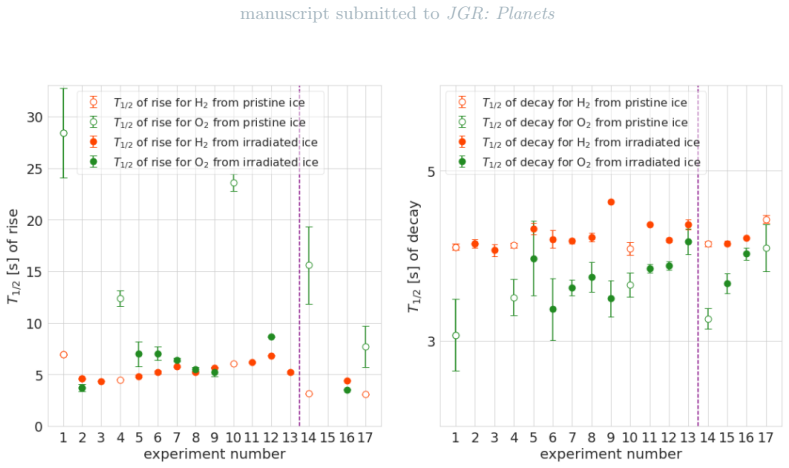
The load-bearing measurement is the rise time of the mass-32 signal after the electron beam is switched on. The authors fit each time series with $I(t) = m \exp(-\lambda t) + k$ and compare the average rise constant for O2 on pristine ice with that on previously irradiated ice; the difference, $\lambda = 0.113 \pm 0.090\,\mathrm{s}^{-1}$, is interpreted as a first-order rate at which newly produced O2 is retained in the ice. That rate enters Eq. 7, which divides the O2 production rate per unit area by the number of H2O molecules in the electron penetration layer (depth $d = 46\,\mathrm{nm}$ at 1 keV) to obtain the O2/H2O ratio. The exponential-release fit and the pristine-versus-pre-irradiated contrast are what turn an observable delay into an in-ice abundance.
What would settle it
Irradiate a fresh spot of the same ice to saturation, then warm the sample while continuously measuring the O2 partial pressure; the total O2 released during warm-up should match the retained inventory implied by Eq. 7 for that fluence. If the desorbed amount differs by more than the stated uncertainties, the rise-time interpretation would have to be abandoned.
Extended reading notes
Core claim
On the paper's own terms, the discovery is that molecular oxygen produced by electron radiolysis of water ice is retained in porous regolith ice at a few tenths to a few percent relative to water, and that this retention is visible in the time evolution of the O2 release signal. The steady-state release ratio of H2 to O2 approaches the stoichiometric 2:1 once the ice is saturated, whereas pristine ice shows a delayed O2 rise with a half-life near 10 s compared with a few seconds for H2 or for re-irradiated ice. The delay is read as O2 accumulating in the ice, and Eq. 7 converts the difference in rise constants into $\mathrm{O}_2/\mathrm{H}_2\mathrm{O} \approx 0.004$ (uncertainty range $0.2\times 10^{-2}$ to $2\times 10^{-2}$). This quantitative bridge between a laboratory time series and the O2 inventories of icy moons is the paper's central contribution.
Load-bearing premise
The entire O2/H2O estimate rests on reading the slower O2 rise on pristine ice as oxygen being stored in the ice at a known first-order rate, rather than as a side effect of the first irradiation changing the ice's structure, porosity, or surface charge.
Editorial extensions
If this is right
- If the interpretation is correct, electron irradiation alone can maintain an O2/H2O ratio of order $10^{-2}$ in the top tens of nanometres of 100 K water ice, the layer that remote spectroscopy actually probes.
- Oxygen built up during one irradiation remains available for at least 19 hours at temperatures below 120 K, so intermittent irradiation events can accumulate a reservoir instead of requiring continuous bombardment.
- At high electron fluxes the released H2/O2 ratio approaches the stoichiometric 2:1, meaning that once saturation is reached the radiolysis products leave the ice in the proportions in which they are produced; the O2 deficit at low flux is the signature of retention.
- The measured saturation fluence of $10^{14}$–$10^{15}$ electrons cm$^{-2}$ for fine-grained ice gives a dose scale that future surface-chemistry models of Ganymede and Europa can use to predict O2 inventories.
Reading between the lines
- Because the experiments were run at 91–93 K, O2 retention at colder polar temperatures (near 80 K on Europa and Ganymede) could be stronger than the quoted 0.1–2%, a testable prediction for future temperature-controlled runs.
- If O2 formation in ion-irradiated ice proceeds through the same precursor chemistry, the same retention argument may extend to the ion irradiation that shapes Europa's and Callisto's exospheres; the paper only measures electrons, so this extrapolation is ours.
- A direct check of Eq. 7 would be to warm the irradiated ice while monitoring O2 release and compare the total desorbed O2 with the inventory implied by the rise-time delay for the same fluence.
- Should the pristine-to-pre-irradiated difference turn out to reflect beam-induced changes in porosity or surface charging rather than O2 storage, the derived ratio would need to be revised; separating these effects calls for simultaneous surface characterization during irradiation.
Editorial analysis
A structured set of objections, weighed in public.
Referee Report
Summary. The paper presents time-of-flight mass spectrometry measurements of electron-irradiated porous water ice regolith samples at 91–93 K in the MEFISTO facility. The authors identify H2 and O2 as the dominant radiolysis products, observe that the O2 signal rises more slowly on pristine ice than on previously irradiated spots, demonstrate that this memory effect persists for at least 19 hours, and convert the difference in O2 rise time constants into a quantitative O2/H2O retention ratio in the irradiated layer using Eq. (7), obtaining r ≈ 0.004, quoted as a range of (0.2–2.0) × 10^-2. The paper also discusses the threshold behavior of H2O release, cold-trapping biases, and the relevance of the results to icy moons and comets.
Significance. The qualitative finding that originally pure, previously unirradiated porous water ice retains radiolytic O2 while pre-irradiated ice releases it on a fast, reproducible timescale is well supported by the time-series fits and is of genuine interest for modeling radiolysis in icy regoliths. The manuscript is commendable for publishing the raw mass spectra and analysis notebooks on Zenodo, for careful treatment of MCP gain, electron-impact ionization cross-sections, and fragmentation patterns, and for using a realistic porous ice analog rather than thin compact films. Eq. (7) is not circular: it uses the O2 sputtering yield from Galli et al. (2018) as an independent input and the retention rate is measured in this work. However, the quantitative headline claim—the O2/H2O ratio of order 10^-2—rests entirely on a rate constant difference that is only marginally significant, so the paper's central quantitative conclusion is not yet secured.
major comments (3)
- [§5.2, Eq. (7), Table 4] The central quantitative result is supported only by a statistically marginal rate difference. The retention rate used in Eq. (7) is λ = 0.113 ± 0.090 s^-1, which is about 1.3 standard deviations from zero; even the raw difference between the Table 4 values λ_pristine = 0.07 ± 0.03 s^-1 and λ_followup = 0.19 ± 0.07 s^-1 is only about 1.6σ. Because r(O2/H2O) in Eq. (7) is inversely proportional to λ, the quoted range (0.2–2.0) × 10^-2 does not include the possibility that λ = 0, and if the null hypothesis of equal rise constants cannot be rejected, the confidence interval for the retention ratio includes zero. I request a formal significance test, for example a likelihood-ratio or permutation test on the open time-series data, and a statement of the resulting confidence interval. Without such a test, the abstract's claim that the experiments 'quantify' residence times and saturation levels is not justified; at most an upper limit could be claimed.
- [§4.3, §5.2] The interpretation of the delayed O2 rise on pristine ice as first-order bulk O2 retention is an assumption, not a demonstrated mechanism. The slower rise could also be caused by electron-beam-induced surface charging of the initially unirradiated porous sample, by compaction or sintering of the regolith during the first irradiation, or by spot-to-spot variations in ice density or grain size between pristine and follow-up irradiations. The manuscript does not report control experiments or diagnostics that would discriminate among these possibilities, such as repeating irradiations on different pristine spots, measuring sample density or morphology before and after irradiation, or monitoring surface charging. This matters because Eq. (7) converts the fitted λ difference into a molecular O2/H2O ratio; if the timescale difference is not caused by O2 retention, the numerical ratio in Section 5.2 has no physical meaning.
- [Table 4, §4.3] The statistical aggregation in Table 4 needs more detail before the 'significant difference' language in Section 4.3 can be evaluated. The number of experiments contributing to each category is not stated, the fits are averaged with equal weight despite heterogeneous fluxes and energies, and no p-value or confidence interval for the difference between pristine and follow-up O2 rise constants is given. The R² ≥ 0.5 cutoff for including fits is unusually permissive and should be documented per experiment, since a few poor fits could dominate the average half-life if the time series are short.
minor comments (4)
- [§4.2] The threshold for coarse-grained ice is given as '5 × 10^13 keV m^-2 s^-1', whereas the surrounding text and Figure 5 use cm^-2; the units should be cm^-2 for consistency.
- [§3] The fragment 'HO' appears in the text and Table 2, while the standard notation for the hydroxyl radical is 'OH'; please use one notation consistently.
- [§4.3] The sentence 'The half dose or saturation fluence d1/2 ... d1/2 = 0 .5 × 10^14 electrons cm^-2' contains a stray space in the numerical value; this should be corrected.
- [Eq. (3)] Equation (3) would be clearer if the symbols MCP(H2), EICS(H2), and FRAG were explicitly defined in the equation or immediately before it, since the reader must otherwise reverse-engineer the correction factors from Table 3.
Circularity Check
No significant circularity: the O2/H2O retention ratio is derived from measured release-time differences and an external sputtering-yield measurement; the only same-group citation is independent support.
full rationale
The paper's central quantitative claim is Eq. 7, r(O2/H2O) = Y_O2 * j_e * m_mol / (A * d * rho * N_A * q_e * lambda) ≈ 0.004, which combines (i) Y_O2 = 1.5 from Galli et al. (2018), (ii) the measured difference between O2 rise times on pristine and pre-irradiated ice, lambda = 0.113 ± 0.090 s^-1 (Table 4 and Section 5.2), and (iii) fixed experimental and geometric constants. The target quantity is not an input to any fit in this paper: lambda is obtained by fitting Eq. 6 to the TOF-MS time series, and Y_O2 comes from an independent prior experiment by the same group that is external to the present data and is not adjusted to reproduce the O2/H2O ratio. The step from time constants to a retained-O2 fraction is a physical model (first-order retention), not a definitional identity; it would fail if the slower pristine rise reflected morphology, charging, or other effects, as the paper itself effectively acknowledges by reporting the large uncertainty on lambda and not testing those alternatives. Those are statistical and physical-interpretation risks, not circularity. The paper also openly declines to derive absolute yields and states the uncertainty is at least as large as sigma_lambda. No self-citation chain is used to forbid alternatives, and no known result is merely renamed. The qualitative memory effect is checked against prior film experiments and the open data/code allow external verification. Therefore there are no circular steps; score 0.
Assumptions & free parameters
free parameters (4)
- O2 retention rate constant (lambda_diff) =
0.113 +/- 0.090 s^-1
- O2 sputtering yield (Y_O2) =
1.5 molecules per electron
- Electron beam current (j_e) =
3 microampere
- Electron penetration depth (d) =
46 nm
assumptions (5)
- domain assumption The release time series of H2 and O2 follow a single exponential with constant lambda (Eq. 6).
- ad hoc to paper The slower O2 rise on pristine ice relative to follow-up irradiations is caused by O2 retention in the ice, modeled as a first-order process with rate lambda_diff.
- domain assumption The O2 sputtering yield Y_O2 = 1.5 from Galli et al. (2018) applies to the present porous ice samples at 1 keV.
- domain assumption H2 is not retained in water ice at 91 to 93 K, while O2 is retained.
- standard math The electron penetration depth in the porous ice is given by d = R0 E^alpha with R0 = 46 nm and alpha = 1.76 for rho = 1 g/cm3.
Cite this review
Pith. "Pith review of Electron-Induced Radiolysis of Water Ice and the Buildup of Oxygen." pith.science (2026). https://pith.science/paper/JEWV642A
@misc{pith2026241204079,
  author       = {Pith},
  title        = {Pith review of: Electron-Induced Radiolysis of Water Ice and the Buildup of Oxygen},
  year         = {2026},
  howpublished = {\url{https://pith.science/paper/JEWV642A}},
  note         = {Machine review of arXiv:2412.04079}
}
read the original abstract
Irradiation by energetic ions, electrons, and UV photons induces sputtering and chemical processes (radiolysis) in the surfaces of icy moons, comets, and icy grains. Laboratory experiments, both of ideal surfaces and of more complex and realistic analog samples, are crucial to understand the interaction of surfaces of icy moons and comets with their space environment. This study shows the first results of mass spectrometry measurements from porous water ice regolith samples irradiated with electrons as a representative analogy to water-ice rich surfaces in the solar system. Previous studies have shown that most electron-induced H2O radiolysis products leave the ice as H2 and O2 and that O2 can be trapped under certain conditions in the irradiated ice. Our new laboratory experiments confirm these findings. Moreover, they quantify residence times and saturation levels of O2 in originally pure water ice. H2O may also be released from the water ice by irradiation, but the quantification of the released H2O is more difficult and the total amount is sensitive to the electron flux and energy.
Figures


Figures from the paper (6 more)



Reference graph
Works this paper leans on
-
[1]
Abdulgalil2017 APACrefauthors Abdulgalil, A G M. , Rosu-Finsen, A. , Marchione, D. , Thrower, J D. , Collings, M P. \ McCoustra, M R S. APACrefauthors \ 2017 . Electron-Promoted Desorption from Water Ice Surfaces: Neutral Gas-Phase Products Electron-promoted desorption from water ice surfaces: Neutral gas-phase products . ACS Earth and Space Chemistry 1 2...
-
[2]
Altwegg2020 APACrefauthors Altwegg, K. , Balsiger, H. , Combi, M. , De Keyser, J. , Drozdovskaya, M N. , Fuselier, S A. Wampfler, S. APACrefauthors \ 2020 . Molecule-dependent oxygen isotopic ratios in the coma of comet 67P/Churyumov-Gerasimenko Molecule-dependent oxygen isotopic ratios in the coma of comet 67p/churyumov-gerasimenko . MNRAS 498 5855 . APA...
-
[3]
oxygen APACrefauthors Baertschi, P. APACrefauthors \ 1976 08 . Absolute18O content of standard mean ocean water Absolute18o content of standard mean ocean water . Earth and Planetary Science Letters 31 3 341--344 . APACrefURL https://doi.org/10.1016/0012-821x(76)90115-1 APACrefURL APACrefDOI doi:10.1016/0012-821x(76)90115-1 APACrefDOI
-
[4]
Bahr2001 APACrefauthors Bahr, D A. , Famá, M. , Vidal, R A. \ Baragiola, R A. APACrefauthors \ 2001 . Radiolysis of water ice in the outer solar system: Sputtering and trapping of radiation products Radiolysis of water ice in the outer solar system: Sputtering and trapping of radiation products . Journal of Geophysical Research: Planets 106 E12 33285-3329...
-
[5]
Baragiola2002 APACrefauthors Baragiola, R. , Atteberry, C. , Dukes, C. , Famá, M. \ Teolis, B. APACrefauthors \ 2002 . Atomic collisions in solids: Astronomical applications Atomic collisions in solids: Astronomical applications . Nuclear Instruments and Methods in Physics Research Section B: Beam Interactions with Materials and Atoms 193 1 720-726 . APAC...
-
[6]
Bar-Nun1985 APACrefauthors Bar-Nun, A. , Herman, G. , Laufer, D. \ Rappaport, M L. APACrefauthors \ 1985 . Trapping and release of gases by water ice and implications for icy bodies Trapping and release of gases by water ice and implications for icy bodies . Icarus 63 317 . APACrefDOI doi:10.1016/0019-1035(85)90048-X APACrefDOI
-
[7]
Bieler2015 APACrefauthors Bieler, A. , Balsiger, H. , Altwegg, K. \ et al. APACrefauthors \ 2015 . Abundant molecular oxygen in the coma of comet 67P/Churyumov-Gerasimenko Abundant molecular oxygen in the coma of comet 67p/churyumov-gerasimenko . Nature 526 678--681 . APACrefDOI doi:10.1038/nature15707 APACrefDOI
-
[8]
Boring1983 APACrefauthors Boring, J. , Johnson, R. , Reimann, C. , Garret, J. , Brown, W. \ Marcantonio, K. APACrefauthors \ 1983 . Ion-induced chemistry in condensed gas solids Ion-induced chemistry in condensed gas solids . Nuclear Instruments and Methods in Physics Research 218 1 707-711 . APACrefDOI doi:https://doi.org/10.1016/0167-5087(83)91070-0 APACrefDOI
Show all 68 references
-
[9]
, Augustyniak, W
Brown1984 APACrefauthors Brown, W. , Augustyniak, W. , Marcantonio, K. , Simmons, E. , Boring, J. , Johnson, R. \ Reimann, C. APACrefauthors \ 1984 . Electronic sputtering of low temperature molecular solids Electronic sputtering of low temperature molecular solids . Nuclear I...
1984 doi
-
[10]
, Johnson, R E
Calvin1996 APACrefauthors Calvin, W M. , Johnson, R E. \ Spencer, J R. APACrefauthors \ 1996 . O _ 2 on Ganymede: Spectral Characteristics and Plasma Formation Mechanisms O _ 2 on ganymede: Spectral characteristics and plasma formation mechanisms . Geophysical Research Letters...
1996 doi
-
[11]
, Liuzzo, L
Carberry2023 APACrefauthors Carberry Mogan, S R. , Liuzzo, L. , Poppe, A R. , Simon, S. , Szalay, J R. , Tucker, O J. \ Johnson, R E. APACrefauthors \ 2023 . Callisto's Atmosphere: The Oxygen Enigma Callisto's atmosphere: The oxygen enigma . Journal of Geophysical Research: Pl...
2023 doi
-
[12]
, Anderson, M
Carlson1999 APACrefauthors Carlson, R W. , Anderson, M. , Johnson, R. , Smythe, W. , Hendrix, A. , Barth, C. Matson, D. APACrefauthors \ 1999 . Hydrogen peroxide on the surface of Europa Hydrogen peroxide on the surface of europa . Science 283 2062--2064 . APACrefDOI doi:10.11...
1999
-
[13]
\ Johnson, R
Cassidy2005 APACrefauthors Cassidy, T. \ Johnson, R. APACrefauthors \ 2005 . Monte Carlo model of sputtering and other ejection processes within a regolith Monte carlo model of sputtering and other ejection processes within a regolith . Icarus 176 2 499-507 . APACrefDOI doi:ht...
2005 doi
-
[14]
, Meier, R M
Davis2021 APACrefauthors Davis, M R. , Meier, R M. , Cooper, J F. \ Loeffler, M J. APACrefauthors \ 2021 . The Contribution of Electrons to the Sputter-produced O _2 Exosphere on Europa The contribution of electrons to the sputter-produced o _2 exosphere on europa . The Astrop...
2021 doi
-
[15]
, Shi, J
Fama2008 APACrefauthors Famá, M. , Shi, J. \ Baragiola, R. APACrefauthors \ 2008 . Sputtering of ice by low-energy ions Sputtering of ice by low-energy ions . Surface Science 602 1 156-161 . APACrefDOI doi:https://doi.org/10.1016/j.susc.2007.10.002 APACrefDOI
2008 doi
-
[16]
, Galli, A
Foehn2021 APACrefauthors Föhn, M. , Galli, A. , Vorburger, A. , Tulej, M. , Lasi, D. , Riedo, A. Wurz, P. APACrefauthors \ 2021 . Description of the Mass Spectrometer for the Jupiter Icy Moons Explorer Mission Description of the mass spectrometer for the jupiter icy moons expl...
2021
-
[17]
Electron-induced radiolysis of water ice and the buildup of oxygen
Galli2024 APACrefauthors Galli, A. APACrefauthors \ 2024 . Data release accompanying JGR publication "Electron-induced radiolysis of water ice and the buildup of oxygen" by Tinner et al. [Data set]. Data release accompanying jgr publication "electron-induced radiolysis of wate...
2024 doi
-
[18]
, Vorburger, A
Galli2016 APACrefauthors Galli, A. , Vorburger, A. , Pommerol, A. , Wurz, P. , Jost, B. , Poch, O. Thomas, N. APACrefauthors \ 2016 . Surface charging of thick porous water ice layers relevant for ion sputtering experiments Surface charging of thick porous water ice layers rel...
2016 doi
-
[19]
, Vorburger, A
Galli2018 APACrefauthors Galli, A. , Vorburger, A. , Wurz, P. , Pommerol, A. , Cerubini, R. , Jost, B. Thomas, N. APACrefauthors \ 2018 . 0.2 to 10 keV electrons interacting with water ice: Radiolysis, sputtering, and sublimation 0.2 to 10 kev electrons interacting with water ...
2018 doi
-
[20]
APACrefauthors \ 2015
Gasc2015 APACrefauthors Gasc, S. APACrefauthors \ 2015 . Sensitivity and Fragmentation Calibration of the ROSINA Reflectron-type Time-Of-Flight Mass Spectrometer. Sensitivity and fragmentation calibration of the rosina reflectron-type time-of-flight mass spectrometer. https://...
2015
-
[21]
, Altwegg, K
Gasc2017 APACrefauthors Gasc, S. , Altwegg, K. , Fiethe, B. , Jäckel, A. , Korth, A. , Le Roy, L. Wurz, P. APACrefauthors \ 2017 Jan . Sensitivity and fragmentation calibration of the time-of-flight mass spectrometer RTOF on board ESA’s Rosetta mission Sensitivity and fragment...
2017 doi
-
[22]
, Killelea, D R
Gibson2011 APACrefauthors Gibson, K D. , Killelea, D R. , Yuan, H. , Becker, J S. \ Sibener, S J. APACrefauthors \ 2011 01 . Determination of the sticking coefficient and scattering dynamics of water on ice using molecular beam techniques Determination of the sticking coeffici...
2011 doi
-
[23]
APACrefauthors \ 2010
Greenberg2010 APACrefauthors Greenberg, R. APACrefauthors \ 2010 . Transport Rates of Radiolytic Substances into Europa's Ocean: Implications for the Potential Origin and Maintenance of Life Transport rates of radiolytic substances into europa's ocean: Implications for the pot...
2010
-
[24]
\ Orlando, T
Grieves2005 APACrefauthors Grieves, G. \ Orlando, T. APACrefauthors \ 2005 . The importance of pores in the electron stimulated production of D _ 2 and O _ 2 in low temperature ice The importance of pores in the electron stimulated production of d _ 2 and o _ 2 in low temperat...
2005 doi
-
[25]
, Nief, G
hydrogen APACrefauthors Hagemann, R. , Nief, G. \ Roth, E. APACrefauthors \ 1970 12 . Absolute isotopic scale for deuterium analysis of natural waters. Absolute D/H ratio for SMOW Absolute isotopic scale for deuterium analysis of natural waters. absolute d/h ratio for SMOW . T...
1970
-
[26]
\ Carlson, R W
Hand2011 APACrefauthors Hand, K P. \ Carlson, R W. APACrefauthors \ 2011 . H _2 O _2 production by high-energy electrons on icy satellites as a function of surface temperature and electron flux H _2 o _2 production by high-energy electrons on icy satellites as a function of su...
2011 doi
-
[27]
, Chyba, C F
Hand2006 APACrefauthors Hand, K P. , Chyba, C F. , Carlson, R W. \ Cooper, J F. APACrefauthors \ 2006 Jun . Clathrate Hydrates of Oxidants in the Ice Shell of Europa Clathrate hydrates of oxidants in the ice shell of europa . Astrobiology 6 3 463–482 . APACrefDOI doi:10.1089/a...
2006 doi
-
[28]
, Sotin, C
Hand2020 APACrefauthors Hand, K P. , Sotin, C. , Hayes, A. \ Coustenis, A. APACrefauthors \ 2020 . On the Habitability and Future Exploration of Ocean Worlds On the habitability and future exploration of ocean worlds . Space Science Reviews 216 95 . APACrefDOI doi:10.1007/s112...
2020 doi
-
[29]
, Acharyya, K
He2016 APACrefauthors He, J. , Acharyya, K. \ Vidali, G. APACrefauthors \ 2016 may . STICKING OF MOLECULES ON NONPOROUS AMORPHOUS WATER ICE Sticking of molecules on nonporous amorphous water ice . The Astrophysical Journal 823 1 56 . APACrefDOI doi:10.3847/0004-637X/823/1/56 A...
2016 doi
-
[30]
\ Schiff, H I
Herron_1956 APACrefauthors Herron, J T. \ Schiff, H I. APACrefauthors \ 1956 jun . Mass Spectrometry of Ozone Mass spectrometry of ozone . The Journal of Chemical Physics 24 6 1266--1267 . APACrefURL https://doi.org/10.1063/1.1742773 APACrefURL APACrefDOI doi:10.1063/1.1742773...
1956 doi
-
[32]
APACrefauthors \ 2003
Itikawa2005 APACrefauthors Itikawa, Y. APACrefauthors \ 2003 . Photon and Electron Interactions with Atoms, Molecules and Ions · Interactions of Photons and Electrons with Molecules Photon and electron interactions with atoms, molecules and ions · interactions of photons and e...
2003 doi
-
[33]
APACrefauthors \ 1990
Johnson1990 APACrefauthors Johnson, R. APACrefauthors \ 1990 . Energetic Charged-Particle Interactions with Atmospheres and Surfaces Energetic charged-particle interactions with atmospheres and surfaces \ ( 19). Springer Verlag, Berlin
1990
-
[34]
, Oza, A
Johnson2019 APACrefauthors Johnson, R. , Oza, A. , Leblanc, F. , Schmidt, C. , Nordheim, T A. \ Cassidy, T A. APACrefauthors \ 2019 . The Origin and Fate of O2 in Europa’s Ice: An Atmospheric Perspective The origin and fate of o2 in europa’s ice: An atmospheric perspective . S...
2019 doi
-
[35]
, Quickenden, T
Johnson2003 APACrefauthors Johnson, R. , Quickenden, T. , Cooper, P D. , McKinley, A J. \ Freeman, C G. APACrefauthors \ 2003 . The Production of Oxidants in Europa's Surface The production of oxidants in europa's surface . Astrobiology 3 4 823-850 . APACrefDOI doi:10.1089/153...
2003 doi
-
[36]
, Irikura, K
Kim2005 APACrefauthors Kim, Y. , Irikura, K. , Rudd, M. , Ali, M. \ Stone1, P. APACrefauthors \ 2005 . Modified binary encounter Bethe model for electron-impact ionization Modified binary encounter bethe model for electron-impact ionization . NIST Standard Reference Database 1...
2005 doi
-
[37]
, Gudipati, M S
Li2022 APACrefauthors Li, J. , Gudipati, M S. , Mishra, Y N. , Liang, M C. \ Yung, Y L. APACrefauthors \ 2022 . Oxidant generation in the ice under electron irradiation: Simulation and application to Europa Oxidant generation in the ice under electron irradiation: Simulation a...
2022
-
[38]
, Gudipati, M S
Li2020 APACrefauthors Li, J. , Gudipati, M S. \ Yung, Y L. APACrefauthors \ 2020 . The influence of Europa's plumes on its atmosphere and ionosphere The influence of europa's plumes on its atmosphere and ionosphere . Icarus 352 113999 . APACrefDOI doi:https://doi.org/10.1016/j...
2020
-
[39]
, Paranicas, C
Ligier2019 APACrefauthors Ligier, N. , Paranicas, C. , Carter, J. , Poulet, F. , Calvin, W. , Nordheim, T. Ferellec, L. APACrefauthors \ 2019 . Surface composition and properties of Ganymede: Updates from ground-based observations with the near-infrared imaging spectrometer SI...
2019
-
[40]
\ Guffy, J C
Lindeman1959 APACrefauthors Lindeman, L P. \ Guffy, J C. APACrefauthors \ 1959 08 . Recalculation of D(HO–OH) Based on New Value of D(O–H) Recalculation of D(HO–OH) Based on New Value of D(O–H) . The Journal of Chemical Physics 30 1 322-323 . APACrefDOI doi:10.1063/1.1729902 A...
1959 doi
-
[41]
, Poppe, A R
Liuzzo2020 APACrefauthors Liuzzo, L. , Poppe, A R. , Paranicas, C. , Nénon, Q. , Fatemi, S. \ Simon, S. APACrefauthors \ 2020 . Variability in the Energetic Electron Bombardment of Ganymede Variability in the energetic electron bombardment of ganymede . Journal of Geophysical ...
2020 doi
-
[42]
, Schletti, R
Marti2001 APACrefauthors Marti, A. , Schletti, R. , Wurz, P. \ Bochsler, P. APACrefauthors \ 2001 . Calibration facility for solar wind plasma instrumentation Calibration facility for solar wind plasma instrumentation . Review of Scientific Instruments 72 2 1354-1360 . APACref...
2001 doi
-
[43]
\ Eberhardt, P
Meier1993 APACrefauthors Meier, R. \ Eberhardt, P. APACrefauthors \ 1993 01 . Velocity and ion species dependence of the gain of microchannel plates Velocity and ion species dependence of the gain of microchannel plates . International Journal of Mass Spectrometry and Ion Proc...
1993 doi
-
[44]
\ Loeffler, M
Meier2020 APACrefauthors Meier, R. \ Loeffler, M. APACrefauthors \ 2020 . Sputtering of water ice by keV electrons at 60 K Sputtering of water ice by kev electrons at 60 k . Surface Science 691 121509 . APACrefDOI doi:https://doi.org/10.1016/j.susc.2019.121509 APACrefDOI
2020
-
[45]
, Chapman, C
Moore2004 APACrefauthors Moore, J. , Chapman, C. , Bierhaus, E. , Greeley, R. , Chuang, F. , Klemaszewski, J. Wagner, R. APACrefauthors \ 2004 . Callisto Callisto \ (F. Bagenal, T E. Dowling, W B. McKinnon \ W. McKinnon, ). Cambridge University Press . APACrefURL https://www.s...
2004
-
[46]
, Lunine, J I
Mousis2016 APACrefauthors Mousis, O. , Lunine, J I. , Luspay-Kuti, A. , Guillot, T. , Marty, B. , Ali-Dib, M. Waite, J H. APACrefauthors \ 2016 3 . A PROTOSOLAR NEBULA ORIGIN FOR THE ICES AGGLOMERATED BY COMET 67P/CHURYUMOV–GERASIMENKO A protosolar nebula origin for the ices a...
2016 doi
-
[47]
, Johnson, R E
Noll1996 APACrefauthors Noll, K S. , Johnson, R E. , Lane, A L. , Domingue, D L. \ Weaver, H A. APACrefauthors \ 1996 . Detection of Ozone on Ganymede Detection of ozone on ganymede . Science 273 341-343 . APACrefDOI doi:10.1126/science.273.5273.341 APACrefDOI
1996 doi
-
[48]
\ Sieger, M
Orlando2003 APACrefauthors Orlando, T. \ Sieger, M. APACrefauthors \ 2003 . The role of electron-stimulated production of O2 from water ice in the radiation processing of outer solar system surfaces The role of electron-stimulated production of o2 from water ice in the radiati...
2003 doi
-
[49]
, Spencer, J R
Orton1996 APACrefauthors Orton, G S. , Spencer, J R. , Travis, L D. , Martin, T Z. \ Tamppari, L K. APACrefauthors \ 1996 . Galileo Photopolarimeter-Radiometer Observations of Jupiter and the Galilean Satellites Galileo photopolarimeter-radiometer observations of jupiter and t...
1996 doi
-
[50]
, Paterson, W R
Paranicas1999 APACrefauthors Paranicas, C. , Paterson, W R. , Cheng, A F. , Mauk, B H. , McEntire, R W. , Frank, L A. \ Williams, D J. APACrefauthors \ 1999 . Energetic particle observations near Ganymede Energetic particle observations near ganymede . Journal of Geophysical R...
1999 doi
-
[51]
, Kavetsky, A G
Petrik2006 APACrefauthors Petrik, N G. , Kavetsky, A G. \ Kimmel, G A. APACrefauthors \ 2006 . Electron-stimulated production of molecular oxygen in amorphous solid water on Pt(111): Precursor transport through the hydrogen bonding network Electron-stimulated production of mol...
2006 doi
-
[52]
\ Kimmel, G A
Petrik2005 APACrefauthors Petrik, N G. \ Kimmel, G A. APACrefauthors \ 2005 08 . Electron-stimulated sputtering of thin amorphous solid water films on Pt(111) Electron-stimulated sputtering of thin amorphous solid water films on Pt(111) . The Journal of Chemical Physics 123 5 ...
2005 doi
-
[53]
, Cassidy, T A
Plainaki2018 APACrefauthors Plainaki, C. , Cassidy, T A. , Shematovich, V I. , Milillo, A. , Wurz, P. , Vorburger, A. Teolis, B. APACrefauthors \ 2018 . Towards a Global Unified Model of Europa’s Tenuous Atmosphere Towards a global unified model of europa’s tenuous atmosphere ...
2018 doi
-
[54]
, Jost, B
Pommerol2019 APACrefauthors Pommerol, A. , Jost, B. , Poch, O. , Yoldi, Z. , Brouet, Y. , Gracia-Bern\'a, A. Thomas, N. APACrefauthors \ 2019 . Experimenting with Mixtures of Water Ice and Dust as Analogues for Icy Planetary Material Experimenting with mixtures of water ice an...
2019 doi
-
[55]
, Meka, J
Ramachandran2024 APACrefauthors Ramachandran, R. , Meka, J. , Rahul, K. , Khan, W. , Lo, J I. , Cheng, B M. Sivaraman, B. APACrefauthors \ 2024 . Ultraviolet spectrum reveals the presence of ozone on Jupiter's moon Callisto Ultraviolet spectrum reveals the presence of ozone on...
2024
-
[56]
, Boring, J
Reimann1984 APACrefauthors Reimann, C. , Boring, J. , Johnson, R. , Garrett, J. , Farmer, K. , Brown, W. Augustyniak, W. APACrefauthors \ 1984 . Ion-induced molecular ejection from D _2 O ice Ion-induced molecular ejection from d _2 o ice . Surface Science 147 1 227-240 . APAC...
1984 doi
-
[57]
, Saur, J
Roth2014 APACrefauthors Roth, L. , Saur, J. , Retherford, K D. , Strobel, D F. , Feldman, P D. , McGrath, M A. \ Nimmo, F. APACrefauthors \ 2014 . Transient Water Vapor at Europa&\#x2019;s South Pole Transient water vapor at europa&\#x2019;s south pole . Science 343 171-174 . ...
2014 doi
-
[58]
APACrefauthors \ 2003
NIST_isotopes_masses APACrefauthors Sansonetti, J. APACrefauthors \ 2003 . Handbook of Basic Atomic Spectroscopic Data, NIST Standard Reference Database 108. Handbook of basic atomic spectroscopic data, nist standard reference database 108. National Institute of Standards and ...
2003 doi
-
[59]
\ Marconi, M L
Smyth2006 APACrefauthors Smyth, W H. \ Marconi, M L. APACrefauthors \ 2006 . Europa's atmosphere, gas tori, and magnetospheric implications Europa's atmosphere, gas tori, and magnetospheric implications . Icarus 181 510-526 . APACrefDOI doi:https://doi.org/10.1016/j.icarus.200...
2006 doi
-
[60]
\ Calvin, W
Spencer2002 APACrefauthors Spencer, J. \ Calvin, W. APACrefauthors \ 2002 . Condensed O[ TINF ]2[/ TINF ] on Europa and Callisto Condensed o[ TINF ]2[/ TINF ] on europa and callisto . The Astronomical Journal 124 3400--3403 . APACrefDOI doi:10.1086/344307 APACrefDOI
2002 doi
-
[61]
, Calvin, W
Spencer1995 APACrefauthors Spencer, J. , Calvin, W. \ Person, M. APACrefauthors \ 1995 . Charge-coupled device spectra of the Galilean satellites: Molecular oxygen on Ganymede Charge-coupled device spectra of the galilean satellites: Molecular oxygen on ganymede . Journal of G...
1995 doi
-
[62]
, Plainaki, C
Teolis2017 APACrefauthors Teolis, B. , Plainaki, C. , Cassidy, T. \ Raut, U. APACrefauthors \ 2017 . Water Ice Radiolytic O _2 , H _2 , and H _2 O _2 Yields for Any Projectile Species, Energy, or Temperature: A Model for Icy Astrophysical Bodies Water ice radiolytic o _2 , h _...
2017 doi
-
[63]
, Shi, J
Teolis2009 APACrefauthors Teolis, B. , Shi, J. \ Baragiola, R. APACrefauthors \ 2009 . Formation, trapping, and ejection of radiolytic O _2 from ion-irradiated water ice studied by sputter depth profiling Formation, trapping, and ejection of radiolytic o _2 from ion-irradiated...
2009 doi
-
[64]
, Vidal, R
Teolis2005 APACrefauthors Teolis, B. , Vidal, R. , Shi, J. \ Baragiola, R. APACrefauthors \ 2005 Dec . Mechanisms of O _2 sputtering from water ice by keV ions Mechanisms of o _2 sputtering from water ice by kev ions . Phys. Rev. B 72 245422 . APACrefDOI doi:10.1103/PhysRevB.7...
2005 doi
-
[65]
\ Loeffler, M J
Tribbett2021 APACrefauthors Tribbett, P D. \ Loeffler, M J. APACrefauthors \ 2021 . The sputtering of radiolytic O2 in ion irradiated H2O-ice The sputtering of radiolytic o2 in ion irradiated h2o-ice . Surface Science 707 121797 . APACrefDOI doi:https://doi.org/10.1016/j.susc....
2021
-
[66]
, Craft, K L
Vance2023 APACrefauthors Vance, S D. , Craft, K L. , Shock, E. , Schmidt, B E. , Lunine, J. , Hand, K P. Elder, C M. APACrefauthors \ 2023 . Investigating Europa’s Habitability with the Europa Clipper Investigating europa’s habitability with the europa clipper . Space Science ...
2023 doi
-
[67]
, Fatemi, S
Vorburger2022 APACrefauthors Vorburger, A. , Fatemi, S. , Galli, A. , Liuzzo, L. , Poppe, A R. \ Wurz, P. APACrefauthors \ 2022 Mar . 3D Monte-Carlo simulation of Ganymede’s water exosphere 3d monte-carlo simulation of ganymede’s water exosphere . Icarus 375 . APACrefDOI doi:1...
2022
-
[68]
APACrefauthors \ 2005
NIST_spectra APACrefauthors Wallace, W E. APACrefauthors \ 2005 . NIST Standard Reference Database Number 69 Nist standard reference database number 69 \ (P. Linstrom\ W. Mallard, ). NIST Chemistry WebBook . (retrieved December 21, 2022) APACrefDOI doi:https://doi.org/10.18434...
2005 doi
-
[69]
, Jewitt, D
Zheng2006 APACrefauthors Zheng, W. , Jewitt, D. \ Kaiser, R I. APACrefauthors \ 2006 . Formation of Hydrogen, Oxygen, and Hydrogen Peroxide in Electron-irradiated Crystalline Water Ice Formation of hydrogen, oxygen, and hydrogen peroxide in electron-irradiated crystalline wate...
2006 doi
Reviewed August 11, 2026 · model on record in the stance chip above.
Discussion (0). Continue with ORCID to comment.