REVIEW 3 major objections 6 minor 51 references
The paper claims that replacing a quantum kernel's full Gram matrix with a trainable sample-to-class-centroid fidelity matrix yields an intrinsically multiclass quantum kernel method with linear runtime O(n_train·M), and that the model is t
Reviewed by Pith at T0; open to challenge. T0 means a machine referee read the full paper against a public rubric. the ladder, T0–T4 →
T0 review · deepseek-v4-flash
2026-08-01 11:43 UTC pith:JKAKIFBG
load-bearing objection A clean, honest multiclass extension of Quack with a sound linear-scaling argument, undercut by a benchmark comparison to Bowles et al. baselines that are taken as reported rather than re-run under matched conditions. the 3 major comments →
A Multiclass Quantum Aligned Centroid Kernel
The pith
A machine-rendered reading of the paper's core claim, the machinery that carries it, and where it could break.
Core claim
McQuack replaces the n_train×n_train Gram matrix with an n_train×M matrix whose entry K_{i,m} is the fidelity between the encoded data point x_i and a trainable class centroid c_m. The embedding parameters (w,b) and the centroids are optimized alternately, both against the same kernel-target alignment objective, so the model learns both a data embedding and a set of class prototypes in Hilbert space. The paper reports that in simulation on 133 synthetic and 19 real-world datasets, the model outperforms existing pure quantum baselines; on hardware, an untrained instance on a 124-qubit subgraph of two 156-qubit devices reaches accuracy in the range of an RBF kernel. The authors also report no
What carries the argument
The central object is the sample-to-centroid fidelity matrix K ∈ R^{n_train×M} with K_{i,m} = |⟨0^{⊗n}|U†(c_m,w,b)U(x_i;w,b)|0^{⊗n}⟩|². It defines a kernel between each sample and each class centroid, rather than between pairs of samples. Training alternates kernel-target alignment on the shared embedding parameters and on the centroid parameters, giving an intrinsically multiclass model whose cost per epoch is O(n_train M) shots via the parameter-shift rule. A secondary object is the mapping of this kernel to a variational-classifier form, which shows that the shared embedding parameters are the key structural difference from an ensemble of independently trained variational classifiers.
Load-bearing premise
The claim that McQuack is the strongest pure quantum model depends on comparing its benchmark rankings to baseline rankings produced in a separate study with possibly different splits, seeds, and hyperparameter choices; if those protocols are not interchangeable, the comparison is not apples-to-apples.
What would settle it
Re-run the 133-dataset benchmark with identical train/test splits, seeds, and hyperparameter optimization budgets for McQuack and all baseline quantum models; if McQuack's average normalized rank is not lower than the other pure quantum models, the paper's headline comparative claim fails.
If this is right
- Training and inference costs scale linearly with the number of training samples and the number of classes, removing the O(n_train²) Gram-matrix bottleneck of standard kernel methods.
- Because the kernel is trainable through kernel-target alignment, the embedding adapts to the dataset instead of being fixed in advance.
- The multiclass formulation is intrinsic: a single model handles M classes through M trainable centroids, without one-vs-rest or one-vs-one decomposition.
- Untrained inference on more than 100 qubits is feasible with error mitigation, suggesting that large fidelity-based quantum kernels are not out of reach on current hardware.
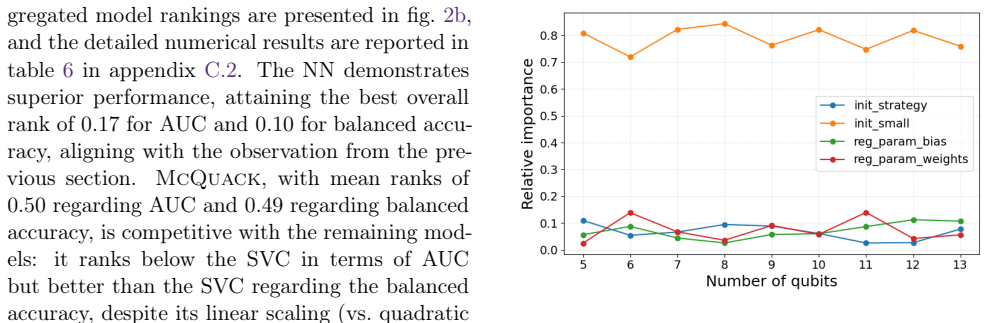
- Parameter initialization—not regularization—dominates trainability in the tested regime, giving concrete guidance for practitioners.
Where Pith is reading between the lines
- If the centroid representation is the real source of the gain, a purely classical analogue—optimizing RBF centers directly against kernel-target alignment—should reproduce much of McQuack's behavior; this is testable and would help isolate whether a quantum advantage is present.
- The O(n_train M) scaling shifts the practical bottleneck toward the shot count and the number of classes, so for very large M the method may still be expensive; gradient-free or hybrid optimizers could change that trade-off.
- The 'no barren plateaus' result is confined to 13 qubits; extending the trainability study to larger system sizes with hardware noise would tell whether the observed stability survives scale-up.
- If linear-time trainable quantum kernels prove robust, a natural next step is to apply them in online or streaming settings where Gram matrices cannot be maintained.
Editorial analysis
A structured set of objections, weighed in public.
Referee Report
Summary. The paper introduces McQuack, a multiclass quantum kernel method that replaces the full n_train×n_train Gram matrix with an n_train×M fidelity matrix between data samples and trainable class-centroid parameters. The shared embedding parameters (w,b) and the centroid parameters (c_m) are optimized alternately via kernel-target alignment (KTA) losses (Eqs. 22–23), and the method is claimed to have O(n_train·M) training cost (Eq. 10). The authors evaluate an untrained version on 124-qubit IBM hardware, benchmark the trained model in simulation on the QML Benchmark Suite of Bowles et al. and on 19 real-world datasets, and present a trainability study for up to 13 qubits. The central claims are the linear-scaling formulation, the empirical claim that McQuack is the strongest "pure" quantum model in the QML Benchmark, and the absence of observed barren plateaus in the tested range.
Significance. If the empirical claims are supported, this is a useful contribution to quantum kernel methods: it directly addresses the quadratic scaling of full-Gram kernels, provides a native multiclass formulation, and includes a rare hardware demonstration on 100+ qubits. The O(n_train·M) derivation in Eq. (10) is explicit and appears sound. The hardware experiment is honestly reported as a feasibility demonstration, and the trainability study, though limited, is practically relevant. However, the headline benchmark comparison rests on a cross-paper ranking against baselines "as reported in [4]" without a matched protocol, and this is not yet auditable. I do not see a circularity problem: KTA training on labeled data and test evaluation are standard supervised learning.
major comments (3)
- [§4.2.1, Fig. 2a, App. B.2.2] The central empirical claim that McQuack is "the strongest pure quantum model in this benchmark" is based on normalized ranks in which the seven QNN baselines are taken "as reported in [4]" rather than re-run under the protocol used for McQuack. McQuack's hyperparameters were chosen by its own grid search (Table 7), accuracies are averaged over 5 seeds, and for downscaled MNIST the training set was reduced to 500 samples (B.2.2), while the baselines come from a separate pipeline with their own splits, seeds, and search budgets. Moreover, Fig. 2a and Fig. 10 show that some baselines (DressedQuantumCircuitClassifier, QuantumBoltzmannMachine) were evaluated on only a subset of the 133 datasets. Averaging normalized ranks over heterogeneous evaluation sets can bias the comparison. To support the claim, the authors should either rerun all baselines under the identical data pipeline and search
- [§4.1, Table 1, §1.2 Contribution 2] The hardware experiment consists of three runs per model and is explicitly non-significant (Sec. 4.1). The abstract and Contribution 2 nevertheless state that McQuack "demonstrate[s] performance comparable to an RBF kernel" on 124 qubits. Table 1 shows 0.83±0.02 (Pittsburgh) and 0.79±0.02 (Aachen) vs. 0.80 for SimpleKernel; with n=3 these differences are within noise. This is a legitimate feasibility demonstration, but the word "demonstrate" overstates the evidence. Please align the abstract/conclusion wording with the statistical caveat stated in Sec. 4.1.
- [§4.3, Figs. 4–5] The trainability claim "no evidence of barren plateaus up to 13 qubits" is based on gradient statistics and loss curves for a few system sizes, with no quantitative scaling analysis of gradient variance vs. qubit number. The paper itself notes the result may not generalize (Sec. 6). I do not block on this, but if the claim is kept as a contribution, report the variance of gradients as a function of n (e.g., a table or fit) so readers can judge whether the data actually constrain barren-plateau behavior. At minimum, the abstract should say "no evidence in the tested range," matching the Limitations section.
minor comments (6)
- [Abstract] Typo: "formulticlass" should be "for multiclass".
- [§2.3, Eq. (6)] The stated upper bound 1/sqrt(M) assumes nonnegative kernel entries; please state this assumption explicitly in the main text and clarify the affine shift in LKAO introduced in footnote 5.
- [§3.2, Eq. (10)] The O(ntrain·M) statement suppresses D and d, which are fixed for a chosen architecture and data dimension; this is fine, but please say so explicitly so readers do not misread the complexity as independent of feature dimension or qubit count.
- [§4.3, Fig. 3] The fANOVA method is not defined or referenced. Add a citation or a sentence describing how the relative importance values are computed.
- [Table 6] Several entries contain formatting artifacts such as "0 .75" (e.g., Census, McQuack F1). Please fix the spacing throughout the table.
- [§7] Code availability is pending export control clearance; this is understandable, but in the meantime the QML benchmark comparison cannot be reproduced. Consider releasing at least the benchmark-evaluation scripts and seeds, or provide a detailed protocol document.
Circularity Check
No circularity found: McQuack's derivation is self-contained; cross-paper benchmark comparability is an external-validity concern, not circularity.
full rationale
The core model is defined explicitly in Section 3: K is a fidelity matrix between samples and trainable class centroids (eqs. 7-9), K* is the label-derived ideal matrix (eq. 4), and training minimizes 1 - A(K,K*) (eqs. 6, 22, 23). Test labels are predicted by argmax over fidelities (eqs. 11, 25). No equation is defined in terms of its own output, and no fitted parameter is renamed as a prediction. The linear-runtime claim (eq. 10) is a direct shot-count of the parameter-shift-rule training loop, not an assertion derived from the model's performance. The 'no barren plateaus' statement is an empirical observation over 13 qubits, explicitly acknowledged as possibly not generalizing (Section 6). The only self-citation to the binary predecessor Quack [7] is used for provenance ('builds upon'), while the multiclass construction and all equations are given in the paper; no load-bearing result is imported solely from [7]. The benchmark claim that McQuack is the strongest 'pure' quantum model does rely on baseline rankings 'as reported in [4]' with McQuack run separately, but this is a question of experimental comparability and external validity, not circularity: it does not make the model's output equal to its input by construction. Code availability is pending, which hampers audit but does not constitute circular reasoning.
Axiom & Free-Parameter Ledger
free parameters (5)
- Trainable feature-map parameters w, b =
Learned per dataset via KTA
- Trainable centroid parameters c_m =
Learned per dataset via centroid optimization
- Model hyperparameters (n_qubits, n_repetitions, learning rates, regularization, batch size, patience) =
Selected by grid search per dataset (Tables 7-8)
- Bit flip tolerance b =
45
- Initialization variance gamma^2 = 1/(3 n L) =
Set per circuit size
axioms (5)
- standard math Fidelity kernel is positive definite (Eq. 3)
- standard math Parameter-shift rule gives correct analytic gradients
- standard math Data re-uploading circuits realize a truncated Fourier series
- domain assumption Classes are representable by centroids in the quantum feature space
- domain assumption Benchmark baselines from Bowles et al. [4] are directly comparable to McQuack's runs
read the original abstract
Kernel methods are powerful tools in machine learning but commonly used full-Gram kernels face three key limitations: (1) quadratic scaling with training set size; (2) the use of fixed, non-trainable kernels; and (3) the absence of an intrinsic formulation for multiclass classification. We present McQuack, a trainable quantum kernel method for multiclass problems that achieves linear scaling in the number of training samples. This is accomplished by replacing the full training-set Gram matrix with a trainable sample-to-(class-centroid) fidelity matrix. We evaluate the model in simulation and on 124 qubits of two IBM devices, across more than 150 datasets. In simulation, McQuack outperforms existing "pure" quantum baselines, while results from hardware inference -- obtained without training -- achieve performance similar to an RBF kernel. Finally, we study the trainability of the model and observe no evidence of barren plateaus in our experiments with up to 13 qubits, and highlight the importance of parameter initialization for successful optimization.
Figures




Reference graph
Works this paper leans on
-
[1]
Training quantum embedding kernels on near-term quantum computers
Thomas Hubregtsen, David Wierichs, Elies Gil-Fuster, Peter-Jan H. S. Derks, Paul K. Faehrmann, and Johannes Jakob Meyer. “Training quantum embedding kernels on near-term quantum computers”. Phys. Rev. A 106, 042431 (2022)
2022
-
[2]
A rigorous and ro- bust quantum speed-up in supervised ma- chine learning
Yunchao Liu, Srinivasan Arunachalam, and Kristan Temme. “A rigorous and ro- bust quantum speed-up in supervised ma- chine learning”. Nature Physics 17, 1013– 1017 (2021)
2021
-
[3]
Power of data in quantum machine learn- ing
Hsin-Yuan Huang, Michael Broughton, Ma- soud Mohseni, Ryan Babbush, Sergio Boixo, Hartmut Neven, and Jarrod R. McClean. “Power of data in quantum machine learn- ing”. Nature Communications12 (2021)
2021
-
[4]
Better than classical? the subtle art of benchmarking quan- tum machine learning models
Joseph Bowles, Shahnawaz Ahmed, and Maria Schuld. “Better than classical? the subtle art of benchmarking quan- tum machine learning models” (2024). arXiv:2403.07059
Pith/arXiv arXiv 2024
-
[5]
Barren plateaus in quantum neural network training landscapes
Jarrod R. McClean, Sergio Boixo, Vadim N. Smelyanskiy, Ryan Babbush, and Hartmut Neven. “Barren plateaus in quantum neural network training landscapes”. Nature Com- munications9 (2018)
2018
-
[6]
Bar- ren plateaus in variational quantum com- puting
Martín Larocca, Supanut Thanasilp, Sam- son Wang, Kunal Sharma, Jacob Biamonte, Patrick J. Coles, Lukasz Cincio, Jarrod R. McClean, Zoë Holmes, and M. Cerezo. “Bar- ren plateaus in variational quantum com- puting”. Nature Reviews Physics 7, 174– 189 (2025)
2025
-
[7]
Quack: Quantum aligned centroid kernel
Kilian Tscharke, Sebastian Issel, and Pascal Debus. “Quack: Quantum aligned centroid kernel”. In 2024 IEEE International Confer- ence on Quantum Computing and Engineer- ing (QCE). Page 1425–1435. IEEE (2024)
2024
-
[8]
Covariantquantumkernelsfordata with group structure
Jennifer R. Glick, Tanvi P. Gujarati, Anto- nio D. Córcoles, Youngseok Kim, Abhinav Kandala, Jay M. Gambetta, and Kristan Temme. “Covariantquantumkernelsfordata with group structure”. Nature Physics 20, 479–483 (2024)
2024
-
[9]
Efficient parameter op- timisation for quantum kernel alignment: A sub-sampling approach in variational train- ing
M. Emre Sahin, Benjamin C. B. Symons, Pushpak Pati, Fayyaz Minhas, Declan Mil- lar, Maria Gabrani, Stefano Mensa, and Jan Lukas Robertus. “Efficient parameter op- timisation for quantum kernel alignment: A sub-sampling approach in variational train- ing”. Quantum8, 1502 (2024)
2024
-
[10]
Quantum kernel alignment with stochastic gradient descent
Gian Gentinetta, David Sutter, Christa Zo- ufal, Bryce Fuller, and Stefan Woerner. 10 “Quantum kernel alignment with stochastic gradient descent”. In 2023 IEEE Interna- tional Conference on Quantum Computing and Engineering (QCE). IEEE (2023)
2023
-
[11]
Quantum-efficient kernel target alignment
Rodrigo Coelho, Georg Kruse, and Andreas Rosskopf. “Quantum-efficient kernel target alignment”. In Proceedings of the 17th Inter- national Conference on Agents and Artificial Intelligence - Volume 1: QAIO. Pages 763–
-
[12]
Hy- brid genetic optimization for quantum fea- ture map design
Rowan Pellow-Jarman, Anban Pillay, Ilya Sinayskiy, and Francesco Petruccione. “Hy- brid genetic optimization for quantum fea- ture map design”. Quantum Machine Intelli- gence6 (2024)
2024
-
[13]
Application of quantum machine learning using quantum kernel algorithms on multi- class neuron m-type classification
Xavier Vasques, Hanhee Paik, and Laura Cif. “Application of quantum machine learning using quantum kernel algorithms on multi- class neuron m-type classification”. Scientific Reports 13, 11541 (2023)
2023
-
[14]
Mitigating exponen- tial concentration in covariant quantum ker- nels for subspace and real-world data
Gabriele Agliardi, Giorgio Cortiana, Anton Dekusar, Kumar Ghosh, Naeimeh Mohseni, Corey O’Meara, Víctor Valls, Kavitha Yoga- raj, and Sergiy Zhuk. “Mitigating exponen- tial concentration in covariant quantum ker- nels for subspace and real-world data”. npj Quantum Information12, 12 (2025)
2025
-
[15]
Supervisedquantummachine learning models are kernel methods
MariaSchuld. “Supervisedquantummachine learning models are kernel methods” (2021). arXiv:2101.11020
Pith/arXiv arXiv 2021
-
[16]
Data re-uploading for a universal quantum classi- fier
Adrián Pérez-Salinas, Alba Cervera-Lierta, Elies Gil-Fuster, and José I. Latorre. “Data re-uploading for a universal quantum classi- fier”. Quantum4, 226 (2020)
2020
-
[17]
Effect of data encod- ing on the expressive power of variational quantum-machine-learning models
Maria Schuld, Ryan Sweke, and Jo- hannes Jakob Meyer. “Effect of data encod- ing on the expressive power of variational quantum-machine-learning models”. Physi- cal Review A103 (2021)
2021
-
[18]
On kernel-target alignment
Nello Cristianini, John Shawe-Taylor, André Elisseeff, and Jaz Kandola. “On kernel-target alignment”. In T. Dietterich, S. Becker, and Z. Ghahramani, editors, Advances in Neural Information Processing Systems. Volume 14. MIT Press (2001). url: https://proceedings.neurips. cc/paper_files/paper/2001/file/ 1f71e393b3809197ed66df836fe833e5-Paper. pdf
2001
-
[19]
Evaluating analytic gradients on quantum hardware
Maria Schuld, Ville Bergholm, Christian Gogolin, Josh Izaac, and Nathan Killoran. “Evaluating analytic gradients on quantum hardware”. Phys. Rev. A99, 032331 (2019)
2019
-
[20]
Dynamical decoupling for superconducting qubits: A performance survey
Nic Ezzell, Bibek Pokharel, Lina Tewala, Gregory Quiroz, and Daniel A. Lidar. “Dynamical decoupling for superconducting qubits: A performance survey”. Physical Re- view Applied20 (2023)
2023
-
[21]
Model-free readout-error mitigation for quantum expectation values
Ewout van den Berg, Zlatko K. Minev, and Kristan Temme. “Model-free readout-error mitigation for quantum expectation values”. Physical Review A105 (2022)
2022
-
[22]
Transfer learning in hybrid classical- quantum neural networks
Andrea Mari, Thomas R. Bromley, Josh Izaac, Maria Schuld, and Nathan Killo- ran. “Transfer learning in hybrid classical- quantum neural networks”. Quantum 4, 340 (2020)
2020
-
[23]
Deep learning
Ian Goodfellow, Yoshua Bengio, and Aaron Courville. “Deep learning”. MIT Press. (2016). url: https: //www.deeplearningbook.org
2016
-
[24]
Training robust and generalizable quantum models
Julian Berberich, Daniel Fink, Daniel Pran- jić, Christian Tutschku, and Christian Holm. “Training robust and generalizable quantum models”. Phys. Rev. Res.6, 043326 (2024)
2024
-
[25]
A Comparative Anal- ysis of Adversarial Robustness for Quan- tum and Classical Machine Learning Mod- els
Maximilian Wendlinger, Kilian Tscharke, and Pascal Debus. “ A Comparative Anal- ysis of Adversarial Robustness for Quan- tum and Classical Machine Learning Mod- els ”. In 2024 IEEE International Confer- ence on Quantum Computing and Engineer- ing (QCE). Pages 1447–1457. Los Alamitos, CA, USA (2024). IEEE Computer Society
2024
-
[26]
Quantum computing
Maria Schuld and Francesco Petruc- cione. “Quantum computing”. Pages 79–146. Springer International Publishing. Cham (2021)
2021
-
[27]
Representation learning: A review and new perspectives
Yoshua Bengio, Aaron Courville, and Pas- cal Vincent. “Representation learning: A review and new perspectives” (2014). arXiv:1206.5538
Pith/arXiv arXiv 2014
-
[28]
Sample complexity of testing the manifold hypothesis
Hariharan Narayanan and Sanjoy Mit- ter. “Sample complexity of testing the manifold hypothesis”. In J. Lafferty, C. Williams, J. Shawe-Taylor, R. Zemel, and A. Culotta, editors, Advances in Neural Information Processing Systems. Volume 23. Curran Associates, Inc. (2010). url: https://proceedings.neurips. cc/paper_files/paper/2010/file/ 8a1e808b55fde9455cb...
2010
-
[29]
The intrinsic dimension of images and its impact on learning
Phillip Pope, Chen Zhu, Ahmed Abdelkader, Micah Goldblum, and Tom Goldstein. “The intrinsic dimension of images and its impact on learning” (2021). arXiv:2104.08894
Pith/arXiv arXiv 2021
-
[30]
Escaping from the bar- ren plateau via gaussian initializations in deep variational quantum circuits
Kaining Zhang, Liu Liu, Min-Hsiu Hsieh, and Dacheng Tao. “Escaping from the bar- ren plateau via gaussian initializations in deep variational quantum circuits”. In Pro- ceedings of the 36th International Confer- ence on Neural Information Processing Sys- tems. NIPS ’22Red Hook, NY, USA (2022). Curran Associates Inc. url:https://arxiv. org/abs/2203.09376
Pith/arXiv arXiv 2022
-
[31]
Variational quantum boltz- mann machines
Christa Zoufal, Aurélien Lucchi, and Ste- fan Woerner. “Variational quantum boltz- mann machines”. Quantum Machine Intel- ligence3 (2021)
2021
-
[32]
Supervised learning with quantum- enhanced feature spaces
Vojtěch Havlíček, Antonio D. Córcoles, Kris- tan Temme, Aram W. Harrow, Abhinav Kandala, Jerry M. Chow, and Jay M. Gam- betta. “Supervised learning with quantum- enhanced feature spaces”. Nature 567, 209–212 (2019)
2019
-
[33]
Quantum embeddings for machine learning
Seth Lloyd, Maria Schuld, Aroosa Ijaz, Josh Izaac, and Nathan Killoran. “Quantum embeddings for machine learning” (2020). arXiv:2001.03622
Pith/arXiv arXiv 2020
-
[34]
Circuit-centric quantum classifiers
Maria Schuld, Alex Bocharov, Krysta M. Svore, and Nathan Wiebe. “Circuit-centric quantum classifiers”. Physical Review A101 (2020)
2020
-
[35]
Toward trainabil- ity of quantum neural networks
Kaining Zhang, Min-Hsiu Hsieh, Liu Liu, and Dacheng Tao. “Toward trainabil- ity of quantum neural networks” (2020). arXiv:2011.06258
Pith/arXiv arXiv 2020
-
[36]
UCI machine learning repository
Dheeru Dua and Casey Graff. “UCI machine learning repository” (2017)
2017
-
[37]
Com- parative accuracies of artificial neural net- works and discriminant analysis in predict- ing forest cover types from cartographic vari- ables
Jock A. Blackard and Denis J. Dean. “Com- parative accuracies of artificial neural net- works and discriminant analysis in predict- ing forest cover types from cartographic vari- ables”. Computers and Electronics in Agri- culture 24, 131–151 (1999)
1999
-
[38]
Detection of doh tun- nels using time-series classification of encrypted traffic
Mohammadreza MontazeriShatoori, Lo- gan Davidson, Gurdip Kaur, and Arash Habibi Lashkari. “Detection of doh tun- nels using time-series classification of encrypted traffic”. In 2020 IEEE Intl Conf on Dependable, Autonomic and Secure Computing, Intl Conf on Pervasive Intelli- gence and Computing, Intl Conf on Cloud and Big Data Computing, Intl Conf on Cybe...
2020
-
[39]
Emnist: Ex- tending mnist to handwritten letters
Gregory Cohen, Saeed Afshar, Jonathan Tapson, and André van Schaik. “Emnist: Ex- tending mnist to handwritten letters”. In 2017 International Joint Conference on Neu- ral Networks (IJCNN). Pages 2921–2926. (2017)
2017
-
[40]
Fashion-mnist: a novel image dataset for benchmarking machine learning algo- rithms
Han Xiao, Kashif Rasul, and Roland Voll- graf. “Fashion-mnist: a novel image dataset for benchmarking machine learning algo- rithms” (2017). arXiv:1708.07747
Pith/arXiv arXiv 2017
-
[41]
R. A. Fisher. “Iris”. UCI Machine Learning Repository (1936)
1936
-
[42]
A detailed anal- ysis of the kdd cup 99 data set
Mahbod Tavallaee, Ebrahim Bagheri, Wei Lu, and Ali A. Ghorbani. “A detailed anal- ysis of the kdd cup 99 data set”. In 2009 IEEE Symposium on Computational Intelli- gence for Security and Defense Applications. Pages 1–6. (2009)
2009
-
[43]
Gradient-based learning applied todocumentrecognition
Y. Lecun, L. Bottou, Y. Bengio, and P. Haffner. “Gradient-based learning applied todocumentrecognition”. Proceedingsofthe IEEE 86, 2278–2324 (1998)
1998
-
[44]
Detecting malicious urls us- ing lexical analysis
Mohammad Saiful Islam Mamun, Mo- hammad Ahmad Rathore, Arash Habibi Lashkari, Natalia Stakhanova, and Ali A. Ghorbani. “Detecting malicious urls us- ing lexical analysis”. In Jiageng Chen, Vincenzo Piuri, Chunhua Su, and Moti Yung, editors, Network and System Security. Pages 467–482. Cham (2016). Springer International Publishing. url: https: //link.sprin...
2016
-
[46]
The entangling unitary is a ring ofCNOT s, connecting each qubit to the next one and the last one to the first one, UENT = n−1∏ q=0 CNOTq→(q+1) mod n
is used, where the gates re-encode the features cyclically from the beginning. The entangling unitary is a ring ofCNOT s, connecting each qubit to the next one and the last one to the first one, UENT = n−1∏ q=0 CNOTq→(q+1) mod n. (21) A.2 Kernel Alignment Optimization During the Kernel Alignment Optimization, the parameter vectorsw and b of the feature ma...
-
[47]
Where not explicitly stated, our benchmarks follows their protocol
points out the huge impact of the experimental design on the results and introduce a benchmark- ing suite consisting of 160 individual datasets from 6 binary classification tasks to better judge the ideas in QML. Where not explicitly stated, our benchmarks follows their protocol. We compare our model to the Quantum Neural Networks model family which is ev...
-
[48]
Themodelisdescribedinsection3.3 and does not use shared parameters
VCs, anensembleofVCsusingthesameunitaryasMcQuack. Themodelisdescribedinsection3.3 and does not use shared parameters. The base classifier is based on [25]
-
[49]
SVC, a Support Vector Classifier based on sklearn’s SVC6
-
[50]
NystroemSVM, a linear SVC that uses the Nystroem method to approximate an RBF kernel
-
[51]
6https://scikit-learn.org/stable/modules/generated/sklearn.svm.SVC.html 18 Figure 8: Map of all 156 qubits and their connectivity onibm_aachen
NN, a two layer feedforward neural network, where the numbers of neurons is selected such that the total number of parameters is the same or slightly larger than that of McQuack. 6https://scikit-learn.org/stable/modules/generated/sklearn.svm.SVC.html 18 Figure 8: Map of all 156 qubits and their connectivity onibm_aachen. The black nodes are the 124 qubits...
-
[772]
INSTICCSciTePress (2025)
2025
discussion (0)
Sign in with ORCID, Apple, or X to comment. Anyone can read and Pith papers without signing in.