REVIEW 3 major objections 5 minor 49 references
Global electromagnetic gyrokinetic simulations of internal transport barriers in reversed-shear tokamaks
T0 review · 3 major / 5 minor · reviewed 2026-08-11 · deepseek-v4-flash
Pith's one-line read Reversed-shear tokamaks form internal transport barriers only when the safety-factor minimum sits close to a low-order rational value (q=2), because that lets turbulent eddies close on themselves and sustain a strong sheared zonal flow.
desk verdict A serious global gyrokinetic study with a genuinely new flux-driven ITB result, but the headline 'necessary ingredient' claim leans on an unconverged qmin=2.03 run and needs a longer run or a softer claim. read the letter →
The pith
A machine-rendered reading of the paper's core claim, the machinery that carries it, and where it could break.
The reading
What carries the argument
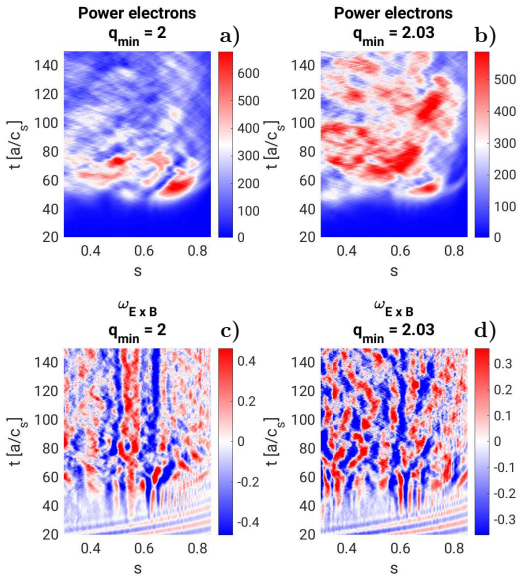
The load-bearing mechanism is parallel eddy self-interaction at a low-order rational surface. In a low-shear region, turbulent eddies become extremely elongated along the magnetic field; when $q_{\min}$ is exactly 2, they extend far enough to close on themselves, 'biting their own tail' and locking turbulence to that surface. This self-interaction, enabled only by kinetic electron dynamics, produces two coupled structures: a strong zonal $E\times B$ shearing dipole that de-correlates eddies and quenches transport, and a steady zonal parallel electron current that, through the perturbed vector potential, flattens and locally shifts the safety factor. The flattening creates a positive feedback loop when $q_{\min}$ is close enough to the rational value (within roughly $\Delta q \sim \rho^* q_0/n$), dragging $q_{\min}$ toward 2 and strengthening self-interaction.
What would settle it
Run the $q_{\min}=2.03$ flux-driven simulation long enough that the radially integrated turbulent losses equal the injected power everywhere in the core, then compare the converged ion temperature and temperature-gradient profiles with the $q_{\min}=2$ run; if the core gradient equilibrates at a similar level, the necessary-ingredient claim fails.
Extended reading notes
Core claim
On the paper's own terms, the central discovery is that rational $q_{\min}$ is a necessary ingredient for ITB formation in reversed-shear configurations. With adiabatic electrons, the transport coefficient shows only a smooth monotonic increase with $q_{\min}$ and no special response at $q_{\min}=2$; once kinetic (drift-kinetic) electrons are included, $q_{\min}=2$ produces a global reduction of heat transport, strong radial profile corrugation, and a steady dipole of $E\times B$ shearing around the zero-shear surface, whereas $q_{\min}=2.03$ behaves like a non-rational value. The electromagnetic response adds zonal parallel currents that persist in time and, through Ampère's law, modify the safety factor: the q profile flattens around $q_{\min}$, an effect that is weak when self-interaction is already complete but decisive when it is only partial. In flux-driven simulations the $q_{\min}=2$ case forms an internal transport barrier in the ion channel at inner and outer radii around $q_{\min}$; the $q_{\min}=2.03$ case, run to a state where core losses still exceed input power, is extrapolated to lose core temperature and not form a barrier. A case starting at $q_{\min}=2.01$ shows partial eddy self-interaction evolving into complete self-interaction as zonal currents drag q down to 2.0, in agreement with flux-tube predictions. The width of the flattened q region scales between $\rho^*$ and $\rho_i$, and the power needed for equal on-axis temperatures is close to gyro-Bohm in the two system sizes considered.
Load-bearing premise
The $q_{\min}=2.03$ flux-driven case was stopped before reaching quasi-steady state, so the claim that no ITB forms at $q_{\min}=2.03$ depends on the assumption that the core temperature continues to drop as its yet-unbalanced power losses suggest.
Editorial extensions
If this is right
- If the claim is right, placing $q_{\min}$ on a low-order rational value is a necessary condition for an ion-channel ITB in reversed-shear tokamaks, not merely a helpful detail.
- Kinetic electron response must be retained in simulations of ITB onset: adiabatic-electron models miss the $q_{\min}=2$ sensitivity entirely in this scenario.
- Turbulent self-generated currents can move $q_{\min}$ downward toward a rational value, so the q profile and the turbulence state are self-consistently coupled: a plasma starting at $q_{\min}=2.01$ can transition to full self-interaction and form a barrier.
- The sensitivity window for self-interaction widens with $\rho^*$, so smaller devices (larger $\rho^*$) should tolerate larger deviations of $q_{\min}$ from the rational value.
- Power requirements for equal on-axis temperatures in this barrier regime are close to gyro-Bohm: going from the smaller to the larger device size costs only about 20% more power in the two cases considered.
Reading between the lines
- This suggests a possible control strategy: modest current drive that nudges $q_{\min}$ onto an integer could trigger an ITB even without a strong shear reversal, and the resulting barrier might then be self-sustaining via the q-flattening feedback.
- Because $q_{\min}=2.01$ evolves toward 2 while $q_{\min}=2.03$ does not, the outcome may be history-dependent for a narrow range of $q_{\min}$, with the same nominal target producing a barrier or not depending on the path taken.
- If the $\rho^*$-dependent tolerance is generic, larger devices (smaller $\rho^*$) would need tighter control of $q_{\min}$ to exploit rational-surface triggering, which could be tested by scanning $q_{\min}$ offsets across device sizes.
- A testable extension would be to map the threshold curve $\Delta q_{\max}(\rho^*)$ in global simulations and see whether it quantitatively matches the flux-tube estimate $\Delta q \sim \rho^* q_0/n$.
Editorial analysis
A structured set of objections, weighed in public.
Referee Report
Summary. The manuscript reports global electromagnetic gyrokinetic simulations with the ORB5 code, examining internal transport barrier (ITB) formation in reversed-shear tokamaks with the minimum safety factor qmin near 2. The paper compares three electron models (adiabatic, hybrid, and fully kinetic) and finds that kinetic electron dynamics is essential: it produces strong zonal flows, temperature profile corrugation, and zonal current sheets that flatten the local safety factor profile. In flux-driven simulations, the authors report that qmin = 2 leads to an ion-channel ITB, while qmin = 2.03 does not, and they attribute this difference to turbulent eddy self-interaction enabled by the rational qmin. Additional simulations show that the width of the q-flattening region scales between rho* and rho_i, that the input power scaling is close to gyroBohm for the two system sizes considered, and that an initial qmin = 2.01 profile evolves toward qmin = 2.0 under the action of turbulence-induced zonal currents.
Significance. If the main claims hold, this work provides a credible causal chain linking a rational minimum safety factor to ITB formation through kinetic-electron-driven zonal flows and zonal currents, extending earlier flux-tube results to global flux-driven simulations. The systematic comparison of adiabatic, hybrid, and fully kinetic electron models is valuable, and the Appendix A check of the df0/dt|_0=0 assumption strengthens confidence in the numerical setup. The q-flattening mechanism is qualitatively consistent with the companion flux-tube paper (Ref. [1]), and the reported system-size dependence is a useful step toward extrapolating ITB physics to reactor scale. However, the central claim that 'qmin close to a lowest order rational value is a necessary ingredient' is currently supported by a single non-converged comparison, so the significance is contingent on closing that gap.
major comments (3)
- [Section 6.1, Figs. 17-19] The decisive comparison between qmin = 2 and qmin = 2.03 is not completed: the text explicitly states that the qmin = 2.03 case 'has not reached quasi steady-state yet', and the no-ITB conclusion is carried by the dashed black 'future' curve in Fig. 17, which is an extrapolation based on the power imbalance in Fig. 19. Because this comparison is the primary evidence for the abstract's claim that rational qmin is a 'necessary ingredient', the claim is not yet demonstrated. Please extend the qmin = 2.03 run to a genuine quasi-steady state, or provide a quantitative convergence check (e.g., time traces of the core temperature and power balance showing approach to a steady state), and report how the central conclusion would change if the extrapolation is inaccurate.
- [Section 6.1, Fig. 19] The heating source for the qmin = 2.03 run is taken from the qmin = 2 gradient-driven calibration. The extrapolated cooling of the core relies on the assumption that the turbulent losses exceeding the source in the s in [0.2, 0.3] region persist long enough to lower the core temperature. However, if the qmin = 2.03 equilibrium were instead simulated toward its own power balance with a different source profile or amplitude, a different outcome cannot be excluded a priori. Please justify the common source choice or test the sensitivity of the conclusion to the source strength and shape.
- [Abstract and Section 7] The term 'necessary ingredient' overstates the logical force of a single pair of simulations. The paper demonstrates that, in this specific setup, qmin = 2 is sufficient to produce an ITB and qmin = 2.03 is not (if the extrapolation holds); it does not establish that no other qmin value or alternative mechanism can produce an ITB. Please soften the claim to state that rational qmin is a necessary ingredient in the parameter regime studied here, or explicitly discuss the limited scope of the necessity claim.
minor comments (5)
- [Section 5.2, text near Fig. 15] The sentence 'The modified q-profile shown in Figure 15 has been computed using equation 5' appears to be a citation error: Eq. (5) defines the effective heat diffusivity chi, while the q-modification is computed via Eq. (7)-(8). Please correct the cross-reference.
- [Section 6.2, Fig. 24-25] The conclusion of 'almost GyroBohm scaling' is based on only two values of rho* with different levels of power balance; please add an explicit caveat that the scaling is preliminary and may depend on the chosen comparison temperature and on the non-converged status of the qmin = 2.03 case.
- [Section 2, numerical setup] The phrase 'solves the full-f Vlasov equation in spite of the delta-f splitting' is awkward and potentially confusing; it would be clearer to say that the code evolves the full distribution function while using a control-variate delta-f splitting for noise reduction.
- [Throughout] There are several typographical errors and inconsistent hyphenation, for example 'Ècole Polytechnique Féedérale', 'V olčokas', and the varying use of 'quasi-steady state' versus 'quasi steady-state'. A careful proofreading pass is recommended.
- [Figure 17] The dashed black curve is described as an extrapolation, but the method used to construct it (beyond 'smoothing of R/LT' and the power imbalance) is not fully specified; please describe the extrapolation procedure or add a note on its uncertainty.
Circularity Check
No significant circularity: the central ITB comparison is a numerical experiment, not a fit; the qmin=2.03 limitation is a convergence risk, not a circular reduction.
full rationale
The derivation chain is self-contained numerical simulation rather than a reduction to inputs. The only apparent candidate for circularity is the qmin=2.03 flux-driven comparison, but Section 6.1 explicitly states "The qmin=2.03 case has not reached quasi steady-state yet" and labels the dashed final profile as "an extrapolation of the final core profile based on the fact that the system has not reached quasi steady-state in the core." That is a disclosed convergence/extrapolation limitation, not a fitted parameter renamed as a prediction; it affects the strength of the causality claim but is not a definitional identity. The heating source is consistently taken from gradient-driven calibration for both qmin=2 and qmin=2.03 runs, so the comparison is not forced by construction. Prior papers by the same group (Refs. [1], [16], [17]) supply the self-interaction and q-flattening concepts, but the present work reproduces eddy self-interaction (Figure 23), zonal-flow shearing (Figures 20-22), and q-flattening (Figures 26-29) in its own global simulations, so the self-citations are corroborative rather than load-bearing. No equation is defined in terms of its target output, and no fitted quantity is relabeled as a prediction. Therefore no circular step passes the quote-and-reduction test.
Assumptions & free parameters
free parameters (2)
- electron-to-ion mass ratio mi/me =
500
- plasma beta =
4e-4
assumptions (3)
- domain assumption The ad-hoc circular, concentric ideal-MHD equilibrium with a prescribed fifth-order polynomial q(r) represents a relevant tokamak configuration.
- domain assumption The term df0/dt|0 is neglected for fully kinetic electrons.
- domain assumption Collisionless gyrokinetic dynamics is sufficient for ITB formation in this scenario.
Cite this review
Pith. "Pith review of Global electromagnetic gyrokinetic simulations of internal transport barriers in reversed-shear tokamaks." pith.science (2026). https://pith.science/paper/JN2PP7MB
@misc{pith2026241210027,
  author       = {Pith},
  title        = {Pith review of: Global electromagnetic gyrokinetic simulations of internal transport barriers in reversed-shear tokamaks},
  year         = {2026},
  howpublished = {\url{https://pith.science/paper/JN2PP7MB}},
  note         = {Machine review of arXiv:2412.10027}
}
abstract
This work aims at improving our understanding of the conditions enabling the development of an Internal transport barriers (ITB), using a more comprehensive physical model, including low-$\beta$ electromagnetic flux-driven simulations. Our key findings are that electron dynamics is crucial for ITB formation even in an ITG scenario and that having $q_{\text{min}}$ close to a lowest order rational value (2 in our simulations) to allow for eddies self-interaction is a necessary ingredient. Electron dynamics has two critical effects. First, it leads to a structure formation characterized by strong zonal flows shearing rate, reduction of turbulence and profile corrugation. Second, it leads to zonal current sheets that result in a broadening of the minimum-q region, qualitatively consistent with the flux-tube simulations of Vol\v{c}okas et al. [1]. Flux-driven simulations performed with $q_{\text{min}}=2$ reveal the development of the transport barrier in the ion channel, forming at inner and outer radial positions with respect to the $q_{\text{min}}$ position. The ITB formation in flux-driven setup is not recovered if $q_{\text{min}} = 2.03$. Additionally, a simulation at higher $\rho^*$ indicates that the extent of the flattened region of the q-profile due to turbulent self-interaction does not change proportionally to $\rho^*$ or to $\rho_i$, but somewhere in between. On the other hand, the input power required to achieve similar on-axis temperatures appears to exhibit almost GyroBohm scaling (for the two considered $\rho^*$ values). Furthermore, considering an initial q-profile with $q_{\text{min}} = 2.01$, flux-driven simulations show that partial self-interaction can evolve to complete self-interaction. This occurs due to turbulent-driven zonal currents that lower and flatten the q-profile down to $q_{\text{min}} = 2.0$, in line with what is reported in Vol\v{c}okas et al.[1].
Figures


Figures from the paper (28 more)


Reference graph
Works this paper leans on
-
[1]
Introduction The safety factor is a critical parameter that affects confine ment properties of fusion plasmas. Since the first discovery in JET [ 2], a safety factor profile with a reversed shear region has been used to generate Internal Transport Bar riers (ITB) in several devices. In particular for JET reversed magnetic shear scen arios, ITB emergence occur...
-
[2]
ORB5 is a global gyrokinetic code that uses a PIC approach an d finite element representation
Numerical setup and case description The global gyrokinetic simulations presented in this work w ere performed with the ORB5 code [ 18]. ORB5 is a global gyrokinetic code that uses a PIC approach an d finite element representation. It solves the full- f Vlasov equation in spite of the δf splitting of f into f0+δf, withf0 used as control variates; while the...
-
[3]
The first assessment concerns the sensitivity of the system with respect to the qmin value
Adiabatic electrons simulations Our analysis starts by considering the adiabatic electrons response. The first assessment concerns the sensitivity of the system with respect to the qmin value. In this scan, qmin has been changed (while keeping the magnetic shear constant ) to evaluate whether being a rational value (or not) affects the transport coefficients ...
-
[4]
Hybrid electron model simulations We focus on the effects of different values of qmin while keeping the magnetic shear constant, as in Figure
-
[5]
We examine three qmin values: qmin = 2, 2. 03, 2. 54. The results are shown in Figure 3. It is evident that using qmin = 2 can lead to a significant reduction in the transport coefficients for both the ion and el ectron channels. The global effect of qmin = 2 is also notable: the transport reduction is achieved across the entire plasma radius. Although this e...
-
[6]
All electrons drift-kinetic simulations Even though the hybrid model does include partial effects ass ociated with kinetic electrons, it neglects the kinetic response of passing elec trons in the QNE for the non- axisymmetric modes. This can lead to inaccurate estimation s of features that are strongly connected with non-adiabaticity of electrons. In our c...
-
[7]
Even though the hybrid model underestimates the fluxes and t he transport coefficients by a factor of 2, a remarkable qualitative agreement emerges from the comparison. Profile corrugations and transport barriers are found in bot h models; however, they are significantly more pronounced for the fully kinetic case, as shown in Figures 7-8. This indicates that a...
-
[8]
Rofman for fruitful discussions, E
Acknowledgments The authors thank B. Rofman for fruitful discussions, E. Lant i for its continuous support to the ORB5 code and Alexey Mishchenko for his support to this w ork providing additional computational time. This work has been carried out within the framework of the EUR Ofusion Consortium, partially funded by the European Union via the Euratom Re...
Show all 49 references
-
[9]
J. F. Drake, Y. T. Lau, P. N. Guzdar, A. B. Hassam, S. V. Nova kovski, B. Rogers, and A. Zeiler. Local negative shear and the formation of transport barrier s. Phys. Rev. Lett. , 77:494–497, Jul 1996
1996
-
[10]
However, the difference is so small that it would be undetectable in an experiment, and it is difficult to a rgue that such a difference is physical rather than numerical
Even though the results are qualitatively identical, with the corrugations happening at the same radi al location, a tiny quantitative difference is present and it can suggest that for the ion chann el EM effects can have a small stabilizing effect even at very low β . However, t...
-
[11]
Flux-driven simulations The flux-driven approach allows one to stress how the tempera ture profiles start to corrugate and to see the emergence of a transport barrier. Mo reover, it enables observation of how the system reacts when there are no constr aints on the temperature pr...
-
[12]
Candy, R
J. Candy, R. E. Waltz, and M. N. Rosenbluth. Smoothness o f turbulent transport across a minimum- q surface. Physics of Plasmas , 11(5):1879–1890, 05 2004
2004
-
[13]
Our simulations setup is inspired by Cyclone Base Case param eters but excludes density gradients
Conclusions and Outlook In this work we discussed the conditions that enable a strong reduction of heat transport and the development of an internal transport barrier (ITB) in a reversed-shear tokamak 28 configuration, with the zero shear position that correspond s to a low-ord...
-
[14]
It is interesting to note that v‖ saturates at lower values for the EM case. This may be due to the fact that , in a purely electrostatic simulation, the current does not provide a non-linear feedb ack to the system, while in the EM simulation, it does through the perturbed ve...
-
[15]
Turbulence-induced safety factor profile flattening at rational surfaces in toka maks with low magnetic shear
Arnas Volčokas, Justin Ball, Giovanni Di Giannatale, an d Stephan Brunner. Turbulence-induced safety factor profile flattening at rational surfaces in toka maks with low magnetic shear. arXiv, 32 0 0.2 0.4 0.6 0.8 1 s -1 -0.5 0 0.5 1 [cs/a] fully-k df 0/dt| 0 0 fully-k df 0/dt| ...
2024 arXiv
-
[16]
Hugon, B.Ph
M. Hugon, B.Ph. van Milligen, P. Smeulders, L.C. Appel, D .V. Bartlett, D. Boucher, A.W. Edwards, L.-G. Eriksson, C.W. Gowers, T.C. Hender, G. Huysmans, J.J. Jacquinot, P. Kupschus, L. Porte, P.H. Rebut, D.F.H. Start, F. Tibone, B.J.D. Tubbing, M.L. Wa tkins, and W. Zwingmann....
1992
-
[17]
Joffrin, C.D
E. Joffrin, C.D. Challis, G.D. Conway, X. Garbet, A. Gude, S. Günter, N.C. Hawkes, T.C. Hender, D.F. Howell, G.T.A. Huysmans, E. Lazzaro, P. Maget, M. Marac hek, A.G. Peeters, S.D. Pinches, S.E. Sharapov, and JET-EFDA contributors. Internal transp ort barrier triggering by rati...
2003
-
[18]
Koide, M
Y. Koide, M. Kikuchi, M. Mori, S. Tsuji, S. Ishida, N. Asak ura, Y. Kamada, T. Nishitani, Y. Kawano, T. Hatae, T. Fujita, T. Fukuda, A. Sakasai, T. Kond oh, R. Yoshino, and Y. Neyatani. Internal transport barrier on q=3 surface and poloidal plas ma spin up in jt-60u high- β p ...
1994
-
[19]
F. M. Levinton, M. C. Zarnstorff, S. H. Batha, M. Bell, R. E. Bell, R. V. Budny, C. Bush, Z. Chang, E. Fredrickson, A. Janos, J. Manickam, A. Ramsey, S . A. Sabbagh, G. L. Schmidt, E. J. Synakowski, and G. Taylor. Improved confinement with re versed magnetic shear in tftr. Phys....
1995
-
[20]
Stationary advanced scenarios with internal transport barrier on asdex upgrade
R C Wolf, O Gruber, M Maraschek, R Dux, C Fuchs, S Günter, A H errmann, A Kallenbach, K Lackner, P J McCarthy, H Meister, G Pereverzev, J Schweinze r, U Seidel, and the ASDEX Upgrade Team. Stationary advanced scenarios with internal transport barrier on asdex upgrade. Plasma P...
1999
-
[21]
03 case the eddies are radially elongated and the regions s ∈ [0, 0
It is evident that in the qmin = 2. 03 case the eddies are radially elongated and the regions s ∈ [0, 0. 4], s ∈ [0. 4, 0. 6],s ∈ [0. 6, 1] are connected, while in the qmin = 2 case the three regions are not connected. To better show this feature, the time-correlation corr( ˜φ...
-
[22]
G. T. Hoang, C. Bourdelle, X. Garbet, G. Antar, R. V. Budny , T. Aniel, V. Basiuk, A. Bécoulet, P. Devynck, J. Lasalle, G. Martin, F. Saint-Laurent, and the Tore Supra Team. Internal transport barrier with ion-cyclotron-resonance minority heating on tore supra. Phys. Rev. Lett...
2000
-
[23]
Stationary magnetic shear reversal experiments in tore supra
X Litaudon, R Arslanbekov, G T Hoang, E Joffrin, F Kazarian -Vibert, D Moreau, Y Peysson, P Bibet, P Froissard, M Goniche, G Rey, J Ferron, and K Kupfer. Stationary magnetic shear reversal experiments in tore supra. Plasma Physics and Controlled Fusion , 38(9):1603, sep 1996
1996
-
[24]
Romanelli and F
F. Romanelli and F. Zonca. The radial structure of the io n-temperature-gradient-driven mode. Physics of Fluids B: Plasma Physics , 5(11):4081–4089, 11 1993
1993
-
[25]
Garbet, C
X. Garbet, C. Bourdelle, G. T. Hoang, P. Maget, S. Benkad da, P. Beyer, C. Figarella, 33 I. Voitsekovitch, O. Agullo, and N. Bian. Global simulation s of ion turbulence with magnetic shear reversal. Physics of Plasmas , 8(6):2793–2803, 06 2001
2001
-
[26]
Murugappan, L
M. Murugappan, L. Villard, S. Brunner, B. F. McMillan, a nd A. Bottino. Gyrokinetic simulations of turbulence and zonal flows driven by steep profile gradient s using a delta-f approach with an evolving background Maxwellian. Physics of Plasmas , 29(10):103904, 10 2022
2022
-
[27]
Indeed, for this initial q-profile with qmin = 2
At this point it is interesting to assess the importance of EM effects. Indeed, for this initial q-profile with qmin = 2. 01 the ES case will always have only a partial self interaction (i.e. self-interactio n without eddies exactly closing on themselves), while, thanks to the m...
-
[28]
R. E. Waltz, M. E. Austin, K. H. Burrell, and J. Candy. Gyr okinetic simulations of off-axis minimum-q profile corrugations. Physics of Plasmas , 13(5):052301, 05 2006
2006
-
[29]
Dominski, B
J. Dominski, B. F. McMillan, S. Brunner, G. Merlo, T.-M. Tran, and L. Villard. An arbitrary wavelength solver for global gyrokinetic simulations. App lication to the study of fine radial structures on microturbulence due to non-adiabatic passin g electron dynamics. Physics of P...
2017
-
[30]
Zonal flows in pl asma—a review
P H Diamond, S-I Itoh, K Itoh, and T S Hahm. Zonal flows in pl asma—a review. Plasma Physics and Controlled Fusion , 47(5):R35–R161, apr 2005
2005
-
[31]
Ultr a long turbulent eddies, magnetic topology, and the triggering of internal transport barriers in tokama ks
Arnas Volčokas, Justin Ball, and Stephan Brunner. Ultr a long turbulent eddies, magnetic topology, and the triggering of internal transport barriers in tokama ks. Nuclear Fusion, 63(1):014003, nov 2022
2022
-
[32]
Self -interaction of turbulent eddies in tokamaks with low magnetic shear, 2024
Arnas Volčokas, Justin Ball, and Stephan Brunner. Self -interaction of turbulent eddies in tokamaks with low magnetic shear, 2024
2024
-
[33]
Lanti, N
E. Lanti, N. Ohana, N. Tronko, T. Hayward-Schneider, A. Bottino, B.F. McMillan, A. Mishchenko, A. Scheinberg, A. Biancalani, P. Angelino, S. Brunner, J. Do minski, P. Donnel, C. Gheller, R. Hatzky, A. Jocksch, S. Jolliet, Z.X. Lu, J.P. Martin Colla r, I. Novikau, E. Sonnendrüc...
2020
-
[34]
McMillan, S
B.F. McMillan, S. Jolliet, A. Bottino, P. Angelino, T.M . Tran, and L. Villard. Rapid fourier space solution of linear partial integro-differential equa tions in toroidal magnetic confinement geometries. Computer Physics Communications , 181(4):715–719, 2010
2010
-
[35]
Mishchenko, A
A. Mishchenko, A. Bottino, A. Biancalani, R. Hatzky, T. Hayward-Schneider, N. Ohana, E. Lanti, S. Brunner, L. Villard, M. Borchardt, R. Kleiber, and A. Köni es. Pullback scheme implementation in orb5. Computer Physics Communications , 238:194–202, 2019
2019
-
[36]
Lütjens, A
H. Lütjens, A. Bondeson, and O. Sauter. The chease code f or toroidal mhd equilibria. Computer Physics Communications , 97(3):219–260, 1996
1996
-
[37]
B. F. McMillan, S. Jolliet, T. M. Tran, L. Villard, A. Bot tino, and P. Angelino. Long global gyrokinetic simulations: Source terms and particle noise control. Physics of Plasmas , 15(5):052308, 05 2008
2008
-
[38]
Brunner, E
S. Brunner, E. Valeo, and J. A. Krommes. Collisional del ta-f scheme with evolving background for transport time scale simulations. Physics of Plasmas , 6(12):4504–4521, 12 1999
1999
-
[39]
Allfrey and R
S.J. Allfrey and R. Hatzky. A revised δf algorithm for nonlinear pic simulation. Computer Physics Communications, 154(2):98–104, 2003
2003
-
[40]
Gyrokinetic flux-driven sim ulations in mixed tem/itg regime using a delta-f pic scheme with evolving background, 2024
Moahan Murugappan, Laurent Villard, Stephan Brunner, Giovanni Di Giannatale, Ben Fynney McMillan, and Alberto Bottino. Gyrokinetic flux-driven sim ulations in mixed tem/itg regime using a delta-f pic scheme with evolving background, 2024
2024
-
[41]
Local gyrokinetic sim ulations of tokamaks with non-uniform magnetic shear
Justin Ball and Stephan Brunner. Local gyrokinetic sim ulations of tokamaks with non-uniform magnetic shear. Plasma Physics and Controlled Fusion , 65(1):014004, dec 2022
2022
-
[42]
Global simulations of tokamak microturbulence: finite-β effects and collisions
A Bottino, T Vernay, B Scott, S Brunner, R Hatzky, S Jolli et, B F McMillan, T M Tran, and L Villard. Global simulations of tokamak microturbulence: finite-β effects and collisions. Plasma Physics and Controlled Fusion , 53(12):124027, nov 2011
2011
-
[43]
Shearless transport barriers in unsteady two-dimensional flows and maps
Mohammad Farazmand, Daniel Blazevski, and George Hall er. Shearless transport barriers in unsteady two-dimensional flows and maps. Physica D: Nonlinear Phenomena , 278-279:44–57, 2014
2014
-
[44]
Gottwald
Sanjeeva Balasuriya and Georg A. Gottwald. Estimating stable and unstable sets and their role as transport barriers in stochastic flows. Phys. Rev. E , 98:013106, Jul 2018. 34
2018
-
[45]
B. F. McMillan, X. Lapillonne, S. Brunner, L. Villard, S . Jolliet, A. Bottino, T. Görler, and F. Jenko. System size effects on gyrokinetic turbulence. Phys. Rev. Lett. , 105:155001, Oct 2010
2010
-
[46]
System size scaling of triangularity effects on glo bal temperature gradient-driven gyrokinetic simulations
Giovanni Di Giannatale, Alberto Bottino, Stephan Brun ner, Moahan Murugappan, and Laurent Villard. System size scaling of triangularity effects on glo bal temperature gradient-driven gyrokinetic simulations. Plasma Physics and Controlled Fusion , 66(9):095003, jul 2024
2024
-
[47]
Juvert Njeck Sama, Alessandro Biancalani, Alberto Bot tino, Daniele Del Sarto, Remi Dumont, Giovanni. Di Giannatale, Alain Ghizzo, Thomas Hayward-Sch neider, Philipp Lauber, Ben McMillan, Alexey Mishchenko, Moahan Muruggapan, Brando Re ttino, Baruch Rofman, Francesco Vannini, ...
2024
-
[48]
Barnes, F
M. Barnes, F. I. Parra, and A. A. Schekochihin. Critical ly balanced ion temperature gradient turbulence in fusion plasmas. Phys. Rev. Lett. , 107:115003, Sep 2011
2011
-
[49]
Angelino, A
P. Angelino, A. Bottino, R. Hatzky, S. Jolliet, O. Saute r, T. M. Tran, and L. Villard. On the definition of a kinetic equilibrium in global gyrokineti c simulations. Physics of Plasmas , 13(5):052304, 05 2006. 35
2006
Reviewed August 11, 2026 · model on record in the stance chip above.
Discussion (0). Continue with ORCID to comment.