REVIEW 4 major objections 5 minor 85 references
Phenomenological Study of Type II Seesaw with $\Delta(27)$ Symmetry
T0 review · 4 major / 5 minor · reviewed 2026-08-14 · deepseek-v4-flash
Pith's one-line read The paper claims that a Delta(27)-symmetric type-II seesaw extension of the Standard Model reproduces the observed neutrino masses, mixing angles, CP phase, baryon asymmetry, and lepton-flavor-violating rates.
desk verdict A systematic Δ(27) type-II seesaw scan whose CP-violating and leptogenesis claims are not derived: δ is set to zero for the diagonalization and then varied to make the plots, and Eq. (49) is identically zero. read the letter →
The pith
A machine-rendered reading of the paper's core claim, the machinery that carries it, and where it could break.
The reading
What carries the argument
The load-bearing object is the light neutrino mass matrix $M_\nu = \begin{pmatrix} a+\epsilon & c & b \\ c & b+\epsilon & a \\ b & a & c+\epsilon \end{pmatrix}$ in the $\Delta(27)$ basis, together with the two-step diagonalization $U = U_{\text{TBM}}\cdot U_{13}\cdot P$. The tribimaximal matrix $U_{\text{TBM}}$ (the mixing pattern with $\sin^2\theta_{12}=1/3$, $\sin^2\theta_{23}=1/2$, $\theta_{13}=0$) block-diagonalizes the matrix; the perturbation $\epsilon$ splits the degenerate pair, and the $U_{13}$ rotation with angle $\theta$ and phase $\delta$ produces a non-zero $\theta_{13}$, a deviated $\theta_{23}$, and CP violation. All subsequent predictions, from the mixing angles and $J_{CP}$ to Majorana phases, neutrinoless double $\beta$ decay, triplet leptogenesis, and muon lepton-flavor-violating rates, are derived from this same matrix and its diagonalization.
What would settle it
Build the scalar potential for the stated $\Delta(27)$ field content and check whether its vacuum alignment produces a diagonal perturbation $\epsilon$: the model is falsified if the minimum forces $\epsilon=0$ (leaving two degenerate light neutrinos) or gives an off-diagonal $\epsilon$-texture, because then the predicted mixing angles contradict the measured reactor angle.
Extended reading notes
Core claim
In the paper's own terms, the central result is that an $SU(2)_L$ extension with three $\Delta(27)$-triplet scalar fields plus two additional Higgs doublets realizes the type-II seesaw in a phenomenologically complete way: it reproduces the current $3\sigma$ ranges of the solar, atmospheric, and reactor mixing angles, the two mass-squared differences, and the Dirac CP phase. The key step is the structure of the neutrino mass matrix, which before perturbation is diagonalized by the tribimaximal matrix and has two degenerate eigenvalues; adding a universal diagonal perturbation $\epsilon$ lifts the degeneracy, and a further $U_{13}$ rotation with angle $\theta$ and phase $\delta$ relates the observable mixing to the model parameters. The authors conclude that all mixing angles can be reproduced for a restricted range of the parameter $\alpha_1$, and the model simultaneously gives a total neutrino mass $\sum m_\nu$ consistent with cosmology, an effective Majorana mass $|m_{ee}|$ relevant for neutrinoless double $\beta$ decay, TeV-scale scalar triplet leptogenesis with the observed baryon asymmetry, and lepton-flavor-violating branching ratios near present bounds.
Load-bearing premise
The entire fit rests on a small diagonal perturbation $\epsilon$ that is added by hand to every diagonal entry of the neutrino mass matrix; the paper states that it could come from extra fields but does not construct them, and without $\epsilon$ the two lighter neutrino masses are equal, so the oscillation data cannot be reproduced.
Editorial extensions
If this is right
- The model reproduces, within $3\sigma$, the observed values of $\Delta m^2_{21}$, $|\Delta m^2_{31}|$, $\sin^2\theta_{12}$, $\sin^2\theta_{23}$, and $\sin^2\theta_{13}$, with the Dirac CP phase $\delta_{CP}$ as a correlated output.
- The predicted sum of neutrino masses lies in the range $0.12$ to $0.29$ eV, compatible with cosmological bounds, and the effective Majorana mass $|m_{ee}|$ is correlated with the lightest neutrino mass and with $\theta$, giving a concrete target for neutrinoless double beta decay searches.
- The TeV-scale decay of the lightest scalar triplet can generate the observed baryon asymmetry through flavored leptogenesis, with the CP asymmetry controlled by the same $\theta$ and $\delta$ that govern neutrino mixing.
- The branching ratios for $\mu\to e\gamma$ and $\mu\to 3e$ are expressed through the same PMNS matrix and light neutrino masses; for TeV-scale triplets they fall near the current experimental upper limits, making the framework testable in upcoming muon experiments.
Reading between the lines
- If the diagonal $\epsilon$ is ever traced to explicit fields, its flavor-diagonal texture becomes the model's decisive prediction: an $\epsilon$ that is not diagonal would alter the block structure that produces the successful mixing-angle relations.
- The $U_{\text{TBM}}\cdot U_{13}$ mixing ansatz is not unique to $\Delta(27)$; the same perturbation logic could be transplanted to other discrete flavor groups, so the specific claim of the paper is that $\Delta(27)$ supplies the matrix texture, and that is what a direct symmetry-breaking calculation would have to check.
- A future measurement of $\delta_{CP}$ combined with a bound on $\mu\to e\gamma$ would select disjoint regions of the $\theta$--$v_\Delta$ parameter space, turning this model into a concrete target that muon experiments can probe.
- If the $\Delta(27)$ scalar potential fixes the phases that the paper's scan leaves free, the allowed $\alpha_1$ range found here could shrink or disappear, so the claimed restricted range is not yet a prediction from the symmetry alone.
Editorial analysis
A structured set of objections, weighed in public.
Referee Report
Summary. The manuscript proposes a type-II seesaw extension of the Standard Model with a Δ(27) flavor symmetry, adding two SU(2)_L Higgs doublets and three scalar triplets. The light neutrino mass matrix is assumed to have a form that can be block-diagonalized by the tribimaximal mixing matrix and then fully diagonalized by a U13 rotation. A diagonal perturbation ε is added by hand to break an exact degeneracy of the light neutrino masses. The authors scan their model parameters to reproduce the observed neutrino mass-squared differences and mixing angles, derive the Dirac CP phase, the effective Majorana mass, scalar-triplet leptogenesis, and the branching ratios of μ→eγ and μ→3e. The central claims are that the model reproduces all current neutrino oscillation data, including nonzero θ13 and δ_CP, and gives testable predictions for neutrinoless double beta decay, leptogenesis, and lepton flavor violation.
Significance. If the derivation were correct, the model would be a useful example of a discrete flavor symmetry producing trimaximal-like mixing with several phenomenological consequences. The paper is clearly organized and uses standard type-II seesaw and LFV formulas, and it does compare with the 3σ ranges of global neutrino oscillation fits. However, the predictive power is severely limited: the neutrino mass spectrum requires an ad hoc perturbation ε with no field-theoretic origin, and the CP-violating predictions rest on an internally inconsistent treatment of the phase δ. Moreover, the leptogenesis asymmetry as written in Eq. (49) is identically zero. With at least ten free inputs used to fit the oscillation observables, the agreement shown is consistency rather than prediction. These issues undermine the central claims of the manuscript in its present form.
major comments (4)
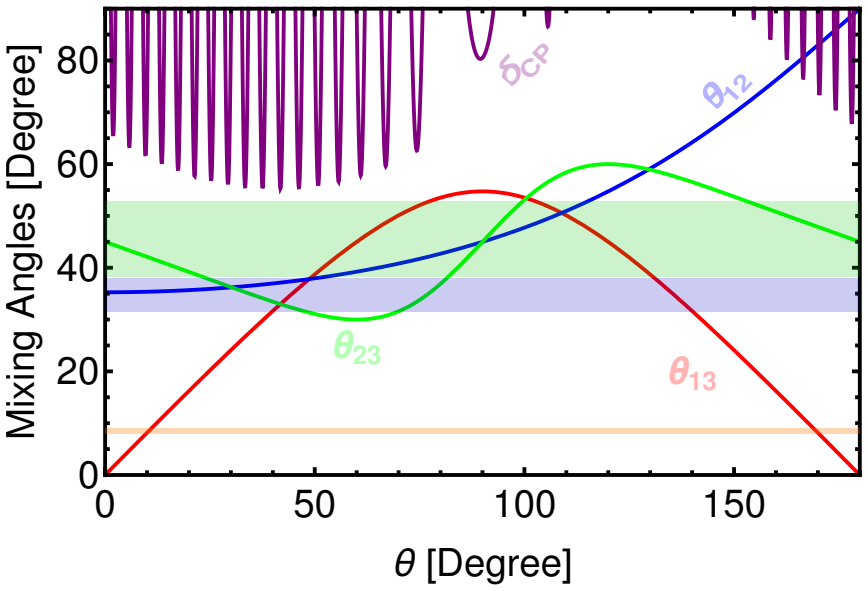
- [II.B, Eqs. (14)-(17); III.B; IV] The treatment of the phase δ is internally inconsistent. The manuscript fixes δ = 0 for the diagonalization: Eq. (16) contains a term 2i ε sinδ in the denominator, and the text before Eq. (17) states 'For rest of our analysis we will use δ = 0.' For δ ≠ 0 with ε ≠ 0, the matrix U13^T M_bd U13 is not diagonal; its (1,3) element acquires an imaginary part -2 c s ε sinδ (in addition to real terms). Nevertheless, Sections III.B and IV treat the same δ as a free parameter: sin²θ23 depends on cosδ in Eq. (29), J_CP is proportional to sinδ in Eq. (30), δ_CP is displayed in Fig. 7, and the scalar-triplet CP asymmetry is plotted against δ in Fig. 12. No mechanism is constructed that would generate a nonzero δ while preserving the block-diagonal form, and the scanned phases φ_ba, φ_ca, φ_εa in Eq. (20) are never connected to δ. Consequently, the CP-violating predictions are imposed by hand, not derived from the model.
- [II.B, Eq. (10)] The diagonal perturbation ε is introduced without a symmetry origin. The text acknowledges that it 'can also be generated by the inclusion of additional fields,' but no such fields are specified. Without ε, the eigenvalues in Eq. (9) give |m1| = |m3|, so Δm²31 vanishes and the oscillation data cannot be reproduced. The agreement with the neutrino mass splittings is therefore entirely dependent on this unmodeled parameter. The adjacent sentence saying 'two eigenvalues m1 and m2 are degenerate' is also a misstatement: Eq. (9) shows that m1 and m3 have equal magnitude.
- [IV.A, Eq. (49)] The simplified CP asymmetry for the lightest scalar triplet is written as ε^{ℓ_i}_{Δ1} ∝ Im[(M_ν^† M_ν)_{ii}]. Since M_ν^†M_ν is Hermitian, its diagonal entries are real, so this expression is identically zero. The flavored asymmetry in Eq. (48) requires products of distinct triplet matrices, Im[(M_{Δα}^† M_{Δβ})_{ii}], which do not reduce to a diagonal element of a single Hermitian matrix. The leptogenesis curves in Figs. 12 and 13 therefore do not follow from the stated equations.
- [III, Eq. (20) and Figs. 4-9] The numerical analysis is a scan over at least ten free inputs (|a|, ε, α1, α2, α3, φ_ba, φ_ca, φ_εa, θ, δ) used to fit the two mass-squared differences and the three mixing angles. The 'predictions' for δ_CP, |mee|, and the LFV rates are then evaluated at the same scanned parameter points, so the agreement with oscillation data is a fit rather than a test of the model. No χ², confidence-level, or number-of-degrees-of-freedom statistic is reported, making it impossible to assess the statistical significance of the claimed 'restricted range of parameter space for α1.'
minor comments (5)
- [Throughout] There are numerous typos and OCR artifacts, e.g., 'Yukuwa' should be 'Yukawa,' 'corelation' should be 'correlation,' and 'fllowing' should be 'following.' These should be corrected in a revised version.
- [III.B, Eq. (31)] The expression for δ_CP in Eq. (31) is not well defined as written and appears to be dimensionally inconsistent; please clarify the intended formula or remove it if it is not used in the numerical analysis.
- [IV, Eq. (50)] The relation Y_B = κ·c·ε_{Δ1}/g* is only schematic; the washout factor κ is not evaluated, so the final baryon asymmetry is not actually determined from the model parameters.
- [VIII.C, Appendix] The scalar potential and symmetry-breaking discussion mention 'flavon fields,' but Table I does not include any flavon fields. Please clarify how the Δ(27) symmetry is broken to obtain the VEV alignments used in Section II.
- [Fig. 12] The text and the figure caption disagree on whether the left panel shows δ or θ; please correct the inconsistency.
Circularity Check
The neutrino-mass 'prediction' is produced by an ad hoc fitted diagonal perturbation ε, and the CP-violating results reuse a phase δ that the mass diagonalization had already fixed to zero.
-
fitted input called prediction
[Section II.B around Eq. (10); scan range in Section III, Eq. (20)]
"Thus, we add a perturbation term ϵ to all diagonal terms in order to generate non-degenerate neutrino masses. This small perturbation can also be generated by the inclusion of additional fields but here we express all diagonal terms as sum of leading terms plus this perturbation term ϵ ≠ 0."
Before ε is added, Eq. (9) yields m1 = -m3, so |m1| = |m3| and Δm²31 = 0, which contradicts oscillation data. The text admits that the ε term is not derived from the Δ(27) structure ('can also be generated by the inclusion of additional fields' is not carried out). In Eq. (20) ε is then scanned over [-0.01, 0.01] eV as a free input. The resulting non-zero mass-squared differences are therefore produced by the fitted perturbation rather than predicted by the symmetry; the reported agreement with oscillation data is a restatement of this input.
-
fitted input called prediction
[Section II.B, Eqs. (16)-(17); Section III.B, Eqs. (29)-(31); Section IV, Figs. 12-13]
"For rest of our analysis we will use δ = 0 and as a result of this, the mixing angle θ is then given by tan 2θ = √3(α1−α2)/(−2+α1+α2). ... The mixing angles prediction are shown as a function of θ in Fig.6. ... sin2θ23 = 1/2(1 + √3 sin 2θ cosδ/(2 + cos 2θ))."
Eq. (16) has 2i ε sinδ in the denominator of tan2θ, so the U13 rotation in Eq. (14) diagonalizes the real block matrix of Eq. (11) only when δ = 0, which is why the paper fixes δ = 0 at Eq. (17). Nevertheless, Eqs. (29)-(31) and Figs. 7, 12, 13 use the same δ as a free parameter to generate sin²θ23, JCP, δCP and the triplet CP asymmetry. No complex phase or additional field structure is introduced to make δ ≠ 0 consistent with the diagonalization. The CP-violating results are thus scanned inputs presented as predictions, not consequences of the Δ(27) model.
1 more flagged steps
-
fitted input called prediction
[Section III, Eq. (20); Section V, Eqs. (52)-(55); Section VI conclusion]
"We examine the correlation between model parameters compatible with 3 σ limits of the current oscillation data for which we present a random scan of these model parameters over the following ranges: a∈ [−0.1, 0.1] eV, ϵ∈ [−0.01, 0.01] eV, α1∈ [0, 0.3], α2∈ [0, 1], α3∈ [0, 0.03], φba,ca,ϵa∈ [−π,π]."
Eight continuous parameters are scanned to select points whose mass-squared differences and mixing angles lie inside the 3σ oscillation windows. The same UPMNS elements and Δm² values then enter the LFV formulas, e.g. Eq. (54) for |(f†f)eμ| and Eq. (55) for Br(µ→3e), and the same inputs feed the |mee| and leptogenesis figures. The agreement with oscillation data is therefore imposed by the scan; the subsequent rates are evaluations of those fitted parameters rather than independent predictions. The concluding statement that the model 'can reproduce all the mixing angles' is a consistency of the scan, not a derivation of those angles from the symmetry.
full rationale
The paper does not rely on a load-bearing self-citation chain: the citations to previous Δ(27) models and to the UPMNS parameterization are contextual or standard, and the mixing-matrix identity U = UTBM·U13·P is an ansatz, not a uniqueness theorem. The circularity is internal. The most concrete reduction is the ε perturbation: the model without ε has |m1| = |m3| and hence cannot produce the observed Δm²31, so ε is introduced by hand, acknowledged as not derived from the field content, and then scanned as a free parameter. The mass spectrum that is later showcased as fitting oscillation data is therefore constructed from that fitted input. A second, sharper problem is the treatment of δ: the mass diagonalization explicitly requires δ = 0, but the mixing-angle, JCP, δCP and leptogenesis analyses all vary δ as a free CP phase. No mechanism is supplied to reconcile δ ≠ 0 with the earlier diagonalization condition, so the CP-violating 'predictions' reduce to inputs. Finally, the parameter scan has enough freedom (|a|, ε, α1, α2, α3 and three phases, plus θ and δ in the mixing section) that the reported 3σ agreement is a selected outcome of the scan rather than a sharp test. For these reasons the central claims are partially circular, meriting a score of 6 rather than a higher score, since the correlations among mixing angles and the type-II seesaw relations do provide some non-trivial structure independent of the fitted parameters.
Assumptions & free parameters
free parameters (8)
- |a| (overall mass scale) =
0.025-0.1 eV (scanned)
- α1 = |b/a| =
0-0.3 (scanned)
- α2 = |c/a| =
0-1 (scanned), α2=1 used in Figs. 1-5
- α3 = |ε/a| =
0-0.03 (scanned)
- Relative phases φba, φca, φεa =
[-π, π] (scanned)
- Internal rotation angle θ =
0-180 degrees (varied)
- Internal phase δ =
0-180 degrees (varied)
- Scalar triplet masses mΔ and VEV vΔ =
mΔ ~ 1 TeV, vΔ ≤ 1 eV (chosen)
assumptions (7)
- domain assumption Type-II seesaw formula Mν = f vΔ with vΔ ≈ μΔ v² / (2 mΔ²)
- standard math The tri-bimaximal mixing matrix UTBM diagonalizes the leading-order mass matrix
- ad hoc to paper Neutrino Yukawa couplings fα, f'α, f''α are set equal
- ad hoc to paper The diagonal perturbation ε can be added without changing the model's symmetry content or VEV alignment
- ad hoc to paper δ=0 for mass diagonalization while δ is later varied for CP observables
- domain assumption Scalar vacuum alignment preserves Δ(27)
- domain assumption Flavored triplet leptogenesis formulas from ref. [83] apply
Cite this review
Pith. "Pith review of Phenomenological Study of Type II Seesaw with $\Delta(27)$ Symmetry." pith.science (2026). https://pith.science/paper/JPPUHKXU
@misc{pith2026190901560,
  author       = {Pith},
  title        = {Pith review of: Phenomenological Study of Type II Seesaw with $\Delta(27)$ Symmetry},
  year         = {2026},
  howpublished = {\url{https://pith.science/paper/JPPUHKXU}},
  note         = {Machine review of arXiv:1909.01560}
}
abstract
We discuss the phenomenology of type-II seesaw by extending the Standard Model with additional Higgs doublets and scalar triplets additionally invoked with $\Delta(27)$ flavor symmetry for the explanation of non-zero neutrino masses and mixings, matter-antimatter asymmetry and lepton flavor violation. The non-zero neutrino masses can be realized via type-II seesaw mechanism by introducing scalar triplets transforming as triplets under $\Delta(27)$ while we add additional $SU(2)_L$ scalar doublets to have correct charge lepton masses. We further demonstrate with detailed numerical analysis in agreement with neutrino oscillation data like non-zero reactor mixing angle, $\delta_{CP}$, the sum of the light neutrino masses, two mass squared differences and its implication to neutrinoless double beta decay. We also discuss on the matter-antimatter asymmetry of the universe through leptogenesis with the decay of TeV scale scalar triplets and variation of CP-asymmetry with input model parameters. Finally, we comment on implication to lepton flavor violating decays like $\mu \to e \gamma$, $\mu \to 3 e$ processes.
Figures


Figures from the paper (13 more)




Reference graph
Works this paper leans on
-
[1]
M. Herrero, “ The Standard model,” NATO Sci. Ser. C 534 (1999) 1–59, arXiv:hep-ph/9812242
work page Pith review arXiv 1999
-
[2]
∆α ℓj ℓi a ∆α ∆β ℓi ℓj ℓm ℓn ∆α ∆β ℓi ℓj H H FIG
Thus, the farther we are from Bα 𝓁 =Bα H = 1 2, the faster the scalar triplet decays. ∆α ℓj ℓi a ∆α ∆β ℓi ℓj ℓm ℓn ∆α ∆β ℓi ℓj H H FIG. 11. One-loop diagrams contributing to the asymmetry in scalar triplet decays. The CP-asymmetry arising from interference between tree level decay of scalar triplets ∆ α and 0 50 100 150 -1.×10 -7 -5.×10 -8 0 5.×10 -8 1.×1...
-
[3]
The Standard Model of Particle Physics
M. K. Gaillard, P. D. Grannis, and F. J. Sciulli, “ The Standard model of particle physics ,” Rev. Mod. Phys. 71 (1999) S96–S111, arXiv:hep-ph/9812285
work page Pith review arXiv 1999
-
[4]
Standard Model: An Introduction
S. F. Novaes, “ Standard model: An Introduction ,” in Particles and fields. Proceedings, 10th Jorge Andre Swieca Summer School, Sao Paulo, Brazil, February 6-12, 1999 , pp. 5–102. 1999. arXiv:hep-ph/0001283
work page Pith review arXiv 1999
-
[5]
The Standard Model of Particle Physics
G. ALTARELLI, “ The Standard model of particle physics ,” arXiv:hep-ph/0510281
-
[6]
Limits of the standard model ,
J. R. Ellis, “ Limits of the standard model ,” in PSI Zuoz Summer School on Exploring the Limits of the Standard Model Zuoz, Engadin, Switzerland, August 18-24, 2002 . 2002. arXiv:hep-ph/0211168. http://weblib.cern.ch/abstract?CERN-TH-2002-320
arXiv 2002
-
[7]
Lectures on Physics Beyond the Standard Model ,
H. M. Lee, “ Lectures on Physics Beyond the Standard Model ,” 2019. arXiv:1907.12409
arXiv 2019
-
[8]
Inverse beta processes and nonconservation of lepton charge ,
B. Pontecorvo, “ Inverse beta processes and nonconservation of lepton charge ,” Sov. Phys. JETP 7 (1958) 172–173. [Zh. Eksp. Teor. Fiz.34,247(1957)]
1958
Show all 85 references
-
[9]
Mesonium and anti-mesonium ,
B. Pontecorvo, “ Mesonium and anti-mesonium ,” Sov. Phys. JETP 6 (1957) 429. [Zh. Eksp. Teor. Fiz.33,549(1957)]
1957
-
[10]
Remarks on the unified model of elementary particles ,
Z. Maki, M. Nakagawa, and S. Sakata, “ Remarks on the unified model of elementary particles ,” Prog. Theor. Phys. 28 (1962) 870–880. [,34(1962)]
1962
-
[11]
Constraints on New Physics from Long Baseline Neutrino Oscillation Experiments ,
M. Honda, Y. Kao, N. Okamura, A. Pronin, and T. Takeuchi, “ Constraints on New Physics from Long Baseline Neutrino Oscillation Experiments ,” arXiv:0707.4545
-
[12]
Precision Measurement of Neutrino Oscillation Parameters with KamLAND,
KamLAND, S. Abe et al., “Precision Measurement of Neutrino Oscillation Parameters with KamLAND,” Phys. Rev. Lett. 100 (2008) 221803, arXiv:0801.4589
2008 arXiv
-
[13]
Review of Particle Physics ,
Particle Data Group , K. A. Olive et al., “Review of Particle Physics ,” Chin. Phys. C38 (2014) 090001
2014
-
[14]
Review of Particle Physics ,
Particle Data Group , M. Tanabashi et al., “Review of Particle Physics ,” Phys. Rev. D98 (2018) 28 no. 3, 030001
2018
-
[15]
Planck 2018 results. VI. Cosmological parameters ,
Planck, N. Aghanim et al., “Planck 2018 results. VI. Cosmological parameters ,” arXiv:1807.06209
2018 arXiv
-
[16]
µ→eγ at a Rate of One Out of 109 Muon Decays?,
P. Minkowski, “µ→eγ at a Rate of One Out of 109 Muon Decays?,” Phys. Lett. 67B (1977) 421–428
1977
-
[17]
Neutrino Mass and Spontaneous Parity Nonconservation ,
R. N. Mohapatra and G. Senjanovic, “ Neutrino Mass and Spontaneous Parity Nonconservation ,” Phys. Rev. Lett. 44 (1980) 912. [,231(1979)]
1980
-
[18]
Neutrino Mass Problem and Gauge Hierarchy ,
M. Magg and C. Wetterich, “ Neutrino Mass Problem and Gauge Hierarchy ,” Phys. Lett. 94B (1980) 61–64
1980
-
[19]
Neutrino Decay and Spontaneous Violation of Lepton Number ,
J. Schechter and J. W. F. Valle, “ Neutrino Decay and Spontaneous Violation of Lepton Number ,” Phys. Rev. D25 (1982) 774
1982
-
[20]
Neutrino Masses in SU(2) x U(1) Theories ,
J. Schechter and J. W. F. Valle, “ Neutrino Masses in SU(2) x U(1) Theories ,” Phys. Rev. D22 (1980) 2227
1980
-
[21]
Neutrino Masses, Mixings and Oscillations in SU(2) x U(1) Models of Electroweak Interactions,
T. P. Cheng and L.-F. Li, “ Neutrino Masses, Mixings and Oscillations in SU(2) x U(1) Models of Electroweak Interactions,” Phys. Rev. D22 (1980) 2860
1980
-
[22]
Proton Lifetime and Fermion Masses in an SO(10) Model,
G. Lazarides, Q. Shafi, and C. Wetterich, “ Proton Lifetime and Fermion Masses in an SO(10) Model,” Nucl. Phys. B181 (1981) 287–300
1981
-
[23]
Neutrino Masses and Mixings in Gauge Models with Spontaneous Parity Violation,
R. N. Mohapatra and G. Senjanovic, “ Neutrino Masses and Mixings in Gauge Models with Spontaneous Parity Violation,” Phys. Rev. D23 (1981) 165
1981
-
[24]
Seesaw Neutrino Masses Induced by a Triplet of Leptons,
R. Foot, H. Lew, X. G. He, and G. C. Joshi, “ Seesaw Neutrino Masses Induced by a Triplet of Leptons,” Z. Phys. C44 (1989) 441
1989
-
[25]
Pathways to naturally small neutrino masses ,
E. Ma, “ Pathways to naturally small neutrino masses ,” Phys. Rev. Lett. 81 (1998) 1171–1174, arXiv:hep-ph/9805219
1998 arXiv
-
[26]
A Different seesaw formula for neutrino masses ,
S. M. Barr, “ A Different seesaw formula for neutrino masses ,” Phys. Rev. Lett. 92 (2004) 101601, arXiv:hep-ph/0309152
2004 arXiv
-
[27]
Baryogenesis Without Grand Unification ,
M. Fukugita and T. Yanagida, “ Baryogenesis Without Grand Unification ,” Phys. Lett. B174 (1986) 45–47
1986
-
[28]
On the Anomalous Electroweak Baryon Number Nonconservation in the Early Universe ,
V. A. Kuzmin, V. A. Rubakov, and M. E. Shaposhnikov, “ On the Anomalous Electroweak Baryon Number Nonconservation in the Early Universe ,” Phys. Lett. 155B (1985) 36
1985
-
[29]
Invisible Axions and Light Neutrinos: Are They Connected?,
P. Langacker, R. D. Peccei, and T. Yanagida, “ Invisible Axions and Light Neutrinos: Are They Connected?,” Mod. Phys. Lett. A1 (1986) 541
1986
-
[30]
Electroweak baryogenesis in left-right symmetric models ,
R. N. Mohapatra and X. Zhang, “ Electroweak baryogenesis in left-right symmetric models ,” Phys. Rev. D46 (1992) 5331–5336
1992
-
[31]
Baryogenesis from a lepton asymmetric universe ,
M. Flanz, E. A. Paschos, and U. Sarkar, “ Baryogenesis from a lepton asymmetric universe ,” Phys. 29 Lett. B345 (1995) 248–252, arXiv:hep-ph/9411366. [Erratum: Phys. Lett.B382,447(1996)]
1995 arXiv
-
[32]
CP violating decays in leptogenesis scenarios ,
L. Covi, E. Roulet, and F. Vissani, “ CP violating decays in leptogenesis scenarios ,” Phys. Lett. B384 (1996) 169–174, arXiv:hep-ph/9605319
1996 arXiv
-
[33]
CP violation and baryogenesis due to heavy Majorana neutrinos ,
A. Pilaftsis, “ CP violation and baryogenesis due to heavy Majorana neutrinos ,” Phys. Rev. D56 (1997) 5431–5451, arXiv:hep-ph/9707235
1997 arXiv
-
[34]
Neutrino masses and leptogenesis with heavy Higgs triplets ,
E. Ma and U. Sarkar, “ Neutrino masses and leptogenesis with heavy Higgs triplets ,” Phys. Rev. Lett. 80 (1998) 5716–5719, arXiv:hep-ph/9802445
1998 arXiv
-
[35]
Baryogenesis through leptogenesis,
R. Barbieri, P. Creminelli, A. Strumia, and N. Tetradis, “ Baryogenesis through leptogenesis,” Nucl. Phys. B575 (2000) 61–77, arXiv:hep-ph/9911315
2000 arXiv
-
[36]
Leptogenesis at the TeV scale ,
T. Hambye, “ Leptogenesis at the TeV scale ,” Nucl. Phys. B633 (2002) 171–192, arXiv:hep-ph/0111089
2002 arXiv
-
[37]
A Lower bound on the right-handed neutrino mass from leptogenesis ,
S. Davidson and A. Ibarra, “ A Lower bound on the right-handed neutrino mass from leptogenesis ,” Phys. Lett. B535 (2002) 25–32, arXiv:hep-ph/0202239
2002 arXiv
-
[38]
Towards a complete theory of thermal leptogenesis in the SM and MSSM ,
G. F. Giudice, A. Notari, M. Raidal, A. Riotto, and A. Strumia, “ Towards a complete theory of thermal leptogenesis in the SM and MSSM ,” Nucl. Phys. B685 (2004) 89–149, arXiv:hep-ph/0310123
2004 arXiv
-
[39]
Consequences of triplet seesaw for leptogenesis ,
T. Hambye and G. Senjanovic, “ Consequences of triplet seesaw for leptogenesis ,” Phys. Lett. B582 (2004) 73–81, arXiv:hep-ph/0307237
2004 arXiv
-
[40]
Thermal leptogenesis with triplet Higgs boson and mass varying neutrinos ,
P.-h. Gu and X.-j. Bi, “ Thermal leptogenesis with triplet Higgs boson and mass varying neutrinos ,” Phys. Rev. D70 (2004) 063511, arXiv:hep-ph/0405092
2004 arXiv
-
[41]
Leptogenesis for pedestrians,
W. Buchmuller, P. Di Bari, and M. Plumacher, “ Leptogenesis for pedestrians,” Annals Phys. 315 (2005) 305–351, arXiv:hep-ph/0401240
2005 arXiv
-
[42]
Leptogenesis,
S. Davidson, E. Nardi, and Y. Nir, “ Leptogenesis,” Phys. Rept. 466 (2008) 105–177, arXiv:0802.2962
2008 arXiv
-
[43]
Falsifying High-Scale Leptogenesis at the LHC ,
F. F. Deppisch, J. Harz, and M. Hirsch, “ Falsifying High-Scale Leptogenesis at the LHC ,” Phys. Rev. Lett. 112 (2014) 221601, arXiv:1312.4447
2014 arXiv
-
[44]
Leptogenesis via Axion Oscillations after Inflation ,
A. Kusenko, K. Schmitz, and T. T. Yanagida, “ Leptogenesis via Axion Oscillations after Inflation ,” Phys. Rev. Lett. 115 (2015) no. 1, 011302, arXiv:1412.2043
2015 arXiv
-
[45]
A Redetermination of the neutrino mass squared difference in tri - maximal mixing with terrestrial matter effects ,
P. F. Harrison, D. H. Perkins, and W. G. Scott, “ A Redetermination of the neutrino mass squared difference in tri - maximal mixing with terrestrial matter effects ,” Phys. Lett. B458 (1999) 79–92, arXiv:hep-ph/9904297
1999 arXiv
-
[46]
Tri-bimaximal mixing and the neutrino oscillation 30 data,
P. F. Harrison, D. H. Perkins, and W. G. Scott, “ Tri-bimaximal mixing and the neutrino oscillation 30 data,” Phys. Lett. B530 (2002) 167, arXiv:hep-ph/0202074
2002 arXiv
-
[47]
Non-Abelian discrete flavor symmetries ,
E. Ma, “ Non-Abelian discrete flavor symmetries ,” arXiv:0705.0327
-
[48]
Observation of electron-antineutrino disappearance at Daya Bay ,
Daya Bay, F. P. An et al., “Observation of electron-antineutrino disappearance at Daya Bay ,” Phys. Rev. Lett. 108 (2012) 171803, arXiv:1203.1669
2012 arXiv
-
[49]
Improved Measurement of Electron Antineutrino Disappearance at Daya Bay,
Daya Bay, F. P. An et al., “Improved Measurement of Electron Antineutrino Disappearance at Daya Bay,” Chin. Phys. C37 (2013) 011001, arXiv:1210.6327
2013 arXiv
-
[50]
Independent measurement of the neutrino mixing angle θ13 via neutron capture on hydrogen at Daya Bay ,
Daya Bay, F. P. An et al., “Independent measurement of the neutrino mixing angle θ13 via neutron capture on hydrogen at Daya Bay ,” Phys. Rev. D90 (2014) no. 7, 071101, arXiv:1406.6468
2014 arXiv
-
[51]
Observation of Reactor Electron Antineutrino Disappearance in the RENO Experiment,
RENO, J. K. Ahn et al., “Observation of Reactor Electron Antineutrino Disappearance in the RENO Experiment,” Phys. Rev. Lett. 108 (2012) 191802, arXiv:1204.0626
2012 arXiv
-
[52]
Indication of Electron Neutrino Appearance from an Accelerator-produced Off-axis Muon Neutrino Beam ,
T2K, K. Abe et al., “Indication of Electron Neutrino Appearance from an Accelerator-produced Off-axis Muon Neutrino Beam ,” Phys. Rev. Lett. 107 (2011) 041801, arXiv:1106.2822
2011 arXiv
-
[53]
Observation of Electron Neutrino Appearance in a Muon Neutrino Beam ,
T2K, K. Abe et al., “Observation of Electron Neutrino Appearance in a Muon Neutrino Beam ,” Phys. Rev. Lett. 112 (2014) 061802, arXiv:1311.4750
2014 arXiv
-
[54]
Indication of Reactor ¯νe Disappearance in the Double Chooz Experiment,
Double Chooz , Y. Abe et al., “Indication of Reactor ¯νe Disappearance in the Double Chooz Experiment,” Phys. Rev. Lett. 108 (2012) 131801, arXiv:1112.6353
2012 arXiv
-
[55]
Improved search for muon-neutrino to electron-neutrino oscillations in MINOS,
MINOS, P. Adamson et al., “Improved search for muon-neutrino to electron-neutrino oscillations in MINOS,” Phys. Rev. Lett. 107 (2011) 181802, arXiv:1108.0015
2011 arXiv
-
[56]
The NOvA Experiment: Status and Outlook ,
NOvA, R. B. Patterson, “ The NOvA Experiment: Status and Outlook ,” arXiv:1209.0716. [Nucl. Phys. Proc. Suppl.235-236,151(2013)]
2013 arXiv
-
[57]
A scaling law for interstellar depletions ,
G. Vladilo, “ A scaling law for interstellar depletions ,” Astrophys. J. 569 (2002) 295, arXiv:astro-ph/0112338
2002 arXiv
-
[58]
Prospects of very long baseline neutrino oscillation experiments with the KEK / JAERI high intensity proton accelerator,
M. Aoki, K. Hagiwara, Y. Hayato, T. Kobayashi, T. Nakaya, K. Nishikawa, and N. Okamura, “Prospects of very long baseline neutrino oscillation experiments with the KEK / JAERI high intensity proton accelerator,” Phys. Rev. D67 (2003) 093004, arXiv:hep-ph/0112338
2003 arXiv
-
[59]
Massive Neutrinos and Neutrino Oscillations ,
S. M. Bilenky and S. T. Petcov, “ Massive Neutrinos and Neutrino Oscillations ,” Rev. Mod. Phys. 59 (1987) 671. [Erratum: Rev. Mod. Phys.60,575(1988)]
1987
-
[60]
Neutrino-less Double Beta Decay and Particle Physics ,
W. Rodejohann, “ Neutrino-less Double Beta Decay and Particle Physics ,” Int. J. Mod. Phys. E20 (2011) 1833–1930, arXiv:1106.1334
2011 arXiv
-
[61]
Sensitivity of CUORE to Neutrinoless Double-Beta Decay ,
CUORE, F. Alessandria et al., “Sensitivity of CUORE to Neutrinoless Double-Beta Decay ,” arXiv:1109.0494
-
[62]
A New Ge76 Double Beta Decay Experiment at LNGS: Letter of Intent ,
I. Abt et al., “A New Ge76 Double Beta Decay Experiment at LNGS: Letter of Intent ,” 31 arXiv:hep-ex/0404039
-
[63]
Results on Neutrinoless Double-β Decay of 76Ge from Phase I of the GERDA Experiment,
GERDA, M. Agostini et al., “Results on Neutrinoless Double-β Decay of 76Ge from Phase I of the GERDA Experiment,” Phys. Rev. Lett. 111 (2013) no. 12, 122503, arXiv:1307.4720
2013 arXiv
-
[64]
The Majorana neutrinoless double beta decay experiment ,
Majorana, C. E. Aalseth et al., “The Majorana neutrinoless double beta decay experiment ,” Phys. Atom. Nucl. 67 (2004) 2002–2010, arXiv:hep-ex/0405008. [Yad. Fiz.67,2025(2004)]
2004 arXiv
-
[65]
Search for Neutrinoless Double-Beta Decay in 136Xe with EXO-200 ,
EXO-200, M. Auger et al., “Search for Neutrinoless Double-Beta Decay in 136Xe with EXO-200 ,” Phys. Rev. Lett. 109 (2012) 032505, arXiv:1205.5608
2012 arXiv
-
[66]
The SNO+ Experiment ,
SNO+, M. C. Chen, “ The SNO+ Experiment ,” in Proceedings, 34th International Conference on High Energy Physics (ICHEP 2008): Philadelphia, Pennsylvania, July 30-August 5, 2008 . 2008. arXiv:0810.3694
2008 arXiv
-
[67]
Near tribimaximal neutrino mixing with Delta(27) symmetry ,
E. Ma, “ Near tribimaximal neutrino mixing with Delta(27) symmetry ,” Phys. Lett. B660 (2008) 505–507, arXiv:0709.0507
2008 arXiv
-
[68]
A Model for trimaximal lepton mixing ,
W. Grimus and L. Lavoura, “ A Model for trimaximal lepton mixing ,” JHEP 09 (2008) 106, arXiv:0809.0226
2008 arXiv
-
[69]
Neutrino Masses via a Seesaw with Heavy Majorana and Dirac Neutrino Mass Matrices from Discrete Subgroup ∆(27) of SU (3),
A. Damanik, “ Neutrino Masses via a Seesaw with Heavy Majorana and Dirac Neutrino Mass Matrices from Discrete Subgroup ∆(27) of SU (3),” in Proceedings, 16th International Seminar on High Energy Physics (QUARKS 2010): Kolomna, Russia, June 6-12, 2010 , pp. 126–131. 2010. arXiv...
2010 arXiv
-
[70]
Maximal CP Violation in Lepton Mixing from a Model with Delta(27) flavour Symmetry ,
P. M. Ferreira, W. Grimus, L. Lavoura, and P. O. Ludl, “ Maximal CP Violation in Lepton Mixing from a Model with Delta(27) flavour Symmetry ,” JHEP 09 (2012) 128, arXiv:1206.7072
2012 arXiv
-
[71]
Neutrino Mass Matrix from Delta(27) Symmetry ,
E. Ma, “ Neutrino Mass Matrix from Delta(27) Symmetry ,” Mod. Phys. Lett. A21 (2006) 1917–1921, arXiv:hep-ph/0607056
2006 arXiv
-
[72]
Neutrino tribimaximal mixing from (27) ,
I. de Medeiros Varzielas, “ Neutrino tribimaximal mixing from (27) ,” AIP Conf. Proc. 903 (2007) no. 1, 397–400, arXiv:hep-ph/0610351
2007 arXiv
-
[73]
Neutrino Mixing and Geometric CP Violation with Delta(27) Symmetry ,
E. Ma, “ Neutrino Mixing and Geometric CP Violation with Delta(27) Symmetry ,” Phys. Lett. B723 (2013) 161–163, arXiv:1304.1603
2013 arXiv
-
[74]
A 3-3-1 model with right-handed neutrinos based on the ∆ (27) family symmetry,
A. E. Crcamo Hernndez, H. N. Long, and V. V. Vien, “ A 3-3-1 model with right-handed neutrinos based on the ∆ (27) family symmetry,” Eur. Phys. J. C76 (2016) no. 5, 242, arXiv:1601.05062
2016 arXiv
-
[75]
Status of neutrino oscillations 2018: 3 σ hint for normal mass ordering and improved CP sensitivity ,
P. F. de Salas, D. V. Forero, C. A. Ternes, M. Tortola, and J. W. F. Valle, “ Status of neutrino oscillations 2018: 3 σ hint for normal mass ordering and improved CP sensitivity ,” Phys. Lett. B782 (2018) 633–640, arXiv:1708.01186
2018 arXiv
-
[76]
Neutrino 32 masses and their ordering: Global Data, Priors and Models ,
S. Gariazzo, M. Archidiacono, P. F. de Salas, O. Mena, C. A. Ternes, and M. Trtola, “ Neutrino 32 masses and their ordering: Global Data, Priors and Models ,” JCAP 1803 (2018) no. 03, 011, arXiv:1801.04946
2018 arXiv
-
[77]
Majorana Phases and Leptogenesis in See-Saw Models with A(4) Symmetry ,
C. Hagedorn, E. Molinaro, and S. T. Petcov, “ Majorana Phases and Leptogenesis in See-Saw Models with A(4) Symmetry ,” JHEP 09 (2009) 115, arXiv:0908.0240
2009 arXiv
-
[78]
A Simplest A4 Model for Tri-Bimaximal Neutrino Mixing ,
G. Altarelli and D. Meloni, “ A Simplest A4 Model for Tri-Bimaximal Neutrino Mixing ,” J. Phys. G36 (2009) 085005, arXiv:0905.0620
2009 arXiv
-
[79]
Geometrical CP Violation,
I. de Medeiros Varzielas and D. Emmanuel-Costa, “ Geometrical CP Violation,” Phys. Rev. D84 (2011) 117901, arXiv:1106.5477
2011 arXiv
-
[80]
CP and Discrete Flavour Symmetries ,
M. Holthausen, M. Lindner, and M. A. Schmidt, “ CP and Discrete Flavour Symmetries ,” JHEP 04 (2013) 122, arXiv:1211.6953
2013 arXiv
-
[81]
A4 realization of Linear Seesaw and Neutrino Phenomenology,
M. Sruthilaya, R. Mohanta, and S. Patra, “ A4 realization of Linear Seesaw and Neutrino Phenomenology,” Eur. Phys. J. C78 (2018) no. 9, 719, arXiv:1709.01737
2018 arXiv
-
[82]
An A4 realization of inverse seesaw: neutrino masses, θ13 and leptonic non-unitarity,
B. Karmakar and A. Sil, “ An A4 realization of inverse seesaw: neutrino masses, θ13 and leptonic non-unitarity,” Phys. Rev. D96 (2017) no. 1, 015007, arXiv:1610.01909
2017 arXiv
-
[83]
Updated fit to three neutrino mixing: exploring the accelerator-reactor complementarity ,
I. Esteban, M. C. Gonzalez-Garcia, M. Maltoni, I. Martinez-Soler, and T. Schwetz, “ Updated fit to three neutrino mixing: exploring the accelerator-reactor complementarity ,” JHEP 01 (2017) 087, arXiv:1611.01514
2017 arXiv
-
[84]
Scalar triplet flavored leptogenesis: a systematic approach,
D. Aristizabal Sierra, M. Dhen, and T. Hambye, “ Scalar triplet flavored leptogenesis: a systematic approach,” JCAP 1408 (2014) 003, arXiv:1401.4347
2014 arXiv
-
[85]
The Flavor group Delta(3n**2) ,
C. Luhn, S. Nasri, and P. Ramond, “ The Flavor group Delta(3n**2) ,” J. Math. Phys. 48 (2007) 073501, arXiv:hep-th/0701188. 33
2007 arXiv
Reviewed August 14, 2026 · model on record in the stance chip above.
Discussion (0). Continue with ORCID to comment.