REVIEW 3 major objections 5 minor 2 cited by
On new regular charged black hole solutions: Limiting Curvature Condition, Quasinormal modes and Shadows
T0 review · 3 major / 5 minor · reviewed 2026-08-12 · deepseek-v4-flash
Pith's one-line read The paper constructs two new regular charged black hole solutions from nonlinear electrodynamics, then derives two further solutions that satisfy the Limiting Curvature Condition, keeping curvature invariants bounded by a universal scale…
desk verdict Two new regular charged black hole metrics are real and carefully worked out, but the LCC claim for the second solution rests on an unproven finite-M bound, and the stability of the first solution is asserted by analogy rather than shown. read the letter →
The pith
A machine-rendered reading of the paper's core claim, the machinery that carries it, and where it could break.
The reading
What carries the argument
The central objects are two mass functions giving the metric functions $f_1(r)$ and $f_2(r)$, together with their explicit nonlinear electrodynamics Lagrangians $L(F)$ (Eqs. 7 and 27), which reduce to Maxwell's $L\to F$ in the weak-field limit. The Moreno–Sarbach inequalities (12)–(15) on the Lagrangian viewed as a function of $x=q^2/r^2$ are used to decide dynamic stability. The Limiting Curvature Condition versions are obtained by the formal substitution $q\to\ell$ in the metric functions; since the Lagrangians are not recomputed for the LCC versions, all claims about their energy conditions and regularity rest on the substitution preserving the structure of the charged solutions. Finally, the eikonal limit of the WKB method connects quasinormal frequencies to the angular velocity $\Omega_c=\sqrt{f(r_{\rm ph})}/r_{\rm ph}$ and the Lyapunov exponent of the unstable circular photon orbit, with the shadow radius $R_{\rm sh}=1/\Omega_c$.
What would settle it
Derive the nonlinear-electrodynamics Lagrangian $L(F)$ directly from the LCC metric $f_I(r)$ or $f_{II}(r)$ and test the four Moreno–Sarbach inequalities (12)–(15) for all $x=q^2/r^2$ between the center and the outer horizon; a single violation for a parameter value the paper lists as stable would refute the stability claim.
Extended reading notes
Core claim
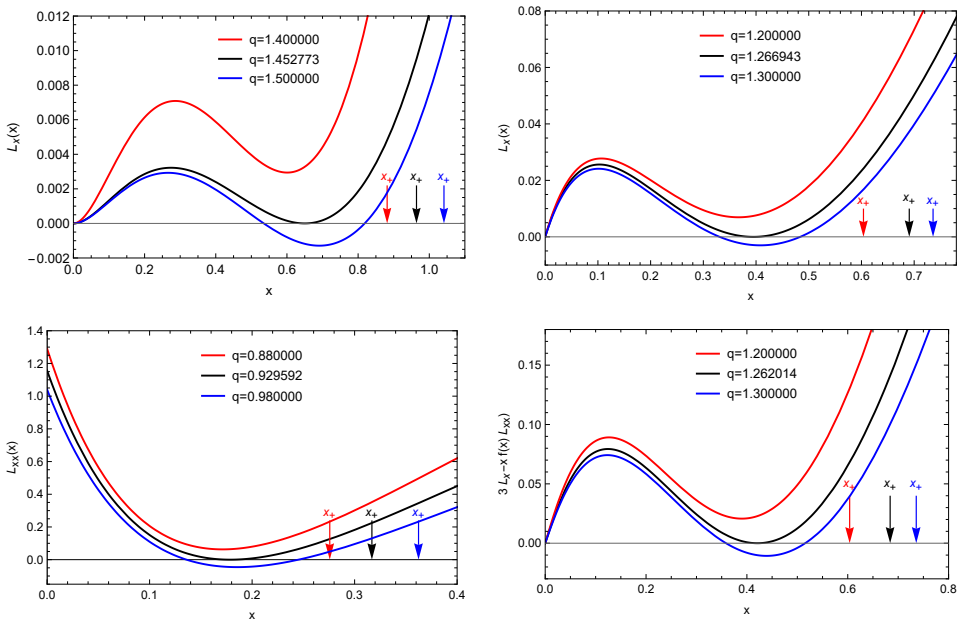
The central claim is that the two metric functions $f_1(r)=1-432M^4r^2/(432M^4q^2+(6Mr+q^2)^3)$ and $f_2(r)=1-(2M/r)(1-Mq^2/(Mq^2+8r^3)-q^2r^3/(2M(q^2+r^2)^2))$ describe regular charged black holes in general relativity with nonlinear electrodynamics, and that the two metrics obtained by the replacement $q\to\ell$ satisfy the Limiting Curvature Condition. In the first LCC solution, as $M\to\infty$, the Ricci scalar tends to $12/\ell^2$ and the Kretschmann scalar to $24/\ell^4$; for the second, the corresponding limits near the center are $192/\ell^2$ and $6144/\ell^4$ for small $\ell$. The authors further assert that solution 1 satisfies the weak energy condition everywhere and the strong energy condition outside the horizon for all charges below its extremal value $q_{\rm ext}=0.6458M$, while solution 2 is dynamically stable only for $q<0.9296M$ and is unstable between $0.9296M$ and its extremal charge $q_{\rm ext}=2.5379M$.
Load-bearing premise
The LCC solutions are made by substituting the length scale $\ell$ for the charge $q$ in the two charged metrics, and the paper assumes this substitution produces physically valid regular charged black holes whose nonlinear-electrodynamics Lagrangians remain well-defined and whose stability and energy-condition behavior is unchanged, even though the explicit $L(F)$ for the LCC models is not given.
Editorial extensions
If this is right
- If the LCC construction is valid, these four metrics are concrete realizations of the conjecture that no spacetime curvature invariant can exceed a universal value set by a fundamental length, independent of the black hole's mass.
- For solution 2, charges in the window $0.9296M \le q \le 2.5379M$ are dynamically unstable, so regular charged black holes in this family cannot persist with such charge-to-mass ratios.
- The computed shadow radii and eikonal quasinormal frequencies for charges $0.6423M$ and $0.6458M$ give quantitative differences between the two solutions that future horizon-scale observations could in principle test.
- The energy-condition results delimit the parameter ranges where the weak, dominant, and strong energy conditions hold, so any attempt to embed these metrics in a broader theory must respect those ranges.
Reading between the lines
- Because the LCC Lagrangians are never written down, the construction may hold only at the level of the metric; a natural next step would be to test whether the Moreno–Sarbach stability inequalities survive the substitution $q\to\ell$.
- The two LCC metrics, with curvature caps set by $\ell$, could serve as effective interior geometries for collapsed objects in any theory where a fundamental length regulates curvature, not just in the specific electrodynamics models used here.
- If the eikonal QNM–shadow correspondence holds for these solutions, then a combined measurement of a shadow radius and a ringdown frequency would distinguish solution 1 from solution 2, since their predicted radii differ by about five percent at the same charge.
Editorial analysis
A structured set of objections, weighed in public.
Referee Report
Summary. The manuscript constructs two static, spherically symmetric regular black hole metrics, f1(r) in Eq. (4) and f2(r) in Eq. (24), together with nonlinear electrodynamics Lagrangians/Hamiltonians for both magnetic and electric interpretations. For each solution the authors analyze dynamic stability via the Moreno–Sarbach inequalities (12)–(15), compute the Ricci and Kretschmann scalars, and test the standard energy conditions. They then replace the charge q by a fundamental length ℓ to obtain two further metrics, Eqs. (39) and (40), and claim these are the first four-dimensional regular charged black hole solutions satisfying the Limiting Curvature Condition, with M→∞ curvature limits R→12/ℓ², K→24/ℓ⁴ and R→192/ℓ², K→6144/ℓ⁴. The paper closes with a computation of null geodesics, shadow radii, and eikonal quasinormal frequencies for the two LCC metrics.
Significance. If the main claims are correct, the paper would supply explicit analytic examples of regular charged black holes whose curvature invariants remain bounded by a fixed length scale as the mass grows without bound, a property that is often stated but rarely verified with closed-form bounds. The explicit metric functions and Lagrangians, the extremal-charge behavior of the second solution, and the reported instability window are useful concrete data for the regular-black-hole and NED literature. The weaknesses are concentrated in two load-bearing places: the LCC property for the second solution is only checked in the M→∞ limit, and the dynamic stability of the first solution is asserted rather than demonstrated. The shadow and eikonal QNM section is standard and adds little beyond tabulated values.
major comments (3)
- [Section 3, Eq. (40)] The LCC property of the second solution is not established. The Limiting Curvature Condition requires |R| ≤ Bℓ⁻² and |K| ≤ B'ℓ⁻⁴ for all finite M and all r, but the argument in Section 3 only quotes the M→∞ limits from Eqs. (32)–(33) and the small-ℓ values 192/ℓ² and 6144/ℓ⁴ in Eq. (42). The statement that the Kretschmann scalar has a global maximum in 0 < r < 5M/672 gives no information about how that maximum depends on M/ℓ, and it does not exclude a bump at intermediate M that exceeds the M→∞ value. Please provide an analytic proof of a uniform bound, or a high-resolution numerical scan over M/ℓ and r, before claiming that f_II(r) satisfies the LCC.
- [Section 2.1, Dynamic stability] For the first solution, the paper does not verify inequalities (14) and (15). The text says that the verification is 'analogous to what is shown in the graphs presented for the subsequent black hole solution', but the Lagrangian L(x) in Eq. (11) is structurally different from L(x) in Eq. (29), so the analogy is not a proof. No stability threshold is reported for solution 1, and no graph or analytic bound for L_xx and 3L_x − xf(x)L_xx is given. Since the abstract advertises a dynamic-stability analysis for each solution, this omission is load-bearing and should be fixed.
- [Section 3] The LCC metrics are presented as NED-based regular charged black hole solutions, but their Lagrangians are not written down explicitly and their validity as NED solutions is only inferred from the substitution q→ℓ. In particular, the dynamic stability of the LCC models is not checked: the thresholds obtained in Section 2 are for the original Lagrangians with charge q, and the paper does not state that the inequalities (12)–(15) remain valid after q is replaced by ℓ. If the substitution makes the Lagrangian ill-defined or unstable in the relevant parameter range, the physical interpretation of Eqs. (39)–(40) as regular charged black holes is unsupported. Please give the explicit L(F) for the LCC models and verify the stability inequalities, or state clearly which stability properties are being assumed.
minor comments (5)
- [Section 2.1, Eq. (15)] The stability condition (15) contains an undefined f(x); if the intended condition is 3L_x ≥ x L_xx, please correct it. The caption of Fig. 3 also garbles this expression ('3L x-x f(x)L xx)'), which should be written cleanly.
- [Section 2.2, after Eq. (32)] The text says the M→∞ limit of the Ricci scalar 'presents a global maximum at r=0 whose value is 180/q² as well as a finite global maximum value'. This is internally inconsistent: the expression in Eq. (32) tends to 192/q² as r→∞, which is larger than 180/q², so the global maximum is not at r=0. Please correct this sentence.
- [Section 2.1, Energy conditions] The range '0.642245M ≥ q ≥ qext = 0.6458M' has the inequality directions reversed; it should read 0.642245M ≤ q ≤ 0.6458M.
- [Section 4 and Conclusions] Table 1 and the conclusions repeatedly refer to 'electric charge', but Section 2 warns that the electric versions of the NED models require different Lagrangians in different regions and suffer from the problems discussed in Ref. [8]. The authors should clarify whether the shadow and QNM results, and the 'charged' designation, apply to the magnetic interpretation, the electric interpretation, or both.
- [Throughout] There are several typographical errors, including 'Laypunov' for Lyapunov, 'differencies' for differences, and 'discussed'/'sketch' minor phrasing issues. A careful proofreading pass is recommended.
Circularity Check
Partial circularity in the LCC claim: 'satisfies LCC' is equated with R,K ∝ ℓ^{-2},ℓ^{-4} limits obtained by q→ℓ substitution, while finite-M uniform bounds are left unproven; the energy/stability/shadow analysis is independent.
-
self definitional
[Section 5 (Conclusions), supported by Section 3, Eqs. (39)-(42)]
"We then confirm by direct inspection that both cases satisfy the limit curvature condition (i.e. in both cases we obtain R ∝ ℓ−2 and K ∝ ℓ−4)."
The Introduction defines LCC as the uniform bound |R| ≤ Bℓ^{-2} for all values of the solution parameters, with B independent of the specific solution. The verification in Section 3 only computes the M→∞ limits of R and K after the q→ℓ substitution (Eqs. (41)-(42)), and the Conclusions then identify 'satisfy the LCC' with 'R ∝ ℓ^{-2}, K ∝ ℓ^{-4}'. This replaces the required all-M, all-r bound by a scaling law that the ansatz was designed to exhibit; for solution 2, Eq. (42) is the M→∞ large-r limit of Eqs. (32)-(33), and no finite-M global maximum is bounded. The central LCC claim thus rests on a self-defined criterion rather than on the stated LCC inequality.
-
other
[Section 3, Eqs. (39)-(42)]
"We can use the results already obtained by replacing the charge q with the parameter ℓ in the previous section to confirm that these solutions do indeed satisfy the limit curvature condition."
The LCC models are the same charged metrics (4) and (24) with q→ℓ, so the quoted curvature bounds are inherited from the ansatz, not derived as a consequence of an independent physical condition. For solution 2 the paper only states that K has a global maximum in 0<r<5M/672 without giving its value as a function of M/ℓ; it therefore never proves that |K| ≤ 6144/ℓ⁴ for all finite M. Presenting the substitution step as 'confirm' makes the LCC satisfaction a design feature rather than a verified result.
full rationale
The paper's core output is a pair of reverse-engineered regular black hole metrics with explicit NED Lagrangians (Eqs. (7) and (27)); deriving L(F) from a chosen f(r) is standard construction, not circularity. The energy-condition and Moreno-Sarbach stability checks are genuine consistency tests because not every reverse-engineered L(F) passes them. The shadow and eikonal QNM numbers follow from the metric via standard geodesic/WKB formulas and involve no fitting to data, so those parts are self-contained. The circularity is confined to the LCC claim. Section 3 constructs fI and fII by replacing the charge q with the length parameter ℓ and then 'confirms' LCC from the M→∞ values of R and K. The Introduction's LCC requires |R|≤Bℓ^{-2} for all M and all r; the Conclusions explicitly equate LCC with 'R∝ℓ^{-2}, K∝ℓ^{-4}', a weaker self-defined criterion. For solution 2, the quoted constants are M→∞ large-r limits, and the finite-M Kretschmann maximum is located but never bounded, so the headline 'first time' claim is not established. This is a genuine gap and a mild self-definitional circularity, but it does not infect the rest of the derivation chain; no load-bearing self-citation is involved, and no prediction is a renamed fit.
Assumptions & free parameters
free parameters (1)
- ell (fundamental length scale) =
not fitted; chosen by hand
assumptions (4)
- domain assumption General relativity coupled to nonlinear electrodynamics (NED) is the correct framework for the solutions.
- domain assumption The Moreno-Sarbach inequalities (12)-(15) are necessary and sufficient for dynamic stability of regular black holes in self-gravitating NED.
- domain assumption The Limiting Curvature Condition is a physically required constraint on regular black holes.
- domain assumption The energy-momentum tensor can be represented as a perfect fluid, T^i_j = diag(-rho, p1, p2, p3) with p1=-rho.
Cite this review
Pith. "Pith review of On new regular charged black hole solutions: Limiting Curvature Condition, Quasinormal modes and Shadows." pith.science (2026). https://pith.science/paper/JXLLEQYE
@misc{pith2026241200550,
  author       = {Pith},
  title        = {Pith review of: On new regular charged black hole solutions: Limiting Curvature Condition, Quasinormal modes and Shadows},
  year         = {2026},
  howpublished = {\url{https://pith.science/paper/JXLLEQYE}},
  note         = {Machine review of arXiv:2412.00550}
}
read the original abstract
We introduce two new static, spherically symmetric regular black hole solutions that can be obtained from non-linear electrodynamics models. For each solution, we investigate the dynamic stability with respect to arbitrary linear fluctuations of the metric and electromagnetic field, and also examine the energy conditions that those black holes satisfy. Moreover, based on those solutions, we present two additional ones that satisfy the Limiting Curvature Condition. Finally, we make a comparison between the two solutions exploring their null geodesics and circular photon orbits.
Figures


Forward citations
Cited by 2 Pith papers
-
Evaporating cosmologically coupled black holes
If a black hole's mass grows with cosmic expansion, Hawking evaporation is slowed or reversed, weakening gamma-ray bounds on primordial black holes.
-
Charged black holes in Kalb-Ramond gravity: Weak Deflection Angle, Shadow cast, Quasinormal Modes and Neutrino annihilation
The Kalb-Ramond black hole phenomenology is mostly an extension of known results, and its shadow formula is internally inconsistent, invalidating the EHT-based constraints.
Reference graph
Works this paper leans on
-
[42]
Quest for realistic non-singular black-hole geometries: regular-center type,
H. Maeda, “Quest for realistic non-singular black-hole geometries: regular-center type,” JHEP11, 108 (2022)
2022
-
[1]
K. A. Bronnikov, [arXiv:2211.00743 [gr-qc]]
-
[2]
Regular Black Holes: A Short Topic Review,
C. Lan, H. Yang, Y. Guo and Y. G. Miao, “Regular Black Holes: A Short Topic Review,” Int. J. Theor. Phys. 62, no.9, 202 (2023)
2023
-
[3]
Non-singular general-relativistic gravitational collapse,
J. M. Bardeen “Non-singular general-relativistic gravitational collapse,” in Proceedings of GR5, Tbil- isi, U.S.S.R, p.174 (1968)
1968
-
[4]
Vacuum nonsingular black hole,
I. Dymnikova, “Vacuum nonsingular black hole,” Gen. Rel. Grav.24, 235-242 (1992)
1992
-
[5]
Regular black hole in general relativity coupled to nonlinear electro- dynamics,
E. Ayon-Beato and A. Garcia, “Regular black hole in general relativity coupled to nonlinear electro- dynamics,” Phys. Rev. Lett.80, 5056 (1998). 12
1998
-
[6]
Nonsingular charged black hole solution for nonlinear source,
E. Ayon-Beato and A. Garcia, “Nonsingular charged black hole solution for nonlinear source,” Gen. Rel. Grav. 31, 629-633 (1999)
1999
-
[7]
New regular black hole solution from nonlinear electrodynamics,
E. Ayon-Beato and A. Garcia, “New regular black hole solution from nonlinear electrodynamics,” Phys. Lett. B464, 25 (1999)
1999
Show all 157 references
-
[8]
Regular magnetic black holes and monopoles from nonlinear electrodynamics,
K. A. Bronnikov, “Regular magnetic black holes and monopoles from nonlinear electrodynamics,” Phys. Rev. D63, 044005 (2001)
2001
-
[9]
Regular electrically charged structures in nonlinear electrodynamics coupled to gen- eral relativity,
I. Dymnikova, “Regular electrically charged structures in nonlinear electrodynamics coupled to gen- eral relativity,” Class. Quant. Grav.21, 4417-4429 (2004)
2004
-
[10]
Four parametric regular black hole solution,
E. Ayon-Beato and A. Garcia, “Four parametric regular black hole solution,” Gen. Rel. Grav.37, 635 (2005)
2005
-
[11]
Formation and evaporation of regular black holes,
S. A. Hayward, “Formation and evaporation of regular black holes,” Phys. Rev. Lett.96, 031103 (2006)
2006
-
[12]
Noncommutative geometry inspired Schwarzschild black hole,
P. Nicolini, A. Smailagic and E. Spallucci, “Noncommutative geometry inspired Schwarzschild black hole,” Phys. Lett. B632, 547-551 (2006)
2006
-
[13]
On a regular modified Schwarzschild spacetime,
H. Culetu, “On a regular modified Schwarzschild spacetime,” [arXiv:1305.5964 [gr-qc]]
-
[14]
Regular black hole metrics and the weak energy condition,
L. Balart and E. C. Vagenas, “Regular black hole metrics and the weak energy condition,” Phys. Lett. B 730, 14 (2014)
2014
-
[15]
Regular black holes with a nonlinear electrodynamics source,
L. Balart and E. C. Vagenas, “Regular black holes with a nonlinear electrodynamics source,” Phys. Rev. D 90, no. 12, 124045 (2014)
2014
-
[16]
Magnetically charged regular black hole in a model of nonlinear electrodynamics,
M. S. Ma, “Magnetically charged regular black hole in a model of nonlinear electrodynamics,” Annals Phys. 362, 529-537 (2015)
2015
-
[17]
Notes on nonsingular models of black holes,
V. P. Frolov, “Notes on nonsingular models of black holes,” Phys. Rev. D94, no.10, 104056 (2016)
2016
-
[18]
Construction of Regular Black Holes in General Relativity,
Z. Y. Fan and X. Wang, “Construction of Regular Black Holes in General Relativity,” Phys. Rev. D 94, no.12, 124027 (2016)
2016
-
[19]
Using dominant and weak energy conditions for build new classe of regular black holes,
M. E. Rodrigues, E. L. B. Junior and M. V. de Sousa Silva, “Using dominant and weak energy conditions for build new classe of regular black holes,” JCAP02, 059 (2018)
2018
-
[20]
Regular multihorizon black holes in General Relativity,
M. E. Rodrigues, M. V. de Sousa Silva and A. S. de Siqueira, “Regular multihorizon black holes in General Relativity,” Phys. Rev. D102, no.8, 084038 (2020)
2020
-
[21]
Regular model of magnetized black hole with rational nonlinear electrodynamics,
S. I. Kruglov, “Regular model of magnetized black hole with rational nonlinear electrodynamics,” Int. J. Mod. Phys. A36, no.21, 2150158 (2021)
2021
-
[22]
Black hole as a magnetic monopole within exponential nonlinear electrodynamics,
S. I. Kruglov, “Black hole as a magnetic monopole within exponential nonlinear electrodynamics,” Annals Phys. 378, 59-70 (2017)
2017
-
[23]
A regular scale-dependent black hole solution,
E. Contreras, Á. Rincón, B. Koch and P. Bargueño, “A regular scale-dependent black hole solution,” Int. J. Mod. Phys. D27, no.03, 1850032 (2017)
2017
-
[24]
Regular black holes in Einstein-Gauss-Bonnet gravity,
S. G. Ghosh, D. V. Singh and S. D. Maharaj, “Regular black holes in Einstein-Gauss-Bonnet gravity,” Phys. Rev. D97, no.10, 104050 (2018)
2018
-
[25]
Note on regular magnetic black hole,
S. H. Mazharimousavi and M. Halilsoy, “Note on regular magnetic black hole,” Phys. Lett. B796, 123-125 (2019)
2019
-
[26]
Regular black holes in Rainbow Gravity,
E. L. B. Junior, M. E. Rodrigues and M. V. de Sousa Silva, “Regular black holes in Rainbow Gravity,” Nucl. Phys. B961, 115244 (2020)
2020
-
[27]
Regular black holes with exotic topologies,
G. Melgarejo, E. Contreras and P. Bargueño, “Regular black holes with exotic topologies,” Phys. Dark Univ. 30, 100709 (2020)
2020
-
[28]
Extended phase space thermodynamics of Bardeen black hole in massive gravity,
B. K. Singh, R. P. Singh and D. V. Singh, “Extended phase space thermodynamics of Bardeen black hole in massive gravity,” Eur. Phys. J. Plus135, no.10, 862 (2020)
2020
-
[29]
Hayward black holes in Einstein–Gauss–Bonnet gravity,
A. Kumar, D. V. Singh and S. G. Ghosh, “Hayward black holes in Einstein–Gauss–Bonnet gravity,” Annals Phys. 419, 168214 (2020)
2020
-
[30]
Quasinormal modes and shadows of a new family of Ayón-Beato-García black holes,
X. C. Cai and Y. G. Miao, “Quasinormal modes and shadows of a new family of Ayón-Beato-García black holes,” Phys. Rev. D103, no.12, 124050 (2021)
2021
-
[31]
P − v criticality, phase structure and extended thermo- dynamics of AdS ABG black holes,
B. K. Singh, R. P. Singh and D. V. Singh, “P − v criticality, phase structure and extended thermo- dynamics of AdS ABG black holes,” Eur. Phys. J. Plus136, no.5, 575 (2021) 13
2021
-
[32]
RemarksonNonsingularModelsofHaywardandMagnetizedBlackHolewithRational Nonlinear Electrodynamics,
S.I.Kruglov, “RemarksonNonsingularModelsofHaywardandMagnetizedBlackHolewithRational Nonlinear Electrodynamics,” Grav. Cosmol.27, no.1, 78-84 (2021)
2021
-
[33]
Complexity conjecture of regular electric black holes,
B. B. Asl, S. H. Hendi and S. N. Sajadi, “Complexity conjecture of regular electric black holes,” Phys. Rev. D104, no.10, 104034 (2021)
2021
-
[34]
Exact nonsingular black holes and thermodynamics,
D. V. Singh, S. G. Ghosh and S. D. Maharaj, “Exact nonsingular black holes and thermodynamics,” Nucl. Phys. B981, 115854 (2022)
2022
-
[35]
Exact solution of Bardeen black hole in Einstein–Gauss–Bonnet gravity,
A. Kumar, D. V. Singh, Y. Myrzakulov, G. Yergaliyeva and S. Upadhyay, “Exact solution of Bardeen black hole in Einstein–Gauss–Bonnet gravity,” Eur. Phys. J. Plus138, no.12, 1071 (2023)
2023
-
[36]
Electrically charged regular black holes in nonlinear electrodynamics: Light rings, shadows, and gravitational lensing,
M. A. A. de Paula, H. C. D. Lima, Junior, P. V. P. Cunha and L. C. B. Crispino, “Electrically charged regular black holes in nonlinear electrodynamics: Light rings, shadows, and gravitational lensing,” Phys. Rev. D108, no.8, 084029 (2023)
2023
-
[37]
Regular Charged Black Holes, Energy Conditions, and Quasinormal Modes,
L. Balart, G. Panotopoulos and Á. Rincón, “Regular Charged Black Holes, Energy Conditions, and Quasinormal Modes,” Fortsch. Phys.71, no.12, 2300075 (2023)
2023
-
[38]
Quasinormal modes of renormalization group improved Dymnikova regular black holes,
R. A. Konoplya, Z. Stuchlik, A. Zhidenko and A. F. Zinhailo, “Quasinormal modes of renormalization group improved Dymnikova regular black holes,” Phys. Rev. D107, no.10, 104050 (2023)
2023
-
[39]
Bardeen spacetime as a quantum corrected Schwarzschild black hole: Quasinormal modes and Hawking radiation,
R. A. Konoplya, D. Ovchinnikov and B. Ahmedov, “Bardeen spacetime as a quantum corrected Schwarzschild black hole: Quasinormal modes and Hawking radiation,” Phys. Rev. D108, no.10, 104054 (2023)
2023
-
[40]
Recovery of consistency in thermodynamics of regular black holes in Einstein’s gravity coupled with nonlinear electrodynamics,
Y. Guo, H. Xie and Y. G. Miao, “Recovery of consistency in thermodynamics of regular black holes in Einstein’s gravity coupled with nonlinear electrodynamics,” Nucl. Phys. B1000, 116491 (2024)
2024
-
[41]
Shadow and greybody bounding of a regular scale-dependent black hole solution,
A. Övgün, R. C. Pantig and Á. Rincón, “Shadow and greybody bounding of a regular scale-dependent black hole solution,” Annals Phys.463, 169625 (2024)
2024
-
[43]
Stability properties of black holes in selfgravitating nonlinear electro- dynamics,
C. Moreno and O. Sarbach, “Stability properties of black holes in selfgravitating nonlinear electro- dynamics,” Phys. Rev. D67, 024028 (2003)
2003
-
[44]
New type of regular black holes and particle - like solutions from NED,
A. Burinskii and S. R. Hildebrandt, “New type of regular black holes and particle - like solutions from NED,” Phys. Rev. D65, 104017 (2002)
2002
-
[45]
Regular black holes and energy conditions,
O. B. Zaslavskii, “Regular black holes and energy conditions,” Phys. Lett. B688, 278-280 (2010)
2010
-
[46]
Constraints on singularity resolution by nonlinear electrodynam- ics,
A. Bokulić, I. Smolić and T. Jurić, “Constraints on singularity resolution by nonlinear electrodynam- ics,” Phys. Rev. D106, no.6, 064020 (2022)
2022
-
[47]
Lagrangian reverse engineering for regular black holes,
A. Bokulic, E. Franzin, T. Juric and I. Smolic, “Lagrangian reverse engineering for regular black holes,” Phys. Lett. B854, 138750 (2024)
2024
-
[48]
Causality and energy conditions in nonlinear electrodynamics,
J. G. Russo and P. K. Townsend, “Causality and energy conditions in nonlinear electrodynamics,” JHEP 06, 191 (2024)
2024
-
[49]
The Large Scale Structure of Space-Time,
S. W. Hawking and G. F. R. Ellis, “The Large Scale Structure of Space-Time,” Cambridge University Press, 2023
2023
-
[50]
Regular black holes with improved energy conditions and their analogues in fluids*,
C. Lan, Y. G. Miao and Y. X. Zang, “Regular black holes with improved energy conditions and their analogues in fluids*,” Chin. Phys. C47, no.5, 052001 (2023)
2023
-
[51]
Limiting density of matter as a universal law of nature,
M. A. Markov, “Limiting density of matter as a universal law of nature,” JETP Lett. 36, 265-267 (1982), Pisma Zh.Eksp.Teor.Fiz. 36, 214-216 (1982)
1982
-
[52]
PROBLEMS OF A PERPETUALLY OSCILLATING UNIVERSE,
M. A. Markov, “PROBLEMS OF A PERPETUALLY OSCILLATING UNIVERSE,” Annals Phys. 155, 333-357 (1984)
1984
-
[53]
Decoupling Versus Excluded Volume or Return of the Giant Wormholes,
J. Polchinski, “Decoupling Versus Excluded Volume or Return of the Giant Wormholes,” Nucl. Phys. B 325, 619-630 (1989)
1989
- [54]
-
[55]
Quantum radiation from an evaporating nonsingular black hole,
V. P. Frolov and A. Zelnikov, “Quantum radiation from an evaporating nonsingular black hole,” Phys. Rev. D95, no.12, 124028 (2017)
2017
-
[56]
Remarks on non-singular black holes,
V. P. Frolov, “Remarks on non-singular black holes,” EPJ Web Conf.168, 01001 (2018)
2018
-
[57]
Nonpolynomial Lagrangian approach to regular black holes,
A. Colléaux, S. Chinaglia and S. Zerbini, “Nonpolynomial Lagrangian approach to regular black holes,” Int. J. Mod. Phys. D27, no.03, 1830002 (2018). 14
2018
-
[58]
The regular black hole in four dimensional Born–Infeld gravity,
C. G. Böhmer and F. Fiorini, “The regular black hole in four dimensional Born–Infeld gravity,” Class. Quant. Grav. 36, no.12, 12LT01 (2019)
2019
-
[59]
Asymptotic magnetically charged non-singular black hole and its thermo- dynamics,
A. Ali and K. Saifullah, “Asymptotic magnetically charged non-singular black hole and its thermo- dynamics,” Phys. Lett. B792, 276-283 (2019)
2019
-
[60]
Non-Singular Model of Magnetized Black Hole Based on Nonlinear Electrodynamics,
S. I. Kruglov, “Non-Singular Model of Magnetized Black Hole Based on Nonlinear Electrodynamics,” Universe 5, no.12, 225 (2019)
2019
-
[61]
Two-dimensional black holes in the limiting curvature theory of gravity,
V. P. Frolov and A. Zelnikov, “Two-dimensional black holes in the limiting curvature theory of gravity,” JHEP 08, 154 (2021)
2021
-
[62]
Limiting curvature models of gravity,
V. P. Frolov, “Limiting curvature models of gravity,” Nuovo Cim. C45, no.2, 38 (2022)
2022
-
[63]
Spherically symmetric black holes in the limiting curvature theory of gravity,
V. P. Frolov and A. Zelnikov, “Spherically symmetric black holes in the limiting curvature theory of gravity,” Phys. Rev. D105, no.2, 024041 (2022)
2022
-
[64]
Black holes in the limiting curvature theory of gravity,
V. P. Frolov, “Black holes in the limiting curvature theory of gravity,” Int. J. Mod. Phys. A37, no.20n21, 2243009 (2022)
2022
-
[65]
Kilometer-scale ultraviolet regulators and astrophysical black holes,
J. Boos and C. D. Carone, “Kilometer-scale ultraviolet regulators and astrophysical black holes,” [arXiv:2311.16319 [gr-qc]]
-
[66]
Stability of a Schwarzschild singularity,
T. Regge and J. A. Wheeler, “Stability of a Schwarzschild singularity,” Phys. Rev.108, 1063-1069 (1957)
1957
-
[67]
Effective potential for even parity Regge-Wheeler gravitational perturbation equations,
F. J. Zerilli, “Effective potential for even parity Regge-Wheeler gravitational perturbation equations,” Phys. Rev. Lett.24, 737-738 (1970)
1970
-
[68]
Gravitational field of a particle falling in a schwarzschild geometry analyzed in tensor harmonics,
F. J. Zerilli, “Gravitational field of a particle falling in a schwarzschild geometry analyzed in tensor harmonics,” Phys. Rev. D2, 2141-2160 (1970)
1970
-
[69]
Perturbation analysis for gravitational and electromagnetic radiation in a reissner- nordstroem geometry,
F. J. Zerilli, “Perturbation analysis for gravitational and electromagnetic radiation in a reissner- nordstroem geometry,” Phys. Rev. D9, 860-868 (1974)
1974
-
[70]
Gauge-invariant perturbations of Reissner-Nordstrom black holes,
V. Moncrief, “Gauge-invariant perturbations of Reissner-Nordstrom black holes,” Phys. Rev. D12, 1526-1537 (1975)
1975
-
[71]
Rotating black holes - separable wave equations for gravitational and electromag- netic perturbations,
S. A. Teukolsky, “Rotating black holes - separable wave equations for gravitational and electromag- netic perturbations,” Phys. Rev. Lett.29, 1114-1118 (1972)
1972
-
[72]
The mathematical theory of black holes,
S. Chandrasekhar, “The mathematical theory of black holes,” OXFORD, UK: CLARENDON (1985) 646 P
1985
-
[73]
B. P. Abbott et al. [LIGO Scientific and Virgo Collaborations], Phys. Rev. Lett.116 (2016) no.6, 061102 [arXiv:1602.03837 [gr-qc]]
2016 arXiv
-
[74]
https://eventhorizontelescope.org
-
[75]
Akiyama et al
K. Akiyama et al. [Event Horizon Telescope Collaboration], Astrophys. J.875 (2019) no.1, L1
2019
-
[76]
Akiyama et al
K. Akiyama et al. [Event Horizon Telescope Collaboration], Astrophys. J.875 (2019) no.1, L2
2019
-
[77]
Akiyama et al
K. Akiyama et al. [Event Horizon Telescope Collaboration], Astrophys. J.875 (2019) no.1, L3
2019
-
[78]
Akiyama et al
K. Akiyama et al. [Event Horizon Telescope Collaboration], Astrophys. J.875 (2019) no.1, L4
2019
-
[79]
Akiyama et al
K. Akiyama et al. [Event Horizon Telescope Collaboration], Astrophys. J.875 (2019) no.1, L5
2019
-
[80]
Akiyama et al
K. Akiyama et al. [Event Horizon Telescope Collaboration], Astrophys. J.875 (2019) no.1, L6
2019
-
[81]
A. E. Broderick, T. Johannsen, A. Loeb and D. Psaltis, Astrophys. J.784 (2014) 7 [arXiv:1311.5564 [astro-ph.HE]]
2014 arXiv
-
[82]
P. G. Nedkova, V. K. Tinchev and S. S. Yazadjiev, Phys. Rev. D 88 (2013) no.12, 124019 [arXiv:1307.7647 [gr-qc]]
2013 arXiv
-
[83]
F. H. Vincent, Z. Meliani, P. Grandclement, E. Gourgoulhon and O. Straub, Class. Quant. Grav.33 (2016) no.10, 105015 [arXiv:1510.04170 [gr-qc]]
2016 arXiv
-
[84]
Ohgami and N
T. Ohgami and N. Sakai, Phys. Rev. D91 (2015) no.12, 124020 [arXiv:1704.07065 [gr-qc]]
2015 arXiv
-
[85]
Ohgami and N
T. Ohgami and N. Sakai, Phys. Rev. D94 (2016) no.6, 064071 [arXiv:1704.07093 [gr-qc]]
2016 arXiv
-
[86]
Gyulchev, P
G. Gyulchev, P. Nedkova, V. Tinchev and S. Yazadjiev, Eur. Phys. J. C 78 (2018) no.7, 544 [arXiv:1805.11591 [gr-qc]]
2018 arXiv
-
[87]
A. B. Abdikamalov, A. A. Abdujabbarov, D. Ayzenberg, D. Malafarina, C. Bambi and B. Ahmedov, Phys. Rev. D100, 024014 (2019) [ arXiv:1904.06207 [gr-qc]. ] 15
2019 arXiv
-
[88]
Shaikh, Phys
R. Shaikh, Phys. Rev. D98, 024044 (2018)
2018
-
[89]
Shaikh, P
R. Shaikh, P. Kocherlakota, R. Narayan, and P. S. Joshi, Mon. Not. R. Astron. Soc.482, 52 (2019)
2019
-
[90]
K. S. Virbhadra and G. F. R. Ellis, Phys.Rev. D62,084003 (2000)
2000
-
[91]
K. S. Virbhadra and G. F. R. Ellis, Phys.Rev. D65, 103004 (2002)
2002
-
[92]
P. V. P. Cunha and C. A. R. Herdeiro, Gen. Rel. Grav.50 (2018) no.4, 42 [arXiv:1801.00860 [gr-qc]]
2018 arXiv
-
[93]
J. L. Synge, Mon. Not. Roy. Astron. Soc.131 (1966) no.3, 463
1966
-
[94]
Luminet, Astron
J.-P. Luminet, Astron. Astrophys.75 (1979) 228
1979
-
[95]
J. M. Bardeen, inBlack Holes (Les Astres Occlus), edited by C. Dewitt and B. S. Dewitt (Gordon and Breach, New York, 1973), pp. 215-239
1973
-
[96]
P. V. P. Cunha, C. A. R. Herdeiro, E. Radu and H. F. Runarsson, Phys. Rev. Lett.115 (2015) no.21, 211102 [arXiv:1509.00021 [gr-qc]]
2015 arXiv
-
[97]
P. V. P. Cunha, C. A. R. Herdeiro, E. Radu and H. F. Runarsson, Int. J. Mod. Phys. D25 (2016) no.09, 1641021 [arXiv:1605.08293 [gr-qc]]
2016 arXiv
-
[98]
Bambi and K
C. Bambi and K. Freese, Phys. Rev. D79, 043002 (2009) [arXiv:0812.1328 [astro-ph]]
2009 arXiv
-
[99]
Bambi and N
C. Bambi and N. Yoshida, Class. Quant. Grav.27, 205006 (2010) [arXiv:1004.3149 [gr-qc]]
2010 arXiv
-
[100]
Abdujabbarov, F
A. Abdujabbarov, F. Atamurotov, Y. Kucukakca, B. Ahmedov and U. Camci, Astrophys. Space Sci. 344 (2013) 429 [arXiv:1212.4949 [physics.gen-ph]]
2013 arXiv
-
[101]
Atamurotov, A
F. Atamurotov, A. Abdujabbarov and B. Ahmedov, Astrophys. Space Sci.348 (2013) 179
2013
-
[102]
J. W. Moffat, Eur. Phys. J. C75 (2015) no.3, 130 [arXiv:1502.01677 [gr-qc]]
2015 arXiv
-
[103]
Abdujabbarov, B
A. Abdujabbarov, B. Toshmatov, Z. Stuchlík and B. Ahmedov, Int. J. Mod. Phys. D26 (2016) no.06, 1750051 [arXiv:1512.05206 [gr-qc]]
2016 arXiv
-
[104]
Younsi, A
Z. Younsi, A. Zhidenko, L. Rezzolla, R. Konoplya and Y. Mizuno, Phys. Rev. D94 (2016) no.8, 084025 [arXiv:1607.05767 [gr-qc]]
2016 arXiv
-
[105]
Schee and Z
J. Schee and Z. Stuchlik, Eur. Phys. J. C76 (2016) no.11, 643 doi:10.1140/epjc/s10052-016-4511-0
2016 doi
-
[106]
P. V. P. Cunha, C. A. R. Herdeiro, B. Kleihaus, J. Kunz and E. Radu, Phys. Lett. B768 (2017) 373 [arXiv:1701.00079 [gr-qc]]
2017 arXiv
-
[107]
M. Wang, S. Chen and J. Jing, JCAP1710 (2017) no.10, 051 [arXiv:1707.09451 [gr-qc]]
2017 arXiv
-
[108]
Schee, Z
J. Schee, Z. Stuchlík, B. Ahmedov, A. Abdujabbarov and B. Toshmatov, Int. J. Mod. Phys. D26 (2017) no.5, 1741011
2017
-
[109]
H. M. Wang, Y. M. Xu and S. W. Wei, JCAP1903 (2019) no.03, 046 [arXiv:1810.12767 [gr-qc]]
2019 arXiv
-
[110]
Toshmatov, Z
B. Toshmatov, Z. Stuchlík, and B. Ahmedov Phys. Rev. D95, 084037 (2017)
2017
-
[111]
R. A. Konoplya, Phys. Lett. B795, 19 (2019)
2019
- [112]
-
[113]
Övgün, I
A. Övgün, I. Sakalli and J. Saavedra, JCAP10, 041 (2018)
2018
-
[114]
Mishra, S
A. Mishra, S. Chakraborty, S. Sarkar, Phys. Rev. D99, 104080 (2019) [arXiv:1903.06376 [gr–qc]]
2019 arXiv
- [115]
-
[116]
Contreras, J.M Ramirez–VElasquez, Á
E. Contreras, J.M Ramirez–VElasquez, Á. Rincón, G. Panotopoulos, P. Bargueño, Eur. Phys. J. C 79, 802 (2019). [arXiv:1905.11443]
2019 arXiv
- [117]
-
[118]
Vagnozzi, L
S. Vagnozzi, L. Visinelli , Phys. Rev. D100 (2019) 024020, [arXiv:1905.12421]
2019 arXiv
-
[119]
Bambi, K
C. Bambi, K. Freese, S. Vagnozzi, L. Visinelli, Phys. Rev. D100 (2019) 044057 [arXiv:1904.12983]
2019 arXiv
-
[120]
R. A. Konoplya, Phys. Lett. B804 (2020), 135363 [arXiv:1912.10582 [gr-qc]]
2020 arXiv
-
[121]
R. A. Konoplya, T. Pappas and A. Zhidenko, Phys. Rev. D 101 (2020) no.4, 044054 [arXiv:1907.10112 [gr-qc]]
2020 arXiv
-
[122]
Allahyari, M
A. Allahyari, M. Khodadi, S. Vagnozzi and D. F. Mota, JCAP02 (2020), 003 [arXiv:1912.08231 [gr-qc]]
2020 arXiv
-
[123]
V. K. Tinchev, [arXiv:1911.13262 [gr-qc]]. 16
1911 arXiv
-
[124]
P. V. P. Cunha, C. A. R. Herdeiro and E. Radu, Universe5 (2019) no.12, 220 [arXiv:1909.08039 [gr-qc]]
2019 arXiv
-
[125]
A.Övgün, İ.Sakallı, J.SaavedraandC.Leiva, Mod.Phys.Lett.A 2050163, 2020[arXiv:1906.05954 [hep-th]]
2020 arXiv
-
[126]
R. A. Konoplya and A. Zhidenko, Phys. Rev. D100 (2019) no.4, 044015 [arXiv:1907.05551 [gr-qc]]
2019 arXiv
-
[127]
Hensh, A
S. Hensh, A. Abdujabbarov, J. Schee and Z. Stuchlík, Eur. Phys. J. C 79 (2019) no.6, 533 [arXiv:1904.08776 [gr-qc]]
2019 arXiv
-
[128]
Stuchlík and J
Z. Stuchlík and J. Schee, Eur. Phys. J. C79 (2019) no.1, 44
2019
-
[129]
Contreras, Á
E. Contreras, Á. Rincón, G. Panotopoulos, P. Bargueño and B. Koch, Phys. Rev. D101 (2020) no.6, 064053 [arXiv:1906.06990 [gr-qc]]
2020 arXiv
-
[130]
Fathi, Á
M. Fathi, Á. Rincón and J. R. Villanueva, Class. Quant. Grav. 37 (2020) no.7, 075004, [arXiv:1903.09037 [gr-qc]]
2020 arXiv
-
[131]
Chang and Q
Z. Chang and Q. H. Zhu, [arXiv:2006.00685 [gr-qc]]. Shadow of a black hole surrounded by dark matter
2006 arXiv
-
[132]
Badía and E
J. Badía and E. F. Eiroa, Phys. Rev. D102 (2020) no.2, 024066 [arXiv:2005.03690 [gr-qc]]
2020 arXiv
-
[133]
P. C. Li, M. Guo and B. Chen, Phys. Rev. D101 (2020) no.8, 084041 [arXiv:2001.04231 [gr-qc]]
2020 arXiv
-
[134]
C. Li, S. F. Yan, L. Xue, X. Ren, Y. F. Cai, D. A. Easson, Y. F. Yuan and H. Zhao, Phys. Rev. Res. 2 (2020), 023164 [arXiv:1912.12629 [astro-ph.CO]]
2020 arXiv
-
[135]
Khodadi, A
M. Khodadi, A. Allahyari, S. Vagnozzi and D. F. Mota, [arXiv:2005.05992 [gr-qc]]
2005 arXiv
- [136]
-
[137]
C. Liu, T. Zhu, Q. Wu, K. Jusufi, M. Jamil, M. Azreg-Aïnou and A. Wang, Phys. Rev. D101 (2020) no.8, 084001 [arXiv:2003.00477 [gr-qc]]
2020 arXiv
-
[138]
Vagnozzi, C
S. Vagnozzi, C. Bambi and L. Visinelli, Class. Quant. Grav. 37 (2020) no.8, 087001 [arXiv:2001.02986 [gr-qc]]
2020 arXiv
-
[139]
S. G. Ghosh, M. Amir and S. D. Maharaj, Nucl. Phys. B957 (2020), 115088 [arXiv:2006.07570 [gr-qc]]
2020 arXiv
-
[140]
Rincon and G
A. Rincon and G. Gómez, Phys. Dark Univ.46 (2024), 101576 [arXiv:2308.11756 [gr-qc]]
2024 arXiv
-
[141]
Övgün, R
A. Övgün, R. C. Pantig and Á. Rincón, Eur. Phys. J. Plus138 (2023) no.3, 192 [arXiv:2303.01696 [gr-qc]]
2023 arXiv
-
[142]
Contreras, Á
E. Contreras, Á. Rincón, G. Panotopoulos and P. Bargueño, Annals Phys.432 (2021), 168567 [arXiv:2010.03734 [gr-qc]]
2021 arXiv
-
[143]
Observational predictions of LQG motivated polymerized black holes and con- straints from Sgr A* and M87*,
R. Kumar Walia, “Observational predictions of LQG motivated polymerized black holes and con- straints from Sgr A* and M87*,” JCAP03, 029 (2023)
2023
-
[144]
Duality rotations and type D solutions to Einstein equations with nonlinear electromagnetic sources,
H. Salazar I., A. Garcia D., J. F. Plebanski “Duality rotations and type D solutions to Einstein equations with nonlinear electromagnetic sources,” J. Math. Phys., 28, 2171 (1987)
1987
-
[145]
A regular metric does not ensure the regularity of spacetime,
M. E. Rodrigues and H. A. Vieira, “A regular metric does not ensure the regularity of spacetime,” Eur. Phys. J. Plus138, no.11, 974 (2023)
2023
-
[146]
Lecture notes on general relativity,
S. M. Carroll, “Lecture notes on general relativity,” [arXiv:gr-qc/9712019 [gr-qc]]
-
[147]
C. K. Qiao and M. Li, Phys. Rev. D106 (2022) no.2, L021501 [arXiv:2204.07297 [gr-qc]]
2022 arXiv
-
[148]
R. A. Konoplya and A. F. Zinhailo, Eur. Phys. J. C80(2020) no.11, 1049 [arXiv:2003.01188 [gr-qc]]
2020 arXiv
-
[149]
Ferrari and L
V. Ferrari and L. Gualtieri, Gen. Rel. Grav.40, 945-970 (2008) [arXiv:0709.0657 [gr-qc]]
2008 arXiv
-
[150]
R. A. Konoplya and A. Zhidenko, Rev. Mod. Phys.83, 793-836 (2011) [arXiv:1102.4014 [gr-qc]]
2011 arXiv
-
[151]
P. A. González, E. Papantonopoulos, Á. Rincón and Y. Vásquez, Phys. Rev. D106 (2022) no.2, 024050 [arXiv:2205.06079 [gr-qc]]
2022 arXiv
-
[152]
P. A. González, Á. Rincón, J. Saavedra and Y. Vásquez, Phys. Rev. D104 (2021) no.8, 084047 [arXiv:2107.08611 [gr-qc]]
2021 arXiv
-
[153]
Harmark, J
T. Harmark, J. Natario and R. Schiappa, Adv. Theor. Math. Phys. 14, no.3, 727-794 (2010) [arXiv:0708.0017 [hep-th]]
2010 arXiv
-
[154]
B. F. Schutz and C. M. Will, Astrophys. J. Lett.291, L33-L36 (1985). 17
1985
-
[155]
Iyer and C
S. Iyer and C. M. Will, Phys. Rev. D35, 3621 (1987)
1987
-
[156]
Geodesic stability, Lyapunov exponents and quasinormal modes,
V. Cardoso, A. S. Miranda, E. Berti, H. Witek and V. T. Zanchin, “Geodesic stability, Lyapunov exponents and quasinormal modes,” Phys. Rev. D79 (2009) 064016 [arXiv:0812.1806 [hep-th]]
2009 arXiv
-
[157]
Ponglertsakul, P
S. Ponglertsakul, P. Burikham and L. Tannukij, Eur. Phys. J. C 78, no.7, 584 (2018) [arXiv:1803.09078 [gr-qc]]. 18
2018 arXiv
Reviewed August 12, 2026 · model on record in the stance chip above.
Discussion (0). Continue with ORCID to comment.