REVIEW 2 major objections 3 minor 2 cited by
Superactivation and Incompressibility of Genuine Multipartite Entanglement
T0 review · 2 major / 3 minor · reviewed 2026-08-11 · deepseek-v4-flash
Pith's one-line read The paper proves that genuine multipartite entanglement can be superactivated in two copies yet be incompressible: no local projection back to a single copy preserves the activated entanglement.
desk verdict Proves a new phenomenon—incompressible entanglement—with clean criteria and honest numerical labeling; the central ICE proof needs shipped certificates to be fully verifiable. read the letter →
The pith
A machine-rendered reading of the paper's core claim, the machinery that carries it, and where it could break.
The reading
What carries the argument
The load-bearing object is the local projection map from the $k$-copy Hilbert space to a single-copy space, $\tau_k = \frac{1}{N}[F_A\otimes F_B\otimes F_C]\,\rho^{\otimes k}\,[F_A^\dagger\otimes F_B^\dagger\otimes F_C^\dagger]$, with the Hadamard map $E_X = \lvert 0\rangle\langle 00\rvert + \lvert 1\rangle\langle 11\rvert$ the special case already used in the literature. Incompressible entanglement is defined by the absence of any such projection producing a GME single-copy state. The proof machinery combines the reformulation of projection existence as a product-vector minimization $\langle abc\rvert \rho^{\otimes 2}\otimes W \lvert abc\rangle < 0$, the PPT-mixture semidefinite relaxation for detecting GME, and partial projections that reduce the problem to checking biseparability of a $3\times 4\times 4$ state; biseparability decompositions from numerical algorithms then close the proof.
What would settle it
Take $\rho^{(s)}$ with $p = 0.782$ and search numerically or analytically for any local Kraus operators $F_A$, $F_B$, $F_C$ such that the renormalized projected state $\tau_2$ is genuinely multipartite entangled; finding one such operator would disprove the incompressibility claim for that state.
Extended reading notes
Core claim
On its own terms, the paper establishes the existence of incompressible entanglement (ICE) at the two-copy level. For the symmetric family $\rho^{(s)} = \frac{1}{3}(\sigma_{AB}\otimes \mathbb{1}_C/2 + \mathbb{1}_A/2\otimes \sigma_{BC} + \sigma_{AC}\otimes \mathbb{1}_B/2)$ built from noisy singlet states, the two-copy state $(\rho^{(s)})^{\otimes 2}$ is GME for $p \geq 0.781$; for the asymmetric family $\rho^{(u)} = \frac{1}{2}(\sigma_{AB}\otimes \mathbb{1}_C/2 + \mathbb{1}_A/2\otimes \sigma_{BC})$, two copies are GME for $p \geq 0.708$. Yet after any local Kraus-map reduction $\tau_2 = \frac{1}{N}[F_A\otimes F_B\otimes F_C](\rho)^{\otimes 2}[F_A^\dagger\otimes F_B^\dagger\otimes F_C^\dagger]$ to a single copy, the result is biseparable, with explicit windows such as $0.781 \leq p \leq 0.784$ for $\rho^{(s)}$. The proof uses the permutation symmetry of the states to reduce the projection problem to a single partial projection, and then certifies biseparability of the projected state by explicit decompositions. This is the promised multipartite analogue of bound entanglement: the superactivated GME cannot be compressed onto three qubits.
Load-bearing premise
The existence proof for incompressible entanglement relies on computer-generated biseparability certificates for the projected states, and those certificates and their solver tolerances are not included in the paper.
Editorial extensions
If this is right
- Superactivation is quantifiable: white-noise robustness of two-copy GME can be computed by semidefinite programming, and for the most robust GHZ-diagonal state $\chi(1,1/3,1/3,1/3)$ the robustness is at least $0.5294$.
- Two copies of a biseparable GHZ-diagonal state can be mapped to a single copy with GHZ fidelity $0.97561$, which is high enough to certify GHZ-class entanglement rather than only W-class entanglement.
- The $k$-copy GHH criterion detects $k$-copy activatability using only single-copy expectation values, and for large $k$ its threshold converges to the PPT boundary for partition separability.
- Incompressible entanglement is an explicit phenomenon: for example, for $p$ between $0.781$ and $0.784$ the two-copy state of the symmetric family is GME, while every single-copy reduction is biseparable.
Reading between the lines
- If ICE exists at the two-copy level, analogous families likely exist for $k > 2$ copies, giving a hierarchy of states whose GME appears only at some copy number and can never be reduced; this would make 'copy depth' a resource parameter.
- The gap in the numerical results between states certified GME by PPT mixtures and states where all projections are excluded suggests there may be two-copy states that are 'bound' in a stronger sense, which would sharpen the analogy to NPT bound entanglement.
- The optimized projections that turn $\chi(1,1,0.05,0)$ into a high-fidelity GHZ-like single copy suggest practical distillation protocols; a natural extension is to test whether such projections can be chained across more copies to purify GHZ states.
Editorial analysis
A structured set of objections, weighed in public.
Referee Report
Summary. This paper develops a framework for studying superactivation of genuine multipartite entanglement (GME) in the multi-copy scenario. The authors reformulate the detection of two-copy GME via local projections as an optimization over product vectors, combine this with PPT-mixture semidefinite programs and graph-state symmetries, and derive quantitative results such as white-noise robustness and achievable GHZ fidelity after projection. They also derive a k-copy generalization of the Gabriel-Hiesmayr-Huber criterion, construct nonlinear witnesses with a statistical model for experiments, and analyze GHZ-symmetric states in relation to SLOCC classes. The central new claim is the existence of incompressible entanglement (ICE): a biseparable tripartite state ρ such that ρ⊗2 is GME while every local projection to a single copy is biseparable. The proof of this claim is given in Appendix G, based on numerical biseparability certificates for the projected states.
Significance. If the ICE existence claim can be made fully rigorous, the paper constitutes a significant advance: it introduces a new phenomenon analogous to bound entanglement in the multipartite setting, provides a quantitative theory of GME superactivation, and delivers analytic criteria (e.g., the k-copy GHH inequality) that are directly usable. The analytic derivations in Appendices E and F are clear and appear correct, and the numerical evidence for GHZ-diagonal states is properly labeled. The paper is broad and well organized, and the proposed nonlinear witnesses with a concrete statistical analysis are a strength. However, the central proof of ICE currently rests on (i) an unjustified symmetry reduction and (ii) unverifiable numerical certificates; both need to be addressed before the main claim can be accepted.
major comments (2)
- [Appendix G, Table I] The proof that the projected states are biseparable rests entirely on the algorithms of Refs. [70–72], but no explicit biseparable decompositions, solver tolerances, or code are provided. The PPT-mixture bounds (e.g., p ≤ 0.800 for ϱ(s)) are only necessary conditions for biseparability, and the claimed ICE window 0.781 ≤ p ≤ 0.784 is narrow; a small numerical error would erase it. Please supply machine-checkable certificates (e.g., explicit decompositions as ancillary data) or replace this step with an analytic argument. As written, the central existence claim is not independently verifiable.
- [Appendix G, Eq. (G8)] The reduction to the single projection P = 1 − |00><00| is not justified. The families ϱ(s) and ϱ(u) are invariant under local unitaries U⊗U⊗U with the same U on the three parties; on Alice's two-qubit subsystem the induced action is U⊗U, whose orbit through |00> consists only of product states |u>|u>. A general product vector |ab> in Eq. (G6) with |a> ≠ |b> (up to phase) cannot be brought to |00> by such a unitary, and not every two-dimensional subspace contains a vector of the form |u>|u>. Hence the numerical certificate for P = 1 − |00><00| does not cover all local projections, and the assertion that 'it suffices to consider' this projection is unsupported. Please either prove a larger symmetry, or certify biseparability for representatives of all orbits of product vectors (e.g., |a> = |0>, |b> = cosθ|0> + sinθ|1> for θ ∈ [0, π/2]).
minor comments (3)
- [Appendix G, Table I] The sentence 'Both methods proved the existence of ICE' is not consistent with the table, where the Gilbert algorithm row is empty/inconclusive for ϱ(s); please adjust the wording.
- [Appendix A and Appendix D] The display equations (e.g., Eq. (A1) and Eq. (D5)) contain garbled symbols in the provided version and should be typeset cleanly.
- [Appendix B] Please state the solver versions and numerical tolerances used for the SDP/LP computations, and consider making the code publicly available, since several quantitative claims depend on these values.
Circularity Check
No significant circularity: analytical derivations are self-contained, and the only caveat is that the ICE proof in Appendix G relies on asserted but unshipped numerical biseparability certificates from co-authored algorithms.
full rationale
The central claims do not reduce to their inputs by definition or by fitted parameters. The k-copy GHH criterion is obtained by direct substitution into the single-copy GHH inequality (Appendix E, Eqs. E1-E4), not by assuming the conclusion. Superactivation detection uses the PPT-mixture SDP and GHZ-fidelity witnesses as detectors; these are previously established criteria and are not fitted to the target states. The ICE definition in Eq. (G1) is operational, and Appendix G verifies both halves of the definition: the two-copy state is shown GME via the PPT-mixture approach, and every single-copy reduction is argued to be biseparable by reducing arbitrary local projections to the partial projection P = 1 - |00><00| on one party and then invoking biseparability algorithms from Refs. [70-72]. Those algorithms are parameter-free and do not assume the target result, so citing them is not circular in the sense of this review. The one caveat is that the actual biseparable decompositions, solver tolerances, and code are not included; Table I merely asserts the parameter windows (e.g., 0.781 <= p <= 0.784 for rho^(s)). That makes the ICE existence proof depend on unverifiable numerical certificates, but that is a reproducibility and correctness risk, not a circularity. Self-citations appear (Refs. [14, 52, 53, 70-72]) but they support tools and background facts; none of the paper's predictions is obtained by renaming a known result or by fitting a parameter to the claimed output.
Assumptions & free parameters
assumptions (5)
- domain assumption GHZ-diagonal states are biseparable iff |mu_1| <= lambda_2 + lambda_3 + lambda_4 (Ref. [42]).
- domain assumption PPT mixtures provide a necessary and sufficient GME criterion for GHZ-diagonal states (Refs. [52,53]).
- standard math Any two-dimensional subspace of a two-qubit space contains a product vector (Ref. [69]).
- standard math Local operations and local projections cannot create genuine multipartite entanglement.
- ad hoc to paper The biseparability algorithms of Refs. [70-72] correctly certify biseparability of the projected states in the stated parameter ranges.
Cite this review
Pith. "Pith review of Superactivation and Incompressibility of Genuine Multipartite Entanglement." pith.science (2026). https://pith.science/paper/KCR6LSMH
@misc{pith2026241218331,
  author       = {Pith},
  title        = {Pith review of: Superactivation and Incompressibility of Genuine Multipartite Entanglement},
  year         = {2026},
  howpublished = {\url{https://pith.science/paper/KCR6LSMH}},
  note         = {Machine review of arXiv:2412.18331}
}
read the original abstract
Quantum correlations in the form of entanglement, quantum steering or Bell nonlocality are resources for various information-processing tasks, but their detailed quantification and characterization remain complicated. One counter-intuitive effect is the phenomenon of superactivation, meaning that two copies of a quantum state may exhibit forms of correlations which are absent on the single-copy level. We develop a systematic approach towards a full understanding of this phenomenon using the paradigm of genuine multipartite entanglement. We introduce systematic methods for studying superactivation of entanglement based on symmetries and generalized notions of multipartite distillability. With this, we present novel criteria for superactivation as well as a quantitative theory of it. Finally, we prove the existence of incompressible entanglement, meaning that there are quantum states for which superactivated multipartite entanglement cannot be reduced to the single-copy level.
Figures


Figures from the paper (3 more)


Forward citations
Cited by 2 Pith papers
-
Scaling Bound Entanglement through Local Extensions
Local extensions produce PPT bound entangled states of Schmidt number 3, 4, and 5 in record dimensions 4×5, 7×7, and 9×9.
-
Protocols for sharing genuine multipartite entanglement by employing copies of biseparable states
Two copies of a three-qutrit biseparable state that is entangled across every bipartition can be transformed by local operations into a genuinely multipartite entangled state.
Reference graph
Works this paper leans on
-
[1]
For a graph with N nodes i∈ {1,
Graph-state formalism First, we give a short introduction to graph states, the reader familiar with them may skip this section. For a graph with N nodes i∈ {1, . . . , N} which are connected by the edges (i, j)∈ E we can define the according graph state by ∣ G⟩= ∏ i,j s.t. (i,j)∈E Ci,j ∣+⟩⊗N , (C1) where Ci,j = CZ denotes the controlled Z gate on the qubi...
-
[2]
This state is the common eigenstate of the set of stabilizers Z1Z21 3, X1X2X3 and 1 1Z2Z3
Generalized Hadamard maps First, one can directly see that not only the Bell state, but also the GHZ state ∣ GHZ⟩ = (∣ 000⟩+ ∣ 111⟩)/ √ 2 falls into the category of graph states. This state is the common eigenstate of the set of stabilizers Z1Z21 3, X1X2X3 and 1 1Z2Z3. Applying a Hadamard transformation on qubits 1 and 3 one obtains the operators X1Z21 3,...
-
[3]
The subregions B2, B3 and B4 of 2-, 3- and 4-copy activatable states are indicated in different shades
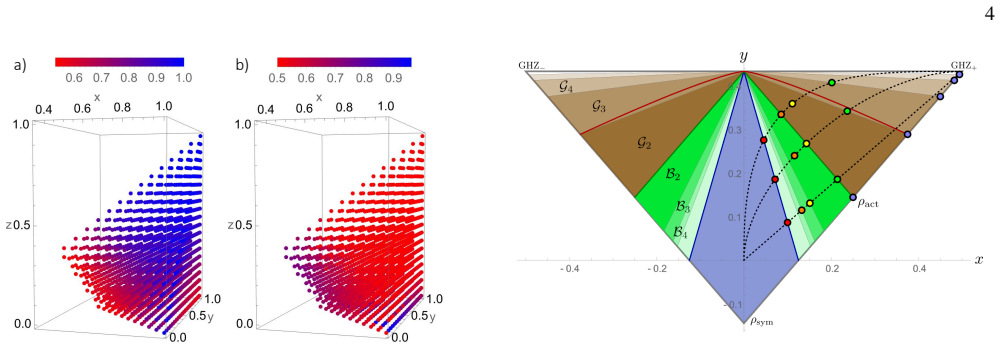
The only non- activatable states in this family are fully separable (blue), while biseparable states (green) are not partition-separable and thus activat- able. The subregions B2, B3 and B4 of 2-, 3- and 4-copy activatable states are indicated in different shades. Brown regions correspond to GME states, with states below the red line belonging to the W cl...
-
[4]
Action of the operations Ez and Ex in terms of graphs Now we take a closer look at the two operations Ez and Ex and give an interpretation in graphical terms. We note that this is connected to the operation of graph-state fusion [55–57], more precisely we will see that the action of the Hadamard map Ez corresponds to the so-called parity check operation [...
-
[5]
two phases
Note, that here we are only interested in the case where node 1 and 2 are not connected. Obviously Ez maps two different qubits to only one resulting qubit, so the two nodes 1 and 2 will be mapped to a single node {1, 2}. There are two different types of nodes connected to 1 and 2: There are nodes which are connected to both 1 and 2, so they are common ne...
-
[6]
Consequences for two-colorable graph states As we have seen above, the two projections Ex and Ez fuse two nodes while keeping all connections to common or unequal neighbours, respectively. In this section we describe how these two operations can therefore be used to map two copies (and therefore iteratively any number of copies) of two-colorable graphs to...
-
[7]
This leads to 1457 data points
Two copies of GHZ-diagonal states for different levels of noise We investigate the states ϱ= pχ(1, x, y, z)+ (1− p) 8 1 8 (D1) for four different levels of noise, that is p = 1, 0.9, 0.8 and p = 0.7, and consider numerically every possible assignment of (x, y, z), such that the state χ(1, x, y, z) is biseparable, in steps of 0.05. This leads to 1457 data ...
-
[8]
White noise robustness of the 2-copy GHZ-diagonal state For the white-noise robustness of ϱ⊗2, that is the value pwnr for which pϱ⊗2+ 1−p 64 1 64 becomes a PPT mixture, one has Tr[(pwnrϱ⊗2+ 1− pwnr 64 1 64)W]= 0 (D3) for the witness W found by the PPT mixture approach. Using the result Tr[ϱW]= t coming from the SDP and the fact that the witness W is norma...
Show all 85 references
-
[9]
GHZ fidelity after local projections of two copies We are interested in the GHZ fidelity that the state ϱ⊗2 can reach after applying local projections to it, that is in the quantity FGHZ(τ2)= Tr(τ2∣GHZ⟩⟨GHZ∣) where τ2 is the projected and renormalized state. As explained in th...
-
[10]
Experimental detection of superactivation
The k-copy GHH criterion We now present ak-copy GME witness, which is constructed as ak-copy version of anm-separability criterion from Ref. [61]. Referring to the original criterion in [61] as the GHH criterion , we call the generalization we derive here the k-copy GHH 13 cri...
-
[11]
The k-copy GHH criterion for GHZ-diagonal states The criterion (E4) can be simplified even further when restricting to particular families of states. Here, we consider so-called GHZ-diagonal states, which are convex combinations ϱGHZ = ∑n pn∣GHZn⟩⟨GHZn∣ of projectors onto the ...
-
[12]
Theoretical considerations Let us start by considering fidelity witnesses [66]. Since it is well-known that for GHZ states the fidelity bound is optimal [42], the GHZ-fidelity witness WGHZ = 1 2 −∣GHZ+⟩⟨GHZ+∣ (F1) is a good candidate to begin with, where we take ∣ GHZ+⟩= ∣ GHZ...
-
[13]
[17] ϱ= p∣GHZ+⟩⟨GHZ+∣+ (1− p) 8 1 8
Statistical model for a realistic experiment To demonstrate how the nonlinear witness can in principle be applied in an experiment, we consider the states used in Ref. [17] ϱ= p∣GHZ+⟩⟨GHZ+∣+ (1− p) 8 1 8. (F13) This type of white noise is typically a good model for photonic ex...
-
[14]
Brunner, D
N. Brunner, D. Cavalcanti, S. Pironio, V . Scarani, and S. Wehner, Bell nonlocality, Rev. Mod. Phys.86, 419–478 (2014)
2014
-
[15]
Cavalcanti and P
D. Cavalcanti and P. Skrzypczyk, Quantum steering: a review with focus on semidefinite programming, Rep. Prog. Phys. 80, 024001 (2017)
2017
-
[16]
R. Uola, A. C. S. Costa, H. C. Nguyen, and O. Gühne, Quantum steering, Rev. Mod. Phys. 92, 015001 (2020)
2020
-
[17]
Gühne and G
O. Gühne and G. Tóth, Entanglement detection, Phys. Rep. 474, 1 (2009)
2009
-
[18]
Horodecki, P
R. Horodecki, P. Horodecki, M. Horodecki, and K. Horodecki, Quantum entanglement, Rev. Mod. Phys. 81, 865–942 (2009)
2009
-
[19]
Friis, G
N. Friis, G. Vitagliano, M. Malik, and M. Huber, Entanglement Certification From Theory to Experiment, Nat. Rev. Phys. 1, 72 (2019)
2019
-
[20]
Brunner and N
N. Brunner and N. Gisin, 0 + 0> 0, Physics 5, 124 (2012)
2012
-
[21]
Smith and J
G. Smith and J. Yard, Quantum Communication With Zero-Capacity Channels, Science 321, 1812–1815 (2008)
2008
-
[22]
Palazuelos, Superactivation of Quantum Nonlocality, Phys
C. Palazuelos, Superactivation of Quantum Nonlocality, Phys. Rev. Lett. 109, 190401 (2012)
2012
-
[23]
Steinberg, H
J. Steinberg, H. C. Nguyen, and M. Kleinmann, Certifying the activation of Bell nonlocality with finite data, Phys. Rev. A 111, 012205 (2025)
2025
-
[24]
Villegas-Aguilar, E
L. Villegas-Aguilar, E. Polino, F. Ghafari, M. T. Quintino, K. T. Laverick, I. R. Berkman, S. Rogge, L. K. Shalm, N. Tischler, E. G. Cavalcanti, S. Slussarenko, and G. J. Pryde, Nonlocality activation in a photonic quantum network, Nat. Commun. 15, 3112 (2024)
2024
-
[25]
M. T. Quintino, N. Brunner, and M. Huber, Superactivation of quantum steering, Phys. Rev. A 94, 062123 (2016)
2016
-
[26]
Huber and M
M. Huber and M. Plesch, Purification of genuine multipartite entanglement, Phys. Rev. A 83, 062321 (2011)
2011
-
[27]
Yamasaki, S
H. Yamasaki, S. Morelli, M. Miethlinger, J. Bavaresco, N. Friis, and M. Huber, Activation of genuine multipartite entanglement: beyond the single-copy paradigm of entanglement characterisation, Quantum 6, 695 (2022)
2022
-
[28]
Palazuelos and J
C. Palazuelos and J. I. de Vicente, Genuine multipartite entanglement of quantum states in the multiple-copy scenario, Quantum 6, 735 (2022)
2022
-
[29]
Baksová, O
K. Baksová, O. Leskovjanová, L. Mišta Jr., E. Agudelo, and N. Friis, Multi-copy activation of genuine multipartite entanglement in continuous-variable systems, Quantum 9, 1699 (2025)
2025
-
[30]
Y .-A. Chen, R. Zhang, Y .-Y . Fei, Z. Liu, X. Zhang, X.-F. Yin, Y . Mao, L. Li, N.-L. Liu, X. Ma, and J.-W. Pan, Entanglement Activation in Multiphoton Distillation Networks (2024), preprint: https://doi.org/10.21203/rs.3.rs-3828402/v1. 21
2024 doi
-
[31]
Friis, O
N. Friis, O. Marty, C. Maier, C. Hempel, M. Holzäpfel, P. Jurcevic, M. B. Plenio, M. Huber, C. Roos, R. Blatt, and B. Lanyon, Observation of Entangled States of a Fully Controlled 20-Qubit System, Phys. Rev. X 8, 021012 (2018)
2018
-
[32]
S. Cao, B. Wu, F. Chen, M. Gong, Y . Wu, Y . Ye, C. Zha, H. Qian, C. Ying, S. Guo, Q. Zhu, H.-L. Huang, Y . Zhao, S. Li, S. Wang, J. Yu, D. Fan, D. Wu, H. Su, H. Deng, H. Rong, Y . Li, K. Zhang, T.-H. Chung, F. Liang, J. Lin, Y . Xu, L. Sun, C. Guo, N. Li, Y .-H. Huo, C.-Z. Pe...
2023
-
[33]
G. L. van de Stolpe, D. P. Kwiatkowski, C. E. Bradley, J. Randall, M. H. Abobeih, S. A. Breitweiser, L. C. Bassett, M. Markham, D. J. Twitchen, and T. H. Taminiau, Mapping a 50-spin-qubit network through correlated sensing, Nat. Commun.15, 2006 (2024)
2024
-
[34]
Bluvstein, S
D. Bluvstein, S. J. Evered, A. A. Geim, S. H. Li, H. Zhou, T. Manovitz, S. Ebadi, M. Cain, M. Kalinowski, D. Hangleiter, J. P. Bonilla Ataides, N. Maskara, I. Cong, X. Gao, P. Sales Rodriguez, T. Karolyshyn, G. Semeghini, M. J. Gullans, M. Greiner, V . Vuleti´c, and M. D. Luki...
2024
-
[35]
Lewenstein, D
M. Lewenstein, D. Bruß, J. I. Cirac, B. Kraus, M. Ku ´s, J. Samsonowicz, A. Sanpera, and R. Tarrach, Separability and distillability in composite quantum systems-a primer, J. Mod. Opt. 47, 2481 (2000)
2000
-
[36]
Horodecki, Ł
P. Horodecki, Ł. Rudnicki, and K. ˙Zyczkowski, Five open problems in quantum information theory, PRX Quantum3, 010101 (2022)
2022
-
[37]
Pankowski, M
Ł. Pankowski, M. Piani, M. Horodecki, and P. Horodecki, A few steps more towards NPT bound entanglement, IEEE Trans. Inf. Theory 56, 4085 (2010)
2010
-
[38]
Bluhm, L
A. Bluhm, L. Rauber, and M. M. Wolf, Quantum compression relative to a set of measurements, Ann. Henri Poincaré 19, 1891 (2018)
2018
-
[39]
R. Uola, T. Kraft, S. Designolle, N. Miklin, A. Tavakoli, J.-P. Pellonpää, O. Gühne, and N. Brunner, Quantum measurement incompati- bility in subspaces, Phys. Rev. A 103, 022203 (2021)
2021
-
[40]
Loulidi and I
F. Loulidi and I. Nechita, The compatibility dimension of quantum measurements, J. Math. Phys. 62, 042205 (2021)
2021
-
[41]
W. Dür, G. Vidal, and J. I. Cirac, Three qubits can be entangled in two inequivalent ways, Phys. Rev. A62, 062314 (2000)
2000
-
[42]
Burchardt, G
A. Burchardt, G. m. c. M. Quinta, and R. André, Entanglement classification via a single entanglement measure, Phys. Rev. A 109, 032424 (2024)
2024
-
[43]
Sauerwein, A
D. Sauerwein, A. Molnar, J. I. Cirac, and B. Kraus, Matrix Product States: Entanglement, Symmetries, and State Transformations, Phys. Rev. Lett. 123, 170504 (2019)
2019
-
[44]
Słowik, M
O. Słowik, M. Hebenstreit, B. Kraus, and A. Sawicki, A link between symmetries of critical states and the structure of SLOCC classes in multipartite systems, Quantum 4, 300 (2020)
2020
-
[45]
Tóth, Multipartite entanglement and high-precision metrology, Phys
G. Tóth, Multipartite entanglement and high-precision metrology, Phys. Rev. A 85, 022322 (2012)
2012
-
[46]
Hyllus, W
P. Hyllus, W. Laskowski, R. Krischek, C. Schwemmer, W. Wieczorek, H. Weinfurter, L. Pezzè, and A. Smerzi, Fisher information and multiparticle entanglement, Phys. Rev. A 85, 022321 (2012)
2012
-
[47]
Wie ´sniak, Multipartite Entanglement versus Multiparticle Entanglement (2024), arXiv:2407.13348 [quant-ph]
M. Wie ´sniak, Multipartite Entanglement versus Multiparticle Entanglement (2024), arXiv:2407.13348 [quant-ph]
2024 arXiv
-
[48]
Clarisse, The distillability problem revisited, Quantum Inf
L. Clarisse, The distillability problem revisited, Quantum Inf. Comput. 6, 539 (2006)
2006
-
[49]
Kraus, M
B. Kraus, M. Lewenstein, and J. I. Cirac, Characterization of distillable and activatable states using entanglement witnesses, Phys. Rev. A 65, 042327 (2002)
2002
-
[50]
C. Ritz, C. Spee, and O. Gühne, Characterizing multipartite entanglement classes via higher-dimensional embeddings, J. Phys. A: Math. Theor. 52, 335302 (2019)
2019
-
[51]
Gühne, M
O. Gühne, M. Reimpell, and R. F. Werner, Estimating Entanglement Measures in Experiments, Phys. Rev. Lett. 98, 110502 (2007)
2007
-
[52]
Gerke, W
S. Gerke, W. V ogel, and J. Sperling, Numerical Construction of Multipartite Entanglement Witnesses, Phys. Rev. X8, 031047 (2018)
2018
-
[53]
Jungnitsch, T
B. Jungnitsch, T. Moroder, and O. Gühne, Taming Multiparticle Entanglement, Phys. Rev. Lett. 106, 190502 (2011)
2011
-
[54]
Jungnitsch, T
B. Jungnitsch, T. Moroder, and O. Gühne, Entanglement witnesses for graph states: General theory and examples, Phys. Rev. A 84, 032310 (2011)
2011
-
[55]
Gühne and M
O. Gühne and M. Seevinck, Separability criteria for genuine multiparticle entanglement, New J. Phys. 12, 053002 (2010)
2010
-
[56]
A. Acín, D. Bruß, M. Lewenstein, and A. Sanpera, Classification of Mixed Three-Qubit States, Phys. Rev. Lett. 87, 040401 (2001)
2001
-
[57]
Coffman, J
V . Coffman, J. Kundu, and W. K. Wootters, Distributed entanglement, Phys. Rev. A61, 052306 (2000)
2000
-
[58]
Dür and H
W. Dür and H. J. Briegel, Entanglement purification and quantum error correction, Rep. Prog. Phys. 70, 1381 (2007)
2007
-
[59]
N. Yu, E. Chitambar, C. Guo, and R. Duan, Tensor rank of the tripartite state ∣w⟩⊗ n, Phys. Rev. A 81, 014301 (2010)
2010
-
[60]
Dür and J
W. Dür and J. I. Cirac, Multiparticle entanglement and its experimental detection, J. Phys. A: Math. Gen. 34, 6837–6850 (2001)
2001
-
[61]
Eltschka and J
C. Eltschka and J. Siewert, Entanglement of Three-Qubit Greenberger-Horne-Zeilinger-Symmetric States, Phys. Rev. Lett. 108, 020502 (2012)
2012
-
[62]
Eltschka and J
C. Eltschka and J. Siewert, A quantitative witness for Greenberger-Horne-Zeilinger entanglement, Sci. Rep. 2, 942 (2012)
2012
-
[63]
Eltschka and J
C. Eltschka and J. Siewert, Optimal witnesses for three-qubit entanglement from Greenberger-Horne-Zeilinger symmetry, Quant. Inf. Comput. 13, 210 (2013)
2013
-
[64]
Piani and C
M. Piani and C. E. Mora, Class of positive-partial-transpose bound entangled states associated with almost any set of pure entangled states, Phys. Rev. A 75, 012305 (2007)
2007
-
[65]
Hofmann, T
M. Hofmann, T. Moroder, and O. Gühne, Analytical characterization of the genuine multiparticle negativity, J. Phys. A: Math. Theor.47, 155301 (2014)
2014
-
[66]
L. Novo, T. Moroder, and O. Gühne, Genuine multiparticle entanglement of permutationally invariant states, Phys. Rev. A 88, 012305 (2013)
2013
-
[67]
Enrico Fermi
M. Hein, W. Dür, J. Eisert, R. Raussendorf, M. Van den Nest, and H. J. Briegel, Entanglement in graph states and its applications, in Proceedings of the International School of Physics "Enrico Fermi" , V ol. 162 (2005) p. 115–218
2005
-
[68]
Knill, R
E. Knill, R. Laflamme, and G. J. Milburn, A scheme for efficient quantum computation with linear optics, Nature 409, 46 (2001)
2001
-
[69]
D. E. Browne and T. Rudolph, Resource-Efficient Linear Optical Quantum Computation, Phys. Rev. Lett. 95, 010501 (2005)
2005
-
[70]
¸ S. K. Özdemir, E. Matsunaga, T. Tashima, T. Yamamoto, M. Koashi, and N. Imoto, An optical fusion gate for W-states, New J. Phys.13, 103003 (2011). 22
2011
-
[71]
J.-W. Pan, S. Gasparoni, R. Ursin, G. Weihs, and A. Zeilinger, Experimental entanglement purification of arbitrary unknown states, Nature 423, 417 (2003)
2003
-
[72]
T. B. Pittman, B. C. Jacobs, and J. D. Franson, Probabilistic quantum logic operations using polarizing beam splitters, Phys. Rev. A 64, 062311 (2001)
2001
-
[73]
Verstraete and J
F. Verstraete and J. I. Cirac, Valence-bond states for quantum computation, Phys. Rev. A70, 060302 (2004)
2004
-
[74]
Gabriel, B
A. Gabriel, B. C. Hiesmayr, and M. Huber, Criterion for k-separability in mixed multipartite systems, Quantum Inf. Comput. 10, 0829 (2010)
2010
-
[75]
Lami and M
L. Lami and M. Huber, Bipartite depolarizing channels, J. Math. Phys. 57, 092201 (2016)
2016
-
[76]
Horodecki, P
M. Horodecki, P. Horodecki, and R. Horodecki, Separability of mixed states: necessary and sufficient conditions, Phys. Lett. A 223, 25 (1996)
1996
-
[77]
S. M. Hashemi Rafsanjani, M. Huber, C. J. Broadbent, and J. H. Eberly, Genuinely multipartite concurrence of N-qubit X matrices, Phys. Rev. A 86, 062303 (2012)
2012
-
[78]
Ma, Z.-H
Z.-H. Ma, Z.-H. Chen, J.-L. Chen, C. Spengler, A. Gabriel, and M. Huber, Measure of genuine multipartite entanglement with computable lower bounds, Phys. Rev. A 83, 062325 (2011)
2011
-
[79]
Bourennane, M
M. Bourennane, M. Eibl, C. Kurtsiefer, S. Gaertner, H. Weinfurter, O. Gühne, P. Hyllus, D. Bruß, M. Lewenstein, and A. Sanpera, Experimental Detection of Multipartite Entanglement using Witness Operators, Phys. Rev. Lett.92, 087902 (2004)
2004
-
[80]
Gühne, C.-Y
O. Gühne, C.-Y . Lu, W.-B. Gao, and J.-W. Pan, Toolbox for entanglement detection and fidelity estimation, Phys. Rev. A76, 030305(R) (2007)
2007
-
[81]
L. T. Weinbrenner, N. Prasannan, K. Hansenne, S. Denker, J. Sperling, B. Brecht, C. Silberhorn, and O. Gühne, Certifying the Topology of Quantum Networks: Theory and Experiment, Phys. Rev. Lett. 132, 240802 (2024)
2024
-
[82]
Sanpera, R
A. Sanpera, R. Tarrach, and G. Vidal, Local description of quantum inseparability, Phys. Rev. A 58, 826–830 (1998)
1998
-
[83]
J. T. Barreiro, P. Schindler, O. Gühne, T. Monz, M. Chwalla, C. F. Roos, M. Hennrich, and R. Blatt, Experimental multiparticle entangle- ment dynamics induced by decoherence, Nat. Phys. 6, 943 (2010)
2010
-
[84]
Kampermann, O
H. Kampermann, O. Gühne, C. Wilmott, and D. Bruß, Algorithm for characterizing stochastic local operations and classical communi- cation classes of multiparticle entanglement, Phys. Rev. A 86, 032307 (2012)
2012
-
[85]
Shang and O
J. Shang and O. Gühne, Convex Optimization over Classes of Multiparticle Entanglement, Phys. Rev. Lett. 120, 050506 (2018)
2018
Reviewed August 11, 2026 · model on record in the stance chip above.
Discussion (0). Continue with ORCID to comment.