REVIEW 1 major objections 6 minor 48 references
Strange B meson fraction measured at 0.219; isospin holds to 5%
Reviewed by Pith at T0; open to challenge. T0 means a machine referee read the full paper against a public rubric. the ladder, T0–T4 →
T0 review · deepseek-v4-flash
2026-08-03 01:10 UTC pith:KR34YDFP
load-bearing objection Solid, careful CMS B-parking measurement: first absolute charmonium PFR normalization and a clean isospin test, but headline f_s values lean on a disclosed QCD-factorization ratio. the 1 major comments →
Measurement of B meson production fraction ratios in proton-proton collisions at sqrt{s} = 13 TeV using open-charm and charmonium decays
The pith
A machine-rendered reading of the paper's core claim, the machinery that carries it, and where it could break.
Core claim
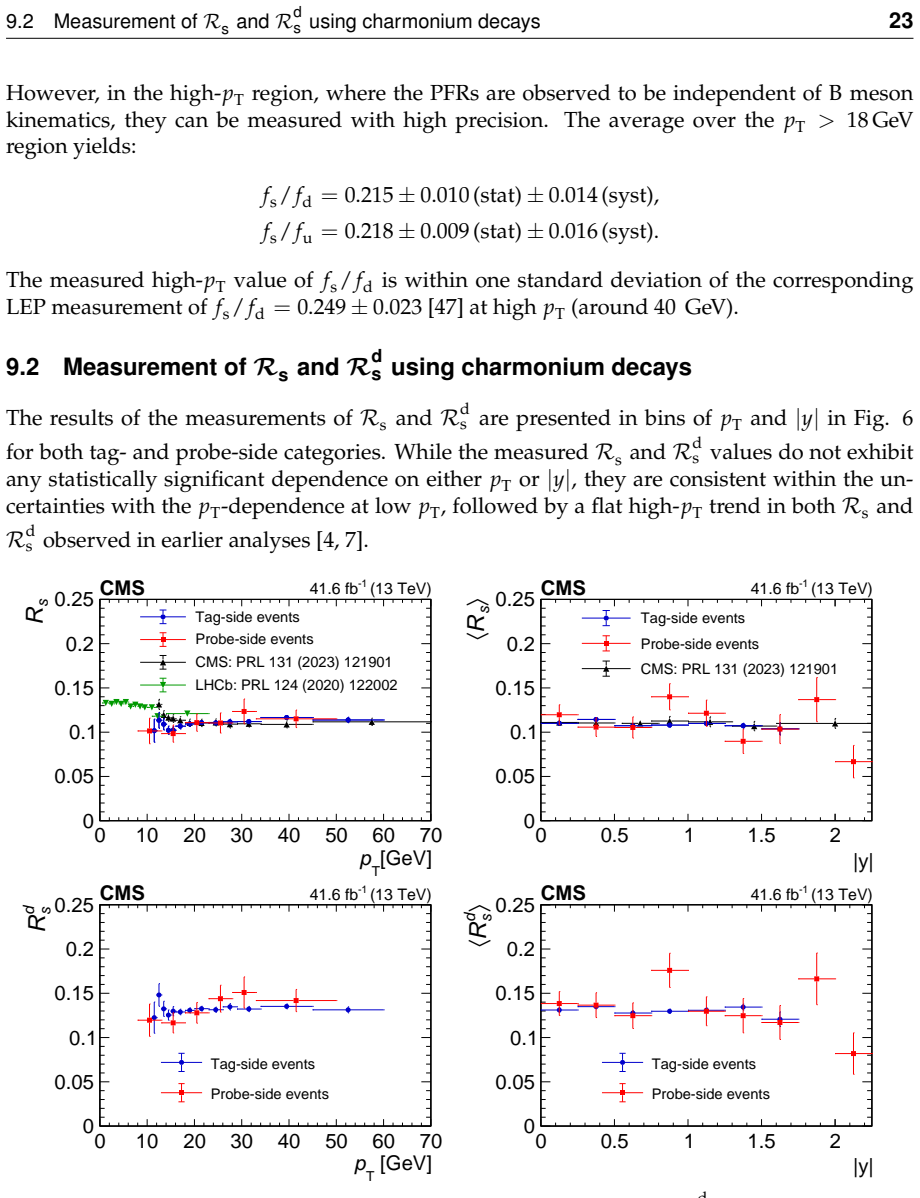
The paper claims that the production fractions of B_s relative to B^0 and B^+ are flat in the kinematic range 8 < pT < 60 GeV and |y| < 2.25, with average values <f_s/f_d> = 0.219 ± 0.008 (stat) ± 0.014 (syst) and <f_s/f_u> = 0.218 ± 0.008 (stat) ± 0.015 (syst). It further claims f_d/f_u = 0.956 ± 0.043, within 5% of unity and therefore consistent with isospin invariance in B meson production at hadron colliders. Using the open-charm results as a reference, the paper derives the first absolute normalizations for charmonium-based production fraction measurements, c_sd = 1.64 ± 0.14 and c_su = 2.02 ± 0.18, and reports branching fraction ratios between charmonium and open-charm decays that impr
What carries the argument
The central mechanism is a double-ratio construction. For the absolute f_s/f_d measurement, efficiency-corrected yields of the open-charm decays B0 → π+D− and B0_s → π+ D_s− (π−φ) are combined with the QCD-factorization prediction for the ratio B(B0 → K+D−)/B(B0_s → π+ D_s−) — a standard perturbative computation of nonleptonic B decay rates — with the pion/kaon ambiguity handled using the world-average ratio B(B0 → K+D−)/B(B0 → π+D−). For the charmonium channels, the relative yield ratios R_s and R_s^d are normalized to the open-charm results through double ratios c_sd and c_su, which cancel any pT dependence and can be applied to any charmonium sample.
Load-bearing premise
The absolute f_s/f_d and f_s/f_u values rest on the QCD-factorization prediction for the ratio B(B0 → K+D−)/B(B0_s → π+ D_s−); if that predicted ratio is biased, the measured production fractions shift by the same relative amount.
What would settle it
Measure the two branching fractions entering the f_s/f_d extraction directly—for example at an electron-positron collider running on the Υ(5S) resonance, where B_s pairs are produced without fragmentation theory—and compare their ratio with the QCD-factorization prediction. A discrepancy beyond combined uncertainties would rescale the reported f_s fractions.
If this is right
- The reported average values can be used as external inputs to normalize measurements of B_s branching fractions, including the rare decay B_s → μ+μ−, reducing its dominant systematic uncertainty.
- The absolute normalization constants c_sd and c_su allow charmonium-based relative measurements to be reported as absolute production fraction ratios, not just shapes.
- The charmonium-to-open-charm branching fraction ratios improve the precision of world averages, especially for B_s → J/ψφ.
- Isospin invariance in B meson production at hadron colliders is confirmed at the 5% precision level.
Where Pith is reading between the lines
- Because the absolute normalizations are built as double ratios, they should remain valid for any charmonium-based analysis even if the open-charm yields are much smaller; reusing them would let future experiments skip the fully hadronic open-charm reconstruction.
- The 5%-level isospin consistency still leaves a 2.2% uncertainty inherited from Υ(4S)-based branching fraction inputs; measuring f_d/f_u purely from proton-proton data without those inputs is a natural next step.
- The paper's own note of a puzzling discrepancy between theory and experiment for the individual decay channels suggests that the f_s/f_d result could be tested by measuring the B_s → πD_s branching fraction directly at a B_s factory, which would also sharpen the global value of f_s/f_u.
Editorial analysis
A structured set of objections, weighed in public.
Referee Report
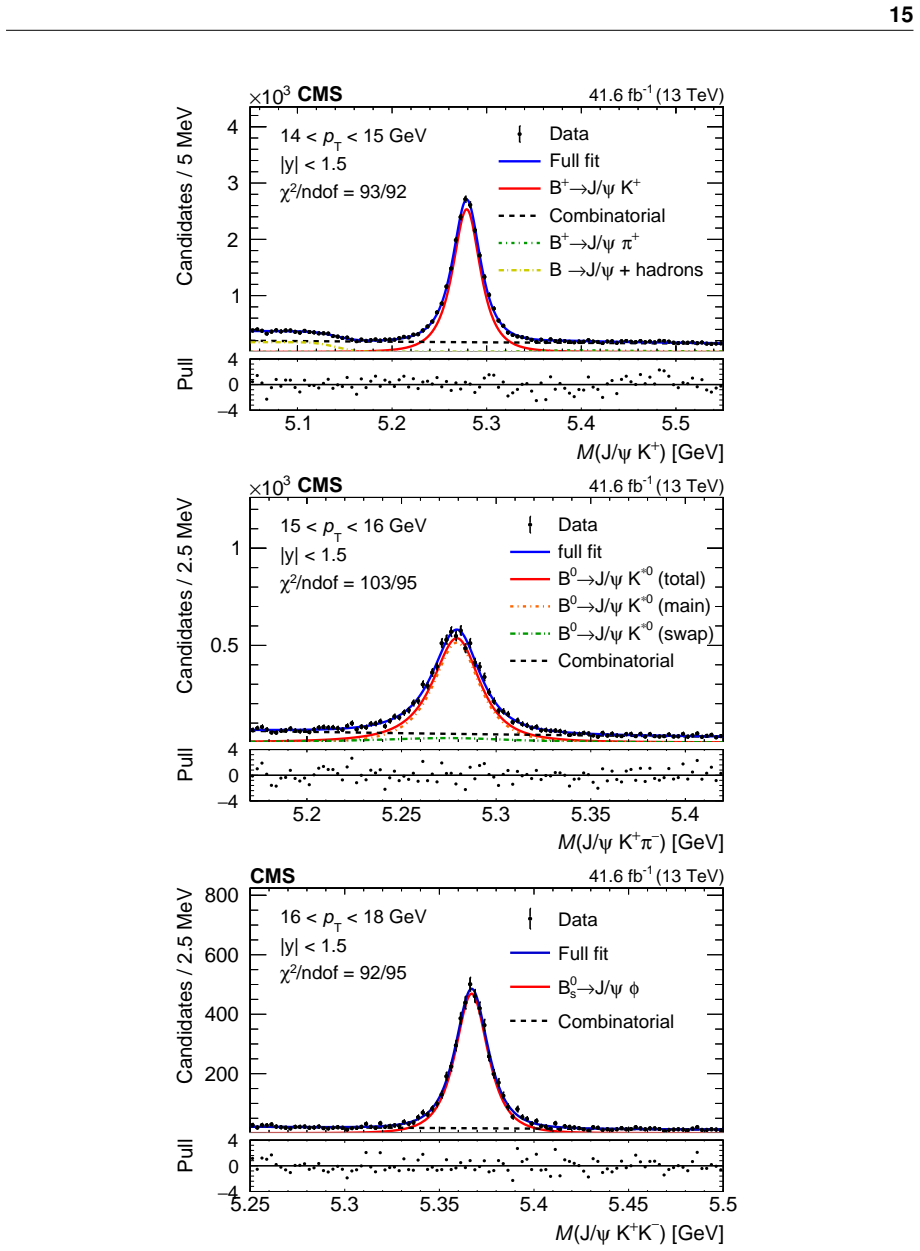
Summary. This paper reports a CMS measurement of B-meson production fraction ratios in proton-proton collisions at sqrt(s)=13 TeV, using the 2018 B-parking data set (41.6 fb^-1) with high-rate single-muon triggers. The open-charm modes B+ -> pi+D0, B0 -> pi+D-, and B0s -> pi+Ds- are used to measure f_s/f_d and f_s/f_u as functions of B pT (8-60 GeV) and |y| (<2.25), yielding averages <f_s/f_d> = 0.219 +/- 0.008 +/- 0.014 and <f_s/f_u> = 0.218 +/- 0.008 +/- 0.015. The same data set provides charmonium measurements of relative PFRs R_s and R_s^d, and open-charm results are used to set an absolute normalization for charmonium-based PFRs via constants c_sd and c_su. Three charmonium-to-open-charm branching-fraction ratios are also measured, with improved precision for the B0s modes. A combined f_d/f_u = 0.956 +/- 0.043 is obtained and used to test isospin invariance, which is found to hold within about 5% precision.
Significance. If the results hold, the paper provides the first absolutely normalized charmonium-based PFR measurement at CMS, a useful input for Bs branching-fraction determinations (e.g., Bs -> mu+ mu-), and a precise test of isospin invariance in pp collisions. The analysis is technically careful: signal yields are extracted from binned maximum-likelihood fits with shape constraints from simulated samples; systematic uncertainties are explored with alternative parameterizations; probe- and tag-side categories provide cross-checks; and the agreement with previous CMS/LHCb measurements is documented. The data are available in HEPData. The main caveat is that the absolute values of f_s/f_d, f_s/f_u, and the normalizations c_sd/c_su inherit the QCD-factorization ratio B(B0 -> K+D-)/B(B0s -> pi+Ds-) from Ref. [31], which is disclosed and assigned a 4.2% systematic uncertainty; the f_d/f_u isospin test and the branching-fraction ratios in Eqs. (7)-(9) do not depend on this input.
major comments (1)
- [Section 4.1, Eq. (1)] The central absolute results - <f_s/f_d>, <f_s/f_u>, and the normalizations c_sd/c_su in Eqs. (10)-(11) - are multiplied by the QCD-factorization ratio B(B0 -> K+D-)/B(B0s -> pi+Ds-) from Ref. [31]. The text notes a 'puzzling substantial discrepancy' in the individual decay channels and states that the ratio is in good agreement with experiment, but no numerical comparison is given. Please (i) quote the theoretical and experimental values of this ratio and their uncertainties, (ii) justify that the individual discrepancies cancel in the ratio, and (iii) state explicitly in the abstract or conclusions that the absolute f_s/f_d and f_s/f_u values are conditional on this theory input. This is a disclosed external input, but it is load-bearing for the absolute scale.
minor comments (6)
- [Tables 3 and 4] The track selection column reads 'Track |eta|>2.4' in both tables; this should be '|eta|<2.4' as stated in the text of Section 5.1.
- [Table 7] The row 'Total systematic uncertainty <7.9 <7.7 <7.2' appears inconsistent with the quadrature sum of the quoted global uncertainties (7.4%, 6.3%, 5.6%) and the maximum bin-to-bin uncorrelated uncertainties (up to 4.7%). For f_s/f_u, the quadrature sum would exceed 8%. Please clarify how the total is defined.
- [Section 8.1] The text states the simulation statistical uncertainty is 1.7-3.7%, while Table 7 lists 2.2-3.7% for all quantities. Please reconcile.
- [Fig. 6 caption] Typo: 'rigtht' should be 'right'.
- [Section 9.5] The phrase 'universal constants' may be too strong; the constants are validated only within the measured pT and rapidity range. Suggest rewording to 'constants within the measured kinematic range' or adding a caveat.
- [Section 9.3] The tag-side charmonium statistical uncertainty of +/-0.002 on f_d/f_u is surprisingly small compared to the other channels; a sentence explaining the event counts that drive this precision would help.
Circularity Check
No significant circularity: absolute f_s/f_d and f_s/f_u inherit a disclosed external QCD-factorization ratio (Ref. [31]), while the f_d/f_u isospin test and branching-fraction ratios are independent of that input.
full rationale
The derivation chain is self-contained and none of the headline results reduces by construction to its inputs. The open-charm f_s/f_d and f_s/f_u (Eqs. 1 and 3) are measured yield ratios (N_corr from this data set) multiplied by external inputs: PDG charm branching fractions, the world-average B(B0→π+D−)/B(B0→K+D−) ratio, and the QCD-factorization ratio B(B0→K+D−)/B(B0s→π+Ds−) from Ref. [31] — an external non-CMS theory paper whose stated assumptions do not contain the target f_s/f_d. The paper explicitly flags this input's limitation (Section 4.1: 'puzzling substantial discrepancy between the theory predictions and the experimental measurements in the individual decay channels ... so we will rely on this theoretical framework to extract the f_s/f_d ratio'), propagates its uncertainty (4.2% global, Table 7), and notes that the ratio itself agrees with experiment; this is a disclosed external dependence weighted as a correctness risk, not a fitted input called a prediction. The f_d/f_u isospin test is independent: Section 4.1 states 'no theoretical calculations are needed' for Eq. (2), and the B-factory branching fractions are explicitly converted to r±,0 = 1.057±0.023 to remove the f_u=f_d assumption. The branching-fraction ratios in Eqs. (7)-(9) cancel production fractions entirely, providing an independent cross-check against world averages. The charmonium absolute normalizations c_sd/c_su (Eqs. 10-11) and the tag-side PFRs converted with them are transparently calibrated to the open-charm result (Section 4: 'we utilize the measured PFRs in the open-charm channels and normalize the relative measurement of PFRs in the charmonium channels'), i.e., a calibration transfer based on new charmonium yields, not a prediction of the same quantity. CMS self-citations (Refs. [7], [9]) are used for comparison, not as load-bearing inputs. The central remaining caveat is the validity of the external theory ratio, which the paper discloses and budgets; this does not make the derivation circular.
Axiom & Free-Parameter Ledger
axioms (4)
- domain assumption The QCD-factorization prediction for B(B0 -> K+D-)/B(B0_s -> pi+ D_s-) from Ref. [31] is correct
- domain assumption The B-parking single-muon trigger leaves the probe-side b-hadron decay unbiased
- domain assumption Simulation reweighting (to data and FONLL) accurately models detector acceptance and efficiency ratios
- domain assumption External inputs (CKM matrix elements, decay constants, lifetimes, world-average branching fractions, r+-0) in Table 2 are correct
read the original abstract
Production fraction ratios of B$^+$, B$^0$, and B$^0_\mathrm{s}$ mesons are measured in proton-proton collisions at $\sqrt{s}$ = 13 TeV using a special data set recorded in 2018 with high-rate triggers designed to collect an unbiased sample of $10^{10}$ b hadrons with the CMS experiment at the LHC. These data allow the study of the open-charm decays of B mesons (B$_\mathrm{(s)}$ $\to$ $\pi$D$_\mathrm{(s)}$) where the D meson decays into fully hadronic final states. By utilizing known branching fractions and precise theoretical calculations, production fraction ratios as functions of B meson transverse momentum ($p_\mathrm{T}$) and rapidity ($y$) are measured using the open-charm decays in the kinematic range of 8 $\lt$ $p_\mathrm{T}$ $\lt$ 60 GeV and $\lvert y \rvert$ $\lt$ 2.25. In addition, the same data set is used to measure the relative production fraction ratios with the charmonium decay channels (B$_\mathrm{(s)}$ $\to$ X$\,$J/$\psi$ with X indicating a K$^+$, K$^*$(892)$^0$, or $\phi$(1020) meson) where the J/$\psi$ meson decays into a pair of muons. The open-charm results are used to normalize the relative production fraction ratios obtained from the charmonium samples. Measurements of the ratios of branching fractions of B meson decays to charmonium and open-charm final states are also reported, which will improve the world-average values of these ratios. Finally, we test isospin invariance in B meson production in proton-proton collisions and observe that it holds within the experimental precision.
Figures






Reference graph
Works this paper leans on
-
[1]
Measurement of b-hadron production fractions in 7 TeV pp collisions
LHCb Collaboration, “Measurement of b-hadron production fractions in 7 TeV pp collisions”,Phys. Rev. D85(2012) 032008,doi:10.1103/PhysRevD.85.032008, arXiv:1111.2357
Pith/arXiv arXiv 2012
-
[2]
Measurement of the fragmentation fraction ratiof s/f d and its dependence on B meson kinematics
LHCb Collaboration, “Measurement of the fragmentation fraction ratiof s/f d and its dependence on B meson kinematics”,JHEP04(2013) 001, doi:10.1007/JHEP04(2013)001,arXiv:1301.5286
Pith/arXiv arXiv 2013
-
[3]
Measurement of b hadron fractions in 13 TeV pp collisions
LHCb Collaboration, “Measurement of b hadron fractions in 13 TeV pp collisions”,Phys. Rev. D100(2019) 031102,doi:10.1103/PhysRevD.100.031102, arXiv:1902.06794
arXiv 2019
-
[4]
Measurement off s/f u variation with proton-proton collision energy and B-meson kinematics
LHCb Collaboration, “Measurement off s/f u variation with proton-proton collision energy and B-meson kinematics”,Phys. Rev. Lett.124(2020) 122002, doi:10.1103/PhysRevLett.124.122002,arXiv:1910.09934. 30
arXiv 2020
-
[5]
LHCb Collaboration, “Precise measurement of thef s/f d ratio of fragmentation fractions and of B0 s decay branching fractions”,Phys. Rev. D104(2021) 032005, doi:10.1103/PhysRevD.104.032005,arXiv:2103.06810
arXiv 2021
-
[6]
ATLAS Collaboration, “Determination of the ratio of b-quark fragmentation fractions fs/f d in pp collisions at √s=7 TeV with the ATLAS detector”,Phys. Rev. Lett.115 (2015) 262001,doi:10.1103/PhysRevLett.115.262001,arXiv:1507.08925
Pith/arXiv arXiv 2015
-
[7]
CMS Collaboration, “Measurement of the dependence of the hadron production fraction ratiof s/f u andf d/f u on B meson kinematic variables in proton-proton collisions at√s=13 TeV”,Phys. Rev. Lett.131(2023) 121901, doi:10.1103/PhysRevLett.131.121901,arXiv:2212.02309
Pith/arXiv arXiv 2023
-
[8]
Belle Collaboration, “Precise measurement of the branching fractions for B0 s →D s (∗)+Ds (∗)− and first measurement of the Ds ∗+Ds ∗− polarization using e+e− collisions”,Phys. Rev. D87(2013) 031101,doi:10.1103/PhysRevD.87.031101, arXiv:1208.0323
Pith/arXiv arXiv 2013
-
[9]
CMS Collaboration, “Measurement of the B 0 s →µ +µ− decay properties and search for the B0 →µ +µ− decay in proton-proton collisions at √s=13 TeV”,Phys. Lett. B842 (2023) 137955,doi:10.1016/j.physletb.2023.137955,arXiv:2212.10311
arXiv 2023
-
[10]
Averages of b-hadron, c-hadron, andτ-lepton properties as of 2023
HFLAV Collaboration, “Averages of b-hadron, c-hadron, andτ-lepton properties as of 2023”, 11, 2024.arXiv:2411.18639
Pith/arXiv arXiv 2023
-
[11]
Novel approaches to determine B ± and B0 meson production fractions
F. Bernlochner et al., “Novel approaches to determine B ± and B0 meson production fractions”,Phys. Rev. D110(2024) 014007,doi:10.1103/PhysRevD.110.014007, arXiv:2306.04686
Pith/arXiv arXiv 2024
-
[12]
Enriching the physics program of the CMS experiment via data scouting and data parking
CMS Collaboration, “Enriching the physics program of the CMS experiment via data scouting and data parking”,Phys. Rep.1115(2025) 678, doi:10.1016/j.physrep.2024.09.006,arXiv:2403.16134
Pith/arXiv arXiv 2025
-
[13]
CMS luminosity measurements for the 2018 data-taking period at√s=13 TeV
CMS Collaboration, “CMS luminosity measurements for the 2018 data-taking period at√s=13 TeV”, CMS Physics Analysis Summary CMS-PAS-LUM-18-001, 2018
2018
-
[14]
HEPDATArecord for this analysis, 2026.doi:10.17182/hepdata.158357
-
[15]
The CMS Phase-1 pixel detector upgrade
W. Adam et al., “The CMS Phase-1 pixel detector upgrade”,JINST16(2021) P02027, doi:10.1088/1748-0221/16/02/P02027,arXiv:2012.14304
Pith/arXiv arXiv 2021
-
[16]
Track impact parameter resolution for the full pseudo rapidity coverage in the 2017 dataset with the CMS phase-1 pixel detector
CMS Collaboration, “Track impact parameter resolution for the full pseudo rapidity coverage in the 2017 dataset with the CMS phase-1 pixel detector”, CMS Detector Performance Note CMS-DP-2020-049, 2020
2017
-
[17]
CMS Collaboration, “Performance of the CMS muon detector and muon reconstruction with proton-proton collisions at √s=13 TeV”,JINST13(2018) P06015, doi:10.1088/1748-0221/13/06/P06015,arXiv:1804.04528
Pith/arXiv arXiv 2018
-
[18]
Performance of the CMS Level-1 trigger in proton-proton collisions at √s=13 TeV
CMS Collaboration, “Performance of the CMS Level-1 trigger in proton-proton collisions at √s=13 TeV”,JINST15(2020) P10017, doi:10.1088/1748-0221/15/10/P10017,arXiv:2006.10165
Pith/arXiv arXiv 2020
-
[19]
CMS Collaboration, “The CMS trigger system”,JINST12(2017) P01020, doi:10.1088/1748-0221/12/01/P01020,arXiv:1609.02366. References 31
Pith/arXiv arXiv 2017
-
[20]
The CMS experiment at the CERN LHC
CMS Collaboration, “The CMS experiment at the CERN LHC”,JINST3(2008) S08004, doi:10.1088/1748-0221/3/08/S08004,arXiv:1003.4038
Pith/arXiv arXiv 2008
-
[21]
Development of the CMS detector for the CERN LHC Run 3
CMS Collaboration, “Development of the CMS detector for the CERN LHC Run 3”, JINST19(2024) P05064,doi:10.1088/1748-0221/19/05/P05064, arXiv:2309.05466
Pith/arXiv arXiv 2024
-
[22]
T. Sj ¨ostrand et al., “An introduction to PYTHIA 8.2”,Comput. Phys. Commun.191(2015) 159,doi:10.1016/j.cpc.2015.01.024,arXiv:1410.3012
Pith/arXiv arXiv 2015
-
[23]
Extraction and validation of a new set of CMS PYTHIA8 tunes from underlying-event measurements
CMS Collaboration, “Extraction and validation of a new set of CMS PYTHIA8 tunes from underlying-event measurements”,Eur. Phys. J. C80(2020) 4, doi:10.1140/epjc/s10052-019-7499-4,arXiv:1903.12179
Pith/arXiv arXiv 2020
-
[24]
Parton distributions from high-precision collider data
NNPDF Collaboration, “Parton distributions from high-precision collider data”,Eur. Phys. J. C77(2017) 663,doi:10.1140/epjc/s10052-017-5199-5, arXiv:1706.00428
Pith/arXiv arXiv 2017
-
[25]
The EvtGen particle decay simulation package
D. J. Lange, “The EvtGen particle decay simulation package”,Nucl. Instrum. Meth. A462 (2001) 152,doi:10.1016/S0168-9002(01)00089-4
-
[26]
PHOTOS: a universal Monte Carlo for QED radiative corrections. Version 2.0
E. Barberio and Z. Was, “PHOTOS: a universal Monte Carlo for QED radiative corrections. Version 2.0”,Comput. Phys. Commun.79(1994) 291, doi:10.1016/0010-4655(94)90074-4
-
[27]
GEANT4 Collaboration, “GEANT4—a simulation toolkit”,Nucl. Instrum. Meth. A506 (2003) 250,doi:10.1016/S0168-9002(03)01368-8
-
[28]
M. Beneke, G. Buchalla, M. Neubert, and C. T. Sachrajda, “QCD factorization for exclusive, nonleptonic B meson decays: General arguments and the case of heavy light final states”,Nucl. Phys. B591(2000) 313,doi:10.1016/S0550-3213(00)00559-9, arXiv:hep-ph/0006124
Pith/arXiv arXiv 2000
-
[29]
Tests of factorization and SU(3) relations in B decays into heavy-light final states
R. Fleischer, N. Serra, and N. Tuning, “Tests of factorization and SU(3) relations in B decays into heavy-light final states”,Phys. Rev. D83(2011) 014017, doi:10.1103/PhysRevD.83.014017,arXiv:1012.2784
Pith/arXiv arXiv 2011
-
[30]
Two-body non-leptonic heavy-to-heavy decays at NNLO in QCD factorization
T. Huber, S. Kr ¨ankl, and X.-Q. Li, “Two-body non-leptonic heavy-to-heavy decays at NNLO in QCD factorization”,JHEP09(2016) 112,doi:10.1007/JHEP09(2016)112, arXiv:1606.02888
Pith/arXiv arXiv 2016
-
[31]
A puzzle in ¯B0 (s) →D (∗)+ (s) {π−,K −}decays and extraction of thef s/f d fragmentation fraction
M. Bordone et al., “A puzzle in ¯B0 (s) →D (∗)+ (s) {π−,K −}decays and extraction of thef s/f d fragmentation fraction”,Eur. Phys. J. C80(2020) 951, doi:10.1140/epjc/s10052-020-08512-8,arXiv:2007.10338
Pith/arXiv arXiv 2020
-
[32]
Particle Data Group Collaboration, “Review of particle physics”,Phys. Rev. D110(2024) 030001,doi:10.1103/PhysRevD.110.030001
-
[33]
Light-meson leptonic decay rates in lattice QCD+QED
M. Di Carlo et al., “Light-meson leptonic decay rates in lattice QCD+QED”,Phys. Rev. D 100(2019) 034514,doi:10.1103/PhysRevD.100.034514,arXiv:1904.08731
Pith/arXiv arXiv 2019
-
[34]
PDG 2025 averages
Heavy Flavor Averaging Group, “PDG 2025 averages”. Averages for the 2025 edition of the Review of Particle Physics. https://hflav-eos.web.cern.ch/hflav-eos/osc/PDG_2025. 32
2025
-
[35]
CMS tracking performance results from early LHC operation
CMS Collaboration, “CMS tracking performance results from early LHC operation”,Eur. Phys. J. C70(2010) 1165,doi:10.1140/epjc/s10052-010-1491-3, arXiv:1007.1988
Pith/arXiv arXiv 2010
-
[36]
Particle-flow reconstruction and global event description with the CMS detector
CMS Collaboration, “Particle-flow reconstruction and global event description with the CMS detector”,JINST12(2017) P10003,doi:10.1088/1748-0221/12/10/P10003, arXiv:1706.04965
Pith/arXiv arXiv 2017
-
[37]
Dalitz plot analysis ofD + s →K +K−π+
BaBar Collaboration, “Dalitz plot analysis ofD + s →K +K−π+”,Phys. Rev. D83(2011) 052001,doi:10.1103/PhysRevD.83.052001,arXiv:1011.4190
Pith/arXiv arXiv 2011
-
[38]
sPlot: A Statistical tool to unfold data distributions
M. Pivk and F. R. Le Diberder, “sPlot: A Statistical tool to unfold data distributions”, Nucl. Instrum. Meth. A555(2005) 356,doi:10.1016/j.nima.2005.08.106, arXiv:physics/0402083
Pith/arXiv arXiv 2005
-
[39]
XGBoost: a scalable tree boosting system
T. Chen and C. Guestrin, “XGBoost: a scalable tree boosting system”, inProc. 22nd ACM SIGKDD Int. Conf. on Knowledge Discovery and Data Mining. 2016.arXiv:1603.02754. doi:10.1145/2939672.2939785
Pith/arXiv arXiv 2016
-
[40]
Scikit-learn: Machine learning in Python
F. Pedregosa et al., “Scikit-learn: Machine learning in Python”,J. Machine Learning Res. 12(2011) 2825,arXiv:1201.0490
Pith/arXiv arXiv 2011
-
[41]
Systems of frequency curves generated by methods of translation
N. L. Johnson, “Systems of frequency curves generated by methods of translation”, Biometrika36(1949) 149,doi:10.1093/biomet/36.1-2.149
-
[42]
A study of the reactionsψ ′ →γγψ
M. J. Oreglia, “A study of the reactionsψ ′ →γγψ”. PhD thesis, Stanford University,
-
[43]
Measurements of inclusive W and Z cross sections in pp collisions at √s=7 TeV
CMS Collaboration, “Measurements of inclusive W and Z cross sections in pp collisions at √s=7 TeV”,JHEP01(2011) 080,doi:10.1007/JHEP01(2011)080, arXiv:1012.2466
Pith/arXiv arXiv 2011
-
[44]
Thep T spectrum in heavy-flavour hadroproduction
M. Cacciari, M. Greco, and P . Nason, “Thep T spectrum in heavy-flavour hadroproduction”,JHEP05(1998) 007,doi:10.1088/1126-6708/1998/05/007, arXiv:hep-ph/9803400
Pith/arXiv arXiv 1998
-
[45]
Tracking performances for charged pions with Run2 legacy data
CMS Collaboration, “Tracking performances for charged pions with Run2 legacy data”, CMS Detector Performance Note CMS-DP-2022-012, 2022
2022
-
[46]
Bayesian Analysis for the Social Sciences
S. Jackman, “Bayesian Analysis for the Social Sciences”. John Wiley & Sons, New Jersey, USA, 2009.doi:10.1002/9780470686621
-
[47]
Averages of b-hadron, c-hadron, andτ-lepton properties as of 2018
HFLAV Collaboration, “Averages of b-hadron, c-hadron, andτ-lepton properties as of 2018”,Eur. Phys. J. C81(2021) 226,doi:10.1140/epjc/s10052-020-8156-7, arXiv:1909.12524. 33 A The CMS Collaboration Yerevan Physics Institute, Yerevan, Armenia A. Hayrapetyan, V . Makarenko , A. Tumasyan1 Institut f ¨ ur Hochenergiephysik, Vienna, Austria W. Adam , J.W. Andr...
Pith/arXiv arXiv 2018
-
[1980]
SLAC Report SLAC-R-236
discussion (0)
Sign in with ORCID, Apple, or X to comment. Anyone can read and Pith papers without signing in.