REVIEW 4 major objections 5 minor 1 cited by
A Geometry-Aware Message Passing Neural Network for Modeling Aerodynamics over Airfoils
T0 review · 4 major / 5 minor · reviewed 2026-08-11 · deepseek-v4-flash
Pith's one-line read Airfoil flow fields can be predicted by a neural network that encodes the airfoil's surface shape and propagates it to every mesh point, training on downsampled meshes without losing accuracy on full-resolution meshes.
desk verdict Competition-grade airfoil RANS surrogate; Surf2Vol message passing is a real contribution, and the untested full-mesh expressiveness question is a non-fatal gap. read the letter →
The pith
A machine-rendered reading of the paper's core claim, the machinery that carries it, and where it could break.
The reading
What carries the argument
The central mechanism is surface-to-volume message passing (Surf2Vol): a directed bipartite graph in which every volume point connects to its eight nearest neighbors on the airfoil surface. Surface points first exchange messages among themselves through four layers of a standard graph network to form a latent geometric representation; that representation is then injected into each directed edge and aggregated into the volume point's node embedding. This one mechanism carries the airfoil shape into the flow field, and by removing edges between volume points it makes the model resolution-independent during training. Supporting it are the hybrid coordinate systems (leading-edge and trailing-edge origins, polar angles computed against four reference axes), sinusoidal and spherical-harmonic basis embeddings of those coordinates, the inlet-velocity rotation, and the log-pressure target.
What would settle it
Run GeoMPNN and a variant that adds volume-volume message passing on the full-resolution test mesh, then compare errors in the wake region downstream of the trailing edge on high-angle-of-attack cases; if the variant is clearly more accurate there, the claim that surface-to-volume message passing alone suffices is wrong.
Extended reading notes
Core claim
GeoMPNN predicts the four steady-state RANS fields, namely two velocity components, reduced pressure, and turbulent viscosity, by treating the airfoil surface as the source of all geometric information. After four layers of message passing over surface points, each volume point aggregates features from its eight nearest surface neighbors, so the message entering a point encodes the shape of the airfoil region closest to it. The architecture deliberately omits volume-to-volume message passing; since each volume point's neighborhood consists only of surface points, the neighborhood is unchanged when the volume mesh is subsampled, which is why training on 32K sampled points transfers to full-resolution evaluation. The input representation gives the model explicit ways to separate freestream, airfoil, and downstream regions and to tell above from below, and rotating the coordinate system so the inlet velocity aligns with the x-axis makes the turbulent-viscosity field a much more concentrated target. Together these choices improve accuracy on the AirfRANS benchmark, with the largest gains in physics-compliance and out-of-distribution scores.
Load-bearing premise
The load-bearing premise is that volume-to-volume communication is unnecessary, meaning each mesh point's steady-state flow value is determined by the nearby airfoil surface and its own position, and the paper supports this with one ablation on a subsampled test set rather than a first-principles argument.
Editorial extensions
If this is right
- Training can be done on roughly 32K randomly sampled mesh points per example per epoch, with full-mesh prediction accuracy matching subsampled accuracy, lowering memory and compute costs.
- Models trained this way transfer to out-of-distribution airfoil geometries and flow conditions, with the largest relative gains in physics-compliance and OOD scores.
- Accurate pressure prediction under the log transform yields better lift-coefficient estimates, which is what makes the surrogate usable for airfoil design optimization.
- The small benefit of adding volume-volume message passing suggests that for steady-state RANS over airfoils, surface-surface and surface-volume interactions dominate.
- The inlet-velocity canonicalization reduces the difficulty of modeling turbulent viscosity, implying a preprocessing step that other rotation-sensitive flow surrogates could adopt.
Reading between the lines
- If surface-to-volume message passing is truly sufficient for this problem, the same recipe may apply to other steady-state PDEs whose inputs are mostly positional with global parameters, such as steady heat conduction or Darcy flow; this is a testable extension the paper does not run.
- Because the architecture's neighborhoods are independent of volume-mesh density, it may naturally support adaptive mesh refinement or variable-resolution training without retraining, which the paper does not demonstrate.
- The inlet-velocity rotation is a form of frame canonicalization; a natural follow-up is to test whether rotating other fields or their gradients into the same frame improves accuracy beyond turbulent viscosity and pressure.
- The paper evaluates on the AirfRANS dataset only; a stronger test of the resolution-invariance claim would be to run the same architecture on a different mesh family or on three-dimensional geometries, where wake interactions are richer.
Editorial analysis
A structured set of objections, weighed in public.
Referee Report
Summary. The paper proposes GeoMPNN, a message passing neural network for surrogate modeling of steady-state incompressible RANS flows over airfoils. The architecture first constructs a latent graph on the airfoil surface via standard message passing, then propagates this representation to all volume mesh points through directed surface-to-volume edges, deliberately omitting volume-to-volume message passing. The model adds physically motivated input features: a trailing-edge coordinate system, polar and spherical-harmonic angle embeddings, sinusoidal positional embeddings, an inlet-velocity canonicalization of coordinates, and a log transform for the pressure target. The method is evaluated on the AirfRANS benchmark in the NeurIPS 2024 ML4CFD Competition, where it won the Best Student Submission award and placed fourth overall. The authors report progressive improvements from MLP and GNN baselines through the S2V, TRAIL, POLAR, SINE, SPH, INLET, and final GeoMPNN variants, with each experiment repeated 8 times, and they demonstrate that training on 32K subsampled mesh points does not degrade accuracy when evaluating on the full mesh.
Significance. If the claims hold, GeoMPNN is a practical and effective neural surrogate for airfoil aerodynamics, with a simple and computationally efficient mechanism for training on subsampled meshes without test-time distribution shift. The paper's strengths include controlled ablations that isolate each design choice, repeated runs on a public benchmark, a public code release in the AIRS library, and a strong competition result. The inlet-velocity canonicalization is a deterministic coordinate transformation rather than a fitted parameter, and no derivation is fit to the target, so circularity is not a concern. The main weaknesses are that the central architectural claim about the unimportance of volume-volume interactions is tested only at training-like resolution, not at the advertised full-mesh deployment regime, and that some close incremental comparisons lack statistical or effect-size support.
major comments (4)
- [Section 4.2.1, Figure 6] The conclusion that "the most important interactions in this problem are surface-surface and surface-volume" is based on comparing S2V with S2V+GNN on the test set randomly subsampled to 32K points, matching the training resolution. This does not test the deployment regime advertised in the abstract and Section 3.1, namely evaluation on the full mesh. At full resolution the volume graph is denser, and because the pressure field in incompressible steady RANS is determined by a globally coupled constraint, volume-volume message passing could in principle have a larger benefit at full resolution than at 32K. Please report the same ablation at full test resolution, or at a sweep of resolutions, or explicitly restrict the architectural claim to the subsampled setting. This is load-bearing because the omission of volume-volume message passing is a central design decision.
- [Sections 4.4 and 4.5, Figures 15 and 17] Several incremental claims are supported only by point estimates or box plots with substantial overlap across the 8 runs. For example, in Figure 15 the statement that "the SINE model achieves a better ML Score" and "the SPH model achieves a new best error on the pressure field" would be more convincing with significance tests or confidence intervals, especially because the differences appear comparable to run-to-run variability. The same applies to the comparisons in Figure 17. Please add statistical summaries or explicitly characterize the magnitude and uncertainty of the reported improvements.
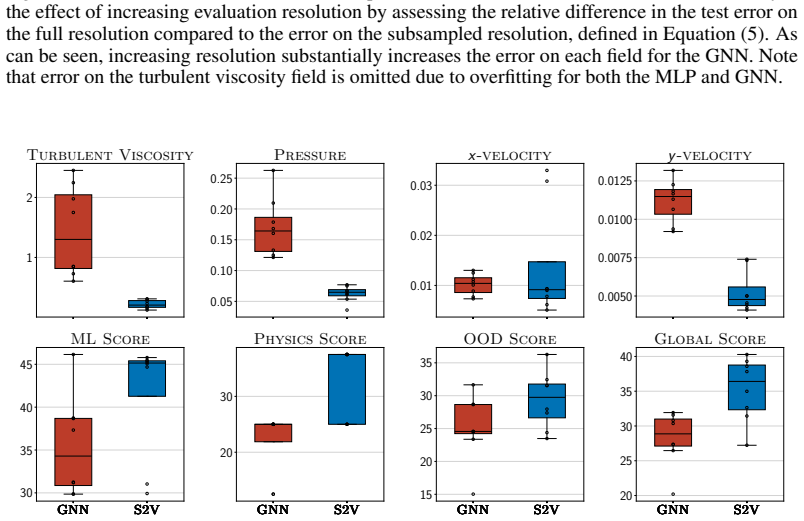
- [Figures 3 and 5, Section 4.1.2 and 4.2.1] The turbulent viscosity field is omitted from both resolution-shift figures, with an explanation given only for Figure 3 (overfitting). Section 4.2.1 states that "the SURF2VOL model error does not change with increased resolution," but this is not empirically verified for the turbulent viscosity field, which is one of the four predicted quantities and is specifically targeted by the inlet-velocity canonicalization in Section 4.5.1. Either report the νt result at subsampled and full resolution or explicitly scope the resolution-invariance claim to the three shown fields.
- [Equations (9) and (10)] The stated formula for the m=0 spherical harmonics, Y_l^0(θ) = sqrt((2l+1)!/4π) P_l(cos θ), is not the standard normalization; the conventional expression is sqrt((2l+1)/(4π)) P_l(cos θ). The same issue appears in the odd-harmonic definition in Equation (10). Please correct the formula and confirm that the code and the paper use the same normalization, as this affects reproducibility of the SPH and downstream models.
minor comments (5)
- [Section 4.2.1] The hyperparameters of the added volume message passing layers in the S2V+GNN ablation (radius, number of layers, hidden dimensions, neighbor sampling threshold) are not specified, which makes the ablation difficult to reproduce exactly.
- [Figure 3 caption] The caption explains that turbulent viscosity is omitted due to overfitting, but the corresponding text in Section 4.1.2 says the error increase is observed "on each field" without this caveat; please align the text with the figure.
- [Section 4.4.1] The notation PE(x) is used both for scalars and, via Equation (8), for 2D vectors. This is understandable but slightly confusing; a distinct symbol for the vectorized version would improve clarity.
- [Section 4.5.1] The matrix Rv is described as belonging to O(2), but the displayed form is a proper rotation with determinant +1, i.e., an element of SO(2); this is a minor mathematical wording issue.
- [General] The manuscript uses "ML Score", "PHYSICS SCORE", "OOD Score", and "GLOBAL SCORE" with inconsistent capitalization; please standardize for readability.
Circularity Check
No circularity found: GeoMPNN's design choices are validated on held-out AirfRANS benchmark data, with deterministic input reparameterizations and external competition results rather than fitted predictions.
full rationale
The paper's central claim is that the GeoMPNN architecture improves aerodynamic surrogate modeling on AirfRANS. Each proposed component—Surf2Vol message passing, trailing-edge coordinates, hybrid polar-Cartesian features, sinusoidal and spherical-harmonic embeddings, inlet-velocity canonicalization, and log-pressure prediction—is either a fixed, closed-form transformation of the input features or is assessed by controlled comparisons on held-out in-distribution and OOD test sets. No parameter is fitted to the target fields and then renamed as a prediction. The inlet-velocity rotation Rv is a deterministic function of the input vector v∞, and the log-pressure transform is invertible, so neither encodes the answer by construction. The volume-volume ablation (Figure 6) is performed on a subsampled test set, which is a limitation in the strength of an empirical conclusion, not a definitional circularity: the claim that volume-volume interactions are unnecessary is supported by experiment rather than being equivalent to the model's inputs. Self-citations (Helwig et al. 2023; Zhang et al. 2024; Lin et al. 2024; Liu et al. 2022) appear only as background references for FNOs, SinENet, frame averaging, and spherical message passing; none is load-bearing, and no uniqueness theorem is imported from the authors' prior work. The NeurIPS 2024 ML4CFD Competition result is an external benchmark, providing independent validation. No circular step can be quoted or exhibited.
Assumptions & free parameters
free parameters (6)
- k (Surf2Vol nearest neighbors) =
8
- Surface radius graph radius r =
0.05
- Surface message passing layers L =
4
- Neighbor sampling threshold M =
8 (surface graph) / 4 (baseline GNN)
- Basis dimension nbasis =
8
- Pressure log-transform =
q = sign(p) * log(|p|+1)
assumptions (5)
- domain assumption Steady-state incompressible RANS equations govern the data
- domain assumption AirfRANS training set (103 solutions) is representative
- ad hoc to paper Volume-volume interactions can be neglected
- ad hoc to paper Inlet-velocity canonicalization is a valid symmetry
- standard math Standard ML components work as expected
Cite this review
Pith. "Pith review of A Geometry-Aware Message Passing Neural Network for Modeling Aerodynamics over Airfoils." pith.science (2026). https://pith.science/paper/KSBUPC7Y
@misc{pith2026241209399,
  author       = {Pith},
  title        = {Pith review of: A Geometry-Aware Message Passing Neural Network for Modeling Aerodynamics over Airfoils},
  year         = {2026},
  howpublished = {\url{https://pith.science/paper/KSBUPC7Y}},
  note         = {Machine review of arXiv:2412.09399}
}
read the original abstract
Computational modeling of aerodynamics is a key problem in aerospace engineering, often involving flows interacting with solid objects such as airfoils. Deep surrogate models have emerged as purely data-driven approaches that learn direct mappings from simulation conditions to solutions based on either simulation or experimental data. Here, we consider modeling of incompressible flows over solid objects, wherein geometric structures are a key factor in determining aerodynamics. To effectively incorporate geometries, we propose a message passing scheme that efficiently and expressively integrates the airfoil shape with the mesh representation. Under this framework, we first obtain a representation of the geometry in the form of a latent graph on the airfoil surface. We subsequently propagate this representation to all collocation points through message passing on a directed, bipartite graph. We demonstrate that this framework supports efficient training by downsampling the solution mesh while avoiding distribution shifts at test time when evaluated on the full mesh. To enable our model to be able to distinguish between distinct spatial regimes of dynamics relative to the airfoil, we represent mesh points in both a leading edge and trailing edge coordinate system. We further enhance the expressiveness of our coordinate system representations by embedding our hybrid Polar-Cartesian coordinates using sinusoidal and spherical harmonics bases. We additionally find that a change of basis to canonicalize input representations with respect to inlet velocity substantially improves generalization. Altogether, these design choices lead to a purely data-driven machine learning framework known as GeoMPNN, which won the Best Student Submission award at the NeurIPS 2024 ML4CFD Competition, placing 4th overall. Our code is publicly available as part of the AIRS library (https://github.com/divelab/AIRS).
Figures


Figures from the paper (18 more)


Forward citations
Cited by 1 Pith paper
-
NeurIPS 2024 ML4CFD Competition: Results and Retrospective Analysis
A retrospective of the ML4CFD competition shows a Gaussian-process-based entry outranking deep learning models and the OpenFOAM solver on a tailored multi-criteria score.
Reference graph
Works this paper leans on
-
[1]
P. W. Battaglia, J. B. Hamrick, V. Bapst, A. Sanchez-Gonzalez, V. Zambaldi, M. Malinowski, A. Tacchetti, D. Raposo, A. Santoro, R. Faulkner, et al. Relational inductive biases, deep learning, and graph networks. arXiv preprint arXiv:1806.01261, 2018
arXiv 2018
- [2]
-
[3]
S. Cao. Choose a transformer: Fourier or galerkin. In A. Beygelzimer, Y. Dauphin, P. Liang, and J. W. Vaughan, editors, Advances in Neural Information Processing Systems, 2021. URL https://openreview.net/forum?id=ssohLcmn4-r
work page 2021
-
[4]
F. Casenave, B. Staber, and X. Roynard. Mmgp: a mesh morphing gaussian process-based machine learning method for regression of physical problems under nonparametrized geometrical variability. Advances in Neural Information Processing Systems, 36, 2024
work page 2024
-
[5]
Fey and J
M. Fey and J. E. Lenssen. Fast graph representation learning with PyTorch Geometric . In ICLR Workshop on Representation Learning on Graphs and Manifolds, 2019
2019
-
[6]
J. Gasteiger, J. Groß, and S. Günnemann. Directional message passing for molecular graphs. In International Conference on Learning Representations, 2020. URL https://openreview.net/forum?id=B1eWbxStPH
work page 2020
- [7]
-
[8]
J. K. Gupta and J. Brandstetter. Towards multi-spatiotemporal-scale generalized PDE modeling. Transactions on Machine Learning Research, 2023. ISSN 2835-8856. URL https://openreview.net/forum?id=dPSTDbGtBY
work page 2023
Show all 28 references
-
[9]
Z. Hao, Z. Wang, H. Su, C. Ying, Y. Dong, S. Liu, Z. Cheng, J. Song, and J. Zhu. Gnot: A general neural operator transformer for operator learning. In International Conference on Machine Learning, pages 12556--12569. PMLR, 2023
2023
-
[10]
Helwig, X
J. Helwig, X. Zhang, C. Fu, J. Kurtin, S. Wojtowytsch, and S. Ji. Group equivariant fourier neural operators for partial differential equations. In International Conference on Machine Learning, pages 12907--12930. PMLR, 2023
2023
-
[11]
D. P. Kingma and J. Ba. Adam: A method for stochastic optimization. In ICLR (Poster), 2015. URL http://arxiv.org/abs/1412.6980
2015 arXiv
-
[12]
Leyli Abadi, A
M. Leyli Abadi, A. Marot, J. Picault, D. Danan, M. Yagoubi, B. Donnot, S. Attoui, P. Dimitrov, A. Farjallah, and C. Etienam. Lips-learning industrial physical simulation benchmark suite. Advances in Neural Information Processing Systems, 35: 0 28095--28109, 2022
2022
-
[13]
Z. Li, N. Kovachki, K. Azizzadenesheli, B. Liu, K. Bhattacharya, A. Stuart, and A. Anandkumar. Neural operator: Graph kernel network for partial differential equations. arXiv preprint arXiv:2003.03485, 2020
2003 arXiv
-
[14]
Z. Li, N. B. Kovachki, K. Azizzadenesheli, B. liu, K. Bhattacharya, A. Stuart, and A. Anandkumar. Fourier neural operator for parametric partial differential equations. In International Conference on Learning Representations, 2021. URL https://openreview.net/forum?id=c8P9NQVtmnO
2021
-
[15]
Z. Li, K. Meidani, and A. B. Farimani. Transformer for partial differential equations operator learning. Transactions on Machine Learning Research, 2023. ISSN 2835-8856. URL https://openreview.net/forum?id=EPPqt3uERT
2023
-
[16]
Y. Lin, J. Helwig, S. Gui, and S. Ji. Equivariance via minimal frame averaging for more symmetries and efficiency. In Forty-first International Conference on Machine Learning, 2024. URL https://openreview.net/forum?id=guFsTBXsov
2024
-
[17]
T. Liu. Evolutionary understanding of airfoil lift. Advances in Aerodynamics, 3 0 (1): 0 37, 2021
2021
-
[18]
Y. Liu, L. Wang, M. Liu, Y. Lin, X. Zhang, B. Oztekin, and S. Ji. Spherical message passing for 3d molecular graphs. In International Conference on Learning Representations, 2022. URL https://openreview.net/forum?id=givsRXsOt9r
2022
-
[19]
L. Lu, P. Jin, G. Pang, Z. Zhang, and G. E. Karniadakis. Learning nonlinear operators via deeponet based on the universal approximation theorem of operators. Nature machine intelligence, 3 0 (3): 0 218--229, 2021
2021
-
[20]
Paszke, S
A. Paszke, S. Gross, F. Massa, A. Lerer, J. Bradbury, G. Chanan, T. Killeen, Z. Lin, N. Gimelshein, L. Antiga, et al. Pytorch: An imperative style, high-performance deep learning library. Advances in neural information processing systems, 32, 2019
2019
-
[21]
O. Puny, M. Atzmon, E. J. Smith, I. Misra, A. Grover, H. Ben-Hamu, and Y. Lipman. Frame averaging for invariant and equivariant network design. In International Conference on Learning Representations, 2022. URL https://openreview.net/forum?id=zIUyj55nXR
2022
-
[22]
L. N. Smith and N. Topin. Super-convergence: Very fast training of neural networks using large learning rates. In Artificial intelligence and machine learning for multi-domain operations applications, volume 11006, pages 369--386. SPIE, 2019
2019
-
[23]
A. Tran, A. Mathews, L. Xie, and C. S. Ong. Factorized fourier neural operators. In The Eleventh International Conference on Learning Representations, 2023. URL https://openreview.net/forum?id=tmIiMPl4IPa
2023
-
[24]
Vaswani, N
A. Vaswani, N. Shazeer, N. Parmar, J. Uszkoreit, L. Jones, A. N. Gomez, L. Kaiser, and I. Polosukhin. Attention is all you need. In Proceedings of the 31st International Conference on Neural Information Processing Systems, 2017
2017
-
[25]
E. W. Weisstein. Spherical harmonic. https://mathworld. wolfram. com/, 2004
2004
-
[26]
Yagoubi, D
M. Yagoubi, D. Danan, M. Leyli-Abadi, J.-P. Brunet, J. A. Mazari, F. Bonnet, A. Farjallah, P. Cinnella, P. Gallinari, M. Schoenauer, et al. Neurips 2024 ml4cfd competition: Harnessing machine learning for computational fluid dynamics in airfoil design. arXiv preprint arXiv:240...
2024 arXiv
-
[27]
Zhang, L
X. Zhang, L. Wang, J. Helwig, Y. Luo, C. Fu, Y. Xie, M. Liu, Y. Lin, Z. Xu, K. Yan, et al. Artificial intelligence for science in quantum, atomistic, and continuum systems. arXiv preprint arXiv:2307.08423, 2023
2023 arXiv
-
[28]
Zhang, J
X. Zhang, J. Helwig, Y. Lin, Y. Xie, C. Fu, S. Wojtowytsch, and S. Ji. Sinenet: Learning temporal dynamics in time-dependent partial differential equations. In The Twelfth International Conference on Learning Representations, 2024. URL https://openreview.net/forum?id=LSYhE2hLWG
2024
Reviewed August 11, 2026 · model on record in the stance chip above.
Discussion (0). Continue with ORCID to comment.