REVIEW 3 major objections 5 minor 107 references
Gravity reshapes kink collisions: resonance windows climb in speed
Reviewed by Pith at T0; open to challenge. T0 means a machine referee read the full paper against a public rubric. the ladder, T0–T4 →
T0 review · deepseek-v4-flash
2026-08-04 04:16 UTC pith:LCJ6MGG3
load-bearing objection First systematic collision study of self-gravitating φ⁴ kinks in 2D MMSS gravity; the resonance-window shift is solid, the narrowing is not yet measured. the 3 major comments →
Kink collisions in a two-dimensional gravity model
The pith
A machine-rendered reading of the paper's core claim, the machinery that carries it, and where it could break.
Core claim
In this self-gravitating φ^4 model, the kink-antikink collision dynamics is governed not by a normalizable shape mode, which does not exist (the stability operator's zero mode is non-normalizable), but by a long-lived open-channel resonance. For κ=0.1, linear perturbation analysis yields a complex frequency dω_res ≈ 1.70583 + 7.05×10⁻⁴i, with quality factor Q ≈ 1.2×10³, close to the flat-space shape-mode frequency √3. This quasi-bound state stores energy during collisions and slowly leaks it, which the paper argues shifts and narrows the bounce windows and mildly raises the critical velocity. The numerical scans across κ=0.1, 0.3, 0.5 confirm the qualitative trend, and the geometry responds
What carries the argument
The load-bearing object is the quasi-bound state, an open-channel resonance of the scalar perturbation equation. In flat space the φ^4 kink has a discrete shape mode below the continuum; here the stability potential V_eff(z)=f''/f with f=φ'/(2A') tends to zero on the AdS-side infinity, so the would-be bound state becomes a resonance with a complex frequency, matched to an outgoing wave on the open side and an evanescent tail on the flat side. This leaky mode replaces the shape-mode mechanism of flat-space kink physics, and the paper fits the bounce intervals through ω_fit τ_n = δ + 2πn, obtaining ω_fit ≈ 1.6261, close to Re(ω_res), supporting the identification.
Load-bearing premise
The entire evolution fixes the dilaton to equal twice the conformal factor (φ=2A), even though the dilaton equation allows other modes, and the paper offers no evidence that this sector is preserved for generic initial data.
What would settle it
Run the same collisions starting from generic initial data that satisfy the constraint equations exactly and do not impose φ=2A; if the resonance windows, their shift with κ, and the finiteness of the Ricci scalar survive, the central claims hold. Alternatively, compute the complex resonance frequency for κ=0.3 and 0.5 using a method that resolves strongly damped modes and check whether the bounce-interval frequency matches Re(ω_res); a mismatch would disprove the quasi-bound state as the mediator.
If this is right
- If the quasi-bound-state mechanism holds, the flat-space resonant energy-exchange picture becomes dissipative: windows persist because of a leaky mode, not a normalizable one, so they should systematically shrink as the leakage rate grows.
- The measured bounce intervals at κ=0.1 reproduce the resonance frequency, meaning the same quantity that governs linear stability also sets the collision timescales.
- Increasing κ makes the resonance shorter-lived and the windows harder to resolve; the trend predicts that beyond some κ the fractal window structure disappears entirely, leaving only the critical-velocity threshold.
- The observed conformal-factor decrease implies a persistent, cumulative contraction of local spatial scale whenever kinks collide, which should affect any observable built from proper distances.
- The finiteness of the Ricci scalar across the scanned (κ,v) range gives the first evidence that two-dimensional self-gravitating kink collisions avoid the singularities seen in AdS5 thick-brane collisions.
Where Pith is reading between the lines
- The evolution is restricted to the exact sector φ=2A; a natural follow-up is to evolve generic dilaton data. If the extra dilaton mode becomes excited, the resonance-window trend and the no-singularity conclusion could change, so the observed κ-dependence might be partly a truncation artifact.
- Extrapolating the quasi-bound-state lifetime trend predicts a κ above which Q drops to O(1) and the fractal windows vanish; this is testable with a resonance-extraction method that resolves heavily damped modes.
- The post-collision conformal-factor contraction resembles a two-dimensional gravitational memory effect; computing the asymptotic energy flux, which the paper leaves to future work, would determine whether the leaked energy truly escapes to the AdS2 boundaries.
Editorial analysis
A structured set of objections, weighed in public.
Referee Report
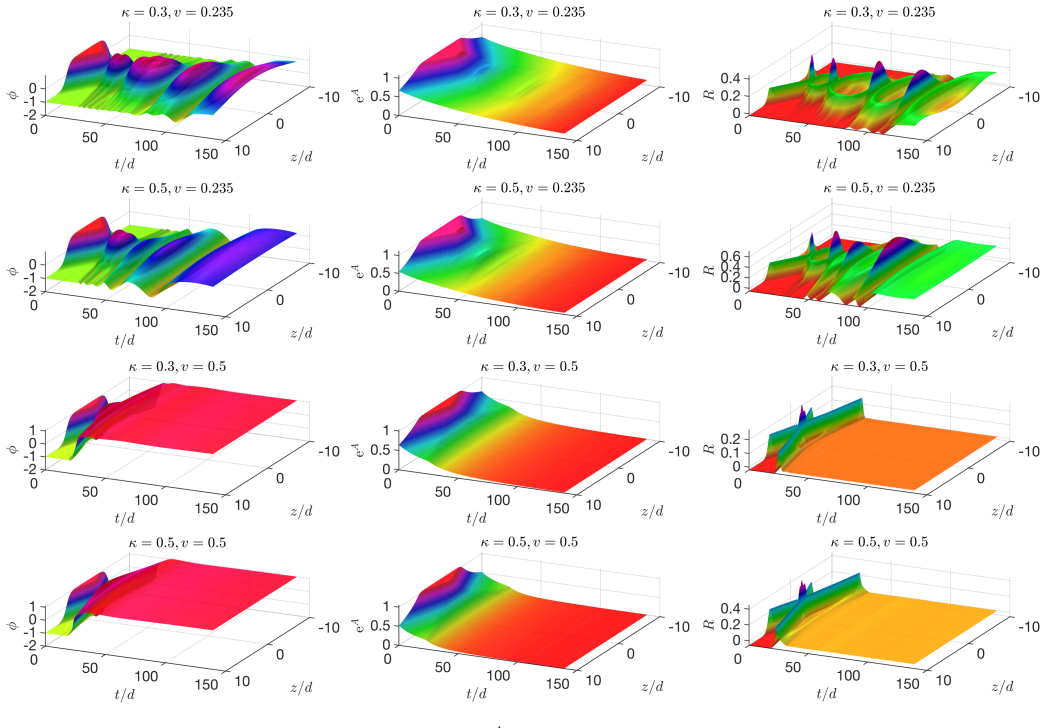
Summary. The paper studies head-on kink-antikink collisions in the ϕ^4 scalar theory coupled to two-dimensional Mann-Morris-Sikkema-Steele (MMSS) dilaton gravity. The authors reduce the system by setting φ(t,z)=2A(t,z), construct approximate boosted-superposition initial data, and evolve the coupled scalar-warp equations in the conformal gauge (12) with fourth-order finite differencing and adaptive time integration. They scan initial velocities at κ=0.1, 0.3, 0.5 and report that gravity shifts the resonance windows to higher velocities and narrows them with increasing κ, while the critical escape velocity increases mildly. A separate linear-stability computation gives a long-lived open-channel resonance at κ=0.1, with Re(ω_res)d≈1.70583 and Q≈1.2×10^3, which the authors connect to the bounce-time intervals via a two-parameter fit. The paper also reports a post-collision decrease of the conformal factor e^A and finite Ricci scalar in all simulations, concluding there is no evidence of singularity formation in this model.
Significance. If the central claims hold, this is the first numerical study of self-gravitating kink collisions in MMSS gravity, and the qualitative picture—stronger gravity shifting and narrowing resonance windows, raising the escape velocity, and producing quasi-bound energy storage—would be a genuinely new result connecting thick-brane phenomenology, 2D dilaton gravity, and kink-scattering theory. The paper has several concrete strengths: the equations of motion are written explicitly; the constraint equations are monitored; the momentum constraint shows fourth-order convergence; the resonance frequency is checked against five different cutoffs; and the stability-operator factorization gives a rigorous non-negative spectrum. The φ=2A truncation, which at first sight looks restrictive, is actually harmless for the evolved sector because Ψ=φ−2A satisfies the free wave equation (13) and does not back-react on the A,ϕ system. However, the quantitative support for the central scattering claims is not yet at the level required: the velocity scan is too coarse to resolve the window narrowing it claims, and the non-convergent Hamiltonian constraint violation in the initial data is not tested against
major comments (3)
- [Sec. 3.1, Fig. 3]
- [Sec. 2.3]
- [Sec. 3.1]
minor comments (5)
- [Sec. 3.2, Eq. (31) and Fig. 5]
- [Sec. 3.1, Fig. 3]
- [Sec. 2.4, Eq. (22)]
- [Sec. 2.2, Eq. (14)]
- [Sec. 3.3]
Circularity Check
No significant circularity: the central scattering results are independent numerical evolutions from stated equations, and the only fitted quantity is explicitly a post-hoc consistency check.
full rationale
The paper's central claims — shifted/narrowed resonance windows, mild increase in critical velocity, post-collision conformal-factor decrease, finite Ricci scalar — are obtained by time-evolving the stated PDE system (15)-(16) from superposed boosted kink initial data (19)-(21). No fitted parameter enters this evolution; κ and v are inputs, and the outcomes are read off the dynamics. The quasi-bound state frequency in Eq. (29) is computed by an eigenvalue/Wronskian shooting problem for the stated linear operator (23)-(25), not by fitting collision data. The subsequent fit ω_fit=1.6261, δ=15.1225 in Eq. (31) is explicitly labeled 'Fit' and used only as a consistency comparison with the independently computed resonance, so it is not a prediction forced by a fit. Self-citations to Refs. [93]-[99] supply the static background (6)-(9), potential (5), and stability factorization (26), but these ingredients are stated explicitly in this paper and are algebraically verifiable; no load-bearing assertion about the collision outcome is imported from a self-citation. The φ=2A sector restriction (14) is an explicit modeling assumption rather than a circular reduction; in fact the difference Ψ=φ-2A satisfies a free wave equation and does not back-react, so the truncation does not secretly encode the scattering conclusion. The manuscript's own caveats — under-resolved windows at κ=0.3,0.5 and non-convergent Hamiltonian constraint violation in the initial data — are numerical reliability concerns, not circularity. Accordingly, there are no circular steps to report.
Axiom & Free-Parameter Ledger
free parameters (2)
- ω_fit (effective oscillation frequency) =
1.6261 (with d=1)
- δ (phase offset) =
15.1225
axioms (3)
- ad hoc to paper The dilaton field is restricted to φ(t,z)=2A(t,z) for all times (Eq. 14).
- ad hoc to paper Initial data are constructed by linear superposition of boosted static solutions (Eqs. 20–21), which does not satisfy the constraints exactly.
- domain assumption Artificial timelike boundaries at z=±L with Dirichlet/Neumann boundary conditions follow the asymptotic forms (Eqs. 10–11, 22).
read the original abstract
We numerically study kink-antikink collisions in the self-gravitating $\phi^4$ model coupled to the two-dimensional dilaton gravity theory proposed by Mann et al. The static kink solutions interpolate between an anti-de Sitter (AdS$_2$) region and a Minkowski region, and can be regarded as two-dimensional analogues of certain thick branes. By scanning the initial velocity for several gravitational couplings, we find that gravity modifies the scattering structure: the resonance windows shift toward higher initial velocities and become progressively narrower as the coupling $\kappa$ increases, while the critical escape velocity increases mildly. A linear perturbation analysis further indicates that the shape modes turn into long-lived quasi-bound states in the weak-gravity regime, which could leak energy during collisions and may therefore contribute to the shift and narrowing of the windows and the increase of the critical velocity. The collisions further produce a clear geometrical response: the conformal factor decreases after the collision, corresponding to a contraction of the local proper spatial scale in the conformal gauge, and this effect becomes stronger for larger $\kappa$. Meanwhile, the Ricci scalar develops transient peaks during kink encounters but remains finite in all simulations considered. Thus, in contrast to higher-dimensional thick-brane collisions, we find no evidence for spacetime singularity formation in this two-dimensional model.
Figures


Reference graph
Works this paper leans on
-
[1]
T. Vachaspati, Kinks and domain walls: an introduction to classical and quantum solitons, Cambridge University Press, 2006.doi:10.1017/9781009290456
-
[2]
A. del Campo, W. H. Zurek, Universality of phase transition dynamics: topological defects from sym- metry breaking, Int. J. Mod. Phys. A 29 (8) (2014) 1430018.arXiv:1310.1600,doi:10.1142/ S0217751X1430018X
Pith/arXiv arXiv 2014
-
[3]
T. W. B. Kibble, Topology of cosmic domains and strings, J. Phys. A 9 (1976) 1387–1398.doi:10.1088/ 0305-4470/9/8/029
1976
-
[4]
T. W. B. Kibble, Some implications of a cosmological phase transition, Phys. Rept. 67 (1980) 183.doi:10. 1016/0370-1573(80)90091-5
1980
-
[5]
Vilenkin, Cosmic strings, Phys
A. Vilenkin, Cosmic strings, Phys. Rev. D 24 (1981) 2082–2089.doi:10.1103/PhysRevD.24.2082
-
[6]
L. Randall, R. Sundrum, A large mass hierarchy from a small extra dimension, Phys. Rev. Lett. 83 (1999) 3370–3373.arXiv:hep-ph/9905221,doi:10.1103/ PhysRevLett.83.3370
Pith/arXiv arXiv 1999
-
[7]
L. Randall, R. Sundrum, An alternative to compactifi- cation, Phys. Rev. Lett. 83 (1999) 4690–4693.arXiv: hep-th/9906064,doi:10.1103/PhysRevLett.83. 4690
Pith/arXiv arXiv 1999
-
[8]
K. Skenderis, P. K. Townsend, Gravitational stabil- ity and renormalization group flow, Phys. Lett. B 468 (1999) 46–51.arXiv:hep-th/9909070,doi:10. 1016/S0370-2693(99)01212-5
Pith/arXiv arXiv 1999
-
[9]
O. DeWolfe, D. Z. Freedman, S. S. Gubser, A. Karch, Modeling the fifth-dimension with scalars and grav- ity, Phys. Rev. D 62 (2000) 046008.arXiv:hep-th/ 9909134,doi:10.1103/PhysRevD.62.046008
-
[10]
Gremm, Four-dimensional gravity on a thick domain wall, Phys
M. Gremm, Four-dimensional gravity on a thick domain wall, Phys. Lett. B 478 (2000) 434–438.arXiv:hep-th/9912060,doi: 10.1016/S0370-2693(00)00303-8
Pith/arXiv arXiv 2000
-
[11]
V . Dzhunushaliev, V . Folomeev, M. Mina- mitsuji, Thick brane solutions, Rept. Prog. Phys. 73 (2010) 066901.arXiv:0904.1775, doi:10.1088/0034-4885/73/6/066901
Pith/arXiv arXiv 2010
-
[12]
Liu, Introduction to extra dimensions and thick braneworlds, World Scientific, 2018, Ch
Y .-X. Liu, Introduction to extra dimensions and thick braneworlds, World Scientific, 2018, Ch. 8, pp. 211–275. 7 Figure 7: Evolution of the scalar fieldϕ(left column), the conformal factor e A (middle column), and the Ricci scalarR(right column) for representative collisions with intermediate and strong gravitational coupling. From top to bottom, the row...
Pith/arXiv arXiv 2018
-
[13]
Sugiyama, Kink-antikink collisions in the two- dimensionalφ 4 model, Prog
T. Sugiyama, Kink-antikink collisions in the two- dimensionalφ 4 model, Prog. Theor. Phys. 61 (1979) 1550–1563.doi:10.1143/PTP.61.1550
-
[14]
Moshir, Soliton-antisoliton scattering and capture in λφ4 theory, Nucl
M. Moshir, Soliton-antisoliton scattering and capture in λφ4 theory, Nucl. Phys. B 185 (1981) 318–332.doi: 10.1016/0550-3213(81)90320-5
-
[15]
D. K. Campbell, J. F. Schonfeld, C. A. Wingate, Reso- nance structure in kink-antikink interactions inφ4 theory, Physica D 9 (1983) 1.doi:10.1016/0167-2789(83) 90289-0
-
[16]
P. Anninos, S. Oliveira, R. A. Matzner, Fractal structure in the scalarλ(φ 2−1) 2 theory, Phys. Rev. D 44 (1991) 1147–1160.doi:10.1103/PhysRevD.44.1147
-
[17]
R. H. Goodman, R. Haberman, Chaotic scatter- ing and then-bounce resonance in solitary-wave interactions, Phys. Rev. Lett. 98 (2007) 104103. doi:10.1103/PhysRevLett.98.104103. URLhttps://link.aps.org/doi/10.1103/ PhysRevLett.98.104103
-
[18]
P. Dorey, A. Halavanau, J. Mercer, T. Roma´nczukiewicz, Y . Shnir, Boundary scattering in theϕ 4 model, JHEP 05 (2017) 107.arXiv:1508.02329,doi:10.1007/ JHEP05(2017)107
Pith/arXiv arXiv 2017
-
[19]
D. K. Campbell, M. Peyrard, P. Sodano, Kink-antikink interactions in the double sine-Gordon equation, Phys- ica D 19 (2) (1986) 165–205.doi:10.1016/ 0167-2789(86)90019-9
1986
-
[20]
V . A. Gani, A. E. Kudryavtsev, Kink-antikink inter- actions in the double sine-Gordon equation and the problem of resonance frequencies, Phys. Rev. E 60 (1999) 3305–3309.arXiv:cond-mat/9809015,doi: 10.1103/PhysRevE.60.3305
Pith/arXiv arXiv 1999
-
[21]
V . A. Gani, A. Gorina, I. Perapechka, Y . Shnir, Re- marks on sine-Gordon kink-fermion system: local- ized modes and scattering, Eur. Phys. J. C 82 (8) (2022) 757.arXiv:2205.13437,doi:10.1140/ epjc/s10052-022-10707-0
Pith/arXiv arXiv 2022
-
[22]
P. Dorey, A. Gorina, I. Perapechka, T. Ro- ma´nczukiewicz, Y . Shnir, Resonance structures in kink-antikink collisions in a deformed sine-Gordon model, JHEP 09 (2021) 145.arXiv:2106.09560, doi:10.1007/JHEP09(2021)145. 8
Pith/arXiv arXiv 2021
-
[23]
R. Carretero-Gonzalez, L. A. Cisneros-Ake, R. Decker, G. N. Koutsokostas, D. J. Frantzeskakis, P. G. Kevrekidis, D. J. Ratliff, Kink–antikink stripe in- teractions in the two-dimensional sine–Gordon equa- tion, Commun. Nonlinear Sci. Numer. Simul. 109 (2022) 106123.arXiv:2108.03121,doi:10.1016/ j.cnsns.2021.106123
Pith/arXiv arXiv 2022
-
[24]
E. da Hora, L. Pereira, C. dos Santos, F. C. Simas, Geometrically constrained sine-Gordon field: BPS soli- tons and their collisions, Commun. Nonlinear Sci. Nu- mer. Simul. 151 (2025) 109070.arXiv:2409.09767, doi:10.1016/j.cnsns.2025.109070
Pith/arXiv arXiv 2025
-
[25]
S. Hoseinmardy, N. Riazi, Inelastic collision of kinks and antikinks in theϕ 6 system, Int. J. Mod. Phys. A 25 (2010) 3261–3270.doi:10.1142/S0217751X10049712
-
[26]
E. Belendryasova, V . A. Gani, Resonance phenomena in theφ 8 kink scattering, J. Phys. Conf. Ser. 934 (1) (2017) 012059.arXiv:1712.02846,doi:10.1088/ 1742-6596/934/1/012059
Pith/arXiv arXiv 2017
-
[27]
V . A. Gani, A. M. Marjaneh, K. Javidan, Exotic final states in theφ 8 multi-kink collisions, Eur. Phys. J. C 81 (12) (2021) 1124.arXiv:2106.06399,doi:10. 1140/epjc/s10052-021-09935-7
Pith/arXiv arXiv 2021
- [28]
-
[29]
A. Moradi Marjaneh, F. C. Simas, D. Bazeia, Collisions of kinks in deformedφ 4 andφ 6 models, Chaos Solitons Fractals 164 (2022) 112723.arXiv:2207.00835,doi: 10.1016/j.chaos.2022.112723
Pith/arXiv arXiv 2022
-
[30]
D. Bazeia, J. G. F. Campos, A. Mohammadi, Kink- antikink collisions in theϕ 8 model: short-range to long- range journey, JHEP 05 (2023) 116.arXiv:2303. 12482,doi:10.1007/JHEP05(2023)116
-
[31]
E. Belendryasova, V . A. Gani, K. G. Zloshchastiev, Kink solutions in logarithmic scalar field theory: excitation spectra, scattering, and decay of bions, Phys. Lett. B 823 (2021) 136776.arXiv:2111.09096,doi:10.1016/ j.physletb.2021.136776
Pith/arXiv arXiv 2021
-
[32]
J. G. F. Campos, A. Mohammadi, Wobbling double sine- Gordon kinks, JHEP 09 (2021) 067.arXiv:2103. 04908,doi:10.1007/JHEP09(2021)067
-
[33]
A. Alonso Izquierdo, L. M. Nieto, J. Queiroga-Nunes, Scattering between wobbling kinks, Phys. Rev. D 103 (4) (2021) 045003.arXiv:2007.15517,doi:10.1103/ PhysRevD.103.045003
Pith/arXiv arXiv 2021
-
[34]
A. Alonso-Izquierdo, L. M. Nieto, J. Queiroga- Nunes, Asymmetric scattering between kinks and wob- blers, Commun. Nonlinear Sci. Numer. Simul. 107 (2022) 106183.arXiv:2109.13904,doi:10.1016/ j.cnsns.2021.106183
Pith/arXiv arXiv 2022
-
[35]
Y . S. Kivshar, Z. Fei, L. Vázquez, Resonant soliton- impurity interactions, Phys. Rev. Lett. 67 (1991) 1177– 1180.doi:10.1103/PhysRevLett.67.1177
-
[36]
Z. Fei, Y . S. Kivshar, L. Vázquez, Resonant kink-impurity interactions in the sine-gordon model, Phys. Rev. A 45 (1992) 6019–6030. doi:10.1103/PhysRevA.45.6019. URLhttps://link.aps.org/doi/10.1103/ PhysRevA.45.6019
-
[37]
Y . Zhou, B. G.-g. Chen, N. Upadhyaya, V . Vitelli, Kink-antikink asymmetry and impurity interactions in topological mechanical chains, Phys. Rev. E 95 (2) (2017) 022202.arXiv:1608.02127,doi:10.1103/ PhysRevE.95.022202
Pith/arXiv arXiv 2017
-
[38]
M. Lizunova, J. Kager, S. de Lange, J. van Wezel, Emer- gence of oscillons in kink-impurity interactions, J. Phys. A 54 (2021) 315701.arXiv:2012.07281,doi:10. 1088/1751-8121/ac0d36
Pith/arXiv arXiv 2021
-
[39]
Y . Zhong, X.-L. Du, Z.-C. Jiang, Y .-X. Liu, Y .-Q. Wang, Collision of two kinks with inner structure, JHEP 02 (2020) 153.arXiv:1906.02920,doi:10.1007/ JHEP02(2020)153
Pith/arXiv arXiv 2020
-
[40]
H. Yan, Y . Zhong, Y .-X. Liu, K.-i. Maeda, Kink-antikink collision in a Lorentz-violatingϕ 4 model, Phys. Lett. B 807 (2020) 135542.arXiv:2004.13329,doi:10. 1016/j.physletb.2020.135542
Pith/arXiv arXiv 2020
-
[41]
C. E. S. Santos, J. G. F. Campos, A. Mohammadi, On the localized and delocalized modes in kink-antikink in- teractions: a toy model, JHEP 01 (2025) 035.arXiv: 2408.00945,doi:10.1007/JHEP01(2025)035
Pith/arXiv arXiv 2025
-
[42]
P. Dorey, K. Mersh, T. Roma ´nczukiewicz, Y . Shnir, Kink-antikink collisions in theϕ 6 model, Phys. Rev. Lett. 107 (2011) 091602.arXiv:1101.5951,doi: 10.1103/PhysRevLett.107.091602
Pith/arXiv arXiv 2011
-
[43]
V . A. Gani, A. E. Kudryavtsev, M. A. Lizunova, Kink interactions in the (1+1)-dimensionalϕ 6 model, Phys. Rev. D 89 (12) (2014) 125009.arXiv:1402.5903, doi:10.1103/PhysRevD.89.125009
Pith/arXiv arXiv 2014
-
[44]
Yan, Kink scattering in a Lorentz-violatingϕ 6 model, EPL 138 (2022) 14001.arXiv:2110.13381,doi:10
H. Yan, Kink scattering in a Lorentz-violatingϕ 6 model, EPL 138 (2022) 14001.arXiv:2110.13381,doi:10. 1209/0295-5075/ac5b9b
Pith/arXiv arXiv 2022
-
[45]
C. Adam, P. Dorey, A. García Martín-Caro, M. Huidobro, K. Ole ´s, T. Roma ´nczukiewicz, Y . Shnir, A. Wereszczy ´nski, Multikink scatter- ing in theϕ 6 model revisited, Phys. Rev. D 106 (12) (2022) 125003.arXiv:2209.08849, doi:10.1103/PhysRevD.106.125003
Pith/arXiv arXiv 2022
-
[46]
P. Dorey, T. Roma ´nczukiewicz, Resonant kink-antikink scattering through quasinormal modes, Phys. Lett. B 779 (2018) 117–123.arXiv:1712.10235,doi:10.1016/ j.physletb.2018.02.003
Pith/arXiv arXiv 2018
-
[47]
J. G. F. Campos, A. Mohammadi, Quasinormal modes in kink excitations and kink–antikink interactions: a toy model, Eur. Phys. J. C 80 (5) (2020) 352.arXiv:1905. 00835,doi:10.1140/epjc/s10052-020-7856-3
-
[48]
J. G. F. Campos, A. Mohammadi, Kink-antikink col- lision in the supersymmetricϕ 4 model, JHEP 08 (2022) 180.arXiv:2205.06869,doi:10.1007/ JHEP08(2022)180
Pith/arXiv arXiv 2022
-
[49]
Weigel, Kink-antikink scattering inφ 4 andϕ 6 models, J
H. Weigel, Kink-antikink scattering inφ 4 andϕ 6 models, J. Phys. Conf. Ser. 482 (2014) 012045.arXiv:1309. 6607,doi:10.1088/1742-6596/482/1/012045
-
[50]
I. Takyi, H. Weigel, Collective coordinates in one- dimensional soliton models revisited, Phys. Rev. D 94 (8) (2016) 085008.arXiv:1609.06833,doi:10. 1103/PhysRevD.94.085008
Pith/arXiv arXiv 2016
-
[51]
H. Weigel, Collective coordinate methods and their ap- plicability toφ 4 models, Springer International Publish- ing, Cham, 2019, Ch. 3, pp. 51–74.arXiv:1809. 9 03772,doi:10.1007/978-3-030-11839-6\_3
-
[52]
N. S. Manton, K. Ole ´s, T. Roma ´nczukiewicz, A. Wereszczy ´nski, Collective coordinate model of kink-antikink collisions inϕ 4 theory, Phys. Rev. Lett. 127 (7) (2021) 071601.arXiv:2106.05153, doi:10.1103/PhysRevLett.127.071601
Pith/arXiv arXiv 2021
-
[53]
N. S. Manton, K. Ole ´s, T. Roma ´nczukiewicz, A. Wereszczy ´nski, Kink moduli spaces: col- lective coordinates reconsidered, Phys. Rev. D 103 (2) (2021) 025024.arXiv:2008.01026, doi:10.1103/PhysRevD.103.025024
Pith/arXiv arXiv 2021
-
[54]
C. Adam, N. S. Manton, K. Ole ´s, T. Roma´nczukiewicz, A. Wereszczy ´nski, Relativistic moduli space for kink collisions, Phys. Rev. D 105 (6) (2022) 065012.arXiv: 2111.06790,doi:10.1103/PhysRevD.105.065012
Pith/arXiv arXiv 2022
-
[55]
C. F. S. Pereira, G. Luchini, T. Tassis, C. P. Constan- tinidis, Some novel considerations about the collective coordinates approximation for the scattering ofϕ 4 kinks, J. Phys. A: Math. Theor. 54 (7) (2021) 075701.arXiv: 2004.00571,doi:10.1088/1751-8121/abd815
Pith/arXiv arXiv 2021
-
[56]
C. F. S. Pereira, E. dos Santos Costa Filho, T. Tassis, Collective coordinates for the hybrid model, Int. J. Mod. Phys. A 38 (1) (2023) 2350006.arXiv:2110.05658, doi:10.1142/S0217751X23500069
Pith/arXiv arXiv 2023
-
[57]
R. H. Goodman, R. Haberman, Kink-antikink collisions in theϕ 4 equation: then-bounce resonance and the sep- aratrix map, SIAM J. Appl. Dynam. Syst. 4 (4) (2005) 1195–1228.doi:10.1137/050632981
-
[58]
S. W. Hawking, I. G. Moss, J. M. Stewart, Bubble colli- sions in the very early universe, Phys. Rev. D 26 (1982) 2681–2693.doi:10.1103/PhysRevD.26.2681. URLhttps://link.aps.org/doi/10.1103/ PhysRevD.26.2681
-
[59]
J. J. Blanco-Pillado, M. Bucher, S. Ghassemi, F. Glanois, When do colliding bubbles produce an expanding universe?, Phys. Rev. D 69 (2004) 103515. doi:10.1103/PhysRevD.69.103515. URLhttps://link.aps.org/doi/10.1103/ PhysRevD.69.103515
-
[60]
B. Freivogel, G. T. Horowitz, S. Shenker, Colliding with a crunching bubble, JHEP 05 (2007) 090.arXiv: hep-th/0703146,doi:10.1088/1126-6708/2007/ 05/090
Pith/arXiv arXiv 2007
-
[61]
R. Easther, J. T. Giblin, Jr, L. Hui, E. A. Lim, A new mechanism for bubble nucleation: classical transitions, Phys. Rev. D 80 (2009) 123519.arXiv:0907.3234, doi:10.1103/PhysRevD.80.123519
Pith/arXiv arXiv 2009
-
[62]
J. T. Giblin, Jr, L. Hui, E. A. Lim, I.-S. Yang, How to run through walls: dynamics of bubble and soliton collisions, Phys. Rev. D 82 (2010) 045019.arXiv:1005.3493, doi:10.1103/PhysRevD.82.045019
Pith/arXiv arXiv 2010
-
[63]
M. C. Johnson, H. V . Peiris, L. Lehner, Determining the outcome of cosmic bubble collisions in full gen- eral relativity, Phys. Rev. D 85 (2012) 083516.arXiv: 1112.4487,doi:10.1103/PhysRevD.85.083516
Pith/arXiv arXiv 2012
-
[64]
D.-i. Hwang, B.-H. Lee, W. Lee, D.-h. Yeom, Bubble collision with gravitation, JCAP 07 (2012) 003.arXiv:1201.6109,doi:10.1088/1475-7516/ 2012/07/003
Pith/arXiv arXiv 2012
-
[65]
J. R. Bond, J. Braden, L. Mersini-Houghton, Cosmic bubble and domain wall instabilities III: the role of oscillons in three-dimensional bubble collisions, JCAP 09 (2015) 004.arXiv:1505.02162,doi:10.1088/ 1475-7516/2015/09/004
Pith/arXiv arXiv 2015
-
[66]
J. C. Aurrekoetxea, K. Clough, E. A. Lim, Cos- mology using numerical relativity, Living Rev. Rel. 28 (1) (2025) 5.arXiv:2409.01939,doi:10.1007/ s41114-025-00058-z
Pith/arXiv arXiv 2025
-
[67]
Y .-i. Takamizu, K.-i. Maeda, Collision of domain walls in asymptotically anti de Sitter spacetime, Phys. Rev. D 73 (2006) 103508.arXiv:hep-th/0603076,doi:10. 1103/PhysRevD.73.103508
Pith/arXiv arXiv 2006
-
[68]
Y .-i. Takamizu, H. Kudoh, K.-i. Maeda, Dynamics of colliding branes and black brane production, Phys. Rev. D 75 (2007) 061304.arXiv:gr-qc/0702138,doi: 10.1103/PhysRevD.75.061304
Pith/arXiv arXiv 2007
-
[69]
J. Omotani, P. M. Saffin, J. Louko, Colliding branes and big crunches, Phys. Rev. D 84 (2011) 063526.arXiv: 1107.3938,doi:10.1103/PhysRevD.84.063526
Pith/arXiv arXiv 2011
-
[70]
K.-i. Maeda, K. Uzawa, Dynamical brane with an- gles: collision of the universes, Phys. Rev. D 85 (2012) 086004.arXiv:1201.3213,doi:10.1103/ PhysRevD.85.086004
Pith/arXiv arXiv 2012
-
[71]
A. Tziolas, A. Wang, Colliding branes and formation of spacetime singularities, Phys. Lett. B 661 (2008) 5– 10.arXiv:0704.1311,doi:10.1016/j.physletb. 2008.01.058
Pith/arXiv arXiv 2008
-
[72]
A. Tziolas, A. Wang, Z. C. Wu, Colliding branes and for- mation of spacetime singularities in string theory, JHEP 04 (2009) 038.arXiv:0812.1377,doi:10.1088/ 1126-6708/2009/04/038
Pith/arXiv arXiv 2009
-
[73]
C. L. Wainwright, M. C. Johnson, A. Aguirre, H. V . Peiris, Simulating the universe(s) II: phenomenology of cosmic bubble collisions in full general relativity, JCAP 10 (2014) 024.arXiv:1407.2950,doi:10.1088/ 1475-7516/2014/10/024
Pith/arXiv arXiv 2014
-
[74]
C. L. Wainwright, M. C. Johnson, H. V . Peiris, A. Aguirre, L. Lehner, S. L. Liebling, Simulating the uni- verse(s): from cosmic bubble collisions to cosmological observables with numerical relativity, JCAP 03 (2014) 030.arXiv:1312.1357,doi:10.1088/1475-7516/ 2014/03/030
Pith/arXiv arXiv 2014
-
[75]
M. C. Johnson, C. L. Wainwright, A. Aguirre, H. V . Peiris, Simulating the universe(s) III: observables for the full bubble collision spacetime, JCAP 07 (2016) 020.arXiv:1508.03641,doi:10.1088/1475-7516/ 2016/07/020
Pith/arXiv arXiv 2016
-
[76]
M. C. Johnson, W. Lin, Observable signatures of a clas- sical transition, JCAP 03 (2016) 051.arXiv:1508. 03786,doi:10.1088/1475-7516/2016/03/051
-
[77]
D.-H. Kim, B.-H. Lee, W. Lee, J. Yang, D.-h. Yeom, Gravitational waves from cosmic bubble collisions, Eur. Phys. J. C 75 (3) (2015) 133.arXiv:1410.4648,doi: 10.1140/epjc/s10052-015-3348-2
Pith/arXiv arXiv 2015
-
[78]
Henneaux, Quantum gravity in two dimensions: exact solution of the Jackiw model, Phys
M. Henneaux, Quantum gravity in two dimensions: exact solution of the Jackiw model, Phys. Rev. Lett. 54 (1985) 959–962.doi:10.1103/PhysRevLett.54. 959
-
[79]
S. P. de Alwis, Quantization of a theory of 2-d dilaton gravity, Phys. Lett. B 289 (1992) 10 278–282.arXiv:hep-th/9205069,doi: 10.1016/0370-2693(92)91219-Y
Pith/arXiv arXiv 1992
-
[80]
C. Vaz, L. Witten, Formation and evaporation of a naked singularity in 2-d gravity, Phys. Lett. B 325 (1994) 27–32.arXiv:hep-th/9311133,doi:10. 1016/0370-2693(94)90066-3
Pith/arXiv arXiv 1994
discussion (0)
Sign in with ORCID, Apple, or X to comment. Anyone can read and Pith papers without signing in.