REVIEW 3 major objections 6 minor 46 references
Explaining the magnitude of Chirality-Induced Spin Selectivity via electron-electron exchange
T0 review · 3 major / 6 minor · reviewed 2026-07-10 · glm-5.2
Pith's one-line read Electron exchange amplifies tiny spin bias into CISS effect
desk verdict Exchange amplification of spin bias in CISS: real mechanism, but the magnitude claim is only as good as the HF approximation and the ad hoc initial perturbation read the letter →
The pith
A machine-rendered reading of the paper's core claim, the machinery that carries it, and where it could break.
The reading
What carries the argument
The key machinery is the non-equilibrium Green's function (NEGF) framework solved self-consistently at the Hartree-Fock level. The system is partitioned into a bulk copper lead, an explicit Cu(111)+molecule region, a photoelectron lead, and a vacuum lead. The exchange interaction enters through the Hartree-Fock self-energy, which depends on the density matrix and is updated iteratively. An initial spin bias is introduced by making the lead coupling parameter gamma spin-dependent (4% asymmetry between alpha and beta electrons), which produces only a 0.0014% net spin polarization in the density because only states near the Fermi level are affected. The amplification then arises self-consist: 1
What would settle it
If the exchange amplification factor depends sensitively on the specific form of the initial spin bias (rather than being robust to it), then the 1000-fold amplification would be an artifact of the chosen proxy rather than a physical mechanism. The paper partially addresses this by showing qualitative stability under parameter variation, but the initial bias form itself is not varied.
Extended reading notes
Core claim
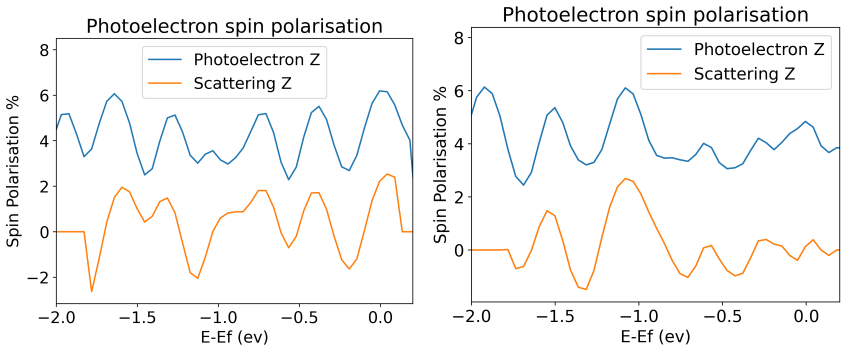
The central discovery is that electron-electron exchange interactions within the Hartree-Fock approximation act as a spin-symmetry-breaking amplifier: a minuscule initial spin bias (~0.0014%) in a copper substrate is amplified into a measurable ~2% spin polarization in photoelectrons transmitted through a chiral molecule, reproducing the experimentally observed magnitude of CISS without unphysical parameters. The mechanism is identified as the same spin-symmetry breaking long known in Hartree-Fock theory (Lowdin's symmetry dilemma), here rendered physically meaningful because the experimental setup (chiral molecule, photoelectron flux) already breaks the relevant point-group and time-reversa
Load-bearing premise
The initial spin bias is introduced artificially by making the lead coupling parameter slightly spin-dependent (a 4% asymmetry), which the authors use as a proxy for the symmetry-breaking that spin-orbit coupling or chiral phonons would produce. The actual source of the initial bias is not explicitly calculated, and whether this proxy faithfully represents the real physical mechanism determines whether the amplification factor is physically meaningful.
Editorial extensions
If this is right
- If exchange-driven amplification is the primary mechanism for CISS magnitude, then larger molecules with more delocalized pi-systems (e.g., helicenes, DNA) should show proportionally larger CISS effects, as the spin texture extends over more of the molecule.
- The theory predicts that CISS should vanish in systems with restored time-reversal or point-group symmetry, making it testable by comparing equilibrium vs. non-equilibrium measurements.
- Any CISS experiment can be understood as a two-stage process: a small relativistic or phonon-driven spin bias is seeded, then amplified by exchange — suggesting that the molecular identity matters less for the seeding and more for the amplification geometry.
- The mechanism implies that standard DFT (which replaces exact exchange with approximate functionals) may fail to reproduce CISS magnitudes, making Hartree-Fock-based or hybrid-functional approaches necessary.
Editorial analysis
A structured set of objections, weighed in public.
Referee Report
Summary. This manuscript proposes that electron-electron exchange interactions within the Hartree-Fock approximation can amplify a small initial spin bias into the percent-level spin polarizations observed in Chirality-Induced Spin Selectivity (CISS) experiments. Using a non-equilibrium Green's function (NEGF) framework with self-consistent HF, the authors simulate 3-methylcyclohexanone on Cu(111) and show that a ~0.0014% initial spin density bias (introduced via spin-dependent lead coupling parameters) produces ~2% oscillations in transmitted photoelectron spin polarization, consistent with experiment. The paper connects this amplification to the well-known phenomenon of spin-symmetry breaking in unrestricted Hartree-Fock and provides a rigorous symmetry analysis (SI-I) establishing when such solutions are physically meaningful.
Significance. The CISS effect has lacked a widely accepted microscopic explanation for over a decade, with existing theories typically requiring unphysical parameters or fine-tuning to reproduce experimental magnitudes. This paper offers a physically motivated mechanism—exchange-driven amplification of a small symmetry-breaking perturbation—that produces the right order of magnitude without invoking unphysical parameters. The connection to spin-symmetry breaking in HF is conceptually valuable and provides a framework that can be tested and extended. The publicly available code and physically motivated parameter choices (where specified) are commendable and enhance reproducibility. The symmetry analysis in SI-I is rigorous and correctly identifies the conditions under which CISS is symmetry-allowed.
major comments (3)
- The central claim is that exchange is 'the primary cause of the magnification' of CISS. The conceptual argument (Section: LINKS TO SPIN SYMMETRY BREAKING) is sound: RHF constrains α/β orbitals to be identical (no spin texture), while UHF allows them to differ, with exchange driving the difference. However, no explicit numerical comparison between RHF (or a non-interacting calculation with the same initial bias) and UHF is presented. Such a control calculation—showing that the ~2% polarization vanishes or is drastically reduced without exchange—would directly substantiate the claim that exchange, rather than the initial bias itself or the transport geometry, is responsible for the amplification. This is load-bearing for the paper's central thesis and should be included.
- The abstract states that 'its ab-initio nature ensures all parameters are physically realistic.' While the γ values for the leads are derived from physical considerations (SI-III, Eq. 56), the 4% spin asymmetry in γ (1.04/0.96 for α/β) is an ad hoc proxy for spin-orbit coupling or chiral phonon effects that are not explicitly calculated. The authors are transparent about this in the main text (Results section: 'This perturbation has been introduced to model the spin symmetry breaking as would be caused by spin-orbit coupling or chiral phonons'), but the abstract's claim of fully physical parameters is misleading and should be qualified.
- The amplification factor (~1400×, from 0.0014% to 2%) is demonstrated only within unrestricted Hartree-Fock. The authors acknowledge that 'the current model is simplistic relying on a mean-field approximation and therefore neglecting electron correlations which could influence spin textures' (Conclusion). However, spin-symmetry breaking in UHF is known to be system-dependent and can be quantitatively affected by correlation (e.g., in bond dissociation). The paper would benefit from at least a brief discussion of whether the amplification is expected to survive or be suppressed in correlated methods, and what the direction of this effect would be. This is relevant because the claim is specifically about the *magnitude* of CISS, not just its qualitative existence.
minor comments (6)
- The relationship between the 4% asymmetry in γ and the resulting 0.0014% spin polarization of the density could be explained more clearly. The text notes that 'the change in γ only effects those states that are within 10kBT ≈ 10mEh of the Fermi level,' but a more quantitative derivation would help the reader understand why a 4% parameter asymmetry produces a 0.0014% density asymmetry.
- Figure 4 (right panel): the y-axis label and units for spin polarization should be clarified. The text states the polarization is defined by Eq. 16, but the figure axis label is not fully specified in the caption.
- SI Figure 2 is referenced in the main text discussion but the figure numbering in the SI appears to restart. Cross-referencing between main text and SI figures could be made more explicit (e.g., 'SI Figure 2' rather than just 'Figure 2').
- The phrase 'connectchiralityto spin' in the Introduction (paragraph 3) appears to be missing a space: 'connect chirality to spin.'
- In the Model Parameters section, the statement 'The results are qualitatively the same (section SI-VI) independent of the exact value chosen' for γ could be strengthened by briefly stating the range tested, rather than requiring the reader to consult SI-VI.
- Reference [29] is a footnote explaining the arbitrariness of the α/β choice. This is important context and could be briefly mentioned in the main text rather than only as a footnote, as it bears on the physical interpretation of the initial bias.
Circularity Check
No significant circularity: the ~2% output polarization emerges from self-consistent HF exchange amplification of a 0.0014% input bias, not by construction.
full rationale
The paper's central claim is that electron-electron exchange within Hartree-Fock amplifies a small initial spin bias (~0.0014%) into a larger output polarization (~2%). Walking the derivation chain: (1) The initial bias is introduced via a 4% asymmetry in the lead coupling parameter γ (1.04/0.96 for α/β electrons), which the paper explicitly states is a proxy for spin-orbit coupling or chiral phonon effects. The resulting equilibrium spin polarization of the density is only 0.0014% — this is an output of the calculation, not an input. (2) The ~2% transmitted photoelectron spin polarization is the result of solving the self-consistent HF Dyson equations (Eqs. 5-9, 46) with the exchange self-energy (Eq. 46) feeding back on the density. The output polarization is not defined in terms of the input bias by construction; it emerges from the self-consistent solution. (3) The paper does cite prior work by one of the authors (Burton, Thom, and Loos, Ref. 34) on spin-symmetry breaking in HF, but this citation provides conceptual context (Lowdin's symmetry dilemma) rather than a load-bearing theorem that forces the conclusion. The amplification mechanism is demonstrated through explicit computation, not imported via self-citation. (4) The paper does not fit any parameter to the output polarization and then claim it as a prediction. The γ parameters are chosen to be physically motivated (Eq. 14-15, SI Table II), and the paper notes the results are qualitatively robust to parameter variation (SI-VI, Figures 3-4). The main limitation — that the amplification may not survive beyond HF — is a correctness risk, not a circularity issue. The derivation is self-contained against external benchmarks (comparison to experiment ~4%, Ref. 25).
Assumptions & free parameters
free parameters (6)
- γ_bulk (spin-up) =
1.04 × 10⁻² Eh
- γ_bulk (spin-down) =
0.96 × 10⁻² Eh
- γ_photoelectron (spin-up/down) =
1.04/0.96 × 10⁻⁴ Eh
- γ_vacuum =
10⁻² Eh
- µ_bulk =
-0.15 Eh (-4.08 eV)
- µ_photoelectron =
-0.15 Eh + 5.9 eV
assumptions (5)
- domain assumption The wide-band limit (constant density of states in leads) is a valid approximation for bulk copper and photoelectron/vacuum reservoirs.
- domain assumption Hartree-Fock mean-field approximation adequately captures the exchange amplification mechanism, and electron correlation effects do not qualitatively change the spin texture.
- ad hoc to paper A spin-dependent modification of the lead coupling parameter γ is a valid proxy for the spin-symmetry breaking caused by SOC or chiral phonons.
- domain assumption The Born-Oppenheimer approximation is valid for this system.
- domain assumption Time-reversal symmetry and point-group symmetry are broken by the experimental setup (incoming photon flux, chiral molecule, no spatial symmetry), making spin-symmetry-broken HF solutions physical.
Cite this review
Pith. "Pith review of Explaining the magnitude of Chirality-Induced Spin Selectivity via electron-electron exchange." pith.science (2026). https://pith.science/paper/M5G6745K
@misc{pith2026260706858,
  author       = {Pith},
  title        = {Pith review of: Explaining the magnitude of Chirality-Induced Spin Selectivity via electron-electron exchange},
  year         = {2026},
  howpublished = {\url{https://pith.science/paper/M5G6745K}},
  note         = {Machine review of arXiv:2607.06858}
}
abstract
Chiral molecular structure can couple to electron spin, leading to unexpected spin polarization effects. This Chirality-Induced Spin Selectivity (CISS) was first reported for DNA molecules adsorbed on gold but its microscopic origin remains unclear. We demonstrated though simulation that the exchange arising from electron-electron Coulomb interactions within the self-consistent mean field (Hartree--Fock) approximation can yield significant ($\sim 2\%$) spin polarisation for $3$-methylcyclohexanone adsorbed on Cu(111) amplifying a much smaller ($\sim 0.0014\%$) initial bias, consistent with experiment. Symmetry considerations ensure the result is physically meaningful, while its ab-initio nature ensures all parameters are physically realistic. This amplification is connected to existing studies on spin-symmetry breaking in Hartree--Fock, providing a new pathway for understanding the magnitude of CISS as an emergent phenomenon of interacting electrons.
Figures


Figures from the paper (5 more)



Reference graph
Works this paper leans on
-
[1]
B. G¨ ohler, V. Hamelbeck, T. Z. Markus, M. Kettner, G. F. Hanne, Z. Vager, R. Naaman, and H. Zacharias. Spin Selectivity in Electron Transmission Through Self- Assembled Monolayers of Double-Stranded DNA.Sci- ence, 331(6019):894–897, February 2011. Publisher: American Association for the Advancement of Science
work page 2011
-
[2]
Schneider, Karl-Heinz Ernst, and Daniel E
Mohammad Reza Safari, Frank Matthes, Vasile Caciuc, Nicolae Atodiresei, Claus M. Schneider, Karl-Heinz Ernst, and Daniel E. B¨ urgler. Enan- tioselective Adsorption on Magnetic Surfaces.Ad- vanced Materials, 36(14):2308666, 2024. eprint: https://onlinelibrary.wiley.com/doi/pdf/10.1002/adma.202308666
-
[3]
Niccol` o Giaconi, Lorenzo Poggini, Michela Lupi, Mat- teo Briganti, Anil Kumar, Tapan K. Das, Andrea L. Sorrentino, Caterina Viglianisi, Stefano Menichetti, Ron Naaman, Roberta Sessoli, and Matteo Mannini. Ef- ficient Spin-Selective Electron Transport at Low Volt- ages of Thia-Bridged Triarylamine Hetero[4]helicenes Chemisorbed Monolayer.ACS Nano, 17(15)...
work page 2023
-
[4]
Y. Lu, B. P. Bloom, S. Qian, and D. H. Waldeck. Enan- tiospecificity of Cysteine Adsorption on a Ferromagnetic Surface: Is It Kinetically or Thermodynamically Con- trolled?J. Phys. Chem. Lett., 12(32):7854–7858, August
-
[6]
Furkan Ozturk. Origin of biological homochirality by crystallization of an RNA precursor on a magnetic sur- face.Sci. Adv., 9, June 2023
work page 2023
-
[7]
A new approach towards spintron- ics–spintronics with no magnets.J
Karen Michaeli, Vaibhav Varade, Ron Naaman, and David H Waldeck. A new approach towards spintron- ics–spintronics with no magnets.J. Phys.: Condens. Matter, 29(10):103002, January 2017. Publisher: IOP Publishing
work page 2017
-
[8]
Bloom, Yossi Paltiel, Ron Naaman, and David H
Brian P. Bloom, Yossi Paltiel, Ron Naaman, and David H. Waldeck. Chiral Induced Spin Selectivity. Chem. Rev., 124(4):1950–1991, February 2024. Pub- lisher: American Chemical Society
work page 1950
-
[9]
van Ruitenbeek, Latha Venkataraman, David H
Ferdinand Evers, Amnon Aharony, Nir Bar-Gill, Ora Entin-Wohlman, Per Hedeg˚ ard, Oded Hod, Pavel Jelinek, Grzegorz Kamieniarz, Mikhail Lemeshko, 7 Karen Michaeli, Vladimiro Mujica, Ron Naaman, Yossi Paltiel, Sivan Refaely-Abramson, Oren Tal, Jos Thijssen, Michael Thoss, Jan M. van Ruitenbeek, Latha Venkataraman, David H. Waldeck, Binghai Yan, and Leeor Kr...
Show all 46 references
-
[10]
Sasselov, Yossi Paltiel, and S
Jonas Fransson, Yael Kapon, Lilach Brann, Shira Yoche- lis, Dimitar D. Sasselov, Yossi Paltiel, and S. Furkan Oz- turk. Chiral Phonons Enhance Ferromagnetism, Decem- ber 2024. arXiv:2412.13787 [cond-mat]
2024 arXiv
-
[11]
Theory of Chiral In- duced Spin Selectivity.Nano Lett., 19(8):5253–5259, Au- gust 2019
Sakse Dalum and Per Hedeg˚ ard. Theory of Chiral In- duced Spin Selectivity.Nano Lett., 19(8):5253–5259, Au- gust 2019. Publisher: American Chemical Society
2019
-
[12]
Geometric spin–orbit coupling and chirality-induced spin selectivity
Atsuo Shitade and Emi Minamitani. Geometric spin–orbit coupling and chirality-induced spin selectivity. New J. Phys., 22(11):113023, November 2020. Publisher: IOP Publishing
2020
-
[13]
Chirality- Driven Magnetization Emerges from Relativistic Four- Current Dynamics, April 2025
Xuechen Zheng, Shiv Upadhyay, Tian Wang, Agam Shayit, Jun Liu, Dali Sun, and Xiaosong Li. Chirality- Driven Magnetization Emerges from Relativistic Four- Current Dynamics, April 2025. arXiv:2504.03781 [cond- mat]
2025
-
[14]
Chirality-Induced Spin–Orbit Coupling and Spin Selectivity.J
Massimiliano Di Ventra, Rafael Gutierrez, and Gianau- relio Cuniberti. Chirality-Induced Spin–Orbit Coupling and Spin Selectivity.J. Phys. Chem. A, 129(40):9504– 9510, October 2025. Publisher: American Chemical So- ciety
2025
-
[15]
Chiral Induced Spin Polarized Electron Current: Origin of the Chiral Induced Spin Selectivity Effect.J
Jonas Fransson. Chiral Induced Spin Polarized Electron Current: Origin of the Chiral Induced Spin Selectivity Effect.J. Phys. Chem. Lett., 16(17):4346–4353, May 2025
2025
-
[16]
Weak elec- tron–phonon coupling is insufficient to generate signifi- cant CISS in two-terminal transport.J
Vipul Upadhyay and Amikam Levy. Weak elec- tron–phonon coupling is insufficient to generate signifi- cant CISS in two-terminal transport.J. Chem. Phys., 164(16):164303, April 2026
2026
-
[17]
Fransson
J. Fransson. Chirality-Induced Spin Selectivity: The Role of Electron Correlations.J. Phys. Chem. Lett., 10(22):7126–7132, November 2019. Publisher: American Chemical Society
2019
-
[18]
Chiral-Induced Spin Selectivity and Non- equilibrium Spin Accumulation in Molecules and In- terfaces: A First-Principles Study.J
Sumit Naskar, Vladimiro Mujica, and Carmen Her- rmann. Chiral-Induced Spin Selectivity and Non- equilibrium Spin Accumulation in Molecules and In- terfaces: A First-Principles Study.J. Phys. Chem. Lett., 14(3):694–701, January 2023. Publisher: Ameri- can Chemical Society
2023
-
[19]
Fransson
J. Fransson. Vibrational origin of exchange splitting and ”chiral-induced spin selectivity.Phys. Rev. B, 102(23):235416, December 2020. Publisher: American Physical Society
2020
-
[20]
Blackert, Rui Xu, Boris I
Jiaming Luo, Tong Lin, Junjie Zhang, Xiaotong Chen, Elizabeth R. Blackert, Rui Xu, Boris I. Yakobson, and Hanyu Zhu. Large effective magnetic fields from chiral phonons in rare-earth halides.Science, 382(6671):698– 702, November 2023. Publisher: American Association for the Ad...
2023
-
[21]
Comstock, Xiao Li, Jun Zhou, Lifa Zhang, Wei You, Dali Sun, and Jun Liu
Kyunghoon Kim, Eric Vetter, Liang Yan, Cong Yang, Ziqi Wang, Rui Sun, Yu Yang, Andrew H. Comstock, Xiao Li, Jun Zhou, Lifa Zhang, Wei You, Dali Sun, and Jun Liu. Chiral-phonon-activated spin Seebeck effect. Nat. Mater., 22(3):322–328, March 2023. Publisher: Na- ture Publishing Group
2023
-
[22]
Charge Redistribution and Spin Polar- ization Driven by Correlation Induced Electron Exchange in Chiral Molecules.Nano Lett., 21(7):3026–3032, April
Jonas Fransson. Charge Redistribution and Spin Polar- ization Driven by Correlation Induced Electron Exchange in Chiral Molecules.Nano Lett., 21(7):3026–3032, April
-
[23]
Publisher: American Chemical Society
-
[24]
Fransson
J. Fransson. Charge and Spin Dynamics and Enantios- electivity in Chiral Molecules.J. Phys. Chem. Lett., 13(3):808–814, January 2022. Publisher: American Chemical Society
2022
-
[25]
Insight into the Origin of Chiral-Induced Spin Selectivity from a Symmetry Analysis of Electronic Transmission.J
Martin Sebastian Z¨ ollner, Solmar Varela, Ernesto Med- ina, Vladimiro Mujica, and Carmen Herrmann. Insight into the Origin of Chiral-Induced Spin Selectivity from a Symmetry Analysis of Electronic Transmission.J. Chem. Theory Comput., 16(5):2914–2929, May 2020. Publisher: Ame...
2020
-
[26]
Gonz´ alez-Arraga, Daniel Finkelstein-Shapiro, Bertrand Berche, and Vladimiro Mujica
Ernesto Medina, Luis A. Gonz´ alez-Arraga, Daniel Finkelstein-Shapiro, Bertrand Berche, and Vladimiro Mujica. Continuum model for chiral induced spin se- lectivity in helical molecules.The Journal of Chemical Physics, 142(19):194308, May 2015
2015
-
[27]
Vectorial Electron Spin Filter- ing by an All-Chiral Metal–Molecule Heterostructure.J
Chetana Badala Viswanatha, Johannes St¨ ockl, Benito Arnoldi, Sebastian Becker, Martin Aeschlimann, and Benjamin Stadtm¨ uller. Vectorial Electron Spin Filter- ing by an All-Chiral Metal–Molecule Heterostructure.J. Phys. Chem. Lett., 13(26):6244–6249, July 2022. Pub- lisher: A...
2022
-
[28]
Cambridge Studies in Semiconductor Physics and Microelectronic Engineering
Supriyo Datta.Electronic Transport in Mesoscopic Sys- tems. Cambridge Studies in Semiconductor Physics and Microelectronic Engineering. Cambridge University Press, Cambridge, 1995
1995
-
[29]
Cambridge University Press, Cam- bridge, 2007
Jørgen Rammer.Quantum Field Theory of Non- equilibrium States. Cambridge University Press, Cam- bridge, 2007
2007
-
[30]
Anderson
Paul A. Anderson. The Work Function of Copper.Phys. Rev., 76(3):388–390, August 1949. Publisher: American Physical Society
1949
-
[31]
This choice is arbitrary, reversing theαandβelectrons would yield related results as seen in CISS experiments where theLenantiomer is exchanged forR, SI-I
-
[32]
B¨ urgler, and Claus M
Mohammad Reza Safari, Frank Matthes, Karl-Heinz Ernst, Daniel E. B¨ urgler, and Claus M. Schneider. De- position of Chiral Heptahelicene Molecules on Ferromag- netic Co and Fe Thin-Film Substrates.Nanomaterials, 12(19):3281, January 2022. Number: 19 Publisher: Mul- tidisciplin...
2022
-
[33]
Maslyuk, Daniel N¨ urenberg, Johannes Seibel, Rafael Gutierrez, Gianaure- lio Cuniberti, Karl-Heinz Ernst, and Helmut Zacharias
Matthias Kettner, Volodymyr V. Maslyuk, Daniel N¨ urenberg, Johannes Seibel, Rafael Gutierrez, Gianaure- lio Cuniberti, Karl-Heinz Ernst, and Helmut Zacharias. Chirality-Dependent Electron Spin Filtering by Molec- ular Monolayers of Helicenes.J. Phys. Chem. Lett., 9(8):2025–20...
2025
-
[34]
Weakly Self- Assembled [6]Helicenes: Circularly Polarized Light and Spin Filtering Properties.Chemistry – A Eu- ropean Journal, 29(63):e202302254, 2023
Rafael Rodr´ ıguez, Cristina Naranjo, Anil Kumar, Kais Dhbaibi, Paola Matozzo, Franck Camerel, Nicolas Vanthuyne, Rafael G´ omez, Ron Naaman, Luis S´ anchez, and Jeanne Crassous. Weakly Self- Assembled [6]Helicenes: Circularly Polarized Light and Spin Filtering Properties.Chem...
2023 doi
-
[35]
Yuthika Pillai, Hugh G. A. Burton, and David J. Wales. Effect of Exact Exchange on the Energy Landscape in Self-Consistent Field Theory.J. Chem. Theory Comput., 21(3):1203–1212, February 2025. Publisher: American Chemical Society. 8
2025
-
[36]
Hugh G. A. Burton, Alex J. W. Thom, and Pierre- Fran¸ cois Loos. Parity-Time Symmetry in Hartree–Fock Theory.J. Chem. Theory Comput., 15(8):4374–4385, Au- gust 2019. Publisher: American Chemical Society
2019
-
[37]
Lykos and G
P. Lykos and G. W. Pratt. Discussion on The Hartree- Fock Approximation.Rev. Mod. Phys., 35(3):496–501, July 1963
1963
-
[38]
Effi- cient implementation of the nonequilibrium Green func- tion method for electronic transport calculations.Phys
Taisuke Ozaki, Kengo Nishio, and Hiori Kino. Effi- cient implementation of the nonequilibrium Green func- tion method for electronic transport calculations.Phys. Rev. B, 81(3):035116, January 2010. Publisher: Ameri- can Physical Society. Supplementary Information for ‘Explaini...
2010
-
[39]
Altmann.Rotations, Quaternions, and Double Groups
Simon L. Altmann.Rotations, Quaternions, and Double Groups. Oxford : Clarendon, 1986
1986
-
[40]
Altmann and Peter Herzig.Point-Group Theory Tables
Simon L. Altmann and Peter Herzig.Point-Group Theory Tables. Oxford : Clarendon, 1994
1994
-
[41]
L. D. Barron and A. David Buckingham. Time Reversal and Molecular Properties|Accounts of Chemical Research
-
[42]
Hugh G. A. Burton, Alex J. W. Thom, and Pierre-Fran¸ cois Loos. Parity-Time Symmetry in 16 Hartree–Fock Theory.J. Chem. Theory Comput., 15(8):4374–4385, August 2019. Publisher: American Chemical Society
2019
-
[43]
L. D. Barron. True and false chirality and parity violation.Chemical Physics Letters, 123(5):423–427, January 1986
1986
-
[44]
Nonorthogonal basis sets in quantum mechanics: Representations and second quantization.Phys
Emilio Artacho and Lorenzo Mil´ ans Del Bosch. Nonorthogonal basis sets in quantum mechanics: Representations and second quantization.Phys. Rev. A, 43(11):5770–5777, June 1991
1991
-
[45]
Cambridge Studies in Semi- conductor Physics and Microelectronic Engineering
Supriyo Datta.Electronic Transport in Mesoscopic Systems. Cambridge Studies in Semi- conductor Physics and Microelectronic Engineering. Cambridge University Press, Cambridge, 1995
1995
-
[46]
Cambridge University Press, Cambridge, 2007
Jørgen Rammer.Quantum Field Theory of Non-equilibrium States. Cambridge University Press, Cambridge, 2007
2007
-
[47]
Iterative subspace algorithms for finite- temperature solution of Dyson equation.The Journal of Chemical Physics, 156(9):094101, March 2022
Pavel Pokhilko, Chia-Nan Yeh, and Dominika Zgid. Iterative subspace algorithms for finite- temperature solution of Dyson equation.The Journal of Chemical Physics, 156(9):094101, March 2022. arXiv:2112.08890 [physics]. 17
2022 arXiv
Reviewed July 10, 2026 · model on record in the stance chip above.
Discussion (0). Continue with ORCID to comment.