REVIEW 3 major objections 5 minor 1 cited by
Hyperon global polarization in isobar Ru+Ru and Zr+Zr collisions at $\sqrt{s_{NN}}$ = 200 GeV
T0 review · 3 major / 5 minor · reviewed 2026-08-15 · deepseek-v4-flash
Pith's one-line read This paper extracts the first second-order azimuthal coefficient of Lambda global polarization in isobar Ru+Ru and Zr+Zr collisions, finding in-plane enhanced polarization at 2.4 sigma, and reports a positive Xi polarization at 2.9 sigma.
desk verdict First isobar-collision hyperon polarization and first Py,c2 extraction, both at modest significance — worth refereeing once Eqs. (5)-(12) show the event-plane resolution treatment. read the letter →
The pith
A machine-rendered reading of the paper's core claim, the machinery that carries it, and where it could break.
The reading
What carries the argument
The carrying object is the hyperon decay asymmetry: because $\Lambda \to p \pi^-$ violates parity, the mean of $\sin(\Psi_1-\phi^*_B)$ in the hyperon rest frame measures polarization along the system angular momentum, with the first-order event plane $\Psi_1$ from spectator-neutron deflection fixing the reaction-plane direction. To reach the azimuthal dependence, the paper expands $P_H(\phi_H-\Psi_{\rm RP})$ as a cosine series, keeps the first two terms, and solves a pair of coupled equations that fold in the Lambda elliptic flow $v_2$ and acceptance integrals $A_0,A_2$ (or their tilted variants $\tilde{A}_0,\tilde{A}_2$), using the main tracking detector's second-order event plane as a proxy for the reaction plane. For the Xi, the cascade decay allows polarization transfer from $\Xi$ to the daughter $\Lambda$ with coefficient $C_{\Xi\Lambda}=+0.944$, a more sensitive extraction than the direct $\alpha_{\Xi}$ method.
What would settle it
Recompute $P_{y,c2}$ after applying the second-order event-plane resolution correction $1/\mathrm{Res}(\Psi_2)$ or a scalar-product estimator; if the corrected value moves by more than the quoted 0.058 percent systematic uncertainty or its significance falls below roughly 2$\sigma$, the in-plane enhancement claim fails. A second decisive check is to repeat the extraction using $\Psi_2$ from each sub-event separately and compare the two results.
Extended reading notes
Core claim
On the paper's own terms, the discovery is that hyperon spin polarization is not only a global average but carries a measurable second-order pattern tied to the elliptic geometry of the fireball. Decomposing the Lambda polarization as $P_H(\phi_H-\Psi_{\rm RP}) = P_{y,c0} + 2P_{y,c2}\cos[2(\phi_H-\Psi_{\rm RP})]$ and solving with the measured elliptic flow and data-derived acceptance factors, the paper finds $P_{y,c2}=0.138\pm0.038\,(\mathrm{stat})\pm0.058\,(\mathrm{syst})$ percent in 20-50% centrality, a positive in-plane enhancement at 2.4$\sigma$. In the same data, the polarization-transfer analysis of the cascade decay $\Xi \to \Lambda \pi$ yields $P_{\Xi^-+\bar{\Xi}^+}=0.61\pm0.21\,(\mathrm{stat})\pm0.04\,(\mathrm{syst})$ percent at 2.9$\sigma$, a hint of a strange-baryon hierarchy $P_{\Xi}>P_{\Lambda}$. The azimuthally integrated Lambda polarization is $0.310\pm0.048\pm0.036$ percent for $\Lambda$ and $0.270\pm0.053\pm0.030$ percent for $\bar{\Lambda}$, consistent with no spin-magnetic coupling contribution within the current precision.
Load-bearing premise
The extraction assumes that the measured second-order event plane from charged tracks faithfully represents the true reaction plane, with any resolution smearing either negligible or already absorbed into the measured $v_2$ and acceptance factors; if that resolution is not fully accounted for, the size and significance of the 2.4$\sigma$ in-plane polarization could shift.
Editorial extensions
If this is right
- A positive $P_{y,c2}$ means in-plane-emitted Lambdas carry more spin than out-of-plane ones; at full significance it would discriminate between models that include thermal shear and models that include only thermal vorticity.
- The positive Xi polarization at 2.9$\sigma$ strengthens the picture that multi-strange baryons inherit polarization from an earlier, more vortical stage, with a possible hierarchy $P_{\Xi}>P_{\Lambda}$ consistent with feed-down expectations.
- Consistency between Lambda and anti-Lambda polarization in both isobar species constrains a late-stage magnetic-field contribution to spin, despite the roughly 15% larger squared magnetic field expected in Ru+Ru than in Zr+Zr.
- The similarity to Au+Au at the same energy implies no obvious system-size dependence in global polarization, and the apparent scaling with participant number $\langle N_{\rm part}\rangle$ supports vorticity as the common driver.
- No significant $p_T$ or pseudorapidity dependence within $|\eta|<1$ leaves the rapidity-dependent vorticity predictions untested in the forward region.
Reading between the lines
- Beyond the paper: a resolution-corrected reanalysis of $P_{y,c2}$, applying $1/\mathrm{Res}(\Psi_2)$ or a scalar-product estimator, is the sharpest single check; the paper's equations do not display such a correction, so the systematic uncertainty on the 2.4$\sigma$ signal deserves re-examination.
- Beyond the paper: the roughly 2$\sigma$ gap between the direct Xi polarization ($-0.32\pm0.39\pm0.08$ percent) and the polarization-transfer value ($0.61\pm0.21\pm0.04$ percent) is a natural target for a blinded re-measurement with tighter background and feed-down modeling.
- Beyond the paper: comparing $P_{y,c2}$ across collision energies and system sizes in existing data sets would test whether the in-plane enhancement grows with elliptic flow or with vorticity gradients, a separation this single-energy measurement cannot make.
- Beyond the paper: combining this isobar sample with higher-statistics future data could push the Lambda-anti-Lambda splitting difference between Ru+Ru and Zr+Zr below the current $\pm0.14$ percent precision, testing magnetic-field effects at the few-percent level.
Signed reviews
Editorial analysis
A structured set of objections, weighed in public.
Referee Report
Summary. This paper reports measurements of the global polarization of Λ, ¯Λ, Ξ−, and ¯Ξ+ hyperons in Ru+Ru and Zr+Zr collisions at √sNN = 200 GeV using STAR data. The analysis uses standard invariant-mass and event-plane methods, with signal extraction cross-checked by three techniques, and reports statistical and systematic uncertainties. The main results are: a Λ+¯Λ polarization of about 0.31% in 20–50% centrality that rises toward peripheral collisions and is consistent with Au+Au results; no significant Λ–¯Λ splitting; no significant pT or η dependence; a first extraction of the second-order azimuthal coefficient of the polarization, Py,c2 = 0.138 ± 0.038 (stat) ± 0.058 (syst) in 20–50% centrality, interpreted as enhanced in-plane polarization at the 2.4σ level; and a positive Ξ−+¯Ξ+ polarization of 0.61 ± 0.21 (stat) ± 0.04 (syst) in 20–50% centrality from the polarization-transfer method. The manuscript concludes that the data are qualitatively consistent with hydrodynamic calculations including shear-induced polarization and show no obvious system-size dependence relative to Au+Au.
Significance. If the central results hold, this is the first measurement of the second-order azimuthal modulation of the global polarization in isobar collisions, providing a new observable that can discriminate between thermal-vorticity and shear-induced contributions in spin-hydrodynamic models. The data set is large (1.8–2.0 billion events per system), the analysis uses well-established methods, and the paper includes useful cross-checks: three signal-extraction techniques, an explicit comparison with Au+Au results, and comparisons with AMPT+MUSIC calculations under two spin-relaxation scenarios. The paper also reports feed-down caveats and does not overstate the Λ–¯Λ splitting. However, the headline claims rest on modest significances (2.4σ and 2.9σ), and there are unresolved internal tensions, most notably the missing documentation of the second-order event-plane resolution correction and a ~2σ discrepancy between the two Ξ polarization methods. These issues must be addressed before the results can be considered quantitatively reliable.
major comments (3)
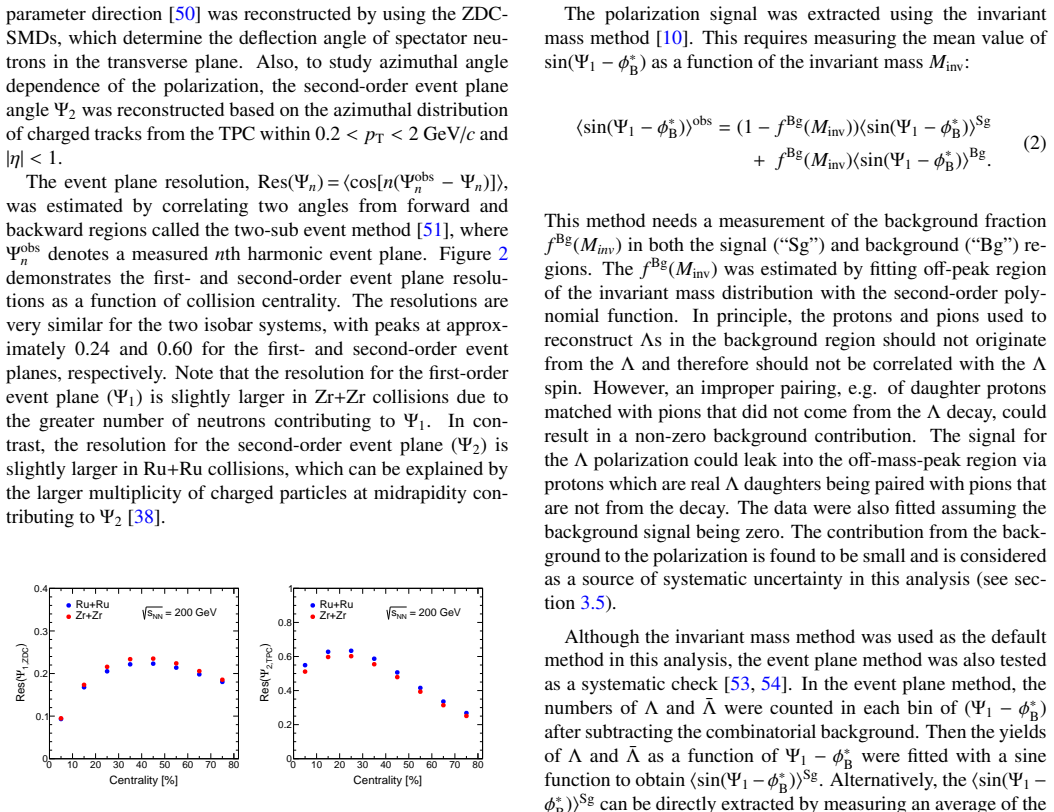
- [Section 3.4, Eqs. (5)–(12) and Section 3.5] The equations for extracting Py,c0 and Py,c2 do not display a resolution correction for the second-order event plane. Eq. (1) explicitly divides by Res(Ψ1), but Eqs. (5)–(12) use Ψ2 as a proxy for ΨRP with no analogous factor. Since Res(Ψ2) ≈ 0.60 in 20–50% centrality (Fig. 2), the moment ⟨sin(Ψ1−ϕ*_B) cos[2(ϕ_H−Ψ2)]⟩ is attenuated by the Ψ2 resolution; omitting this factor changes the extracted Py,c2 by roughly 40%, directly affecting the size and significance of the in-plane polarization claim. The statement in Section 3.5 that the event-plane-resolution systematic is below 0.1% is hard to reconcile with this unless the moments are already resolution-corrected and the equations simply omit the factor, which would make the analysis non-reproducible as written. Please state explicitly whether the left-hand sides of Eqs. (5)–(12) are corrected for Res(Ψ1) and/or Res(Ψ2), show the correction factors used, and explain the 0.1% systematic estimate in light of a ∼40% uncorrected effect.
- [Section 4.2, Fig. 8] The quoted 2.4σ significance for Py,c2 = 0.138 ± 0.038 (stat) ± 0.058 (syst) does not follow from the stated uncertainties. Combining the two uncertainties in quadrature gives sqrt(0.038² + 0.058²) ≈ 0.069, so the significance is approximately 2.0σ; the value 0.138/0.058 ≈ 2.4 corresponds to the systematic uncertainty alone. Please specify how the significance level was computed and quote the combined-statistical-plus-systematic significance, since the current presentation appears to overstate the result.
- [Section 4.3, Fig. 9] The two methods used to measure Ξ polarization give results that differ by about 2σ in the 20–50% centrality bin: PΞ = 0.61 ± 0.21 (stat) ± 0.04 (syst) via polarization transfer versus PΞ = −0.32 ± 0.39 (stat) ± 0.08 (syst) via direct measurement of the daughter Λ distribution. Because both methods are expected to measure the same physical quantity, presenting the polarization-transfer result as a 2.9σ positive observation without resolving this discrepancy is problematic. The authors should either provide a combined estimate, investigate possible sources of the difference (e.g., background treatment or feed-down), or temper the claim accordingly.
minor comments (5)
- [Throughout] There are numerous typographical and formatting issues, including inconsistent spacing in "Ru +Ru", "Zr+Zr", "di fference", and occasionally missing √ before sNN in the text and figure captions. These should be corrected.
- [Section 3.4, Eq. (3)] The notation Py,c(2n) is not defined; the reader must infer that it refers to the coefficient of cos[2n(ϕH−ΨRP)]. Please define it explicitly.
- [Section 3.4, Eqs. (7)–(8)] The text states that A0 and A2 are extracted directly from the data, but it does not describe how the acceptance function A(pH, p*) is estimated. A brief description of this extraction would improve reproducibility.
- [Section 3.3] The definition of Res(Ψn) = ⟨cos[n(Ψobs_n − Ψn)]⟩ uses the true event-plane angle Ψn, but this quantity is not directly accessible in data; the sentence could clarify that it is estimated using the two-sub-event method.
- [References] Reference [62] cites a private communication; if the calculation details are not publicly available, the authors should ensure that the quoted model predictions can be verified by interested readers.
Circularity Check
No circularity: the central results are direct extractions from measured moments using external decay parameters and independent model comparisons.
full rationale
The paper's central claims—Λ/Λbar global polarization and its centrality, pT and eta dependence, the first extraction of Py,c2, and the Xi polarization—are direct experimental measurements. Equation (1) uses the standard relation between the observed sine moment and polarization, with an external decay parameter and a measured event-plane resolution. Equations (5)-(12) are two independent measured moments solved for Py,c0 and Py,c2, using acceptance integrals and hyperon v2 as inputs; no parameter is fitted to force the reported coefficients, and Py,c2 is not defined as one of the measured moments by construction. The Py,c0 result is cross-checked against the azimuthally integrated PH from Eq. (1), rather than being imposed to agree. The hydrodynamic curves (AMPT+MUSIC with the 'Lambda equilibrium' and 's-quark memory' scenarios) are external calculations from refs. [62,63], compared after the fact and not fitted to the isobar data. Comparisons with Au+Au results [10] and previous Xi measurements [8] use independent published data. Self-citations in the paper refer to earlier STAR methodology or measurements; none is invoked as an unverified premise that forces the present result. The absence of an explicit Res(Psi2) correction in Eqs. (6)/(10) is a reproducibility and potential bias concern, not a circularity: it concerns whether an attenuation correction is missing, not whether an output is identical to an input by definition or by fitted construction. No circular step is therefore established.
Assumptions & free parameters
assumptions (4)
- domain assumption CP symmetry is assumed for the decay parameters: alpha_Lambda = -alpha_Lambdabar = 0.732 +/- 0.014 and alpha_Xi = -alpha_Xibar = -0.401 +/- 0.058.
- domain assumption The first-order event plane from ZDC-SMD spectator neutrons estimates the initial impact parameter direction, and dividing by Res(Psi1) fully corrects for its dispersion.
- domain assumption The measured second-order event plane Psi2 can be used as the reaction-plane proxy in Eqs. (5)-(12), with the effect of its resolution accounted for via the measured v2 and acceptance factors.
- domain assumption Feed-down corrections are not applied, and the measured inclusive Lambda and Xi polarizations are compared with primary-particle hydrodynamic calculations without correcting for the model-dependent 10-15% dilution of Lambda and 25% enhancement of Xi.
Cite this review
Pith. "Pith review of Hyperon global polarization in isobar Ru+Ru and Zr+Zr collisions at $\sqrt{s_{NN}}$ = 200 GeV." pith.science (2026). https://pith.science/paper/MFWU6I2O
@misc{pith2026250505046,
  author       = {Pith},
  title        = {Pith review of: Hyperon global polarization in isobar Ru+Ru and Zr+Zr collisions at $\sqrts_NN$ = 200 GeV},
  year         = {2026},
  howpublished = {\url{https://pith.science/paper/MFWU6I2O}},
  note         = {Machine review of arXiv:2505.05046}
}
abstract
The polarization of Lambda, Anti-Lambda, Xi, and Anti-Xi hyperons along the angular momentum of the system has been measured in isobar collisions of Ru+Ru and Zr+Zr at $\sqrt{s_{NN}}$ = 200 GeV with the STAR detector at RHIC. The polarization dependence on collision centrality is explored and found to show an increasing trend in more peripheral collisions. Dependencies on transverse momentum and pseudorapidity are investigated for Lambda and Anti-Lambda hyperons, but no significant dependence has been observed. The polarization measurements for Lambda and Anti-Lambda are consistent with each other, indicating little contribution of the spin-magnetic coupling in the observed polarization. The results for Lambda hyperons measurements are qualitatively consistent with hydrodynamic calculations incorporating effects from shear-induced polarization and thermal vorticity, and show no obvious system size dependence in comparison with previous results in Au+Au collisions. For the first time, the dependence of the polarization on the hyperon's emission azimuthal angle with respect to the second harmonic event plane is extracted and shows stronger polarization for the in-plane emitted hyperons at the level of 2.4$\sigma$ significance in 20-50% centrality. The measurements of Xi hyperons polarization via the polarization transfer analysis exhibit a finite positive polarization, 2.9$\sigma$ significance in 20-50% centrality, slightly enhanced compared to the inclusive Lambda polarization.
Figures


Figures from the paper (6 more)


Forward citations
Cited by 1 Pith paper
-
Nonlinear causality and stability of perfect spin hydrodynamics and its nonperturbative character
All four studied formulations of perfect spin hydrodynamics satisfy divergence-type structure and are nonlinearly causal and stable when exact, nonperturbative distribution functions are used.
Reference graph
Works this paper leans on
-
[65]
J. G. Russo, M. Tierz, Quantum phase transition in many-flavor super- symmetric QED 3, Phys. Rev. D 95 (3) (2017) 031901. arXiv:1610. 08527, doi:10.1103/PhysRevD.95.031901
-
[1]
Z.-T. Liang, X.-N. Wang, Globally polarized quark-gluon plasma in non-central A+A collisions, Phys. Rev. Lett. 94 (2005) 102301, [Erra- tum: Phys.Rev.Lett. 96, 039901 (2006)]. arXiv:nucl-th/0410079, doi:10.1103/PhysRevLett.94.102301
arXiv 2005
-
[2]
S. A. V oloshin, Polarized secondary particles in unpolarized high energy hadron-hadron collisions? arXiv:nucl-th/0410089
-
[3]
Z.-T. Liang, X.-N. Wang, Spin alignment of vector mesons in non-central A+A collisions, Phys. Lett. B 629 (2005) 20–26. arXiv:nucl-th/ 0411101, doi:10.1016/j.physletb.2005.09.060. 7
-
[4]
F. Becattini, F. Piccinini, J. Rizzo, Angular momentum conservation in heavy ion collisions at very high energy, Phys. Rev. C 77 (2008) 024906. arXiv:0711.1253, doi:10.1103/PhysRevC.77.024906
arXiv 2008
- [5]
-
[6]
L. Adamczyk, et al., Global Λ hyperon polarization in nuclear collisions: evidence for the most vortical fluid, Nature 548 (2017) 62–65. arXiv: 1701.06657, doi:10.1038/nature23004
arXiv 2017
-
[7]
M. S. Abdallah, et al., Pattern of global spin alignment of ϕ and K∗0 mesons in heavy-ion collisions, Nature 614 (7947) (2023) 244–248. arXiv:2204.02302, doi:10.1038/s41586-022-05557-5
arXiv 2023
Show all 71 references
-
[8]
Adam, et al., Global Polarization of Ξ and Ω Hyperons in Au+Au Col- lisions at √sNN = 200 GeV, Phys
J. Adam, et al., Global Polarization of Ξ and Ω Hyperons in Au+Au Col- lisions at √sNN = 200 GeV, Phys. Rev. Lett. 126 (16) (2021) 162301. arXiv:2012.13601, doi:10.1103/PhysRevLett.126.162301
2021
-
[9]
B. I. Abelev, et al., Global polarization measurement in Au +Au colli- sions, Phys. Rev. C 76 (2007) 024915, [Erratum: Phys.Rev.C 95, 039906 (2017)]. arXiv:0705.1691, doi:10.1103/PhysRevC.76.024915
2007 arXiv
-
[10]
Adam, et al., Global polarization of Λ hyperons in Au+Au collisions at√sNN = 200 GeV, Phys
J. Adam, et al., Global polarization of Λ hyperons in Au+Au collisions at√sNN = 200 GeV, Phys. Rev. C 98 (2018) 014910. arXiv:1805.04400, doi:10.1103/PhysRevC.98.014910
2018 arXiv
-
[11]
Acharya, et al., Global polarization of Λ ¯Λ hyperons in Pb-Pb colli- sions at√sNN = 2.76 and 5.02 TeV, Phys
S. Acharya, et al., Global polarization of Λ ¯Λ hyperons in Pb-Pb colli- sions at√sNN = 2.76 and 5.02 TeV, Phys. Rev. C 101 (4) (2020) 044611, [Erratum: Phys.Rev.C 105, 029902 (2022)]. arXiv:1909.01281, doi: 10.1103/PhysRevC.101.044611
2020 arXiv
-
[12]
M. S. Abdallah, et al., Global Λ-hyperon polarization in Au +Au colli- sions at √sNN =3 GeV, Phys. Rev. C 104 (6) (2021) L061901. arXiv: 2108.00044, doi:10.1103/PhysRevC.104.L061901
2021
-
[13]
M. I. Abdulhamid, et al., Global polarization of Λ and Λ¯ hyperons in Au+Au collisions at sNN=19.6 and 27 GeV, Phys. Rev. C 108 (1) (2023) 014910. arXiv:2305.08705, doi:10.1103/PhysRevC.108.014910
2023 arXiv
-
[14]
Abou Yassine, et al., Measurement of global polarization of Λ hyper- ons in few-GeV heavy-ion collisions, Phys
R. Abou Yassine, et al., Measurement of global polarization of Λ hyper- ons in few-GeV heavy-ion collisions, Phys. Lett. B 835 (2022) 137506. arXiv:2207.05160, doi:10.1016/j.physletb.2022.137506
2022 arXiv
-
[15]
Deng, X.-G
W.-T. Deng, X.-G. Huang, V orticity in Heavy-Ion Collisions, Phys. Rev. C 93 (6) (2016) 064907. arXiv:1603.06117, doi:10.1103/ PhysRevC.93.064907
2016 arXiv
-
[16]
Wei, W.-T
D.-X. Wei, W.-T. Deng, X.-G. Huang, Thermal vorticity and spin po- larization in heavy-ion collisions, Phys. Rev. C 99 (1) (2019) 014905. arXiv:1810.00151, doi:10.1103/PhysRevC.99.014905
2019 arXiv
-
[17]
Y . Guo, J. Liao, E. Wang, H. Xing, H. Zhang, Hyperon polarization from the vortical fluid in low-energy nuclear collisions, Phys. Rev. C 104 (4) (2021) L041902. arXiv:2105.13481, doi:10.1103/PhysRevC.104. L041902
2021 arXiv
-
[18]
Bozek, I
P. Bozek, I. Wyskiel, Directed flow in ultrarelativistic heavy-ion col- lisions, Phys. Rev. C 81 (2010) 054902. arXiv:1002.4999, doi: 10.1103/PhysRevC.81.054902
2010 arXiv
-
[19]
Y . B. Ivanov, A. A. Soldatov, V ortex rings in fragmentation regions in heavy-ion collisions at √sNN = 39 GeV, Phys. Rev. C 97 (4) (2018) 044915. arXiv:1803.01525, doi:10.1103/PhysRevC.97.044915
2018 arXiv
-
[20]
Wu, L.-G
H.-Z. Wu, L.-G. Pang, X.-G. Huang, Q. Wang, Local spin polarization in high energy heavy ion collisions, Phys. Rev. Research. 1 (2019) 033058. arXiv:1906.09385, doi:10.1103/PhysRevResearch.1.033058
2019 arXiv
-
[21]
Y . B. Ivanov, V . D. Toneev, A. A. Soldatov, Estimates of hyperon po- larization in heavy-ion collisions at collision energies √sNN = 4–40 GeV, Phys. Rev. C 100 (1) (2019) 014908. arXiv:1903.05455, doi: 10.1103/PhysRevC.100.014908
2019 arXiv
-
[22]
Y . B. Ivanov, A. A. Soldatov, Correlation between global polarization, an- gular momentum, and flow in heavy-ion collisions, Phys. Rev. C 102 (2) (2020) 024916. arXiv:2004.05166, doi:10.1103/PhysRevC.102. 024916
2020 arXiv
-
[23]
Liang, J
Z.-T. Liang, J. Song, I. Upsal, Q. Wang, Z.-B. Xu, Rapidity dependence of global polarization in heavy ion collisions, Chin. Phys. C 45 (1) (2021) 014102. arXiv:1912.10223, doi:10.1088/1674-1137/abc065
2021 arXiv
-
[24]
Jiang, Z.-W
Y . Jiang, Z.-W. Lin, J. Liao, Rotating quark-gluon plasma in relativis- tic heavy ion collisions, Phys. Rev. C 94 (4) (2016) 044910, [Erratum: Phys.Rev.C 95, 049904 (2017)]. arXiv:1602.06580, doi:10.1103/ PhysRevC.94.044910
2016 arXiv
-
[25]
McLerran, V
L. McLerran, V . Skokov, Comments About the Electromagnetic Field in Heavy-Ion Collisions, Nucl. Phys. A 929 (2014) 184–190.arXiv:1305. 0774, doi:10.1016/j.nuclphysa.2014.05.008
2014 doi
-
[26]
Becattini, I
F. Becattini, I. Karpenko, M. Lisa, I. Upsal, S. V oloshin, Global hyperon polarization at local thermodynamic equilibrium with vorticity, magnetic field and feed-down, Phys. Rev. C 95 (5) (2017) 054902. arXiv:1610. 02506, doi:10.1103/PhysRevC.95.054902
2017 doi
-
[27]
M ¨uller, A
B. M ¨uller, A. Sch¨afer, Chiral magnetic effect and an experimental bound on the late time magnetic field strength, Phys. Rev. D 98 (7) (2018) 071902. arXiv:1806.10907, doi:10.1103/PhysRevD.98.071902
2018 arXiv
-
[28]
Y . Xie, D. Wang, L. P. Csernai, Fluid dynamics study of theΛ polarization for Au + Au collisions at√sNN = 200 GeV, Eur. Phys. J. C 80 (1) (2020)
2020
-
[29]
S. Shi, K. Li, J. Liao, Searching for the Subatomic Swirls in the CuCu and CuAu Collisions, Phys. Lett. B 788 (2019) 409–413. arXiv:1712. 00878, doi:10.1016/j.physletb.2018.09.066
2019 doi
-
[30]
Alzhrani, S
S. Alzhrani, S. Ryu, C. Shen, Λ spin polarization in event-by-event relativistic heavy-ion collisions, Phys. Rev. C 106 (1) (2022) 014905. arXiv:2203.15718, doi:10.1103/PhysRevC.106.014905
2022 arXiv
-
[31]
Adam, et al., Polarization of Λ ( ¯Λ) hyperons along the beam direc- tion in Au+Au collisions at √sNN = 200 GeV, Phys
J. Adam, et al., Polarization of Λ ( ¯Λ) hyperons along the beam direc- tion in Au+Au collisions at √sNN = 200 GeV, Phys. Rev. Lett. 123 (13) (2019) 132301. arXiv:1905.11917, doi:10.1103/PhysRevLett. 123.132301
2019
-
[32]
Acharya, et al., Polarization of Λ and ¯Λ Hyperons along the Beam Di- rection in Pb-Pb Collisions at√sNN =5.02 TeV, Phys
S. Acharya, et al., Polarization of Λ and ¯Λ Hyperons along the Beam Di- rection in Pb-Pb Collisions at√sNN =5.02 TeV, Phys. Rev. Lett. 128 (17) (2022) 172005. arXiv:2107.11183, doi:10.1103/PhysRevLett. 128.172005
2022 arXiv
-
[33]
Abdulhamid, et al., Hyperon Polarization along the Beam Direc- tion Relative to the Second and Third Harmonic Event Planes in Isobar Collisions at sNN =200 GeV, Phys
M. Abdulhamid, et al., Hyperon Polarization along the Beam Direc- tion Relative to the Second and Third Harmonic Event Planes in Isobar Collisions at sNN =200 GeV, Phys. Rev. Lett. 131 (20) (2023) 202301. arXiv:2303.09074, doi:10.1103/PhysRevLett.131.202301
2023
-
[34]
Becattini, M
F. Becattini, M. A. Lisa, Polarization and V orticity in the Quark–Gluon Plasma, Ann. Rev. Nucl. Part. Sci. 70 (2020) 395–423. arXiv:2003. 03640, doi:10.1146/annurev-nucl-021920-095245
2020 doi
-
[35]
Becattini, M
F. Becattini, M. Buzzegoli, T. Niida, S. Pu, A.-H. Tang, Q. Wang, Spin polarization in relativistic heavy-ion collisions, Int. J. Mod. Phys. E 33 (06) (2024) 2430006. arXiv:2402.04540, doi:10.1142/ S0218301324300066
2024 arXiv
-
[36]
Niida, S
T. Niida, S. A. V oloshin, Polarization phenomenon in heavy-ion colli- sions, Int. J. Mod. Phys. E 33 (09) (2024) 2430010.arXiv:2404.11042, doi:10.1142/S0218301324300108
2024 arXiv
-
[37]
Chen, et al., Properties of the QCD matter: review of selected results from the relativistic heavy ion collider beam energy scan (RHIC BES) program, Nucl
J. Chen, et al., Properties of the QCD matter: review of selected results from the relativistic heavy ion collider beam energy scan (RHIC BES) program, Nucl. Sci. Tech. 35 (12) (2024) 214. arXiv:2407.02935, doi:10.1007/s41365-024-01591-2
2024 arXiv
-
[38]
Abdallah, et al., Search for the chiral magnetic e ffect with isobar collisions at √sNN =200 GeV by the STAR Collaboration at the BNL Relativistic Heavy Ion Collider, Phys
M. Abdallah, et al., Search for the chiral magnetic e ffect with isobar collisions at √sNN =200 GeV by the STAR Collaboration at the BNL Relativistic Heavy Ion Collider, Phys. Rev. C 105 (1) (2022) 014901. arXiv:2109.00131, doi:10.1103/PhysRevC.105.014901
2022
-
[39]
arXiv:1907.00773, doi:10.1140/epjc/s10052-019-7576-8
1907 arXiv
-
[40]
S. A. V oloshin, Testing the Chiral Magnetic E ffect with Central U +U collisions, Phys. Rev. Lett. 105 (2010) 172301. arXiv:1006.1020, doi:10.1103/PhysRevLett.105.172301
2010 arXiv
-
[41]
Deng, X.-G
W.-T. Deng, X.-G. Huang, G.-L. Ma, G. Wang, Test the chiral magnetic effect with isobaric collisions, Phys. Rev. C 94 (2016) 041901. arXiv: 1607.04697, doi:10.1103/PhysRevC.94.041901
2016 arXiv
-
[42]
Anderson, et al., The Star time projection chamber: A Unique tool for studying high multiplicity events at RHIC, Nucl
M. Anderson, et al., The Star time projection chamber: A Unique tool for studying high multiplicity events at RHIC, Nucl. Instrum. Meth. A 499 (2003) 659–678. arXiv:nucl-ex/0301015, doi:10.1016/ S0168-9002(02)01964-2
2003 arXiv
-
[43]
W. J. Llope, Multigap RPCs in the STAR experiment at RHIC, Nucl. In- strum. Meth. A 661 (2012) S110–S113. doi:10.1016/j.nima.2010. 07.086
2012 doi
-
[44]
Adler, H
C. Adler, H. Strobele, A. Denisov, E. Garcia, M. Murray, S. White, The RHIC zero-degree calorimeters, Nucl. Instrum. Meth. A 461 (2001) 337–
2001
-
[45]
STAR Techincal Note SN0448 (2003), Proposed Addition of a Shower Max Detector to the STAR Zero Degree Calorimeters, https://drupal.star.bnl.gov/STAR/starnotes/public/sn0448
2003
-
[46]
W. J. Llope, et al., The STAR Vertex Position Detector, Nucl. Instrum. Meth. A 759 (2014) 23–28. arXiv:1403.6855, doi:10.1016/j. nima.2014.04.080
2014 arXiv
-
[47]
Gorbunov, On-line reconstruction algorithms for the CBM and AL- ICE experiments, Ph.D
S. Gorbunov, On-line reconstruction algorithms for the CBM and AL- ICE experiments, Ph.D. thesis, Goethe U., Frankfurt (main), Frankfurt U. (2013)
2013
-
[48]
M. L. Miller, K. Reygers, S. J. Sanders, P. Steinberg, Glauber modeling in high energy nuclear collisions, Ann. Rev. Nucl. Part. Sci. 57 (2007) 8 205–243. arXiv:nucl-ex/0701025, doi:10.1146/annurev.nucl. 57.090506.123020
2007 arXiv
-
[49]
Kisel, Event Topology Reconstruction in the CBM Experiment, J
I. Kisel, Event Topology Reconstruction in the CBM Experiment, J. Phys. Conf. Ser. 1070 (1) (2018) 012015. doi:10.1088/1742-6596/1070/ 1/012015
2018 doi
-
[50]
Zyzak, Online selection of short-lived particles on many-core com- puter architectures in the CBM experiment at FAIR, Ph.D
M. Zyzak, Online selection of short-lived particles on many-core com- puter architectures in the CBM experiment at FAIR, Ph.D. thesis, Goethe U., Frankfurt (main), Frankfurt U. (2016)
2016
-
[51]
A. M. Poskanzer, S. A. V oloshin, Methods for analyzing anisotropic flow in relativistic nuclear collisions, Phys. Rev. C 58 (1998) 1671–1678. arXiv:nucl-ex/9805001, doi:10.1103/PhysRevC.58.1671
1998 arXiv
-
[52]
S. A. V oloshin, T. Niida, Ultra-relativistic nuclear collisions: Direction of spectator flow, Phys. Rev. C 94 (2016) 021901(R).arXiv:1604.04597, doi:10.1103/PhysRevC.94.021901
2016 arXiv
-
[53]
Adamczyk, et al., Elliptic flow of identified hadrons in Au +Au col- lisions at √sNN = 7.7-62.4 GeV, Phys
L. Adamczyk, et al., Elliptic flow of identified hadrons in Au +Au col- lisions at √sNN = 7.7-62.4 GeV, Phys. Rev. C 88 (2013) 014902. arXiv:1301.2348, doi:10.1103/PhysRevC.88.014902
2013 arXiv
-
[54]
R. L. Workman, et al., Review of Particle Physics, PTEP 2022 (2022) 083C01. doi:10.1093/ptep/ptac097
2022 doi
-
[55]
Karpenko, F
I. Karpenko, F. Becattini, Study of Λ polarization in relativistic nuclear collisions at √sNN = 7.7 –200 GeV, Eur. Phys. J. C 77 (4) (2017) 213. arXiv:1610.04717, doi:10.1140/epjc/s10052-017-4765-1
2017 arXiv
-
[56]
Borghini, J
N. Borghini, J. Y . Ollitrault, Azimuthally sensitive correlations in nucleus-nucleus collisions, Phys. Rev. C 70 (2004) 064905. arXiv: nucl-th/0407041, doi:10.1103/PhysRevC.70.064905
2004 arXiv
-
[57]
Becattini, G
F. Becattini, G. Cao, E. Speranza, Polarization transfer in hyperon decays and its e ffect in relativistic nuclear collisions, Eur. Phys. J. C 79 (9) (2019) 741. arXiv:1905.03123, doi:10.1140/epjc/ s10052-019-7213-6
2019 arXiv
-
[58]
X.-L. Xia, H. Li, X.-G. Huang, H. Z. Huang, Feed-down e ffect on Λ spin polarization, Phys. Rev. C 100 (1) (2019) 014913. arXiv:1905.03120, doi:10.1103/PhysRevC.100.014913
2019 arXiv
-
[59]
Fang, L.-G
R.-H. Fang, L.-G. Pang, Q. Wang, X.-N. Wang, Polarization of massive fermions in a vortical fluid, Phys. Rev. C 94 (2) (2016) 024904. arXiv: 1604.04036, doi:10.1103/PhysRevC.94.024904
2016 arXiv
-
[60]
Li, X.-L
H. Li, X.-L. Xia, X.-G. Huang, H. Z. Huang, Global spin polarization of multistrange hyperons and feed-down e ffect in heavy-ion collisions, Phys. Lett. B 827 (2022) 136971. arXiv:2106.09443, doi:10.1016/ j.physletb.2022.136971
2022 arXiv
-
[61]
Vitiuk, L
O. Vitiuk, L. V . Bravina, E. E. Zabrodin, Is di fferent Λ and ¯Λ polariza- tion caused by different spatio-temporal freeze-out picture?, Phys. Lett. B 803 (2020) 135298. arXiv:1910.06292, doi:10.1016/j.physletb. 2020.135298
2020 arXiv
-
[62]
L. P. Csernai, J. I. Kapusta, T. Welle, Λ and ¯Λ spin interaction with meson fields generated by the baryon current in high energy nuclear collisions, Phys. Rev. C 99 (2) (2019) 021901. arXiv:1807.11521, doi:10.1103/PhysRevC.99.021901
2019 arXiv
-
[63]
Becattini, M
F. Becattini, M. Buzzegoli, G. Inghirami, I. Karpenko, A. Palermo, Lo- cal Polarization and Isothermal Local Equilibrium in Relativistic Heavy Ion Collisions, Phys. Rev. Lett. 127 (27) (2021) 272302. arXiv:2103. 14621, doi:10.1103/PhysRevLett.127.272302
2021 doi
-
[64]
B. Fu, S. Y . F. Liu, L. Pang, H. Song, Y . Yin, Shear-Induced Spin Polarization in Heavy-Ion Collisions, Phys. Rev. Lett. 127 (14) (2021) 142301, private communication. arXiv:2103.10403, doi:10.1103/ PhysRevLett.127.142301
2021 arXiv
-
[66]
Becattini, G
F. Becattini, G. Inghirami, V . Rolando, A. Beraudo, L. Del Zanna, A. De Pace, M. Nardi, G. Pagliara, V . Chandra, A study of vorticity for- mation in high energy nuclear collisions, Eur. Phys. J. C 75 (9) (2015) 406, [Erratum: Eur.Phys.J.C 78, 354 (2018)]. arXiv:1501.04468, d...
2015 arXiv
-
[67]
C. Yi, S. Pu, D.-L. Yang, Reexamination of local spin polarization beyond global equilibrium in relativistic heavy ion collisions, Phys. Rev. C 104 (6) (2021) 064901. arXiv:2106.00238, doi:10.1103/ PhysRevC.104.064901
2021 arXiv
-
[68]
B. Fu, K. Xu, X.-G. Huang, H. Song, Hydrodynamic study of hyperon spin polarization in relativistic heavy ion collisions, Phys. Rev. C 103 (2) (2021) 024903. arXiv:2011.03740, doi:10.1103/PhysRevC.103. 024903
2021 arXiv
-
[69]
Palermo, E
A. Palermo, E. Grossi, I. Karpenko, F. Becattini, Λ polarization in very high energy heavy ion collisions as a probe of the quark–gluon plasma formation and properties, Eur. Phys. J. C 84 (9) (2024) 920. arXiv: 2404.14295, doi:10.1140/epjc/s10052-024-13229-z . 9
2024 arXiv
-
[70]
STAR, Elliptic flow of strange and multi-strange hadrons in isobar colli- sions at√sNN = 200 GeV at RHIC, to be submitted
-
[340]
doi:10.1016/S0168-9002(00)01238-9
Reviewed August 15, 2026 · model on record in the stance chip above.
Discussion (0). Continue with ORCID to comment.