REVIEW 3 major objections 5 minor 57 references
Sample Weight Averaging for Stable Prediction
T0 review · 3 major / 5 minor · reviewed 2026-08-08 · deepseek-v4-flash
Pith's one-line read Averaging K independently learned sample weights reduces the error of independence-based reweighting and improves stable prediction under covariate shift.
desk verdict A simple, plausible weight-space ensembling trick with consistent empirical gains, but the theory proves less than the abstract claims because the key covariance term in Eq. (5) is never bounded. read the letter →
The pith
A machine-rendered reading of the paper's core claim, the machinery that carries it, and where it could break.
The reading
What carries the argument
The load-bearing object is the error decomposition of Proposition 3.3: $\mathbb{E}[(\bar{w}(X)-w(X))^2] = \text{bias}^2 + \text{variance}/K + \frac{K-1}{K}\text{(covariance term)}$. The bias term is fixed by the algorithm, the variance term shrinks with the number $K$ of averaged weight sets, and the covariance term measures how dissimilar two weight functions from different initializations are; diversity makes this term small. The convexity results of Propositions 3.1 and 3.2 (for a stronger version of DWR and for LSIF-based SRDO with a linear parameterized family, justified for wide MLPs via the neural tangent kernel approximation) ensure that the averaged weights still lie in the valid solution set, so averaging is a legitimate reweighting rather than a heuristic blend.
What would settle it
Run DWR or SRDO many times on a dataset with strong collinearity and compute the three terms of Equation (5) directly: if the average pairwise covariance term is large and positive (say, comparable to the variance term), or if increasing $K$ from 1 to 10 leaves the total squared weight error and the resulting WLS coefficient error essentially unchanged, then the paper's central mechanism is not operating in that regime.
Extended reading notes
Core claim
The central claim is that averaging $K$ sets of sample weights obtained by the same independence-based reweighting procedure from different random initializations yields a weighting function whose estimation error is strictly smaller in expectation than that of a single run, provided the individual weight functions are not too positively correlated. Proposition 3.3 states that the expected squared error of the averaged weight function equals the squared bias of the algorithm (constant in $K$), plus a variance term proportional to $1/K$, plus a cross-term measuring pairwise covariance of the weight functions; Proposition 3.4 then bounds the WLS coefficient estimation error by a factor of the weight-learning error. Because Propositions 3.1 and 3.2 show that the solution sets of DWR and SRDO are convex, the averaged weights remain valid solutions. The paper concludes that refining weight learning in this way improves coefficient estimation on the stable variable set $\boldsymbol{S}$ and pushes coefficients on unstable variables $\boldsymbol{V}$ toward zero, which is exactly what is needed for stable prediction under agnostic covariate shift.
Load-bearing premise
The benefit of averaging depends on the third term in Equation (5) being small or negative, i.e., the weight functions learned from different random initializations must be sufficiently diverse and not strongly positively correlated; the paper argues for this diversity but does not prove it for DWR or SRDO, and it also assumes the weight-learning optimizations reach exact solutions in a convex set, which is not guaranteed in finite samples.
Editorial extensions
If this is right
- Any independence-based reweighting algorithm whose weight-learning objective has a convex solution set can be wrapped with SAWA without changing its assumptions, since averaged weights remain valid solutions.
- Increasing $K$ reduces the variance component of the weight error by $1/K$, so the practical benefit saturates; the paper recommends $K=10$ based on its experiments.
- Because the WLS coefficient error is bounded by the weight error, improved weight estimation translates into coefficients on unstable variables closer to zero, which is the mechanism for covariate-shift robustness.
- SAWA is parallelizable and needs no outcome labels or environment labels, so it is cheaper than iterative alternatives and can be applied to deep-learning-based weighting functions like SRDO's MLP.
- The diversity term explains why averaging across random initializations outperforms moving averages computed along a single optimization trajectory.
Reading between the lines
- The argument implies a direct diagnostic: practitioners can measure the three terms in Equation (5) on their own data to predict whether SAWA will help before committing to it; if the covariance term is already large and positive, averaging many runs will show diminishing returns.
- By analogy with bagging, the same averaging principle could be applied to other stochastic components of weight learning (bootstrap resampling of samples, random feature subsets, different loss weights) rather than initialization alone, potentially increasing the diversity term further.
- The convexity assumptions are the fragile point: if a reweighting algorithm solves a non-convex finite-sample problem, the averaged weights may not lie in the solution set, so the validity argument would need a new proof rather than the convexity argument.
- The theory is stated for expected error over repeated sampling; a natural testable extension is to estimate the bias-variance-covariance terms empirically in real datasets to see whether the observed gains match the predicted $1/K$ variance shrinkage.
Signed reviews
Editorial analysis
A structured set of objections, weighed in public.
Referee Report
Summary. The paper proposes SAmple Weight Averaging (SAWA), a method that averages multiple sets of sample weights obtained by running an independence-based reweighting algorithm (DWR, SRDO, SVI, etc.) from different random initializations, with the goal of reducing variance and coefficient estimation error under covariate shift. The authors provide theoretical results: Proposition 3.3 decomposes the expected squared error of the averaged weighting function into bias, variance, and a cross-covariance term, and Proposition 3.4 bounds the WLS coefficient estimation error in terms of the weight-learning error. Experiments on synthetic data and several real-world datasets report that SAWA improves the prediction error of existing reweighting methods.
Significance. If the theoretical benefit were fully established, SAWA would be a simple, parallelizable, label-free plug-in that addresses a known weakness of independence-based reweighting methods. The paper has several strengths: it gives a clean bias-variance-covariance decomposition, provides convexity results for idealized versions of DWR and SRDO, and evaluates the method across a broad set of synthetic and real-world tasks, including settings with strong collinearity that previous methods handle poorly. The central gap is that the main theoretical claim of guaranteed improvement depends on an unproved assumption about the cross-covariance term in Eq. (5); the empirical evaluation also lacks run-level uncertainty measures. The method is plausible and the experimental results are mostly positive, but the theoretical claim as stated is not yet supported.
major comments (3)
- [§3.3.2, Eq. (5), Prop. 3.4] The theoretical benefit claim is not established. Proposition 3.3 is an algebraic identity: it decomposes the expected squared error of the averaged weighting function into a K-independent bias term, a variance term of order 1/K, and a cross-covariance term scaled by (K-1)/K. The paper does not prove that the cross-covariance term is non-positive or dominated by the variance reduction for DWR or SRDO; the assertion that diverse initializations mitigate this term is supported only by the empirical similarity plot in Figure 2(b). Since Proposition 3.4 is monotone in the weight-learning error epsilon^2, the coefficient-estimation benefit disappears unless the total epsilon^2 decreases with K. The bias term is also independent of K, so a large algorithmic bias would leave SAWA ineffective regardless of variance reduction. The abstract's claim to 'prove its rationality and benefits theoretically' is therefore conditional on an unproved correlation condition; the authors should either prove a covariance bound for the specific algorithms or explicitly restate the theoretical contribution as a decomposition plus an empirically verified diversity assumption.
- [§3.3.1, Props. 3.1–3.2] The validity results do not cover the actual algorithms used. Proposition 3.1 concerns a 'stronger version' of DWR that additionally constrains the weighted mean to zero; DWR as defined in Eq. (3) only constrains pairwise covariances. Convexity of the solution set of a stronger constrained problem does not imply convexity of the solution set of the original problem, so the averaged weights are not shown to be valid solutions for DWR. Proposition 3.2 is proved only for the linear parameterization W_lin with the LSIF loss; the paper's SRDO implementation uses an MLP, and the NTK extension is invoked only as an informal 'with proper assumptions' remark. Please either prove convexity for the exact optimizations solved in the experiments or state clearly that the validity guarantee applies to idealized versions.
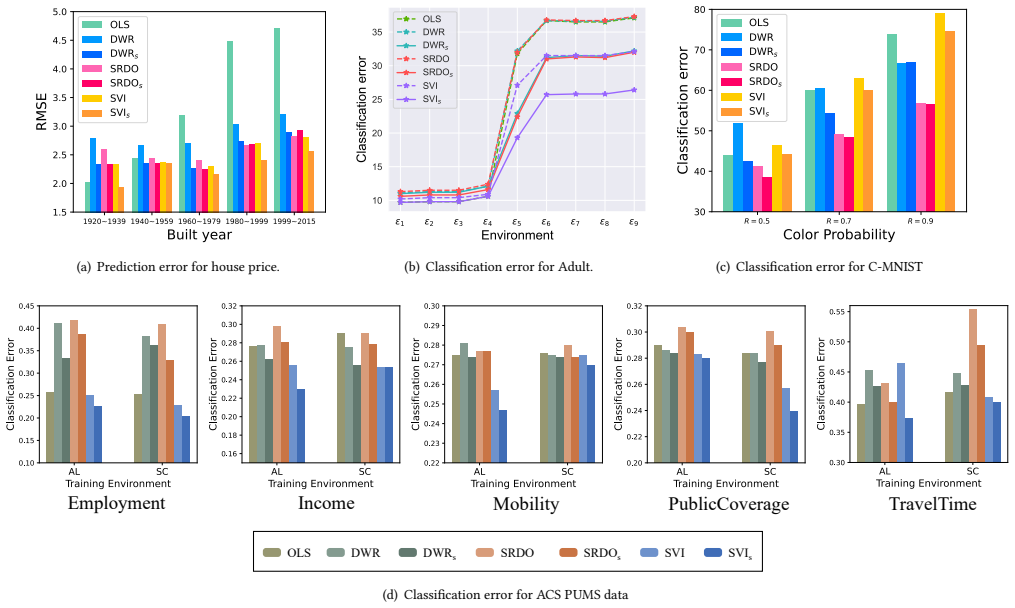
- [§4.3.2, Tables 1–2] The experimental comparison rests on averages over 10 runs, but no standard deviations, confidence intervals, or significance tests for these run-level averages are reported. The Std_Error column is the dispersion across test environments, not across the 10 repetitions, so it does not indicate whether the SAWA improvements are stable across random seeds. Given that the theoretical improvement is not guaranteed, the empirical claim of consistent superiority needs run-level variability reported (e.g., mean ± std over seeds) or paired tests.
minor comments (5)
- [§3.2] The phrase 'DWR is well fitted for the case' should be 'well suited'; also, please clarify that the DWR objective in Eq. (3) is pairwise covariance only, while Proposition 3.1 additionally imposes a weighted mean constraint.
- [§3.3.2, Eq. (5) and Prop. 3.4] Equation (5) evaluates the squared error under P_te, while Proposition 3.4 defines epsilon^2 under P_tr; the relationship between these two error measures should be stated explicitly.
- [§4.3.4, Figure 1(b)] The bias and variance quantities plotted in Figure 1(b) are not defined in the text; please specify whether they are averaged over test environments, over coefficient vectors, or over the 10 experimental runs.
- [Algorithm 1] The averaging step should state whether the returned weights are renormalized to satisfy the constraint E_P[w]=1 from Definition 3.1; if no renormalization is applied, the finite-sample weights may deviate from the stated weighting-function set.
- [§3.3.1, Prop. 3.2] The claim that W_lin is 'rich' because functions a and b can arbitrary change is informal; please give a precise statement of the function class and the conditions under which the NTK approximation applies to the experimental MLP implementation.
Circularity Check
No significant circularity: the theoretical claims are an unproven-conditioned variance decomposition plus an imported prior bound, not a derivation that reduces to its inputs.
full rationale
The paper's derivation chain does not exhibit a circular step. Proposition 3.3 is an algebraic identity decomposing the expected squared error of averaged weights into bias, variance/K, and a covariance term; it is not fitted to data and does not by itself assert improvement. Proposition 3.4 is an imported bound from Xu et al. [51] relating coefficient error to weight-learning error; it is monotone in epsilon^2 but is not constructed from SAWA's own outputs. The central claim that averaging reduces epsilon^2 depends on the unproved assumption that the covariance term in Eq. (5) is favorable or dominated by variance reduction; this is a theoretical gap or a condition on the algorithm, but it is not a self-definitional equivalence or a fitted parameter renamed as a prediction. Propositions 3.1 and 3.2 establish only that the averaged weight lies in the solution set of the convex weight-learning problem, which is validity, not error reduction. The empirical sections benchmark against OLS, Ridge, DWR, SRDO, SVI, and real-world datasets, so the reported improvements are external evidence rather than consequences of the paper's equations. The paper cites prior work by overlapping authors (Xu et al. [51], Yu et al. [53]) for the foundation of independence-based reweighting, but those are prior theoretical results with stated assumptions and are not invoked as a uniqueness theorem to rule out alternatives; hence they are independent support, not load-bearing circularity. Overall, no prediction reduces to its input by construction.
Assumptions & free parameters
free parameters (1)
- K (number of averaged weight sets) =
10
assumptions (4)
- domain assumption There exists a minimal stable variable set S such that E[Y|S]=E[Y|X] and the covariates can be split into stable S and unstable V (Definition 3.2).
- domain assumption For the weighted distribution P_w, the minimal stable variable set S is the optimal predictor under test distribution, and WLS with w in W_perp yields zero coefficients on V almost surely (Xu et al. [51]).
- ad hoc to paper The optimization problems for DWR and SRDO have convex solution sets under the stated conditions (Props 3.1 and 3.2).
- ad hoc to paper The pairwise covariance term in Eq. (5) is small enough or favorable so that averaging reduces expected error.
Cite this review
Pith. "Pith review of Sample Weight Averaging for Stable Prediction." pith.science (2026). https://pith.science/paper/MUVLFE4S
@misc{pith2026250207414,
  author       = {Pith},
  title        = {Pith review of: Sample Weight Averaging for Stable Prediction},
  year         = {2026},
  howpublished = {\url{https://pith.science/paper/MUVLFE4S}},
  note         = {Machine review of arXiv:2502.07414}
}
read the original abstract
The challenge of Out-of-Distribution (OOD) generalization poses a foundational concern for the application of machine learning algorithms to risk-sensitive areas. Inspired by traditional importance weighting and propensity weighting methods, prior approaches employ an independence-based sample reweighting procedure. They aim at decorrelating covariates to counteract the bias introduced by spurious correlations between unstable variables and the outcome, thus enhancing generalization and fulfilling stable prediction under covariate shift. Nonetheless, these methods are prone to experiencing an inflation of variance, primarily attributable to the reduced efficacy in utilizing training samples during the reweighting process. Existing remedies necessitate either environmental labels or substantially higher time costs along with additional assumptions and supervised information. To mitigate this issue, we propose SAmple Weight Averaging (SAWA), a simple yet efficacious strategy that can be universally integrated into various sample reweighting algorithms to decrease the variance and coefficient estimation error, thus boosting the covariate-shift generalization and achieving stable prediction across different environments. We prove its rationality and benefits theoretically. Experiments across synthetic datasets and real-world datasets consistently underscore its superiority against covariate shift.
Figures


Reference graph
Works this paper leans on
-
[1]
Martin Arjovsky, Léon Bottou, Ishaan Gulrajani, and David Lopez-Paz. 2019. Invariant risk minimization. arXiv preprint arXiv:1907.02893 (2019)
arXiv 2019
-
[2]
Devansh Arpit, Huan Wang, Yingbo Zhou, and Caiming Xiong. 2022. Ensemble of averages: Improving model selection and boosting performance in domain generalization. Advances in Neural Information Processing Systems 35 (2022), 8265–8277
work page 2022
-
[3]
Yogesh Balaji, Swami Sankaranarayanan, and Rama Chellappa. 2018. Metareg: Towards domain generalization using meta-regularization. Advances in neural information processing systems 31 (2018)
2018
-
[4]
Shai Ben-David, John Blitzer, Koby Crammer, and Fernando Pereira. 2006. Anal- ysis of representations for domain adaptation. Advances in neural information processing systems 19 (2006)
work page 2006
-
[5]
Steffen Bickel, Michael Brückner, and Tobias Scheffer. 2009. Discriminative learning under covariate shift. Journal of Machine Learning Research 10, 9 (2009)
work page 2009
-
[6]
Leo Breiman. 1996. Bagging predictors. Machine learning 24 (1996), 123–140
work page 1996
-
[7]
Tom Brown, Benjamin Mann, Nick Ryder, Melanie Subbiah, Jared D Kaplan, Prafulla Dhariwal, Arvind Neelakantan, Pranav Shyam, Girish Sastry, Amanda Askell, et al. 2020. Language models are few-shot learners. Advances in neural information processing systems 33 (2020), 1877–1901
2020
-
[8]
Junbum Cha, Sanghyuk Chun, Kyungjae Lee, Han-Cheol Cho, Seunghyun Park, Yunsung Lee, and Sungrae Park. 2021. Swad: Domain generalization by seeking flat minima. Advances in Neural Information Processing Systems 34 (2021), 22405– 22418
2021
Show all 57 references
-
[9]
Wen-Sheng Chu, Fernando De la Torre, and Jeffrey F Cohn. 2016. Selective transfer machine for personalized facial expression analysis. IEEE transactions on pattern analysis and machine intelligence 39, 3 (2016), 529–545
2016
-
[10]
Peng Cui and Susan Athey. 2022. Stable learning establishes some common ground between causal inference and machine learning. Nature Machine Intelli- gence 4, 2 (2022), 110–115
2022
-
[11]
Frances Ding, Moritz Hardt, John Miller, and Ludwig Schmidt. 2021. Retiring adult: New datasets for fair machine learning. Advances in neural information processing systems 34 (2021), 6478–6490
2021
-
[12]
John C Duchi and Hongseok Namkoong. 2021. Learning models with uniform performance via distributionally robust optimization. The Annals of Statistics 49, 3 (2021), 1378–1406
2021
-
[13]
Robert Geirhos, Jörn-Henrik Jacobsen, Claudio Michaelis, Richard Zemel, Wieland Brendel, Matthias Bethge, and Felix A Wichmann. 2020. Shortcut learn- ing in deep neural networks. Nature Machine Intelligence 2, 11 (2020), 665–673
2020
-
[14]
Muhammad Ghifary, W Bastiaan Kleijn, Mengjie Zhang, and David Balduzzi
-
[15]
Benyamin Ghojogh and Mark Crowley. 2019. The theory behind overfitting, cross validation, regularization, bagging, and boosting: tutorial. arXiv preprint arXiv:1905.12787 (2019)
2019 arXiv
-
[16]
Xavier Glorot and Yoshua Bengio. 2010. Understanding the difficulty of training deep feedforward neural networks. In Proceedings of the thirteenth international conference on artificial intelligence and statistics . JMLR Workshop and Conference Proceedings, 249–256
2010
-
[17]
Kaiming He, Xiangyu Zhang, Shaoqing Ren, and Jian Sun. 2016. Deep residual learning for image recognition. In Proceedings of the IEEE conference on computer vision and pattern recognition . 770–778
2016
-
[18]
Jiayuan Huang, Arthur Gretton, Karsten Borgwardt, Bernhard Schölkopf, and Alex Smola. 2006. Correcting sample selection bias by unlabeled data. Advances in neural information processing systems 19 (2006)
2006
-
[19]
Guido W Imbens and Donald B Rubin. 2015. Causal inference in statistics, social, and biomedical sciences. Cambridge University Press
2015
-
[20]
Leslie Kish. 2011. Survey sampling. In Survey sampling. 643–643
2011
-
[21]
Ron Kohavi et al . 1996. Scaling up the accuracy of naive-bayes classifiers: A decision-tree hybrid.. In Kdd, Vol. 96. 202–207
1996
-
[22]
Masanori Koyama and Shoichiro Yamaguchi. 2020. Out-of-distribution general- ization with maximal invariant predictor. (2020)
2020
-
[23]
David Krueger, Ethan Caballero, Joern-Henrik Jacobsen, Amy Zhang, Jonathan Binas, Dinghuai Zhang, Remi Le Priol, and Aaron Courville. 2021. Out-of- distribution generalization via risk extrapolation (rex). InInternational Conference on Machine Learning. PMLR, 5815–5826
2021
-
[24]
Kun Kuang, Ruoxuan Xiong, Peng Cui, Susan Athey, and Bo Li. 2020. Stable pre- diction with model misspecification and agnostic distribution shift. InProceedings of the AAAI Conference on Artificial Intelligence , Vol. 34. 4485–4492
2020
-
[25]
Brian K Lee, Justin Lessler, and Elizabeth A Stuart. 2010. Improving propensity score weighting using machine learning. Statistics in medicine 29, 3 (2010), 337–346
2010
-
[26]
Jaehoon Lee, Lechao Xiao, Samuel Schoenholz, Yasaman Bahri, Roman Novak, Jascha Sohl-Dickstein, and Jeffrey Pennington. 2019. Wide neural networks of any depth evolve as linear models under gradient descent. Advances in neural information processing systems 32 (2019)
2019
-
[27]
Da Li, Yongxin Yang, Yi-Zhe Song, and Timothy M Hospedales. 2018. Learning to generalize: Meta-learning for domain generalization. In Thirty-Second AAAI Conference on Artificial Intelligence
2018
-
[28]
Da Li, Jianshu Zhang, Yongxin Yang, Cong Liu, Yi-Zhe Song, and Timothy M Hospedales. 2019. Episodic training for domain generalization. In Proceedings of the IEEE/CVF International Conference on Computer Vision . 1446–1455
2019
-
[29]
Fan Li, Kari Lock Morgan, and Alan M Zaslavsky. 2018. Balancing covariates via propensity score weighting. J. Amer. Statist. Assoc. 113, 521 (2018), 390–400
2018
-
[30]
Haoliang Li, Sinno Jialin Pan, Shiqi Wang, and Alex C Kot. 2018. Domain gener- alization with adversarial feature learning. In Proceedings of the IEEE conference on computer vision and pattern recognition . 5400–5409
2018
-
[31]
Evan Z Liu, Behzad Haghgoo, Annie S Chen, Aditi Raghunathan, Pang Wei Koh, Shiori Sagawa, Percy Liang, and Chelsea Finn. 2021. Just train twice: Improving group robustness without training group information. InInternational Conference on Machine Learning. PMLR, 6781–6792
2021
-
[32]
Jiashuo Liu, Zheyuan Hu, Peng Cui, Bo Li, and Zheyan Shen. 2021. Heterogeneous risk minimization. In International Conference on Machine Learning . PMLR, 6804– 6814
2021
-
[33]
Jiashuo Liu, Jiayun Wu, Bo Li, and Peng Cui. 2022. Distributionally robust optimization with data geometry. Advances in neural information processing systems 35 (2022), 33689–33701
2022
-
[34]
Mingsheng Long, Yue Cao, Jianmin Wang, and Michael Jordan. 2015. Learning transferable features with deep adaptation networks. In International conference on machine learning. PMLR, 97–105
2015
-
[35]
Luca Martino, Víctor Elvira, and Francisco Louzada. 2017. Effective sample size for importance sampling based on discrepancy measures. Signal Processing 131 (2017), 386–401
2017
-
[36]
Aditya Menon and Cheng Soon Ong. 2016. Linking losses for density ratio and class-probability estimation. In International Conference on Machine Learning . PMLR, 304–313
2016
-
[37]
Khan Muhammad, Amin Ullah, Jaime Lloret, Javier Del Ser, and Victor Hugo C de Albuquerque. 2020. Deep learning for safe autonomous driving: Current challenges and future directions. IEEE Transactions on Intelligent Transportation Systems 22, 7 (2020), 4316–4336
2020
-
[38]
Fengchun Qiao, Long Zhao, and Xi Peng. 2020. Learning to learn single domain generalization. In Proceedings of the IEEE/CVF Conference on Computer Vision and Pattern Recognition. 12556–12565
2020
-
[39]
Alexandre Rame, Corentin Dancette, and Matthieu Cord. 2022. Fishr: Invari- ant gradient variances for out-of-distribution generalization. In International Conference on Machine Learning . PMLR, 18347–18377
2022
-
[40]
Alexandre Rame, Matthieu Kirchmeyer, Thibaud Rahier, Alain Rakotomamonjy, Patrick Gallinari, and Matthieu Cord. 2022. Diverse weight averaging for out-of- distribution generalization. Advances in Neural Information Processing Systems 35 (2022), 10821–10836
2022
-
[41]
Shiori Sagawa, Aditi Raghunathan, Pang Wei Koh, and Percy Liang. 2020. An investigation of why overparameterization exacerbates spurious correlations. In International Conference on Machine Learning . PMLR, 8346–8356
2020
-
[42]
Shiv Shankar, Vihari Piratla, Soumen Chakrabarti, Siddhartha Chaudhuri, Preethi Jyothi, and Sunita Sarawagi. 2018. Generalizing Across Domains via Cross- Gradient Training. In International Conference on Learning Representations
2018
-
[43]
Zheyan Shen, Peng Cui, Jiashuo Liu, Tong Zhang, Bo Li, and Zhitang Chen. 2020. Stable learning via differentiated variable decorrelation. InProceedings of the 26th ACM SIGKDD International Conference on Knowledge Discovery & Data Mining . 2185–2193
2020
-
[44]
Zheyan Shen, Peng Cui, Tong Zhang, and Kun Kunag. 2020. Stable learning via sample reweighting. In Proceedings of the AAAI Conference on Artificial Intelli- gence, Vol. 34. 5692–5699
2020
-
[45]
Zheyan Shen, Jiashuo Liu, Yue He, Xingxuan Zhang, Renzhe Xu, Han Yu, and Peng Cui. 2021. Towards out-of-distribution generalization: A survey. arXiv preprint arXiv:2108.13624 (2021)
2021 arXiv
-
[46]
Aman Sinha, Hongseok Namkoong, and John Duchi. 2018. Certifying Some Distributional Robustness with Principled Adversarial Training. In International Conference on Learning Representations
2018
-
[47]
Harry Surden. 2014. Machine learning and law. Wash. L. Rev. 89 (2014), 87
2014
-
[48]
Robert Tibshirani. 1996. Regression shrinkage and selection via the lasso.Journal of the Royal Statistical Society Series B: Statistical Methodology 58, 1 (1996), 267– 288
1996
-
[49]
Andrei N Tikhonov. 1963. Solution of incorrectly formulated problems and the regularization method. Sov Dok 4 (1963), 1035–1038
1963
-
[50]
Riccardo Volpi, Hongseok Namkoong, Ozan Sener, John C Duchi, Vittorio Murino, and Silvio Savarese. 2018. Generalizing to unseen domains via adversarial data augmentation. Advances in neural information processing systems 31 (2018)
2018
-
[51]
Renzhe Xu, Xingxuan Zhang, Zheyan Shen, Tong Zhang, and Peng Cui. 2022. A Theoretical Analysis on Independence-driven Importance Weighting for Covariate-shift Generalization. In International Conference on Machine Learning . PMLR, 24803–24829
2022
-
[52]
Yutaro Yamada, Ofir Lindenbaum, Sahand Negahban, and Yuval Kluger. 2020. Feature selection using stochastic gates. In International Conference on Machine Learning. PMLR, 10648–10659
2020
-
[53]
Han Yu, Peng Cui, Yue He, Zheyan Shen, Yong Lin, Renzhe Xu, and Xingxuan Zhang. 2023. Stable Learning via Sparse Variable Independence. In Proceedings of the AAAI Conference on Artificial Intelligence , Vol. 37. 10998–11006
2023
-
[54]
Xingxuan Zhang, Peng Cui, Renzhe Xu, Linjun Zhou, Yue He, and Zheyan Shen
-
[55]
Kaiyang Zhou, Yongxin Yang, Yu Qiao, and Tao Xiang. 2020. Domain Generaliza- tion with MixStyle. In International Conference on Learning Representations
2020
-
[2015]
In Proceedings of the IEEE international conference on computer vision
Domain generalization for object recognition with multi-task autoencoders. In Proceedings of the IEEE international conference on computer vision . 2551–2559
-
[2021]
InProceedings of the IEEE/CVF Conference on Computer Vision and Pattern Recognition
Deep stable learning for out-of-distribution generalization. InProceedings of the IEEE/CVF Conference on Computer Vision and Pattern Recognition . 5372–5382
Reviewed August 8, 2026 · model on record in the stance chip above.
Discussion (0). Continue with ORCID to comment.