REVIEW 3 major objections 5 minor 1 cited by
Flipped Rotating Axion Non-minimally Coupled to Gravity: Baryogenesis and Dark Matter
T0 review · 3 major / 5 minor · reviewed 2026-08-07 · deepseek-v4-flash
Pith's one-line read A single spectator axion, non-minimally coupled to gravity, can rotate after inflation and generate both the baryon asymmetry and dark matter.
desk verdict A well-motivated cogenesis idea with an honest but unresolved constant-xi window; the running-coupling bridge needs to be made concrete before the mechanism is viable. read the letter →
The pith
A machine-rendered reading of the paper's core claim, the machinery that carries it, and where it could break.
The reading
What carries the argument
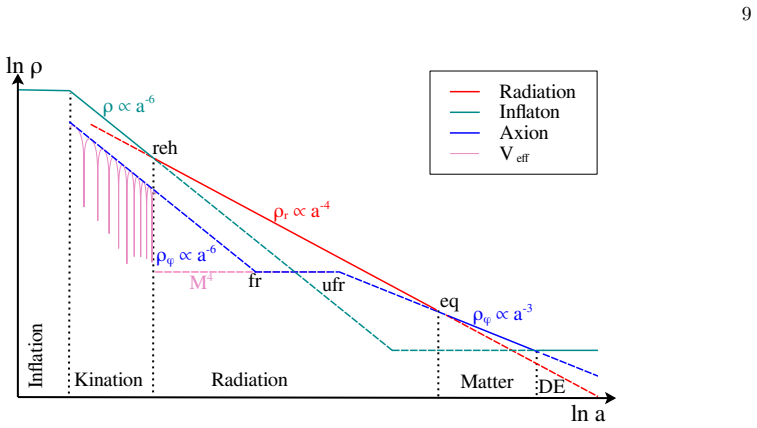
The load-bearing object is the periodic non-minimal coupling $\gamma^2(\phi)=1+\xi[1-\cos(\phi/f)]$ in Eq. (2), inserted into $\mathcal{L}=\frac12 m_P^2\gamma^2 R-\frac12(\partial\phi)^2-M^4[1-\cos(\phi/f)]$. This coupling respects the discrete shift symmetry while tying the height and sign of the axion's cosine potential to the Ricci scalar; when $R$ changes sign at the inflation-to-kination transition, the minimum and maximum swap, and the matched $a^{-6}$ scaling of the barrier height and of the rolling kinetic energy lets the axion cross the barrier each cycle and rotate. The same object sets the condition (Eq. (9)) for rolling, the baryon yield (Eq. (26)) through $\dot\theta_m \simeq \sqrt{12\xi}\,m_P H_{\rm end}/f$, and the constraints from fragmentation (Eqs. (60), (65)) and the Kibble problem (Eq. (67)).
What would settle it
Numerically evolve the homogeneous axion together with its fluctuation modes using a concrete running coupling $\xi(\sigma)$ from Eq. (68) that interpolates between $\xi<\frac14(f/m_P)^2$ at the end of inflation and $\xi>\frac34(f/m_P)^2$ during kination. If for all choices of $\beta$ and $\mu$ the angular velocity $\dot\theta$ drops below $\sqrt{|V_{\rm eff}|}/f$ before reheating, or the fluctuation modes grow enough to stop the rotation, then the cogenesis mechanism fails in the regime the paper needs.
Extended reading notes
Core claim
The paper's claim is that cogenesis can be driven by a 'flipped rotating axion': the effective potential appearing in Eq. (5), $V_{\rm eff} = (M^4 - \frac12 \xi m_P^2 R)[1-\cos(\phi/f)]$, changes phase between inflation and kination because $R=3(1-3w)H^2$ flips sign. During inflation the minimum sits at $\phi=\pi f$; during kination that point becomes the top of the barrier and the new minimum is at zero. Because both the barrier height and the axion's kinetic energy scale as $a^{-6}$ in kination, the field slides over the diminishing barrier and enters sustained rotation. The rotation gives a baryon yield $Y_B \simeq (3\sqrt{30}\,\xi c_B / 2\pi\sqrt{g_*})\, T_{B-L}^2/(f T_{\rm reh})$ through spontaneous baryogenesis, while later freezing and thawing in the bare potential $M^4[1-\cos(\phi/f)]$ produces the dark matter abundance with $M\sim 10^{-9}\,{\rm GeV}\,(m_P/f)^{3/2}$. In the concrete Type-I seesaw realization the rotating axion is the Majoron, with sub-eV mass and right-handed neutrino masses above $3\times10^8$ GeV, and the kination era makes the inflationary gravitational-wave background blue-tilted and constrained by BBN.
Load-bearing premise
The load-bearing premise is that a running non-minimal coupling $\xi(\sigma)$ can smoothly grow from below $\frac14(f/m_P)^2$ during inflation to above $\frac34(f/m_P)^2$ during kination, so that the axion both avoids the Kibble problem and acquires enough kick to rotate; the paper offers this as a possibility (Eq. (68)) without a concrete model or simulation showing that the rotation starts and persists under the running coupling.
Editorial extensions
If this is right
- Cogenesis needs only one spectator field: the axion's rotation generates the baryon asymmetry, and its later oscillations in the bare potential produce the dark matter, with no separate dark sector.
- The axion mass decouples from the baryon asymmetry (cf. Eq. (26) vs Eq. (35)), so the Majoron can be lighter than sub-eV while the seesaw's right-handed neutrinos sit above about $10^8$ GeV; this is the concrete prediction of the Type-I seesaw realization.
- The kination era turns the inflationary gravitational-wave spectrum blue-tilted; avoiding overproduction during BBN forces $T_{\rm reh}\gtrsim2\times10^7$ GeV, and near-future CMB and GW experiments can probe the resulting $\Delta N_{\rm eff}$ and peak frequency.
- Both fragmentation and the Kibble problem push $\xi$ toward $(f/m_P)^2$, which in the GUT-scale example means $\xi\sim10^{-4}$ and ties the baryogenesis condition to $T_{B-L}^2/T_{\rm reh}\sim Y_B m_P$.
- If the reheating temperature is too low for the field to freeze (violating Eq. (36)), the axion can still become dark matter by switching from rotation to coherent oscillations once its mass catches up with the Hubble rate.
Reading between the lines
- The paper leaves the running of $\xi$ as a loose end; a concrete UV model that fixes $\beta$ and $\mu$ in Eq. (68) would either close the gap between the rolling bound and the Kibble bound or reveal that the rotation window is empty.
- Because the sign of the rotation is set by quantum diffusion during inflation, the mechanism predicts a single, coherent rotation direction inside our horizon; a dedicated calculation of the induced isocurvature power spectrum could turn that prediction into a CMB polarization test.
- The fragmentation estimates neglect backreaction; a lattice simulation at $\xi\sim(f/m_P)^2$ would show whether the baryon yield in Eq. (26) needs an order-one efficiency correction, which would shift the inferred right-handed neutrino mass scale.
- Nothing in the mechanism binds the axion mass to the baryon asymmetry; applying the same flipped-potential kick to other pNGBs, such as a QCD-axion-like state whose potential appears at a late phase transition, could open a new route to kinetic misalignment, though the paper only gestures at this extension.
Editorial analysis
A structured set of objections, weighed in public.
Referee Report
Summary. The paper proposes a cogenesis mechanism in which an axion-like particle non-minimally coupled to gravity acquires a rotating expectation value when the Ricci scalar flips sign at the transition from inflation (w = -1) to kination (w = 1). The effective potential changes phase, giving the axion a kinetic kick, and the decreasing potential barrier in kination sustains the rotation. The rotating axion generates the baryon asymmetry via spontaneous baryogenesis (Eq. (26)) and later freezes and oscillates as dark matter when the bare mass potential dominates (Eqs. (32)-(35)). The authors derive constraints on the non-minimal coupling ξ and reheating temperature from gravitational waves, axion fragmentation, and the Kibble mechanism, and apply the setup to the Majoron in a Type-I seesaw model, finding Majoron masses below sub-eV and right-handed neutrino masses above roughly 10^8 GeV.
Significance. If the mechanism is realized, it offers a novel way to source axion rotation without explicit U(1) breaking operators, potentially achieving both baryogenesis and dark matter from a single spectator field, with testable gravitational-wave spectra and neutrino-mass relations. The paper contains useful analytic estimates for the baryon yield, dark matter scale, and gravitational-wave spectrum, and it includes numerical background solutions for rotation and fluctuations. However, the central viability is currently weakened by the unresolved tension between the rolling condition and the Kibble bound, and by the unquantified running coupling invoked to bridge them; the claimed parameter space therefore lacks a demonstrated point where all constraints are simultaneously satisfied.
major comments (3)
- [Section VIII, Eqs. (9), (67), (68)] The constant-ξ windows in Eqs. (9) and (67) are disjoint: Eq. (9) requires ξ > (3/4)(f/mP)^2 for rolling, while Eq. (67) requires ξ < (1/4)(f/mP)^2 to avoid the Kibble problem. The rescuing running coupling ξ(σ) of Eq. (68) is only an ansatz; the paper gives no concrete model or numerical demonstration that ξ rises by the required factor of a few during kination while preserving the assumptions used to derive the rotation, the baryon yield, and the dark matter scale. The text near Eq. (69) claiming ξ ∼ (f/mP)^2 is 'near the edge of both ranges' is inaccurate, since (f/mP)^2 is a factor of 4 above the Eq. (67) upper bound.
- [Section III, Eq. (26) and Section VIII text] The baryon yield Eq. (26) uses θ̇_m from Eq. (21), derived for ξ ≫ (f/mP)^2. In the parameter space judged viable in Section VIII (ξ ∼ (f/mP)^2, Eq. (69)), the paper states that Eq. (21) is unreliable and appeals to the average θ̇ remaining close to the barrier height; however, no quantitative estimate or simulation of this average for ξ ∼ (f/mP)^2 is given. Fig. 2 shows that θ̇ oscillates, and the average may differ from Eq. (21) by an O(1) or larger factor, which directly enters the central YB prediction through Eq. (22).
- [Section II, Fig. 2] The numerical demonstration of rotation in Fig. 2 is performed for constant ξ ≥ (f/mP)^2, i.e., values that violate the Kibble-safe bound of Eq. (67). The paper does not present a numerical evolution with the running ξ(σ) of Eq. (68), so the sustained rotation in the argued consistent parameter space is not demonstrated. A benchmark simulation with ξ starting below (1/4)(f/mP)^2 and growing to above (3/4)(f/mP)^2 during kination would directly address this gap.
minor comments (5)
- [Eq. (22)] The phrase 'entropy energy density' should read 'entropy density'.
- [Section VII, after Eq. (60)] The phrase 'compared to blue the bound' should read 'compared to the bound'.
- [Abstract and throughout] The spelling of 'co-genesis' in the abstract and 'cogenesis' elsewhere should be harmonised.
- [Section VIII, after Eq. (66)] The statement that the lower bound in Eq. (9) is 'mildly violated' is misleading; the upper bound of Eq. (67) is a factor of 3 below the lower bound of Eq. (9), which is not a mild violation.
- [Figs. 2 and 6] The numerical setup is not fully specified; a short paragraph describing the time-stepping, initial conditions, and any back-reaction treatment would improve reproducibility.
Circularity Check
No circular derivation: rotation, Y_B, and Omega_DM are computed from explicit dynamics, with observed values used as constraints; the running-xi bridge between Eqs. (9) and (67) is an acknowledged modeling gap, not a circular step.
full rationale
The paper's derivation chain is self-contained. The periodic non-minimal coupling is an explicit model input (Eq. (2)), and the potential flip (Eqs. (6)-(7)) follows from R = 3(1 - 3w)H^2 with w = -1 to w = +1, not from the baryon or dark-matter abundances. Rotation is established by numerically solving Eq. (18) with the quantum-diffusion initial condition (19); Fig. 2 shows barrier crossing for xi = (f/m_P)^2 and larger, so the central dynamical claim is not assumed as an output. The baryon yield (26) is derived from the standard spontaneous-baryogenesis formula using the rotation velocity and its redshift; the observed Y_B is then used to constrain T_{B-L}^2/T_reh (Eq. (28)), which is normal model-building, not a fitted-input-as-prediction. The dark-matter relation (35) follows from matching the rotating-axion energy density to the observed dark-matter abundance at equality, again a constraint rather than a circular definition. Self-citations (e.g., Refs. [93], [116]) are pointers to earlier Ricci-reheating and gravitational-wave calculations whose relevant results are reproduced or stated in the text; they are not load-bearing. The paper itself flags the unresolved issues: to connect the Kibble-safe bound xi < (1/4)(f/m_P)^2 (Eq. (67)) with the rolling bound xi > (3/4)(f/m_P)^2 (Eq. (9)) it introduces a running xi(sigma) and says 'changing xi by an order of magnitude seems quite realistic' (Sec. VIII), while also stating 'We leave a detailed numerical simulation for future studies'; in the low-xi regime it admits 'our estimate of thetadot_m given by Eq. (21) is unreliable' with only order-of-magnitude validity claimed. These are honestly acknowledged modeling and viability gaps, not input-output equivalence. No step reduces a 'prediction' to its own input by construction; hence no significant circularity.
Assumptions & free parameters
free parameters (8)
- xi, non-minimal coupling strength =
~ (f/mP)^2, e.g. 1e-4 for f ~ 1e-2 mP
- f, axion decay constant =
>= 1e11 GeV; benchmark f ~ 1e-2 mP
- M, bare symmetry-breaking scale (axion mass m_phi = M^2/f) =
M ~ 1e-9 GeV (mP/f)^{3/2}
- Treh, reheating temperature =
>~ 2.2e7 GeV from Planck DeltaNeff bound
- TB-L, decoupling temperature of B-L interactions (or MN/zfo) =
Constrained by observed YB; benchmark TB-L ~ 8e7 GeV
- cB, O(1) transport coefficient =
O(1)
- zfo, freeze-out parameter for RHN inverse decays =
O(10)
- xi0, beta, mu in the running coupling xi(sigma) =
Not specified
assumptions (8)
- standard math FRW background with radiation, matter and kination, and R = 3(1-3w)H^2.
- domain assumption The periodic non-minimal coupling gamma^2 = 1 + xi(1-cos(phi/f)) preserves the discrete shift symmetry and can be treated as a purely effective potential term.
- domain assumption The axion remains a spectator with subdominant energy density during rotation, rho_phi/rho = 2xi << 1.
- domain assumption The bare mass term M^4 is negligible during inflation and kination compared with the xi-dependent term.
- domain assumption A thermal bath is present during kination with a maximum temperature bounded by Tmax ~ (sqrt(lambda)/g) f, and the U(1) symmetry remains broken.
- domain assumption B-L violating inverse decays are in equilibrium down to TB-L and act as a wash-in source, with no other significant source or washout of the asymmetry.
- ad hoc to paper The running non-minimal coupling xi(sigma) in Eq. (68) can increase xi by a couple of orders of magnitude during kination without spoiling inflation or the rotation.
- ad hoc to paper Quantum diffusion during inflation gives the mean-squared displacement in Eq. (66) and homogenizes the direction of rotation within our observable universe.
Cite this review
Pith. "Pith review of Flipped Rotating Axion Non-minimally Coupled to Gravity: Baryogenesis and Dark Matter." pith.science (2026). https://pith.science/paper/MVGZWKMW
@misc{pith2026250208720,
  author       = {Pith},
  title        = {Pith review of: Flipped Rotating Axion Non-minimally Coupled to Gravity: Baryogenesis and Dark Matter},
  year         = {2026},
  howpublished = {\url{https://pith.science/paper/MVGZWKMW}},
  note         = {Machine review of arXiv:2502.08720}
}
abstract
We demonstrate that the co-genesis of baryon asymmetry and dark matter can be achieved through the rotation of an axion-like particle, driven by a flip in the vacuum manifold's direction at the end of inflation. This can occur if the axion has a periodic non-minimal coupling to gravity, while preserving the discrete shift symmetry. In non-oscillating inflation models, after inflation there is typically a period of kination (with $w = 1$). In this case, it is shown that the vacuum manifold of the axion is flipped and the axion begins rotating in field space, because it can slide across the decreasing potential barrier as in Ricci reheating. Such a rotating axion can generate the baryon asymmetry of the Universe through spontaneous baryogenesis, while at later epochs it can oscillate as dark matter. The period of kination makes the primordial gravitational waves (GW) generated during inflation sharply blue-tilted which constrains the parameter space due to GW overproduction, while being testable by next generation CMB experiments. As a concrete example, we show that such a cogenesis of baryon asymmetry and dark matter can be realized for the axion as the Majoron in the Type-I seesaw setup, predicting mass ranges for the Majoron below sub eVs, with right-handed neutrino mass above $\mathcal{O}(10^{8})$ GeV. We also show that in order to avoid fragmentation of the axion condensate during the rotation, we require the non-minimal coupling $\xi \sim (f/m_P)^2 $ or somewhat larger, where $f$ is the axion decay constant.
Figures


Figures from the paper (3 more)


Forward citations
Cited by 1 Pith paper
-
Flipped rotating axion: Baryogenesis and Dark Matter
A flipped vacuum manifold for a non-minimally coupled spectator ALP generates both baryon asymmetry through spontaneous baryogenesis and cold dark matter from later oscillations when ξ ∼ (f/m_P)^{2}.
Reference graph
Works this paper leans on
-
[1]
A. A. Starobinsky, Phys. Lett. B 91, 99 (1980)
1980
-
[2]
Sato, Mon
K. Sato, Mon. Not. Roy. Astron. Soc. 195, 467 (1981)
1981
-
[3]
Kazanas, Astrophys
D. Kazanas, Astrophys. J. Lett. 241, L59 (1980)
1980
-
[4]
A. H. Guth, Phys. Rev. D 23, 347 (1981)
1981
-
[5]
N. Aghanim et al. (Planck), Astron. Astrophys. 641, A6 (2020), [Erratum: Astron.Astrophys. 652, C4 (2021)], arXiv:1807.06209 [astro- ph.CO]
arXiv 2020
- [6]
-
[7]
Hazumi et al., J
M. Hazumi et al., J. Low Temp. Phys. 194, 443 (2019)
2019
-
[8]
H. Sugai et al., J. Low. Temp. Phys. 199, 1107 (2020), arXiv:2001.01724 [astro-ph.IM]
arXiv 2020
Show all 157 references
-
[9]
Abazajian et al
K. Abazajian et al. (CMB-S4), Astrophys. J. 926, 54 (2022), arXiv:2008.12619 [astro- ph.CO]
2022 arXiv
- [10]
-
[11]
D. Adak, A. Sen, S. Basak, J. Delabrouille, T. Ghosh, A. Rotti, G. Mart ´ ınez-Solaeche, and T. Souradeep, Mon. Not. Roy. Astron. Soc.514, 3002 (2022), arXiv:2110.12362 [astro-ph.CO]
2022 arXiv
-
[12]
Martin, C
J. Martin, C. Ringeval, and V. Vennin, JCAP 10, 038 (2014), arXiv:1407.4034 [astro-ph.CO]
2014 arXiv
-
[13]
B. A. Bassett, S. Tsujikawa, and D. Wands, Rev. Mod. Phys. 78, 537 (2006), arXiv:astro- ph/0507632
2006
-
[14]
Martin and C
J. Martin and C. Ringeval, Phys. Rev. D 82, 023511 (2010), arXiv:1004.5525 [astro-ph.CO]
2010 arXiv
-
[15]
Martin, C
J. Martin, C. Ringeval, and V. Vennin, Phys. Rev. Lett. 114, 081303 (2015), arXiv:1410.7958 [astro-ph.CO]
2015 arXiv
-
[16]
P. D. Meerburg et al. , Bull. Am. Astron. Soc. 51, 107 (2019), arXiv:1903.04409 [astro- ph.CO]
2019 arXiv
-
[17]
Allahverdi, R
R. Allahverdi, R. Brandenberger, F.-Y. Cyr- Racine, and A. Mazumdar, Ann. Rev. Nucl. Part. Sci. 60, 27 (2010), arXiv:1001.2600 [hep- th]
2010 arXiv
-
[18]
M. A. Amin, M. P. Hertzberg, D. I. Kaiser, and J. Karouby, Int. J. Mod. Phys. D 24, 1530003 (2014), arXiv:1410.3808 [hep-ph]
2014 arXiv
-
[19]
G. N. Felder, L. Kofman, and A. D. Linde, Phys. Rev. D 60, 103505 (1999), arXiv:hep- ph/9903350
1999
-
[20]
P. J. E. Peebles and A. Vilenkin, Phys. Rev. D 59, 063505 (1999), arXiv:astro-ph/9810509
1999 arXiv
-
[21]
Bettoni and J
D. Bettoni and J. Rubio, Galaxies 10, 22 (2022), arXiv:2112.11948 [astro-ph.CO]
2022 arXiv
-
[22]
de Haro and L
J. de Haro and L. A. Sal´ o, Galaxies9, 73 (2021), arXiv:2108.11144 [gr-qc]
2021 arXiv
-
[23]
Wetterich, Galaxies 10, 50 (2022), arXiv:2201.12213 [astro-ph.CO]
C. Wetterich, Galaxies 10, 50 (2022), arXiv:2201.12213 [astro-ph.CO]
2022 arXiv
- [24]
-
[25]
R. R. Caldwell, R. Dave, and P. J. Steinhardt, Phys. Rev. Lett. 80, 1582 (1998), arXiv:astro- ph/9708069
1998
-
[26]
Dimopoulos and T
K. Dimopoulos and T. Markkanen, JCAP 06, 021 (2018), arXiv:1803.07399 [gr-qc]
2018 arXiv
-
[27]
Opferkuch, P
T. Opferkuch, P. Schwaller, and B. A. Stefanek, JCAP 07, 016 (2019), arXiv:1905.06823 [gr-qc]
2019 arXiv
-
[28]
Bettoni, A
D. Bettoni, A. Lopez-Eiguren, and J. Rubio, JCAP 01, 002 (2022), arXiv:2107.09671 [hep- ph]
2022 arXiv
- [29]
-
[30]
Gouttenoire, G
Y. Gouttenoire, G. Servant, and P. Simaka- chorn, (2021), arXiv:2111.01150 [hep-ph]
2021 arXiv
-
[31]
Laverda and J
G. Laverda and J. Rubio, JCAP 03, 033 (2024), [Erratum: JCAP 06, E01 (2024)], arXiv:2307.03774 [astro-ph.CO]
2024 arXiv
-
[32]
R. D. Peccei and H. R. Quinn, Phys. Rev. Lett. 38, 1440 (1977)
1977
-
[33]
Chikashige, R
Y. Chikashige, R. N. Mohapatra, and R. D. Peccei, Phys. Lett. B 98, 265 (1981)
1981
-
[34]
C. D. Froggatt and H. B. Nielsen, Nucl. Phys. B 147, 277 (1979)
1979
-
[35]
Weinberg, Phys
S. Weinberg, Phys. Rev. Lett. 40, 223 (1978)
1978
-
[36]
Wilczek, Phys
F. Wilczek, Phys. Rev. Lett. 40, 279 (1978)
1978
-
[37]
Davidson and K
A. Davidson and K. C. Wali, Phys. Rev. Lett. 48, 11 (1982)
1982
-
[38]
D. B. Reiss, Phys. Lett. B 115, 217 (1982)
1982
-
[39]
Wilczek, Phys
F. Wilczek, Phys. Rev. Lett. 49, 1549 (1982)
1982
-
[40]
Davidson, V
A. Davidson, V. P. Nair, and K. C. Wali, Phys. Rev. D 29, 1504 (1984)
1984
-
[41]
Davidson, V
A. Davidson, V. P. Nair, and K. C. Wali, Phys. Rev. D 29, 1513 (1984)
1984
-
[42]
Arvanitaki, S
A. Arvanitaki, S. Dimopoulos, S. Dubovsky, N. Kaloper, and J. March-Russell, Phys. Rev. D 81, 123530 (2010), arXiv:0905.4720 [hep-th]
2010 arXiv
-
[43]
Georgi, D
H. Georgi, D. B. Kaplan, and L. Randall, Phys. Lett. B 169, 73 (1986)
1986
-
[44]
Jaeckel and A
J. Jaeckel and A. Ringwald, Ann. Rev. Nucl. Part. Sci. 60, 405 (2010), arXiv:1002.0329 [hep- ph]
2010 arXiv
-
[45]
Ringwald, in 49th Rencontres de Moriond on Electroweak Interactions and Unified Theories (2014) pp
A. Ringwald, in 49th Rencontres de Moriond on Electroweak Interactions and Unified Theories (2014) pp. 223–230, arXiv:1407.0546 [hep-ph]
2014 arXiv
-
[46]
Bauer, M
M. Bauer, M. Neubert, and A. Thamm, JHEP 12, 044 (2017), arXiv:1708.00443 [hep-ph]. 19
2017 arXiv
-
[47]
Brivio, M
I. Brivio, M. B. Gavela, L. Merlo, K. Mimasu, J. M. No, R. del Rey, and V. Sanz, Eur. Phys. J. C 77, 572 (2017), arXiv:1701.05379 [hep-ph]
2017 arXiv
-
[48]
K. Choi, S. H. Im, and C. Sub Shin, Ann. Rev. Nucl. Part. Sci. 71, 225 (2021), arXiv:2012.05029 [hep-ph]
2021 arXiv
-
[49]
Giannotti, J
M. Giannotti, J. Phys. Conf. Ser. 2502, 012003 (2023), arXiv:2205.06831 [hep-ph]
2023 arXiv
-
[50]
Dalla Valle Garcia, F
G. Dalla Valle Garcia, F. Kahlhoefer, M. Ovchynnikov, and A. Zaporozhchenko, Phys. Rev. D 109, 055042 (2024), arXiv:2310.03524 [hep-ph]
2024 arXiv
-
[51]
Domcke, Y
V. Domcke, Y. Ema, K. Mukaida, and M. Ya- mada, JHEP 08, 096 (2020), arXiv:2006.03148 [hep-ph]
2020 arXiv
-
[52]
E. J. Chun and T. H. Jung, Phys. Rev. D 109, 095004 (2024), arXiv:2311.09005 [hep-ph]
2024 arXiv
-
[53]
C. S. Fong, A. Ghoshal, A. Naskar, M. H. Rahat, and S. Saad, JHEP 11, 182 (2023), arXiv:2307.07550 [hep-ph]
2023 arXiv
-
[54]
Datta, S
A. Datta, S. K. Manna, and A. Sil, Phys. Rev. D 110, 095035 (2024), arXiv:2405.07003 [hep- ph]
2024 arXiv
-
[55]
Preskill, M
J. Preskill, M. B. Wise, and F. Wilczek, Phys. Lett. B 120, 127 (1983)
1983
-
[56]
L. F. Abbott and P. Sikivie, Phys. Lett. B 120, 133 (1983)
1983
-
[57]
Dine and W
M. Dine and W. Fischler, Phys. Lett. B 120, 137 (1983)
1983
-
[58]
B. Li, T. Rindler-Daller, and P. R. Shapiro, Phys. Rev. D 89, 083536 (2014), arXiv:1310.6061 [astro-ph.CO]
2014 arXiv
-
[59]
R. T. Co, D. Dunsky, N. Fernandez, A. Ghal- sasi, L. J. Hall, K. Harigaya, and J. Shelton, JHEP 09, 116 (2022), arXiv:2108.09299 [hep- ph]
2022 arXiv
-
[60]
Gouttenoire, G
Y. Gouttenoire, G. Servant, and P. Simaka- chorn, (2021), arXiv:2108.10328 [hep-ph]
2021 arXiv
-
[61]
Harigaya, K
K. Harigaya, K. Inomata, and T. Terada, Phys. Rev. D 108, L081303 (2023), arXiv:2305.14242 [hep-ph]
2023 arXiv
-
[62]
Harigaya, K
K. Harigaya, K. Inomata, and T. Terada, Phys. Rev. D 108, 123538 (2023), arXiv:2309.00228 [astro-ph.CO]
2023 arXiv
-
[63]
D. J. H. Chung and S. C. Tadepalli, (2024), arXiv:2406.12976 [astro-ph.CO]
2024 arXiv
-
[64]
Duval, S
H. Duval, S. Kuroyanagi, A. Mariotti, A. Romero-Rodr ´ ıguez, and M. Sakellari- adou, Phys. Rev. D 110, 103503 (2024), arXiv:2405.10201 [gr-qc]
2024 arXiv
-
[65]
Affleck and M
I. Affleck and M. Dine, Nucl. Phys. B 249, 361 (1985)
1985
-
[66]
R. T. Co and K. Harigaya, Phys. Rev. Lett. 124, 111602 (2020), arXiv:1910.02080 [hep-ph]
2020 arXiv
-
[67]
R. T. Co, L. J. Hall, and K. Hari- gaya, Phys. Rev. Lett. 124, 251802 (2020), arXiv:1910.14152 [hep-ph]
2020 arXiv
-
[68]
R. T. Co, L. J. Hall, K. Harigaya, K. A. Olive, and S. Verner, JCAP 08, 036 (2020), arXiv:2004.00629 [hep-ph]
2020 arXiv
-
[69]
R. T. Co, L. J. Hall, and K. Harigaya, JHEP 01, 172 (2021), arXiv:2006.04809 [hep-ph]
2021 arXiv
-
[70]
R. T. Co, N. Fernandez, A. Ghalsasi, L. J. Hall, and K. Harigaya, JHEP 03, 017 (2021), arXiv:2006.05687 [hep-ph]
2021 arXiv
-
[71]
K. S. Jeong and F. Takahashi, JHEP 04, 121 (2013), arXiv:1302.1486 [hep-ph]
2013 arXiv
-
[72]
K. S. Jeong and F. Takahashi, Phys. Lett. B 727, 448 (2013), arXiv:1304.8131 [hep-ph]
2013 arXiv
-
[73]
Higaki, K
T. Higaki, K. S. Jeong, and F. Takahashi, Phys. Lett. B 734, 21 (2014), arXiv:1403.4186 [hep- ph]
2014 arXiv
-
[74]
R. T. Co, K. Harigaya, and A. Pierce, JHEP 12, 099 (2021), arXiv:2104.02077 [hep-ph]
2021 arXiv
- [75]
-
[76]
R. T. Co, K. Harigaya, Z. Johnson, and A. Pierce, JHEP 11, 210 (2021), arXiv:2110.05487 [hep-ph]
2021 arXiv
-
[77]
R. T. Co, T. Gherghetta, and K. Harigaya, JHEP 10, 121 (2022), arXiv:2206.00678 [hep- ph]
2022 arXiv
-
[78]
Barnes, R
P. Barnes, R. T. Co, K. Harigaya, and A. Pierce, JHEP 05, 114 (2023), arXiv:2208.07878 [hep-ph]
2023 arXiv
-
[79]
R. T. Co, V. Domcke, and K. Harigaya, JHEP 07, 179 (2023), arXiv:2211.12517 [hep-ph]
2023 arXiv
- [80]
-
[81]
Berbig, JHEP 01, 061 (2024), arXiv:2307.14121 [hep-ph]
M. Berbig, JHEP 01, 061 (2024), arXiv:2307.14121 [hep-ph]
2024 arXiv
- [82]
-
[83]
Barnes, R
P. Barnes, R. T. Co, K. Harigaya, and A. Pierce, (2024), arXiv:2402.10263 [hep-ph]
2024 arXiv
-
[84]
D. G. Figueroa and C. T. Byrnes, Phys. Lett. B 767, 272 (2017), arXiv:1604.03905 [hep-ph]
2017 arXiv
-
[85]
Nakama and J
T. Nakama and J. Yokoyama, PTEP 2019, 033E02 (2019), arXiv:1803.07111 [gr-qc]
2019 arXiv
-
[86]
E. J. Chun, S. Jyoti Das, M. He, T. H. Jung, and J. Sun, (2024), arXiv:2406.04180 [hep-ph]
2024
-
[87]
R. Z. Ferreira, A. Notari, and G. Simeon, JCAP 11, 021 (2018), arXiv:1806.05511 [astro- ph.CO]
2018 arXiv
- [88]
-
[89]
Huang, A
J. Huang, A. Madden, D. Racco, and M. Reig, JHEP 10, 143 (2020), arXiv:2006.07379 [hep- ph]
2020 arXiv
-
[90]
A. G. Cohen and D. B. Kaplan, Phys. Lett. B 199, 251 (1987)
1987
-
[91]
A. G. Cohen and D. B. Kaplan, Nucl. Phys. B 308, 913 (1988)
1988
-
[92]
Salvio, JCAP 10, 011 (2021), arXiv:2107.03389 [hep-ph]
A. Salvio, JCAP 10, 011 (2021), arXiv:2107.03389 [hep-ph]
2021 arXiv
-
[93]
Ghoshal, M
A. Ghoshal, M. Y. Khlopov, Z. Lalak, and S. Porey, (2023), arXiv:2306.08675 [hep-ph]
2023 arXiv
-
[94]
Takahashi and M
F. Takahashi and M. Yamada, JCAP 10, 010 (2015), arXiv:1507.06387 [hep-ph]
2015 arXiv
- [95]
-
[96]
Bettoni and J
D. Bettoni and J. Rubio, Phys. Lett. B 784, 122 (2018), arXiv:1805.02669 [astro-ph.CO]
2018 arXiv
-
[97]
Bettoni, G
D. Bettoni, G. Laverda, A. L. Eiguren, and J. Rubio, (2024), arXiv:2409.15450 [gr-qc]
2024
-
[98]
G. N. Felder, L. Kofman, and A. D. Linde, Phys. Rev. D 59, 123523 (1999), arXiv:hep- ph/9812289. 20
1999
-
[99]
Dimopoulos, L
K. Dimopoulos, L. Donaldson Wood, and C. Owen, Phys. Rev. D 97, 063525 (2018), arXiv:1712.01760 [astro-ph.CO]
2018 arXiv
-
[100]
The left panel shows the evolution of δθk (multiplied by k3/2, making it dimensionless) for several values of ξ. Interestingly, as anticipated, we see that the growth happens only ifξ is greater than O(102) − O(103) × (f /mP )2, which is sig- nificantly relaxed compared to blu...
-
[101]
J. C. Bueno Sanchez and K. Dimopoulos, JCAP 11, 007 (2007), arXiv:0707.3967 [hep-ph]
2007 arXiv
- [102]
-
[103]
G. N. Felder, L. Kofman, and A. D. Linde, Phys. Rev. D 64, 123517 (2001), arXiv:hep- th/0106179
2001
-
[104]
Dalianis and G
I. Dalianis and G. P. Kodaxis, Galaxies 10, 31 (2022), arXiv:2112.15576 [astro-ph.CO]
2022
-
[105]
N. D. Barrie, C. Han, and H. Mu- rayama, Phys. Rev. Lett. 128, 141801 (2022), arXiv:2106.03381 [hep-ph]
2022 arXiv
-
[106]
Harigaya, JHEP 08, 085 (2019), arXiv:1906.05286 [hep-ph]
K. Harigaya, JHEP 08, 085 (2019), arXiv:1906.05286 [hep-ph]
2019 arXiv
-
[107]
N. D. Barrie and C. Han, (2024), arXiv:2402.15245 [hep-ph]
2024 arXiv
-
[108]
N. D. Barrie, C. Han, and H. Murayama, JHEP 05, 160 (2022), arXiv:2204.08202 [hep-ph]
2022 arXiv
-
[109]
Davoudiasl, R
H. Davoudiasl, R. Kitano, G. D. Kribs, H. Mu- rayama, and P. J. Steinhardt, Phys. Rev. Lett. 93, 201301 (2004), arXiv:hep-ph/0403019
2004 arXiv
-
[110]
Kajantie, M
K. Kajantie, M. Laine, K. Rummukainen, and Y. Schroder, Phys. Rev. D 67, 105008 (2003), arXiv:hep-ph/0211321
2003 arXiv
- [111]
- [112]
- [113]
-
[114]
A. Deur, V. Burkert, J. P. Chen, and W. Ko- rsch, Particles 5, 171 (2022), arXiv:2205.01169 [hep-ph]
2022 arXiv
-
[115]
D. G. Figueroa and E. H. Tanin, JCAP 08, 011 (2019), arXiv:1905.11960 [astro-ph.CO]
2019 arXiv
-
[116]
M. R. Haque, D. Maity, T. Paul, and L. Sri- ramkumar, Phys. Rev. D 104, 063513 (2021), arXiv:2105.09242 [astro-ph.CO]
2021 arXiv
- [117]
-
[118]
C. Chen, K. Dimopoulos, C. Er¨ oncel, and A. Ghoshal, Phys. Rev. D 110, 063554 (2024), arXiv:2405.01679 [hep-ph]
2024 arXiv
-
[119]
Caprini and D
C. Caprini and D. G. Figueroa, Class. Quant. Grav. 35, 163001 (2018), arXiv:1801.04268 [astro-ph.CO]
2018 arXiv
-
[120]
L. A. Boyle and A. Buonanno, Phys. Rev. D 78, 043531 (2008), arXiv:0708.2279 [astro-ph]
2008 arXiv
- [121]
-
[122]
T.-H. Yeh, J. Shelton, K. A. Olive, and B. D. Fields, JCAP 10, 046 (2022), arXiv:2207.13133 [astro-ph.CO]
2022 arXiv
- [123]
- [124]
- [125]
-
[126]
F. R. Bouchet et al. (COrE), (2011), arXiv:1102.2181 [astro-ph.CO]
2011 arXiv
-
[127]
Buchmuller, P
W. Buchmuller, P. Di Bari, and M. Plumacher, Annals Phys. 315, 305 (2005), arXiv:hep- ph/0401240
2005
-
[128]
G. B. Gelmini and M. Roncadelli, Phys. Lett. B 99, 411 (1981)
1981
-
[129]
Audren, J
B. Audren, J. Lesgourgues, G. Mangano, P. D. Serpico, and T. Tram, JCAP 12, 028 (2014), arXiv:1407.2418 [astro-ph.CO]
2014 arXiv
-
[130]
S.-L. Chen, A. Dutta Banik, and Z.-K. Liu, JCAP 03, 009 (2020), arXiv:1912.07185 [hep- ph]
2020 arXiv
-
[131]
Nygaard, T
A. Nygaard, T. Tram, and S. Hannestad, JCAP 05, 017 (2021), arXiv:2011.01632 [astro- ph.CO]
2021 arXiv
-
[132]
Enqvist, S
K. Enqvist, S. Nadathur, T. Sekiguchi, and T. Takahashi, JCAP 04, 015 (2020), arXiv:1906.09112 [astro-ph.CO]
2020 arXiv
-
[133]
Simon, G
T. Simon, G. Franco Abell´ an, P. Du, V. Poulin, and Y. Tsai, Phys. Rev. D 106, 023516 (2022), arXiv:2203.07440 [astro-ph.CO]
2022 arXiv
-
[134]
S. Alvi, T. Brinckmann, M. Gerbino, M. Lat- tanzi, and L. Pagano, JCAP 11, 015 (2022), arXiv:2205.05636 [astro-ph.CO]
2022 arXiv
-
[135]
Corbin and N
V. Corbin and N. J. Cornish, Class. Quant. Grav. 23, 2435 (2006), arXiv:gr-qc/0512039
2006 arXiv
-
[136]
Crowder and N
J. Crowder and N. J. Cornish, Phys. Rev. D 72, 083005 (2005), arXiv:gr-qc/0506015
2005 arXiv
- [137]
-
[138]
Sato et al
S. Sato et al. , J. Phys. Conf. Ser. 840, 012010 (2017)
2017
-
[139]
Ringwald and C
A. Ringwald and C. Tamarit, Phys. Rev. D106, 063027 (2022), arXiv:2203.00621 [hep-ph]
2022 arXiv
-
[140]
Moreover, the ∆ Neff values from the GW background, can be within reach of several near-future CMB experiments (cf
for a review. Moreover, the ∆ Neff values from the GW background, can be within reach of several near-future CMB experiments (cf. Ta- ble I), which are shown by different black lines in Fig. 5. Finally, our example also has some predictions for light neutrino mass as follows. ...
-
[141]
Ringwald, J
A. Ringwald, J. Sch¨ utte-Engel, and C. Tamarit, JCAP 03, 054 (2021), arXiv:2011.04731 [hep-ph]
2021 arXiv
-
[142]
Aggarwal et al
N. Aggarwal et al. , Living Rev. Rel. 24, 4 (2021), arXiv:2011.12414 [gr-qc]
2021 arXiv
-
[143]
Aker et al
M. Aker et al. (KATRIN), Nature Phys.18, 160 (2022), arXiv:2105.08533 [hep-ex]
2022 arXiv
-
[144]
Fonseca, E
N. Fonseca, E. Morgante, R. Sato, and G. Ser- vant, JHEP 04, 010 (2020), arXiv:1911.08472 [hep-ph]
2020 arXiv
-
[145]
Er¨ oncel, R
C. Er¨ oncel, R. Sato, G. Servant, and P. Sørensen, JCAP 10, 053 (2022), arXiv:2206.14259 [hep-ph]
2022 arXiv
-
[146]
Er¨ oncel and G
C. Er¨ oncel and G. Servant, JCAP 01, 009 (2023), arXiv:2207.10111 [hep-ph]
2023 arXiv
-
[147]
Mukhanov, Physical Foundations of Cos- mology (Cambridge University Press, Oxford, 2005)
V. Mukhanov, Physical Foundations of Cos- mology (Cambridge University Press, Oxford, 2005)
2005
-
[148]
T. S. Bunch and P. C. W. Davies, Proc. Roy. Soc. Lond. A 360, 117 (1978)
1978
- [149]
-
[150]
D. H. Lyth, C. Ungarelli, and D. Wands, Phys. Rev. D 67, 023503 (2003), arXiv:astro- ph/0208055
2003
-
[151]
D. H. Lyth and D. Wands, Phys. Rev. D 68, 103516 (2003), arXiv:astro-ph/0306500
2003 arXiv
-
[152]
Bezrukov and M
F. Bezrukov and M. Shaposhnikov, Phys. Lett. B 734, 249 (2014), arXiv:1403.6078 [hep-ph]
2014 arXiv
-
[153]
Hamada, H
Y. Hamada, H. Kawai, K.-y. Oda, and S. C. Park, Phys. Rev. D 91, 053008 (2015), 21 arXiv:1408.4864 [hep-ph]
2015 arXiv
-
[154]
J. M. Ezquiaga, J. Garcia-Bellido, and E. Ruiz Morales, Phys. Lett. B 776, 345 (2018), arXiv:1705.04861 [astro-ph.CO]
2018 arXiv
-
[155]
Drees and Y
M. Drees and Y. Xu, Eur. Phys. J. C 81, 182 (2021), arXiv:1905.13581 [hep-ph]
2021 arXiv
-
[156]
D. Y. Cheong, S. M. Lee, and S. C. Park, J. Korean Phys. Soc. 78, 897 (2021), arXiv:2103.00177 [hep-ph]
2021 arXiv
-
[157]
Ghoshal, N
A. Ghoshal, N. Okada, A. Paul, and D. Raut, (2024), arXiv:2405.10537 [astro-ph.CO]
2024 arXiv
Reviewed August 7, 2026 · model on record in the stance chip above.
Discussion (0). Continue with ORCID to comment.