REVIEW 2 major objections 4 minor 44 references
From a Sharp Thin-Shell Obstruction to a Smooth Positive-Density Initial-Data Embedding of a Virialized Halo in Lambda-FLRW Cosmology
T0 review · 2 major / 4 minor · reviewed 2026-08-16 · deepseek-v4-flash
Pith's one-line read Sharp halo matching forces a negative shell; a smooth slice removes it
desk verdict Clean sharp obstruction and a genuinely new smooth ADM construction, but the energy-condition audit doesn't actually reach the constraint-solved matter because W(r) is never specified. read the letter →
The pith
A machine-rendered reading of the paper's core claim, the machinery that carries it, and where it could break.
The reading
What carries the argument
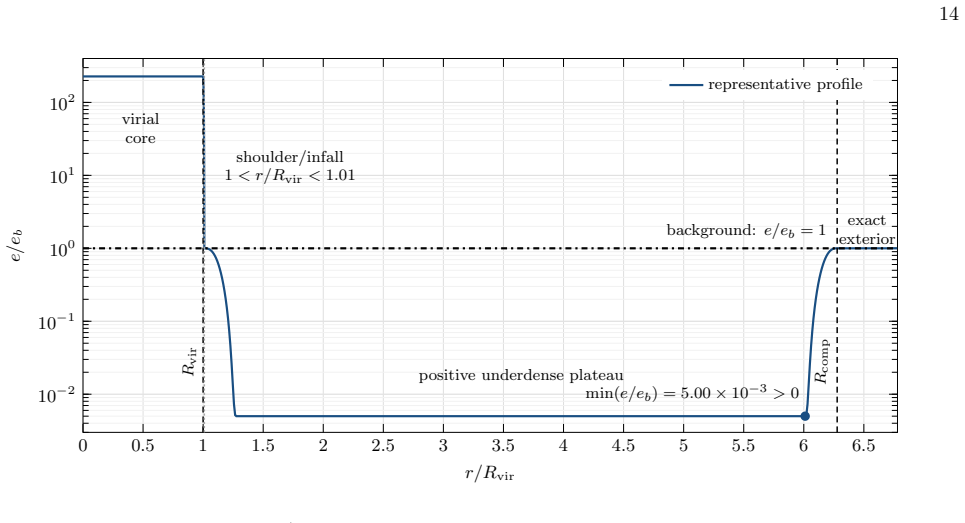
The load-bearing identity is the sharp-junction mass relation $F_+^{\rm eff}-F_- = \frac{2G_0}{c_0^2 R}\Delta M_{\rm halo}$, which converts a positive mass excess into the ordering $F_+^{\rm eff}>F_-$ and hence into a negative Israel surface density on the ordinary static branch. The constructive machinery is the conformal ADM initial-data system: a conformally flat spatial metric $\gamma_{ij}=\psi^4\delta_{ij}$, a constant mean curvature $K=-3H_p/c_0$, a trace-free extrinsic curvature parametrized by one radial function $A(r)$, and a cumulative background-relative mass contrast $\Delta M_E(r)$. Three shooting conditions — $\psi(r_{\rm comp})=1$, $A(r_{\rm comp})=0$, and $\Delta M_E(r_{\rm comp})=0$ — fix the central conformal factor, the velocity-profile amplitude, and the compensation radius; the deliberately unused condition $\psi_{,\bar r}(r_{\rm comp})\simeq0$ serves as an independent closure check. A density-positivity volume bound $R_{\rm comp}/R_{\rm vir}\ge \Delta_{\rm vir}^{1/3}\simeq6.1$ explains why a finite-width compensation region is necessary at all.
What would settle it
Solve the same constraint system with an independent code for a range of underdensity amplitudes around $A_-=0.995$; if any of these source profiles admits no compensated solution with $e>0$ everywhere, or if the Hamiltonian and momentum residuals do not converge to zero under resolution refinement, the constructive claim would fail. Evolving the constructed slice and finding a negative-energy layer forming at $R_{\rm vir}$ or $R_{\rm comp}$ would likewise break the no-shell property dynamically.
Extended reading notes
Core claim
The paper's central claim is constructive: there exist regular boundary and initial-data conditions connecting the bound core, through a compensating environment, to the homogeneous exterior without a residual thin shell on the constructed slice. Concretely, for an assumed virialized core with positive excess mass, sharp Darmois–Israel matching to the local-effective FLRW exterior on the ordinary branch yields $\sigma_m<0$, because $\Delta M_{\rm halo}>0$ implies $F_+^{\rm eff}>F_-$, so the omitted environmental compensation is compressed into a negative surface layer. Replacing that zero-width source by a finite-width, background-relative underdensity whose local rest-frame energy density stays positive, the paper solves the conformal ADM Hamiltonian and momentum constraints on a conformally flat, constant-mean-curvature slice. At finite radius the numerical data close to the exact analytic FLRW exterior: the conformal factor returns to one, the trace-free extrinsic curvature vanishes, the cumulative mass contrast returns to zero, and the Misner–Sharp endpoint residual lies within the declared tolerance. The author states explicitly that this is an initial-data existence result only — no time evolution, no full timelike junction to the global background, and no new gravitational degree of freedom or screening mechanism is introduced.
Load-bearing premise
The result is established for one prescribed source family — an overdense core, a narrow shoulder of width $0.01\,R_{\rm vir}$, and an underdensity amplitude $A_-=0.995$ — and the paper does not show that realistic infall environments generate such profiles, nor does it prove a continuity argument around the representative solution.
Editorial extensions
If this is right
- Sharp matching of any positive-excess halo directly to an exactly homogeneous exterior on the ordinary branch requires a negative surface layer; a shell-free junction is possible only under the mass-locking condition $M=(4\pi/3)\rho_{m,\mathrm{LE}}R^3$.
- Within the adopted source family, a positive compensating environment with minimum rest-frame density ratio $\min(e/e_b)\simeq5\times10^{-3}$ and closure radius $R_{\rm comp}/R_{\rm vir}\simeq6.28$ satisfies both Einstein constraints and returns all geometric and matter variables to the FLRW values at finite radius.
- Because the weak, null, and dominant energy conditions hold on the constructed slice, the negative layer of the sharp construction can be removed without invoking exotic bulk matter in this family.
- The construction is limited to initial-data existence: it does not by itself establish dynamical formation, stability, or persistence of the local proper-time sector.
Reading between the lines
- The necessary volume bound $R_{\rm comp}\ge\Delta_{\rm vir}^{1/3}R_{\rm vir}$ suggests a testable extension: computing the compensation radius for realistic infall density profiles would show whether astrophysical environments sit above, near, or below this purely geometric floor.
- The near-cancellation between the integrated Israel surface mass and the halo excess mass indicates that the sharp negative shell can be read as a diagnostic of omitted environmental compensation; repeating the construction with a different exterior (for example, a vacuum exterior without FLRW matter) would expose how much of the sign structure depends on the background.
- A natural next computation, not performed in the paper, is to evolve the constructed initial slice; if the no-shell property and positive density survive under constraint-preserving evolution, the existence result would become a dynamical statement about the local–cosmological transition.
Signed reviews
Editorial analysis
A structured set of objections, weighed in public.
Referee Report
Summary. This paper addresses the embedding of a virialized, positive-excess halo in a spatially flat Λ-FLRW environment via two complementary constructions. The sharp construction performs a Darmois–Israel timelike junction between a local-static SdS boundary representation and a local-effective FLRW exterior and shows, both analytically from the mass-excess relation and numerically, that on the ordinary branch the required surface layer has negative energy density; this is interpreted as the distributional image of omitted finite-width environmental compensation. The smooth construction instead solves the conformal ADM Hamiltonian and momentum constraints on one conformally flat, constant-mean-curvature spacelike slice, with a prescribed compensated source family (overdense core, shoulder, positive underdense plateau), and reports a representative solution that closes to the FLRW exterior at finite radius, satisfies the constraints under resolution refinement, and passes proper-volume mass compensation, invariant Misner–Sharp mass-length, and WEC/NEC/DEC audits. The paper is careful to limit claims to initial-data existence and admissibility for the adopted source family, explicitly disclaiming dynamical formation, stability, and full GCT junction constructions.
Significance. The sharp sign result is a clean, parameter-free structural statement: ΔMhalo > 0 implies F_+ > F_- and hence σm < 0 on the ordinary branch, and the zero-shell limit recovers the mass-locking condition. The smooth construction is transparently documented, with a reproducible numerical protocol, a resolution study, independent manufactured-state tests, and explicit claim boundaries; these are genuine strengths. If the matter-variable consistency issue identified below is resolved, the paper would provide a useful constructive example showing that a finite-width positive-density compensation region can replace a negative Israel layer at the level of the constraints. The significance is moderate: it is a local-effective, slice-level existence demonstration rather than a dynamical or observational result.
major comments (2)
- [Sec. II C, Eq. (27); Sec. V A; App. C, Eqs. (C11), (C16)] The manuscript never specifies the fluid Lorentz factor W(r) or the map from the rest-frame variables (e,p) to the Eulerian sources (εE, jE). The shooting problem in Sec. V A includes a non-zero 'velocity-profile amplitude' as a shooting parameter, so the fluid is generically not comoving with the hypersurface normal and W ≠ 1. Yet the Hamiltonian and momentum constraints (C11) and (C16) are solved with prescribed εE(r) and jE(r), while the energy-condition audit in Sec. V D and Table IV uses separately prescribed e(r) and p(r). For a perfect fluid these sets of variables must be connected through Eq. (27) and the definition of jE; as written, the positive rest-frame density and the WEC/NEC/DEC margins are not demonstrated for the constraint-satisfying geometry itself. Please either specify W(r) and derive e, p from εE, jE (or conversely), or set the velocity-profile amplitude to zero and state explicitly that the fluid is comoving, so that e = εE and the audit applies directly.
- [Sec. V D, Eq. (70), Table IV] The reported margins for e+p and e−|p| are 1.06×10⁻¹⁰ in barred energy-density units, which is orders of magnitude smaller than the Hamiltonian constraint residual ∥H∥∞ = 2.63×10⁻⁸ quoted in Table II for the same N = 800 solution. This raises the question whether the 'strictly satisfied' WEC/NEC/DEC statement is numerically robust. Please show the radial profiles of the three margins near their minima, compare the margins with the discretization error of the independent residual evaluator, and state whether the strict positivity conclusion survives at the highest resolution.
minor comments (4)
- [Sec. II C and throughout] The symbol b is used both for the GCT exponent and, via subscripts, for background quantities (e.g., eb, εEb); although the text flags this convention, it remains a readability hazard and should be changed (e.g., bg subscript).
- [Sec. V B, Eq. (64)] The lower bound Rcomp/Rvir ≥ Δ_vir^(1/3) is presented as a 'simple volume bound'; the derivation assumes a homogeneous core and a maximal-deficit plateau, but these assumptions are stated only informally. A one-line derivation would make the bound easier to check.
- [Fig. A1] The residual maxima are located just outside the shoulder at rmax/Rvir ≃ 1.04946; adding a marker at this location in both panels would help the reader connect the text to the figure.
- [Sec. VI C] The claim boundaries are clearly stated, but the abstract's phrase 'no residual distributional layer' could be misread as a statement about the evolved spacetime; a phrase such as 'on the constructed initial slice' should appear in the abstract itself.
Circularity Check
Smooth-construction mass closure and energy-condition margins are imposed source/shooting inputs rather than independent outputs; the sharp obstruction and the constraint solve remain genuinely independent.
-
fitted input called prediction
[Sec. V A (Eq. 62) and Sec. V B (Eqs. 65-66)]
"For a chosen underdensity amplitude A−<1, the shooting conditions ψ(rcomp)=1, A(rcomp)=0, ΔME(rcomp)=0 determine the central conformal factor, velocity-profile parameter, and isotropic-coordinate endpoint rcomp."
ΔME(rcomp)=0 is one of the three shooting conditions, so the reported cancellation ΔMcore=+2.01705565×10⁻⁵, ΔMtrans=−2.01705565×10⁻⁵, and ΔME(rcomp)=1.6383×10⁻²⁰ is the root-finding target, not an independent prediction. The construction is defined to have vanishing cumulative background-relative energy contrast at Rcomp, so the 'mass closure' displayed in Fig. 3 follows by construction. The paper is transparent that this is an endpoint condition, and the separate Misner–Sharp endpoint check is a genuine independent diagnostic, but the proper-volume mass-closure result itself is an imposed condition reported as a diagnostic.
-
fitted input called prediction
[Sec. II C (Eq. 27), Sec. V D (Eqs. 69-70), Appendix D 5]
"A prescribed positive compensated matter-source family supplies the Eulerian energy and momentum sources together with the rest-frame energy density and pressure."
Equation (27) defines εE=(e+p)W^2−p with an unspecified Lorentz factor W, yet the source family independently prescribes εE, jE, e, and p, and the velocity-profile amplitude is a free shooting parameter. The paper never gives W(r) or the four-velocity map connecting the prescribed rest-frame quantities to the Eulerian sources used in the constraint equations (C11) and (C16). Consequently, the e and p audited for WEC, NEC, and DEC are not shown to be the rest-frame variables of the fluid whose Eulerian sources actually solve the constraints.
full rationale
The sharp-junction sign result is not circular: Eq. (48) analytically gives F+eff−F−>0 for a positive mass excess, and Eq. (46) then yields σm<0 on the ordinary branch. The numerical constraint solve in the smooth construction is also genuine: the Hamiltonian and momentum residuals are evaluated a posteriori with a separate finite-difference operator and converge under resolution refinement, and the unused derivative condition ψ,r(rcomp)≈0 plus the invariant Misner–Sharp endpoint check provide independent closure evidence. The GCT self-citations are not load-bearing here because the paper explicitly restricts the calculations to local-effective classical GR with c0 and G0 fixed. The circularity burden comes from two places. First, the proper-volume mass closure ΔME(rcomp)=0 is a shooting condition, not a discovered result; the paper labels it a diagnostic, but it is an imposed target. Second, and more seriously, the energy-condition audit is performed on prescribed rest-frame e and p while the constraints are solved with separately prescribed Eulerian εE and jE, with no W(r) mapping; the WEC/NEC/DEC margins therefore reduce to the chosen source amplitude A−=0.995 by construction. These issues do not destroy the independent content of the constraint-solving and the sharp analytic obstruction, so the overall circularity is partial rather than total.
Assumptions & free parameters
free parameters (4)
- A- =
0.995
- source profile shape =
shoulder width 0.01 Rvir; core profile unspecified
- velocity-profile amplitude =
determined by shooting
- central conformal factor psi(0) =
determined by shooting
assumptions (5)
- standard math Standard conformal ADM initial-data framework (York; Maxwell)
- domain assumption The local-static SdS metric represents the exterior of the bound halo in the sharp comparison
- domain assumption The virial boundary data are taken from a spherical-collapse benchmark with Omega_m0=0.3, Omega_Lambda0=0.7, zta=1
- domain assumption The matter source is an isotropic perfect fluid with diagonal rest-frame stress
- domain assumption The constructed initial slice is conformally flat with CMC slicing
Cite this review
Pith. "Pith review of From a Sharp Thin-Shell Obstruction to a Smooth Positive-Density Initial-Data Embedding of a Virialized Halo in Lambda-FLRW Cosmology." pith.science (2026). https://pith.science/paper/N32T23XT
@misc{pith2026260812433,
  author       = {Pith},
  title        = {Pith review of: From a Sharp Thin-Shell Obstruction to a Smooth Positive-Density Initial-Data Embedding of a Virialized Halo in Lambda-FLRW Cosmology},
  year         = {2026},
  howpublished = {\url{https://pith.science/paper/N32T23XT}},
  note         = {Machine review of arXiv:2608.12433}
}
read the original abstract
Within classical general relativity, we compare a sharp timelike junction and a smooth finite-width spacelike initial-data embedding of a positive-excess virialized halo in a homogeneous Lambda-FLRW environment. On the ordinary branch, timelike Israel matching at the virial boundary produces a negative surface layer: a distributional representation of the environmental compensation omitted by the sharp construction. We replace this zero-width source by a finite-width, background-relative underdensity whose local rest-frame energy density remains positive. The resulting conformally flat, constant-mean-curvature ADM initial slice satisfies the Hamiltonian and momentum constraints, with the residuals converging under resolution refinement. At finite radius, its geometric and matter variables return to the local-effective FLRW data within the declared tolerances: the constructed slice contains no residual distributional layer and satisfies the reconstructed weak, null, and dominant energy conditions. For radii beyond the numerical endpoint, the exterior is defined by the exact analytic local-effective FLRW solution. The GCT framework supplies the global motivation clock interpretation, while the present calculations are local-effective classical-GR calculations with the bound-sector constants c0 and G0 held fixed: no radial GCT lapse or constant interpolation is constructed.
Figures


Reference graph
Works this paper leans on
-
[1]
The corresponding electromagnetic and thermodynamic scalings are described in Refs
=ℏ 0.(5) Within the GCT interpretation adopted below, the same c0 and G0 also serve as the fixed reference constants used to describe the assumed locally bound proper-time sector. The corresponding electromagnetic and thermodynamic scalings are described in Refs. [ 22–25]. The correlated assignments preserve the standard local forms of special relativity,...
-
[2]
It does not introduce a new matter component, an independent continuity law, or a second value of the parameter b. The corresponding vacuum quantities are ρΛ,bg(a) = Λc2 bg(a) 8πGbg(a) =ρ Λ0a−b/2, eΛ,b≡ρ Λ,bg(a)c2 bg(a) = Λc4 bg(a) 8πGbg(a) = Λc4 0 8πG0 ≡e Λ, ρΛ,LE≡ eΛ c2 0 =ρ Λ0, ρ Λ,loc≡ρ Λ,LE.(18) For a spatially flat homogeneous reference background c...
-
[3]
Symbols, meanings, and SI units Symbol Meaning SI unit Sector Role Tadopted cosmological time coordinate s common physical Nbg,N loc background and local lapse normalizations 1 bg/local physical convention cbg,c 0 background clock coefficient and reference/local speed m/s bg/local physical Gbg,G 0 background and reference/local Newton couplings m 3/kg/s2 ...
-
[4]
Restoration is obtained by inverting Eq
Numerical normalization and SI restoration Choose a fixed local lengthR ∗ =R vir and define ¯r= r R∗ ,¯x 0≡ x0 R∗ = c0T+ R∗ , ¯K=R ∗K, ¯Λ = ΛR2 ∗, ¯e=G0R2 ∗ c4 0 e,¯ε E = G0R2 ∗ c4 0 εE,¯p= G0R2 ∗ c4 0 p,¯µ MS = µMS R∗ = G0mloc MS c2 0R∗ .(A1) Only after these definitions may a code use unity-valued reference constants. Restoration is obtained by invertin...
-
[5]
Space III-B local-static boundary side Using the length-like time coordinatex 0 −≡c 0T−, the local-side metric in Eq. (30) may be written as ds2 − =−F−(R)(dx0 −)2 + dR2 F−(R) +R 2dΩ2.(B1) The shell trajectory is then xµ −(τ) = c0T−(τ),R(τ),θ,ϕ , u µ −≡ dxµ − dτ = c0 ˙T−, ˙R,0,0 ,(B2) where an overdot denotes differentiation with respect to the shell prope...
-
[6]
Space II-A local-effective FLRW side Again, by using the length-like time coordinate x0 +≡c 0T+ (i.e., dx0 + = c0dT+), the areal-radius form of the local-effective FLRW metric, obtained from Eqs. (9) and (12), becomes ds2 + =−(dx 0 +)2 + dR− HpR c0 dx0 + 2 +R 2dΩ2.(B8) Equivalently, ds2 + =− 1− H2 pR2 c2 0 ! (dx0 +)2−2 HpR c0 dx0 +dR+dR 2 +R 2dΩ2.(B9) Its...
-
[7]
denote intrinsic coordinates on the shell hypersurface Σ, whereas hatted indices ˆa,ˆb,
Israel projection and zero-shell limit The indices a,b,... denote intrinsic coordinates on the shell hypersurface Σ, whereas hatted indices ˆa,ˆb,... denote components in an orthonormal frame intrinsic to Σ. The intrinsic coordinates on the timelike junction hypersurface Σ are chosen as ya = (y0,θ,ϕ) = (c 0τ,θ,ϕ).(B18) Thus, the induced line element is ds...
-
[8]
On the ordinary branch ϵ+ = ϵ− = +1 and in the static limit ˙R = 0, it reduces directly to Eq
Equations (B7) and (B17) then give the unsquared master equation (44). On the ordinary branch ϵ+ = ϵ− = +1 and in the static limit ˙R = 0, it reduces directly to Eq. (46). Therefore, the verified orderingF eff + >F− fixes the negative sign without squaring the junction equation. Because σE =c2 0σm, the result σm < 0 is equivalently σE < 0. Thus, on the or...
Show all 44 references
-
[9]
Spatial curvature and extrinsic curvature For the conformally flat spatial metric in Eq. (25), the three-dimensional conformal transformation law gives (3)R=ψ −4 −8ψ−1∇2 flatψ =−8ψ−5 ψ,rr + 2 rψ,r ,(C1) 22 where the derivatives are with respect to the physical isotropic radius...
-
[10]
Hamiltonian and momentum ODE reduction For the numerical construction, we set R∗ =Rvir and ¯r≡r/R∗ as in Eq. (A1). Here Rvir is the physical reference scale used to normalize the isotropic coordinate r, whereas the areal radius on the conformal slice is R(r) =ψ2(r)r as in Eq. ...
-
[11]
Origin regularity and endpoint conditions Regularity at the spherical origin constrains the parity and leading radial behavior of the initial-data variables. A regular scalar such asψhas an even expansion, ψ(¯r) =ψc +O(¯r2),(C22) 24 and hence ψ,¯r(0) = 0.(C23) A regular radial...
-
[12]
The spatial geometry and extrinsic curvature must satisfy the Hamiltonian and momentum constraints
Hamiltonian and momentum constraints Positive density alone does not define admissible relativistic initial data. The spatial geometry and extrinsic curvature must satisfy the Hamiltonian and momentum constraints. Thus, we define the physical constraint residuals by H≡ (3)R+K ...
-
[13]
The conformal geometry, extrinsic curvature, and matter sources must approach together the values induced by the homogeneous Space II-A FLRW exterior
Finite-radius FLRW matching Density matching alone is not sufficient for finite-radius closure of the initial data. The conformal geometry, extrinsic curvature, and matter sources must approach together the values induced by the homogeneous Space II-A FLRW exterior. The corres...
-
[14]
Local energy-condition audit The radial density morphology is already shown in Fig. 2. The separate question here is whether the same isotropic perfect-fluid rest-frame source satisfies the tested pointwise energy conditions. At every stored radial point we evaluate qe≡ e eb ,...
-
[15]
In particular, ∆ ME integrates the Eulerian energy contrast with the proper-volume element of the chosen ADM slice
Invariant Misner–Sharp mass-length diagnostic Proper-volume compensation is slice dependent. In particular, ∆ ME integrates the Eulerian energy contrast with the proper-volume element of the chosen ADM slice. A geometrically distinct spherical check is provided by the Misner–S...
-
[16]
A prescribed positive compensated matter-source family supplies the Eulerian energy and momentum sources together with the rest-frame energy density and pressure
Numerical procedure and reproducibility protocol The calculation begins by applying the barred normalization of Appendix A, with R∗ = Rvir, to a spherical radial domain extending from the regular center to the unknown finite FLRW closure radius. A prescribed positive compensat...
-
[17]
Singular hypersurfaces and thin shells in general relativity,
W. Israel, “Singular hypersurfaces and thin shells in general relativity,” Nuovo Cim. B44S10, 1 (1966) [erratum: Nuovo Cim. B48, 463 (1967)] doi:10.1007/BF02710419
1966 doi
-
[18]
The influence of the expansion of space on the gravitation fields surrounding the individual stars,
A. Einstein and E. G. Straus, “The influence of the expansion of space on the gravitation fields surrounding the individual stars,” Rev. Mod. Phys.17, 120-124 (1945) doi:10.1103/RevModPhys.17.120
1945 doi
-
[19]
On the influence of global cosmological expansion on the dynamics and kinematics of local systems,
M. Carrera and D. Giulini, “On the influence of global cosmological expansion on the dynamics and kinematics of local systems,” Rev. Mod. Phys.82, 169 (2010) doi:10.1103/RevModPhys.82.169 [arXiv:0810.2712 [gr-qc]]
2010 arXiv
-
[20]
Generalized Swiss-Cheese Cosmologies II: Spherical Dust,
C. Grenon and K. Lake, “Generalized Swiss-Cheese Cosmologies II: Spherical Dust,” Phys. Rev. D84, 083506 (2011) doi:10.1103/PhysRevD.84.083506 [arXiv:1108.6320 [gr-qc]]
2011 arXiv
-
[21]
Kinematics and Dynamics of General Relativity,
J. W. York, Jr., “Kinematics and Dynamics of General Relativity,” inSources of Gravitational Radiation, edited by L. L. Smarr, Cambridge University Press, Cambridge, pp. 83–126 (1979)
1979
-
[22]
Initial Data in General Relativity Described by Expansion, Conformal Deformation and Drift,
D. Maxwell, “Initial Data in General Relativity Described by Expansion, Conformal Deformation and Drift,” Commun. Anal. Geom.29, no.1, 207-281 (2021) doi:10.4310/CAG.2021.v29.n1.a7 [arXiv:1407.1467 [gr-qc]]. 31
2021 arXiv
-
[23]
Killing vector fields and a homogeneous isotropic universe,
M. O. Katanaev, “Killing vector fields and a homogeneous isotropic universe,” Phys. Usp.59, no.7, 689-700 (2016) doi:10.3367/UFNe.2016.05.037808 [arXiv:1610.05628 [gr-qc]]
2016 arXiv
-
[24]
An Introduction to mathematical cosmology,
J. N. Islam, “An Introduction to mathematical cosmology,” Cambridge University Press, 2005, ISBN 978-0-511-03793-1, 978-0-521-49650-6, 978-0-521-49973-6
2005
-
[25]
M. P. Hobson, G. P. Efstathiou and A. N. Lasenby,General Relativity: An Introduction for Physicists, Cambridge University Press, Cambridge (2006), ISBN 978-0-521-82951-9, doi:10.1017/CBO9780511790904
2006 doi
-
[26]
Revisiting varying speed of light in cosmology: Insights from the Friedmann-Lemaˆ ıtre-Robertson-Walker Metric,
S. Lee, “Revisiting varying speed of light in cosmology: Insights from the Friedmann-Lemaˆ ıtre-Robertson-Walker Metric,” Phys. Dark Univ.48, 101947 (2025) doi:10.1016/j.dark.2025.101947 [arXiv:2505.15838 [physics.gen-ph]]
2025
-
[27]
Geometric matching of local static regions in cosmological spacetimes with an evolving lapse,
S. Lee, “Geometric matching of local static regions in cosmological spacetimes with an evolving lapse,” Class. Quant. Grav. 43, no.10, 105017 (2026) doi:10.1088/1361-6382/ae6cac [arXiv:2606.09945 [gr-qc]]
2026 arXiv
-
[28]
Constraint on the minimally extended varying speed of light using time dilations in Type Ia supernovae,
S. Lee, “Constraint on the minimally extended varying speed of light using time dilations in Type Ia supernovae,” Mon. Not. Roy. Astron. Soc.524, no.3, 4019-4023 (2023) doi:10.1093/mnras/stad2084 [arXiv:2302.09735 [astro-ph.CO]]
2023 arXiv
-
[29]
The significance of measuring cosmological time dilation in the Dark Energy Survey Supernova Program,
S. Lee, “The significance of measuring cosmological time dilation in the Dark Energy Survey Supernova Program,” Phys. Dark Univ.46, 101703 (2024) doi:10.1016/j.dark.2024.101703 [arXiv:2407.09532 [physics.gen-ph]]
2024
-
[30]
A unified interpretation of supernova, GRB, and QSO time dilation signals in a generalized cosmological time framework,
S. Lee, “A unified interpretation of supernova, GRB, and QSO time dilation signals in a generalized cosmological time framework,” Eur. Phys. J. C86, no.2, 196 (2026) doi:10.1140/epjc/s10052-026-15459-9 [arXiv:2603.00427 [hep-ph]]
2026
-
[31]
To the problem of nonvanishing gravitation mass,
A. I. Vainshtein, “To the problem of nonvanishing gravitation mass,” Phys. Lett. B39, 393-394 (1972) doi:10.1016/0370- 2693(72)90147-5
1972 doi
-
[32]
Chameleon fields: Awaiting surprises for tests of gravity in space,
J. Khoury and A. Weltman, “Chameleon fields: Awaiting surprises for tests of gravity in space,” Phys. Rev. Lett.93, 171104 (2004) doi:10.1103/PhysRevLett.93.171104 [arXiv:astro-ph/0309300 [astro-ph]]
2004 arXiv
-
[33]
Chameleon cosmology,
J. Khoury and A. Weltman, “Chameleon cosmology,” Phys. Rev. D69, 044026 (2004) doi:10.1103/PhysRevD.69.044026 [arXiv:astro-ph/0309411 [astro-ph]]
2004 arXiv
-
[34]
Dynamical effects of the cosmological constant,
O. Lahav, P. B. Lilje, J. R. Primack and M. J. Rees, “Dynamical effects of the cosmological constant,” Mon. Not. Roy. Astron. Soc.251, 128-136 (1991) doi:10.1093/mnras/251.1.128
1991 doi
-
[35]
Spherical collapse model with and without curvature,
S. Lee, “Spherical collapse model with and without curvature,” Phys. Lett. B685, 110-114 (2010) doi:10.1016/j.physletb.2010.01.058 [arXiv:0909.0826 [astro-ph.CO]]
2010 arXiv
-
[36]
Spherical collapse model with non-clustering dark energy,
S. Lee and K. W. Ng, “Spherical collapse model with non-clustering dark energy,” JCAP10, 028 (2010) doi:10.1088/1475- 7516/2010/10/028 [arXiv:0910.0126 [astro-ph.CO]]
2010 arXiv
-
[37]
Singular hypersurfaces and thin shells in cosmology,
A. Sahu, “Singular hypersurfaces and thin shells in cosmology,” Phys. Scripta101, no.12, 125001 (2026) doi:10.1088/1402- 4896/ae4ae1 [arXiv:2402.09539 [hep-th]]
2026
-
[38]
The minimally extended Varying Speed of Light (meVSL),
S. Lee, “The minimally extended Varying Speed of Light (meVSL),” JCAP08, 054 (2021) doi:10.1088/1475- 7516/2021/08/054 [arXiv:2011.09274 [astro-ph.CO]]
2021 arXiv
-
[39]
A Viable Varying Speed of Light Model in the RW Metric,
S. Lee, “A Viable Varying Speed of Light Model in the RW Metric,” Found. Phys.53, 40 (2023) doi:10.1007/s10701-023- 00682-1 [arXiv:2303.13772 [physics.gen-ph]]
2023 arXiv
-
[40]
The cosmological evolution condition of the Planck constant in the varying speed of light models through adiabatic expansion,
S. Lee, “The cosmological evolution condition of the Planck constant in the varying speed of light models through adiabatic expansion,” Phys. Dark Univ.42, 101286 (2023) doi:10.1016/j.dark.2023.101286 [arXiv:2212.03728 [astro-ph.CO]]
2023
-
[41]
3+1 formalism of the minimally extended varying speed of light model,
S. Lee, “3+1 formalism of the minimally extended varying speed of light model,” Class. Quant. Grav.42, no.2, 025026 (2025) doi:10.1088/1361-6382/ada2d5 [arXiv:2412.19049 [gr-qc]]
2025 arXiv
-
[42]
Classical Mechanics
H. Goldstein, C. P. Poole and J. L. Safko, “Classical Mechanics”, Addison-Wesley, 2002, ISBN-10 0201657023
2002
-
[43]
The Large Scale Structure of Space-Time,
S. W. Hawking and G. F. R. Ellis, “The Large Scale Structure of Space-Time,” Cambridge University Press, 2023, ISBN 978-1-009-25316-1, doi:10.1017/9781009253161
2023 doi
-
[44]
Relativistic equations for adiabatic, spherically symmetric gravitational collapse,
C. W. Misner and D. H. Sharp, “Relativistic equations for adiabatic, spherically symmetric gravitational collapse,” Phys. Rev.136, B571-B576 (1964) doi:10.1103/PhysRev.136.B571
1964 doi
Reviewed August 16, 2026 · model on record in the stance chip above.
Discussion (0). Continue with ORCID to comment.