REVIEW 4 major objections 4 minor 108 references
The imprint of cosmic voids from the DESI Legacy Survey DR9 LRGs in the Planck 2018 lensing map through spectroscopically calibrated mocks
T0 review · 4 major / 4 minor · reviewed 2026-08-11 · deepseek-v4-flash
Pith's one-line read Cross-correlating 140,712 cosmic voids from the DESI Legacy Survey DR9 LRG sample with the Planck 2018 CMB lensing map yields a lensing amplitude Aκ = 1.016 ± 0.054, in full agreement with ΛCDM predictions once the Buzzard mocks are…
desk verdict A serious, well-calibrated void-lensing measurement whose central A_kappa ~ 1 claim is probably right, but the headline 14 sigma and 17 sigma significances rest on a doubtful chi-square formula and a post-hoc bin choice. read the letter →
The pith
A machine-rendered reading of the paper's core claim, the machinery that carries it, and where it could break.
The reading
What carries the argument
The analysis is carried by three coupled elements: a 3D void catalog built with the REVOLVER/ZOBOV watershed algorithm; the λv parameter, defined as λv = δ̄v (Rv / 1 h⁻¹ Mpc)^1.2, which separates void-in-voids (negative λv, strongly underdense) from void-in-clouds (positive λv, embedded in overdense environments); and a template-fitting scheme in which the observed stacked convergence profile is compared with a ΛCDM template from four Buzzard mock realizations. The mocks are first calibrated: photometric redshifts of mock galaxies are resampled so that the mock redshift-error CDF matches the observed one derived from about one million DESI spectra, and the mock galaxy samples are subsampled to match the observed sparseness (mean galaxy separation) in the North and South caps separately. The stacked signal is measured on a Planck 2018 convergence map smoothed with a 0.5° Gaussian filter, using patches of radius 5 times the void radius, with errors from 1000 random realizations of the CMB lensing field and a Hartlap-corrected covariance.
What would settle it
Recompute Aκ using voids identified directly from spectroscopic redshifts (or from a fully spectroscopic survey) and compare with the photo-z-based measurement; a significant shift in Aκ would indicate the photo-z calibration does not fully capture the void population. Alternatively, generate mock templates from an independent simulation suite without the photo-z CDF remapping and check whether Aκ deviates from unity, which would show that the calibration is doing the work. A third check: artificially amplify the residual sparseness mismatch at z < 0.5 and z > 0.8 and see whether Aκ moves by more than the current 5% uncertainty.
Extended reading notes
Core claim
The central claim is that the cross-correlation between cosmic voids and CMB lensing in the observed universe is fully consistent with the ΛCDM prediction, once the simulated template is built from mocks whose photometric redshift error distribution and galaxy sparseness are calibrated against the actual DESI Legacy Survey LRG sample using more than one million DESI spectra. In the full-sky sample of 140,712 voids between 0.35 < z < 0.95, the best-fit lensing amplitude is Aκ = 1.016 ± 0.054, a 14σ detection; separating voids into negative-λv (void-in-void) and positive-λv (void-in-cloud) populations yields Aκ = 0.944 ± 0.064 and Aκ = 0.975 ± 0.060, respectively, with signal-to-noise ratios of about 17. The same agreement holds in the North and South Galactic Caps separately (Aκ = 1.088 ± 0.081 and Aκ = 0.936 ± 0.087) and across all four redshift bins. The authors interpret the previously reported "lensing-is-low" tension as a systematic effect: uncalibrated mocks produce void populations with different lensing properties, and matching sparseness and redshift errors removes the discrepancy.
Load-bearing premise
The analysis assumes that the Buzzard mocks, after calibration, are an unbiased template for the lensing signal of the true void population, in particular that the photometric-redshift error CDF measured from about one million DESI spectra represents the full 10.4 million LRG sample, and that residual sparseness differences below 5% at z < 0.5 and z > 0.8 have negligible impact on void identification and lensing amplitude.
Editorial extensions
If this is right
- If correct, the "lensing-is-low" tension in void-CMB lensing is resolved as a systematic of mock construction, not evidence against ΛCDM.
- Void lensing measurements at 14-17σ significance become competitive probes of the matter distribution, and the λv-split populations give independent high-S/N channels.
- Future void lensing analyses must match photometric redshift errors and sparseness between mocks and data; otherwise they risk producing artificial tensions.
- The tomographic result, with consistent Aκ across four redshift bins, strengthens the case that the void lensing kernel evolves as ΛCDM predicts.
Reading between the lines
- A direct extension would be to repeat the calibration procedure on an independent mock suite, or with voids identified from spectroscopic redshifts, to test whether Aκ ≈ 1 is robust to the choice of calibration target; the paper itself notes residual sparseness differences below 5% at the redshift edges.
- The same calibration logic could be applied to other large-scale structure lensing probes, such as clusters or cosmic filaments, where similar "low lensing" anomalies have been reported; those tensions may also shrink once mock selection effects are matched.
- The λv-based population split, which the paper shows increases S/N, could be optimized further by fine-tuning the bin edges to push detection significance beyond 17σ with current data.
Signed reviews
Editorial analysis
A structured set of objections, weighed in public.
Referee Report
Summary. This paper measures the stacked imprint of cosmic voids from the DESI Legacy Survey DR9 LRG sample on the Planck 2018 CMB lensing convergence map, and compares it to a ΛCDM template built from four Buzzard mock realizations that are calibrated to the observed galaxy clustering, photometric redshift errors, and sparseness. The amplitude of the observed signal relative to the template is fitted as a free parameter Aκ. The authors report Aκ = 1.016 ± 0.054 for the full void sample (S/N = 14), and consistent values for subpopulations split by the λv void parameter, concluding that the previously reported 'lensing-is-low' tension is eliminated when the mocks are properly calibrated.
Significance. If correct, this result would resolve a current tension in void-CMB lensing studies and would demonstrate that the discrepancy was driven by mock galaxy catalogs that did not reproduce the photometric and sparseness properties of the real data. The paper makes a strong methodological contribution by showing quantitative improvements from matching photo-z error CDFs and sparse-sampling the mocks to the survey. The use of four independent mock realizations and the public data availability are positive features. However, the central quantitative claims hinge on the template-fitting statistic and on the treatment of the data-driven λv bin choice.
major comments (4)
- [§3.4, Eq. (15)] The chi-square statistic used for the template fit is not the chi-square of the residual. For independent Legacy and Buzzard measurements, the residual d(A) = x^L - A x^B has covariance C^L + A^2 C^B, so the correct statistic is d(A)^T (C^L + A^2 C^B)^{-1} d(A). Equation (15) instead uses (C^L)^{-1} + A^2 (C^B)^{-1}, which is the sum of precisions and is not the inverse of the residual covariance. The limiting case C^B → 0 makes the problem clear: Eq. (15) diverges, whereas the correct statistic reduces to the data-only chi-square. Because every value of Aκ, σ_Aκ, and S/N in Tables 2–4 is obtained from Eq. (15), the reported 14σ detection and 17σ sub-population significances are not presently supported. The authors should repeat the analysis with the correct likelihood, or provide a formal justification for their weighting (e.g., if one of the covariance matrices is negligible, this should be demonstrated bin-by-bin).
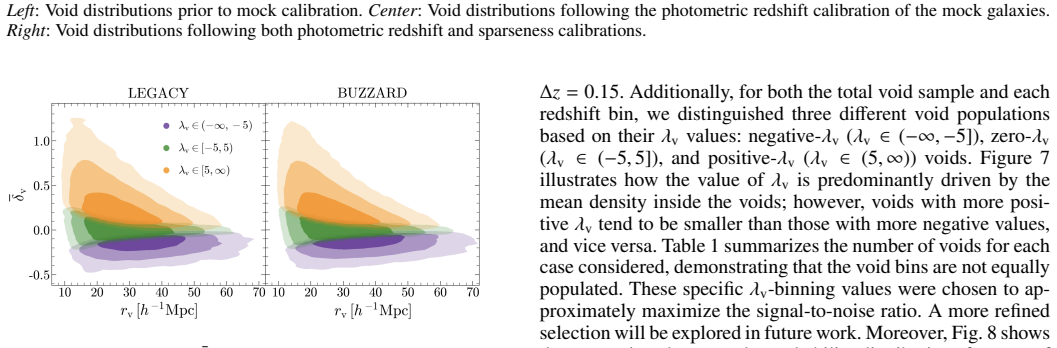
- [§3.2.1 and §5] The λv bin boundaries (λv = -5 and +5) are described as chosen to approximately maximize the signal-to-noise ratio. If these boundaries were selected after inspecting the observed data, the quoted S/N values for the void-in-void and void-in-cloud samples (16.94 and 17.02) are optimistic and the corresponding '17σ' claim in the abstract is not a valid detection significance. The authors should either demonstrate that the boundaries were fixed a priori based on previous literature (e.g., Raghunathan et al. 2020) or quantify the trials factor associated with scanning over bin boundaries. The full-sample result is not affected by this concern, but the sub-population significance claims are.
- [§3.4, Eq. (17)] The detection significance S/N is defined as the maximum of M_j/σ_j over the 25 radial bins. Since the bins are correlated and the maximum over a set of noise realizations is biased high, the quoted 14σ and 17σ values overstate the significance of the detection unless a trials correction is applied. The authors should quote the amplitude significance from the template fit (Aκ/σ_Aκ) as the primary detection significance, or provide an effective number of independent bins.
- [§3.1.2] The statement that residual sparseness differences below 5% (at z<0.5 and z>0.8) have 'almost negligible' impact on void identification is not demonstrated. Given that the tomographic analysis in Section 4.2 reports agreement with ΛCDM in these very redshift bins, the authors should provide a quantitative test, e.g., constructing additional mock realizations with matched sparseness in those ranges or comparing void property distributions in the affected bins separately, to show that the residual mismatch does not bias Aκ.
minor comments (4)
- [§4.2 vs. Table 3] The uncertainty for the negative-λv bin is given as 0.060 in the text but 0.064 in Table 3 and the abstract; the authors should correct the inconsistency.
- [§3.4, Eq. (16)] The sentence about the Hartlap correction says it decreases the covariance value by ~2.6%; the factor in Eq. (16) actually multiplies the inverse covariance, so it increases the effective covariance. Please rephrase to avoid confusion.
- [§3.4, Eq. (14)] The expression for the mock covariance in Eq. (14) uses (1/N) times the average internal covariance; if this is intended to be the covariance of the mean template, a factor of 1/N may be missing, and the authors should clarify the normalization.
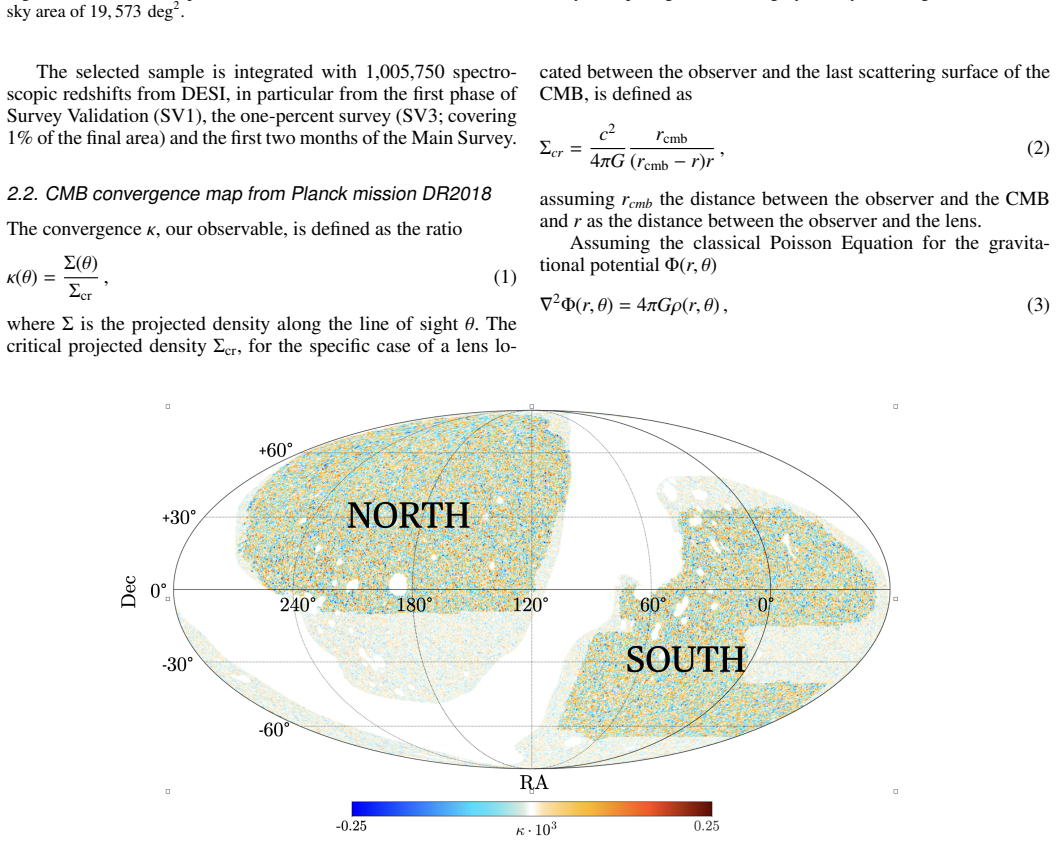
- [General terminology] The use of 'full-sky' to refer to the combined North+South survey footprint is misleading, since only ~19,500 deg² of the sky is covered; consider 'full-survey' or 'combined' instead.
Circularity Check
Core A_kappa measurement is an independent template fit; the 17-sigma subpopulation significances are selected on the same S/N objective used to choose the lambda_v bins.
-
fitted input called prediction
[Sec. 3.2.1 (void catalogs); Sec. 4.2 and Table 3 (full-sky results)]
"These specific λ_v-binning values were chosen to approximately maximize the signal-to-noise ratio. ... we measured Aκ = 0.944±0.060 (S/N = 16.94) for the negative λ_v bin, Aκ = 0.975±0.060 (S/N = 17.02) for the positive λ_v bin."
The λ_v bin edges are selected to maximize S/N, and the same S/N statistic is then reported as the headline detection significance for the void-in-void and void-in-cloud subsamples. Choosing the binning that optimizes S/N and then quoting the optimized S/N as an independent discovery significance is a selection effect: the reported 16.94 and 17.02 values are the outcome of an optimization, not a prediction made before the bin choice. The A_kappa amplitudes in these bins remain genuine comparisons, so this circularity is partial and does not by construction force A_kappa = 1.
full rationale
The central A_kappa measurement is not circular. The Buzzard mock template is generated from ΛCDM N-body lightcone simulations, with calibration applied to photometric redshift errors and galaxy sparseness to match the DESI LRG sample; the Planck lensing data are not used in that calibration. Fitting A_kappa = kappa_Legacy / kappa_Buzzard is therefore an independent amplitude comparison, and the reported A_kappa ≈ 1 is a real consistency result rather than an input recovered by construction. The one circular element is the subpopulation significance claim: the λ_v bin boundaries are explicitly chosen to approximately maximize S/N, and the abstract's 17σ values for void-in-void and void-in-cloud are quoted from those same optimized bins without a trials correction. This affects the significance headline but does not force the cosmological amplitude. The skeptic's Eq. (15) concern is a statistical-error issue rather than a circularity: the chi-square form is adopted from a self-citation (Vielzeuf et al. 2021, with overlapping authors) and carries all quoted uncertainties, but a wrong or imported covariance formula does not make the measurement equivalent to its inputs by definition. Overall, the main cosmological claim has independent content, with a partial circularity in the S/N-maximized subpopulation claims.
Assumptions & free parameters
free parameters (1)
- λ_v bin edges =
-5 and 5 (dimensionless)
assumptions (5)
- domain assumption The Buzzard mock lightcones with Ωm=0.286, σ8=0.82 provide an accurate ΛCDM template for the void lensing signal after calibration.
- domain assumption The CDF of photo-z errors measured from about one million DESI spectroscopic redshifts is representative of the full 10.4 million LRG sample.
- domain assumption Residual sparseness differences below 5% (for z<0.5 and z>0.8) have negligible impact on the void lensing template.
- domain assumption The Born approximation and the Poisson equation with the mean density (Eqs. 3-7) describe CMB lensing by voids at the required accuracy.
- domain assumption REVOLVER/ZOBOV void identification with the 20% ridge merging threshold yields a void population whose lensing signal is the relevant observable.
Cite this review
Pith. "Pith review of The imprint of cosmic voids from the DESI Legacy Survey DR9 LRGs in the Planck 2018 lensing map through spectroscopically calibrated mocks." pith.science (2026). https://pith.science/paper/NC2PFMAR
@misc{pith2026241202761,
  author       = {Pith},
  title        = {Pith review of: The imprint of cosmic voids from the DESI Legacy Survey DR9 LRGs in the Planck 2018 lensing map through spectroscopically calibrated mocks},
  year         = {2026},
  howpublished = {\url{https://pith.science/paper/NC2PFMAR}},
  note         = {Machine review of arXiv:2412.02761}
}
abstract
The cross-correlation of cosmic voids with the lensing convergence ($\kappa$) map of the Cosmic Microwave Background (CMB) fluctuations provides a powerful tool to refine our understanding of the cosmological model. However, several studies have reported a moderate tension between the lensing imprint of cosmic voids on the observed CMB and the simulated $\mathrm{\Lambda}$CDM signal. To address this "lensing-is-low" tension and to obtain new, precise measurements, we exploit the large DESI Legacy Survey Luminous Red Galaxy (LRG) dataset, covering approximately 19,500 $\deg^2$ of the sky and including about 10 million LRGs at $z < 1.05$. Our $\mathrm{\Lambda}$CDM template was created using the Buzzard mocks, which we specifically calibrated to match the clustering properties of the observed galaxy sample by exploiting more than one million DESI spectra. We identified our catalogs of 3D voids in the range $0.35 < z < 0.95$, dividing the sample into bins according to the redshift and $\lambda_\mathrm{v}$ values of the voids. We report a 14$\sigma$ detection of the lensing signal, with $A_\kappa = 1.016 \pm 0.054$, which increases to 17$\sigma$ when considering the void-in-void ($A_\kappa = 0.944 \pm 0.064$) and the void-in-cloud ($A_\kappa = 0.975 \pm 0.060$) populations individually, the highest detection significance for studies of this kind. We observe a full agreement between the observations and $\mathrm{\Lambda}$CDM predictions across all redshift bins, sky regions, and void populations considered. In addition to these findings, our analysis highlights the importance of matching sparseness and redshift error distributions between mocks and observations, as well as the role of $\lambda_\mathrm{v}$ in enhancing the signal-to-noise ratio.
Figures


Figures from the paper (10 more)




Reference graph
Works this paper leans on
-
[1]
C., Hložek, R., & Spergel, D
Alonso, D., Hill, J. C., Hložek, R., & Spergel, D. N. 2018, Phys. Rev. D, 97, 063514
2018
-
[2]
2022, MNRAS, 513, 186
Aubert, M., Cousinou, M.-C., Escoffier, S., et al. 2022, MNRAS, 513, 186
2022
-
[3]
2018, Phys
Baker, T., Clampitt, J., Jain, B., & Trodden, M. 2018, Phys. Rev. D, 98, 023511
2018
-
[4]
& Dalal, N
Banerjee, A. & Dalal, N. 2016, J. Cosmology Astropart. Phys., 2016, 015
2016
-
[5]
M., & Pascoli, S
Barreira, A., Cautun, M., Li, B., Baugh, C. M., & Pascoli, S. 2015, J. Cosmology Astropart. Phys., 2015, 028
2015
-
[6]
L., Larson, D., Weiland, J
Bennett, C. L., Larson, D., Weiland, J. L., et al. 2013, ApJS, 208, 20
2013
-
[7]
& Schneider, J
Blanchard, A. & Schneider, J. 1987, A&A, 184, 1
1987
-
[8]
D., Burleigh, K., Dey, A., et al
Blum, R. D., Burleigh, K., Dey, A., et al. 2016, 228, 317.01
2016
Show all 108 references
-
[9]
2023, A&A, 670, A47
Bonici, M., Carbone, C., Davini, S., et al. 2023, A&A, 670, A47
2023
-
[10]
2023 [arXiv:2311.14586]
Boschetti, R., Vielzeuf, P., Cousinou, M.-C., Esco ffier, S., & Jullo, E. 2023 [arXiv:2311.14586]
2023 arXiv
-
[11]
C., Szapudi, I., Cole, S., & Frenk, C
Cai, Y .-C., Neyrinck, M. C., Szapudi, I., Cole, S., & Frenk, C. S. 2014, ApJ, 786, 110
2014
-
[12]
2015, MNRAS, 451, 1036
Cai, Y .-C., Padilla, N., & Li, B. 2015, MNRAS, 451, 1036
2015
-
[13]
2023, arXiv e-prints, arXiv:2312.08483
Camacho-Ciurana, G., Lee, P., Arsenov, N., et al. 2023, arXiv e-prints, arXiv:2312.08483
2023 arXiv
-
[14]
2018, MNRAS, 476, 3195
Cautun, M., Paillas, E., Cai, Y .-C., et al. 2018, MNRAS, 476, 3195
2018
-
[15]
C., Hamaus, N., & Biagetti, M
Chan, K. C., Hamaus, N., & Biagetti, M. 2019, Phys. Rev. D, 99, 121304
2019
-
[16]
C., Hamaus, N., & Desjacques, V
Chan, K. C., Hamaus, N., & Desjacques, V . 2014, Phys. Rev. D, 90, 103521
2014
-
[17]
2024, Not all lensing is low: An analysis of DESI×DES using the Lagrangian Effective Theory of LSS
Chen, S., DeRose, J., Zhou, R., et al. 2024, Not all lensing is low: An analysis of DESI×DES using the Lagrangian Effective Theory of LSS
2024
-
[18]
2013, MNRAS, 431, 749
Clampitt, J., Cai, Y .-C., & Li, B. 2013, MNRAS, 431, 749
2013
-
[19]
2016, MNRAS, 456, 4425
Clampitt, J., Jain, B., & Sánchez, C. 2016, MNRAS, 456, 4425
2016
-
[20]
M., Pearce, F., Foster, C., et al
Colberg, J. M., Pearce, F., Foster, C., et al. 2008, MNRAS, 387, 933
2008
-
[21]
& Efstathiou, G
Cole, S. & Efstathiou, G. 1989, MNRAS, 239, 195
1989
-
[22]
2023, ApJ, 953, 46
Contarini, S., Pisani, A., Hamaus, N., et al. 2023, ApJ, 953, 46
2023
-
[23]
2024, A&A, 682, A20
Contarini, S., Pisani, A., Hamaus, N., et al. 2024, A&A, 682, A20
2024
-
[24]
2019, MNRAS, 488, 3526
Contarini, S., Ronconi, T., Marulli, F., et al. 2019, MNRAS, 488, 3526
2019
-
[25]
Correa, C. M. & Paz, D. J. 2022, Boletin de la Asociacion Argentina de Astrono- mia La Plata Argentina, 63, 193
2022
-
[26]
2006, Mon
Crocce, M., Pueblas, S., & Scoccimarro, R. 2006, Mon. Not. Roy. Astron. Soc., 373, 369
2006
-
[27]
S., Kneib, J.-P., Percival, W
Dawson, K. S., Kneib, J.-P., Percival, W. J., et al. 2016, AJ, 151, 44
2016
-
[28]
S., Schlegel, D
Dawson, K. S., Schlegel, D. J., Ahn, C. P., et al. 2013, AJ, 145, 10
2013
-
[29]
2024, arXiv e-prints, arXiv:2404.18278
Demirbozan, U., Nadathur, S., Ferrero, I., et al. 2024, arXiv e-prints, arXiv:2404.18278
2024
-
[30]
R., & Wechsler, R
DeRose, J., Becker, M. R., & Wechsler, R. H. 2022, ApJ, 940, 13
2022
-
[31]
H., Becker, M
DeRose, J., Wechsler, R. H., Becker, M. R., et al. 2019, arXiv e-prints, arXiv:1901.02401
2019 arXiv
-
[32]
DeRose, J. e. a. 2024, in prep DESI Collaboration, Aghamousa, A., Aguilar, J., et al. 2016a, arXiv e-prints, arXiv:1611.00036 DESI Collaboration, Aghamousa, A., Aguilar, J., et al. 2016b, arXiv e-prints, arXiv:1611.00037
2024 arXiv
-
[33]
J., Lang, D., et al
Dey, A., Schlegel, D. J., Lang, D., et al. 2019, AJ, 157, 168
2019
-
[34]
J., Zehavi, I., Hogg, D
Eisenstein, D. J., Zehavi, I., Hogg, D. W., et al. 2005, ApJ, 633, 560
2005
-
[35]
T., Honscheid, K., et al
Flaugher, B., Diehl, H. T., Honscheid, K., et al. 2015, AJ, 150, 150
2015
-
[36]
2022, A&A, 658, A20 Article number, page 17 of 19 A&A proofs: manuscript no
Hamaus, N., Aubert, M., Pisani, A., et al. 2022, A&A, 658, A20 Article number, page 17 of 19 A&A proofs: manuscript no. main
2022
-
[37]
M., Lavaux, G., & Wandelt, B
Hamaus, N., Sutter, P. M., Lavaux, G., & Wandelt, B. D. 2014a, J. Cosmology Astropart. Phys., 2014, 013
2014
-
[38]
M., Lavaux, G., & Wandelt, B
Hamaus, N., Sutter, P. M., Lavaux, G., & Wandelt, B. D. 2015, J. Cosmology Astropart. Phys., 2015, 036
2015
-
[39]
M., & Wandelt, B
Hamaus, N., Sutter, P. M., & Wandelt, B. D. 2016, in The Zeldovich Universe: Genesis and Growth of the Cosmic Web, ed. R. van de Weygaert, S. Shan- darin, E. Saar, & J. Einasto, V ol. 308, 538–541
2016
-
[40]
Hang, Q., Alam, S., Cai, Y .-C., & Peacock, J. A. 2021, MNRAS, 507, 510
2021
-
[41]
2007, A&A, 464, 399
Hartlap, J., Simon, P., & Schneider, P. 2007, A&A, 464, 399
2007
-
[42]
R., Ema, S
Hossen, M. R., Ema, S. A., Bolejko, K., & Lewis, G. F. 2022, MNRAS, 513, 5575
2022
-
[43]
& Okamoto, T
Hu, W. & Okamoto, T. 2002, ApJ, 574, 566 Ili´c, S., Langer, M., & Douspis, M. 2013, A&A, 556, A51
2002
-
[44]
2013, MNRAS, 434, 2167
Jennings, E., Li, Y ., & Hu, W. 2013, MNRAS, 434, 2167
2013
-
[45]
1988, ApJ, 331, L1
Kashlinsky, A. 1988, ApJ, 331, L1
1988
-
[46]
M., Dunkley, J., et al
Komatsu, E., Smith, K. M., Dunkley, J., et al. 2011, ApJS, 192, 18 Kovács, A. 2018, MNRAS, 475, 1777 Kovács, A., Vielzeuf, P., Ferrero, I., et al. 2022, MNRAS, 515, 4417
2011
-
[47]
2013, ApJ, 762, L20
Krause, E., Chang, T.-C., Doré, O., & Umetsu, K. 2013, ApJ, 762, L20
2013
-
[48]
D., Pisani, A., Carbone, C., et al
Kreisch, C. D., Pisani, A., Carbone, C., et al. 2019, MNRAS, 488, 4413
2019
-
[49]
& Wandelt, B
Lavaux, G. & Wandelt, B. D. 2010, MNRAS, 403, 1392
2010
-
[50]
& Wandelt, B
Lavaux, G. & Wandelt, B. D. 2012, ApJ, 754, 109
2012
-
[51]
& Park, D
Lee, J. & Park, D. 2009, ApJ, 696, L10
2009
-
[52]
& Bridle, S
Lewis, A. & Bridle, S. 2002, Phys. Rev. D, 66, 103511
2002
-
[53]
2024, MNRAS, 527, 2663
Li, G., Ma, Y .-Z., Tramonte, D., & Li, G.-L. 2024, MNRAS, 527, 2663
2024
-
[54]
2020, arXiv e-prints, arXiv:2002.01689
Li, Y .-C., Ma, Y .-Z., & Nadathur, S. 2020, arXiv e-prints, arXiv:2002.01689
2020 arXiv
-
[55]
Linder, E. V . 1990, MNRAS, 243, 353
1990
-
[56]
1999, Philosophical Transactions of the Royal Society of London Series A, 357, 93
Margon, B. 1999, Philosophical Transactions of the Royal Society of London Series A, 357, 93
1999
-
[57]
J., Dalal, N., et al
Massara, E., Percival, W. J., Dalal, N., et al. 2022, MNRAS, 517, 4458
2022
-
[58]
Massara, E., Villaescusa-Navarro, F., Viel, M., & Sutter, P. M. 2015, J. Cosmol- ogy Astropart. Phys., 2015, 018
2015
-
[59]
F., & Winther, H
Mauland, R., Elgarøy, Ø., Mota, D. F., & Winther, H. A. 2023, A&A, 674, A185
2023
-
[60]
M., Sheldon, E
Melchior, P., Sutter, P. M., Sheldon, E. S., Krause, E., & Wandelt, B. D. 2014, MNRAS, 440, 2922
2014
-
[61]
2022, Living Reviews in Relativity, 25
Moresco, M., Amati, L., Amendola, L., et al. 2022, Living Reviews in Relativity, 25
2022
-
[62]
M., Percival, W
Nadathur, S., Carter, P. M., Percival, W. J., Winther, H. A., & Bautista, J. E. 2019, Astrophysics Source Code Library, record ascl:1907.023
2019
-
[63]
2017, MNRAS, 467, 4067
Nadathur, S., Hotchkiss, S., & Crittenden, R. 2017, MNRAS, 467, 4067
2017
-
[64]
Nadathur, S., Hotchkiss, S., & Sarkar, S. 2012, J. Cosmology Astropart. Phys., 2012, 042
2012
-
[65]
& Percival, W
Nadathur, S. & Percival, W. J. 2019, MNRAS, 483, 3472
2019
-
[66]
A., & Bilicki, M
Naidoo, K., Jaber, M., Hellwing, W. A., & Bilicki, M. 2024, Phys. Rev. D, 109, 083511
2024
-
[67]
Neyrinck, M. C. 2008, MNRAS, 386, 2101
2008
-
[68]
Paz, D., Lares, M., Ceccarelli, L., Padilla, N., & Lambas, D. G. 2013, MNRAS, 436, 3480
2013
-
[69]
Peebles, P. J. E. 1980, The large-scale structure of the universe
1980
-
[70]
2023, MNRAS, 522, 152
Pelliciari, D., Contarini, S., Marulli, F., et al. 2023, MNRAS, 522, 152
2023
-
[71]
1999, ApJ, 517, 565
Perlmutter, S., Aldering, G., Goldhaber, G., et al. 1999, ApJ, 517, 565
1999
-
[72]
N., et al
Pisani, A., Massara, E., Spergel, D. N., et al. 2019, Cosmic voids: a novel probe to shed light on our Universe
2019
-
[73]
M., Hamaus, N., et al
Pisani, A., Sutter, P. M., Hamaus, N., et al. 2015, Phys. Rev. D, 92, 083531 Planck Collaboration, Aghanim, N., Akrami, Y ., et al. 2020a, A&A, 641, A6 Planck Collaboration, Aghanim, N., Akrami, Y ., et al. 2020b, A&A, 641, A8
2015
-
[74]
Platen, E., van de Weygaert, R., & Jones, B. J. T. 2007, MNRAS, 380, 551 Radinovi´c, S., Nadathur, S., Winther, H. A., et al. 2023, A&A, 677, A78
2007
-
[75]
D., & Whitehorn, N
Raghunathan, S., Nadathur, S., Sherwin, B. D., & Whitehorn, N. 2020, ApJ, 890, 168
2020
-
[76]
2020, ApJ, 902, 102
Rezaei, Z. 2020, ApJ, 902, 102
2020
-
[77]
G., Filippenko, A
Riess, A. G., Filippenko, A. V ., Challis, P., et al. 1998, AJ, 116, 1009
1998
-
[78]
2019, MN- RAS, 488, 5075
Ronconi, T., Contarini, S., Marulli, F., Baldi, M., & Moscardini, L. 2019, MN- RAS, 488, 5075
2019
-
[79]
Ryden, B. S. 1995, ApJ, 452, 25
1995
-
[80]
Sachs, R. K. & Wolfe, A. M. 1967, ApJ, 147, 73
1967
-
[81]
2024, Cosmological constraints from the cross-correlation of DESI Luminous Red Galaxies with CMB lensing from Planck PR4 and ACT DR6 Sánchez, C., Clampitt, J., Kovacs, A., et al
Sailer, N., Kim, J., Ferraro, S., et al. 2024, Cosmological constraints from the cross-correlation of DESI Luminous Red Galaxies with CMB lensing from Planck PR4 and ACT DR6 Sánchez, C., Clampitt, J., Kovacs, A., et al. 2017, MNRAS, 465, 746
2024
-
[82]
1989, MNRAS, 240, 415
Sasaki, M. 1989, MNRAS, 240, 415
1989
-
[83]
2021, 237, 235.03
Schlegel, D., Dey, A., Herrera, D., et al. 2021, 237, 235.03
2021
-
[84]
P., Suntzeff, N
Schmidt, B. P., Suntzeff, N. B., Phillips, M. M., et al. 1998, ApJ, 507, 46
1998
-
[85]
Schuster, N., Hamaus, N., Dolag, K., & Weller, J. 2023, J. Cosmology Astropart. Phys., 2023, 031
2023
-
[86]
Schuster, N., Hamaus, N., Dolag, K., & Weller, J. 2024, J. Cosmology Astropart. Phys., 2024, 065
2024
-
[87]
Schuster, N., Hamaus, N., Pisani, A., et al. 2019, J. Cosmology Astropart. Phys., 2019, 055
2019
-
[88]
Sheth, R. K. & van de Weygaert, R. 2004, MNRAS, 350, 517
2004
-
[89]
R., Blum, R
Silva, D. R., Blum, R. D., Allen, L., et al. 2016, 228, 317.02
2016
-
[90]
2024, arXiv e-prints, arXiv:2402.05492
Song, Y ., Xiong, Q., Gong, Y ., et al. 2024, arXiv e-prints, arXiv:2402.05492
2024 arXiv
-
[91]
2013, Phys
Spolyar, D., Sahlén, M., & Silk, J. 2013, Phys. Rev. Lett., 111, 241103
2013
-
[92]
2005, MNRAS, 364, 1105
Springel, V . 2005, MNRAS, 364, 1105
2005
-
[93]
Sunyaev, R. A. & Zeldovich, Y . B. 1970, Ap&SS, 7, 3
1970
-
[94]
M., Lavaux, G., Wandelt, B
Sutter, P. M., Lavaux, G., Wandelt, B. D., & Weinberg, D. H. 2012, ApJ, 761, 187
2012
-
[95]
M., Pisani, A., Wandelt, B
Sutter, P. M., Pisani, A., Wandelt, B. D., & Weinberg, D. H. 2014, MNRAS, 443, 2983 The Dark Energy Survey Collaboration. 2005a, The Dark Energy Survey The Dark Energy Survey Collaboration. 2005b, arXiv e-prints, astro
2014
-
[96]
2023, arXiv e-prints, arXiv:2307.07555
Thiele, L., Massara, E., Pisani, A., et al. 2023, arXiv e-prints, arXiv:2307.07555
2023 arXiv
-
[97]
& Watanabe, K
Tomita, K. & Watanabe, K. 1989, Progress of Theoretical Physics, 82, 563
1989
-
[98]
2024, arXiv e-prints, arXiv:2401.14451
Verza, G., Carbone, C., Pisani, A., Porciani, C., & Matarrese, S. 2024, arXiv e-prints, arXiv:2401.14451
2024 arXiv
-
[99]
Vielzeuf, P., Calabrese, M., Carbone, C., Fabbian, G., & Baccigalupi, C. 2023, J. Cosmology Astropart. Phys., 2023, 010
2023
-
[100]
2021, MNRAS, 500, 464
Vielzeuf, P., Kovács, A., Demirbozan, U., et al. 2021, MNRAS, 500, 464
2021
-
[101]
H., DeRose, J., Busha, M
Wechsler, R. H., DeRose, J., Busha, M. T., et al. 2022, ApJ, 931, 145
2022
-
[102]
& Bean, R
Wilson, C. & Bean, R. 2023, Phys. Rev. D, 107, 124008
2023
-
[103]
L., Eisenhardt, P
Wright, E. L., Eisenhardt, P. R. M., Mainzer, A. K., et al. 2010, AJ, 140, 1868
2010
-
[104]
G., Adelman, J., Anderson, John E., J., et al
York, D. G., Adelman, J., Anderson, John E., J., et al. 2000, AJ, 120, 1579
2000
-
[105]
A., et al
Zhou, R., Dey, B., Newman, J. A., et al. 2023, AJ, 165, 58
2023
-
[106]
& Sutter, P
Zivick, P. & Sutter, P. M. 2016, in The Zeldovich Universe: Genesis and Growth of the Cosmic Web, ed. R. van de Weygaert, S. Shandarin, E. Saar, & J. Einasto, V ol. 308, 589–590
2016
-
[107]
M., Wandelt, B
Zivick, P., Sutter, P. M., Wandelt, B. D., Li, B., & Lam, T. Y . 2015, MNRAS, 451, 4215
2015
-
[108]
Momentum
Zou, H., Zhou, X., Fan, X., et al. 2017, PASP, 129, 064101 1 Aix Marseille Univ, CNRS/IN2P3, CPPM, Marseille, France 2 MTA-CSFK Lendület "Momentum" Large-Scale Structure (LSS) Research Group, 1121 Budapest, Konkoly Thege Miklós út 15-17, Hungary 3 Konkoly Observatory, HUN-REN ...
2017
Reviewed August 11, 2026 · model on record in the stance chip above.
Discussion (0). Continue with ORCID to comment.