REVIEW 3 major objections 3 minor 47 references
From minimal informationally complete measurements to orthocentric simplices and back again
T0 review · 3 major / 3 minor · reviewed 2026-08-05 · deepseek-v4-flash
Pith's one-line read Minimal s-tight informationally complete measurements are, after a unique rescaling, exactly the vertices of an acute orthocentric simplex with orthocentre at the origin—equivalently, of a homothetically self-dual simplex.
desk verdict The core equivalence is solid and worthwhile; the advertised classification of directions is deferred, so the abstract oversells the scope. read the letter →
The pith
A machine-rendered reading of the paper's core claim, the machinery that carries it, and where it could break.
The reading
What carries the argument
The load-bearing object is the rescaling Φ_j=(c_j/p_j)ψ_j together with the probability vector p giving barycentric coordinates of the origin. Lemma 11 shows for any Φ satisfying the closure condition Σ p_j φ_j=0 that √p Φ being a tight frame, conv Φ being an acute orthocentric simplex with orthocentre at 0, and conv Φ being homothetically self-dual are equivalent; in that case the Gram matrix is A(δ_jk/√(p_j p_k)−1). The skeleton p encodes the angular structure: in unit directions η_i the off-diagonal inner products are −t_i t_j with t_i=√(p_i/(1−p_i)), so the cross-ratio rule factorises the Gram entries and the normalization Σ p_i=1 is exactly the rank condition that makes such unit vector
What would settle it
Attempt to construct d+1 unit vectors in R^d with inner products −t_i t_j, t_i=√(p_i/(1−p_i)), for a probability vector p whose entries do not sum to 1; the paper's classification says such vectors cannot exist. Producing them, or failing to produce them for a p with Σp_i=1, would refute the moduli-space claim.
Extended reading notes
Core claim
Let (Ψ,c) be a minimal IC measurement in any geometric generalised probabilistic theory. Theorem 12 states: (Ψ,c) is s-tight iff there exists a probability vector p such that conv((c/p)Ψ) is an acute orthocentric simplex with orthocentre at 0, iff the same simplex is homothetic to its dual set. The p is unique, determined by the scalability constants s by p_j=(c_j/s_j)^2 normalized, and the Gram matrix is ⟨ψ_j,ψ_k⟩=A(δ_jk/√(p_j p_k)−1), with A the frame bound, the negated obtuseness, and the homothety ratio. From this, the tight IC case is p=c (no rescaling), and the morphophoric case is p uniform (the rescaled simplex is regular). Theorem 20 gives a purely angular test: the measurement is s
Load-bearing premise
The classification of all valid direction patterns rests on an external scalable-frame criterion and on the claim that unit vectors with inner products determined by a skeleton exist in R^d exactly when the skeleton's probabilities sum to one; if either premise fails, the claimed moduli space of directions could be wrong.
Editorial extensions
If this is right
- Tight IC measurements (p=c) have conv Ψ itself acute orthocentric at the origin; no rescaling is needed.
- Morphophoric measurements (p uniform) are exactly those whose rescaled simplex conv(cΨ) is regular.
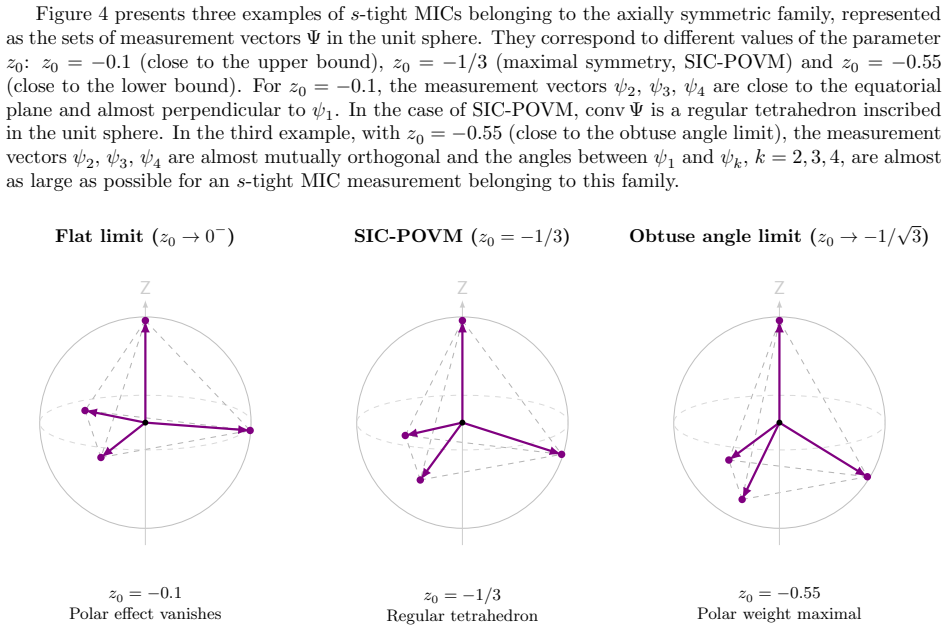
- A MIC is s-tight iff its directions satisfy the obtuse-angle condition and the cross-ratio rule; in dimension 2 the cross-ratio rule is vacuous, so obtuse angles alone suffice.
- Modulo rotations, s-tight MIC directions are classified by a skeleton p∈Δ°_{d+1} and an orientation sign; near white-noise measurements the same families occur in every generalised probabilistic theory of the same dimension.
- Every acute orthocentric simplex with orthocentre at the origin generates a family of minimal s-tight IC measurements, and within each family exactly one member is tight IC up to overall scaling.
Reading between the lines
- Inference: because the paper shows the same minimal IC measurement becomes tight IC under one choice of inner product and morphophoric under another, orthocentricity should be read not as an intrinsic property of the measurement vectors alone but as a joint property of the measurement and the Euclidean structure one chooses.
- Inference: the direction classification is state-space independent; this suggests tomography designs derived from skeletons in the quantum case could be transplanted to other generalised probabilistic theories of the same dimension, provided the resulting vector lengths are small enough to fit in the dual state set.
- Inference: the realisability question of which skeletons can actually be anchored in a given state space turns a longstanding existence problem such as SIC-POVMs into a geometric constraint problem; the maximally symmetric skeleton is the regular one, and its anchoring is exactly the SIC case.
Editorial analysis
A structured set of objections, weighed in public.
Referee Report
Summary. The paper establishes a correspondence between minimal s-tight informationally complete measurements in geometric generalised probabilistic theories and acute orthocentric simplices. The central result, Theorem 12, gives a three-way equivalence: a MIC is s-tight iff, after a unique rescaling, its measurement vectors form an acute orthocentric simplex with orthocentre at the origin, which is also equivalent to homothetic self-duality of that simplex. The authors also state an angular characterisation of s-tightness (Theorem 20) and, in Section 8.2, advertise a complete classification of admissible direction configurations by a skeleton vector p in the open probability simplex and an orientation sign, so that the moduli space is claimed to be Δ°_{d+1}×{±1}. The converse direction, from an acute orthocentric simplex to a family of s-tight MICs containing a unique tight IC measurement, is also proved.
Significance. If the results are fully established, this is a significant and elegant contribution. Theorem 12 and its consequences provide a concrete geometric dictionary for a class of measurements that includes tight IC and morphophoric measurements, and the explicit qubit analysis in Section 7.4 gives a useful testbed. The proof of Lemma 11 and the variational argument in Theorem 12 are presented in sufficient detail to be checkable, and the paper is careful about the distinction between measurement-to-simplex and simplex-to-measurement directions. The classification claim, if completed, would be a strong result: it would reduce the angular structure of all minimal s-tight IC measurements to a single probability vector and an orientation. However, as explained in the major comments, the classification portion is currently only sketched and deferred to a forthcoming paper, and Theorem 20's sufficiency direction relies on an external criterion whose hypotheses are not stated. These are load-bearing gaps for the advertised main results.
major comments (3)
- [§8.2, Eq. (28)] The abstract and Section 8.2 advertise a complete classification of direction configurations by Δ°_{d+1}×{±1}. The subsection itself states "Full details of the arguments sketched in this subsection will be given in a forthcoming work." In particular, the key realization step — that for every skeleton p there exist d+1 unit vectors in R^d with ⟨η_i,η_j⟩ = -t_i t_j — is compressed into a matrix-determinant-lemma remark, with no proof that the Gram matrix is positive semidefinite of rank d exactly when ∑p_i=1. This step is essential to the claimed bijection. As written, the classification is an unproved assertion, not a theorem; it should either be proved in this paper or the claim should be re-scoped.
- [Theorem 20, (b)⇒(a)] The sufficiency direction of the angular characterisation rests entirely on [30, Cor. 2.9], but the hypotheses of that external criterion are not stated and are not explicitly verified beyond condition (18). Since Theorem 20 is presented as a full angular characterisation and Section 8.2 builds the skeleton classification on the same criterion, the reader cannot check whether the cited corollary applies (e.g., whether it requires a particular frame cardinality, linear independence, or extra positivity assumptions). The proof should state the criterion and confirm all hypotheses, or provide a self-contained proof of (b)⇒(a).
- [§8.2, orientation class] The claim that configurations with a fixed skeleton p form exactly two orbits under O(d), distinguished by ε = sgn det(η_1,…,η_d), is asserted without proof. A complete moduli-space statement requires (i) existence of a realization for every p, (ii) transitivity of O(d) on realizations of the same Gram matrix, and (iii) a consistent treatment of the orientation sign under the relabellings and permutations that preserve p. None of these is demonstrated in the manuscript. This is load-bearing for the advertised classification result.
minor comments (3)
- [Proof of Theorem 12] In the implication (b)⇒(a), the definition of s is typeset as "s := c√p"; from the surrounding identities it must be s_j = c_j/√p_j. Please correct the display to avoid confusion.
- [Section 8.2] The sentence "every tuple of length below r is therefore admissible in one GGPT exactly when it is admissible in another" is imprecise: admissibility of a tuple of lengths depends on the radial function of the dual body S^⋆ through the box Σ(g), not only on a uniform ball radius. Consider rewording.
- [Table 2] The flat-limit column lists p_1=0, which lies outside the open simplex Δ°_{d+1}; the table is otherwise clearly labelled as a limit, but it may help to add a footnote that the limiting value is not an admissible skeleton.
Circularity Check
No significant circularity: the central equivalences are proven from frame theory and orthocentric-simplex geometry; self-citations are definitional and non-load-bearing.
full rationale
The paper's main claim, Theorem 12, is a genuine mathematical derivation rather than a restatement of definitions. The equivalence (a) s-tight IC ↔ (b) rescaled vectors form an acute orthocentric simplex is obtained from Lemma 11, which is proved directly: tightness of √pΦ is checked via the variational characterisation of tight frames (Theorem 5), and the orthocentric-simplex property is verified using the classical criterion of Edmonds--Hajja--Martini (Theorem 7). The homothetic self-duality direction in Lemma 11 is also proved by explicit facet/hyperplane duality. No parameter is fitted: the skeleton p is constructed from the measurement data via eq. (14) and its uniqueness follows from the external uniqueness result [9, Thm 3.1] for scalability constants. Theorem 20's angular criterion invokes the external scalable-frame criterion [30, Cor. 2.9]; while the paper does not reproduce that criterion's hypotheses in full, this is a dependence on an independent, non-self-cited result, not a circular reduction. Section 8.2's moduli-space classification is admittedly sketched and deferred to a forthcoming work, but the argument given is a standard Gram-matrix realisation argument: cross-ratio factorization yields off-diagonal entries -−t_i t_j, and the matrix determinant lemma is used to translate existence of unit vectors into a condition on the t_i. Even if this sketch later needs additional verification, that is a correctness/completeness risk, not circularity. The paper's self-citations to [44] and [45] supply the definition of s-tight IC measurements and prior morphophoric context; they do not carry the load of the new equivalence theorems. Overall, the derivation chain is self-contained and no 'prediction' reduces by construction to its inputs.
Assumptions & free parameters
assumptions (4)
- standard math Finite frame theory: variational characterization of tight frames (Theorem 5) and scalable-frame criterion of Kutyniok et al. [30, Cor. 2.9].
- standard math Orthocentric simplex geometry: Theorem 7, Proposition 9, and equations (8), (9) from Edmonds et al. [15].
- domain assumption GGPT framework: states as a convex body S in a finite-dimensional real inner product space with 0 in int S, effects as pairs (ψ,c), measurements as (Ψ,c) with the closure condition (Props. 1 and 2).
- domain assumption Tightness is relative to a fixed inner product; the classification is stated for a fixed Euclidean structure.
Cite this review
Pith. "Pith review of From minimal informationally complete measurements to orthocentric simplices and back again." pith.science (2026). https://pith.science/paper/NC6YSS4Q
@misc{pith2026260800809,
  author       = {Pith},
  title        = {Pith review of: From minimal informationally complete measurements to orthocentric simplices and back again},
  year         = {2026},
  howpublished = {\url{https://pith.science/paper/NC6YSS4Q}},
  note         = {Machine review of arXiv:2608.00809}
}
abstract
The reconstruction of unknown quantum states via minimal informationally complete measurements (MICs) is a cornerstone of quantum tomography. Although the statistical properties of these measurements are well-understood, their geometric structure has remained elusive. In this work, we establish a correspondence between the class of minimal $s$-tight informationally complete measurements, encompassing, among others, tight IC and morphophoric measurements, and the classical geometry of orthocentric simplices. In particular, we prove a three-way equivalence: a MIC is $s$-tight if and only if its measurement vectors, upon suitable rescaling, form the vertices of an acute orthocentric simplex with the orthocentre at the origin, and such simplices are precisely the homothetically self-dual ones. This geometric manifestation of operational ''tightness'' provides a bridge between the physical world and Euclidean geometry. Furthermore, the $s$-tight class is fully characterised by its measurement directions: the angles between them must be obtuse and satisfy a cross-ratio condition. We determine the space of admissible direction configurations: modulo rotations, every such configuration is encoded by a single probability vector, the ''skeleton'' of the measurement, together with an orientation class, so that the moduli space of $s$-tight MIC directions is $\Delta^{\circ}_{d+1}\times\{\pm 1\}$. Conversely, every acute orthocentric simplex with the orthocentre at the origin can be anchored in the state space, generating a class of minimal $s$-tight IC measurements that contains exactly one tight IC measurement up to overall rescaling.
Figures


Figures from the paper (2 more)

Reference graph
Works this paper leans on
-
[1]
D. M. Appleby, Symmetric informationally complete measurements of arbitrary rank, Opt. Spectrosc. 103 (2007), 416–428. doi:10.1134/s0030400x07090111
-
[2]
Barrett, Information processing in generalised probabilistic theories, Phys
J. Barrett, Information processing in generalised probabilistic theories, Phys. Rev. A 75 (2007), 032304. doi:10.1103/physreva.75.032304
-
[3]
I. Bengtsson, S. Weis, K. Życzkowski, Geometry of the set of mixed quantum states: An apophatic approach, in: P. Kielanowski, S. T. Ali, A. Odzijewicz, M. Schlichenmaier, T. Voronov (eds), Geometric Methods in Physics. XXX Workshop 2011, Trends in Mathematics, Birkh¨ auser, Basel 2013, 175–197. doi:10.1007/978-3-0348-0448-6 15
-
[4]
I. Bengtsson, K. Życzkowski, Geometry of Quantum States: An Introduction to Quantum Entanglement (2nd ed.), Cambridge UP, Cambridge 2017. doi:10.1017/9781139207010
-
[5]
Berger, Geometry I, Springer, Berlin 1994
M. Berger, Geometry I, Springer, Berlin 1994
work page 1994
-
[6]
R. A. Bertlmann, P. Krammer, Bloch vectors for qudits, J. Phys. A 41 (2008), 235303. doi:10.1088/1751- 8113/41/23/235303
doi:10.1088/1751- 2008
-
[7]
Bloch, Nuclear induction, Phys
F. Bloch, Nuclear induction, Phys. Rev. 70 (1946), 460–474. doi:10.1103/physrev.70.460
- [8]
Show all 47 references
-
[9]
A. Chan, R. Domagalski, Y. H. Kim, S. K. Narayan, H. Suh, X. Zhang, Minimal scalings and structural properties of scalable frames, Operators and Matrices 11 (2017), 1057–1073. doi:10.7153/oam-2017-11-73
2017 doi
-
[10]
N. A. Court, Notes on the orthocentric tetrahedron, Amer. Math. Monthly 41 (1934), 499–502. doi:10.1080/00029890.1934.11987633
1934
-
[11]
Curran, Quantum randomness beyond projective measurements, 2026, arXiv:2605.18291 [quant-ph]
F. Curran, Quantum randomness beyond projective measurements, 2026, arXiv:2605.18291 [quant-ph]
2026 arXiv
-
[12]
J. B. DeBrota, Informationally Complete Measurements and Optimal Representations of Quantum Theory, PhD Thesis, University of Massachusetts, Boston 2020
2020
-
[13]
J. B. DeBrota, C. A. Fuchs, B. C. Stacey, Symmetric informationally complete measurements identify the irreducible difference between classical and quantum systems, Phys. Rev. Res. 2 (2020), 013074. doi:10.1103/physrevresearch.2.013074
2020 doi
-
[14]
J. B. DeBrota, C. A. Fuchs, B. C. Stacey, The varieties of minimal tomographically complete measure- ments, Int. J. Quantum Inf. 19 (2021), 2040005. doi:10.1142/s0219749920400055
2021 doi
-
[15]
A. L. Edmonds, M. Hajja, H. Martini, Orthocentric simplices and their centers, Results Math. 47 (2005), 266–295. doi:10.1007/bf03323029
2005 doi
-
[16]
Egerv´ ary, On orthocentric simplexes, Acta Litt
E. Egerv´ ary, On orthocentric simplexes, Acta Litt. Sci. Szeged 9 (1940), 218–226
1940
-
[17]
Ehler, K
M. Ehler, K. A. Okoudjou, Probabilistic frames: an overview, in: Finite frames, Appl. Numer. Harmon. Anal., Birkh¨ auser/Springer, New York 2013, 415–436. doi:10.1007/978-0-8176-8373-312
2013 doi
-
[18]
Eltschka, M
C. Eltschka, M. Huber, S. Morelli, J. Siewert, The shape of higher-dimensional state space: Bloch-ball analog for a qutrit, Quantum 5 (2021), 485. doi:10.22331/q-2021-06-29-485
2021 doi
-
[19]
Fiedler, Geometrie simplexu vE n
M. Fiedler, Geometrie simplexu vE n. III. (Czech) [Geometry of the simplex inE n. III.]. ˇCasopis pro pˇ estov´ an´ ı matematiky 81 (1956), 182–223. doi:10.21136/cpm.1956.117189
1956
-
[20]
Fiedler, Matrices and Graphs in Geometry (Encyclopedia of Mathematics and its Applications, Series Number 139), Cambridge UP, Cambridge 2011
M. Fiedler, Matrices and Graphs in Geometry (Encyclopedia of Mathematics and its Applications, Series Number 139), Cambridge UP, Cambridge 2011. doi:10.1017/cbo9780511973611
2011 doi
-
[21]
C. A. Fuchs, R. Schack, Quantum-Bayesian coherence, Rev. Mod. Phys. 85 (2013), 1693–1715. doi:10.1103/revmodphys.85.1693
2013 doi
-
[22]
Gerber, The orthocentric simplex as an extreme simplex, Pacific J
L. Gerber, The orthocentric simplex as an extreme simplex, Pacific J. Math. 56 (1975), 97–111. doi:10.2140/pjm.1975.56.97
1975 doi
-
[23]
Hajja, Coincidences of centers in edge-incentric, or balloon, simplices, Results Math
M. Hajja, Coincidences of centers in edge-incentric, or balloon, simplices, Results Math. 49 (2006), 237–263. doi:10.1007/s00025-006-0222-4
2006 doi
-
[24]
Hajja, H
M. Hajja, H. Martini, Orthocentric simplices as the true generalizations of triangles, Math. Intelligencer 35 (2013), 16–28. doi:10.1007/s00283-013-9367-7
2013 doi
-
[25]
Innocenti, S
L. Innocenti, S. Lorenzo, I. Palmisano, F. Albarelli, A. Ferraro, M. Paternostro, G. M. Palma, Shadow tomography on general measurement frames, PRX Quantum 4 (2023), 040328. doi:10.1103/PRXQuantum.4.040328
2023 doi
-
[26]
Janotta, C
P. Janotta, C. Gogolin, J. Barrett, N. Brunner, Limits on nonlocal correlations from the structure of the local state space, New J. Phys. 13 (2011), 063024. doi:10.1088/1367-2630/13/6/063024
2011 doi
-
[27]
Janotta, H
P. Janotta, H. Hinrichsen, Generalized probability theories: what determines the structure of quantum theory? J. Phys. A 47 (2014), 323001. doi:10.1088/1751-8113/47/32/323001
2014 doi
-
[28]
Kabluchko, P
Z. Kabluchko, P. Schange, Angles of orthocentric simplices, Trans. Amer. Math. Soc., accepted (2026). doi:10.1090/tran/9812 31
2026 doi
-
[29]
Kimura, The Bloch vector for N-level systems, Phys
G. Kimura, The Bloch vector for N-level systems, Phys. Lett. A 314 (2003), 339–349. doi:10.1016/s0375- 9601(03)00941-1
2003 doi
-
[30]
Kutyniok, K
G. Kutyniok, K. A. Okoudjou, F. Philipp, E. K. Tuley, Scalable frames, Linear Algebra Appl. 438 (2013), 2225–2238. doi:10.1016/j.laa.2012.10.046
2013 doi
-
[31]
Lhuilier, De Relatione mutua Capacitatis et Terminorum Figurarum, geometrice considerata: seu de maximis et minimis pars prior, elementaris, Varsoviae 1782
S. Lhuilier, De Relatione mutua Capacitatis et Terminorum Figurarum, geometrice considerata: seu de maximis et minimis pars prior, elementaris, Varsoviae 1782
-
[32]
de Longchamps, Sur le t´ etra` edre orthocentrique, Mathesis 10 (1890), 49–53, 77–82
G. de Longchamps, Sur le t´ etra` edre orthocentrique, Mathesis 10 (1890), 49–53, 77–82
-
[33]
Masanes, M
L. Masanes, M. P. M¨ uller, A derivation of quantum theory from physical requirements, New J. Phys. 13 (2011), 063001. doi:10.1088/1367-2630/13/6/063001
2011 doi
-
[34]
M. P. M¨ uller, Probabilistic theories and reconstructions of quantum theory, SciPost Phys. Lect. Notes 28 (2021). doi:10.21468/scipostphyslectnotes.28
2021 doi
-
[35]
Pl´ avala, General probabilistic theories: An introduction, Phys
M. Pl´ avala, General probabilistic theories: An introduction, Phys. Rep. 1033 (2023), 1–64. doi:10.1016/j.physrep.2023.09.001
2023 doi
-
[36]
P. H. Schoute, Mehrdimensionale Geometrie. I. Teil: Die linearen R¨ aume, G. J. G¨ oschen’sche Ver- lagshandlung, Leipzig 1902
1902
-
[37]
A. J. Scott, Tight informationally complete quantum measurements, J. Phys. A 39 (2006), 13507–13530. doi:10.1088/0305-4470/39/43/009
2006 doi
-
[38]
Słomczyński, Dynamical Entropy, Markov Operators, and Iterated Function Systems, Wydawnictwo Uniwersytetu Jagiellońskiego, Kraków 2003
W. Słomczyński, Dynamical Entropy, Markov Operators, and Iterated Function Systems, Wydawnictwo Uniwersytetu Jagiellońskiego, Kraków 2003
2003
-
[39]
Słomczyński, Frugal QBism: fiducial measurements in generalised probabilistic theories, in prepa- ration
W. Słomczyński, Frugal QBism: fiducial measurements in generalised probabilistic theories, in prepa- ration
-
[40]
Słomczyński, A
W. Słomczyński, A. Szymusiak, Morphophoric POVMs, generalised qplexes, and 2-designs, Quantum 4 (2020), 338. doi:10.22331/q-2020-09-30-338
2020 doi
-
[41]
D. M. Y. Sommerville, An Introduction to the Geometry ofNDimensions, Methuen & Co., London 1929
1929
-
[42]
Steiner, Fortsetzung der geometrischen Betrachtungen, J
J. Steiner, Fortsetzung der geometrischen Betrachtungen, J. Reine Angew. Math. 1 (1826), 252–288
-
[43]
Szczepanek, Quantum Dynamical Entropy of Unitary Operators in Finite-dimensional State Spaces, PhD Thesis, Jagiellonian University, Kraków 2019
A. Szczepanek, Quantum Dynamical Entropy of Unitary Operators in Finite-dimensional State Spaces, PhD Thesis, Jagiellonian University, Kraków 2019
2019
-
[44]
Szymusiak, Beyond morphophoricity:s-tight IC measurements in geometric generalised probabilistic theories, 2025, arXiv:2507.01745 [quant-ph]
A. Szymusiak, Beyond morphophoricity:s-tight IC measurements in geometric generalised probabilistic theories, 2025, arXiv:2507.01745 [quant-ph]
2025 arXiv
-
[45]
Szymusiak, W
A. Szymusiak, W. Słomczyński, Can QBism exist without Q? Morphophoric measurements in gener- alised probabilistic theories, Quantum 9 (2025), 1598. doi:10.22331/q-2025-01-15-1598
2025 doi
- [46]
-
[47]
S. F. D. Waldron, An Introduction to Finite Tight Frames, Birkh¨ auser, New York 2018. doi:10.1007/978- 0-8176-4815-2 32 A Instrument and Bayes’ rule Letx=λx 1 + (1−λ)x 2 ∈Sbe a convex combination (statistical mixture) of two states, withx 1, x2 ∈S, λ∈(0,1), and letj= 1, . . ....
2018 doi
Reviewed August 5, 2026 · model on record in the stance chip above.
Discussion (0). Continue with ORCID to comment.