REVIEW 4 major objections 5 minor 27 references
Multi-marginal temporal Schr\"odinger Bridge Matching from unpaired data
T0 review · 4 major / 5 minor · reviewed 2026-08-04 · deepseek-v4-flash
Pith's one-line read The IMFF algorithm converges to the unique multi-marginal Schrödinger bridge, enabling dynamic reconstruction from unpaired static snapshots.
desk verdict Useful empirical recipe for multi-marginal SB matching, but the convergence proof does not hold up and the theory is under-supported. read the letter →
The pith
A machine-rendered reading of the paper's core claim, the machinery that carries it, and where it could break.
The reading
What carries the argument
The load-bearing object is the factorized reciprocal class R⊗(Q): for a grid of times, a path measure in this class is built by choosing a coupling at the grid points and filling each interval [t_i, t_{i+1}] independently with the bridge of the reference process Q between the two endpoints. The IMFF algorithm alternates two projections: the Markovian projection, which replaces a factorized mixture by the diffusion with the same one-time marginals and conditional expected drift, and the factorized reciprocal projection, which re-glues the dynamics with Q-bridges while keeping the grid coupling. KL Pythagorean identities for these two projections make the alternating sequence monotone and driv
What would settle it
Run IMFF on a low-dimensional problem with three or four prescribed Gaussian-mixture marginals, compute the static multi-marginal Schrödinger bridge directly by iterative proportional fitting (or another exact method) on a fine discretization, and compare the couplings. A strictly positive gap in KL(P_IMFF∥Q) − KL(P_MMSB∥Q) would falsify the claim that the IMFF limit is the multi-marginal Schrödinger bridge.
Extended reading notes
Core claim
The central claim is that the IMFF sequence converges in KL divergence to the unique solution of the multi-marginal Schrödinger bridge (MMSB). More precisely, the paper's Theorem 3.2 asserts that the limit P⋆ satisfies KL(P_MMSB∥Q) = KL(P⋆∥Q) ≤ KL(P_pair∥Q), where P_pair is the collage of pairwise bridges, and concludes 'Thus, P⋆ is the multi-marginal Schrödinger Bridge.' The solution's density with respect to the reference factorizes as a product of one-point functions over the grid, and the full path is obtained by gluing independent reference bridges between the grid endpoints. The algorithm trains forward and backward drifts interval-by-interval, and experiments aim to show the limit is
Load-bearing premise
Everything rests on Conjecture 3.1—that a Markov path measure matching all prescribed marginals and lying in the reciprocal class of the reference is the unique multi-marginal Schrödinger bridge; if that fails, the algorithm's limit may not be the object the paper claims to recover.
Editorial extensions
If this is right
- If the convergence result is correct, learning forward and backward drifts by simple regression losses is enough to solve multi-marginal Schrödinger bridges, not just two-marginal ones.
- The factorized formulation means intervals can be processed in parallel, so the method scales to many time points and high dimensions without storing full trajectories.
- For a Brownian reference, the MMSB objective is exactly entropy-regularized multi-marginal optimal transport with a time-structured quadratic cost, giving an interpretation of the learned trajectories as regularized transport paths.
- On real cell-transition benchmarks, the method yields lower MMD, sliced-Wasserstein, and W1 distances than previous bridge-based trajectory inference, supporting its use when samples are unpaired.
- In image space, the method produces temporally coherent videos from unpaired frames, which would make it the first such demonstration for purely unpaired data.
Reading between the lines
- The convergence theorem is conditional on a conjecture: the paper assumes that any Markov measure matching the marginals and lying in the reciprocal class is the MMSB. If this holds only for the full reciprocal class rather than the factorized class used by the algorithm, the limit could be a different process that still beats the pairwise collage; the inequality in Theorem 3.2 does not by itself
- A practical implication the authors leave implicit: the strength of the output depends on the time grid. With few grid points, the factorized reciprocal projection can only enforce constraints at those times, so intermediate behavior is determined by the reference, not by the data.
- A testable extension would be to compare IMFF against direct multi-marginal Sinkhorn/IPF on finite low-dimensional problems to see whether the conjectured uniqueness holds empirically for the factorized class.
Editorial analysis
A structured set of objections, weighed in public.
Referee Report
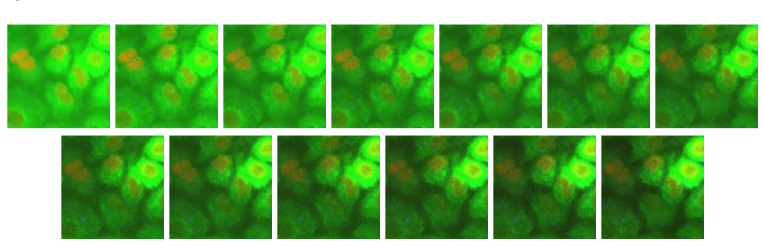
Summary. The paper formulates a multi-marginal temporal Schrödinger bridge (MMSB) problem with prescribed marginals on a time grid and proposes Iterative Markovian Factorized Fitting (IMFF), an alternating projection algorithm between Markov diffusions (M) and a factorized reciprocal class R⊗(Q). The main theoretical claims are that the IMFF sequence converges to the unique MMSB solution (Prop. 3.8, Thm. 3.2), based on an unproved analogue of Léonard's characterization (Conjecture 3.1). The method is evaluated on Gaussian mixtures, 50D Gaussian transport, 100D single-cell benchmarks, and on image/video datasets including MNIST and a fluorescence microscopy dataset.
Significance. If the central convergence theorem were valid, this would be a substantial contribution: a scalable, parallelizable multi-marginal Schrödinger bridge solver with strong empirical results, including state-of-the-art transcriptomic trajectory inference and a first demonstration of video generation from purely unpaired data. The paper is also commendable for releasing code, providing detailed experimental documentation, and transparently flagging Conjecture 3.1 as a conjecture. However, the proof of the central claim contains a false induction step, and the equality identifying the IMFF limit with the MMSB is asserted rather than derived. The advertised theoretical guarantee — the main distinction from a heuristic alternating projection — is therefore not established.
major comments (4)
- [Appendix A.6.10 / Proposition 3.8] The second claim of Proposition 3.8 is proved by an induction step that asserts 'P^n ∈ M ∩ R⊗(Q) for all n'. This is inconsistent with the update (7): P^{2n+1}=proj_M(P^{2n}) is only guaranteed to lie in M, and P^{2n+2}=proj_{R⊗(Q)}(P^{2n+1}) only in R⊗(Q). No iterate after P^0 is shown to be in the intersection, so the concluding argument — that the decreasing sequence KL(P^n||P*) must converge to P*, 'the unique measure in this intersection' — is applied to an empty premise. Monotone decrease of KL does not by itself identify the limit.
- [Theorem 3.2 / Appendix A.6.11] The central equality KL(P_MMSB||Q)=KL(P*||Q) is exactly what needs proof, but the proof only asserts that a subsequential weak limit P^∞ lies in M∩R⊗(Q) and matches the marginals, and then invokes 'uniqueness of the weak MMSB solution' to conclude P^∞=P*. This assumes the identification result that is at stake. The downstream claim that P* is 'the best Markovian candidate in M∩R⊗(Q)' is not derived from the variational problem (4), so the inequality chain in Theorem 3.2 does not establish that the IMFF limit is the MMSB.
- [Conjecture 3.1 and §3.2.2] The algorithm is explicitly 'Based on Conjecture 3.1', but the conjecture is stated for the full reciprocal class R(Q), whereas IMFF alternates projections onto M and the factorized class R⊗(Q). These classes are not equivalent: a measure built from Q-bridges conditioned on interior grid points need not belong to R(Q). Therefore even a proof of Conjecture 3.1 would not characterize fixed points of the proposed algorithm. A version of the conjecture for R⊗(Q), or a different argument connecting IMFF fixed points to the MMSB, is required.
- [Lemma 3.1 / Appendix A.6.8] The Pythagorean identities in Lemma 3.1 are the mechanism behind the monotonicity claimed in Proposition 3.8. The proof of the Markovian part is deferred by 'follows analogously to the proof of (Shi et al., 2023)', but the set M of Markov diffusions with fixed noise coefficient is not convex, so the standard KL Pythagorean theorem does not apply without additional argument. Since the proof is omitted, this is another load-bearing gap in the convergence analysis.
minor comments (5)
- [Abstract] The abstract in the arXiv listing emphasizes 'recovering hidden dynamics from static data', while the full-text abstract says the method is 'for video generation from unpaired data'. The two versions should be harmonized.
- [Appendix A.6.7 / Proposition 3.6] The proof ends with 'M⋆ = Π', which conflicts with the proposition statement; the established equality is between time marginals, M⋆_t = Π_t.
- [Table 3] The table includes GAGA with W1=27.04, which is substantially lower than MMtSBM's 44.542. The 'state-of-the-art' and '-15%' claims should be restricted to the stated comparison class (no precomputed OT plan, no pinned endpoints) and should explicitly acknowledge GAGA's result in the other setting.
- [Proposition 3.7] The proof uses reversibility of Q for an arbitrary Markov reference process. Reversibility holds for the Brownian reference used in the experiments, but not for a general Markov Q; the statement should either be restricted to reversible references or use the correct time-reversal formula.
- [Appendix A.3 / Algorithm numbering] The main-text Algorithm 1 and the appendix Algorithm 3 carry the same name and description; the numbering should be aligned to avoid confusion.
Circularity Check
Central convergence theorem reduces to Conjecture 3.1; the proof of Prop. 3.8 assumes every iterate already lies in M∩R⊗(Q).
-
other
[Appendix A.6.10, proof of Proposition 3.8]
"Moreover, by induction we have P^n ∈ M ∩ R⊗(Q) for all n, so the limit must coincide with P⋆, the unique measure in this intersection with prescribed marginals."
The IMFF update (7) gives P^{2n+1}=proj_M(P^{2n})∈M and P^{2n+2}=proj_{R⊗(Q)}(P^{2n+1})∈R⊗(Q); generically neither projection lands in the other set. The induction hypothesis 'P^n ∈ M ∩ R⊗(Q) for all n' therefore already asserts that every iterate is a common fixed point of the two projections, i.e. that convergence has occurred. The limit is then declared to be the unique measure in this intersection, so KL(P^n||P⋆)→0 is obtained by naming P⋆ rather than by the alternating-projection dynamics.
-
other
[Theorem 3.2 and Appendix A.6.11]
"By construction, P∞ ∈ M ∩ R⊗(Q) and matches the marginals (µ_ti)K i=0, so by uniqueness of the weak MMSB solution we must have P∞ = P⋆. ... Thus, P⋆ is the multi-marginal Schrödinger Bridge."
Membership in M∩R⊗(Q) plus matched marginals does not imply global KL-minimality over all path measures unless one invokes the analogue Conjecture 3.1, which the paper states (unproved) for R(Q), not R⊗(Q). The equality KL(P_MMSB||Q)=KL(P⋆||Q) in Theorem 3.2 is asserted, not derived; the final identification of P⋆ with the MMSB is exactly the conjecture on which Algorithm 1 is said to be 'based.' The theorem therefore restates its unproved input as the conclusion.
full rationale
The empirical sections (toy OT, 50D/100D benchmarks, video) are held-out evaluations and give genuine external grounding; they do not, however, repair the theoretical derivation chain. The paper's central claim—that IMFF converges to the true multi-marginal Schrödinger bridge—is supported by Proposition 3.8 and Theorem 3.2. The proof of Proposition 3.8 contains a false induction (each alternating projection would have to land in the intersection M∩R⊗(Q), which is not true after P0), and it presupposes existence and uniqueness of P⋆ in that intersection. Theorem 3.2 then identifies this P⋆ with the MMSB by invoking 'uniqueness of the weak MMSB solution' without proving that P∞ is a minimizer; the missing implication is precisely Conjecture 3.1, which the paper explicitly leaves unproved and which is stated for the full reciprocal class R(Q) while the algorithm uses the factorized class R⊗(Q). The convergence result thus reduces to the paper's own conjecture and to a fixed-point object whose equality with the MMSB is assumed rather than shown. This is a substantive circularity in the theory, though the empirical comparisons are independent, so the score is set at 7 rather than higher.
Assumptions & free parameters
free parameters (1)
- σ (reference Brownian noise scale) =
0.3 (MULTI benchmark)
assumptions (5)
- ad hoc to paper Conjecture 3.1: a Markov path measure in the reciprocal class matching all grid marginals is the MMSB solution.
- ad hoc to paper The alternating projections P^{2n+1}=proj_M(P^{2n}) and P^{2n+2}=proj_{R⊗(Q)}(P^{2n+1}) converge to a point in M∩R⊗(Q).
- domain assumption Regularity conditions ('mild assumptions', A1-A3) for the Markovian projection theorems.
- domain assumption The neural network families {v_θ} and {v_ϕ} are expressive enough to represent the optimal forward and backward drifts.
- standard math Entropy additivity and Csiszár's Pythagorean identity for KL projections.
Cite this review
Pith. "Pith review of Multi-marginal temporal Schr\"odinger Bridge Matching from unpaired data." pith.science (2026). https://pith.science/paper/NDJS7J5A
@misc{pith2026251001894,
  author       = {Pith},
  title        = {Pith review of: Multi-marginal temporal Schr\"odinger Bridge Matching from unpaired data},
  year         = {2026},
  howpublished = {\url{https://pith.science/paper/NDJS7J5A}},
  note         = {Machine review of arXiv:2510.01894}
}
read the original abstract
Many natural dynamic processes -- such as in vivo cellular differentiation or disease progression -- can only be observed through the lens of static sample snapshots. While challenging, reconstructing their temporal evolution to decipher underlying dynamic properties is of major interest to scientific research. Existing approaches enable data transport along a temporal axis but are poorly scalable in high dimension and require restrictive assumptions to be met. To address these issues, we propose Multi-Marginal temporal Schr\"odinger Bridge Matching (MMtSBM) from unpaired data, extending the theoretical guarantees and empirical efficiency of Diffusion Schr\"odinger Bridge Matching (arXiv:2303.16852) by deriving the Iterative Markovian Fitting algorithm to multiple marginals in a novel factorized fashion. Experiments show that MMtSBM retains theoretical properties on toy examples, achieves state-of-the-art performance on real-world datasets such as transcriptomic trajectory inference in 100 dimensions, and, for the first time, recovers couplings and dynamics in very high-dimensional image settings. Our work establishes multi-marginal Schr\"odinger bridges as a practical and principled approach for recovering hidden dynamics from static data.
Figures


Figures from the paper (4 more)


Reference graph
Works this paper leans on
-
[1]
Schr\"odinger bridge flow for unpaired data translation, 2024
Valentin De Bortoli, Iryna Korshunova, Andriy Mnih, and Arnaud Doucet. Schr\"odinger bridge flow for unpaired data translation, 2024. URL https://arxiv.org/abs/2409.09347
arXiv 2024
-
[2]
Stark, Gabriele Gut, Eran H.K
Charlotte Bunne, Stefan G. Stark, Gabriele Gut, Eran H.K. Stelzer, Gunnar Rätsch, and Marco Cuturi. Learning single-cell perturbation responses using neural optimal transport. Nature Methods, 20 0 (12): 0 1820--1829, 2023
2023
- [3]
- [4]
-
[5]
I-divergence geometry of probability distributions and minimization problems
Imre Csisz \'a r. I-divergence geometry of probability distributions and minimization problems. The Annals of Probability, 3 0 (1): 0 146--158, 1975. doi:10.1214/aop/1176996454. URL https://projecteuclid.org/journals/annals-of-probability/volume-3/issue-1/I-Divergence-Geometry-of-Probability-Distributions-and-Minimization-Problems/10.1214/aop/1176996454.full
arXiv 1975
-
[6]
Sinkhorn distances: Lightspeed computation of optimal transport
Marco Cuturi. Sinkhorn distances: Lightspeed computation of optimal transport. In Advances in Neural Information Processing Systems (NeurIPS), 2013
2013
-
[7]
Diffusion schr\"odinger bridge with applications to score-based generative modeling, 2021
Valentin De Bortoli, James Thornton, Jeremy Heng, and Arnaud Doucet. Diffusion schr\"odinger bridge with applications to score-based generative modeling, 2021. URL https://arxiv.org/abs/2106.01357
arXiv 2021
-
[8]
Mimicking the one-dimensional marginal distributions of processes having an it \^o differential
Istv \'a n Gy \"o ngy. Mimicking the one-dimensional marginal distributions of processes having an it \^o differential. Probability Theory and Related Fields, 71: 0 501--516, 1986
1986
Show all 27 references
-
[9]
Trajectory inference with smooth schr\"odinger bridges, 2025
Wanli Hong, Yuliang Shi, and Jonathan Niles-Weed. Trajectory inference with smooth schr\"odinger bridges, 2025. URL https://arxiv.org/abs/2503.00530
2025 arXiv
-
[10]
Kullback
S. Kullback. Probability Densities with Given Marginals . The Annals of Mathematical Statistics, 39 0 (4): 0 1236 -- 1243, 1968. doi:10.1214/aoms/1177698249. URL https://doi.org/10.1214/aoms/1177698249
1968
-
[11]
From the schr \"o dinger problem to the monge--kantorovich problem
Christian L \'e onard. From the schr \"o dinger problem to the monge--kantorovich problem. Journal of Functional Analysis, 262 0 (4): 0 1879--1920, 2012
1920
-
[12]
A survey of the schr \"o dinger problem and some of its connections with optimal transport
Christian L \'e onard. A survey of the schr \"o dinger problem and some of its connections with optimal transport. Discrete and Continuous Dynamical Systems - A, 34 0 (4): 0 1533--1574, 2014
2014
-
[13]
Yaron Lipman, Ricky T. Q. Chen, Heli Ben-Hamu, Maximilian Nickel, and Matt Le. Flow matching for generative modeling, 2023. URL https://arxiv.org/abs/2210.02747
2023 arXiv
-
[14]
Flow straight and fast: Learning to generate and transfer data with rectified flow, 2022
Xingchao Liu, Chengyue Gong, and Qiang Liu. Flow straight and fast: Learning to generate and transfer data with rectified flow, 2022. URL https://arxiv.org/abs/2209.03003
2022 arXiv
-
[15]
Moon, David van Dijk, Zheng Wang, Scott Gigante, Daniel B
Kevin R. Moon, David van Dijk, Zheng Wang, Scott Gigante, Daniel B. Burkhardt, William S. Chen, Kristina Yim, Antonia van den Elzen, Matthew J. Hirn, Ronald R. Coifman, Natalia B. Ivanova, Guy Wolf, and Smita Krishnaswamy. Visualizing structure and transitions in high-dimensio...
2019 doi
-
[16]
Diffusion bridge mixture transports, schr \"o dinger bridge problems and generative modeling
Stefano Peluchetti. Diffusion bridge mixture transports, schr \"o dinger bridge problems and generative modeling. J. Mach. Learn. Res., 24: 0 374:1--374:51, 2023. URL https://api.semanticscholar.org/CorpusID:257912618
2023
-
[17]
Über die umkehrung der naturgesetze
Erwin Schr \"o dinger. Über die umkehrung der naturgesetze. Sitzungsberichte der Preussischen Akademie der Wissenschaften, Physikalisch-mathematische Klasse, pp.\ 144--153, 1931
1931
-
[18]
Diffusion schr\"odinger bridge matching, 2023
Yuyang Shi, Valentin De Bortoli, Andrew Campbell, and Arnaud Doucet. Diffusion schr\"odinger bridge matching, 2023. URL https://arxiv.org/abs/2303.16852
2023 arXiv
-
[19]
Kingma, Abhishek Kumar, Stefano Ermon, and Ben Poole
Yang Song, Jascha Sohl-Dickstein, Diederik P. Kingma, Abhishek Kumar, Stefano Ermon, and Ben Poole. Score-based generative modeling through stochastic differential equations. In International Conference on Learning Representations (ICLR), 2021
2021
-
[20]
Saravanos, Evangelos A
Panagiotis Theodoropoulos, Augustinos D. Saravanos, Evangelos A. Theodorou, and Guan-Horng Liu. Momentum multi-marginal schr\"odinger bridge matching, 2025. URL https://arxiv.org/abs/2506.10168
2025
-
[21]
Trajectorynet: A dynamic optimal transport network for modeling cellular dynamics, 2020
Alexander Tong, Jessie Huang, Guy Wolf, David van Dijk, and Smita Krishnaswamy. Trajectorynet: A dynamic optimal transport network for modeling cellular dynamics, 2020. URL https://arxiv.org/abs/2002.04461
2020 arXiv
-
[22]
Improving and generalizing flow-based generative models with minibatch optimal transport, 2024
Alexander Tong, Kilian Fatras, Nikolay Malkin, Guillaume Huguet, Yanlei Zhang, Jarrid Rector-Brooks, Guy Wolf, and Yoshua Bengio. Improving and generalizing flow-based generative models with minibatch optimal transport, 2024. URL https://arxiv.org/abs/2302.00482
2024 arXiv
-
[23]
Deep generative learning via schr\" o dinger bridge, 2021
Gefei Wang, Yuling Jiao, Qian Xu, Yang Wang, and Can Yang. Deep generative learning via schr\" o dinger bridge, 2021. URL https://arxiv.org/abs/2106.10410
2021 arXiv
-
[24]
write newline
" write newline "" before.all 'output.state := FUNCTION n.dashify 't := "" t empty not t #1 #1 substring "-" = t #1 #2 substring "--" = not "--" * t #2 global.max substring 't := t #1 #1 substring "-" = "-" * t #2 global.max substring 't := while if t #1 #1 substring * t #2 gl...
-
[25]
@esa (Ref
\@ifxundefined[1] #1\@undefined \@firstoftwo \@secondoftwo \@ifnum[1] #1 \@firstoftwo \@secondoftwo \@ifx[1] #1 \@firstoftwo \@secondoftwo [2] @ #1 \@temptokena #2 #1 @ \@temptokena \@ifclassloaded agu2001 natbib The agu2001 class already includes natbib coding, so you should ...
-
[26]
\@lbibitem[] @bibitem@first@sw\@secondoftwo \@lbibitem[#1]#2 \@extra@b@citeb \@ifundefined br@#2\@extra@b@citeb \@namedef br@#2 \@nameuse br@#2\@extra@b@citeb \@ifundefined b@#2\@extra@b@citeb @num @parse #2 @tmp #1 NAT@b@open@#2 NAT@b@shut@#2 \@ifnum @merge>\@ne @bibitem@firs...
-
[27]
@open @close @open @close and [1] URL: #1 \@ifundefined chapter * \@mkboth \@ifxundefined @sectionbib * \@mkboth * \@mkboth\@gobbletwo \@ifclassloaded amsart * \@ifclassloaded amsbook * \@ifxundefined @heading @heading NAT@ctr thebibliography [1] @ \@biblabel @NAT@ctr \@bibset...
Reviewed August 4, 2026 · model on record in the stance chip above.
Discussion (0). Continue with ORCID to comment.