REVIEW 3 major objections 3 minor 3 cited by
Bottomoniumlike states in proton collisions: Fragmentation and resummation
T0 review · 3 major / 3 minor · reviewed 2026-08-11 · deepseek-v4-flash
Pith's one-line read This paper claims that unobserved bottomoniumlike tetraquarks—states containing a bottom-antibottom pair plus either light quarks or a second heavy pair—can be described at high transverse momentum by single-parton fragmentation, and it…
desk verdict A well-executed incremental update with genuinely new T4b FFs and first resummed T4b+jet predictions; the absolute normalization rests on one unvalidated, ninth-power LDME Ansatz. read the letter →
The pith
A machine-rendered reading of the paper's core claim, the machinery that carries it, and where it could break.
The reading
What carries the argument
The central objects are the two new fragmentation-function families, TQHL1.1 and TQ4Q1.1, each defined by initial-scale inputs at kinematic thresholds—$3m_Q+2m_q$ for the doubly heavy channel, and $4m_Q$ for the gluon and $5m_Q$ for the heavy-quark channel in the fully heavy case—and then evolved with DGLAP using a threshold-consistent heavy-flavor nonrelativistic evolution scheme. The carrying mechanism is the leading-power variable-flavor-number-scheme fragmentation picture, in which a short-distance coefficient for a single parton splitting into the tetraquark Fock state is convoluted with a nonperturbative hadronization matrix element or wave function. The gluon channel plays a dedicated role as a natural stabilizer of the high-energy resummed series, since its smooth scale dependence keeps the next-to-leading-log corrections under control.
What would settle it
A lattice QCD calculation (or an independent potential-model determination) of the ratio $\langle O_{T_{4b}}\rangle/\langle O_{T_{4c}}\rangle$ for the $0^{++}$ state would settle the normalization claim: if the ratio differs substantially from the $\simeq 400$ value used in Eq. (21), all $T_{4b}$ cross sections in Section 4 would shift by the same factor. In the charmed sector, a precise high-transverse-momentum measurement of prompt $T_{4c}$ production could already constrain the analogous matrix elements and test the fragmentation picture.
Extended reading notes
Core claim
The central claim is that both doubly bottomed tetraquarks $X_{b\bar{b}q\bar{q}}$ and fully bottomed $T_{4b}$ (and their charmed analogues) can be treated as produced by collinear fragmentation of a single parton, with initial conditions computed from QCD-based models and then evolved by DGLAP, and that this treatment yields phenomenologically usable predictions. Concretely, the paper releases TQHL1.1 functions for $X_{c\bar{c}u\bar{u}}$, $X_{c\bar{c}s\bar{s}}$, $X_{b\bar{b}u\bar{u}}$, and $X_{b\bar{b}s\bar{s}}$, built on a spin-physics-inspired model with a fixed average transverse momentum $\langle \vec q_T^2 \rangle = 4$ GeV$^2$, and TQ4Q1.1 functions for $T_{4c/b}(0^{++})$ and $T_{4c/b}(2^{++})$, built on potential-NRQCD short-distance coefficients and long-distance matrix elements. The fully bottomed rates inherit their absolute normalization from a color-Coulomb scaling Ansatz that sets $\langle O_{T_{4b}}\rangle/\langle O_{T_{4c}}\rangle \simeq (m_b\alpha_s^{(b)}/(m_c\alpha_s^{(c)}))^9 \simeq 400$. The resulting rapidity-interval and transverse-momentum distributions for tetraquark-plus-jet production are stable under scale variation and under next-to-leading logarithmic corrections, which the paper interprets as a sign that heavy-flavor fragmentation stabilizes high-energy resummation.
Load-bearing premise
The load-bearing premise is that the color-Coulomb scaling Ansatz of Eq. (21), which sets the ratio of bottom- to charm-tetraquark nonperturbative matrix elements to about 400, correctly fixes the overall normalization of all fully bottomed tetraquark rates.
Editorial extensions
If this is right
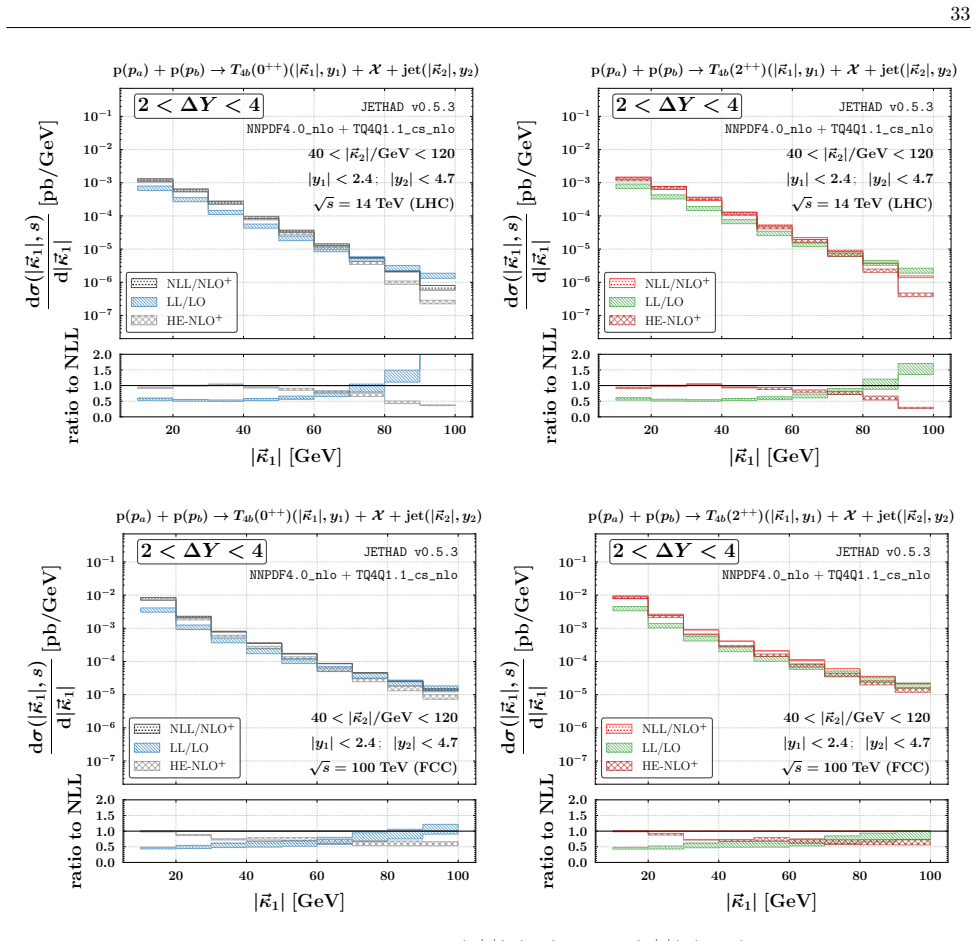
- Predictions are now available for $X_{b\bar{b}u\bar{u}}$, $X_{b\bar{b}s\bar{s}}$, $T_{4b}(0^{++})$, and $T_{4b}(2^{++})$ plus a jet in rapidity-interval and transverse-momentum bins at 14 TeV LHC and 100 TeV FCC, with rates from about 1 pb down to $10^{-5}$ pb.
- The gluon fragmentation channel, though smaller than the heavy-quark one, controls the stability of the resummed distributions, so future data can test the natural-stability picture directly.
- The released machine-readable sets let other groups compute single-inclusive and semi-inclusive bottom-tetraquark observables without redoing the model inputs.
- Variants evolved without the initial heavy-quark input differ from the full sets by factors of 1.5 to 10 in the heavy-quark channel, so precision measurements could discriminate the initial condition.
- Cross sections grow by roughly an order of magnitude from LHC to FCC energies, which would make a future 100 TeV collider a substantially more sensitive discovery channel.
Reading between the lines
- The absolute normalization of every $T_{4b}$ prediction rests on the color-Coulomb Ansatz of Eq. (21); a lattice or potential-model computation of the four-body wave function at the origin could rescale all $T_{4b}$ rates by orders of magnitude without changing their shapes.
- The same initial-scale inputs could be applied to photoproduction and deep-inelastic channels at an electron-ion collider, where the gluon-initiated fragmentation channel would be probed directly.
- Comparing the $T_{4c}$ analogue predictions against existing LHC double-$J/\psi$ data at high transverse momentum would calibrate the long-distance matrix elements and thereby sharpen the $T_{4b}$ predictions.
- The transverse-momentum parameter that fixes the doubly heavy fragmentation functions is chosen by heuristic peak scans rather than data; a data-driven determination of this parameter would convert the fragmentation functions from model-guided into measured inputs.
Editorial analysis
A structured set of objections, weighed in public.
Referee Report
Summary. The paper constructs two new families of DGLAP-evolving, VFNS collinear fragmentation functions for tetraquark production: TQHL1.1, describing the fragmentation of a heavy quark into a doubly heavy tetraquark X_{Q\bar Q q\bar q} via an improved Suzuki model, and TQ4Q1.1, describing the fragmentation of a gluon or heavy quark into a fully heavy tetraquark T_{4Q} via potential-NRQCD short-distance coefficients and long-distance matrix elements. These FFs are evolved with DGLAP/HF-NRevo and released in LHAPDF format. Using the NLL/NLO+ hybrid factorization implemented in (sym)JETHAD, the authors provide predictions for rapidity-interval and transverse-momentum distributions for bottomoniumlike-state-plus-jet production at 14 TeV LHC and 100 TeV FCC. The central claim is that these FF sets provide usable leading-power, factorized predictions for future searches, superseding the earlier 1.0 versions.
Significance. If the underlying model inputs are accepted, the paper makes a useful and concrete contribution: it provides public, DGLAP-evolved VFNS FFs for doubly and fully bottomed tetraquarks, with transparent symbolic computations through symJETHAD and numerical results through JETHAD. The phenomenology extends the group's established program on high-energy resummation to the exotic bottom sector, and the LHAPDF release is a genuine asset for future experimental and theoretical work. The main scientific value lies in the predictions for tetraquark-plus-jet rates at LHC/FCC energies, which are falsifiable once data on these hypothetical states become available. However, the absolute normalization of the T4b predictions rests on an unvalidated LDME scaling, and the TQHL1.1 shape relies on a heuristic transverse-momentum parameter; these inputs are acknowledged in the text but are not quantified as uncertainties, which limits the strength of the central claim.
major comments (3)
- [Sec. 2.3.2, Eq. (21)] The T4b predictions inherit their absolute normalization from the assumption ⟨O_{T4b}⟩/⟨O_{T4c}⟩ ≃ (m_b α_s^{(b)}/(m_c α_s^{(c)}))^9 ≃ 400. Since Eq. (10) is linear in each color-composite LDME, the same factor multiplies every [g→T4b] and [Q→T4b] initial-scale FF and, through the linear convolution in Eq. (33), every T4b cross section shown in Figs. 13, 16, and 17. The ninth-power exponent makes this input extremely sensitive: changing the bracketed ratio from 1.8 to 2.07 changes the ratio by roughly a factor of 2.6, and the paper gives no explicit values of α_s, renormalization scales, or velocities that produce the number 400. The text itself states that exact T4b LDMEs have not been computed and labels Eq. (21) a 'reasonable Ansatz,' with no lattice, data, or independent potential-model value used to anchor it. Please provide an uncertainty band or a sensitivity scan over this ratio, and ideally a cross-check from an alternative LDME model, before presenting the T4b rates as quantitative predictions.
- [Sec. 2.2.1, Eq. (9)] The TQHL1.1 ⟨q_T^2⟩ parameter is fixed at 4 GeV² through the relation sqrt(⟨q_T²⟩_{X}) ≈ sqrt(⟨q_T²⟩_{T4Q})/2, where ⟨q_T²⟩_{T4Q}=70 GeV² was itself chosen in Ref. [106] by requiring ⟨z⟩≳0.4 and that the quark channel have the same order of magnitude as the gluon one. This is a heuristic tuning of the peak position, and the statement that the [Q→X_{Q\bar Q q\bar q}] FFs peak in the window 0.65<z<0.85 is therefore partly imposed rather than predicted. Since the phenomenological rates in Figs. 12, 14, and 15 depend directly on these FFs, please show how the rapidity-interval and transverse-momentum distributions respond to a variation of ⟨q_T^2⟩ over a plausible range, or justify the chosen value with an independent observable.
- [Sec. 2.3.3, Fig. 7] The paper notes that the [g→T4Q] initial-scale FFs do not vanish as z→1 and acknowledges that this behavior raises questions about compatibility with collinear factorization. Because these FFs enter the convolution in Eq. (33) over a z range that reaches unity, the endpoint region contributes to the cross section. Please estimate the numerical impact of the z→1 region, for instance by comparing with a version of the FF regulated near z=1, or state explicitly the z-range over which the predictions are meant to be trusted.
minor comments (3)
- [Summary and Sec. 5] The second doubly bottomed state is denoted X_{b\bar b u\bar s} in the Summary and Sec. 5, while elsewhere in the paper the same state is denoted X_{b\bar b s\bar s}; please make the notation uniform.
- [Fig. 15 caption] The caption contains a duplicated phrase: 'ratio between LL/LO or HE-NLO+ or HE-NLO+ and NLL/NLO+ predictions.' Please correct the caption.
- [References] References [332] and [333] are identical entries for the CMS JINST 16 P02010 paper; one of the duplicates should be removed or replaced with the intended citation.
Circularity Check
No significant circularity: the FF inputs come from external NRQCD and Suzuki calculations, while the TQHL ⟨q²_T⟩ choice and Eq. (21) T4b rescaling are openly labeled heuristics/Ansätze, making the T4b normalization a model-dependence caveat rather than a circular derivation.
full rationale
Walking the derivation chain, the TQHL1.1 initial-scale inputs are built from the Suzuki-model fragmentation function of Ref. [94], with the normalization in Eqs. (1)-(8) evaluated analytically and one free parameter, ⟨q²_T⟩, chosen so that the FF peaks at moderate-to-large z and has a magnitude comparable to gluon channels. The paper transparently calls this a heuristic choice ('Beyond the heuristic nature of the previous relation, there exists a deeper rationale supporting our choice'), and it is a model-construction input, not a quantity fitted to the high-energy observables that are later predicted. The TQ4Q1.1 family uses the external NRQCD short-distance coefficients of Refs. [104,105], with T4c LDMEs taken from the Lü-Chen-Dong potential model, Eq. (20). For T4b, Eq. (21) rescales the T4c LDMEs by a Coulomb dimensional-analysis ratio of about 400; the paper twice states that exact T4b LDMEs have not been computed and that the rescaling is 'a reasonable Ansatz.' As a result, the absolute normalization of the T4b rates in Figs. 13, 16 and 17 inherits this Ansatz, and because the ratio enters to the ninth power, a 15% change in (m_b α_s^b)/(m_c α_s^c) changes it by roughly a factor of 2.6. That is an important model-uncertainty caveat, but it is not circularity: no parameter is fitted to the rapidity or transverse-momentum distributions, and no prediction is claimed to be derived from those observables. The DGLAP evolution, BFKL resummation, PDFs, and the NLL/NLO+ hybrid factorization are standard external frameworks, and the gluon FF is benchmarked against Ref. [104]. The self-citations to HF-NRevo [115,116], JETHAD [96,117-120], and the 'natural stability' concept [197] are methodological or interpretive rather than a load-bearing uniqueness argument, and the central initial-scale inputs come from external calculations. The paper therefore does not reduce any of its central predictions to its own inputs by construction; the appropriate finding is no significant circularity, with a minor caveat for the explicitly heuristic TQHL parameter choice and the explicitly Ansatz-based T4b normalization.
Assumptions & free parameters
free parameters (2)
- ⟨q_T^2⟩ for doubly heavy tetraquarks (TQHL1.1) =
4 GeV^2
- T4b-to-T4c LDME ratio =
approximately 400
assumptions (5)
- domain assumption The Suzuki model provides the correct initial-scale input for Q→X_QbarQqbar fragmentation once normalization and ⟨q_T^2⟩ are fixed as in Sec. 2.2.
- domain assumption NRQCD factorization applies to fully heavy tetraquark fragmentation, with LDMEs taken from potential model Ref. [235].
- ad hoc to paper The T4b LDMEs follow from T4c LDMEs through the Coulomb scaling in Eq. (21), with ratio approximately 400.
- domain assumption Initial-scale contributions from light partons and nonconstituent heavy quarks are negligible for both FF families.
- domain assumption The NLL/NLO+ hybrid factorization with a small-cone jet selection is valid for tetraquark-plus-jet production at high energy.
Cite this review
Pith. "Pith review of Bottomoniumlike states in proton collisions: Fragmentation and resummation." pith.science (2026). https://pith.science/paper/NDP6FVID
@misc{pith2026241210549,
  author       = {Pith},
  title        = {Pith review of: Bottomoniumlike states in proton collisions: Fragmentation and resummation},
  year         = {2026},
  howpublished = {\url{https://pith.science/paper/NDP6FVID}},
  note         = {Machine review of arXiv:2412.10549}
}
abstract
We study the semi-inclusive hadroproduction of doubly bottomed tetraquarks ($X_{b\bar{b}q\bar{q}}$) as well as fully bottomed ones ($T_{4b}$), to which we collectively refer as "bottomoniumlike" states. We rely upon the variable-flavor number-scheme fragmentation at leading power, where a single parton perturbatively splits into the corresponding Fock state, which then hadronizes into the color-neutral, observed tetraquark. To this end, we build new sets of DGLAP/HF-NRevo consistent, hadron-structure oriented collinear fragmentation functions, which we name TQHL1.1 and TQ4Q1.1 parametrizations. They extend and supersede the corresponding 1.0 versions recently derived in previous works. The first family describes the fragmentation of doubly heavy tetraquarks and is based on an improved version of the Suzuki model for the heavy-quark channel. The second family depicts the fragmentation of fully heavy tetraquarks and embodies initial-scale inputs for gluon and heavy-quark channels, both of them calculated by the hands of potential nonrelativistic QCD. As a phenomenological application, we provide novel predictions for tetraquark-plus-jet high-energy distributions, computed within the NLL/NLO$^+$ hybrid factorization from (sym)JETHAD, at 14 TeV and 100 TeV FCC.
Figures


Figures from the paper (14 more)



Forward citations
Cited by 3 Pith papers
-
The Scaffold Effect: How Prompt Framing Drives Apparent Multimodal Gains in Clinical VLM Evaluation
Merely mentioning MRI availability in the prompt drives 70-80% of apparent multimodal F1 gains in clinical VLMs, even when no imaging is present.
-
High-energy dynamics of QCD: Theoretical and phenomenological results
Real NLO corrections to the BFKL Higgs impact factor are derived with a physical top-quark mass, and updated tetraquark fragmentation functions are applied to predict rates at 14 and 100 TeV.
-
All-charm tetraquarks at hadron colliders: A high-precision fragmentation perspective
TQ4Q2.0 supplies the first complete, uncertainty-quantified set of NRQCD-based fragmentation functions for all-heavy tetraquarks, including nonconstituent channels and public grids for jet-associated production.
Reference graph
Works this paper leans on
-
[104]
F. Feng, Y. Huang, Y. Jia, W.-L. Sang, X. Xiong, and J.-Y. Zhang, Phys. Rev. D 106, 114029 (2022), 2009.08450
arXiv 2022
-
[106]
F. G. Celiberto, G. Gatto, and A. Papa, Eur. Phys. J. C 84, 1071 (2024), 2405.14773
arXiv 2024
-
[1]
R. Abdul Khalek et al., Nucl. Phys. A 1026, 122447 (2022), 2103.05419
arXiv 2022
-
[2]
Abdul Khalek et al., in 2022 Snowmass Sum- mer Study (2022), 2203.13199
R. Abdul Khalek et al., in 2022 Snowmass Sum- mer Study (2022), 2203.13199
arXiv 2022
-
[3]
Hentschinski et al., Acta Phys
M. Hentschinski et al., Acta Phys. Polon. B 54, 2 (2023), 2203.08129
arXiv 2023
-
[4]
S. Amoroso et al., Acta Phys. Polon. B 53, A1 (2022), 2203.13923
arXiv 2022
- [5]
-
[6]
C. Allaire et al., Comput. Softw. Big Sci. 8, 5 (2024), 2307.08593
arXiv 2024
Show all 300 references
-
[7]
Abada et al
A. Abada et al. (FCC), Eur. Phys. J. C 79, 474 (2019)
2019
-
[8]
Abada et al
A. Abada et al. (FCC), Eur. Phys. J. ST 228, 261 (2019)
2019
-
[9]
Abada et al
A. Abada et al. (FCC), Eur. Phys. J. ST 228, 755 (2019)
2019
-
[10]
Abada et al
A. Abada et al. (FCC), Eur. Phys. J. ST 228, 1109 (2019)
2019
- [11]
- [12]
-
[13]
Berwein, N
M. Berwein, N. Brambilla, J. Tarr´ us Castell` a, and A. Vairo, Phys. Rev. D 92, 114019 (2015), 1510.04299
2015 arXiv
- [14]
-
[15]
Mathieu, N
V. Mathieu, N. Kochelev, and V. Vento, Int. J. Mod. Phys. E 18, 1 (2009), 0810.4453
2009 arXiv
-
[16]
V. M. Abazov et al. (D0, TOTEM), Phys. Rev. Lett. 127, 062003 (2021), 2012.03981
2021 arXiv
-
[17]
Cs¨ org˝ o, T
T. Cs¨ org˝ o, T. Novak, R. Pasechnik, A. Ster, and I. Szanyi, Eur. Phys. J. C 81, 180 (2021), 1912. 11968
2021
-
[18]
Gell-Mann, Phys
M. Gell-Mann, Phys. Lett. 8, 214 (1964)
1964
-
[19]
R. L. Jaffe, Phys. Rev. D 15, 267 (1977)
1977
-
[20]
J. P. Ader, J. M. Richard, and P. Taxil, Phys. Rev. D 25, 2370 (1982)
1982
-
[21]
S. K. Choi et al. (Belle), Phys. Rev. Lett. 91, 262001 (2003), hep-ex/0309032
2003 arXiv
- [22]
- [23]
-
[24]
A. M. Sirunyan et al. (CMS), Phys. Rev. Lett. 128, 032001 (2022), 2102.13048
2022 arXiv
-
[25]
E. S. Swanson, Phys. Rept. 429, 243 (2006), hep-ph/0601110
2006 arXiv
-
[26]
J. E. Augustin et al. (SLAC-SP-017), Phys. Rev. Lett. 33, 1406 (1974)
1974
-
[27]
J. J. Aubert et al. (E598), Phys. Rev. Lett. 33, 1404 (1974)
1974
-
[28]
Bacci et al., Phys
C. Bacci et al., Phys. Rev. Lett. 33, 1408 (1974), [Erratum: Phys.Rev.Lett. 33, 1649 (1974)]
1974
-
[29]
H.-X. Chen, W. Chen, X. Liu, and S.-L. Zhu, Phys. Rept. 639, 1 (2016), 1601.02092
2016 arXiv
-
[30]
Liu, H.-X
Y.-R. Liu, H.-X. Chen, W. Chen, X. Liu, and S.- L. Zhu, Prog. Part. Nucl. Phys. 107, 237 (2019), 1903.11976
2019 arXiv
-
[31]
Aaij et al
R. Aaij et al. (LHCb), Phys. Rev. Lett. 125, 242001 (2020), 2009.00025
2020
-
[32]
Maiani, F
L. Maiani, F. Piccinini, A. D. Polosa, and V. Ri- quer, Phys. Rev. D 71, 014028 (2005), hep-ph/ 0412098
2005
-
[33]
’t Hooft, G
G. ’t Hooft, G. Isidori, L. Maiani, A. D. Polosa, and V. Riquer, Phys. Lett. B 662, 424 (2008), 0801.2288
2008 arXiv
-
[34]
Maiani, V
L. Maiani, V. Riquer, R. Faccini, F. Piccinini, A. Pilloni, and A. D. Polosa, Phys. Rev. D 87, 111102 (2013), 1303.6857
2013 arXiv
-
[35]
Maiani, F
L. Maiani, F. Piccinini, A. D. Polosa, and V. Ri- quer, Phys. Rev. D 89, 114010 (2014), 1405. 1551
2014
-
[36]
Maiani, A
L. Maiani, A. D. Polosa, and V. Riquer, Phys. Lett. B 778, 247 (2018), 1712.05296
2018 arXiv
-
[37]
Mutuk, Eur
H. Mutuk, Eur. Phys. J. C 81, 367 (2021), 2104. 11823
2021
- [38]
- [39]
-
[40]
Grinstein, L
B. Grinstein, L. Maiani, and A. D. Polosa, Phys. Rev. D 109, 074009 (2024), 2401.11623
2024 arXiv
-
[41]
N. A. Tornqvist, Z. Phys. C 61, 525 (1994), hep-ph/9310247
1994 arXiv
- [42]
-
[43]
F.-K. Guo, C. Hidalgo-Duque, J. Nieves, and M. P. Valderrama, Phys. Rev. D 88, 054007 (2013), 1303.6608
2013 arXiv
-
[44]
Mutuk, Eur
H. Mutuk, Eur. Phys. J. C 82, 1142 (2022), 2211. 14836
2022
- [45]
- [46]
-
[47]
Esposito, D
A. Esposito, D. Germani, A. Glioti, A. D. Polosa, R. Rattazzi, and M. Tarquini, Phys. Lett. B 847, 138285 (2023), 2307.11400
2023 arXiv
-
[48]
Dubynskiy and M
S. Dubynskiy and M. B. Voloshin, Phys. Lett. B 666, 344 (2008), 0803.2224
2008 arXiv
-
[49]
M. B. Voloshin, Phys. Rev. D 87, 091501 (2013), 1304.0380
2013 arXiv
-
[50]
F.-K. Guo, C. Hanhart, U.-G. Meißner, Q. Wang, Q. Zhao, and B.-S. Zou, Rev. Mod. Phys. 90, 015004 (2018), [Erratum: Rev.Mod.Phys. 94, 029901 (2022)], 1705.00141
2018 arXiv
-
[51]
Ferretti, E
J. Ferretti, E. Santopinto, M. Naeem Anwar, and M. A. Bedolla, Phys. Lett. B 789, 562 (2019), 1807.01207
2019 arXiv
- [52]
- [53]
-
[54]
Esposito, E
A. Esposito, E. G. Ferreiro, A. Pilloni, A. D. Polosa, and C. A. Salgado, Eur. Phys. J. C 81, 39 669 (2021), 2006.15044
2021 arXiv
-
[55]
Armesto, E
N. Armesto, E. G. Ferreiro, M. A. Escobedo, and V. L´ opez-Pardo, Phys. Lett. B854, 138760 (2024), 2401.10125
2024 arXiv
-
[56]
Aaij et al
R. Aaij et al. (LHCb), Nature Phys. 18, 751 (2022), 2109.01038
2022
-
[57]
Aaij et al
R. Aaij et al. (LHCb), Nature Commun. 13, 3351 (2022), 2109.01056
2022
-
[58]
Fleming, R
S. Fleming, R. Hodges, and T. Mehen, Phys. Rev. D 104, 116010 (2021), 2109.02188
2021 arXiv
-
[59]
L. Dai, S. Fleming, R. Hodges, and T. Mehen, Phys. Rev. D 107, 076001 (2023), 2301.11950
2023 arXiv
- [60]
-
[61]
Fleming, M
S. Fleming, M. Kusunoki, T. Mehen, and U. van Kolck, Phys. Rev. D 76, 034006 (2007), hep-ph/ 0703168
2007
- [62]
-
[63]
Braaten, H.-W
E. Braaten, H.-W. Hammer, and T. Mehen, Phys. Rev. D 82, 034018 (2010), 1005.1688
2010 arXiv
- [64]
-
[65]
Mehen, Phys
T. Mehen, Phys. Rev. D 92, 034019 (2015), 1503. 02719
2015
-
[66]
Braaten, L.-P
E. Braaten, L.-P. He, K. Ingles, and J. Jiang, Phys. Rev. D 101, 096020 (2020), 2004.12841
2020 arXiv
-
[67]
Aaij et al
R. Aaij et al. (LHCb), Sci. Bull. 65, 1983 (2020), 2006.16957
2020
-
[68]
H.-X. Chen, W. Chen, X. Liu, Y.-R. Liu, and S.-L. Zhu, Rept. Prog. Phys. 86, 026201 (2023), 2204.02649
2023 arXiv
- [69]
-
[70]
Maiani, A
L. Maiani, A. D. Polosa, and V. Riquer, Phys. Rev. D 100, 014002 (2019), 1903.10253
2019 arXiv
-
[71]
Maciu la, W
R. Maciu la, W. Sch¨ afer, and A. Szczurek, Phys. Lett. B 812, 136010 (2021), 2009.02100
2021 arXiv
-
[72]
A. V. Berezhnoy, A. K. Likhoded, A. V. Luchin- sky, and A. A. Novoselov, Phys. Rev. D 84, 094023 (2011), 1101.5881
2011 arXiv
-
[73]
Karliner, S
M. Karliner, S. Nussinov, and J. L. Rosner, Phys. Rev. D 95, 034011 (2017), 1611.00348
2017 arXiv
-
[74]
Becchi, A
C. Becchi, A. Giachino, L. Maiani, and E. San- topinto, Phys. Lett. B 806, 135495 (2020), 2002. 11077
2020
-
[75]
Carvalho, E
F. Carvalho, E. R. Cazaroto, V. P. Gon¸ calves, and F. S. Navarra, Phys. Rev. D 93, 034004 (2016), 1511.05209
2016 arXiv
-
[76]
L. M. Abreu, F. Carvalho, J. V. C. Oliveira, and V. P. Gon¸ calves, Eur. Phys. J. C84, 470 (2024), 2306.12731
2024 arXiv
-
[77]
Cisek, W
A. Cisek, W. Sch¨ afer, and A. Szczurek, Eur. Phys. J. C 82, 1062 (2022), 2203.07827
2022 arXiv
-
[78]
F. Feng, Y. Huang, Y. Jia, W.-L. Sang, and J.-Y. Zhang, Phys. Lett. B 818, 136368 (2021), 2011. 03039
2021
-
[79]
F. Feng, Y. Huang, Y. Jia, W.-L. Sang, D.-S. Yang, and J.-Y. Zhang, Phys. Rev. D 110, 054007 (2024), 2311.08292
2024 arXiv
- [80]
-
[81]
L. C. Bland et al. (ANDY) (2019), 1909.03124
2019 arXiv
- [82]
-
[83]
Francis, R
A. Francis, R. J. Hudspith, R. Lewis, and K. Malt- man, Evidence for charm-bottom tetraquarks and the mass dependence of heavy-light tetraquark states from lattice QCD (2019), 1810.10550
2019 arXiv
-
[84]
Padmanath, A
M. Padmanath, A. Radhakrishnan, and N. Mathur, Phys. Rev. Lett. 132, 201902 (2024), 2307.14128
2024 arXiv
-
[85]
Bicudo, K
P. Bicudo, K. Cichy, A. Peters, B. Wagenbach, and M. Wagner, Phys. Rev. D 92, 014507 (2015), 1505.00613
2015 arXiv
-
[86]
Leskovec, S
L. Leskovec, S. Meinel, M. Pflaumer, and M. Wag- ner, Phys. Rev. D 100, 014503 (2019), 1904. 04197
2019
-
[87]
Alexandrou, J
C. Alexandrou, J. Finkenrath, T. Leontiou, S. Meinel, M. Pflaumer, and M. Wagner, Phys. Rev. D 110, 054510 (2024), 2404.03588
2024 arXiv
- [88]
- [89]
-
[90]
Aaij et al
R. Aaij et al. (LHCb), JHEP 01, 131 (2022), 2109.07360
2022
-
[91]
Suzuki, Phys
M. Suzuki, Phys. Lett. B 71, 139 (1977)
1977
-
[92]
Suzuki, Phys
M. Suzuki, Phys. Rev. D 33, 676 (1986)
1986
-
[93]
Amiri and C.-R
F. Amiri and C.-R. Ji, Phys. Lett. B 195, 593 (1987)
1987
-
[94]
S. M. Moosavi Nejad and N. Amiri, Phys. Rev. D 105, 034001 (2022), 2110.15251
2022 arXiv
-
[95]
F. G. Celiberto and A. Papa, Phys. Lett. B 848, 138406 (2024), 2308.00809. 40
2024 arXiv
-
[96]
F. G. Celiberto, Symmetry 16, 550 (2024), 2403. 15639
2024
-
[97]
W. E. Caswell and G. P. Lepage, Phys. Lett. B 167, 437 (1986)
1986
-
[98]
B. A. Thacker and G. P. Lepage, Phys. Rev. D 43, 196 (1991)
1991
-
[99]
G. T. Bodwin, E. Braaten, and G. P. Lep- age, Phys. Rev. D 51, 1125 (1995), [Erratum: Phys.Rev.D 55, 5853 (1997)], hep-ph/9407339
1995 arXiv
-
[100]
P. L. Cho and A. K. Leibovich, Phys. Rev. D 53, 150 (1996), hep-ph/9505329
1996 arXiv
-
[101]
P. L. Cho and A. K. Leibovich, Phys. Rev. D 53, 6203 (1996), hep-ph/9511315
1996 arXiv
-
[102]
A. K. Leibovich, Phys. Rev. D 56, 4412 (1997), hep-ph/9610381
1997 arXiv
-
[103]
G. T. Bodwin, E. Braaten, and J. Lee, Phys. Rev. D 72, 014004 (2005), hep-ph/0504014
2005 arXiv
-
[105]
X.-W. Bai, F. Feng, C.-M. Gan, Y. Huang, W.-L. Sang, and H.-F. Zhang, JHEP 09, 002 (2024), 2404.13889
2024 arXiv
-
[107]
Gribov and L
V. Gribov and L. Lipatov, Sov. J. Nucl. Phys. 15, 438 (1972)
1972
-
[108]
V. N. Gribov and L. N. Lipatov, Sov. J. Nucl. Phys. 15, 675 (1972)
1972
-
[109]
L. N. Lipatov, Yad. Fiz. 20, 181 (1974)
1974
-
[110]
Altarelli and G
G. Altarelli and G. Parisi, Nucl. Phys. B 126, 298 (1977)
1977
-
[111]
Y. L. Dokshitzer, Sov. Phys. JETP 46, 641 (1977)
1977
-
[112]
Mele and P
B. Mele and P. Nason, Nucl. Phys. B 361, 626 (1991), [Erratum: Nucl.Phys.B 921, 841–842 (2017)]
1991
- [113]
-
[114]
M. Buza, Y. Matiounine, J. Smith, and W. L. van Neerven, Eur. Phys. J. C 1, 301 (1998), hep-ph/ 9612398
1998
-
[115]
F. G. Celiberto, in 58th Rencontres de Moriond on QCD and High Energy Interactions (2024), 2405.08221
2024 arXiv
-
[116]
F. G. Celiberto, PoS DIS2024, 168 (2025), 2406. 10779
2025
-
[117]
F. G. Celiberto, Eur. Phys. J. C 81, 691 (2021), 2008.07378
2021 arXiv
-
[118]
F. G. Celiberto, Phys. Rev. D 105, 114008 (2022), 2204.06497
2022 arXiv
-
[119]
F. G. Celiberto, Universe 9, 324 (2023), 2305. 14295
2023
-
[120]
F. G. Celiberto, Particles 7, 502 (2024), 2405. 09526
2024
-
[121]
F. G. Celiberto and M. Fucilla, Eur. Phys. J. C 82, 929 (2022), 2202.12227
2022 arXiv
-
[122]
F. G. Celiberto, Phys. Lett. B 835, 137554 (2022), 2206.09413
2022 arXiv
-
[123]
F. G. Celiberto, Eur. Phys. J. C 84, 384 (2024), 2401.01410
2024 arXiv
-
[124]
Cacciari, M
M. Cacciari, M. Greco, S. Rolli, and A. Tanzini, Phys. Rev. D 55, 2736 (1997), hep-ph/9608213
1997 arXiv
-
[125]
B. A. Kniehl, G. Kramer, I. Schienbein, and H. Spiesberger, Eur. Phys. J. C 41, 199 (2005), hep-ph/0502194
2005 arXiv
- [126]
- [127]
-
[128]
Mele and P
B. Mele and P. Nason, Phys. Lett. B 245, 635 (1990)
1990
-
[129]
P. J. Rijken and W. L. van Neerven, Phys. Lett. B 386, 422 (1996), hep-ph/9604436
1996 arXiv
- [130]
- [131]
- [132]
- [133]
- [134]
-
[135]
Kartvelishvili, A
V. Kartvelishvili, A. Likhoded, and V. Petrov, Phys. Lett. B 78, 615 (1978)
1978
-
[136]
M. G. Bowler, Z. Phys. C 11, 169 (1981)
1981
-
[137]
Peterson, D
C. Peterson, D. Schlatter, I. Schmitt, and P. M. Zerwas, Phys. Rev. D 27, 105 (1983)
1983
-
[138]
Andersson, G
B. Andersson, G. Gustafson, and B. Soderberg, Z. Phys. C 20, 317 (1983)
1983
-
[139]
P. D. B. Collins and T. P. Spiller, J. Phys. G 11, 1289 (1985). 41
1985
-
[140]
Colangelo and P
G. Colangelo and P. Nason, Phys. Lett. B 285, 167 (1992)
1992
-
[141]
Georgi, Phys
H. Georgi, Phys. Lett. B 240, 447 (1990)
1990
-
[142]
Eichten and B
E. Eichten and B. R. Hill, Phys. Lett. B 234, 511 (1990)
1990
-
[143]
Grinstein, Ann
B. Grinstein, Ann. Rev. Nucl. Part. Sci. 42, 101 (1992)
1992
- [144]
-
[145]
R. L. Jaffe and L. Randall, Nucl. Phys. B 412, 79 (1994), hep-ph/9306201
1994 arXiv
-
[146]
B. A. Kniehl, G. Kramer, I. Schienbein, and H. Spiesberger, Phys. Rev. D 77, 014011 (2008), 0705.4392
2008 arXiv
- [147]
- [148]
- [149]
- [150]
-
[151]
E. J. Eichten and C. Quigg, Phys. Rev. D 49, 5845 (1994), hep-ph/9402210
1994 arXiv
-
[152]
G. P. Lepage, L. Magnea, C. Nakhleh, U. Magnea, and K. Hornbostel, Phys. Rev. D 46, 4052 (1992), hep-lat/9205007
1992 arXiv
-
[153]
C. T. H. Davies, K. Hornbostel, A. Langnau, G. P. Lepage, A. Lidsey, J. Shigemitsu, and J. H. Sloan, Phys. Rev. D 50, 6963 (1994), hep-lat/9406017
1994 arXiv
-
[154]
E. L. Berger and D. L. Jones, Phys. Rev. D 23, 1521 (1981)
1981
-
[155]
Baier and R
R. Baier and R. Ruckl, Phys. Lett. B 102, 364 (1981)
1981
-
[156]
G. T. Bodwin, E. Braaten, and G. P. Lep- age, Phys. Rev. D 46, R1914 (1992), hep-lat/ 9205006
1992
-
[157]
Barbieri, R
R. Barbieri, R. Gatto, and E. Remiddi, Phys. Lett. B 61, 465 (1976)
1976
-
[158]
M. L. Mangano, AIP Conf. Proc. 357, 120 (1996), hep-ph/9507353
1996 arXiv
-
[159]
Braaten, S
E. Braaten, S. Fleming, and T. C. Yuan, Ann. Rev. Nucl. Part. Sci. 46, 197 (1996), hep-ph/ 9602374
1996
-
[160]
Artoisenet, Ph.D
P. Artoisenet, Ph.D. thesis, Louvain U., CP3 (2009)
2009
-
[161]
Braaten and T
E. Braaten and T. C. Yuan, Phys. Rev. Lett. 71, 1673 (1993), hep-ph/9303205
1993 arXiv
-
[162]
J. H. Kuhn and H. Schneider, Z. Phys. C 11, 263 (1981)
1981
-
[163]
J. H. Kuhn and H. Schneider, Phys. Rev. D 24, 2996 (1981)
1981
-
[164]
Cacciari and M
M. Cacciari and M. Greco, Phys. Rev. Lett. 73, 1586 (1994), hep-ph/9405241
1994 arXiv
-
[165]
Braaten, M
E. Braaten, M. A. Doncheski, S. Fleming, and M. L. Mangano, Phys. Lett. B 333, 548 (1994), hep-ph/9405407
1994 arXiv
-
[166]
Braaten, K.-m
E. Braaten, K.-m. Cheung, and T. C. Yuan, Phys. Rev. D 48, 4230 (1993), hep-ph/9302307
1993 arXiv
- [167]
-
[168]
J. P. Ma, Nucl. Phys. B 447, 405 (1995), hep-ph/ 9503346
1995
-
[169]
T. C. Yuan, Phys. Rev. D 50, 5664 (1994), hep-ph/9405348
1994 arXiv
-
[170]
Alonso, B
R. Alonso, B. Grinstein, and J. Martin Ca- malich, Phys. Rev. Lett. 118, 081802 (2017), 1611.06676
2017 arXiv
-
[171]
Aebischer and B
J. Aebischer and B. Grinstein, Phys. Lett. B 834, 137435 (2022), 2108.10285
2022 arXiv
- [172]
-
[173]
P. G. Ortega, J. Segovia, D. R. Entem, and F. Fernandez, Eur. Phys. J. C 80, 223 (2020), 2001.08093
2020 arXiv
- [174]
- [175]
-
[176]
D. P. Roy and K. Sridhar, Phys. Lett. B 339, 141 (1994), hep-ph/9406386
1994 arXiv
-
[177]
Cacciari, M
M. Cacciari, M. Greco, M. L. Mangano, and A. Pe- trelli, Phys. Lett. B 356, 553 (1995), hep-ph/ 9505379
1995
-
[178]
Cacciari and M
M. Cacciari and M. Kr¨ amer, Phys. Rev. Lett.76, 4128 (1996), hep-ph/9601276
1996 arXiv
-
[179]
Lansberg, Phys
J.-P. Lansberg, Phys. Rept. 889, 1 (2020), 1903. 09185
2020
-
[180]
Kolodziej, A
K. Kolodziej, A. Leike, and R. Ruckl, Phys. Lett. B 355, 337 (1995), hep-ph/9505298
1995 arXiv
-
[181]
Artoisenet, J
P. Artoisenet, J. P. Lansberg, and F. Maltoni, Phys. Lett. B 653, 60 (2007), hep-ph/0703129. 42
2007 arXiv
-
[182]
Kang, J.-W
Z.-B. Kang, J.-W. Qiu, and G. Sterman, Phys. Rev. Lett. 108, 102002 (2012), 1109.1520
2012 arXiv
- [183]
- [184]
-
[185]
Chang and Y.-Q
C.-H. Chang and Y.-Q. Chen, Phys. Rev. D 46, 3845 (1992), [Erratum: Phys.Rev.D 50, 6013 (1994)]
1992
-
[186]
Braaten, K.-m
E. Braaten, K.-m. Cheung, and T. C. Yuan, Phys. Rev. D 48, R5049 (1993), hep-ph/9305206
1993 arXiv
-
[187]
J. P. Ma, Phys. Lett. B 332, 398 (1994), hep-ph/ 9401249
1994
-
[188]
Zheng, C.-H
X.-C. Zheng, C.-H. Chang, T.-F. Feng, and X.- G. Wu, Phys. Rev. D 100, 034004 (2019), 1901. 03477
2019
- [189]
-
[190]
F. Feng, Y. Jia, and D. Yang, Phys. Rev. D 106, 054030 (2022), 2112.15569
2022 arXiv
- [191]
-
[192]
F. G. Celiberto, D. Yu. Ivanov, B. Murdaca, and A. Papa, Phys. Rev. D 94, 034013 (2016), 1604. 08013
2016
-
[193]
F. G. Celiberto, D. Yu. Ivanov, B. Murdaca, and A. Papa, Eur. Phys. J. C 77, 382 (2017), 1701. 05077
2017
-
[194]
F. G. Celiberto, M. Fucilla, D. Yu. Ivanov, and A. Papa, Eur. Phys. J. C 81, 780 (2021), 2105. 06432
2021
-
[195]
F. G. Celiberto, M. Fucilla, D. Yu. Ivanov, M. M. A. Mohammed, and A. Papa, Phys. Rev. D 104, 114007 (2021), 2109.11875
2021 arXiv
-
[196]
F. G. Celiberto, Eur. Phys. J. C 83, 332 (2023), 2208.14577
2023 arXiv
-
[197]
F. G. Celiberto, Acta Phys. Polon. Supp. 16, 41 (2023), 2211.11780
2023 arXiv
-
[198]
F. G. Celiberto, M. Fucilla, M. M. A. Mohammed, and A. Papa, Phys. Rev. D 105, 114056 (2022), 2205.13429
2022 arXiv
- [199]
-
[200]
Aaij et al
R. Aaij et al. (LHCb), Phys. Rev. Lett. 118, 052002 (2017), [Erratum: Phys.Rev.Lett. 119, 169901 (2017)], 1612.05140
2017 arXiv
-
[201]
Alekhin, J
S. Alekhin, J. Blumlein, S. Klein, and S. Moch, Phys. Rev. D 81, 014032 (2010), 0908.2766
2010 arXiv
-
[202]
Fleming, A
S. Fleming, A. K. Leibovich, T. Mehen, and I. Z. Rothstein, Phys. Rev. D 86, 094012 (2012), 1207. 2578
2012
-
[203]
M. G. Echevarria, JHEP 10, 144 (2019), 1907. 06494
2019
-
[204]
D. Boer, J. Bor, L. Maxia, C. Pisano, and F. Yuan, JHEP 08, 105 (2023), 2304.09473
2023 arXiv
- [205]
-
[206]
Hayrapetyan et al
A. Hayrapetyan et al. (CMS), Phys. Rev. Lett. 132, 111901 (2024), 2306.07164
2024 arXiv
- [207]
-
[208]
Zhu, Nucl
R. Zhu, Nucl. Phys. B 966, 115393 (2021), 2010. 09082
2021
-
[209]
F. Feng, Y. Huang, Y. Jia, W.-L. Sang, D.- S. Yang, and J.-Y. Zhang, Phys. Rev. D 108, L051501 (2023), 2304.11142
2023 arXiv
-
[210]
G. P. Lepage and S. J. Brodsky, Phys. Rev. D 22, 2157 (1980)
1980
-
[211]
S. J. Brodsky and C.-R. Ji, Phys. Rev. Lett. 55, 2257 (1985)
1985
-
[212]
P. A. Zyla et al. (Particle Data Group), PTEP 2020, 083C01 (2020)
2020
-
[213]
M. A. Gomshi Nobary, J. Phys. G 20, 65 (1994)
1994
-
[214]
A. D. Bolognino, F. G. Celiberto, D. Yu. Ivanov, M. M. A. Mohammed, and A. Papa, Eur. Phys. J. C 78, 772 (2018), 1808.05483
2018 arXiv
- [215]
-
[216]
Zhang, C.-Y
P. Zhang, C.-Y. Wang, X. Liu, Y.-Q. Ma, C. Meng, and K.-T. Chao, JHEP 04, 116 (2019), 1810. 07656
2019
- [217]
-
[218]
Zheng, Z.-Y
X.-C. Zheng, Z.-Y. Zhang, and X.-G. Wu, Phys. Rev. D 103, 074004 (2021), 2101.01527
2021 arXiv
-
[219]
J. D. Bjorken, Phys. Rev. D 17, 171 (1978)
1978
-
[220]
Kinoshita, Prog
K. Kinoshita, Prog. Theor. Phys. 75, 84 (1986)
1986
- [221]
-
[222]
Fickinger, S
M. Fickinger, S. Fleming, C. Kim, and E. Mereghetti, JHEP 11, 095 (2016), 1606. 07737
2016
- [223]
-
[224]
Maltoni, G
F. Maltoni, G. Ridolfi, M. Ubiali, and M. Zaro, JHEP 10, 027 (2022), 2207.10038
2022 arXiv
-
[225]
M. L. Czakon, T. Generet, A. Mitov, and R. Pon- celet, JHEP 10, 216 (2021), 2102.08267
2021 arXiv
-
[226]
Czakon, T
M. Czakon, T. Generet, A. Mitov, and R. Pon- celet, JHEP 03, 251 (2023), 2210.06078
2023 arXiv
-
[227]
Generet, Ph.D
T. Generet, Ph.D. thesis, R WTH Aachen Univer- sity, R WTH Aachen U. (2023)
2023
-
[228]
Aglietti, L
U. Aglietti, L. Di Giustino, G. Ferrera, A. Renza- glia, G. Ricciardi, and L. Trentadue, Phys. Lett. B 653, 38 (2007), 0707.2010
2007 arXiv
-
[229]
U. G. Aglietti and G. Ferrera, Eur. Phys. J. C 83, 335 (2023), 2211.14397
2023 arXiv
-
[230]
Gaggero, A
D. Gaggero, A. Ghira, S. Marzani, and G. Ridolfi, JHEP 09, 058 (2022), 2207.13567
2022 arXiv
- [231]
- [232]
-
[233]
Cacciari, A
M. Cacciari, A. Ghira, S. Marzani, and G. Ridolfi, Eur. Phys. J. C 84, 889 (2024), 2406.04173
2024 arXiv
-
[234]
J. Zhao, S. Shi, and P. Zhuang, Phys. Rev. D 102, 114001 (2020), 2009.10319
2020 arXiv
-
[235]
L¨ u, D.-Y
Q.-F. L¨ u, D.-Y. Chen, and Y.-B. Dong, Eur. Phys. J. C 80, 871 (2020), 2006.14445
2020 arXiv
-
[236]
Liu, F.-X
M.-S. Liu, F.-X. Liu, X.-H. Zhong, and Q. Zhao, Phys. Rev. D 109, 076017 (2024), 2006.11952
2024 arXiv
-
[237]
Eichten, K
E. Eichten, K. Gottfried, T. Kinoshita, J. B. Kogut, K. D. Lane, and T.-M. Yan, Phys. Rev. Lett. 34, 369 (1975), [Erratum: Phys.Rev.Lett. 36, 1276 (1976)]
1975
-
[238]
Eichten, K
E. Eichten, K. Gottfried, T. Kinoshita, K. D. Lane, and T.-M. Yan, Phys. Rev. D 17, 3090 (1978), [Erratum: Phys.Rev.D 21, 313 (1980)]
1978
-
[239]
A. M. Sirunyan et al. (CMS), Phys. Lett. B 780, 251 (2018), 1710.11002
2018 arXiv
-
[240]
Zheng, C.-H
X.-C. Zheng, C.-H. Chang, and X.-G. Wu, Phys. Rev. D 100, 014005 (2019), 1905.09171
2019 arXiv
-
[241]
X.-W. Bai, Y. Huang, and W.-L. Sang (2024), 2411.19296
2024 arXiv
-
[242]
V. S. Fadin, E. Kuraev, and L. Lipatov, Phys. Lett. B 60, 50 (1975)
1975
-
[243]
Kuraev, L
E. Kuraev, L. Lipatov, and V. S. Fadin, Sov. Phys. JETP 45, 199 (1977)
1977
-
[244]
Balitsky and L
I. Balitsky and L. Lipatov, Sov. J. Nucl. Phys. 28, 822 (1978)
1978
-
[245]
V. S. Fadin and L. N. Lipatov, Phys. Lett. B 429, 127 (1998), hep-ph/9802290
1998 arXiv
-
[246]
Ciafaloni and G
M. Ciafaloni and G. Camici, Phys. Lett. B 430, 349 (1998), hep-ph/9803389
1998 arXiv
-
[247]
Colferai, F
D. Colferai, F. Schwennsen, L. Szymanowski, and S. Wallon, JHEP 12, 026 (2010), 1002.1365
2010 arXiv
-
[248]
F. G. Celiberto, D. Yu. Ivanov, M. M. A. Mo- hammed, and A. Papa, Eur. Phys. J. C 81, 293 (2021), 2008.00501
2021 arXiv
-
[249]
A. D. Bolognino, F. G. Celiberto, M. Fucilla, D. Yu. Ivanov, and A. Papa, Phys. Rev. D 103, 094004 (2021), 2103.07396
2021 arXiv
- [250]
- [251]
- [252]
- [253]
-
[254]
Silvetti, Phd thesis, Rome U
F. Silvetti, Phd thesis, Rome U. (2023), 2403. 20315
2023
-
[255]
Rinaudo, Phd thesis, Genoa U
A. Rinaudo, Phd thesis, Genoa U. (2024)
2024
-
[256]
A. H. Mueller and H. Navelet, Nucl. Phys. B 282, 727 (1987)
1987
- [257]
-
[258]
Duclou´ e, L
B. Duclou´ e, L. Szymanowski, and S. Wallon, Phys. Rev. Lett. 112, 082003 (2014), 1309.3229
2014 arXiv
-
[259]
Caporale, D
F. Caporale, D. Yu. Ivanov, B. Murdaca, and A. Papa, Eur. Phys. J. C 74, 3084 (2014), [Erra- tum: Eur.Phys.J.C 75, 535 (2015)], 1407.8431
2014 arXiv
-
[260]
F. G. Celiberto, D. Yu. Ivanov, B. Murdaca, and A. Papa, Eur. Phys. J. C 75, 292 (2015), 1504. 08233
2015
-
[261]
F. G. Celiberto, D. Yu. Ivanov, B. Murdaca, and A. Papa, Acta Phys. Polon. Supp. 8, 935 (2015), 1510.01626
2015 arXiv
-
[262]
F. G. Celiberto, D. Yu. Ivanov, B. Murdaca, and A. Papa, Eur. Phys. J. C 76, 224 (2016), 1601. 07847
2016
-
[263]
F. G. Celiberto and A. Papa, Phys. Rev. D 106, 114004 (2022), 2207.05015
2022 arXiv
-
[264]
Caporale, F
F. Caporale, F. G. Celiberto, G. Chachamis, D. Gordo G´ omez, and A. Sabio Vera, Nucl. Phys. B 935, 412 (2018), 1806.06309. 44
2018 arXiv
-
[265]
N. B. de Le´ on, G. Chachamis, and A. Sabio Vera, Eur. Phys. J. C 81, 1019 (2021), 2106.11255
2021 arXiv
-
[266]
Baldenegro, G
C. Baldenegro, G. Chachamis, M. Kampshoff, M. Klasen, G. J. Milhano, C. Royon, and A. Sabio Vera, Phys. Rev. D 110, 114027 (2024), 2406.10681
2024 arXiv
-
[267]
A. I. Egorov and V. T. Kim, Phys. Rev. D 108, 014010 (2023), 2305.19854
2023 arXiv
-
[268]
F. G. Celiberto, D. Yu. Ivanov, and A. Papa, Phys. Rev. D 102, 094019 (2020), 2008.10513
2020 arXiv
-
[269]
A. D. Bolognino, F. G. Celiberto, D. Yu. Ivanov, M. M. A. Mohammed, and A. Papa, PoS DIS2019, 049 (2019), 1906.11800
2019 arXiv
-
[270]
A. D. Bolognino, F. G. Celiberto, D. Yu. Ivanov, M. M. A. Mohammed, and A. Papa, Acta Phys. Polon. Supp. 12, 773 (2019), 1902.04511
2019 arXiv
-
[271]
F. G. Celiberto, D. Gordo G´ omez, and A. Sabio Vera, Phys. Lett. B786, 201 (2018), 1808.09511
2018 arXiv
-
[272]
Golec-Biernat, L
K. Golec-Biernat, L. Motyka, and T. Stebel, JHEP 12, 091 (2018), 1811.04361
2018 arXiv
-
[273]
F. G. Celiberto and A. Papa (2023), 2305.00962
2023 arXiv
-
[274]
F. G. Celiberto, L. Delle Rose, M. Fucilla, G. Gatto, and A. Papa, in 57th Rencontres de Moriond on QCD and High Energy Interactions (2023), 2305.05052
2023 arXiv
-
[275]
F. G. Celiberto, L. Delle Rose, M. Fucilla, G. Gatto, and A. Papa, PoS RADCOR2023, 069 (2024), 2309.11573
2024 arXiv
-
[276]
F. G. Celiberto, L. Delle Rose, M. Fucilla, G. Gatto, and A. Papa, PoS EPS-HEP2023, 390 (2024), 2310.16967
2024 arXiv
-
[277]
F. G. Celiberto, M. Fucilla, M. M. A. Mo- hammed, D. Yu. Ivanov, and A. Papa, PoSRAD- COR2023, 091 (2024), 2309.07570
2024 arXiv
-
[278]
M. A. Nefedov, Nucl. Phys. B 946, 114715 (2019), 1902.11030
2019 arXiv
-
[279]
F. G. Celiberto, D. Yu. Ivanov, B. Murdaca, and A. Papa, Phys. Lett. B 777, 141 (2018), 1709. 10032
2018
-
[280]
Boussarie, B
R. Boussarie, B. Duclou´ e, L. Szymanowski, and S. Wallon, Phys. Rev. D 97, 014008 (2018), 1709. 01380
2018
-
[281]
A. D. Bolognino, F. G. Celiberto, M. Fucilla, D. Yu. Ivanov, B. Murdaca, and A. Papa, PoS DIS2019, 067 (2019), 1906.05940
2019 arXiv
-
[282]
A. D. Bolognino, F. G. Celiberto, M. Fucilla, D. Yu. Ivanov, and A. Papa, Eur. Phys. J. C 79, 939 (2019), 1909.03068
2019 arXiv
-
[283]
A. D. Bolognino, F. G. Celiberto, M. Fucilla, D. Yu. Ivanov, M. M. A. Mohammed, and A. Papa, Acta Phys. Polon. Supp. 16, 17 (2023), 2211.16818
2023 arXiv
-
[284]
F. G. Celiberto and M. Fucilla, in 29th Interna- tional Workshop on Deep-Inelastic Scattering and Related Subjects (2022), 2208.07206
2022 arXiv
-
[285]
Anikin, A
I. Anikin, A. Besse, D. Yu. Ivanov, B. Pire, L. Szy- manowski, and S. Wallon, Phys. Rev. D 84, 054004 (2011), 1105.1761
2011 arXiv
-
[286]
A. D. Bolognino, F. G. Celiberto, D. Yu. Ivanov, and A. Papa, Eur. Phys. J. C78, 1023 (2018), 1808.02395
2018 arXiv
-
[287]
A. D. Bolognino, F. G. Celiberto, D. Yu. Ivanov, and A. Papa, Frascati Phys. Ser. 67, 76 (2018), 1808.02958
2018 arXiv
-
[288]
A. D. Bolognino, F. G. Celiberto, D. Yu. Ivanov, and A. Papa, Acta Phys. Polon. Supp. 12, 891 (2019), 1902.04520
2019 arXiv
-
[289]
A. D. Bolognino, A. Szczurek, and W. Schaefer, Phys. Rev. D 101, 054041 (2020), 1912.06507
2020 arXiv
-
[290]
F. G. Celiberto, Nuovo Cim. C42, 220 (2019), 1912.11313
2019 arXiv
-
[291]
Luszczak, M
A. Luszczak, M. Luszczak, and W. Sch¨ afer, Phys. Lett. B 835, 137582 (2022), 2210.02877
2022 arXiv
-
[292]
A. D. Bolognino, F. G. Celiberto, D. Yu. Ivanov, A. Papa, W. Sch¨ afer, and A. Szczurek, Eur. Phys. J. C 81, 846 (2021), 2107.13415
2021 arXiv
-
[293]
A. D. Bolognino, F. G. Celiberto, D. Yu. Ivanov, and A. Papa, SciPost Phys. Proc. 8, 089 (2022), 2107.12725
2022 arXiv
-
[294]
A. D. Bolognino, F. G. Celiberto, M. Fucilla, D. Yu. Ivanov, A. Papa, W. Sch¨ afer, and A. Szczurek, Rev. Mex. Fis. Suppl. 3, 0308109 (2022), 2202.02513
2022 arXiv
-
[295]
A. D. Bolognino, F. G. Celiberto, D. Yu.. Ivanov, A. Papa, W. Sch¨ afer, and A. Szczurek, in 29th International Workshop on Deep-Inelastic Scat- tering and Related Subjects (2022), 2207.05726
2022 arXiv
-
[296]
Arroyo Garcia, M
A. Arroyo Garcia, M. Hentschinski, and K. Kutak, Phys. Lett. B 795, 569 (2019), 1904.04394
2019 arXiv
-
[297]
Hentschinski and E
M. Hentschinski and E. Padr´ on Molina, Phys. Rev. D 103, 074008 (2021), 2011.02640. 45
2021 arXiv
-
[298]
M. A. Peredo and M. Hentschinski, Phys. Rev. D 109, 014032 (2024), 2308.15430
2024 arXiv
-
[299]
R. D. Ball, V. Bertone, M. Bonvini, S. Marzani, J. Rojo, and L. Rottoli, Eur. Phys. J. C78, 321 (2018), 1710.05935
2018 arXiv
-
[300]
Abdolmaleki et al
H. Abdolmaleki et al. (xFitter Developers’ Team), Eur. Phys. J. C 78, 621 (2018), 1802.00064
2018 arXiv
Reviewed August 11, 2026 · model on record in the stance chip above.
Discussion (0). Continue with ORCID to comment.