REVIEW 2 major objections 3 minor 96 references
Reduced-cost Relativistic Equation-of-Motion Coupled Cluster Method based on Frozen Natural Spinors: A State-Specific Approach
T0 review · 2 major / 3 minor · reviewed 2026-08-15 · deepseek-v4-flash
Pith's one-line read State-specific frozen natural spinors derived from ADC(2) excited-state densities let a relativistic EOM-CCSD calculation retain the accuracy of the full canonical calculation while using only about a third of the virtual spinors.
desk verdict Useful relativistic extension of state-specific FNS to EOM-CCSD, but the transition-dipole claim is under-supported. read the letter →
The pith
A machine-rendered reading of the paper's core claim, the machinery that carries it, and where it could break.
The reading
What carries the argument
The load-bearing object is the state-specific frozen natural spinor (SS-FNS) basis: eigenfunctions of $D^{SS}_{ab}(k) = D^{MP2}_{ab} + D^{EE-ADC(2)}_{ab}(k)$, the virtual-virtual block of the correlated one-particle density for excited state $k$ built from MP2 plus an ADC(2) difference density. Diagonalizing this matrix, retaining spinors above an occupation threshold $\eta_{crit}$, and semi-canonicalizing gives a compact one-particle basis in which the EOM-CCSD equations are solved root-wise. A perturbative correction, $\omega_{corrected} = \omega_{uncorrected} + (\omega^{EE-ADC(2)}_{canonical} - \omega^{EE-ADC(2)}_{SS-FNS})$, transfers the cheap method's truncation error into the expensive answer. The practical cost reduction comes from joining this basis with the X2CAMF two-component Hamiltonian, which avoids relativistic two-electron integrals, and Cholesky decomposition, which avoids forming integrals with three or four external indices in the canonical basis.
What would settle it
Run SS-FNS-EE-EOM-CCSD at the recommended $10^{-4.5}$ occupation threshold on a state known to be dominated by double excitations or a strong charge-transfer state in a heavy-element molecule, and compare with the untruncated canonical calculation; a deviation much larger than 0.01 eV in the excitation energy would show the ADC(2)-derived spinors do not always span the needed virtual space.
Extended reading notes
Core claim
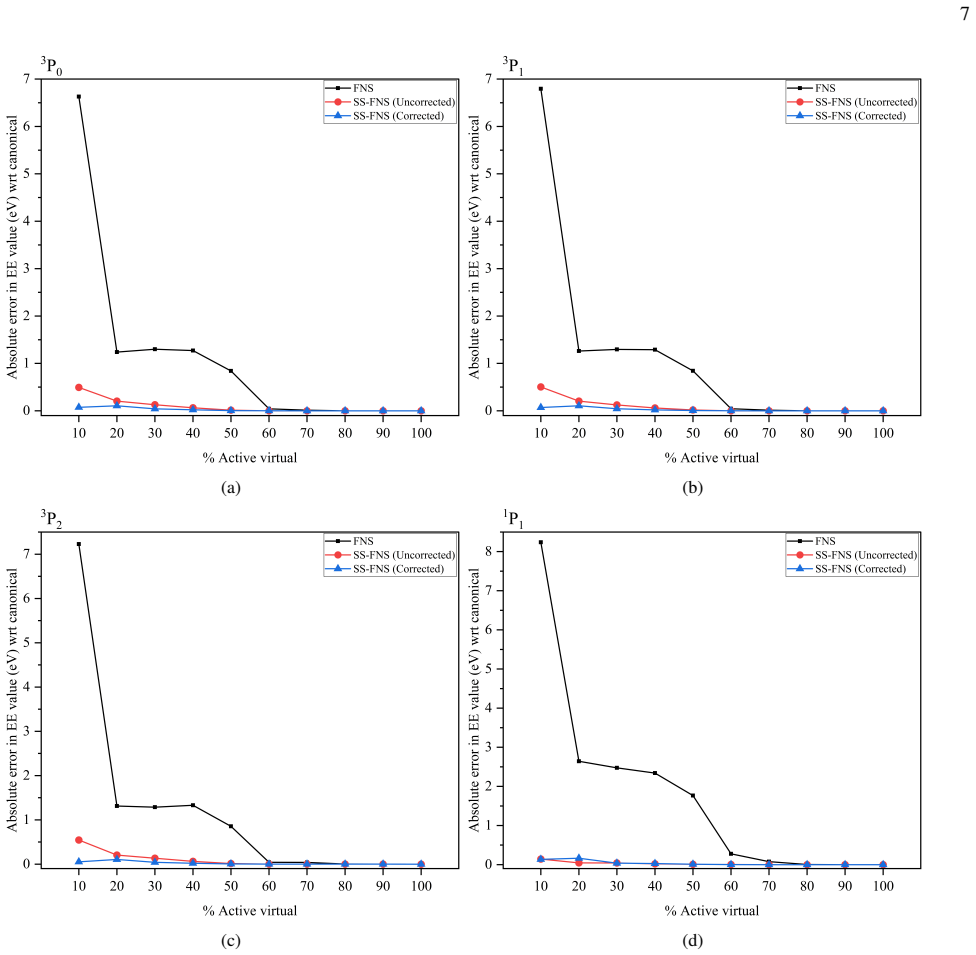
The central claim is that the character of an excited state is encoded in the virtual-space one-particle density of a cheap but qualitatively reliable excited-state method, ADC(2), and that diagonalizing that density yields natural spinors in which the subsequent EOM-CCSD calculation converges with far fewer virtuals. Concretely, the state-specific density is the sum of the MP2 ground-state density and the EE-ADC(2) difference density for that state (Eq. 31). Diagonalizing this virtual-virtual block and truncating on occupation number produces a compact, state-adapted spinor basis; an optional perturbative correction, the difference between the ADC(2) excitation energy in the full and truncated bases, removes most of the remaining truncation bias. Across zinc, gallium, indium, and thallium cations, AuH, the triiodide ion, and xenon, the truncated method reproduces canonical relativistic EOM-CCSD excitation energies, spin-orbit fine-structure splittings, and transition dipoles to within about 0.01 eV (RMSD 0.021 eV over 18 states of I3−), while keeping only about 30–40% of the virtual spinors.
Load-bearing premise
The method assumes the cheap ADC(2) calculation describes each excited state well enough that the spinors it keeps are exactly the ones the expensive coupled-cluster calculation needs; if ADC(2) misidentifies a state's character, the truncated space is biased no matter how accurate EOM-CCSD is.
Editorial extensions
If this is right
- Relativistic EOM-CCSD becomes practical for molecules with well over a thousand virtual spinors: the solvated triiodide complex benchmark keeps only 517 of 1394 virtuals and completes in about five days on a workstation.
- Fine-structure splittings of heavy-element cations are preserved to within about 0.01–0.08 eV of experiment, so the method can predict spin-orbit-resolved spectra without a full canonical relativistic calculation.
- The perturbative ADC(2) correction is a cheap way to remove most of the remaining truncation bias, improving the I3− RMSD from 0.029 to 0.021 eV.
- Because each excited state is solved in its own basis, ground-to-excited transition properties remain well defined and match canonical values, with Xe transition dipole moments within about 0.02 a.u. while dropping roughly 70% of the virtual spinors.
Reading between the lines
- If the SS-FNS construction is as transferable as the benchmarks suggest, the same ADC(2)-density recipe could be paired with other high-level excited-state methods, such as EOM-CCSD(T) or algebraic diagrammatic construction at third order, to cut their cost in heavy-element applications.
- The perturbative-correction idea is a template for a general two-level scheme: use a cheap method to measure the bias introduced by any basis truncation, then add that bias to an expensive method computed in the truncated space; this could reduce the cost of other truncated expansions, such as natural transition orbital bases for response properties.
- The method's accuracy likely degrades for states where ADC(2) is a poor zero-order description, such as strong double excitations, charge transfer with large orbital relaxation, or highly multireference spin-orbit-mixed states, so a practical implementation would want a diagnostic flag in the ADC(2) step that warns when the SS-FNS subspace is too small.
Signed reviews
Editorial analysis
A structured set of objections, weighed in public.
Referee Report
Summary. This manuscript presents the theory, implementation, and benchmarks of a state-specific frozen natural spinor (SS-FNS) approach to reduce the cost of relativistic equation-of-motion coupled cluster singles and doubles (EOM-CCSD) for excited states. The SS-FNS virtual space is generated from the one-particle density matrix of the relativistic ADC(2) excited state (Eq. 31), and the method is implemented both with the four-component Dirac-Coulomb Hamiltonian and with the X2CAMF two-component Hamiltonian combined with Cholesky decomposition of the two-electron integrals. The authors show that SS-FNS converges faster in the virtual-space truncation threshold than the standard MP2-based FNS for Zn, Ga+, and AuH, that the 4c-DC and X2CAMF versions agree closely, and that excitation energies and fine-structure splittings for Ga+, In+, Tl+, and I3- agree with canonical EOM-CCSD to within about 0.01-0.04 eV. A single transition-dipole benchmark is reported for Xe, and a timing demonstration is given for [I3(H2O)6]-. The central claim is that the method reproduces canonical excitation energies, spin-orbit splittings, and transition properties at a fraction of the virtual-space size.
Significance. If the accuracy claims hold, the method is a practically useful compromise for heavy-element excited-state calculations, because it removes a large fraction of the virtual space while preserving EOM-CCSD accuracy for energies and splittings. The strengths are the clear formal derivation, the use of ADC(2)-based state-specific densities rather than MP2 densities to describe excited states, the inclusion of a perturbative correction (Eq. 32), and the demonstration of both 4c-DC and X2CAMF implementations. The benchmarks against canonical EOM-CCSD, FSCC, and experiment are appropriate and generally convincing. The main caveat is that the transition-property evidence is thin: only one atom is tested, with errors up to 8% at the chosen threshold, while the conclusion claims excellent agreement for transition properties.
major comments (2)
- [Section IV.B-IV.E] The conclusion that the method provides 'excellent agreement with the canonical EOM-CCSD method for ... transition properties' is not supported by the evidence presented. The only transition-property benchmark is the Xe atom in Table V, and at the threshold eta_crit=10^-4.5 the SS-FNS transition dipole moments differ from the canonical 4c-DC-EE-EOM-CCSD values by +0.020, +0.026, -0.010, and -0.011 a.u. for the four bright states. The largest relative error, 8.1%, occurs for the 5p5(2P3/2)5d[1/2]1 state, where the truncated value 0.114 a.u. moves away from the experimental value 0.120 +/- 0.003 a.u. relative to the canonical value 0.124 a.u. No molecular transition dipole moment is reported, the truncation threshold was selected using excitation-energy convergence only, and the perturbative correction of Eq. (32) is applied only to energies. The authors should either add a molecular TDM benchmark together with a TDM convergence test in eta_crit, or explicitly restrict the central claim to excitation energies and fine-structure splittings.
- [Section IV.B-IV.E] The method's reliability rests on the assumption that the relativistic ADC(2) one-particle density matrix in Eq. (31) retains the essential character of the target excited state after truncation. The benchmarks cover singly excited valence and Rydberg states in atoms, AuH, I3-, and Xe, but they do not include states with strong double-excitation character, long-range charge transfer, or strongly mixed spin-orbit manifolds in a relativistic setting. A qualitative failure of ADC(2) for such a state would directly bias the truncated SS-FNS-EE-EOM-CCSD result, because the retained virtual spinors would be the wrong ones. This limitation should be stated explicitly, or at least one known difficult state should be benchmarked before the method is presented as a general low-cost relativistic excited-state approach.
minor comments (3)
- [Section IV.E, Table V caption] The text in Section IV.E says the Xe calculations use the triply augmented dyall.v3z basis set, while the Table V caption says triply augmented dyall.ae3z basis set; please reconcile this inconsistency.
- [Section III, step 2] Step 2 of the X2CAMF-SS-FNS algorithm says 'generate three-centered two-electron integrals in the canonical natural spinor basis,' but natural spinors have not yet been constructed at that point; this should presumably read 'canonical spinor basis'.
- [Table I] In Table I, the standard FNS row leaves the 'Corrected' and 'Canonical' cells empty, which makes the comparison difficult to parse; explicit 'not applicable' entries would clarify that the perturbative correction is not defined for that variant.
Circularity Check
No circularity found: the SS-FNS basis is generated from independent ADC(2) densities and the truncation threshold is a fixed convergence parameter, not a fit to the canonical EOM-CCSD targets.
full rationale
The claimed reduction is not circular. The SS-FNS virtual space is built from the relativistic ADC(2) one-particle density matrix (Eq. 31), not from the EOM-CCSD target, and the excitation energies and transition moments are subsequently computed with EE-EOM-CCSD in that truncated basis. No parameter is fitted to the canonical EOM-CCSD values used as benchmarks. The occupation threshold of 10^-4.5 is fixed by convergence tests on Zn and AuH (Section IV.A) and then applied unchanged to Ga+, In+, Tl+, I3-, and Xe; this is a normal convergence criterion, not a fit to the predicted quantities. Equation (32) adds a perturbative correction built from canonical and truncated EE-ADC(2) energies; since ADC(2) is an independent lower-level method, the correction does not insert the canonical EOM-CCSD answer by construction. The self-citation in Section II.C ('We have recently shown that the ADC(2) method gives an accurate first-order description of the excited state wave function...') is motivational and is independently supported by the paper's own convergence data for Zn, Ga+, and AuH, so it is not load-bearing. The statement in Section IV.E that 'No perturbative correction is considered for the transition properties' is a limitation on TDM accuracy (Xe TDM deviations up to about 8% at the chosen threshold), but it is an accuracy concern, not a circularity. No equation or parameter in the derivation reduces to the canonical EOM-CCSD results being predicted.
Assumptions & free parameters
free parameters (3)
- FNS occupation truncation threshold eta_crit =
10^-4.5
- Cholesky decomposition threshold tau =
10^-3
- Virtual spinor energy cutoff for I3- =
12.0 Eh
assumptions (5)
- domain assumption No-pair approximation: only positive-energy spinors are included in the correlation treatment.
- domain assumption ADC(2) provides an accurate first-order description of the excited state wave function and its one-particle density matrix.
- domain assumption X2CAMF Hamiltonian with AMF and neglect of two-electron picture-change accurately reproduces 4c-DC excitation energies.
- domain assumption Root-wise Davidson solver with transformed ADC(2) guess vectors converges the correct EOM-CCSD root in the truncated SS-FNS basis.
- domain assumption Frozen core approximation is valid for the I3- and [I3(H2O)6]- calculations.
Cite this review
Pith. "Pith review of Reduced-cost Relativistic Equation-of-Motion Coupled Cluster Method based on Frozen Natural Spinors: A State-Specific Approach." pith.science (2026). https://pith.science/paper/NF5543WP
@misc{pith2026250507080,
  author       = {Pith},
  title        = {Pith review of: Reduced-cost Relativistic Equation-of-Motion Coupled Cluster Method based on Frozen Natural Spinors: A State-Specific Approach},
  year         = {2026},
  howpublished = {\url{https://pith.science/paper/NF5543WP}},
  note         = {Machine review of arXiv:2505.07080}
}
read the original abstract
We present the theoretical framework, implementation, and benchmark results for a reduced-cost relativistic equation-of-motion coupled cluster singles and doubles (EOM-CCSD) method based on state-specific frozen natural spinors (SS-FNS). In this approach, the state-specific frozen natural spinors are derived from the second-order algebraic diagrammatic construction (ADC(2)) method, providing a compact virtual space for excited-state calculations. The excitation energies computed with the SS-FNS-EE-EOM-CCSD method exhibit smooth convergence with respect to the truncation threshold and demonstrate significant improvements over those obtained using the conventional MP2-based FNS approach. We have implemented the relativistic SS-FNS-EE-EOM-CCSD method using both the four-component Dirac-Coulomb and the exact two-component atomic mean-field (X2CAMF) Hamiltonians to compute excitation energies and transition properties. The X2CAMF-based relativistic EOM-CCSD method emerges as a promising approach for large-scale excited-state calculations, achieving excellent agreement with the standard relativistic EOM-CCSD method based on the untruncated canonical spinor basis, but at a significantly reduced computational cost.
Figures


Figures from the paper (2 more)


Reference graph
Works this paper leans on
-
[1]
merlin.mbs aapmrev4-1.bst 2010-07-25 4.21a (PWD, AO, DPC) hacked
FUNCTION id.bst "merlin.mbs aapmrev4-1.bst 2010-07-25 4.21a (PWD, AO, DPC) hacked" ENTRY address archive archivePrefix author bookaddress booktitle chapter collaboration doi edition editor eid eprint howpublished institution isbn issn journal key language month note number organization pages primaryClass publisher school SLACcitation series title translat...
2010
-
[2]
merlin.mbs aipauth4-1.bst 2010-07-25 4.21a (PWD, AO, DPC) hacked
FUNCTION id.bst "merlin.mbs aipauth4-1.bst 2010-07-25 4.21a (PWD, AO, DPC) hacked" ENTRY address archive archivePrefix author bookaddress booktitle chapter collaboration doi edition editor eid eprint howpublished institution isbn issn journal key language month note number organization pages primaryClass publisher school SLACcitation series title translat...
2010
-
[3]
merlin.mbs aipnum4-1.bst 2010-07-25 4.21a (PWD, AO, DPC) hacked
FUNCTION id.bst "merlin.mbs aipnum4-1.bst 2010-07-25 4.21a (PWD, AO, DPC) hacked" ENTRY address archive archivePrefix author bookaddress booktitle chapter collaboration doi edition editor eid eprint howpublished institution isbn issn journal key language month note number organization pages primaryClass publisher school SLACcitation series title translati...
2010
-
[4]
merlin.mbs apsrev4-1.bst 2010-07-25 4.21a (PWD, AO, DPC) hacked
FUNCTION id.bst "merlin.mbs apsrev4-1.bst 2010-07-25 4.21a (PWD, AO, DPC) hacked" ENTRY address archive archivePrefix author bookaddress booktitle chapter collaboration doi edition editor eid eprint howpublished institution isbn issn journal key language month note number organization pages primaryClass publisher school SLACcitation series title translati...
2010
-
[5]
merlin.mbs apsrmp4-1.bst 2010-07-25 4.21a (PWD, AO, DPC) hacked
FUNCTION id.bst "merlin.mbs apsrmp4-1.bst 2010-07-25 4.21a (PWD, AO, DPC) hacked" ENTRY address archive archivePrefix author bookaddress booktitle chapter collaboration doi edition editor eid eprint howpublished institution isbn issn journal key language month note number organization pages primaryClass publisher school SLACcitation series title translati...
2010
-
[6]
author author L. Gonz \'a lez \ and\ author R. Lindh ,\ 10.1002/9781119417774 title Quantum Chemistry and Dynamics of Excited States : Methods and Applications \ ( publisher John Wiley & Sons, Ltd ,\ year 2020 ) NoStop
-
[7]
C \'i z ek ,\ 10.1063/1.1727484 journal journal J
author author J. C \'i z ek ,\ 10.1063/1.1727484 journal journal J. Chem. Phys. \ volume 45 ,\ pages 4256 ( year 1966 ) NoStop
-
[8]
author author J. Paldus , author J. C \'i z ek , \ and\ author I. Shavitt ,\ 10.1103/PhysRevA.5.50 journal journal Phys. Rev. A \ volume 5 ,\ pages 50 ( year 1972 ) NoStop
Show all 96 references
-
[9]
Shavitt \ and\ author R
author author I. Shavitt \ and\ author R. J. \ Bartlett ,\ 10.1017/CBO9780511596834 title Many- Body Methods in Chemistry and Physics : MBPT and Coupled-Cluster Theory ,\ Cambridge Molecular Science \ ( publisher Cambridge University Press ,\ address Cambridge ,\ year 2009 ) NoStop
-
[10]
author author D. J. \ ROWE ,\ 10.1103/RevModPhys.40.153 journal journal Rev. Mod. Phys. \ volume 40 ,\ pages 153 ( year 1968 ) NoStop
1968 doi
-
[11]
author author J. F. \ Stanton \ and\ author R. J. \ Bartlett ,\ 10.1063/1.464746 journal journal J. Chem. Phys. \ volume 98 ,\ pages 7029 ( year 1993 ) NoStop
1993 doi
-
[12]
Nooijen \ and\ author R
author author M. Nooijen \ and\ author R. J. \ Bartlett ,\ 10.1063/1.468592 journal journal J. Chem. Phys. \ volume 102 ,\ pages 3629 ( year 1995 ) NoStop
1995 doi
-
[13]
author author A. I. \ Krylov ,\ 10.1146/annurev.physchem.59.032607.093602 journal journal Annu. Rev. Phys. Chem. \ volume 59 ,\ pages 433 ( year 2008 ) NoStop
2008 arXiv
-
[14]
Kowalski \ and\ author P
author author K. Kowalski \ and\ author P. Piecuch ,\ https://doi.org/10.1063/1.1318757 journal journal J. Chem. Phys. \ volume 113 ,\ pages 8490 ( year 2000 ) NoStop
-
[15]
Koch \ and\ author P
author author H. Koch \ and\ author P. J rgensen ,\ 10.1063/1.458814 journal journal J. Chem. Phys. \ volume 93 ,\ pages 3333 ( year 1990 ) NoStop
1990 doi
-
[16]
author author H. J. \ Monkhorst ,\ 10.1002/qua.560120850 journal journal Int. J. Quantum Chem. \ volume 12 ,\ pages 421 ( year 1977 ) NoStop
1977 doi
-
[17]
Mukherjee \ and\ author P
author author D. Mukherjee \ and\ author P. K. \ Mukherjee ,\ 10.1016/0301-0104(79)80153-6 journal journal Chem. Phys. \ volume 39 ,\ pages 325 ( year 1979 ) NoStop
1979 doi
-
[18]
author author P. S. \ Bagus \ and\ author H. F. \ Schaefer , III ,\ 10.1063/1.1676248 journal journal J. Chem. Phys. \ volume 55 ,\ pages 1474 ( year 1971 ) NoStop
1971 doi
-
[19]
author author P. S. \ Bagus ,\ 10.1103/PhysRev.139.A619 journal journal Phys. Rev. \ volume 139 ,\ pages A619 ( year 1965 ) NoStop
1965 doi
-
[20]
Lee , author D
author author J. Lee , author D. W. \ Small , \ and\ author M. Head-Gordon ,\ 10.1063/1.5128795 journal journal J. Chem. Phys. \ volume 151 ,\ pages 214103 ( year 2019 ) NoStop
2019 doi
-
[21]
Zheng \ and\ author L
author author X. Zheng \ and\ author L. Cheng ,\ 10.1021/acs.jctc.9b00568 journal journal J. Chem. Theory Comput. \ volume 15 ,\ pages 4945 ( year 2019 ) NoStop
2019 doi
-
[22]
South , author A
author author C. South , author A. Shee , author D. Mukherjee , author A. K. \ Wilson , \ and\ author T. Saue ,\ 10.1039/C6CP00262E journal journal Phys. Chem. Chem. Phys. \ volume 18 ,\ pages 21010 ( year 2016 ) NoStop
2016 doi
-
[23]
author author J. D. \ Watts \ and\ author R. J. \ Bartlett ,\ 10.1063/1.467620 journal journal J. Chem. Phys. \ volume 101 ,\ pages 3073 ( year 1994 ) NoStop
1994 doi
-
[24]
author author S. A. \ Kucharski , author M. W och , author M. Musia , \ and\ author R. J. \ Bartlett ,\ https://doi.org/10.1063/1.1416173 journal journal J. Chem. Phys. \ volume 115 ,\ pages 8263 ( year 2001 ) NoStop
2001 doi
-
[25]
Hirata ,\ 10.1063/1.1753556 journal journal J
author author S. Hirata ,\ 10.1063/1.1753556 journal journal J. Chem. Phys. \ volume 121 ,\ pages 51 ( year 2004 ) NoStop
2004 doi
-
[26]
author author K. G. \ Dyall \ and\ author K. F gri Jr. ,\ 10.1093/oso/9780195140866.001.0001 title Introduction to Relativistic Quantum Chemistry \ ( publisher Oxford University Press ,\ address Oxford, New York ,\ year 2007 ) NoStop
2007
-
[27]
Shee , author T
author author A. Shee , author T. Saue , author L. Visscher , \ and\ author A. S. P. \ Gomes ,\ 10.1063/1.5053846 journal journal J. Chem. Phys. \ volume 149 ,\ pages 174113 ( year 2018 ) NoStop
2018 doi
-
[28]
Mukhopadhyay , author S
author author T. Mukhopadhyay , author S. Chakraborty , author S. Chamoli , author M. K. \ Nayak , \ and\ author A. K. \ Dutta ,\ 10.1063/5.0229955 journal journal J. Chem. Phys. \ volume 162 ,\ pages 054115 ( year 2025 ) NoStop
2025 doi
-
[29]
Eliav , author A
author author E. Eliav , author A. Borschevsky , author A. Zaitsevskii , author A. V. \ Oleynichenko , \ and\ author U. Kaldor ,\ in\ 10.1016/B978-0-12-821978-2.00042-8 booktitle Comprehensive Computational Chemistry \ ( publisher Elsevier ,\ address Oxford ,\ year 2024 )\ pp....
-
[30]
author author B. A. \ Hess ,\ 10.1103/PhysRevA.33.3742 journal journal Phys. Rev. A \ volume 33 ,\ pages 3742 ( year 1986 ) NoStop
1986 doi
-
[31]
van Lenthe , author R
author author E. van Lenthe , author R. van Leeuwen , author E. J. \ Baerends , \ and\ author J. G. \ Snijders ,\ 10.1002/(SICI)1097-461X(1996)57:3<281::AID-QUA2>3.0.CO;2-U journal journal Int. J. Quantum Chem. \ volume 57 ,\ pages 281 ( year 1996 ) NoStop
1996 doi
-
[32]
author author K. G. \ Dyall ,\ 10.1063/1.473860 journal journal J. Chem. Phys. \ volume 106 ,\ pages 9618 ( year 1997 ) NoStop
1997 doi
-
[33]
Nakajima \ and\ author K
author author T. Nakajima \ and\ author K. Hirao ,\ 10.1016/S0009-2614(99)00150-5 journal journal Chem. Phys. Lett. \ volume 302 ,\ pages 383 ( year 1999 ) NoStop
1999 doi
-
[34]
Barysz \ and\ author A
author author M. Barysz \ and\ author A. J. \ Sadlej ,\ 10.1016/S0166-1280(01)00542-5 journal journal J. Mol. Struct. THEOCHEM \ volume 573 ,\ pages 181 ( year 2001 ) NoStop
2001 doi
-
[35]
Liu \ and\ author D
author author W. Liu \ and\ author D. Peng ,\ 10.1063/1.3159445 journal journal J. Chem. Phys. \ volume 131 ,\ pages 031104 ( year 2009 ) NoStop
2009 doi
-
[36]
Saue ,\ 10.1002/cphc.201100682 journal journal ChemPhysChem \ volume 12 ,\ pages 3077 ( year 2011 ) NoStop
author author T. Saue ,\ 10.1002/cphc.201100682 journal journal ChemPhysChem \ volume 12 ,\ pages 3077 ( year 2011 ) NoStop
2011 doi
-
[37]
author author B. A. \ He , author C. M. \ Marian , author U. Wahlgren , \ and\ author O. Gropen ,\ 10.1016/0009-2614(96)00119-4 journal journal Chem. Phys. Lett. \ volume 251 ,\ pages 365 ( year 1996 ) NoStop
1996 doi
-
[38]
Liu \ and\ author L
author author J. Liu \ and\ author L. Cheng ,\ 10.1063/1.5023750 journal journal J. Chem. Phys. \ volume 148 ,\ pages 144108 ( year 2018 ) NoStop
2018 doi
-
[39]
Zhang \ and\ author L
author author C. Zhang \ and\ author L. Cheng ,\ 10.1021/acs.jpca.2c02181 journal journal J. Phys. Chem. A \ volume 126 ,\ pages 4537 ( year 2022 ) NoStop
2022 doi
-
[40]
Knecht , author M
author author S. Knecht , author M. Repisky , author H. J. A. \ Jensen , \ and\ author T. Saue ,\ 10.1063/5.0095112 journal journal J. Chem. Phys. \ volume 157 ,\ pages 114106 ( year 2022 ) NoStop
2022 doi
-
[41]
author author M. S. \ Kelley \ and\ author T. Shiozaki ,\ 10.1063/1.4807612 journal journal J. Chem. Phys. \ volume 138 ,\ pages 204113 ( year 2013 ) NoStop
2013 doi
-
[42]
author author J. E. \ Bates \ and\ author T. Shiozaki ,\ 10.1063/1.4906344 journal journal J. Chem. Phys. \ volume 142 ,\ pages 044112 ( year 2015 ) NoStop
2015 doi
-
[43]
Helmich-Paris , author M
author author B. Helmich-Paris , author M. Repisky , \ and\ author L. Visscher ,\ 10.1016/j.chemphys.2018.11.009 journal journal Chem. Phys. \ volume 518 ,\ pages 38 ( year 2019 ) NoStop
2018 doi
-
[44]
Banerjee , author T
author author S. Banerjee , author T. Zhang , author K. G. \ Dyall , \ and\ author X. Li ,\ 10.1063/5.0161871 journal journal J. Chem. Phys. \ volume 159 ,\ pages 114119 ( year 2023 ) NoStop
2023 doi
-
[45]
Uhl \'i r ov \'a , author D
author author T. Uhl \'i r ov \'a , author D. Cianchino , author T. Nottoli , author F. Lipparini , \ and\ author J. Gauss ,\ 10.1021/acs.jpca.4c04353 journal journal J. Phys. Chem. A \ volume 128 ,\ pages 8292 ( year 2024 ) NoStop
2024 doi
-
[46]
Zhang , author F
author author C. Zhang , author F. Lipparini , author S. Stopkowicz , author J. Gauss , \ and\ author L. Cheng ,\ 10.1021/acs.jctc.3c01236 journal journal J. Chem. Theory Comput. \ volume 20 ,\ pages 787 ( year 2024 ) NoStop
2024 doi
-
[47]
author author J. V. \ Pototschnig , author A. Papadopoulos , author D. I. \ Lyakh , author M. Repisky , author L. Halbert , author A. S. P. \ Gomes , author H. J. A. \ Jensen , \ and\ author L. Visscher ,\ 10.1021/acs.jctc.1c00260 journal journal J. Chem. Theory Comput. \ volu...
-
[48]
author author A. E. I. \ DePrince \ and\ author J. R. \ Hammond ,\ 10.1021/ct100584w journal journal J. Chem. Theory Comput. \ volume 7 ,\ pages 1287 ( year 2011 ) NoStop
2011 doi
-
[49]
Chamoli , author K
author author S. Chamoli , author K. Surjuse , author B. Jangid , author M. K. \ Nayak , \ and\ author A. K. \ Dutta ,\ 10.1063/5.0085932 journal journal J. Chem. Phys. \ volume 156 ,\ pages 204120 ( year 2022 ) NoStop
2022 doi
-
[50]
\ L \"o wdin ,\ 10.1103/PhysRev.97.1474 journal journal Phys
author author P.-O. \ L \"o wdin ,\ 10.1103/PhysRev.97.1474 journal journal Phys. Rev. \ volume 97 ,\ pages 1474 ( year 1955 ) NoStop
1955 doi
-
[51]
Majee , author S
author author K. Majee , author S. Chakraborty , author T. Mukhopadhyay , author M. K. \ Nayak , \ and\ author A. K. \ Dutta ,\ 10.1063/5.0207091 journal journal J. Chem. Phys. \ volume 161 ,\ pages 034101 ( year 2024 ) NoStop
2024 doi
-
[52]
Surjuse , author S
author author K. Surjuse , author S. Chamoli , author M. K. \ Nayak , \ and\ author A. K. \ Dutta ,\ 10.1063/5.0125868 journal journal J. Chem. Phys. \ volume 157 ,\ pages 204106 ( year 2022 ) NoStop
2022 doi
-
[53]
Chamoli , author X
author author S. Chamoli , author X. Wang , author C. Zhang , author M. K. \ Nayak , \ and\ author A. K. \ Dutta ,\ https://pubs.acs.org/doi/full/10.1021/acs.jctc.5c00199 journal journal J. Chem. Theory Comput. \ volume 21 ,\ pages 4532 ( year 2025 ) NoStop
-
[54]
Yuan , author L
author author X. Yuan , author L. Halbert , author L. Visscher , \ and\ author A. S. P. \ Gomes ,\ 10.1021/acs.jctc.3c01011 journal journal J. Chem. Theory Comput. \ volume 19 ,\ pages 9248 ( year 2023 ) NoStop
2023 doi
-
[55]
Lindroth ,\ 10.1103/PhysRevA.37.316 journal journal Phys
author author E. Lindroth ,\ 10.1103/PhysRevA.37.316 journal journal Phys. Rev. A \ volume 37 ,\ pages 316 ( year 1988 ) NoStop
1988 doi
-
[56]
Visscher , author T
author author L. Visscher , author T. J. \ Lee , \ and\ author K. G. \ Dyall ,\ 10.1063/1.472655 journal journal J. Chem. Phys. \ volume 105 ,\ pages 8769 ( year 1996 ) NoStop
1996 doi
-
[57]
Visscher , author E
author author L. Visscher , author E. Eliav , \ and\ author U. Kaldor ,\ 10.1063/1.1415746 journal journal J. Chem. Phys. \ volume 115 ,\ pages 9720 ( year 2001 ) NoStop
2001 doi
-
[58]
Sucher ,\ 10.1103/PhysRevA.22.348 journal journal Phys
author author J. Sucher ,\ 10.1103/PhysRevA.22.348 journal journal Phys. Rev. A \ volume 22 ,\ pages 348 ( year 1980 ) NoStop
1980 doi
-
[59]
Reiher \ and\ author A
author author M. Reiher \ and\ author A. Wolf ,\ https://onlinelibrary.wiley.com/doi/book/10.1002/9783527667550 title Relativistic Quantum Chemistry : The Fundamental Theory of Molecular Science \ ( publisher John Wiley & Sons ,\ year 2015 ) NoStop
-
[60]
Yuan , author L
author author X. Yuan , author L. Visscher , \ and\ author A. S. P. \ Gomes ,\ 10.1063/5.0087243 journal journal J. Chem. Phys. \ volume 156 ,\ pages 224108 ( year 2022 ) NoStop
2022 doi
-
[61]
Chamoli , author M
author author S. Chamoli , author M. K. \ Nayak , \ and\ author A. K. \ Dutta ,\ in\ 10.1002/9781394217656.ch5 booktitle Electron Density \ ( publisher John Wiley & Sons, Ltd ,\ year 2024 )\ Chap. chapter 5 , pp.\ pages 83--96 NoStop
2024 doi
-
[62]
Helmich \ and\ author C
author author B. Helmich \ and\ author C. H \"a ttig ,\ 10.1063/1.3664902 journal journal J. Chem. Phys. \ volume 135 ,\ pages 214106 ( year 2011 ) NoStop
2011 doi
-
[63]
Mester , author P
author author D. Mester , author P. R. \ Nagy , \ and\ author M. K \'a llay ,\ 10.1063/1.4983277 journal journal J. Chem. Phys. \ volume 146 ,\ pages 194102 ( year 2017 ) NoStop
2017 doi
-
[64]
Peng , author M
author author C. Peng , author M. C. \ Clement , \ and\ author E. F. \ Valeev ,\ 10.1021/acs.jctc.8b00171 journal journal J. Chem. Theory Comput. \ volume 14 ,\ pages 5597 ( year 2018 ) NoStop
2018 doi
-
[65]
author author A. K. \ Dutta , author M. Nooijen , author F. Neese , \ and\ author R. Izs \'a k ,\ 10.1021/acs.jctc.7b00802 journal journal J. Chem. Theory Comput. \ volume 14 ,\ pages 72 ( year 2018 ) NoStop
2018 doi
-
[66]
Manna \ and\ author A
author author A. Manna \ and\ author A. K. \ Dutta ,\ https://arxiv.org/abs/2506.16894 ( year 2025 ),\ http://arxiv.org/abs/2506.16894 arXiv:2506.16894 [physics.chem-ph] NoStop
2025 arXiv
-
[67]
Pernpointner ,\ 10.1063/1.4865964 journal journal J
author author M. Pernpointner ,\ 10.1063/1.4865964 journal journal J. Chem. Phys. \ volume 140 ,\ pages 084108 ( year 2014 ) NoStop
2014 doi
-
[68]
Pernpointner , author L
author author M. Pernpointner , author L. Visscher , \ and\ author A. B. \ Trofimov ,\ 10.1021/acs.jctc.7b01056 journal journal J. Chem. Theory Comput. \ volume 14 ,\ pages 1510 ( year 2018 ) NoStop
2018 doi
-
[69]
Chakraborty , author T
author author S. Chakraborty , author T. Mukhopadhyay , author M. K. \ Nayak , \ and\ author A. K. \ Dutta ,\ 10.1063/5.0246920 journal journal J. Chem. Phys. \ volume 162 ,\ pages 104106 ( year 2025 ) NoStop
2025 doi
-
[70]
Schirmer \ and\ author A
author author J. Schirmer \ and\ author A. B. \ Trofimov ,\ 10.1063/1.1752875 journal journal J. Chem. Phys. \ volume 120 ,\ pages 11449 ( year 2004 ) NoStop
2004 doi
-
[71]
Hirao \ and\ author H
author author K. Hirao \ and\ author H. Nakatsuji ,\ 10.1016/0021-9991(82)90119-X journal journal J. Comput. Phys. \ volume 45 ,\ pages 246 ( year 1982 ) NoStop
1982 doi
-
[72]
author author K. G. \ Dyall ,\ 10.1063/1.466508 journal journal J. Chem. Phys. \ volume 100 ,\ pages 2118 ( year 1994 ) NoStop
1994 doi
-
[73]
author author A. K. \ Dutta , author A. Manna , author B. Jangid , author K. Majee , author K. Surjuse , author M. Mukherjee , author M. Thapa , author S. Arora , author S. Chamoli , author S. Haldar , author S. Chakraborty , author S. Mandal , \ and\ author T. Mukhopadhyay ,\...
2025
-
[74]
Sun ,\ https://doi.org/10.1002/jcc.23981 journal journal J
author author Q. Sun ,\ https://doi.org/10.1002/jcc.23981 journal journal J. Comput. Chem. \ volume 36 ,\ pages 1664 ( year 2015 ) NoStop
2015 doi
-
[75]
Sun , author T
author author Q. Sun , author T. C. \ Berkelbach , author N. S. \ Blunt , author G. H. \ Booth , author S. Guo , author Z. Li , author J. Liu , author J. D. \ McClain , author E. R. \ Sayfutyarova , author S. Sharma , author S. Wouters , \ and\ author G. K.-L. \ Chan ,\ 10.100...
-
[76]
Sun , author X
author author Q. Sun , author X. Zhang , author S. Banerjee , author P. Bao , author M. Barbry , author N. S. \ Blunt , author N. A. \ Bogdanov , author G. H. \ Booth , author J. Chen , author Z.-H. \ Cui , author J. J. \ Eriksen , author Y. Gao , author S. Guo , author J. Her...
-
[77]
Wang ,\ https://github.com/xubwa/socutils title Xubwa/socutils , \ ( year 2025 ) NoStop
author author X. Wang ,\ https://github.com/xubwa/socutils title Xubwa/socutils , \ ( year 2025 ) NoStop
2025
-
[78]
Bast , author A
author author R. Bast , author A. S. P. \ Gomes , author T. Saue , author L. Visscher , author H. J. Aa . \ Jensen , author I. A. \ Aucar , author V. Bakken , author C. Chibueze , author J. Creutzberg , author K. G. \ Dyall , author S. Dubillard , author U. Ekstr \"o m , autho...
-
[79]
author author G. M. J. \ Barca , author C. Bertoni , author L. Carrington , author D. Datta , author N. De Silva , author J. E. \ Deustua , author D. G. \ Fedorov , author J. R. \ Gour , author A. O. \ Gunina , author E. Guidez , author T. Harville , author S. Irle , author J....
-
[80]
Chamoli , author A
author author S. Chamoli , author A. Mishra , author A. K. \ Dutta , author R. S. \ Kesarkar , \ and\ author B. Sahoo ,\ 10.1103/PhysRevA.109.063111 journal journal Phys. Rev. A \ volume 109 ,\ pages 063111 ( year 2024 ) NoStop
2024 doi
-
[81]
Kramida , author Y
author author A. Kramida , author Y. Ralchenko , author J. Reader , et al. ,\ https://dx.doi.org/10.18434/T4W30F title NIST Atomic Spectra Database (version 5.12) , \ ( year 2024 ) NoStop
2024 doi
-
[82]
author author K. P. \ Huber \ and\ author G. Herzberg ,\ in\ 10.1007/978-1-4757-0961-2_2 booktitle Molecular Spectra and Molecular Structure : IV . Constants of Diatomic Molecules \ ( publisher Springer US ,\ address Boston, MA ,\ year 1979 )\ pp.\ pages 8--689 NoStop
-
[83]
Borschevsky , author E
author author A. Borschevsky , author E. Eliav , author Y. Ishikawa , \ and\ author U. Kaldor ,\ 10.1103/PhysRevA.74.062505 journal journal Phys. Rev. A \ volume 74 ,\ pages 062505 ( year 2006 ) NoStop
2006 doi
-
[84]
Schreiber , author M
author author M. Schreiber , author M. R. \ Silva-Junior , author S. Sauer , \ and\ author W. Thiel ,\ 10.1063/1.2889385 journal journal J. Chem. Phys. \ volume 128 ,\ pages 134110 ( year 2008 ) NoStop
2008 doi
-
[85]
Landau , author E
author author A. Landau , author E. Eliav , author Y. Ishikawa , \ and\ author U. Kaldor ,\ 10.1063/1.1788652 journal journal J. Chem. Phys. \ volume 121 ,\ pages 6634 ( year 2004 ) NoStop
2004 doi
-
[86]
Andersson , author P
author author Kerstin . Andersson , author P. A. \ Malmqvist , author B. O. \ Roos , author A. J. \ Sadlej , \ and\ author Krzysztof . Wolinski ,\ 10.1021/j100377a012 journal journal J. Phys. Chem. \ volume 94 ,\ pages 5483 ( year 1990 ) NoStop
-
[87]
author author B. O. \ Roos , author P. R. \ Taylor , \ and\ author P. E. M. \ Sigbahn ,\ 10.1016/0301-0104(80)80045-0 journal journal Chem. Phys. \ volume 48 ,\ pages 157 ( year 1980 ) NoStop
1980 doi
-
[88]
Vala , author R
author author J. Vala , author R. Kosloff , \ and\ author J. N. \ Harvey ,\ 10.1063/1.1361248 journal journal J. Chem. Phys. \ volume 114 ,\ pages 7413 ( year 2001 ) NoStop
2001 doi
-
[89]
Fleig , author J
author author T. Fleig , author J. Olsen , \ and\ author L. Visscher ,\ 10.1063/1.1590636 journal journal J. Chem. Phys. \ volume 119 ,\ pages 2963 ( year 2003 ) NoStop
2003 doi
-
[90]
Fleig , author H
author author T. Fleig , author H. J. A. \ Jensen , author J. Olsen , \ and\ author L. Visscher ,\ 10.1063/1.2176609 journal journal J. Chem. Phys. \ volume 124 ,\ pages 104106 ( year 2006 ) NoStop
2006 doi
-
[91]
author author E. K. U. \ Gross \ and\ author W. Kohn ,\ in\ 10.1016/S0065-3276(08)60600-0 booktitle Advances in Quantum Chemistry ,\ series Density Functional Theory of Many-Fermion Systems , Vol. volume 21 ,\ editor edited by\ editor P.-O. \ L \"o wdin \ ( publisher Academic ...
-
[92]
Wang , author Z
author author Z. Wang , author Z. Tu , \ and\ author F. Wang ,\ 10.1021/ct500854m journal journal J. Chem. Theory Comput. \ volume 10 ,\ pages 5567 ( year 2014 ) NoStop
2014 doi
-
[93]
Zaitsevskii , author A
author author A. Zaitsevskii , author A. V. \ Oleynichenko , \ and\ author E. Eliav ,\ 10.3390/sym12111845 journal journal Symmetry \ volume 12 ,\ pages 1845 ( year 2020 ) NoStop
2020 doi
-
[94]
author author J. E. \ Sansonetti \ and\ author W. C. \ Martin ,\ 10.1063/1.1800011 journal journal J. Phys. Chem. Ref. Data \ volume 34 ,\ pages 1559 ( year 2005 ) NoStop
2005 doi
-
[95]
Margulis , author D
author author C. Margulis , author D. Coker , \ and\ author R. Lynden-Bell ,\ https://doi.org/10.1063/1.1328757 journal journal J. Chem. Phys. \ volume 114 ,\ pages 367 ( year 2001 ) NoStop
2001 doi
-
[96]
Neese ,\ 10.1002/wcms.1606 journal journal WIREs Comput
author author F. Neese ,\ 10.1002/wcms.1606 journal journal WIREs Comput. Mol. Sci. \ volume 12 ,\ pages e1606 ( year 2022 ) NoStop
2022 doi
Reviewed August 15, 2026 · model on record in the stance chip above.
Discussion (0). Continue with ORCID to comment.