REVIEW 3 major objections 4 minor 85 references
Quasinormal modes and complexity in saddle-dominated SU(N) spin systems
T0 review · 3 major / 4 minor · reviewed 2026-08-07 · deepseek-v4-flash
Pith's one-line read This paper shows that a finite-dimensional SU(2) spin Hamiltonian reproduces, at large spin, the density of states of a massive particle in two-dimensional de Sitter space, including its quasinormal-mode poles.
desk verdict A useful extension of the SU(2)/dS2 toy model to complementary series and SU(3), but the complementary-series section rests on an unproven real-spectrum threshold and should be strengthened before the claim is treated as closed. read the letter →
The pith
A machine-rendered reading of the paper's core claim, the machinery that carries it, and where it could break.
The reading
What carries the argument
The key machinery is the coarse-grained character of the spin Hamiltonian evaluated through SU(N) coherent states in the large-spin limit. Classical orbits near two hyperbolic fixed points behave like an upside-down harmonic oscillator, and each fixed point contributes a factor $1/|1-e^{-t}|$ to the character; the mass term $\nu$ shifts the exponents to $\Delta$ and $\bar{\Delta}$. Fourier-transforming the resulting Harish-Chandra character yields the de Sitter density of states, so quasinormal modes appear as poles of the analytic continuation. For the PT-symmetric extension, the machinery adds holomorphic-polarization eigenfunctions expressed as Heun polynomials, which locate the exceptional points at which eigenvalues leave the real axis.
What would settle it
Numerically diagonalize the SU(2) Hamiltonian for even $j$ at imaginary $\nu$ values between $0$ and $i/2$ and check whether any eigenvalue acquires a nonzero imaginary part before the claimed critical value; if one does, the complementary-series density comparison loses its stated meaning.
Extended reading notes
Core claim
The central discovery is that the inverse level spacing of the SU(2) Hamiltonian $H_j = \frac{i}{4j}(J_-^2 - J_+^2) + \frac{\nu}{j} J_z$ converges in the large-$j$ limit to the density of states of a massive particle in dS$_2$ with scaling dimension $\Delta = \frac{1}{2} + i\nu$, whose poles are the de Sitter quasinormal modes. Convergence is shown at the level of the coarse-grained character, which in the large-$j$ limit becomes the Harish-Chandra character $\chi(t) = (e^{-\Delta t} + e^{-\bar{\Delta}t})/|1-e^{-t}|$, the sum over quasinormal resonances. For imaginary $\nu$, the Hamiltonian is non-Hermitian but PT-symmetric; below a critical value that approaches $1/2$ at large $j$, the eigenvalues remain real and the complementary-series density of states is obtained. For SU(3), the paper derives an analytic density of states, equation (3.13), whose $\mathrm{Re}\,\omega > 0$ peaks match the fixed-angular-momentum density of a massive particle in dS$_3$.
Load-bearing premise
The load-bearing premise is that, for imaginary values of the mass parameter, all eigenvalues of the complexified Hamiltonian remain real up to a critical value that approaches $1/2$ at large spin; the paper proves this only for special parameter values and parities and otherwise relies on a numerical fit.
Editorial extensions
If this is right
- The spin model provides a finite-dimensional matrix whose large-$j$ spectrum encodes de Sitter quasinormal frequencies, so QNM data can be read off from a Hermitian or PT-symmetric Hamiltonian.
- With imaginary $\nu$, the same model reproduces the complementary-series density of states of a light scalar in dS$_2$, covering both principal and complementary series by varying the phase of $\nu$.
- The SU(3) extension shows the construction generalizes beyond one degree of freedom, with positive-frequency peaks matching dS$_3$ fixed-angular-momentum sectors.
- Level spacing and spectral form factor diagnostics confirm integrability, with Poisson statistics emerging only after combining SU(3) angular-momentum sectors.
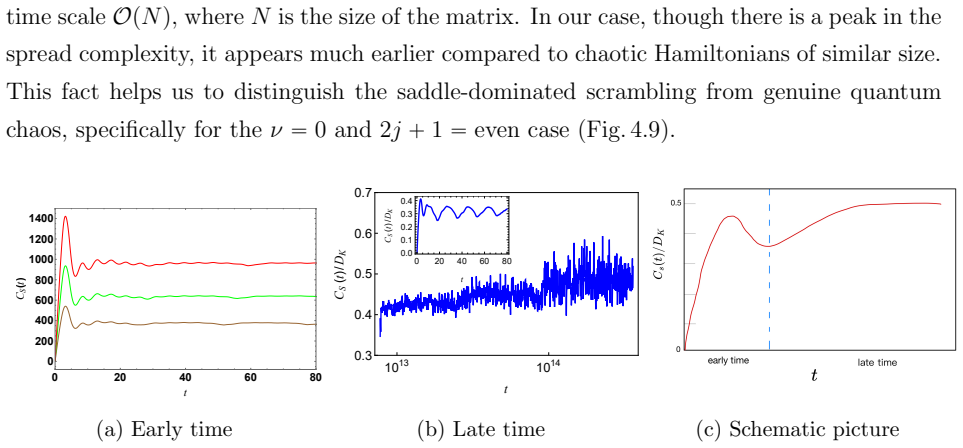
- Early-time exponential growth of squared commutators and Krylov complexity is attributable to saddle points rather than chaos, while late-time oscillations and the saturation value above $D_O/2$ distinguish the two.
Reading between the lines
- The mechanism suggests a general recipe: any spin Hamiltonian whose classical phase space has a hyperbolic fixed point should produce a tower of resonances in the density of states, making de Sitter quasinormal modes a generic large-spin phenomenon rather than a special property of this particular model.
- The PT-symmetric complexified model may offer a finite-dimensional regularization of discrete-series quasinormal spectra; the paper notes that at integer imaginary $\nu$ there appear to be exactly $2|\nu|$ imaginary modes, a count reminiscent of discrete-series representations.
- One could test the same construction in higher-rank groups or with modified mass terms, such as $\nu(J_z/j)^3$ instead of $\nu J_z/j$, which the paper argues does not change the large-$j$ density near the hyperbolic fixed points.
- The late-time criteria identified here—oscillations instead of saturation for squared commutators, and saturation from below for spread complexity—could serve as practical numerical diagnostics in other integrable models suspected of saddle-dominated scrambling.
Editorial analysis
A structured set of objections, weighed in public.
Referee Report
Summary. The paper studies SU(2) and SU(3) spin Hamiltonians whose large-j classical phase spaces have hyperbolic fixed points, and shows that the resulting quantum inverse level spacing reproduces, up to a matched UV constant, the density of states of a massive particle in dS2 and, partially, dS3, whose poles are quasinormal modes. It extends the SU(2) model to an imaginary mass parameter nu in iR while retaining PT symmetry, claiming to reproduce the complementary-series density of states below a critical |nu_c| -> 1/2. The second half computes two-point functions, squared commutators/OTOCs, Krylov operator complexity, and spread complexity, and argues that early-time saddle-dominated scrambling mimics chaos while late-time behavior reveals the integrable nature of the system.
Significance. If the results hold, the paper provides explicit finite-dimensional toy models for emergent de Sitter quasinormal-mode spectra in both the principal and complementary series, together with a useful catalog of diagnostics that distinguish saddle-dominated scrambling from true chaos. Its strengths include the transparent analytic IHO/saddle-point derivation of the densities in Secs. 3.1 and 3.2, the direct numerical diagonalization checks in Figs. 3.1, 3.3, and 5.1, and the systematic treatment of late-time distinguishability criteria. The complementary-series claim in Sec. 5 is the most novel and also the least supported piece of the paper.
major comments (3)
- [Sec. 5.3 / Eq. (5.6)] The complementary-series claim rests on the unproven statement that for nu = i beta with 0 < beta < nu_c(j), all eigenvalues of H_j remain real, with nu_c(j) -> 1/2. The paper proves zero-energy polynomial solutions only at special values nu = i(m+1/2) and analyzes nu = 0, but PT-symmetry alone does not imply a real spectrum; exceptional points can occur at intermediate beta without any eigenvalue crossing zero. For odd j the threshold nu_c = i/2 and the associated Jordan-block mechanism are asserted rather than derived, while for even j the threshold is obtained from the numerical fit in Eq. (5.6), for which no data, error bars, or fitting procedure are given, and whose parity label (j in 2N+1, as written) contradicts the surrounding text that considers even j. Because Fig. 5.1a and the comparison to the density (A.3) require a real spectrum over the full interval, the complementary-series conclusion is not yet supported; please provide a proof (for example, via a continued-fraction or characteristic-polynomial argument) or a high-resolution numerical sweep over beta with a clear criterion for detecting the first exceptional point.
- [App. A / Sec. 3.1.1] The claimed convergence of the inverse level spacing to the dS2 density (A.3) involves a matched constant Lambda, stated in footnote 18 to scale like Lambda ~ j; the constant is fitted to the numerical spectrum. Since Lambda only shifts the density by an overall constant, the shape comparison is meaningful, but the phrase 'converges to the density of states' overstates the result unless the offset is derived or at least its fitted value is reported transparently. Please state explicitly that Lambda is matched to the spin model, quantify the sensitivity of the agreement to Lambda, and, if possible, derive Lambda from the microscopic model rather than fit it.
- [Sec. 4.4 / Eq. (4.24)] For nu = 0 with 2j+1 even, the spread-complexity calculation deletes one member of each degenerate pair and constructs the infinite-temperature TFD state from the reduced Hamiltonian; the resulting spread complexity is not a property of the original H_j. The conclusion that the peak appears at O(1) time and that saturation is approached from below therefore needs either a justification that the deleted sector decouples from the chosen initial state in the large-j limit, or a separate computation, for example on a symmetry-resolved TFD, performed in the full Hilbert space.
minor comments (4)
- [Sec. 3.2.1] The formulas in Eqs. (3.12) and (3.13) use a mass parameter nu, but the Hamiltonian in Eq. (2.4) does not include the mass term; please state explicitly whether the diagonalization is performed for (2.4) augmented by the term (2.21), or adjust the notation accordingly.
- [References] Reference [27] is incomplete: 'Sur les courbes definies par des equations differentielles, .' lacks the journal, volume, year, and page range.
- [Figs. 4.9 and 4.10] The spread-complexity curves are presented without numerical tolerance or error estimates; please add error bars or state that the differences between curves are below plot resolution.
- [Table 4.1] The notation 'Fast scrambled^' in Table 4.1 should be clarified; if the caret is a footnote marker, it should be placed consistently and the corresponding note should be provided.
Circularity Check
Principal-series SU(2) density result is imported from a coauthor's prior work [19], and the complementary-series PT-unbroken window is anchored to a numerical fit, Eq. (5.6), rather than a derivation.
-
self citation load bearing
[Sec. 3.1.1, following Eq. (3.4)]
"It was shown in [19] that the inverse level spacing of the Hamiltonian (2.1) converges to the density of states (A.3) for a massive particle in dS2 with scaling dimension Δ = 1/2 + iν. The numerical result is shown in fig. 4.3 in [19], reproduced here in fig. 3.1."
The paper's first central result — the SU(2) principal-series identification — is not re-derived in the present work. The subsequent character argument ('One can use coherent spin states to show ... each of which contributes to the character as an IHO [19]') also delegates the load-bearing step to reference [19]. Since [19] is authored by coauthor Klaas Parmentier and is not machine-checked or independently verified inside the present text, the analytic convergence claim is justified by a self-citation. The numerical reproduction in Fig. 3.1 confirms the imported formula but does not replace the missing derivation; the later SU(3) analysis and complementary-series section are independent content.
-
fitted input called prediction
[Sec. 5.3, Eq. (5.6)]
"From a fit, see fig. 5.1b, we find |νc| « 1/2 + 1/(1 + log 2j) as j → ∞, j ∈ 2N + 1, so that at large j the critical value becomes 1/2."
The complementary-series claim requires the spectrum of H_j with ν = iβ to be entirely real for 0 < β < ν_c(j). For even j this threshold is not derived; it is obtained by fitting the numerical spectra, and the fitted formula is then used to conclude that 'below the critical value, the large-spin density of states is that of a light scalar in dS2.' The PT-unbroken window is therefore an input extracted from the same numerical data, not an independent prediction. The parity label in (5.6), j ∈ 2N+1, also contradicts the surrounding even-j discussion, and no error bars or data points are given, so the extrapolation to ν_c → 1/2 is not a parameter-free result.
full rationale
The paper is not circular by construction: the density-of-states comparison in Figs. 3.1 and 3.3 is a nontrivial numerical match, and the matched constant Λ in (A.3) only shifts the density vertically without determining the peak structure. The SU(3) analytic density (3.13) is derived in the text from the IHO character and checked numerically, and the dynamical probes in Sec. 4 are independent numerical studies. The principal circularity concern is the delegation of the SU(2) principal-series convergence proof to [19], a prior paper by one of the authors; the present paper reproduces the numerical result but does not supply the analytic argument. A second, non-identity circularity is the complementary-series extension: the real-spectrum threshold that justifies the PT-unbroken phase is fitted in Eq. (5.6) for even j, and for odd j it is asserted rather than proven that no eigenvalue becomes complex before ν = i/2. These are load-bearing gaps in the most novel claim, but they do not reduce the final density formula to the input by definition; hence the score is 4 rather than higher.
Assumptions & free parameters
free parameters (2)
- UV regulator Lambda in the dS density of states =
matched to numerics; Lambda ~ j
- critical PT-breaking value nu_c(j) =
approximately 1/2 + 1/(1 + log 2j) for j in 2N+1
assumptions (4)
- standard math Large-j spin dynamics is governed by coherent-state expectation values (Berezin quantization), with 1/j as the effective Planck constant.
- domain assumption Only hyperbolic fixed points contribute to the coarse-grained character and density of states at large j; elliptic fixed points and periodic orbits are negligible after coarse-graining.
- standard math The Harish-Chandra character formulas (A.2), (A.3), (A.6)-(A.8) correctly give the dS2 and dS3 densities of states.
- ad hoc to paper For nu in iR with |nu| below nu_c, the PT-symmetric LMG Hamiltonian has a real spectrum and defines a valid quantum theory.
Cite this review
Pith. "Pith review of Quasinormal modes and complexity in saddle-dominated SU(N) spin systems." pith.science (2026). https://pith.science/paper/NH63DL4O
@misc{pith2026250605458,
  author       = {Pith},
  title        = {Pith review of: Quasinormal modes and complexity in saddle-dominated SU(N) spin systems},
  year         = {2026},
  howpublished = {\url{https://pith.science/paper/NH63DL4O}},
  note         = {Machine review of arXiv:2506.05458}
}
abstract
We study SU($N$) spin systems that mimic the behavior of particles in $N$-dimensional de Sitter space for $N=2,3$. Their Hamiltonians describe a dynamical system with hyperbolic fixed points, leading to emergent quasinormal modes at the quantum level. These manifest as quasiparticle peaks in the density of states. For a particle in 2-dimensional de Sitter, we find both principal and complementary series densities of states from a PT-symmetric version of the Lipkin-Meshkov-Glick model, having two hyperbolic fixed points in the classical phase space. We then study different spectral and dynamical properties of this class of models, including level spacing statistics, two-point functions, squared commutators, spectral form factor, Krylov operator and state complexity. We find that, even though the early-time properties of these quantities are governed by the saddle points -- thereby in some cases mimicking corresponding properties of chaotic systems, a close look at the late-time behavior reveals the integrable nature of the system.
Figures


Figures from the paper (16 more)



Reference graph
Works this paper leans on
-
[19]
Parmentier, Coherent spin states and emergent de Sitter quasinormal modes , 2312.08430
K. Parmentier, Coherent spin states and emergent de Sitter quasinormal modes , 2312.08430
-
[1]
E.B. Rozenbaum, L.A. Bunimovich and V. Galitski, Early-Time Exponential Instabilities in Nonchaotic Quantum Systems , Phys. Rev. Lett. 125 (2020) 014101 [ 1902.05466]
arXiv 2020
-
[2]
T. Xu, T. Scaffidi and X. Cao, Does scrambling equal chaos? , Phys. Rev. Lett. 124 (2020) 140602 [1912.11063]
arXiv 2020
-
[3]
P. Nandy, Tridiagonal Hamiltonians modeling the density of states of the Double-Scaled SYK model, 2410.07847
-
[4]
J. Erdmenger, S.-K. Jian and Z.-Y. Xian, Universal chaotic dynamics from Krylov space , JHEP 08 (2023) 176 [ 2303.12151]
arXiv 2023
-
[5]
V. Balasubramanian, J.M. Magan and Q. Wu, Tridiagonalizing random matrices, Phys. Rev. D 107 (2023) 126001 [ 2208.08452]
arXiv 2023
-
[6]
V. Balasubramanian, P. Caputa, J.M. Magan and Q. Wu, Quantum chaos and the complexity of spread of states , Phys. Rev. D 106 (2022) 046007 [ 2202.06957]
arXiv 2022
-
[7]
V. Balasubramanian, J.M. Magan and Q. Wu, Quantum chaos, integrability, and late times in the Krylov basis , 2312.03848
Show all 85 references
-
[8]
Baggioli, K.-B
M. Baggioli, K.-B. Huh, H.-S. Jeong, K.-Y. Kim and J.F. Pedraza, Krylov complexity as an order parameter for quantum chaotic-integrable transitions , 2407.17054
-
[9]
Alishahiha, S
M. Alishahiha, S. Banerjee and M.J. Vasli, Krylov Complexity as a Probe for Chaos , 2408.10194
-
[10]
Jha and R
R.G. Jha and R. Roy, Sparsity dependence of Krylov state complexity in the SYK model , 2407.20569
-
[11]
Camargo, K.-B
H.A. Camargo, K.-B. Huh, V. Jahnke, H.-S. Jeong, K.-Y. Kim and M. Nishida, Spread and spectral complexity in quantum spin chains: from integrability to chaos , JHEP 08 (2024) 241 [2405.11254]
2024 arXiv
-
[12]
Bhattacharjee, X
B. Bhattacharjee, X. Cao, P. Nandy and T. Pathak, Krylov complexity in saddle-dominated scrambling, JHEP 05 (2022) 174 [ 2203.03534]
2022 arXiv
-
[13]
Huh, H.-S
K.-B. Huh, H.-S. Jeong and J.F. Pedraza, Spread complexity in saddle-dominated scrambling , JHEP 05 (2024) 137 [ 2312.12593]
2024 arXiv
-
[14]
Pilatowsky-Cameo, J
S. Pilatowsky-Cameo, J. Ch´ avez-Carlos, M.A. Bastarrachea-Magnani, P. Str´ ansk´ y, S. Lerma-Hern´ andez, L.F. Santos et al.,Positive quantum lyapunov exponents in experimental systems with a regular classical limit , Phys. Rev. E 101 (2020) 010202. 49
2020
-
[15]
R. Kidd, A. Safavi-Naini and J. Corney, Saddle-point scrambling without thermalization , Physical Review A 103 (2021) 033304
2021
-
[16]
Lipkin, N
H.J. Lipkin, N. Neshkov and A.J. Glick, Validity of many-body approximation methods for a solvable model. 1. Exact solutions and perturbation theory , Nucl. Phys. 62 (1965) 188
1965
-
[17]
Meshkov, A.J
N. Meshkov, A.J. Glick and H.J. Lipkin, Validity of many-body approximation methods for a solvable model: (II). Linearization procedures , Nucl. Phys. 62 (1965) 199
1965
-
[18]
Glick, H.J
A.J. Glick, H.J. Lipkin and N. Meshkov, Validity of many-body approximation methods for a solvable model: (III). Diagram summations , Nucl. Phys. 62 (1965) 211
1965
-
[20]
Aalsma and G
L. Aalsma and G. Shiu, Chaos and complementarity in de Sitter space , JHEP 05 (2020) 152 [2002.01326]
2020 arXiv
-
[21]
Susskind, Entanglement and Chaos in De Sitter Space Holography: An SYK Example , JHAP 1 (2021) 1 [ 2109.14104]
L. Susskind, Entanglement and Chaos in De Sitter Space Holography: An SYK Example , JHAP 1 (2021) 1 [ 2109.14104]
2021 arXiv
-
[22]
Berezin, General Concept of Quantization , Commun
F.A. Berezin, General Concept of Quantization , Commun. Math. Phys. 40 (1975) 153
1975
-
[23]
Perelomov, Generalized coherent states and some of their applications , Soviet Physics Uspekhi 20 (1977) 703
A.M. Perelomov, Generalized coherent states and some of their applications , Soviet Physics Uspekhi 20 (1977) 703
1977
-
[24]
Gitman and A.L
D.M. Gitman and A.L. Shelepin, Coherent states of su(n) groups , Journal of Physics A: Mathematical and General 26 (1993) 313
1993
-
[25]
Ribeiro, J
P. Ribeiro, J. Vidal and R. Mosseri, Exact spectrum of the lipkin-meshkov-glick model in the thermodynamic limit and finite-size corrections , Phys. Rev. E 78 (2008) 021106
2008
-
[26]
Poincar´ e,Sur les courbes d´ efinies par les ´ equations diff´ erentielles (quatri` eme partie), Journal de math´ ematiques pures et appliqu´ ees2 (1886) 151
H. Poincar´ e,Sur les courbes d´ efinies par les ´ equations diff´ erentielles (quatri` eme partie), Journal de math´ ematiques pures et appliqu´ ees2 (1886) 151
-
[27]
Bendixson, Sur les courbes d´ efinies par des ´ equations diff´ erentielles,
I. Bendixson, Sur les courbes d´ efinies par des ´ equations diff´ erentielles,
-
[28]
Berry and M
M.V. Berry and M. Tabor, Level clustering in the regular spectrum , Proc. R. Soc. Lond. A 356 (1977) 375
1977
-
[29]
Jeong, A
H.-S. Jeong, A. Kundu and J.F. Pedraza, Brickwall One-Loop Determinant: Spectral Statistics & Krylov Complexity , 2412.12301
-
[30]
Br´ ezin and S
E. Br´ ezin and S. Hikami,Spectral form factor in a random matrix theory , Physical Review E 55 (1997) 4067. 50
1997
-
[31]
Liu, Spectral form factors and late time quantum chaos , Phys
J. Liu, Spectral form factors and late time quantum chaos , Phys. Rev. D 98 (2018) 086026 [1806.05316]
2018 arXiv
-
[32]
Gaikwad and R
A. Gaikwad and R. Sinha, Spectral Form Factor in Non-Gaussian Random Matrix Theories , Phys. Rev. D 100 (2019) 026017 [ 1706.07439]
2019 arXiv
-
[33]
Cotler, G
J.S. Cotler, G. Gur-Ari, M. Hanada, J. Polchinski, P. Saad, S.H. Shenker et al., Black Holes and Random Matrices , JHEP 05 (2017) 118 [ 1611.04650]
2017 arXiv
-
[34]
Berry, Semiclassical theory of spectral rigidity , Proc
M.V. Berry, Semiclassical theory of spectral rigidity , Proc. R. Soc. Lond. A 400 (1985) 229
1985
-
[35]
S. Das, C. Krishnan, A.P. Kumar and A. Kundu, Synthetic fuzzballs: a linear ramp from black hole normal modes , JHEP 01 (2023) 153 [ 2208.14744]
2023 arXiv
-
[36]
Ageev, V.V
D.S. Ageev, V.V. Pushkarev and A.N. Zueva, Spectral form factors for curved spacetimes with horizon , 2412.19672
-
[37]
Rozenbaum, L.A
E.B. Rozenbaum, L.A. Bunimovich and V. Galitski, Early-time exponential instabilities in nonchaotic quantum systems , Physical Review Letters 125 (2020) 014101
2020
-
[38]
Garc ´ ıa-Mata, R.A
I. Garc ´ ıa-Mata, R.A. Jalabert and D.A. Wisniacki,Out-of-time-order correlators and quantum chaos , Scholarpedia 18 (2023) 55237 [ 2209.07965]
2023 arXiv
-
[39]
Xu and B
S. Xu and B. Swingle, Scrambling Dynamics and Out-of-Time-Ordered Correlators in Quantum Many-Body Systems , PRX Quantum 5 (2024) 010201 [ 2202.07060]
2024 arXiv
-
[40]
Rammensee, J.D
J. Rammensee, J.D. Urbina and K. Richter, Many-body quantum interference and the saturation of out-of-time-order correlators , Physical Review Letters 121 (2018) 124101
2018
-
[41]
Garc ´ ıa-Mata, M
I. Garc ´ ıa-Mata, M. Saraceno, R.A. Jalabert, A.J. Roncaglia and D.A. Wisniacki, Chaos signatures in the short and long time behavior of the out-of-time ordered correlator , Physical review letters 121 (2018) 210601
2018
-
[42]
Hashimoto, K.-B
K. Hashimoto, K.-B. Huh, K.-Y. Kim and R. Watanabe, Exponential growth of out-of-time-order correlator without chaos: inverted harmonic oscillator , Journal of High Energy Physics 2020 (2020) 1
2020
-
[43]
Trunin, Quantum chaos without false positives , Phys
D.A. Trunin, Quantum chaos without false positives , Phys. Rev. D 108 (2023) L101703
2023
-
[44]
Camargo, Y
H.A. Camargo, Y. Fu, V. Jahnke, K. Pal and K.-Y. Kim, Quantum Signatures of Chaos from Free Probability, 2503.20338
-
[45]
Cotler, D
J.S. Cotler, D. Ding and G.R. Penington, Out-of-time-order Operators and the Butterfly Effect, Annals Phys. 396 (2018) 318 [ 1704.02979]. 51
2018 arXiv
-
[46]
Parker, X
D.E. Parker, X. Cao, A. Avdoshkin, T. Scaffidi and E. Altman, A universal operator growth hypothesis, Phys. Rev. X 9 (2019) 041017
2019
-
[47]
Rabinovici, A
E. Rabinovici, A. S´ anchez-Garrido, R. Shir and J. Sonner, Operator complexity: a journey to the edge of Krylov space , JHEP 06 (2021) 062 [ 2009.01862]
2021 arXiv
-
[48]
Rabinovici, A
E. Rabinovici, A. S´ anchez-Garrido, R. Shir and J. Sonner, Krylov complexity from integrability to chaos , JHEP 07 (2022) 151 [ 2207.07701]
2022 arXiv
-
[49]
Rabinovici, A
E. Rabinovici, A. S´ anchez-Garrido, R. Shir and J. Sonner, Krylov localization and suppression of complexity , JHEP 03 (2022) 211 [ 2112.12128]
2022 arXiv
-
[50]
Bhattacharya, R.N
A. Bhattacharya, R.N. Das, B. Dey and J. Erdmenger, Spread complexity and localization in PT -symmetric systems , 2406.03524
-
[51]
Nandy, A.S
P. Nandy, A.S. Matsoukas-Roubeas, P. Mart ´ ınez-Azcona, A. Dymarsky and A. del Campo, Quantum Dynamics in Krylov Space: Methods and Applications , 2405.09628
-
[52]
Balasubramanian, R.N
V. Balasubramanian, R.N. Das, J. Erdmenger and Z.-Y. Xian, Chaos and integrability in triangular billiards , J. Stat. Mech. 2025 (2025) 033202 [ 2407.11114]
2025 arXiv
-
[53]
Fu, K.-Y
Y. Fu, K.-Y. Kim, K. Pal and K. Pal, Statistics and Complexity of Wavefunction Spreading in Quantum Dynamical Systems , 2411.09390
-
[54]
Afrasiar, J
M. Afrasiar, J. Kumar Basak, B. Dey, K. Pal and K. Pal, Time evolution of spread complexity in quenched Lipkin–Meshkov–Glick model , J. Stat. Mech. 2310 (2023) 103101 [ 2208.10520]
2023 arXiv
-
[55]
Medina-Guerra, I.V
E. Medina-Guerra, I.V. Gornyi and Y. Gefen, Correlations and Krylov spread for a non-Hermitian Hamiltonian: Ising chain with a complex-valued transverse magnetic field , 2502.07775
-
[56]
Camargo, Y
H.A. Camargo, Y. Fu, V. Jahnke, K.-Y. Kim and K. Pal, Higher-Order Krylov State Complexity in Random Matrix Quenches , 2412.16472
-
[57]
Takahashi, Dynamical quantum phase transition, metastable state, and dimensionality reduction: Krylov analysis of fully-connected spin models , 2504.07474
K. Takahashi, Dynamical quantum phase transition, metastable state, and dimensionality reduction: Krylov analysis of fully-connected spin models , 2504.07474
-
[58]
Chakrabarti, N
N. Chakrabarti, N. Nirbhan and A. Bhattacharyya, Dynamics of monitored SSH Model in Krylov Space: From Complexity to Quantum Fisher Information , 2502.03434
-
[59]
Chattopadhyay, V
A. Chattopadhyay, V. Malvimat and A. Mitra, Krylov complexity of deformed conformal field theories, JHEP 08 (2024) 053 [ 2405.03630]. 52
2024 arXiv
-
[60]
Hu, W.-Y
Q. Hu, W.-Y. Zhang, Y. Han and W.-L. You, Krylov complexity in quantum many-body scars of spin-1 models , Phys. Rev. B 111 (2025) 165106 [ 2503.24073]
2025 arXiv
-
[61]
Gautam, K
M. Gautam, K. Pal, K. Pal, A. Gill, N. Jaiswal and T. Sarkar, Spread complexity evolution in quenched interacting quantum systems , Phys. Rev. B 109 (2024) 014312 [ 2308.00636]
2024 arXiv
-
[62]
Bhattacharjee and P
B. Bhattacharjee and P. Nandy, Krylov fractality and complexity in generic random matrix ensembles, Phys. Rev. B 111 (2025) L060202 [ 2407.07399]
2025 arXiv
-
[63]
Bhattacharjee, S
B. Bhattacharjee, S. Sur and P. Nandy, Probing quantum scars and weak ergodicity breaking through quantum complexity , Phys. Rev. B 106 (2022) 205150 [ 2208.05503]
2022 arXiv
-
[64]
Nandy, B
S. Nandy, B. Mukherjee, A. Bhattacharyya and A. Banerjee, Quantum state complexity meets many-body scars, J. Phys. Condens. Matter 36 (2024) 155601 [ 2305.13322]
2024 arXiv
-
[65]
Aguilar-Gutierrez and A
S.E. Aguilar-Gutierrez and A. Rolph, Krylov complexity is not a measure of distance between states or operators , Phys. Rev. D 109 (2024) L081701 [ 2311.04093]
2024 arXiv
-
[66]
Aguilar-Gutierrez, Towards complexity in de Sitter space from the doubled-scaled Sachdev-Ye-Kitaev model, JHEP 10 (2024) 107 [ 2403.13186]
S.E. Aguilar-Gutierrez, Towards complexity in de Sitter space from the doubled-scaled Sachdev-Ye-Kitaev model, JHEP 10 (2024) 107 [ 2403.13186]
2024 arXiv
-
[67]
Aguilar-Gutierrez, From chords to dynamical wormholes with matter: Towards a bulk double-scaled (SYK) algebra, 2505.22716
S.E. Aguilar-Gutierrez, From chords to dynamical wormholes with matter: Towards a bulk double-scaled (SYK) algebra, 2505.22716
-
[68]
Aguilar-Gutierrez, H.A
S.E. Aguilar-Gutierrez, H.A. Camargo, V. Jahnke, K.-Y. Kim and M. Nishida, Krylov operator complexity in holographic CFTs: Smeared boundary reconstruction and the dual proper radial momentum, 2506.03273
-
[69]
R.N. Das, S. Demulder, J. Erdmenger and C. Northe, Spread complexity for the planar limit of holography, 2412.09673
-
[70]
Baiguera, V
S. Baiguera, V. Balasubramanian, P. Caputa, S. Chapman, J. Haferkamp, M.P. Heller et al., Quantum complexity in gravity, quantum field theory, and quantum information science , 2503.10753
-
[71]
Bender and S
C.M. Bender and S. Boettcher, Real spectra in nonHermitian Hamiltonians having PT symmetry, Phys. Rev. Lett. 80 (1998) 5243 [ physics/9712001]
1998 arXiv
- [72]
-
[73]
Bento, A
P.H.S. Bento, A. del Campo and L.C. C´ eleri, Krylov complexity and dynamical phase transition in the quenched Lipkin-Meshkov-Glick model , Phys. Rev. B 109 (2024) 224304 [2312.05321]. 53
2024 arXiv
-
[74]
Dodelson, Black holes from chaos , 2501.06170
M. Dodelson, Black holes from chaos , 2501.06170
-
[75]
Avdoshkin and A
A. Avdoshkin and A. Dymarsky, Euclidean operator growth and quantum chaos , Phys. Rev. Res. 2 (2020) 043234 [ 1911.09672]
2020 arXiv
-
[76]
Ortiz, R
G. Ortiz, R. Somma, J. Dukelsky and S. Rombouts, Exactly-solvable models derived from a generalized gaudin algebra, Nuclear Physics B 707 (2005) 421
2005
-
[77]
S. Lerma H. and J. Dukelsky, The lipkin–meshkov–glick model as a particular limit of the su(1,1) richardson–gaudin integrable models , Nuclear Physics B 870 (2013) 421
2013
-
[78]
Anninos, T
D. Anninos, T. Anous, B. Pethybridge and G. S ¸eng¨ or,The discreet charm of the discrete series in dS 2, J. Phys. A 57 (2024) 025401 [ 2307.15832]
2024 arXiv
-
[79]
Letsios, B
V.A. Letsios, B. Pethybridge and A. Rios Fukelman, Quite Discrete for a fermion , 2501.03724
-
[80]
Jafferis, A
D.L. Jafferis, A. Lupsasca, V. Lysov, G.S. Ng and A. Strominger, Quasinormal quantization in de Sitter spacetime , JHEP 01 (2015) 004 [ 1305.5523]
2015 arXiv
-
[81]
Law and K
Y.T.A. Law and K. Parmentier, Black hole scattering and partition functions , JHEP 10 (2022) 039 [ 2207.07024]
2022 arXiv
-
[82]
Anninos, F
D. Anninos, F. Denef, Y.T.A. Law and Z. Sun, Quantum de Sitter horizon entropy from quasicanonical bulk, edge, sphere and topological string partition functions , JHEP 01 (2022) 088 [2009.12464]
2022 arXiv
-
[83]
Perelomov, Coherent states for arbitrary lie groups , Commun
A.M. Perelomov, Coherent states for arbitrary lie groups , Commun. Math. Phys. 26 (1972) 222
1972
-
[84]
Kirillov, Elements of the Theory of Representations , Grundlehren der mathematischen Wissenschaften, Springer-Verlag (1976)
A. Kirillov, Elements of the Theory of Representations , Grundlehren der mathematischen Wissenschaften, Springer-Verlag (1976)
1976
-
[85]
Nemoto, Generalized coherent states for su(n) systems , Journal of Physics A: Mathematical and General 33 (2000) 3493
K. Nemoto, Generalized coherent states for su(n) systems , Journal of Physics A: Mathematical and General 33 (2000) 3493. 54
2000
Reviewed August 7, 2026 · model on record in the stance chip above.
Discussion (0). Sign in to comment.