REVIEW 3 major objections 4 minor 20 references
Simulation of positronium laser cooling using the Lindblad master equation
T0 review · 3 major / 4 minor · reviewed 2026-08-07 · deepseek-v4-flash
Pith's one-line read The paper predicts sub-recoil cooling of positronium in a chirped pulse-train laser, with narrow momentum peaks attributed to velocity-selective coherent population trapping.
desk verdict Useful quantum treatment of Ps chirp cooling with a credible sub-recoil prediction, but the quantitative result is only as good as the unvalidated cubic pulse-train model. read the letter →
The pith
A machine-rendered reading of the paper's core claim, the machinery that carries it, and where it could break.
The reading
What carries the argument
The central object is the Lindblad master equation for the density matrix of positronium, evolved jointly over internal states and a one-dimensional momentum grid. The laser field is modeled as a chirped pulse-train envelope with third-harmonic conversion, $E_L(t) = (E_f^{\mathrm{CPT}}(t))^3$, and the dissipative term includes spontaneous emission with momentum-resolved rates and self-annihilation. The mechanism carrying the sub-recoil claim is velocity-selective coherent population trapping, where destructive interference among transition amplitudes from different momentum states creates dark ground-state superpositions that accumulate population.
What would settle it
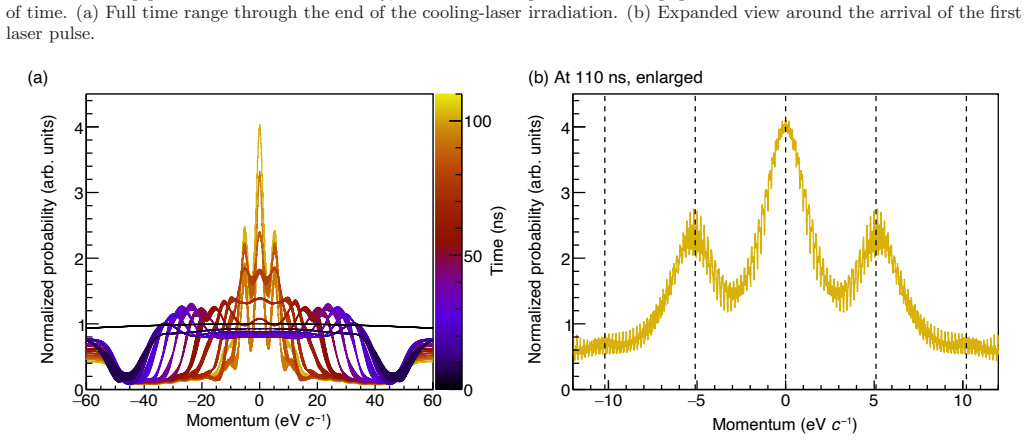
Measure the momentum distribution of laser-cooled positronium under the same pulse-train parameters used in the simulation: if no peaks appear at integer multiples of 5.1 eV/c, or if the overall envelope is much broader than about 10 eV/c, the prediction of sub-recoil cooling via velocity-selective coherent population trapping would be refuted. Alternatively, measure the optical spectrum of the third-harmonic pulse train and compare it with the spectrum implied by Eq. (7); a mismatch in sideband or chirp structure would invalidate the assumed laser field.
Extended reading notes
Core claim
A quantum-mechanical treatment of positronium chirp cooling predicts that a train of short, chirped laser pulses can cool Ps atoms into momentum states whose widths are narrower than the single-photon recoil momentum, in addition to producing a recoil-limited overall envelope. The simulated momentum distribution shows peaks centered at integer multiples of the cooling-photon momentum (≈5.1 eV/c), with individual widths around 3 eV/c, which the authors attribute to velocity-selective coherent population trapping: coherent superpositions of ground states with different momenta become decoupled from the excited states and accumulate population. The paper further shows that the experimentally developed laser parameters are near optimal, and that longer cooling durations trade off against losses from positronium annihilation.
Load-bearing premise
The simulation's prediction depends on the assumed laser pulse-train field faithfully reproducing the real laser's chirp, pulse shape, and sideband spectrum; the paper does not validate this model against a measured laser spectrum or against the measured cooled momentum distribution from the experiment.
Editorial extensions
If this is right
- The existing chirped pulse-train laser is already close to optimal, so no major redesign is needed to achieve recoil-limit cooling in the one-dimensional geometry.
- The appearance of sub-recoil peaks suggests that further tuning of chirp rate, pulse spacing, or intensity could push positronium below the recoil limit, potentially enabling ultracold ensembles for quantum-degeneracy studies.
- The simulation platform can be applied to other coherent pulse-train cooling schemes, such as those proposed for more efficient cooling, because it retains the coherence needed to describe short-pulse interactions.
- The predicted momentum distribution provides a quantitative target for experimental verification: if the narrow peaks at recoil-spacing are absent or much broader, the coherent population-trapping interpretation would be challenged.
Reading between the lines
- If the sub-recoil mechanism holds in three dimensions, the same dark-state physics could be used to cool positronium toward Bose–Einstein condensation, a goal the paper mentions but does not model.
- The paper assumes atoms remain within the laser field; extending the simulation to track real-space trajectories would be needed to predict whether the cooled component can be extracted and used for spectroscopy, and this extension is left to a Monte Carlo approach.
- A direct comparison of the simulated momentum distribution at 110 ns with the experimental measurement from the authors' own chirp-cooling demonstration would provide a sharp test; discrepancies would pinpoint errors in the assumed laser envelope or in the treatment of spontaneous emission.
- The assumption that the laser field is well described by Eq. (7) with third-harmonic conversion could be validated independently by measuring the optical spectrum of the generated 243-nm pulses; if the actual sideband structure or chirp shape differs, the predicted cooling efficiency would change.
Editorial analysis
A structured set of objections, weighed in public.
Referee Report
Summary. The manuscript develops a one-dimensional Lindblad master-equation simulation of positronium (Ps) laser cooling driven by a chirped pulse-train generator. The model retains atomic coherence, resolves the internal (1S/2P) and center-of-mass momentum degrees of freedom, and includes spontaneous emission and annihilation. Using parameters from the authors' previous laser-development work, the simulation predicts that a 300-K Ps distribution is compressed to a recoil-scale envelope and exhibits narrow sub-recoil peaks attributed to velocity-selective coherent population trapping. A parameter scan is used to argue that the developed laser's parameters are close to optimal.
Significance. If the simulation is quantitatively reliable, it would be a valuable tool for Ps cooling: it goes beyond rate equations in a regime where pulse spacing is comparable to the decoherence time, and it makes a concrete, falsifiable prediction of sub-recoil cooling via coherent population trapping. The paper is self-contained in its formalism: the master equation, the electric-dipole and carrier-momentum approximations, and the state restriction are clearly stated, and the parameter scan is a useful practical contribution. The main weakness is that the central quantitative prediction is not benchmarked: the laser envelope model is taken as a pure cube of an idealized generator output, and no comparison is made with the measured cooled momentum distribution from the authors' own experiment (Ref. [8]).
major comments (3)
- [Section II.B, Eq. (7)] The simulation's quantitative output inherits every spectral detail of the field model E_L(t) = (E_CPT_f(t))^3. Real third-harmonic conversion to 243 nm is not a pure instantaneous cube: phase-matching bandwidth, group-velocity mismatch, and nonlinear phase shifts modify the spectral amplitude and phase, which set the single-photon detunings, Rabi frequencies, and the two-photon resonance condition that creates the dark states. The paper reports no measured 243-nm spectrum or envelope and no sensitivity analysis against deviations from the cube model. Because the sub-recoil peak positions and widths are the advertised quantitative result, this unvalidated envelope model is load-bearing. I recommend either benchmarking Eq. (7) against a measured laser spectrum or adding a sensitivity study that varies the spectral phase/amplitude distortions.
- [Section III, Fig. 2; Abstract] The abstract claims the simulation 'quantitatively predict[s] the momentum distribution after laser cooling,' but the manuscript contains no comparison with the measured cooled distribution from the authors' own experiment, Ref. [8]. Even a qualitative comparison of peak locations, widths, or overall envelope would calibrate the model; without it, the quantitative claim remains conditional on the fidelity of the laser model. This is a validation gap rather than an internal inconsistency, but it is central to the paper's headline claim and should be addressed before publication.
- [Section III, Fig. 2(b)] The attribution of the narrow peaks to velocity-selective coherent population trapping is plausible but not demonstrated. The observed peak spacing equals the recoil momentum and the widths are below recoil, but the finite interaction time, the chirped pulse spectrum, and the momentum-grid discretization could also shape narrow features. The paper should provide a more direct diagnostic, for example an analysis of the ground-state coherences or a projection onto the predicted dark states, to support the VSCPT interpretation rather than inferring it solely from the momentum distribution.
minor comments (4)
- [Section II.B, Eq. (7) and Table I] Table I lists the main laser parameters but omits the CPTG modulation depth β, modulation frequency Ω, and pulse-repetition frequency ω_r, although these are required to reproduce Eq. (7). They appear only in the text with approximate values; adding them to the table would make the simulation reproducible.
- [Section II.A, Eq. (5)] In the dissipator, the first term sums over both a and b even though only the total decay rate out of state a is needed; this notation is not incorrect but is confusing. Defining total decay rates (e.g., Γ_a^tot = Σ_b Γ_sp.ab + Γ_ann.a) would make the Lindblad structure clearer.
- [Section III, Fig. 3] The claim that the Table I parameters are 'close to optimal' is based on visual inspection of the plotted distributions. A quantitative metric, such as the fraction of atoms below a recoil-momentum threshold or an effective temperature, would make the parameter scan more objective and the conclusion more convincing.
- [Section I, paragraph 2] The statement that 'previous precision measurements used Ps gases at several hundred kelvin' would benefit from a citation, and the later phrase 'approximately 1 K' in the introduction should clarify that it refers to the envelope temperature of the velocity distribution rather than a true thermodynamic temperature of the sample.
Circularity Check
No significant circularity: the simulation's predictions follow from specified physical inputs, and self-citations supply experimental laser parameters rather than the conclusion.
full rationale
The paper's derivation chain is self-contained. The Lindblad master equation (Eq. 1), the electric-dipole Hamiltonian (Eq. 3), the dissipative term (Eq. 5), and the laser envelope (Eq. 7) with the cubic third-harmonic conversion E_L(t) = (E^CPT_f(t))^3 are all stated as inputs. The momentum distribution and the sub-recoil peaks are outputs of the numerical integration; they are not imposed by any fitted parameter and are not equivalent to any input by construction. The parameters in Table I are taken from the authors' prior laser development and demonstration (Refs. [8,14,15]); this is self-citation for the input laser parameters, not for the central predictive claim. The parameter scan varies these inputs and reports optimality relative to the simulation's own cooling metric, which is a legitimate application rather than a circular reduction. The cubic-envelope assumption and the absence of a direct experimental benchmark are validation gaps, not circularity: the prediction does not reduce to its inputs merely because the inputs are unvalidated or inherited from prior work.
Assumptions & free parameters
free parameters (7)
- Chirp rate =
500 GHz/µs
- Instantaneous spectral width =
9 GHz
- Average intensity =
1 kW/cm²
- Pulse train duration =
100 ns
- CPTG modulation depth β =
0.403 rad
- CPTG modulation frequency Ω =
2π × 78.8 MHz
- Pulse repetition angular frequency ω_r =
2π × 236 MHz
assumptions (6)
- standard math The Lindblad master equation with Markovian dissipation correctly describes the Ps-laser interaction.
- domain assumption Electric-dipole interaction and neglect of laser-mode depletion are valid.
- domain assumption Only s=1, n=1,2 states are relevant; para-Ps and higher-n states are negligible.
- domain assumption Spontaneous emission does not transfer coherence from excited to ground states.
- domain assumption Every laser photon transfers the carrier momentum ħk_L^c; the laser spectrum enters only through the temporal envelope.
- domain assumption Ps atoms remain in the laser field for the entire pulse train; no real-space dynamics.
Cite this review
Pith. "Pith review of Simulation of positronium laser cooling using the Lindblad master equation." pith.science (2026). https://pith.science/paper/NWNCNBMD
@misc{pith2026260806160,
  author       = {Pith},
  title        = {Pith review of: Simulation of positronium laser cooling using the Lindblad master equation},
  year         = {2026},
  howpublished = {\url{https://pith.science/paper/NWNCNBMD}},
  note         = {Machine review of arXiv:2608.06160}
}
abstract
We present a formulation and numerical results for positronium (Ps) laser cooling. The formulation is based on the Lindblad master equation and follows the time evolution of the density matrix of Ps atoms. It therefore accounts for atomic coherence, which is necessary to describe the interaction of Ps with the train of short laser pulses generated by the system developed by Shu $\textit{et al.}$ [K. Shu $\textit{et al.}$, Phys. Rev. A $\textbf{109}$, 043520 (2024)]. Using this formulation, we calculate the time evolution of the populations in each internal and momentum state and thereby quantitatively predict the momentum distribution after laser cooling. We present the representative time evolution of the internal-state populations and momentum distribution, together with a comprehensive scan of the laser parameters used to optimize the cooling efficiency. A prominent feature of the simulated distributions is sub-recoil cooling through velocity-selective coherent population trapping, a coherent effect captured by the quantum-mechanical treatment.
Figures


Reference graph
Works this paper leans on
-
[8]
K. Shu, Y. Tajima, R. Uozumi, N. Miyamoto, S. Shi- raishi, T. Kobayashi, A. Ishida, K. Yamada, R. W. Gladen, T. Namba, S. Asai, K. Wada, I. Mochizuki, T. Hyodo, K. Ito, K. Michishio, B. E. O’Rourke, N. Oshima, and K. Yoshioka, Cooling positronium to ultralow velocities with a chirped laser pulse train, Nature 633, 793 (2024)
work page 2024
-
[1]
S. G. Karshenboim, Precision physics of simple atoms: QED tests, nuclear structure and fundamental constants, Phys. Rep. 422, 1 (2005)
work page 2005
-
[2]
G. S. Adkins, D. B. Cassidy, and J. P´ erez-R´ ıos, Precision spectroscopy of positronium: Testing bound-state QED theory and the search for physics beyond the Standard Model, Phys. Rep. 975, 1 (2022)
work page 2022
-
[3]
D. B. Cassidy, Experimental progress in positronium laser physics, Eur. Phys. J. D 72, 53 (2018)
2018
-
[4]
M. S. Fee, A. P. Mills, S. Chu, E. D. Shaw, K. Danzmann, R. J. Chichester, and D. M. Zuck- erman, Measurement of the positronium 1 3S1-23S1 interval by continuous-wave two-photon excitation, Phys. Rev. Lett. 70, 1397 (1993)
work page 1993
- [5]
-
[6]
R. Sheldon, T. Babij, S. Reeder, S. Hogan, and D. Cassidy, Precision Microwave Spec- troscopy of the Positronium 2 3S1 →23P2 Interval, Phys. Rev. Lett. 131, 043001 (2023)
work page 2023
-
[7]
C. Frugiuele, J. P´ erez-R´ ıos, and C. Peset, Cur- rent and future perspectives of positronium and muonium spectroscopy as dark sectors probe, Phys. Rev. D 100, 015010 (2019)
work page 2019
Show all 20 references
-
[9]
Gl¨ oggler, N
L. Gl¨ oggler, N. Gusakova, B. Rien¨ acker, A. Camper, R. Caravita, S. Huck, M. Volponi, T. Wolz, L. Penasa, V. Krumins, F. Gustafsson, D. Comparat, M. Auzins, B. Bergmann, P. Burian, R. Brusa, F. Castelli, G. Cerchiari, R. Ciury/suppress lo, G. Consolati, M. Doser, /suppress ...
2024
-
[10]
E. P. Liang and C. D. Dermer, Laser cooling of positro- nium, Opt. Commun. 65, 419 (1988)
1988
-
[11]
Kumita, T
T. Kumita, T. Hirose, M. Irako, K. Kadoya, B. Matsumoto, K. Wada, N. Mondal, H. Yabu, K. Kobayashi, and M. Kajita, Study on laser cooling of ortho-positronium, Nucl. Instrum. Methods Phys. Res. B 192, 171 (2002)
2002
-
[12]
K. Shu, X. Fan, T. Yamazaki, T. Namba, S. Asai, K. Yoshioka, and M. Kuwata-Gonokami, Study on 8 cooling of positronium for Bose–Einstein condensation, J. Phys. B: At. Mol. Opt. Phys. 49, 104001 (2016)
2016
-
[13]
Zimmer, P
C. Zimmer, P. Yzombard, A. Camper, and D. Com- parat, Positronium laser cooling in a magnetic field, Phys. Rev. A 104, 023106 (2021)
2021
-
[14]
Yamada, Y
K. Yamada, Y. Tajima, T. Murayoshi, X. Fan, A. Ishida, T. Namba, S. Asai, M. Kuwata-Gonokami, E. Chae, K. Shu, and K. Yoshioka, Theoretical Analysis and Ex- perimental Demonstration of a Chirped Pulse-Train Gen- erator and its Potential for Efficient Cooling of Positro- nium, Ph...
2021
-
[15]
K. Shu, N. Miyamoto, Y. Motohashi, R. Uozumi, Y. Tajima, and K. Yoshioka, Development of a laser for chirp cooling of positronium to near the recoil limit using a chirped pulse-train generator, Phys. Rev. A 109, 043520 (2024)
2024
-
[16]
Meystre and M
P. Meystre and M. Sargent, Elements of Quantum Optics , 4th ed. (Springer, Berlin, Heidelberg, 2007)
2007
-
[17]
Ilinova, M
E. Ilinova, M. Ahmad, and A. Derevianko, Doppler cool- ing with coherent trains of laser pulses and a tunable velocity comb, Phys. Rev. A 84, 033421 (2011)
2011
-
[18]
Aspect, E
A. Aspect, E. Arimondo, R. Kaiser, N. Vansteenkiste, and C. Cohen-Tannoudji, Laser cooling below the one-photon recoil energy by velocity-selective co- herent population trapping: theoretical analysis, J. Opt. Soc. Am. B 6, 2112 (1989)
1989
-
[19]
Papoff, F
F. Papoff, F. Mauri, and E. Arimondo, Transient velocity-selective coherent population trapping in one di- mension, J. Opt. Soc. Am. B 9, 321 (1992)
1992
-
[20]
Malamant, N
J. Malamant, N. Gusakova, H. Sandaker, I. T. Sorokina, D. Comparat, and A. Camper, Coherent laser cooling with trains of ultrashort laser pulses, Phys. Rev. A 110, 013109 (2024)
2024
Reviewed August 7, 2026 · model on record in the stance chip above.
Discussion (0). Continue with ORCID to comment.