REVIEW 3 major objections 6 minor 188 references
Predicting Pseudo-nitzschia harmful algal blooms along the Portuguese Coast using satellite-derived predictors
T0 review · 3 major / 6 minor · reviewed 2026-07-10 · grok-4.5
Pith's one-line read Satellite-only models predict Pseudo-nitzschia bloom occurrence on the Portuguese coast with ROC-AUC up to 0.77 under strict year-and-cluster holdout.
desk verdict Solid applied ML paper: honest moderate AUCs under a real year∪ cluster CV, with the main novelty in the Portuguese matchup and river-aware blocking rather than the model class. read the letter →
The pith
A machine-rendered reading of the paper's core claim, the machinery that carries it, and where it could break.
The reading
What carries the argument
Union-of-year-and-cluster blocking combined with river-aware spatial clustering of sampling sites: each validation fold holds out every observation from one calendar year together with every observation from one freshwater-influence cluster, so lagged satellite predictors cannot leak information from the held-out regime.
What would settle it
Re-run the same year-and-cluster cross-validation after re-labelling HAB events from matched shellfish domoic-acid measurements (or actual harvest-ban days) instead of the fixed cell threshold; if discrimination collapses well below the reported 0.7 range, the occurrence proxy does not support operational early warning.
Extended reading notes
Core claim
Under a leakage-resistant spatio-temporal cross-validation that simultaneously withholds calendar years and river-aware spatial clusters, Pseudo-nitzschia HAB occurrence (defined as cell concentration above 10,000 cells per litre) on the L1-L2 Portuguese hotspot is moderately predictable from exclusively satellite-derived predictors. Extra Trees with environmental plus biological features reach ROC-AUC 0.77 plus or minus 0.06; Random Forest with environmental features alone reaches 0.74 plus or minus 0.05. Seasonal harmonics, spatial coordinates, and lagged physical forcing dominate, while short-lag chlorophyll and plankton functional types refine likelihood within favourable windows.
Load-bearing premise
The claim treats a fixed cell-count threshold of 10,000 cells per litre as an adequate operational proxy for harmful risk, even though toxin and harvest-ban events can occur at lower abundances and toxicity itself is not the modelled target.
Signed reviews
Editorial analysis
A structured set of objections, weighed in public.
Referee Report
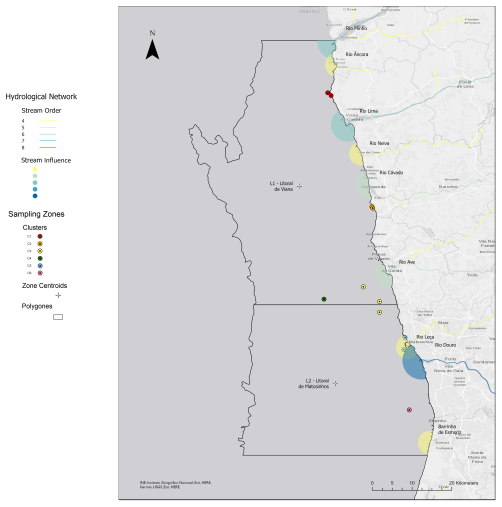
Summary. The manuscript develops a satellite-only machine-learning framework to predict Pseudo-nitzschia HAB occurrence (PN > 10,000 cells L⁻¹) along the northern Portuguese coast (zones L1–L2, 2013–2023; 1,440 observations). Predictors include SST, a Bakun-style upwelling index, chlorophyll-a, plankton functional types, seasonal harmonics, spatial coordinates, and lags up to 45 days. Sampling sites are partitioned by a river-aware (ROFI) clustering scheme, and models are evaluated under a stringent year∪cluster cross-validation (66 folds) that withholds entire years and spatial clusters simultaneously. Across linear, margin-based, and tree ensembles, HAB occurrence is moderately predictable: Random Forest reaches ROC–AUC 0.74±0.05 with environmental features; Extra Trees reaches 0.77±0.06 when biological predictors are added. Feature importance attributes skill primarily to seasonality, location, and multi-week SST/UI lags, with short-lag Chl-a refining predictions. Confusion matrices at fixed FPRs and spatial probability maps illustrate operational threshold trade-offs and adaptive sampling use.
Significance. If the reported discrimination holds under the stated protocol, the work provides a carefully scoped, leakage-resistant demonstration that satellite-only predictors can support early-warning of Pseudo-nitzschia bloom occurrence on an eastern-boundary upwelling coast. Strengths include strict separation of IPMA labels from CMEMS predictors, multi-model and nested feature-set comparison, fold-wise mean±std over 66 year×cluster splits, open code for CMEMS matchup and ROFI clustering, and explicit operational framing (threshold trade-offs, adaptive sampling maps). The contribution is methodological and regional rather than a universal HAB solution, but it is a credible baseline for satellite-supported monitoring support where in situ coverage is sparse.
major comments (3)
- §2.4 and Table 1: The supervised target is a fixed threshold HAB = 1 if PN > 10,000 cells L⁻¹ (~14% positives). The paper repeatedly notes that DA toxicity and harvest bans can occur at low cell abundances and that toxicity is not the modelling target (Introduction; §2.4; Discussion 4.3; Conclusion limitations). That disclosure is appropriate, but the operational claim in the abstract and highlights (“operationally relevant skill for … early-warning systems”) still rests on occurrence as a risk proxy. A sensitivity analysis over alternative thresholds (e.g. 5×10³, 2×10⁴, or a percentile-based definition) and/or a secondary analysis against ban-day labels would show whether the reported AUC range is robust to the definitional choice that is load-bearing for uptake.
- §2.7 and Figure 10: The year∪cluster blocking is a genuine strength, but the manuscript does not quantify residual leakage risk from (i) multi-week lagged predictors that may still share large-scale forcing with held-out years/clusters, or (ii) the fact that a held-out cluster’s other years remain in training (and a held-out year’s other clusters remain in training). Reporting a pure leave-one-year-out and pure leave-one-cluster-out ablation alongside the union design would make the “realistic forecasting” claim more transparent and would show how much of the 0.74–0.77 AUC is carried by each blocking axis.
- §2.7.1 / Table 2: Hyperparameters for the winning RF (env-only) and Extra Trees (full) configurations are stated as selected within training folds, but the selection procedure (grid vs. default, search space, whether nested CV was used) is not fully specified, and only the final settings are given. Given class imbalance and 66 folds, a brief nested-CV or fixed-hyperparameter sensitivity check is needed to confirm that the 0.03 AUC gain from adding biological predictors is not partly an artefact of unequal tuning effort across feature sets.
minor comments (6)
- Appendix A vs. main text §2.1/Figure 7: Main text refers to “river-aware K-means” and K=6, while Appendix A primarily describes DBSCAN with an augmented distance and notes k-means as an alternative. Please state unambiguously which algorithm produced the six clusters used for CV blocking.
- Table 1: “Remote-sensed biological uncertainty estimates” list CHL and PFT uncertainty ranges but it is unclear whether these uncertainty fields enter any of the three model configurations or are only descriptive. Clarify in §2.3/§2.6.
- Figure 9 caption and §2.5: Toxicity-related ban periods are highlighted, but ban labels are not used as a modelling target. A short note in the figure caption that bans are shown for context only would avoid reader confusion.
- §2.3 / Appendix B: Coastline angle defaults (−32°) and zone-specific adjustments for L1/L2 are mentioned; give the numerical angles used for L1 and L2 so the UI is fully reproducible from the text.
- Typographical/consistency: “Pseudo-nitzschia” is occasionally concatenated without space or italics in headings; “Downwelling/Upwelling Index” units and sign convention should be stated once in the main text as well as Appendix B.
- References: Several recent HAB ML and Portuguese Pseudo-nitzschia monitoring papers are cited appropriately; ensure all arXiv/software DOIs (CMEMS_Data_Analysis, ROFI_Clustering) remain accessible at publication.
Circularity Check
No significant circularity: independent in-situ labels, external satellite predictors, and out-of-fold year×cluster evaluation; no claimed prediction reduces to its inputs by construction.
full rationale
This is a standard empirical machine-learning forecasting paper, not a first-principles derivation. The supervised HAB target is constructed solely from independent IPMA in-situ Pseudo-nitzschia cell counts via a fixed literature threshold (PN > 10 000 cells L⁻¹, citing Lane et al. 2009); satellite predictors (CMEMS SST, Bakun-style UI, CHL, PFTs and lags) are never used to define the label. Seasonal harmonics (sin/cos of DOY) and the upwelling index are conventional encodings, not tautologies of the target. Models are trained and scored under a leakage-resistant year∪ cluster cross-validation that withholds entire years and spatial blocks; reported ROC–AUC values (0.74–0.77) are therefore out-of-fold generalisation estimates, not in-sample fits renamed as predictions. Feature-importance rankings and confusion matrices are likewise computed on held-out folds. Self-citations point only to open-source code repositories that implement data pipelines and clustering; they supply no uniqueness theorems or load-bearing lemmas. Hyper-parameter selection inside the CV folds is ordinary ML practice and does not force the discrimination numbers. Consequently no step in the claimed chain reduces, by the paper’s own equations or by self-citation, to its own inputs. Score 0 is the correct, proportionate finding.
Assumptions & free parameters
free parameters (8)
- HAB cell-concentration threshold =
10000 cells L^-1
- Maximum lag depth =
45 days
- Number of river-aware spatial clusters K =
6
- River-influence weight alpha / ROFI decay L =
L=30 km; alpha not numerically fixed in main text
- Spatial matchup tolerance =
0.05 degrees
- Coastline orientation for upwelling index =
-32 degrees (default)
- Random Forest hyperparameters (env-only winner) =
n_estimators=400, max_depth=8, min_samples_leaf=3
- Extra Trees hyperparameters (full-feature winner) =
n_estimators=200, min_samples_leaf=2
assumptions (6)
- domain assumption Satellite-derived SST, wind-based upwelling index, CHL and PFTs (with lags) contain transferable information about conditions conducive to Pseudo-nitzschia bloom occurrence.
- domain assumption A fixed PN concentration threshold of 10,000 cells L⁻¹ defines HAB occurrence in a way that is operationally meaningful for early warning.
- ad hoc to paper Withholding the union of one calendar year and one spatial cluster yields a realistic estimate of operational generalisation without temporal or spatial leakage.
- domain assumption Bakun/Ekman coastal upwelling index with local coastline angle is an adequate scalar of nutrient-injection forcing for this margin.
- standard math ROC–AUC (and fixed-FPR confusion matrices) are appropriate primary metrics under ~14% positive-class imbalance.
- domain assumption In optically complex ROFI waters, CMEMS CHL/PFT retrievals remain useful enough as community-state proxies despite acknowledged bio-optical uncertainty.
invented entities (1)
-
River-aware ROFI spatial clustering of L1–L2 sampling sites
independent evidence
Cite this review
Pith. "Pith review of Predicting Pseudo-nitzschia harmful algal blooms along the Portuguese Coast using satellite-derived predictors." pith.science (2026). https://pith.science/paper/NXHSN6SQ
@misc{pith2026260707834,
  author       = {Pith},
  title        = {Pith review of: Predicting Pseudo-nitzschia harmful algal blooms along the Portuguese Coast using satellite-derived predictors},
  year         = {2026},
  howpublished = {\url{https://pith.science/paper/NXHSN6SQ}},
  note         = {Machine review of arXiv:2607.07834}
}
read the original abstract
Pseudo-nitzschia diatoms pose recurrent risks to coastal ecosystems and shellfish harvesting along the Portuguese Atlantic coast. Here we develop and evaluate a spatio-temporal machine-learning framework to predict harmful algal bloom (HAB) occurrence using exclusively satellite-derived predictors under realistic forecasting constraints. We characterised environmental and biological variability across shellfish production zones (L1-L9) using 5,882 observations, providing system-wide context. Predictive models were developed for zones L1-L2, a hotspot for Pseudo-nitzschia and domoic acid events, using a decade-long dataset (2013-2023; 1,440 observations; more than 1,000 satellite-based predictors including sea surface temperature, an upwelling index, chlorophyll-a, and plankton functional types). Sampling locations were partitioned into ecologically meaningful sub-regions using a river-aware spatial clustering scheme. A stringent spatio-temporal cross-validation strategy that simultaneously withholds entire years and spatial clusters prevents leakage and closely mimics real-world forecasting conditions. HAB occurrence proved moderately predictable across model classes and feature configurations. Ensemble tree-based methods achieved the strongest discrimination: Random Forest reached 0.74 +/- 0.05 with environmental predictors; Extra Trees reached 0.77 +/- 0.06 with biological variables added. Feature-importance analyses revealed that seasonal structure, spatial context, and lagged environmental conditions dominate model decisions, while biological indicators refine bloom likelihood within physically favourable periods. The framework demonstrates operationally relevant skill for satellite-supported HAB early-warning systems along eastern boundary upwelling coasts.
Figures


Figures from the paper (14 more)




Reference graph
Works this paper leans on
-
[1]
International Journal of Environmental Science and Technology , volume=
Harmful algal blooms (red tide): a review of causes, impacts and approaches to monitoring and prediction , author=. International Journal of Environmental Science and Technology , volume=. 2019 , publisher=
work page 2019
-
[2]
Pseudo-nitzschia physiological ecology, phylogeny, toxicity, monitoring and impacts on ecosystem health , author=. Harmful Algae , volume=. 2012 , publisher=
work page 2012
-
[3]
A HAB warning system for shellfish harvesting in Portugal , author=. Harmful Algae , volume=. 2016 , publisher=
work page 2016
-
[4]
Bivalve shellfish safety in Portugal: variability of faecal levels, metal contaminants and marine biotoxins during the last decade (2011--2020) , author=. Toxins , volume=. 2023 , publisher=
work page 2011
-
[5]
Can Pseudo-nitzschia blooms be modeled by coastal upwelling in Lisbon Bay? , author=. Harmful Algae , volume=. 2010 , publisher=
work page 2010
-
[6]
Progress in Oceanography , volume=
The physical oceanography of upwelling systems and the development of harmful algal blooms , author=. Progress in Oceanography , volume=. 2010 , publisher=
work page 2010
-
[7]
Initial skill assessment of the California harmful algae risk mapping (C-HARM) system , author=. Harmful Algae , volume=. 2016 , publisher=
work page 2016
-
[8]
Frontiers in Marine Science , volume=
Satellite observations of phytoplankton functional type spatial distributions, phenology, diversity, and ecotones , author=. Frontiers in Marine Science , volume=. 2017 , publisher=
work page 2017
Show all 188 references
-
[9]
Proceedings of the National Academy of Sciences , volume=
Molecular forecasting of domoic acid during a pervasive toxic diatom bloom , author=. Proceedings of the National Academy of Sciences , volume=. 2024 , publisher=
2024
-
[10]
Water , volume=
Pseudo-nitzschia blooms in a coastal upwelling system: Remote sensing detection, toxicity and environmental variables , author=. Water , volume=. 2019 , publisher=
2019
-
[11]
Remote Sensing , volume=
A new algorithm using support vector machines to detect and monitor bloom-forming Pseudo-nitzschia from OLCI data , author=. Remote Sensing , volume=. 2024 , publisher=
2024
-
[12]
Water , volume=
Comparison of in-situ chlorophyll-a time series and sentinel-3 ocean and land color instrument data in Slovenian National Waters (gulf of trieste, Adriatic Sea) , author=. Water , volume=. 2021 , publisher=
2021
-
[13]
Regional Studies in Marine Science , volume=
Monitoring Tangier (Morocco) coastal waters for As, Fe and P concentrations using ESA Sentinels-2 and 3 data: An exploratory study , author=. Regional Studies in Marine Science , volume=. 2019 , publisher=
2019
-
[14]
Remote Sensing , volume=
Determination of bathing water quality using thermal images Landsat 8 on the west coast of Tangier: Preliminary results , author=. Remote Sensing , volume=. 2019 , publisher=
2019
-
[15]
ISPRS Journal of Photogrammetry and Remote Sensing , volume=
Characterization of harmful algal blooms (HABs) in the Arabian Gulf and the Sea of Oman using MERIS fluorescence data , author=. ISPRS Journal of Photogrammetry and Remote Sensing , volume=. 2015 , publisher=
2015
-
[16]
Desalination and Water Treatment , volume=
Reverse osmosis desalination system and algal blooms Part I: harmful algal blooms (HABs) species and toxicity , author=. Desalination and Water Treatment , volume=. 2016 , publisher=
2016
-
[17]
Harmful Algae , volume=
Harmful algal blooms: A climate change co-stressor in marine and freshwater ecosystems , author=. Harmful Algae , volume=. 2020 , publisher=
2020
-
[18]
International Journal of Oceans and Oceanography , volume=
Harmful algal blooms and their impacts in the middle and outer ROPME sea area , author=. International Journal of Oceans and Oceanography , volume=
-
[19]
Harmful Algae , volume=
Harmful algal blooms and public health , author=. Harmful Algae , volume=. 2016 , publisher=
2016
-
[20]
Biological Reviews , volume=
Emerging threats and persistent conservation challenges for freshwater biodiversity , author=. Biological Reviews , volume=. 2019 , publisher=
2019
-
[21]
Harmful Algae , volume=
Harmful algal blooms and their effects in coastal seas of Northern Europe , author=. Harmful Algae , volume=. 2021 , publisher=
2021
-
[22]
Nature Climate Change , volume=
Toxic algal bloom induced by ocean acidification disrupts the pelagic food web , author=. Nature Climate Change , volume=. 2018 , publisher=
2018
-
[23]
Ecology of Harmful Algae , pages=
The economic effects of harmful algal blooms , author=. Ecology of Harmful Algae , pages=. 2006 , publisher=
2006
-
[24]
Freshwater Algae of North America , pages=
Harmful algal blooms , author=. Freshwater Algae of North America , pages=. 2015 , publisher=
2015
-
[25]
Harmful Algae , volume=
Economic and sociocultural impacts of fisheries closures in two fishing-dependent communities following the massive 2015 US West Coast harmful algal bloom , author=. Harmful Algae , volume=. 2018 , publisher=
2015
-
[26]
Harmful Algae , volume=
Understanding the blob bloom: Warming increases toxicity and abundance of the harmful bloom diatom Pseudo-nitzschia in California coastal waters , author=. Harmful Algae , volume=. 2017 , publisher=
2017
-
[27]
Limnology and Oceanography , volume=
Effects of changing pCO2 and phosphate availability on domoic acid production and physiology of the marine harmful bloom diatom Pseudo-nitzschia multiseries , author=. Limnology and Oceanography , volume=. 2011 , publisher=
2011
-
[28]
Natural Toxins , volume=
Environmental stress and domoic acid production by Pseudo-nitzschia: a physiological perspective , author=. Natural Toxins , volume=. 1998 , publisher=
1998
-
[29]
Harmful Algae , volume=
Variability patterns and phenology of harmful phytoplankton blooms off southern Portugal: Looking for region-specific environmental drivers and predictors , author=. Harmful Algae , volume=. 2022 , publisher=
2022
-
[30]
Phycologia , volume=
Pseudo-nitzschia (Bacillariophyceae) species, domoic acid and amnesic shellfish poisoning: revisiting previous paradigms , author=. Phycologia , volume=. 2012 , publisher=
2012
-
[31]
Harmful Algae , volume=
Climate change and harmful algal blooms: insights and perspective , author=. Harmful Algae , volume=. 2020 , publisher=
2020
-
[32]
2005 , publisher=
Remote Sensing of Coastal Aquatic Environments: Technologies, Techniques and Applications , author=. 2005 , publisher=
2005
-
[33]
pelagic seed banks
Turbulence, watermass stratification and harmful algal blooms: an alternative view and frontal zones as “pelagic seed banks” , author=. Harmful Algae , volume=. 2002 , publisher=
2002
-
[34]
Global Ecology and Oceanography of Harmful Algal Blooms , pages=
The role of life cycle characteristics in harmful algal bloom dynamics , author=. Global Ecology and Oceanography of Harmful Algal Blooms , pages=. 2018 , publisher=
2018
-
[35]
Cyanobacterial harmful algal blooms: state of the science and research needs , pages=
Global warming and cyanobacterial harmful algal blooms , author=. Cyanobacterial harmful algal blooms: state of the science and research needs , pages=. 2008 , publisher=
2008
-
[36]
Ecology of Harmful Algae , pages=
Harmful algal bloom dynamics in relation to physical processes , author=. Ecology of Harmful Algae , pages=. 2006 , publisher=
2006
-
[37]
Manual on harmful marine microalgae , volume=
Harmful algal blooms: a global overview , author=. Manual on harmful marine microalgae , volume=. 2003 , publisher=
2003
-
[38]
Journal of Phycology , volume=
Ocean climate change, phytoplankton community responses, and harmful algal blooms: a formidable predictive challenge 1 , author=. Journal of Phycology , volume=. 2010 , publisher=
2010
-
[39]
Reviews in Aquaculture , volume=
Assessing risks and mitigating impacts of harmful algal blooms on mariculture and marine fisheries , author=. Reviews in Aquaculture , volume=. 2020 , publisher=
2020
-
[40]
Ecological Indicators , volume=
Predicting coastal algal blooms with environmental factors by machine learning methods , author=. Ecological Indicators , volume=. 2021 , publisher=
2021
-
[41]
, author=
Harmful algal blooms. , author=. 2017 , publisher=
2017
-
[42]
Environmental Modeling & Assessment , volume=
Multiple effects of environmental factors on algal growth and nutrient thresholds for harmful algal blooms: application of response surface methodology , author=. Environmental Modeling & Assessment , volume=. 2016 , publisher=
2016
-
[43]
Harmful Algae , volume=
Monitoring, modeling and projection of harmful algal blooms in China , author=. Harmful Algae , volume=. 2022 , publisher=
2022
-
[44]
Journal of Marine Science and Engineering , volume=
A review of recent machine learning advances for forecasting harmful algal blooms and shellfish contamination , author=. Journal of Marine Science and Engineering , volume=. 2021 , publisher=
2021
-
[45]
and Bryan, J
Yang, X. and Bryan, J. and Okubo, K. and Jiang, C. and Clements, T. and Denolle, M. A. , title=. Geophysical Journal International , volume=. 2022 , month=
2022
-
[46]
and Huang, W
Qi, Q. and Huang, W. and Zhang, D. and Han, L. , title=. Applied Sciences , volume=. 2023 , url=
2023
-
[47]
and Embury, O
Merchant, C.J. and Embury, O. and Bulgin, C.E. and Block, T. and Corlett, G.K. and Fiedler, E. and Good, S.A. and Mittaz, J. and Rayner, N.A. and Berry, D. and Eastwood, S. and Taylor, M. and Tsushima, Y. and Waterfall, A. and Wilson, R. and Donlon, C. , title=. Scientific Dat...
-
[48]
Brand, L. E. and Sunda, W. G. and Guillard, R. R. L. , title=. Journal of Experimental Marine Biology and Ecology , volume=
-
[49]
Bruland, K. W. and Franks, R. P. and Knauer, G. A. and Martin, J. H. , title=. Earth and Planetary Science Letters , volume=
-
[50]
and Costa, M
Caeiro, S. and Costa, M. H. and Ramos, T. B. and Fernandes, F. and Silveira, N. and Coimbra, A. and Medeiros, G. and Painho, M. , title=. Ecological Indicators , volume=
-
[51]
Cullen, J. T. and Sherrell, R. M. , title=. Marine Chemistry , volume=
-
[52]
Limnology and Oceanography , volume=
Trace metal nutrition of marine phytoplankton: a review , author=. Limnology and Oceanography , volume=
-
[53]
Figueiras, F. G. and Labarta, U. and Fernández-Reiriz, M. J. , title=. ICES Journal of Marine Science , volume=
-
[54]
and others , title=
Ferreira da Silva, E. and others , title=. Environmental Earth Sciences , volume=
-
[55]
and Pan, G
Guo, M. and Pan, G. and Zhang, M. and Song, Y. , title=. Acta Ecologica Sinica , volume=
-
[56]
Environmental Pollution , volume=
Lead toxicity and its impact on phytoplankton growth and diversity in freshwater ecosystems , author=. Environmental Pollution , volume=
-
[57]
Lane, T. W. and Saito, M. A. and George, G. N. and Pickering, I. J. and Prince, R. C. and Morel, F. M. M. , title=. Met Ions Life Sci. , volume=
-
[58]
Proceedings of the National Academy of Sciences , volume=
Biogeochemical evidence for the importance of cadmium in marine phytoplankton , author=. Proceedings of the National Academy of Sciences , volume=. 2000 , publisher=
2000
-
[59]
and others , title=
Lima, A. and others , title=. Journal of Geochemical Exploration , volume=
-
[60]
Maldonado, M. T. and Hughes, M. P. and Rue, E. L. and Wells, M. L. , title=. Proceedings of the National Academy of Sciences , volume=
-
[61]
Limnology and Oceanography , volume=
Influence of dissolved and particulate iron on the growth of phytoplankton from the Southern Ocean , author=. Limnology and Oceanography , volume=
-
[62]
Science , volume=
The biogeochemical cycles of trace metals in the oceans , author=. Science , volume=. 2003 , publisher=
2003
-
[63]
Treatise on Geochemistry , publisher=
Marine bioinorganic chemistry: The role of trace metals in the oceanic cycles of major nutrients , author=. Treatise on Geochemistry , publisher=
-
[64]
and Cobelo-García, A
Prego, R. and Cobelo-García, A. and Millward, G. E. and Nombela, M. A. , title=. Estuarine, Coastal and Shelf Science , volume=
-
[65]
and Prego, R
Santos-Echeandía, J. and Prego, R. and Cobelo-García, A. and Millward, G. E. , title=. Estuarine, Coastal and Shelf Science , volume=
-
[66]
Sunda, W. G. , title=. Frontiers in Microbiology , volume=
-
[67]
Wells, M. L. and Trick, C. G. and Cochlan, W. P. and Hughes, M. P. and Trainer, V. L. , title=. Harmful Algae , volume=
-
[68]
from Monterey Bay, California , author=
Nitrogenous preference of toxigenic Pseudo-nitzschia spp. from Monterey Bay, California , author=. Harmful Algae , volume=. 2007 , publisher=
2007
-
[69]
Pitcher, G. C. and Figueiras, F. G. and Hickey, B. M. , title=. Ecology of Harmful Algae , editor=. 2006 , publisher=
2006
-
[70]
Coastal upwelling indices, West Coast of North America, 1946–71 , author=
1946
-
[71]
Journal of Sea Research , volume=
Composition and interannual variability of phytoplankton in a coastal upwelling region (Lisbon Bay, Portugal) , author=. Journal of Sea Research , volume=
-
[72]
Remote Sensing of Environment , volume=
Unravelling region-specific environmental drivers of phytoplankton biomass and phenology in a coastal upwelling system , author=. Remote Sensing of Environment , volume=
-
[73]
Anderson, D. M. , title=. Estuaries , year=
-
[74]
Wells, M. L. and Trainer, V. L. and Smayda, T. J. and Karlson, B. S. and Trick, C. G. and Kudela, R. M. and Ishikawa, A. and Bernard, S. and Wulff, A. and Anderson, D. M. and Cochlan, W. P. , title=. Harmful Algae , year=
-
[75]
Trainer, V. L. and Hickey, B. M. and Horner, R. A. , title=. Harmful Algae , year=
-
[76]
McCabe, R. M. and Hickey, B. M. and Kudela, R. M. and Lefebvre, K. A. and Adams, N. G. and Bill, B. D. and Gulland, F. M.D. and Thomson, J. R. and Cochlan, W. P. and Trainer, V. L. , title=. Geophysical Research Letters , year=
-
[77]
Nature Communications , volume=
Tracking the global reduction of marine traffic during the COVID-19 pandemic , author=. Nature Communications , volume=. 2021 , publisher=
2021
-
[78]
Remote Sensing Letters , volume=
Effects of the Covid-19 pandemic on the oceans , author=. Remote Sensing Letters , volume=. 2021 , publisher=
2021
-
[79]
Remote Sensing of Coastal Aquatic Environments , pages=
Remote sensing of harmful algal blooms , author=. Remote Sensing of Coastal Aquatic Environments , pages=. 2005 , publisher=
2005
-
[80]
Oceanography , volume=
Global ecology and oceanography of harmful algal blooms , author=. Oceanography , volume=
-
[81]
Water Research , volume=
Climate change: Links to global expansion of harmful cyanobacteria , author=. Water Research , volume=
-
[82]
Oceanography , volume=
Blooms of harmful microalgae in the Benguela current system , author=. Oceanography , volume=
-
[83]
Frontiers in Ecology and the Environment , volume=
Coupled biogeochemical cycles: Eutrophication and hypoxia in temperate estuaries and coastal marine ecosystems , author=. Frontiers in Ecology and the Environment , volume=
-
[84]
Remote Sensing of Environment , volume=
A review of remote sensing approaches for monitoring harmful algal blooms: progress and future perspectives , author=. Remote Sensing of Environment , volume=
-
[85]
Harmful Algae , volume=
Pseudo-nitzschia blooms, domoic acid, and shellfish toxicity in the United States west coast region: present and future implications , author=. Harmful Algae , volume=
-
[86]
Annual Review of Marine Science , volume=
Progress in understanding harmful algal blooms: paradigm shifts and new technologies for research, monitoring, and management , author=. Annual Review of Marine Science , volume=
-
[87]
Environmental Science & Technology , volume=
Mitigating the expansion of harmful algal blooms across the freshwater-to-marine continuum , author=. Environmental Science & Technology , volume=
-
[88]
Frontiers in Marine Science , volume=
Climate-driven trends in harmful algal blooms along the Iberian upwelling system , author=. Frontiers in Marine Science , volume=
-
[89]
Proceedings of the National Academy of Sciences , volume=
Ocean warming since 1982 has expanded the niche of toxic algal blooms , author=. Proceedings of the National Academy of Sciences , volume=
1982
-
[90]
IPCC Special Report on the Ocean and Cryosphere in a Changing Climate , editor=
Changing ocean, marine ecosystems, and dependent communities , author=. IPCC Special Report on the Ocean and Cryosphere in a Changing Climate , editor=
-
[91]
Harmful Algae , volume=
Eutrophication and harmful algal blooms: A scientific consensus , author=. Harmful Algae , volume=
-
[92]
Harmful Algae , volume=
Nitrogenous preference of toxigenic Pseudo-nitzschia australis (Bacillariophyceae) from field and laboratory experiments , author=. Harmful Algae , volume=. 2007 , publisher=
2007
-
[93]
Harmful Algae , volume=
Harmful algae at the complex nexus of eutrophication and climate change , author=. Harmful Algae , volume=. 2020 , publisher=
2020
-
[94]
Oceanography , volume=
Harmful algal blooms in a changing world: causes, impacts and management , author=. Oceanography , volume=
-
[95]
Marine Pollution Bulletin , volume=
The relevance of defining trace metal baselines in coastal waters at a regional scale: the case of the Portuguese coast (SW Europe) , author=. Marine Pollution Bulletin , volume=
-
[96]
Harmful Algae , volume=
Emerging phylogeographic perspective on the toxigenic diatom genus Pseudo-nitzschia , author=. Harmful Algae , volume=
-
[97]
Marine Ecology Progress Series , volume=
Development of a logistic regression model for the prediction of toxigenic Pseudo-nitzschia blooms in Monterey Bay, California , author=. Marine Ecology Progress Series , volume=. 2009 , url=
2009
-
[98]
Journal of Artificial Intelligence Research , volume=
SMOTE: Synthetic Minority Over-sampling Technique , author=. Journal of Artificial Intelligence Research , volume=
-
[99]
Arkiv for Matematik, Astronomi och Fysik , volume=
On the influence of the Earth's rotation on ocean-currents , author=. Arkiv for Matematik, Astronomi och Fysik , volume=
-
[100]
Coastal Upwelling: Its Sediment Record , editor=
Upwelling patterns off Portugal , author=. Coastal Upwelling: Its Sediment Record , editor=
-
[101]
ICES Journal of Marine Science , volume=
Phytoplankton dynamics in a Norwegian fjord: the influence of river runoff , author=. ICES Journal of Marine Science , volume=. 1997 , publisher=
1997
-
[102]
Progress in Oceanography , volume=
The influence of river plumes on coastal biogeochemistry and phytoplankton dynamics: Insights from the Columbia River plume , author=. Progress in Oceanography , volume=
-
[103]
Journal of Geophysical Research: Oceans , year=
The Rio de la Plata plume response to wind variability in synoptic to intraseasonal scales: Barotropic response , author=. Journal of Geophysical Research: Oceans , year=
-
[104]
Harris, T. D. and Weisberg, R. H. and Hu, C. , title=. Harmful Algae , year=
-
[105]
and Stumpf, R
Chen, Y. and Stumpf, R. P. and Binding, C. E. and Anderson, D. M. , title=. Remote Sensing of Environment , year=
-
[106]
and Sun, D
Pan, G. and Sun, D. and Zhang, Y. , title=. Remote Sensing , year=
-
[107]
and Shi, K
Zhang, Y. and Shi, K. and Zhou, Y. , title=. Science of the Total Environment , year=
-
[108]
and Devred, E
Wilson, C. and Devred, E. and Sathyendranath, S. , title=. Progress in Oceanography , year=
-
[109]
and Pino, L
Bertani, I. and Pino, L. and Cazzaniga, E. , title=. Ecological Informatics , year=
-
[110]
and Xia, M
Kuang, D. and Xia, M. and Penta, B. , title=. Journal of Marine Systems , year=
-
[111]
Machine Learning , volume=
Random Forests , author=. Machine Learning , volume=
-
[112]
Machine Learning , volume=
Extremely Randomized Trees , author=. Machine Learning , volume=
-
[113]
The Elements of Statistical Learning: Data Mining, Inference, and Prediction , author=
-
[114]
BMC Bioinformatics , volume=
Bias in Random Forest Variable Importance Measures: Illustrations, Sources and a Solution , author=. BMC Bioinformatics , volume=
-
[115]
Marine Ecology Progress Series , volume=
Phytoplankton growth and nutrient uptake in relation to freshwater influence in coastal waters , author=. Marine Ecology Progress Series , volume=
-
[116]
Brewin, R. J. W. and Sathyendranath, S. and Platt, T. , title=. Progress in Oceanography , year=
-
[117]
Advances in Neural Information Processing Systems , volume=
Revisiting Deep Learning Models for Tabular Data , author=. Advances in Neural Information Processing Systems , volume=
-
[118]
arXiv preprint arXiv:2012.06678 , year=
TabTransformer: Tabular Data Modeling Using Contextual Embeddings , author=. arXiv preprint arXiv:2012.06678 , year=
2012 arXiv
-
[119]
arXiv preprint arXiv:2207.01848 , year=
TabPFN: A Transformer That Solves Small Tabular Classification Problems in a Second , author=. arXiv preprint arXiv:2207.01848 , year=
-
[120]
International Journal of Forecasting , volume=
Temporal Fusion Transformers for Interpretable Multi-horizon Time Series Forecasting , author=. International Journal of Forecasting , volume=
-
[121]
Proceedings of the AAAI Conference on Artificial Intelligence , volume=
Informer: Beyond Efficient Transformer for Long Sequence Time-Series Forecasting , author=. Proceedings of the AAAI Conference on Artificial Intelligence , volume=
-
[122]
Advances in Neural Information Processing Systems , volume=
Autoformer: Decomposition Transformers with Auto-Correlation for Long-Term Series Forecasting , author=. Advances in Neural Information Processing Systems , volume=
-
[123]
arXiv preprint arXiv:2307.08637 , year=
A Survey of Time-Series Foundation Models , author=. arXiv preprint arXiv:2307.08637 , year=
-
[124]
arXiv preprint arXiv:2303.04856 , year=
Multimodal Transformers for Learning from Structured and Temporal Data , author=. arXiv preprint arXiv:2303.04856 , year=
-
[125]
Environmental Modelling & Software , volume=
Hybrid Deep Learning Models for Environmental Time Series Forecasting , author=. Environmental Modelling & Software , volume=
-
[126]
and Zambrano, M
Arias, F. and Zambrano, M. and Galagarza, E. and Broce, K. , title=. Remote Sensing , year=
-
[127]
Demiray, B. Z. and Mermer, O. and Baydaro. Predicting Harmful Algal Blooms Using Explainable Deep Learning Models: A Comparative Study , journal=. 2025 , volume=
2025
-
[128]
and Huang, J
Chen, S. and Huang, J. and Huang, J. and Wang, P. and Sun, C. and Zhang, Z. and Jiang, S. , title=. Environmental Science and Ecotechnology , year=
-
[129]
and Bruinsma, W
Bodnar, C. and Bruinsma, W. P. and Lucic, A. and Stanley, M. and Vaughan, A. and Brandstetter, J. and Garvan, P. and Riechert, M. and Weyn, J. A. and Dong, H. and Gupta, J. K. and Thambiratnam, K. and Archibald, A. T. and Wu, Chun. A foundation model for the Earth system , journal=
-
[130]
International Conference on Learning Representations (ICLR) , year=
TimesNet: Temporal 2D-Variation Modeling for General Time Series Analysis , author=. International Conference on Learning Representations (ICLR) , year=
-
[131]
Transactions on Machine Learning Research , year=
Chronos: Learning the Language of Time Series , author=. Transactions on Machine Learning Research , year=
-
[132]
International Conference on Machine Learning (ICML) , year=
A Decoder-Only Foundation Model for Time-Series Forecasting , author=. International Conference on Machine Learning (ICML) , year=
-
[133]
and Srinivasan, A
Cai, Y. and Srinivasan, A. and Goswami, M. and Choudhry, A. and Dubrawski, A. , title=. Proceedings of the AAAI Conference on Artificial Intelligence , year=
-
[134]
and Vantrepotte, V
Mélin, F. and Vantrepotte, V. , title=. Remote Sensing of Environment , volume=
-
[135]
2014 , number=
Phytoplankton Functional Types from Space , author=. 2014 , number=
2014
-
[136]
and Boulesteix, A.-L
Strobl, C. and Boulesteix, A.-L. and Kneib, T. and Augustin, T. and Zeileis, A. , title =. BMC Bioinformatics , volume =
-
[137]
and Li, X
Cai, Y. and Li, X. and Goswami, M. and Wilinski, M. and Welter, G. and Dubrawski, A. , title=. arXiv preprint arXiv:2505.13291 , year=
-
[138]
Annual Review of Fluid Mechanics , volume=
Mixing and transport in coastal river plumes , author=. Annual Review of Fluid Mechanics , volume=. 2015 , doi=
2015
-
[139]
Frontiers in Marine Science , volume=
Editorial: River plumes and estuaries , author=. Frontiers in Marine Science , volume=. 2022 , doi=
2022
-
[140]
2023 , note=
C-HARM: Predicting harmful algal blooms with satellite data , howpublished=. 2023 , note=
2023
-
[141]
Good, S. A. and Embury, O. and Bulgin, C. E. and Mittaz, J. , title=
-
[142]
2023 , note=
Motu Python Client , author=. 2023 , note=
2023
-
[143]
About EMODnet , year=
-
[144]
2020 , howpublished=
2020
-
[145]
2024 , howpublished=
EMODnet Regional Contaminants Aggregated Datasets v2024: Metals and Metalloids in Biota (Median Values since 2012) , author=. 2024 , howpublished=
2012
-
[146]
2024 , note=
North Atlantic Ocean Colour Plankton, Reflectance, Transparency and Optics Multi-Year L3 Daily Observations , author=. 2024 , note=
2024
-
[147]
2024 , note=
EMODnet Physics: Surface Currents Dataset , author=. 2024 , note=
2024
-
[148]
2024 , version=
CMEMS\_Data\_Analysis: Retrieval and preprocessing of CMEMS environmental and biological NetCDF data , author=. 2024 , version=
2024
-
[149]
IBM and partners open-source a new AI model for monitoring Earth’s oceans , year=
-
[150]
and Vandaele, R
Dawson, G. and Vandaele, R. and Taylor, A. and Moffat, D. and Tamura-Wicks, H. and Jackson, S. and Lickorish, R. and Fraccaro, P. and Williams, H. and Luo, C. and Jones, A. , title=. 2025 , eprint=
2025
-
[151]
2026 , version=
ROFI_Clustering: River-informed coastal segmentation for freshwater-driven spatial structure , author=. 2026 , version=
2026
-
[152]
Bates, S. S. and others , title =. Canadian Journal of Fisheries and Aquatic Sciences , year =
-
[153]
Perl, Trish M. and B. An Outbreak of Toxic Encephalopathy Caused by Eating Mussels Contaminated with Domoic Acid , journal =. 1990 , volume =
1990
-
[154]
and Sampayo, M
Vale, P. and Sampayo, M. A. , title =. Toxicon , year =
-
[155]
Phycologia , year =
Lelong, Aur. Phycologia , year =
-
[156]
and Bates, Stephen S
Trainer, Vera L. and Bates, Stephen S. and Lundholm, Nina and Thessen, Anne E. and Cochlan, William P. and Adams, Nicolaus G. and Trick, Charles G. , title =. Harmful Algae , year =
-
[157]
and Hubbard, K
Bates, Stephen S. and Hubbard, K. A. and Lundholm, Nina and Montresor, Marina and Leaw, Chui Pin , title =. Harmful Algae , year =
-
[158]
, title =
Gobler, Christopher J. , title =. Harmful Algae , year =
-
[159]
, title =
Hallegraeff, Gustaaf M. , title =. Journal of Phycology , year =
-
[160]
and Glibert, P
Heisler, J. and Glibert, P. M. and Burkholder, J. M. and Anderson, D. M. and Cochlan, W. and Dennison, W. C. and Dortch, Q. and Gobler, C. J. and Heil, C. A. and others , title =. Harmful Algae , year =
-
[161]
and Glibert, Patricia M
Anderson, Donald M. and Glibert, Patricia M. and Burkholder, JoAnn M. , title =. Estuaries , year =
-
[162]
and Figueiras, Francisco G
Pitcher, Grant C. and Figueiras, Francisco G. and Hickey, Barbara M. and Moita, Maria Teresa , title =. Progress in Oceanography , year =
-
[163]
, title =
Relvas, Paulo and Barton, Eric D. , title =. Journal of Geophysical Research: Oceans , year =
-
[164]
Blondeau-Patissier, David and Gower, James F. R. and Dekker, Arnold G. and Phinn, Stuart R. and Brando, Vittorio E. , title =. Progress in Oceanography , year =
-
[165]
and others , title =
Groom, Simon and Sathyendranath, Shubha and Ban, Yong X. and others , title =. Frontiers in Marine Science , year =
-
[166]
2014 , number =
Phytoplankton Functional Types from Space , institution =. 2014 , number =
2014
-
[167]
and Rufty, Kay M
Moisan, Tiffany A. and Rufty, Kay M. and Moisan, John R. and Linkswiler, Matthew A. , title =. Frontiers in Marine Science , year =
-
[168]
and Mangin, Antoine and Garnesson, Pierre and Bretagnon, Maxime and Demaria, Julien and Soppa, Mariana A
Xi, Hongyan and Losa, Svetlana N. and Mangin, Antoine and Garnesson, Pierre and Bretagnon, Maxime and Demaria, Julien and Soppa, Mariana A. and Fanton d'Andon, Olivier H. and Bracher, Astrid , title =. Journal of Geophysical Research: Oceans , year =
-
[169]
Copernicus Marine Product User Manual for Ocean Colour Products (Issue 6.0, 11/2025) , year =
2025
-
[170]
A New Algorithm Using Support Vector Machines to Detect and Monitor Bloom-Forming
Gonz. A New Algorithm Using Support Vector Machines to Detect and Monitor Bloom-Forming. Remote Sensing , year =
-
[171]
and Gonz
Torres Palenzuela, Jesus M. and Gonz. Water , year =
-
[172]
and Siegel, David A
Anderson, Clarissa R. and Siegel, David A. and Kudela, Raphael M. and Brzezinski, Mark A. , title =. Harmful Algae , year =
-
[173]
and Kudela, Raphael M
Anderson, Clarissa R. and Kudela, Raphael M. and Benitez-Nelson, Claudia and Sekula-Wood, Emily and Burrell, Charlyn T. and Chao, Yi and Langlois, Guillaume and Goodman, Josh and Siegel, David A. , title =. Geophysical Research Letters , year =
-
[174]
and Moore, S
Anderson, Clarissa R. and Moore, S. and Tomlinson, M. and Silvagni, P. and others , title =. Harmful Algae , year =
-
[175]
Machine Learning Methods Applied to the Prediction of
Al. Machine Learning Methods Applied to the Prediction of. ISPRS International Journal of Geo-Information , year =
-
[176]
and others , title =
Cruz, Ricardo C. and others , title =. Journal of Marine Science and Engineering , year =
-
[177]
and Fu, Fei-Xue and Hutchins, David A
Tatters, Avery O. and Fu, Fei-Xue and Hutchins, David A. , title =. PLOS ONE , year =
-
[178]
and Bill, Brian D
Cochlan, William P. and Bill, Brian D. and Cailipan, Adrielle B. and Trainer, Vera L. , title =. Harmful Algae , year =
-
[179]
and others , title =
Brunson, Jennifer K. and others , title =. Proceedings of the National Academy of Sciences , year =
-
[180]
Braga, A. C. and Rodrigues, S. M. and Louren. Bivalve Shellfish Safety in. Toxins , year =
-
[181]
Lima, M. J. and Relvas, P. and Barbosa, A. B. , title =. Harmful Algae , year =
-
[182]
Phytoplankton dynamics in relation to seasonal variability and upwelling and relaxation patterns at the mouth of
Vidal, T. Phytoplankton dynamics in relation to seasonal variability and upwelling and relaxation patterns at the mouth of. PLOS ONE , year =
-
[183]
A 60-Year Time Series Analyses of the Upwelling along the
Leit. A 60-Year Time Series Analyses of the Upwelling along the. Water , year =
-
[184]
Regulation (EC) No 853/2004 laying down specific hygiene rules for food of animal origin (consolidated version) , year =
2004
-
[185]
Biotoxin Forecast Bulletin (shellfish harvesting forecast based on weekly monitoring, satellite imagery and hydrodynamic modelling) , year =
-
[186]
International Journal of Euro-Mediterranean Studies , year =
Assessment of Coastal Water Quality by Testing a Linear Model Using Landsat 8 SST Data: Exploratory Study , author =. International Journal of Euro-Mediterranean Studies , year =
-
[187]
and Leitão, P
Braunschweig, F. and Leitão, P. C. and Fernandes, L. and Pina, P. and Neves, R. , title =. Developments in Water Science , volume =. 2004 , doi =
2004
-
[188]
MOHID Water Modelling System , year =
Reviewed July 10, 2026 · model on record in the stance chip above.
Discussion (0). Continue with ORCID to comment.