REVIEW 4 major objections 6 minor 13 references
First-order phase transitions in the heavy quark region of lattice QCD at high temperatures and high densities
T0 review · 4 major / 6 minor · reviewed 2026-08-09 · deepseek-v4-flash
Pith's one-line read In the heavy quark region of lattice QCD, the complex phase of the quark determinant shifts beta only in the low-temperature phase, so as mu increases a plaquette gap—a first-order phase transition—appears at very high baryon density.
desk verdict A plausible but unproven prediction of a reentrant first-order transition at high mu/T, undercut by an uncontrolled m=1 truncation and an eyeballed beta-shift formula. read the letter →
The pith
A machine-rendered reading of the paper's core claim, the machinery that carries it, and where it could break.
The reading
What carries the argument
The carrying object is the effective heavy-quark action $S_{\rm eff} = -6N_{\rm site}\beta^* P - (N_s^3\lambda/2)(e^{\mu/T}\Omega + e^{-\mu/T}\Omega^*)$, built from the hopping parameter expansion, in which the Polyakov loop $\Omega$ couples with strength $\lambda$. At finite density the complex phase factor is treated in a cumulant expansion truncated at second order, so that $\ln\langle\cos(N_s^3\lambda\sinh(\mu/T)\Omega_I)\rangle \approx -(1/2)(N_s^3\lambda\sinh(\mu/T))^2\langle\Omega_I^2\rangle$, an approximation called the Gaussian approximation because it is exact for a Gaussian-distributed phase. The decisive element is the $\beta$-shift formula, Eq. (14): in the low-temperature phase $\partial\langle\Omega_I^2\rangle/\partial P|_{\Omega_R} = (3N_t/(N_s^3N_c))P^{N_t-1}(1-\Omega_R)e^{-3\Omega_R}$ and zero in the high-temperature phase. This derivative converts the complex-phase variance into a $\mu$-dependent shift of $\beta$ acting on the cold phase alone, which is what produces the predicted plaquette gap.
What would settle it
Measure the derivative $\partial\langle\Omega_I^2\rangle/\partial P$ at fixed $\Omega_R$ directly with high-statistics simulations in the low-temperature phase at $\lambda = 0.005$ and compare it with Eq. (14); if it is much smaller near $\Omega_R \sim 1$, the predicted gap at $\mu/T \simeq 8$ closes. Alternatively, simulate the effective theory at finite $\mu$ without truncating the cumulant expansion and check whether the plaquette histogram at $\lambda\cosh(\mu/T) \approx 10$ develops two peaks; a single sharp peak would falsify the first-order prediction.
Extended reading notes
Core claim
The paper is trying to establish that the reappearance of a first-order phase transition in the heavy quark region at very high density is driven by the complex phase of the quark determinant. Using an effective theory based on the hopping parameter expansion, the author measures the variance of the imaginary part of the Polyakov loop, $\langle\Omega_I^2\rangle$, and finds that its derivative with respect to the plaquette $P$ is nonzero in the low-temperature phase and essentially zero in the high-temperature phase. This derivative enters as a shift of the gauge coupling $\beta$ through the Gaussian (second-order cumulant) approximation of the phase factor. The paper models the low-temperature derivative with Eq. (14) and concludes that as $\mu$ increases, the plaquette in the low-temperature phase shifts in $\beta$ while the high-temperature plaquette does not, producing a gap at the transition point. The claim is that a first-order phase transition therefore appears at large $\mu/T$, for example $\mu/T \approx 7.6$–$9$ for $\lambda = 0.005$.
Load-bearing premise
The prediction rests on the assumed $\beta$-shift in the low-temperature phase, Eq. (14), whose exponential factor $(1-\Omega_R)e^{-3\Omega_R}$ was fitted to the simulation data by eye with the coefficient 3, together with the assumption that the same derivative vanishes in the high-temperature phase; if the true derivatives differ from these choices, no gap need appear.
Editorial extensions
If this is right
- For $\lambda = 0.005$ the plaquette gap is expected to open once $\lambda\cosh(\mu/T) \ge 5$, corresponding to $\mu/T \simeq 7.6$ and larger.
- The critical $\mu$ for the first-order transition decreases as the quark mass decreases, because the effective coupling $\lambda$ grows with the hopping parameter $\kappa$.
- The complex phase of the quark determinant, not just its modulus, is essential for the reappearance of the transition: the phase-quenched (isospin) theory shows only a steeper crossover at large $\mu$.
- If the heavy-quark first-order boundary connects to the first-order region in the light quark sector, its location constrains the position of the QCD critical point at physical quark masses.
Reading between the lines
- A natural extension is to include the fourth-order cumulant of $\Omega_I$; if it is sizable near the transition, the predicted threshold $\mu/T \simeq 8$ could shift, although the mechanism—an asymmetric beta-shift between phases—would survive.
- The mechanism points to a general principle: any observable whose fluctuation couples asymmetrically to the gauge action in the two phases acts as a $\mu$-dependent beta shift, so chemical potential generically sharpens or even creates first-order transitions wherever such asymmetry exists.
- The predicted densities (about $\mu/T \sim 8$) are far beyond the reach of heavy-ion collisions, so the result bears on the global structure of the QCD phase diagram and on comparisons with effective models, rather than on directly observable experimental signals.
Editorial analysis
A structured set of objections, weighed in public.
Referee Report
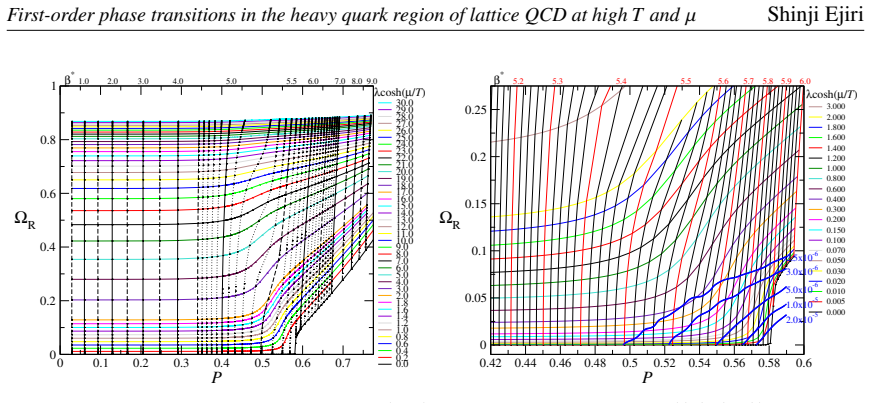
Summary. This proceedings paper studies the heavy quark region of finite-temperature and finite-density lattice QCD using an effective action derived from the hopping parameter expansion. The effective action retains Polyakov-loop terms of winding number m=1 with coefficient λ, and the phase-quenched case is treated by replacing λ with λ cosh(μ/T). The complex phase is then included through a Gaussian approximation for the cosine factor, leading to a shift of β* given by Eq. (11). Using a strong-coupling estimate and an interpolating form for ∂⟨Ω_I^2⟩/∂P at fixed Ω_R (Eq. (14)), the author argues that the complex phase shifts β in the low-temperature phase but not in the high-temperature phase, so that at large μ/T the plaquette develops a gap, suggesting a first-order transition (e.g., μ/T ≈ 7.6–9.0 for λ=0.005).
Significance. If the prediction survives scrutiny, it is an interesting possibility: the first-order region near the heavy-quark limit at μ=0 could reappear at high density, with consequences for the QCD phase diagram. The paper is valuable for its transparent presentation of the effective theory, the phase-quenched study, the strong-coupling calculation of ⟨Ω_I^2⟩, and the explicit statement of the ad hoc interpolation in Eq. (14). However, the central claim is not yet established: it depends on uncontrolled truncations of the hopping expansion and of the cumulant expansion, and on a phenomenological function fitted 'by eye.' The paper is more a well-posed conjecture than a demonstrated prediction.
major comments (4)
- [Sec. 2, Eq. (6)] The effective action keeps only winding-number m=1 Polyakov-loop terms. The stated justification (Sec. 2, property (2)) is based on measurements at μ=0. At the large values μ/T≈8–9 where the transition is predicted, the higher-winding terms in Eq. (3) are enhanced by e^{m μ/T}. The relative weight of the m=2 to m=1 sector is of order κ^{N_t} e^{μ/T}, i.e., of order λ e^{μ/T} up to O(1) factors; for λ=0.005 this is 10–60 in the predicted transition region. Unless these O(1) factors are very small, the neglected terms are comparable to or larger than the kept term, so the effective theory is uncontrolled exactly where the first-order transition is claimed. The statement in Sec. 3 that 'if we fix κ, the convergence does not worsen' does not address this e^{m μ/T} enhancement.
- [Sec. 4, Eq. (10)] The Gaussian approximation truncates the cumulant expansion of ln⟨cos(N_s^3 λ sinh(μ/T) Ω_I)⟩ at second order. At the claimed transition (μ/T≈8–9, λ=0.005, N_s^3=27000), the combination N_s^3 λ sinh(μ/T) Ω_I is large for Ω_I values in the range seen in Fig. 3, and the fourth cumulant term is not estimated. Since the β-shift formula Eq. (11) is derived from Eq. (10), the quantitative location of the predicted transition depends on this uncontrolled approximation. The text acknowledges that the approximation is intended only for 'qualitative estimation,' but the paper also draws quantitative conclusions (μ/T≈7.6, 8.29, 8.99) from it.
- [Sec. 4, Eq. (14)] The central prediction is generated by the assumed form of the derivative ∂⟨Ω_I^2⟩/∂P|Ω_R: zero in the high-temperature phase and 3N_t/(N_s^3 N_c) P^{N_t-1}(1-Ω_R)e^{-3Ω_R} in the low-temperature phase. The factor 3 is 'chosen by eye,' the interpolation is not derived, and the low-temperature data are described as very small compared to the error. The appearance of a plaquette gap follows from the difference between this assumed function and zero. A robustness check (e.g., varying the exponent, using the direct data instead of the interpolation, or matching the function to finite-μ simulations) is needed before this can be called a prediction rather than a scenario.
- [Secs. 4–5] The transition is identified from a gap in the plaquette expectation value between the two phases in the saddle-point/peak approximation. No histograms, Binder cumulants, or finite-size scaling are presented for the finite-μ case. A first-order transition is a property of the infinite-volume distribution (two coexisting peaks); the mean-field-like gap estimate is suggestive but not sufficient to establish first-order behavior. The wording 'This predicts the appearance of a first-order phase transition' is stronger than the evidence presented; 'suggests' would be more accurate.
minor comments (6)
- [Sec. 2] First sentence: 'stidy' should be 'study'.
- [Sec. 3] In the text near Fig. 1, 'strng coupling' should be 'strong coupling', and 'read dashed line' should be 'red dashed line'.
- [Eq. (11)] The second line reads 'λ cos μ/T = ...'; it should be 'λ cosh(μ/T)'.
- [Eq. (9)] The notation '∂ ln F/∂∂Ω_R' contains a duplicated differential and should be '∂ ln F/∂Ω_R'.
- [Sec. 3] The phrase '𝑊(𝑛) mainly effect to shift the gauge coupling' should be 'mainly affects' or 'mainly has the effect of shifting'.
- [Figs. 3 and 4] The axis labels and contour-value legends in these figures are very small; they are difficult to read in print.
Circularity Check
The high-density first-order transition is generated by the mu=0-fitted beta-shift ansatz Eq. (14), so the 'prediction' is a repackaging of the fitted input rather than an independent result.
-
fitted input called prediction
[Sec. 4, Eq. (14) and the following paragraph (pages 7-8)]
"The "3" in e^{-3Ω_R} is chosen by eye to reproduce the simulation data. ... Since β does not shift in the high-temperature phase, as μ increases, the β shift increases the change in the plaquette at the phase transition point. When μ is further increased, the difference between ⟨P⟩ of the low-temperature phase, in which β shifts, and ⟨P⟩ of the high-temperature phase, in which β does not shift, becomes larger, and a gap is expected to appear at the transition point. This predicts the appearance of a first-order phase transition."
The predicted first-order discontinuity is not measured at finite μ; it is produced by applying the assumed derivative Eq. (14) to shift β in the low-temperature phase while setting the shift to zero in the high-temperature phase. The free exponent "3" in Eq. (14) is fitted by eye to μ=0 simulation data, and the prefactor is taken from the strong-coupling λ=0 limit. Thus the gap is, by construction, a consequence of the input derivative ansatz: changing the fitted "3" or the assumption of zero high-temperature shift would change or remove the gap. Calling this a "prediction" renames the fitted input as an independent result.
full rationale
The central circular element is in Sec. 4: the beta-shift function Eq. (14) is fitted to μ=0 data (the exponent "3" is chosen by eye to reproduce the simulation data), and the predicted gap at high μ is obtained by applying this fitted shift to the low-temperature phase only. That makes the high-density first-order claim a repackaging of the fitted derivative rather than an independent prediction. The rest of the derivation chain is not circular: the effective action Eq. (6) is based on published hopping-parameter measurements that are simulation-based and not fitted to the μ>0 gap; the phase-quenched results are direct simulations of the effective theory; and the Gaussian approximation Eq. (10) is an approximation rather than an identity that smuggles in the conclusion. The concern about m≥2 Polyakov-loop truncation is a correctness/robustness issue, not circularity: the paper's claim that fixing κ keeps the hopping expansion convergent does not address the e^{m μ/T} enhancement of higher winding sectors, but this is an uncontrolled approximation, not an equivalence between input and output. Because the "prediction" of a first-order transition is forced by the fitted ansatz Eq. (14), the circularity score is 6.
Assumptions & free parameters
free parameters (1)
- Exponential damping exponent in Eq. (14) =
3
assumptions (3)
- domain assumption The effective action Eq. (6) captures the full QCD quark determinant in the heavy quark region, using the hopping parameter expansion with the properties W(n) shifting beta, L(n) approximately L0 c_n Re Omega, and Arg L approximately Arg Omega from Refs. [9,10].
- domain assumption The complex-phase factor in Eq. (7) can be replaced by its Gaussian approximation, truncating the cumulant expansion at second order (Eq. (10)).
- domain assumption The peak of the probability distribution F(P,Omega_R) equals the expectation value (<P>,<Omega_R>), and <Omega_I^2> at fixed P and Omega_R approximately equals the usual expectation value <Omega_I^2> because the distributions are narrow.
Cite this review
Pith. "Pith review of First-order phase transitions in the heavy quark region of lattice QCD at high temperatures and high densities." pith.science (2026). https://pith.science/paper/NY45CKAJ
@misc{pith2026250118828,
  author       = {Pith},
  title        = {Pith review of: First-order phase transitions in the heavy quark region of lattice QCD at high temperatures and high densities},
  year         = {2026},
  howpublished = {\url{https://pith.science/paper/NY45CKAJ}},
  note         = {Machine review of arXiv:2501.18828}
}
read the original abstract
If there is a first-order phase transition in the light quark region of 2+1-flavor finite temperature and density QCD and if the region of the first-order phase transition expands with increasing density as suggested by several studies, then, at very high densities, we may expect that the first-order phase transition region expands into the heavy quark region of QCD, where we can perform efficient large scale simulations by adopting an effective theory of heavy quark QCD based on the hopping parameter expansion. In the heavy quark region of QCD, we have another first-order phase transition region around the heavy quark limit at zero density. By numerical simulations of effective heavy quark QCD, we found that, the first-order transition at zero density turns into a crossover as the chemical potential is increased, but, when we increase the chemical potential further, the change in the plaquette value near the crossover point becomes much steeper. This may be suggesting reappearance of the first-order phase transition. In this talk, we first show the nature of the phase transition of phase-quenched finite density QCD in the heavy quark region and then study the effect of the complex phase to discuss whether the QCD phase transition changes again to a first-order phase transition at very high densities.
Figures


Figures from the paper (1 more)

Reference graph
Works this paper leans on
-
[1]
P. de Forcrand and O. Philipsen,The Chiral critical line of N(f) = 2+1 QCD at zero and non-zero baryon density, JHEP01(2007) 077 [hep-lat/0607017]
arXiv 2007
- [2]
-
[3]
S. Ejiri and N. Yamada,End Point of a First-Order Phase Transition in Many-Flavor Lattice QCD at Finite Temperature and Density, Phys. Rev. Lett.110 (2013) 172001 [1212.5899]
work page Pith review arXiv 2013
-
[4]
Phase structure of finite temperature QCD in the heavy quark region
H. Saito, S. Ejiri, S. Aoki, T. Hatsuda, K. Kanaya, Y. Maezawa, H. Ohno, T. Umeda [WHOT- QCD],Phase structure of finite temperature QCD in the heavy quark region, Phys. Rev. D84 (2011) 054502 [1106.0974]
work page Pith review arXiv 2011
- [5]
-
[6]
S.Ejiri,S.Itagaki,R.Iwami,K.Kanaya,M.Kitazawa,A.Kiyohara,M.Shirogane,T.Umeda [WHOT-QCD],Endpointofthefirst-orderphasetransitionofQCDintheheavyquarkregion by reweighting from quenched QCD, Phys. Rev. D101 (2020) 054505 [1912.10500]
arXiv 2020
-
[7]
A.Kiyohara,M.Kitazawa,S.EjiriandK.Kanaya, Finite-sizescalingaroundthecriticalpoint in the heavy quark region of QCD, Phys. Rev. D104 (2021) 114509 [2108.00118]
arXiv 2021
-
[8]
R. Ashikawa, M. Kitazawa, S. Ejiri and K. Kanaya,High-precision analysis of the critical point in heavy-quark QCD at Nt=6, Phys. Rev. D110 (2024) 074508 [2407.09156]
arXiv 2024
Show all 13 references
-
[9]
Wakabayashi, S
N. Wakabayashi, S. Ejiri, K. Kanaya and M. Kitazawa,Scope and convergence of the hop- ping parameter expansion in finite-temperature quantum chromodynamics with heavy quarks around the critical point, Prog. Theor. Exp. Phys.2022 (2022) 033B05 [2112.06340]
2022 arXiv
-
[10]
Ejiri, K
S. Ejiri, K. Kanaya and M. Kitazawa,Chemical potential dependence of the endpoint of first-order phase transition in heavy-quark region of finite-temperature lattice QCD, PoS LATTICE2023(2024) 174 [2311.11508]
2024 arXiv
-
[11]
B. B. Brandt, G. Endrodi and S. Schmalzbauer,QCD phase diagram for nonzero isospin- asymmetry, Phys. Rev. D97(2018) 054514 [1712.08190]
2018 arXiv
-
[12]
Ejiri,Existence of the critical point in finite density lattice QCD, Phys
S. Ejiri,Existence of the critical point in finite density lattice QCD, Phys. Rev. D77 (2008) 014508 [0706.3549]
2008 arXiv
-
[13]
Ejiri, Y
S. Ejiri, Y. Maezawa, N. Ukita, S. Aoki, T. Hatsuda, N. Ishii, K. Kanaya, T. Umeda [WHOT- QCD], Equation of State and Heavy-Quark Free Energy at Finite Temperature and Density in Two Flavor Lattice QCD with Wilson Quark Action, Phys. Rev. D82 (2010) 014508 [0909.2121]. 9
2010 arXiv
Reviewed August 9, 2026 · model on record in the stance chip above.
Discussion (0). Continue with ORCID to comment.