REVIEW 2 major objections 5 minor 36 references
On radiative corrections to lepton number violating processes
T0 review · 2 major / 5 minor · reviewed 2026-08-11 · deepseek-v4-flash
Pith's one-line read The minimal seesaw model's one-loop correction to active-neutrino Majorana masses enlarges HNL mixing enough to raise the maximal $e^-e^- \to W^-W^-$ cross section by about 15% at $\sqrt{s} = 3$ TeV.
desk verdict A competent numerical study pointing to a ~15% radiative enhancement in e−e− → W−W−, but the central number sits on an unquantified neglect of δM_D and δM_M that could be as large as the effect itself. read the letter →
The pith
A machine-rendered reading of the paper's core claim, the machinery that carries it, and where it could break.
The reading
What carries the argument
The load-bearing object is the one-loop corrected seesaw block, whose upper-left entry is $\delta M_{LL} = M_D M_M^{-1} \delta_{LL} M_D^T$ with $\delta_{LL}$ diagonal in the heavy-neutrino basis. Inserting this correction into the seesaw relation replaces the heavy Majorana mass matrix $M_M$ by $\tilde M_M = M_M(1+\delta_{MM})$, and in the standard parametrization of the neutrino Yukawa matrix the mixing elements become $\Theta^{(1)}_{\alpha I} = i[U D_\nu^{1/2}\Omega \tilde M_M^{1/2} M_M^{-1}]_{\alpha I}$. This shifted mixing enters the $t$- and $u$-channel heavy-neutrino amplitudes that dominate the $e^-e^- \to W^-W^-$ cross section, which is what produces the $\mathcal{O}(10)$% enhancement.
What would settle it
Compute the full one-loop radiative corrections to $M_D$ and $M_M$ in the same two-right-handed-neutrino model and compare the resulting mixing elements with $\Theta^{(1)}$ from Eq. (13). If the full result changes the mixing by more than a few percent for TeV-scale heavy neutral leptons, the 15% cross-section enhancement is not robust; a future $e^-e^-$ collider measurement of $\sigma(e^-e^- \to W^-W^-)$ at $\sqrt{s}=3$ TeV could also settle the question empirically.
Extended reading notes
Core claim
Starting from the two-right-handed-neutrino seesaw model with electroweak-scale heavy neutral leptons, the paper claims that the one-loop correction $\delta M_{LL}$ to the active-neutrino Majorana mass matrix is not negligible: it modifies the seesaw relation and hence the heavy-neutral-lepton mixing elements, even though it enters only through the diagonal matrix $\delta_{MM}$. With this correction included, the maximal cross section of $e^-e^- \to W^-W^-$, computed while imposing the neutrinoless double $\beta$ decay bound on the effective mass and the electroweak precision bound on mixing, increases by about 15% at $\sqrt{s}=3$ TeV for heavy lepton masses near a few TeV. The same correction shifts the effective mass in ordinary $0\nu\beta\beta$ decay by less than a few percent, and the special parameter choice that makes the effective mass vanish remains available once the loop parameter in the cancellation condition is updated.
Load-bearing premise
The argument assumes that radiative corrections to the Dirac mass matrix $M_D$ and to the heavy Majorana masses $M_M$ are negligible compared with the correction $\delta M_{LL}$, so that $\delta M_{LL}$ alone controls the loop-level change in the mixing elements; if those other corrections were comparable, the predicted 15% enhancement could shrink or disappear.
Editorial extensions
If this is right
- The maximal $e^-e^- \to W^-W^-$ cross section at $\sqrt{s}=3$ TeV is about 15% larger than the tree-level prediction after including the one-loop correction to left-handed neutrino masses.
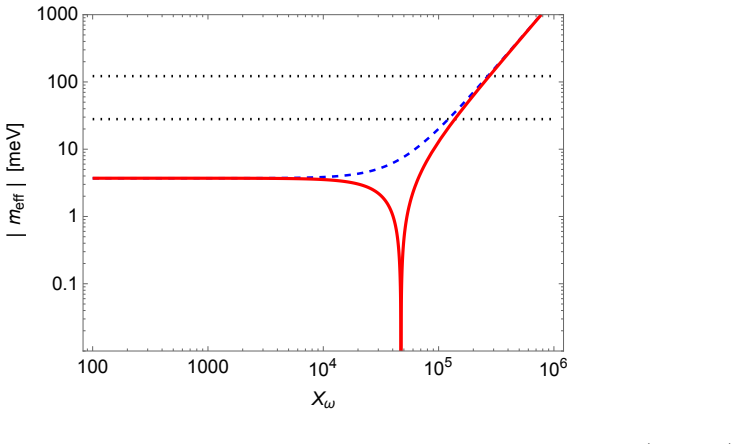
- The loop correction tightens the upper bound on the heavy-neutrino mixing parameter $X_\omega$ set by $0\nu\beta\beta$ by roughly 3% for the benchmark $M_1=5\times10^3$ GeV, $M_2=10^2 M_1$, and $\mathrm{Re}\,\omega=\pi/4$.
- The cancellation point $m_{\mathrm{eff}}=0$ survives the radiative corrections, with the parameter $\delta$ in the cancellation condition replaced by $\tilde\delta$, so the model still admits a vanishing effective mass despite the loop shift.
- For heavy neutral lepton masses above about 10 GeV the correction $\delta_{MM}$ becomes sizable, so any precision prediction of lepton-number-violating observables in this model should include it.
- A 15% larger signal improves the discovery reach of future $e^-e^-$ colliders for heavy neutral leptons compared with tree-level estimates.
Reading between the lines
- This suggests the same one-loop shift will appear in other lepton-number-violating observables that grow quadratically with heavy-neutrino mixing, such as same-sign dilepton searches, where the correction may be larger than the few-percent effect seen in $0\nu\beta\beta$.
- The functional form of $\delta_{MM}$ in the paper indicates the enhancement likely grows as the heavy lepton mass rises toward $\gtrsim 10$ TeV, so the 15% figure may be a lower-end estimate for heavier spectra probed by future colliders.
- A natural next step, not taken in the paper, is a full one-loop computation of the Dirac and heavy Majorana mass corrections; depending on their size, the 15% prediction could move by a comparable amount.
- Because the relative phases between active and heavy contributions are known to control interference in the cross section, the corrected mixing may shift the angular distribution beyond a simple overall normalization change.
Editorial analysis
A structured set of objections, weighed in public.
Referee Report
Summary. This paper studies the impact of one-loop radiative corrections to the left-handed neutrino Majorana masses (δMLL) on lepton-number-violating processes in the minimal seesaw model with two right-handed neutrinos. The authors derive the corrected HNL mixing elements Θ^(1) via a modified Casas-Ibarra parametrization, express the 0νββ effective mass including the correction, extend their previous meff=0 cancellation condition, and compute the cross section for e−e−→W−W−. They find that the maximal cross section at √s=3 TeV increases by about 15% when the one-loop correction is included for TeV-scale HNLs, a result they argue is relevant for future collider searches.
Significance. The central claim is specific and falsifiable: a 15% enhancement of the i0νββ cross section at CLIC-like energies due to radiative corrections to active-neutrino Majorana masses. If the result is robust, it sharpens the projected sensitivity of future e−e− colliders and demonstrates that radiative corrections cannot be ignored in LNV searches. The analytic relations are internally consistent: Eq. (20) reduces to the expected δMM fβ term, and the loop function δMM in Fig. 1 grows with the HNL mass as expected. The numerical estimate is based on explicitly defined constraints and external inputs rather than a fit to data, and the meff=0 cancellation is extended to the radiative case in closed form. The main weakness is the unquantified neglect of one-loop corrections to M_D and M_M in the parameter region used for the maximal cross section, which needs to be addressed before the central number can be considered reliable.
major comments (2)
- [Sec. 2, Eq. (9)] The statement just after Eq. (9) that corrections to the Dirac masses M_D and the Majorana masses M_M are 'subdominant due to the loop suppression' is load-bearing for the central result, because the 15% enhancement in Sec. 3 is obtained by changing only the mixing elements via Eq. (13). In the parameter region that maximizes the cross section in Fig. 4 (|ΘeI|^2 near 2.1e-3 and M1 = 3–5 TeV), the electron-flavor Yukawa entry is Y_eI = Θ_eI M_I/v ≈ 0.6–1. The one-loop fractional corrections to M_M and M_D are then of order (Y†Y)_II/(16π^2) log(M_I^2/m_H^2), which is several percent, i.e., comparable to or larger than the retained δMM of about 1–2% from Eq. (8). The loop-suppression argument does not discriminate between retained and neglected terms because both are one-loop; the M^2/(16π^2 v^2) enhancement that makes δMLL sizable is absent in δM_D/M_D and δM_M/M_M. Since the enhancement arises near the active–HNL cancellation described by Eqs. (21)–(23), a neglected few-percent shift in Θ can change the 15% result substantially. The authors should include the δM_D and δM_M contributions in the one-loop matching or specify an on-shell scheme that removes them, and demonstrate the numerical stability of the central result.
- [Sec. 3, Fig. 4] The claimed 15% increase is not reproducible from the information given. The text says that the 'maximal cross section' is estimated by imposing |meff|<122 meV and |Θe|^2<2.1e-3, but it does not state the values of Xω and Reω (or the scan procedure) used for the solid and dashed curves, nor whether the maximum is taken over all free parameters. Because the cross section depends sensitively on these parameters through the cancellation condition, please specify the parameter choices and the maximization procedure so that the central number can be verified.
minor comments (5)
- [Fig. 4 caption] The constraint in the caption reads '|Θe|2 < 2.1×10³'; it should read '|Θe|^2 < 2.1×10^-3'.
- [Fig. 2 caption] The notation 'Xω = 104' and '10 3' should be '10^4' and '10^3' with proper superscripts; in several places the superscripts are lost in the text.
- [Sec. 3, Eq. (24)] The abbreviation 'i0νββ' is used in the abstract and in Sec. 3 without a formal definition at first use in the main text; please define it explicitly.
- [Sec. 2, Eq. (8)] The loop function fδLL depends on mZ and mH; please state explicitly that these are the physical masses taken from Ref. [30] and specify the renormalization scheme or scale used for the one-loop correction.
- [Sec. 3, Eq. (26)] The cross section formula is a tree-level expression for the scattering process; please state clearly that radiative corrections to the process itself are not included, to avoid ambiguity with the title of the paper.
Circularity Check
No circularity: the 15% cross-section enhancement is computed from a standard one-loop formula and external constraints, not from fitted or self-referential inputs.
full rationale
The paper's central result, a ~15% increase in e−e−→W−W− at sqrt(s)=3 TeV, is obtained by replacing the tree-level HNL mixing Θ(0) with the one-loop-corrected Θ(1) of Eq. (13). The correction δMLL in Eq. (7) is taken from the standard one-loop formula [25–27], and Eq. (13) is the Casas–Ibarra expression with ilde M_M, adapted from the external reference [28]; the cross-section formula in Eq. (26) is written out explicitly. The numerical estimate enforces external constraints (|meff|<122 meV and |Θe|^2<2.1×10^-3), so no quantity is fitted to the predicted cross section. The self-citations [31,33,34] appear only in the meff=0 cancellation discussion and in the large-Xω note, which are not needed for the i0νββ estimate, and Ref. [24] supplies an explicit, standard formula rather than an unverified premise. The neglect of one-loop corrections to M_D and M_M is a stated physical approximation (a possible model limitation) but not a circular reduction: those corrections are not defined in terms of the predicted cross section, and omitting them does not make Eq. (13) equivalent to the paper's inputs by construction.
Assumptions & free parameters
free parameters (5)
- M1 =
3 TeV and 5 TeV in Fig. 4
- M2 =
M2 = 10 M1 in Fig. 4
- Re(ω) =
π/4
- Xω = exp(Imω) =
varied up to values of order 2.8e5 under bounds
- sqrt<p²> =
200 MeV
assumptions (6)
- domain assumption Seesaw hierarchy |MD|_αI << M_I is assumed so that the light and heavy states decouple.
- domain assumption One-loop radiative corrections to left-handed neutrino Majorana masses are given by Eq. (7) with fδLL from Refs [25-27].
- ad hoc to paper Radiative corrections to MD and MM are negligible compared with δMLL.
- domain assumption The CI parametrization with \tilde M_M, Eq. (13), correctly gives the physical HNL mixing after one-loop corrections.
- domain assumption The nuclear matrix element suppression fβ(M) is approximated by ⟨p²⟩/(⟨p²⟩+M²) with sqrt⟨p²⟩ = 200 MeV.
- standard math The cross-section formula for e−e− → W−W−, Eq. (26), from Ref [24] is complete for the seesaw contributions.
Cite this review
Pith. "Pith review of On radiative corrections to lepton number violating processes." pith.science (2026). https://pith.science/paper/O6TBKEMV
@misc{pith2026241208015,
  author       = {Pith},
  title        = {Pith review of: On radiative corrections to lepton number violating processes},
  year         = {2026},
  howpublished = {\url{https://pith.science/paper/O6TBKEMV}},
  note         = {Machine review of arXiv:2412.08015}
}
abstract
We consider the minimal model of the seesaw mechanism by introducing two right-handed neutrinos, whose masses are comparable to the electroweak scale. This framework is attractive, since it is testable at terrestrial experiments. A critical consequence of this mechanism is the violation of lepton number conservation due to the Majorana masses of both active neutrinos and heavy neutral leptons. In particular, we investigate the impact of the radiative corrections to Majorana masses of left-handed neutrinos on the lepton number violating processes, such as the neutrinoless double beta decay: $(Z, A) \to (Z+2,A) + 2 e^-$ and the inverse neutrinoless double beta decay: $e^- e^- \to W^- W^-$. It is shown that the cross section of the inverse neutrinoless double beta decay can increase by ${\cal O}(10)$~% when the masses of heavy neutral leptons are ${\cal O}(1)$~TeV, which has significant implications on future experiments.
Figures


Figures from the paper (1 more)

Reference graph
Works this paper leans on
-
[1]
Minkowski, Phys
P. Minkowski, Phys. Lett. B 67, 421 (1977)
1977
-
[2]
T. Yanagida, in Proceedings of the Workshop on Unified Theory and Baryon Number of the Universe, edited by.O. Sawada and A. Sugamoto (KEK, Tsukuba, Ibaraki 305- 0801 Japan,
- [3]
-
[4]
M. Gell-Mann, P. Ramond, and R. Slansky, in Supergravity, edited by.P. van Niewwenhuizen and D. Freedman (North Holland, Amsterdam, 1979) [arXiv:1306.4669 [hep-th]]
arXiv 1979
-
[5]
Ramond, in Talk given at the Sanibel Symposium, Palm Coast, Fla., Feb
P. Ramond, in Talk given at the Sanibel Symposium, Palm Coast, Fla., Feb. 25-Mar. 2, 1979, preprint CALT-68-709 (retroprinted as hep-ph/9809459)
arXiv 1979
-
[6]
S. L. Glashow, in Proc. of the Carg´ ese Summer Institute on Quarks and Leptons , Carg´ ese, July 9-29, 1979, eds. M. L´ evy et. al, , (Plenum, 1980, New York), p707
work page 1979
-
[7]
D. Gorbunov and M. Shaposhnikov, JHEP 0710 (2007) 015 Erratum: [JHEP 1311 (2013) 101] doi:10.1007/JHEP11(2013)101, 10.1088/1126-6708/2007/10/015 [arXiv:0705.1729 [hep- ph]]. 9
arXiv 2007
-
[8]
A. Atre, T. Han, S. Pascoli and B. Zhang, JHEP 0905 (2009) 030 doi:10.1088/1126- 6708/2009/05/030 [arXiv:0901.3589 [hep-ph]]
arXiv 2009
Show all 36 references
-
[9]
F. F. Deppisch, P. S. Bhupal Dev and A. Pilaftsis, New J. Phys. 17 (2015) no.7, 075019 doi:10.1088/1367-2630/17/7/075019 [arXiv:1502.06541 [hep-ph]]
2015 arXiv
-
[10]
W. H. Furry, Phys. Rev. 56, 1184-1193 (1939) doi:10.1103/PhysRev.56.1184
1939 doi
-
[11]
Abe et al
S. Abe et al. [KamLAND-Zen], [arXiv:2406.11438 [hep-ex]]
-
[12]
T. G. Rizzo, Phys. Lett. B 116, 23-28 (1982) doi:10.1016/0370-2693(82)90027-2
1982 doi
- [13]
-
[14]
Accomando et al
E. Accomando et al. [CLIC Physics Working Group Collaboration], hep-ph/0412251
-
[15]
Brunner, P
O. Brunner, P. N. Burrows, S. Calatroni, N. C. Lasheras, R. Corsini, G. D’Auria, S. Doebert, A. Faus-Golfe, A. Grudiev and A. Latina, et al. [arXiv:2203.09186 [physics.acc-ph]]
-
[16]
London, G
D. London, G. Belanger and J. N. Ng, Phys. Lett. B 188, 155 (1987)
1987
-
[17]
D. A. Dicus, D. D. Karatas and P. Roy, Phys. Rev. D 44, 2033 (1991)
1991
- [18]
-
[19]
Belanger, F
G. Belanger, F. Boudjema, D. London and H. Nadeau, Phys. Rev. D 53, 6292 (1996) [hep- ph/9508317]
1996
- [20]
-
[21]
Greub and P
C. Greub and P. Minkowski, eConf C 960625, NEW149 (1996) [Int. J. Mod. Phys. A 13, 2363 (1998)] [hep-ph/9612340]
1996 arXiv
- [22]
-
[23]
Banerjee, P
S. Banerjee, P. S. B. Dev, A. Ibarra, T. Mandal and M. Mitra, Phys. Rev. D 92 (2015) 075002 doi:10.1103/PhysRevD.92.075002 [arXiv:1503.05491 [hep-ph]]
2015 arXiv
-
[24]
Asaka and T
T. Asaka and T. Tsuyuki, Phys. Rev. D 92, no.9, 094012 (2015) doi:10.1103/PhysRevD.92.094012 [arXiv:1508.04937 [hep-ph]]
2015 arXiv
-
[25]
Pilaftsis, Z
A. Pilaftsis, Z. Phys. C 55, 275-282 (1992) doi:10.1007/BF01482590 [arXiv:hep-ph/9901206 [hep-ph]]
1992 arXiv
-
[26]
Grimus and L
W. Grimus and L. Lavoura, Phys. Lett. B 546, 86-95 (2002) doi:10.1016/S0370- 2693(02)02672-2 [arXiv:hep-ph/0207229 [hep-ph]]. 10
2002 arXiv
-
[27]
Aristizabal Sierra and C
D. Aristizabal Sierra and C. E. Yaguna, JHEP 08, 013 (2011) doi:10.1007/JHEP08(2011)013 [arXiv:1106.3587 [hep-ph]]
2011 arXiv
-
[28]
Lopez-Pavon, E
J. Lopez-Pavon, E. Molinaro and S. T. Petcov, JHEP 11, 030 (2015) doi:10.1007/JHEP11(2015)030 [arXiv:1506.05296 [hep-ph]]
2015 arXiv
-
[29]
J. A. Casas and A. Ibarra, Nucl. Phys. B 618, 171-204 (2001) doi:10.1016/S0550- 3213(01)00475-8 [arXiv:hep-ph/0103065 [hep-ph]]
2001 arXiv
-
[30]
Navas et al
S. Navas et al. [Particle Data Group], Phys. Rev. D 110, no.3, 030001 (2024) doi:10.1103/PhysRevD.110.030001
2024 doi
-
[31]
Asaka, S
T. Asaka, S. Eijima and H. Ishida, JHEP 04, 011 (2011) doi:10.1007/JHEP04(2011)011 [arXiv:1101.1382 [hep-ph]]
2011 arXiv
-
[32]
Esteban, M
I. Esteban, M. C. Gonzalez-Garcia, M. Maltoni, I. Martinez-Soler, J. P. Pinheiro and T. Schwetz, [arXiv:2410.05380 [hep-ph]], NuFIT 6.0 (2024), www.nu-fit.org
2024 arXiv
-
[33]
Asaka, H
T. Asaka, H. Ishida and K. Tanaka, Phys. Rev. D 103, no.1, 015014 (2021) doi:10.1103/PhysRevD.103.015014 [arXiv:2012.12564 [hep-ph]]
2021 arXiv
-
[34]
Asaka, H
T. Asaka, H. Ishida and K. Tanaka, PTEP 2021, no.6, 063B01 (2021) doi:10.1093/ptep/ptab046 [arXiv:2012.13186 [hep-ph]]
2021 arXiv
-
[35]
Faessler, M
A. Faessler, M. Gonz´ alez, S. Kovalenko and F. ˇSimkovic, Phys. Rev. D 90, no.9, 096010 (2014) doi:10.1103/PhysRevD.90.096010 [arXiv:1408.6077 [hep-ph]]
2014 arXiv
-
[36]
Antusch and O
S. Antusch and O. Fischer, JHEP 10, 094 (2014) doi:10.1007/JHEP10(2014)094 [arXiv:1407.6607 [hep-ph]]. 11
2014 arXiv
Reviewed August 11, 2026 · model on record in the stance chip above.
Discussion (0). Continue with ORCID to comment.