REVIEW 3 major objections 5 minor 29 references
Electron polarization in the resonant inelastic scattering on hydrogen-like ions
T0 review · 3 major / 5 minor · reviewed 2026-08-11 · deepseek-v4-flash
Pith's one-line read Resonant inelastic electron scattering on hydrogen-like ions produces an observable electron-beam polarization, even in light ions whose final 2p fine-structure states cannot be resolved.
desk verdict A solid extension of the authors' QED/LPA program to electron polarization in inelastic scattering, with a testable 40% polarization prediction for F8+ that still needs a truncation sensitivity check. read the letter →
The pith
A machine-rendered reading of the paper's core claim, the machinery that carries it, and where it could break.
The reading
What carries the argument
The central object is the spin-dependent scattering amplitude $U_{if} = \langle \Psi_f | \Delta \hat{V} | \Phi_i \rangle$ of Eq. (6), where the initial two-electron state $\Phi_i$ is a superposition of the non-resonant configuration (ground-state ion plus incident continuum electron) and the resonant admixture of two-electron bound states $(3l3l')$ of the helium-like ion. The line-profile approach (LPA), a QED-based method that sums the interelectron interaction to all orders within the $n \le 5$ two-electron subspace and treats the rest in standard QED perturbation theory, determines the admixture coefficients and includes radiative corrections that affect the autoionizing state widths. The polarization observable is the Sherman function $P = \boldsymbol{\zeta}_e \cdot \mathbf{n}$, computed as the projection of the scattered electron's polarization vector onto the normal to the scattering plane via the trace ratio $\mathrm{Tr}(MM^\dagger \sigma^{(1)})/\mathrm{Tr}(MM^\dagger)$, where $M$ is the scattering matrix built from all spin-projection amplitudes. The load-bearing output is the total polarization $P_t$ of Eq. (19), which averages the three final-state channels ($2s$, $2p_{1/2}$, $2p_{3/2}$) weighted by their differential cross sections and remains non-zero even when the two $2p$ states are experimentally unresolved.
What would settle it
A measurement of the polarization of electrons scattered at $90^\circ$ from F$^{8+}$ ions, with the incident electron energy swept through the $(3l3l')$ autoionizing resonances, that finds no resonant polarization peaks near 40% or finds them at energies shifted from the predicted resonance positions would falsify the central claim. A converged independent calculation that includes $n > 5$ intermediate configurations or multi-photon exchange and yields significantly different Fano profiles would also test the truncation assumption.
Extended reading notes
Core claim
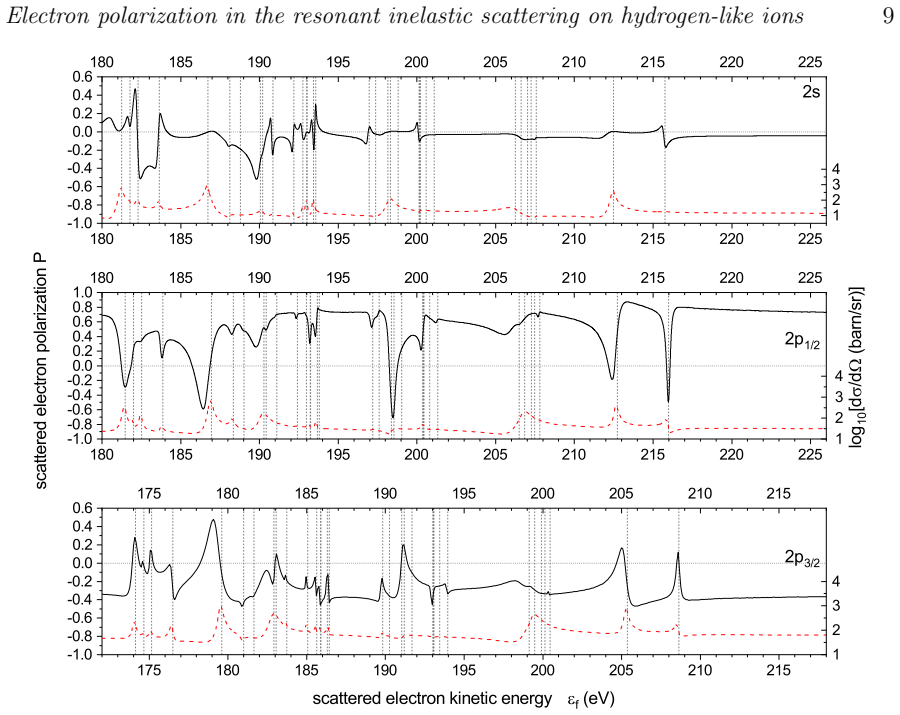
The paper's central claim is that the resonant channel of inelastic electron scattering on hydrogen-like ions — the path in which the incident electron is temporarily captured into a $(3l3l')$ autoionizing state that subsequently decays by Auger emission — produces an electron-beam polarization that is both large and experimentally useful, in contrast to the non-resonant background. In the non-resonant channel the polarization for the final $2s$ state scales quadratically with nuclear charge and is negligible for light ions, while for the final $2p$ states the individual $2p_{1/2}$ and $2p_{3/2}$ contributions are substantial but almost exactly cancel when the fine structure is not resolved. The resonant channel breaks this cancellation because the prolonged collision time lets spin-orbit and exchange interactions act jointly, so the approximate relations $P_{2p_{1/2}} = -2P_{2p_{3/2}}$ and the $1{:}2$ cross-section ratio no longer hold. The paper shows by explicit calculation that the energy dependence of the polarization parameter contains Fano-like interference between overlapping autoionizing states and between the resonant and non-resonant channels, and that the total polarization $P_t$ (Eq. 19) for scattering on F$^{8+}$ reaches values near 40% at $\theta = 90^\circ$, an effect large enough to observe even when the $2p$ fine-structure splitting is unresolved.
Load-bearing premise
The calculation assumes that one-photon exchange in the scattering operator $\Delta \hat{V}$ is sufficient and that the interelectron interaction must be summed to all orders only inside the $n \le 5$ two-electron subspace, with everything else treated perturbatively; if higher-order photon exchange or $n > 5$ configurations materially change the spin-dependent amplitudes, the predicted polarization profiles and the claimed observability would change.
Editorial extensions
If this is right
- Electron-beam polarization becomes a practical observable for studying autoionizing states in light ions, where the $2p_{1/2}$ and $2p_{3/2}$ levels cannot be resolved by energy.
- The mismatch between peaks in the differential cross section and extrema in the polarization parameter provides a direct experimental signature of interference between resonances.
- For heavy ions such as Kr$^{35+}$, the large fine-structure splitting lets the three final-state channels be studied separately, yielding channel-resolved polarization data.
- The resonant enhancement of spin-orbit and exchange interactions implies that polarization measurements carry information about the lifetimes and composition of the intermediate autoionizing states.
Reading between the lines
- The same resonant-enhancement mechanism should operate for other doubly excited series (e.g., $4l4l'$) and for elastic resonant scattering, so the polarization technique may generalize beyond the $3l3l'$ case studied here.
- An experiment using a polarized electron source and a Mott polarimeter at lateral scattering angles could test the F$^{8+}$ prediction, since the effect is largest near $90^\circ$ and the total cross section remains at the kilobarn scale.
- Comparing the F$^{8+}$ results at resonance energies with independent converged collision calculations would provide a direct sensitivity check on the paper's truncations of the interaction to one-photon exchange and to the $n \le 5$ subspace.
- If confirmed, the Fano-like polarization profiles could serve as a spectroscopy tool for autoionizing states, complementing cross-section measurements.
Editorial analysis
A structured set of objections, weighed in public.
Referee Report
Summary. This paper presents an ab initio QED study of the spin polarization acquired by an initially unpolarized electron beam in inelastic scattering on hydrogen-like F8+, Ca19+, and Kr35+ ions, with excitation to 2s, 2p1/2, and 2p3/2 final states. The resonant channel is described through 3l3l' autoionizing states of the intermediate helium-like ion using the line-profile approach. The central claim is that resonant scattering breaks the statistical cancellation between 2p1/2 and 2p3/2 channels, producing a large, observable polarization even in light ions where the fine structure is unresolved; for F8+ the predicted peaks reach about 40%. The paper also reports Fano-like interference patterns in the energy dependence of the Sherman function P.
Significance. The result is potentially important because it identifies a new, experimentally accessible observable in electron-ion scattering that is sensitive to resonance interference and spin-dependent dynamics beyond integrated cross sections. The method is ab initio and has been validated against measured and R-matrix cross sections for F8+ in the authors' prior work, which is a genuine strength. The predicted 40% polarization for F8+ is a sharp, falsifiable prediction. However, because P is an asymmetry of small spin-difference cross sections, the prediction is sensitive to the approximations used, and the manuscript does not yet demonstrate robustness of the central claim.
major comments (3)
- [Section 2, Eq. (6)-(7); Section 3, Fig. 6] The central prediction of a roughly 40% resonant polarization for F8+ is computed with two truncations that are not sensitivity-tested: one-photon exchange in ΔV (Eq. (6)) and the restriction of the all-order interelectron interaction to the n≤5 two-electron subspace (Eq. (7)). The polarization P is a ratio of spin-difference cross sections (Eq. (15)), so it is controlled by relative phases between resonant and non-resonant amplitudes and among closely spaced autoionizing states; agreement with total or differential cross sections for F8+ does not constrain these phases. Please provide a sensitivity study (e.g., n=4 versus n=6 cutoffs and an estimate of two-photon exchange) or otherwise justify why the neglected terms cannot change the sign or magnitude of the predicted peaks.
- [Section 3, Eqs. (17)-(18), Fig. 6] The observability argument for light ions relies on the exact cancellation of the non-resonant 2p background through Eqs. (17)-(18), stated to hold 'with a high degree of accuracy.' The manuscript should quantify the residual non-resonant background in the total 2p polarization for F8+ by showing the actual numerical deviation from these relations. If the residual is non-negligible relative to the 40% resonant peaks, the interpretation of Fig. 6 as evidence of a purely resonant effect would need to be revised.
- [Section 3, Fig. 6 and Eq. (19)] The total polarization Pt in Eq. (19) is the cross-section-weighted average of the three channel polarizations, and its magnitude in Fig. 6 is the decisive observable claim. The paper currently reports no numerical convergence checks for P with respect to partial-wave expansion or energy grid, and no uncertainty estimate for any plotted quantity. Because the Fano-like structures are narrow and the asymmetry is a ratio of small differences, a convergence statement is needed to establish that the predicted peaks are not numerical artifacts.
minor comments (5)
- [Figures 1-7] The text of the manuscript as provided contains garbled character sequences (e.g., '/s48 /s51 ...') in and around the figures; please ensure that all figure labels and captions are rendered correctly in the final version.
- [References] The reference list contains a duplicate: [15] and [24] refer to the same article (Vasileva et al., Phys. Rev. A 104, 052808 (2021)). Please merge or distinguish them.
- [Section 3, first paragraph] The phrase 'the contributions of the non-resonant and resonant channels both decrease with increasing atomic number Z, allowing resonances to remain highly visible' is ambiguous; the visibility of resonances depends on the ratio of the two contributions, not only on their absolute magnitudes. Please clarify.
- [Figure 4 caption] The caption says 'In both panels, the energies for three possible channels are chosen...' but the figure shows two panels and the text discusses three channels; please clarify the wording.
- [Section 2, Eq. (14) and (15)] The notation for the polarization parameter P is introduced as the projection of ζ_e onto n and then identified with the Sherman function; for readers not familiar with electron-atom scattering, a brief sentence connecting Eqs. (12)-(15) to the conventional definition of the Sherman function would improve accessibility.
Circularity Check
No significant circularity: the polarization parameter is computed from spin-resolved QED amplitudes, with autoionizing energies taken from an earlier calculation that is benchmarked against independent R-matrix and experimental F8+ cross sections.
full rationale
The paper's central claim is that resonant inelastic scattering through 3l3l' autoionizing states produces an observable electron-beam polarization even for light ions. The derivation chain is: spin-dependent amplitudes are obtained from the one-photon-exchange amplitude (Eq. 6), the scattering matrix M is formed from these amplitudes, and the polarization parameter P is computed from Eq. (12) or Eq. (15), with the total unresolved-channel polarization given by the cross-section-weighted average in Eq. (19). Nothing in this chain is fitted to the polarization data being predicted. The autoionizing-state energies are taken from the authors' previous paper [17], which is a self-citation, but the paper explicitly states that the method was validated against experimental data and R-matrix calculations: 'A comparison of our results for F8+ [17] with both experimental data and R-matrix calculations [21] shows strong agreement.' That is independent support, not a circular justification. The statistical cancellation in the non-resonant background, Eqs. (17)-(18), is imported from the external literature [7] and is used only as a baseline; the resonant-channel violation of this relation is a calculated consequence, not an assumption. The paper does contain approximations that are not sensitivity-tested (one-photon exchange in Eq. 6, all-orders interelectron interaction only within the n <= 5 subspace), and the validation against F8+ cross sections does not directly test spin-resolved phases. That is a legitimate uncertainty-quantification concern, but it is not circularity: no parameter is defined in terms of the predicted polarization, and no load-bearing premise reduces to the conclusion by construction. The central calculation is self-contained against external benchmarks, so the appropriate finding is no significant circularity.
Assumptions & free parameters
assumptions (4)
- domain assumption One-photon exchange in ΔV is sufficient for the inelastic scattering amplitude.
- domain assumption Interelectron interaction is summed to all orders only within the subset of two-electron states with n ≤ 5; the rest is treated by standard QED perturbation theory.
- domain assumption Nuclear spin effects are negligible for the polarization change.
- domain assumption The line-profile approach for quasidegenerate states correctly describes the formation and Auger decay of 3l3l' autoionizing states.
Cite this review
Pith. "Pith review of Electron polarization in the resonant inelastic scattering on hydrogen-like ions." pith.science (2026). https://pith.science/paper/OCRQZLYE
@misc{pith2026241214998,
  author       = {Pith},
  title        = {Pith review of: Electron polarization in the resonant inelastic scattering on hydrogen-like ions},
  year         = {2026},
  howpublished = {\url{https://pith.science/paper/OCRQZLYE}},
  note         = {Machine review of arXiv:2412.14998}
}
read the original abstract
We investigate the polarization of the electron beam acquired during the inelastic resonant scattering on hydrogen-like ions initially being in the ground state. The formation and subsequent Auger decay of the intermediate (3l3l') doubly excited states in the resonant channel modify the mechanism of polarization change by enhancing both spin-orbit and exchange interactions. Consequently, in the presence of the resonant channel, the acquired polarization can be clearly observed even for light ions when it is challenging to discern which state of the ion was excited in the process. We also show that the energy dependence of the polarization parameter clearly demonstrates strong interference both between the contributions of specific autoionizing states in the resonant channel and between the non-resonant and resonant channels.
Figures


Figures from the paper (4 more)


Reference graph
Works this paper leans on
-
[1]
Vockert M, Weber G, Br¨ auning H, Surzhykov A, Brandau C, Frit zsche S, Geyer S, Hagmann S, Hess S, Kozhuharov C, M¨ artin R, Petridis N, Hess R, Trotsenko S, Litvinov Y A, Glorius J, Gumberidze A, Steck M, Litvinov S, Gaßner T, Hillenbrand P M, Lest insky M, Nolden F, Sanjari M S, Popp U, Trageser C, Winters D F A, Spillmann U, Krings T a nd St¨ ohlker T...
-
[2]
2024 Proceedings of the 20th International Workshop on Polarize d Source, Targets, and Polarime- try (SISSA) ( Preprint https://pos.sissa.it/472/) URL https://pos.sissa.it/472/ Electron polarization in the resonant inelastic scatterin g on hydrogen-like ions 15
work page 2024
-
[3]
Lin F 2023 Electron Polarization (Cham: Springer International Publishing) pp 155–181 ISBN 978-3-031-16715-7 URL https://doi.org/10.1007/978-3-031-16715-7_6
-
[4]
Kanik I, McConkey W and Trajmar S 2023 Electron–Atom and Electron–Molecule Collisions (Cham: Springer International Publishing) pp 981–993 ISBN 978-3 -030-73893-8 URL https://doi.org/10.1007/978-3-030-73893-8_67
-
[5]
Kessler J 1985 Polarized Electrons (Berlin, Heidelberg: Springer)
work page 1985
-
[6]
Burke P 2011 R-matrix theory of atomic collisions (Berlin Heidelberg: Springer-Verlag) URL https://doi.org/10.1007/978-3-642-15931-2
-
[7]
Hanne G 1983 Physics Reports 95 95–165 ISSN 0370-1573 URL https://www.sciencedirect.com/science/article/pii/0370157383900935
arXiv 1983
-
[8]
Hitomi Collaboration 2018 Publications of the Astronomical Society of Japan 70 12 ISSN 0004-6264 (Preprint https://academic.oup.com/pasj/article-pdf/70/2/12/2 4612359/psx156.pdf) URL https://doi.org/10.1093/pasj/psx156
Show all 29 references
-
[9]
Nakamura N, Kato D, Miura N, Nakahara T and Ohtani S 2001 Phys. Rev. A 63(2) 024501 URL https://link.aps.org/doi/10.1103/PhysRevA.63.024501
2001 doi
-
[10]
Robbins D L, Beiersdorfer P, Faenov A Y, Pikuz T A, Thorn D B, Ch en H, Reed K J, Smith A J, Boyce K R, Brown G V, Kelley R L, Kilbourne C A and Porter F S 2006 Phys. Rev. A 74(2) 022713 URL https://link.aps.org/doi/10.1103/PhysRevA.74.022713
2006 doi
-
[11]
Bostock C J, Fursa D V and Bray I 2009 Phys. Rev. A 80(5) 052708 URL https://link.aps.org/doi/10.1103/PhysRevA.80.052708
2009 doi
-
[12]
Chen Z B, Dong C Z and Jiang J 2015 Physica Scripta 90 054007 URL https://dx.doi.org/10.1088/0031-8949/90/5/054007
2015 doi
-
[13]
Wu Z W, He Z M, Tian Z Q, Dong C Z and Fritzsche S 2022 Phys. Rev. A 105(6) 062813 URL https://link.aps.org/doi/10.1103/PhysRevA.105.062813
2022 doi
-
[14]
Wu Z W, Tian Z Q, Dong C Z, Surzhykov A and Fritzsche S 2023 New Journal of Physics 25 093039 URL https://dx.doi.org/10.1088/1367-2630/acf8e9
2023 doi
-
[16]
Andreev O Y, Labzowsky L N, Plunien G and Solovyev D A 2008 Physics Reports 455 135 – 246 ISSN 0370-1573 URL http://www.sciencedirect.com/science/article/pii/S0370157307004176
2008
-
[17]
Vasileva D M, Lyashchenko K N, Andreev O Y and Yu D 2024 Physica Scripta 99 115410 URL https://dx.doi.org/10.1088/1402-4896/ad87b9
2024 doi
-
[18]
Lyashchenko K N, Vasileva D M, Andreev O Y and Voitkiv A B 2020 Phys. Rev. Research 2(1) 013087 URL https://link.aps.org/doi/10.1103/PhysRevResearch.2.013087
2020 doi
-
[19]
Akhiezer A I and Berestetskii V B 1965 Quantum Electrodynamics (New York: Wiley Interscience)
1965
-
[20]
Varshalovich D A, Moskalev A N and Khersonskii V K 1988 Quantum Theory of Angular Momentum (P. O. Box 128, Farrer Road, Singapore 9128: World Scientific Publis hing Co. Pte. Ltd.)
1988
-
[21]
Z´ avodszky P A, T´ oth G, Grabbe S R, Zouros T J M, Richard P, B halla C P and Tanis J A 1999 Journal of Physics B: Atomic, Molecular and Optical Physics 32 4425 URL https://dx.doi.org/10.1088/0953-4075/32/18/303
1999 doi
-
[22]
Lipps F and Tolhoek H 1954 Physica 20 85 – 98 ISSN 0031-8914 URL http://www.sciencedirect.com/science/article/pii/S0031891454800188
1954
-
[23]
Burke P G and Mitchell J F B 1974 Journal of Physics B: Atomic and Molecular Physics 7 214–228 URL https://doi.org/10.1088/0022-3700/7/2/007
1974 doi
-
[24]
Vasileva D M, Lyashchenko K N, Voitkiv A B, Yu D and Andreev O Y 20 21 Phys. Rev. A 104(5) 052808 URL https://link.aps.org/doi/10.1103/PhysRevA.104.052808
-
[25]
Johnson W R, Weber T A and Mullin C J 1961 Phys. Rev. 121(4) 933–939 URL https://link.aps.org/doi/10.1103/PhysRev.121.933
1961 doi
-
[26]
Sherman N 1956 Phys. Rev. 103(6) 1601–1607 URL http://link.aps.org/doi/10.1103/PhysRev.103.1601 Electron polarization in the resonant inelastic scatterin g on hydrogen-like ions 16
1956 doi
-
[27]
Toth G, Grabbe S, Richard P and Bhalla C P 1996 Phys. Rev. A 54(6) R4613–R4616 URL https://link.aps.org/doi/10.1103/PhysRevA.54.R4613
1996 doi
-
[28]
Grabbe S, Toth G, Bhalla C and Richard P 1997 Nuclear Instruments and Methods in Physics Research Section B: Beam Interactions wi th Materi- als and Atoms 124 347–349 ISSN 0168-583X fast Ion-Atom Collisions URL https://www.sciencedirect.com/science/article/pii/S0168583X96008798
1997
-
[29]
Z´ avodszky P, Richard P and Bhalla C 1999 Nuclear Instruments and Methods in Physics Research Section B: Beam Interactions with Materials and Atoms 154 153–165 ISSN 0168-583X URL https://www.sciencedirect.com/science/article/pii/S0168583X99000063
1999
-
[30]
Richard P, Bhalla C, Hagmann S and Zavodszky P 1999 Physica Scripta 1999 87 URL https://dx.doi.org/10.1238/Physica.Topical.080a00087
1999 doi
Reviewed August 11, 2026 · model on record in the stance chip above.
Discussion (0). Continue with ORCID to comment.