REVIEW 4 major objections 7 minor 43 references
Mixture-of-Experts Graph Transformers for Interpretable Particle Collision Detection
T0 review · 4 major / 7 minor · reviewed 2026-08-10 · deepseek-v4-flash
Pith's one-line read The paper claims that a graph transformer whose feed-forward layers are swapped for a mixture-of-experts router can classify rare simulated supersymmetric events slightly better than a plain graph transformer, and that the resulting…
desk verdict Reasonable GT+MoE application to SUSY classification, but the accuracy gain over the plain graph transformer is within run-to-run fluctuation and the interpretability claims are not backed by faithfulness checks. read the letter →
The pith
A machine-rendered reading of the paper's core claim, the machinery that carries it, and where it could break.
The reading
What carries the argument
The central object is the Mixture-of-Experts Graph Transformer (MGT), a graph transformer in which each feed-forward network is replaced by a mixture-of-experts layer with six experts and noisy top-2 gating. Multi-head scaled dot-product attention supplies per-node attention weights, and the routing network assigns each node to a sparse subset of experts; a load-balancing loss keeps the experts uniformly used while the attention maps and routing decisions serve as the interpretability channel. Laplacian positional encoding and two encoder layers complete the architecture, and the claims rest on the visual pattern of attention and expert activation across signal and background events.
What would settle it
A causal test would settle it: after training, randomize or zero out the attention weights assigned to the b-jet and missing-energy nodes, or force all nodes through one expert, and measure the drop in accuracy. If predictions barely change, the attention maps and routing specializations are not the features driving the decision, and the interpretability claim collapses.
Extended reading notes
Core claim
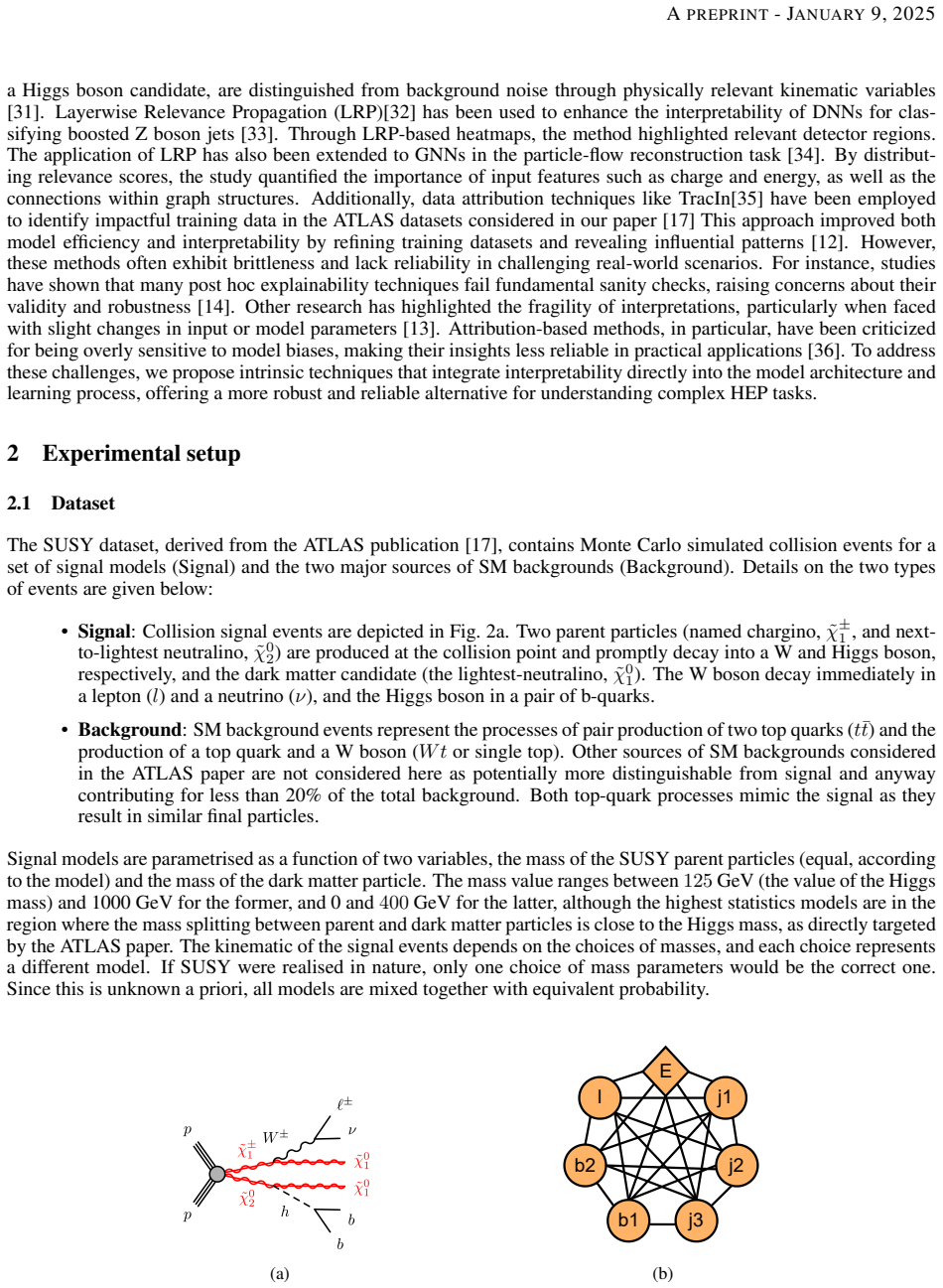
The central discovery, as the authors state it, is that the Mixture-of-Experts Graph Transformer (MGT) outperforms comparable baselines on the signal-versus-background task while giving interpretable access to its internal decision-making. Attention maps show the model first aggregating broad dependencies and then refining them, with focus on the b-jets, lepton, and missing-energy nodes; expert routing shows layer-1 experts sharply separating correlated particle groups (b1/b2, lepton/energy, jets) and layer-2 experts combining those features with more overlap. The authors interpret this as the model discovering the Higgs-decay origin of b-jets and the dark-matter/neutrino origin of missing energy, and they present the architecture itself, rather than a post-hoc explanation method, as the source of this transparency.
Load-bearing premise
The load-bearing premise is that attention weights and expert routing values faithfully reflect the features that drive the model's classification, so reading them as physical explanations is valid; the paper does not test this equivalence directly.
Editorial extensions
If this is right
- If the claim holds, a single model can serve both as classifier and as explanation source, reducing the need for post-hoc explainers that the paper argues are fragile.
- Attention maps and expert specializations can be inspected per event to check whether a particular classification relies on physically expected features such as b-jets, missing energy, and lepton kinematics.
- The MoE sparsity gives the architecture a path to larger capacity: only k of n experts are computed per node, so interpretability and scaling are coupled rather than competing.
- The reported gains over the plain graph transformer are small, so the practical value of the architecture lies in interpretability rather than in a large jump in accuracy.
- The same built-in interpretability could support searches where analysts need to justify why a rare event was flagged, not just that it was flagged.
Reading between the lines
- Editorial inference: if the attention and routing values are causal, they could be used as a discovery aid, scanning many events for unusual routing patterns to surface kinematic corners where the model sees something the analyst does not.
- Editorial inference: the same architecture should transfer to other sparse-signal searches such as long-lived particles or exotic Higgs decays, where the test would be whether expert specializations reorganize around the new physics' distinctive final states.
- Editorial inference: the interpretability claim is testable in a way the paper does not attempt: intervene on attention weights or routing probabilities after training and measure how predictions change, which would separate genuinely explanatory internals from correlated artifacts.
Editorial analysis
A structured set of objections, weighed in public.
Referee Report
Summary. The paper proposes the Mixture-of-Experts Graph Transformer (MGT), which replaces the feed-forward blocks of a two-layer Graph Transformer with a sparsely-gated mixture of experts, and applies it to binary classification of simulated supersymmetric signal events versus Standard Model background from an ATLAS search. The authors report accuracy, precision, recall, F1, and AUC for MGT against GCN, MLP, and GT baselines (Table 2), and use attention maps and expert routing statistics to argue that the model's decisions align with known physics (Sections 4.1 and 4.2). The central claims are that MGT achieves superior predictive accuracy and provides intrinsic, physics-aligned interpretability.
Significance. If the interpretability claims were validated, the paper would offer a useful demonstration of a transparent deep-learning model for a realistic HEP classification task, and the public dataset link is a helpful resource. The architecture is described clearly, and the ablation study in the supplementary material gives useful practical guidance. However, the current evidence for the performance advantage and for the faithfulness of the attention/expert explanations is insufficient; the contribution is presently more of an application report than a demonstrated methodological advance.
major comments (4)
- [Section 3, Table 2] Table 2 reports MGT accuracy 0.852 ± 0.0005 versus GT accuracy 0.849 ± 0.0059, with overlapping standard deviations; the AUC values also overlap (0.929 ± 0.0039 vs 0.928 ± 0.0057). The text concludes that 'The MoE architecture outperforms the other models,' but no significance test (e.g., paired bootstrap or McNemar's test) is provided. The claim of superiority is not supported by the reported numbers and should be revised to 'competitive' or supported with a proper statistical comparison.
- [Section 4.1, Eq. (1)] Attention weights are presented as 'a guiding mechanism, directing how information is aggregated and propagated,' but Eq. (1) shows they are softmax coefficients on value vectors whose outputs are subsequently projected; high attention need not imply causal influence on the logit. The paper cites Refs [13,14] on the fragility of post-hoc explanations yet performs no equivalent sanity check (e.g., randomization of attention weights, comparison against a model without attention) on its own attention maps. The physical-alignment conclusions in Section 4.1 are therefore unsupported.
- [Section 4.2, Tables 3-4, Fig. 8] Expert specialization is quantified by counting which expert processes each node type, but the router is optimized for classification and load balancing, not for explanation. The load-balancing loss in S1 forces roughly uniform expert usage, so the observed 'specialization' could be a consequence of the loss and the fixed node ordering in the input rather than of meaningful physical roles. No quantitative test (e.g., comparing to random experts, or measuring routing stability across seeds) is provided, so the physical interpretations in Tables 3 and 4 are post-hoc narratives.
- [Section S2] The ablation study states that the number of experts, expert size, and routing choice 'have no measurable impact on the performance of the model.' This directly weakens the claim that the MoE component provides the performance advantage in Table 2; if these MoE hyperparameters do not change accuracy, the accuracy difference between MGT and GT cannot readily be attributed to the MoE mechanism. The authors should either demonstrate a statistically significant performance benefit or reframe the contribution as interpretability-only.
minor comments (7)
- [Section S3] The training details do not specify the train/validation/test split; please add the number of events used for each set.
- [Fig. 3 caption] The caption refers to '(c) for the EMissT' but the figure shows only (a) and (b); the caption should be corrected.
- [Section 5] The term 'Structural Attention Explanations (SAE)' is likely a misnomer; if sparse autoencoders are intended, please use the correct term or clarify the abbreviation.
- [Section 1.3] There is a typo 'Mod-els' in the text; please fix it.
- [Eq. (2)] The formula for MultiHead outputs uses Concat(head1,...,headH) but the head definitions are not explicitly written with superscript h; make the notation consistent.
- [Data Availability Statement] The dataset link is a CERNBox URL; consider providing a persistent identifier such as a DOI or Zenodo record to ensure long-term availability.
- [Table 5] For the MGT row, '2 Transformer Layers with Mixture of Experts Layer' is awkward; consider '2 layers, each with attention followed by MoE'.
Circularity Check
No significant circularity; the classification results are standard held-out evaluations and the interpretability analysis is an empirical sanity check, not a derivation from its own inputs.
full rationale
The paper contains no derivation that reduces a prediction to its inputs. The central quantitative result (Table 2) is obtained by training the proposed MGT on 800,000 simulated events and evaluating on a test split; no parameter is fitted to a subset and then reported as a prediction of a closely related quantity. The MGT architecture combines a standard Graph Transformer (Dwivedi & Bresson, Ref. [15]) with Shazeer-style noisy top-k MoE routing (Ref. [16]); these are external precedents and are not used to smuggle in the paper's conclusions. The interpretability section is an empirical description of averaged attention weights and router counts after training. The claim that these maps 'align with established physical principles' is a sanity check against physics expectations that also motivated the dataset node definitions; while this is a self-referential validation in a loose sense and lacks a faithfulness test, it is not a circular derivation because the attention values are not constructed from those physics labels, and the paper does not claim to derive the physics from the maps. The only self-citation (Ref. [12]) appears in related-work context and is not load-bearing. Hence no specific circular step can be exhibited under the required standard.
Assumptions & free parameters
free parameters (8)
- hidden_size =
80
- num_attention_heads =
2
- num_experts =
6
- top_k_routing =
2
- dropout_probability =
0
- num_layers =
2
- load_balancing_weight =
1
- learning_rate_configuration =
not specified
assumptions (4)
- domain assumption Monte Carlo simulated events from the ATLAS publication faithfully represent detector response and physics for the considered processes.
- domain assumption Attention weights and expert routing values are faithful explanations of the model's decision process.
- domain assumption Omitting SM backgrounds other than ttbar and single-top is acceptable for the classification benchmark.
- domain assumption Training on a balanced 50/50 signal and background dataset is a valid proxy for the rare-signal detection scenario.
Cite this review
Pith. "Pith review of Mixture-of-Experts Graph Transformers for Interpretable Particle Collision Detection." pith.science (2026). https://pith.science/paper/OF7NKJZ4
@misc{pith2026250103432,
  author       = {Pith},
  title        = {Pith review of: Mixture-of-Experts Graph Transformers for Interpretable Particle Collision Detection},
  year         = {2026},
  howpublished = {\url{https://pith.science/paper/OF7NKJZ4}},
  note         = {Machine review of arXiv:2501.03432}
}
read the original abstract
The Large Hadron Collider at CERN produces immense volumes of complex data from high-energy particle collisions, demanding sophisticated analytical techniques for effective interpretation. Neural Networks, including Graph Neural Networks, have shown promise in tasks such as event classification and object identification by representing collisions as graphs. However, while Graph Neural Networks excel in predictive accuracy, their "black box" nature often limits their interpretability, making it difficult to trust their decision-making processes. In this paper, we propose a novel approach that combines a Graph Transformer model with Mixture-of-Expert layers to achieve high predictive performance while embedding interpretability into the architecture. By leveraging attention maps and expert specialization, the model offers insights into its internal decision-making, linking predictions to physics-informed features. We evaluate the model on simulated events from the ATLAS experiment, focusing on distinguishing rare Supersymmetric signal events from Standard Model background. Our results highlight that the model achieves competitive classification accuracy while providing interpretable outputs that align with known physics, demonstrating its potential as a robust and transparent tool for high-energy physics data analysis. This approach underscores the importance of explainability in machine learning methods applied to high energy physics, offering a path toward greater trust in AI-driven discoveries.
Figures


Figures from the paper (8 more)


Reference graph
Works this paper leans on
-
[1]
The atlas experiment at the cern large hadron collider
ATLAS Collaboration. The atlas experiment at the cern large hadron collider. Journal of Instrumentation, 3(8),
-
[2]
I. Bird. Computing for the large hadron collider. Annual Review of Nuclear and Particle Science , 61:99–118,
-
[3]
Software performance of the atlas track reconstruction for lhc run 3
ATLAS Collaboration. Software performance of the atlas track reconstruction for lhc run 3. Computing and Software for Big Science, 8, 2024. https://doi.org/10.1007/s41781-023-00111-y
- [4]
-
[5]
ATLAS Collaboration. The LHCb Detector at the LHC. Journal of Instrumentation , 3(8), 2008. https: //doi.org/10.1088/1748-0221/3/08/S08005
-
[6]
R. Staszewski and J. Chwastowski. Transport simulation and diffractive event reconstruction at the lhc. Nuclear Instruments and Methods in Physics Research Section A: Accelerators, Spectrometers, Detectors and Associated Equipment, 609(2):136–141, 2009. https://doi.org/10.1016/j.nima.2009.08.023
-
[7]
P. Crochet and P. Braun-Munzinger. Investigation of background subtraction techniques for high mass dilep- ton physics. Nuclear Instruments and Methods in Physics Research Section A: Accelerators, Spectrometers, Detectors and Associated Equipment , 484:564–572, 2002. https://doi.org/10.1016/S0168-9002(01) 02005-8
-
[8]
S. Thais, P. Calafiura, G. Chachamis, G. DeZoort, J. Duarte, S. Ganguly, M. Kagan, D. Murnane, M. Neubauer, and K. Terao. Graph neural networks in particle physics: Implementations, innovations, and challenges, 2022. https://doi.org/10.48550/arXiv.2203.12852
Show all 43 references
-
[9]
P. E. Pope, S. Kolouri, M. Rostami, C. E. Martin, and H. Hoffmann. Explainability methods for graph convolu- tional neural networks. In IEEE Conference on Computer Vision and Pattern Recognition, pages 10772–10781,
- [10]
- [11]
- [12]
-
[13]
Ghorbani, A
A. Ghorbani, A. Abid, and J. Y . Zou. Interpretation of neural networks is fragile. InProceedings of the 33rd AAAI Conference on Artificial Intelligence , pages 3681–3688, 2019. https://doi.org/10.1609/aaai.v33i01. 33013681
2019 doi
-
[14]
Adebayo, J
J. Adebayo, J. Gilmer, M. Muelly, I. J. Goodfellow andM. Hardt, and B. Kim. Sanity checks for saliency maps. In Proceedings of the 32nd International Conference on Neural Information Processing Systems, pages 9525–9536,
- [15]
-
[16]
Shazeer, A
N. Shazeer, A. Mirhoseini, K. Maziarz, A. Davis, Q. V . Le, G. E. Hinton, and J. Dean. Outrageously large neural networks: The sparsely-gated mixture-of-experts layer. In Proceedings of the 5th International Conference on Learning Representations, 2017. https://doi.org/10.4855...
-
[17]
Search for direct production of electroweakinos in final states with one lepton, jets and missing transverse momentum in pp collisions at √s = 13 tev with the atlas detector
ATLAS Collaboration. Search for direct production of electroweakinos in final states with one lepton, jets and missing transverse momentum in pp collisions at √s = 13 tev with the atlas detector. Journal of High Energy Physics, 2023, 2023. https://doi.org/10.1007/JHEP12(2023)167
2023 doi
-
[18]
Shlomi, P
J. Shlomi, P. Battaglia, and J.-R. Vlimant. Graph neural networks in particle physics.Machine Learning: Science and Technology, 2, 2020. https://doi.org/10.1088/2632-2153/abbf9a
2020 doi
-
[19]
Duarte and J.-R
J. Duarte and J.-R. Vlimant. Graph Neural Networks for Particle Tracking and Reconstruction, chapter 12, pages 387–436. World Scientific, 2020. https://doi.org/10.1142/9789811234033_0012
2020 doi
- [20]
-
[21]
DeZoort, P
G. DeZoort, P. W. Battaglia, C. Biscarat, and J.-R. Vlimant. Graph neural networks at the large hadron collider. Nature Reviews Physics, 5(5):281–303, 2023. https://doi.org/10.1038/s42254-023-00569-0
2023 doi
-
[22]
Vaswani, N
A. Vaswani, N. Shazeer, N. Parmar, J. Uszkoreit, L. Jones, A. N. Gomez, L. Kaiser, and I. Polosukhin. Attention is all you need. In Proceedings of the 31st International Conference on Neural Information Processing Systems, pages 5998–6008, 2017. https://doi.org/10.48550/arXiv....
-
[23]
Dosovits, L
A. Dosovits, L. Beyer, A. Kolesnikov, D. Weissenborn, X. Zhai, T. Unterthiner, M. Dehghani, M. Minderer, G. Heigold, S. Gelly, J. Uszkoreit, and N. Houlsby. An image is worth 16x16 words: Transformers for image recognition at scale. In Proceedings of the 9th International Conf...
-
[24]
F. Xia, K. Sun, S. Yu, A. Aziz, L. Wan, S. Pan, and H. Liu. Graph learning: A survey. IEEE Transactions on Artificial Intelligence, 2(2):109–127, 2021. https://doi.org/10.1109/TAI.2021.3076021
2021
- [25]
- [26]
-
[27]
Lepikhin, H
D. Lepikhin, H. Lee, Y . Xu, D. Chen, O. Firat, Y . Huang, M. Krikun, N. Shazeer, and Z. Chen. Gshard: Scaling giant models with conditional computation and automatic sharding. In Proceedings of the 9th International Conference on Learning Representations, 2021. https://doi.or...
-
[28]
Mustafa, C
B. Mustafa, C. Riquelme, J. Puigcerver, R. Jenatton, and N. Houlsby. Multimodal contrastive learning with limoe: the language-image mixture of experts. In Proceedings of the 36th International Conference on Neural Information Processing Systems, 2022. https://doi.org/10.48550/...
-
[29]
Chen and C
T. Chen and C. Guestrin. Xgboost: A scalable tree boosting system. In Proceedings of the 22nd ACM SIGKDD International Conference on Knowledge Discovery and Data Mining , pages 785–794, 2016. https://doi. org/10.1145/2939672.2939785. 17 A PREPRINT - JANUARY 9, 2025
2016
- [30]
-
[31]
Pezoa, L
R. Pezoa, L. Salinas, and C. Torres. Explainability of high energy physics events classification using shap. Jour- nal of Physics: Conference Series, 2438, 2023. https://doi.org/10.1088/1742-6596/2438/1/012082
2023 doi
-
[32]
Lapuschkin, A
S. Lapuschkin, A. Binder, G. Montavon, F. Klauschen, K.-R. Müller, and W. Samek. On pixel-wise explanations for non-linear classifier decisions by layer-wise relevance propagation. PLoS ONE, 10, 2015. https://doi. org/10.1371/journal.pone.0130140
2015 doi
-
[33]
Explainable ai for ml jet taggers using expert variables and layerwise relevance propagation
Garvita Agarwal, Lauren Hay, Ia Iashvili, Benjamin Mannix, Christine McLean, Margaret Morris, Salvatore Rappoccio, and Ulrich Schubert. Explainable ai for ml jet taggers using expert variables and layerwise relevance propagation. Journal of High Energy Physics, 2021, 2021. htt...
2021 doi
-
[34]
Explaining machine-learned particle-flow reconstruction
Farouk Mokhtar, Raghav Kansal, Daniel Diaz, Javier Duarte, Joosep Pata, Maurizio Pierini, and Jean-Roch Vlimant. Explaining machine-learned particle-flow reconstruction. In 35th Conference on Neural Information Processing Systems, 2021. https://doi.org/10.48550/arXiv.2111.12840
-
[35]
Pruthi, F
G. Pruthi, F. Liu, S. Kale, and M. Sundararajan. Estimating training data influence by tracing gradient descent. In Proceedings of the 34th International Conference on Neural Information Processing Systems , pages 19920– 19930, 2020. https://doi.org/10.48550/arXiv.2002.08484
- [36]
-
[37]
D. Lim, J. D. Robinson, L. Zhao, T. E. Smidt, S. Sra, H. Maron, and S. Jegelka. Sign and basis invariant networks for spectral graph representation learning. In The 11th International Conference on Learning Representations ,
-
[38]
On the equivalence between positional node embeddings and structural graph representations
Balasubramaniam Srinivasan and Bruno Ribeiro. On the equivalence between positional node embeddings and structural graph representations. In 8th International Conference on Learning Representations , 2019. https: //doi.org/10.48550/arXiv.1910.00452. Acknowledgements The work i...
-
[2008]
https://doi.org/10.1088/1748-0221/3/08/S08003
-
[2011]
https://doi.org/10.1146/annurev-nucl-102010-130059
- [2018]
-
[2019]
https://doi.org/10.1109/CVPR.2019.01103
2019
- [2023]
Reviewed August 10, 2026 · model on record in the stance chip above.
Discussion (0). Continue with ORCID to comment.