REVIEW 3 major objections 6 minor 78 references
The paper's central claim is that analytic continuation of Nc to complex values makes the Yang-Mills dilatation operator non-Hermitian, with an exceptional point at Nc=2.82466 where two operator eigenstates coalesce.
Reviewed by Pith at T0; open to challenge. T0 means a machine referee read the full paper against a public rubric. the ladder, T0–T4 →
T0 review · deepseek-v4-flash
2026-08-02 17:50 UTC pith:ONMGNOGH
load-bearing objection One-loop EP is explicit and reproducible from the printed matrices; the physical story at non-integer Nc is honest but underbuilt, so the paper deserves refereeing with a request to ship data and separate math from interpretation. the 3 major comments →
Non-Hermitian Structure and Exceptional Points in Yang-Mills Theory from Analytic Continuation of Nc
The pith
A machine-rendered reading of the paper's core claim, the machinery that carries it, and where it could break.
Core claim
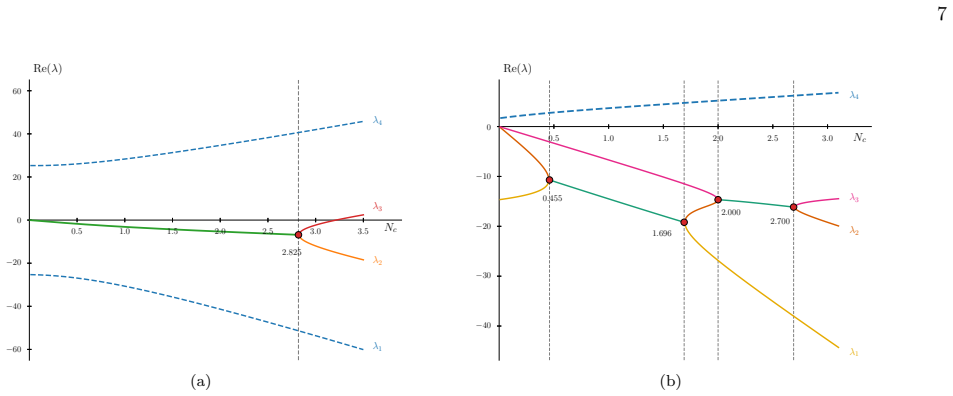
On the paper's own terms: SU(Nc) Yang-Mills admits a consistent analytic continuation in Nc, and in the continued theory operators that are evanescent at integer Nc become negative-norm states. The leading-order Gram matrix therefore has indefinite signature for Nc<3. The one-loop dilatation matrix in the (−)4 helicity sector is non-Hermitian with respect to that metric, and its characteristic discriminant has a single positive real root at Nc=2.82466. At that point two anomalous dimensions meet and their eigenvectors align, forming a Jordan block — an exceptional point. The spectrum is real for Nc between the EP and 3 (the unbroken phase of an emergent PT symmetry) and complex below the EP
What carries the argument
The load-bearing device is the color-evanescent operator: an operator built with a rank-n generalized Kronecker symbol that vanishes at integer Nc<n via trace identities but survives for complex Nc and contributes a negative-norm state. The leading-order Gram matrix G(0), extracted from two-point functions, encodes the operator-space metric; the symmetrized dilatation matrix H=M D M^{-1} is Hermitian exactly when G is positive-definite and becomes complex when G is indefinite. The discriminant of the characteristic polynomial of D(1) locates the EPs, and the biorthonormal left/right eigenvector transport defines the non-Abelian Berry connection whose Wilson loop is the monodromy matrix.
Load-bearing premise
The whole construction depends on the belief that Yang-Mills operators still have a well-defined, physically meaningful inner product after the number of colors is made a complex variable, and that the unusual negative-norm states that appear there are genuine states rather than artifacts of the chosen description.
What would settle it
Compute the one-loop Gram and dilatation matrices for the (−)4 dimension-8 sector by a method independent of on-shell unitarity (e.g., direct Feynman-diagram renormalization) and diagonalize D(1) at Nc=2.82466: if the two eigenvalues are not exactly degenerate and their eigenvectors do not become parallel, the EP is an artifact. A second check: continue the eigenvalues along a small closed contour around Nc=2.82466; if after one circuit the eigenvectors return to themselves rather than being permuted by the matrix in Eq. (55), the topological-monodromy claim fails.
If this is right
- At two loops the EP at Nc=2.825 shifts by -4.518 αs/4π and the accidental EP at Nc=2 moves; only the Gram-signature flips at integer Nc are loop-stable.
- Some length-5 dimension-12 sectors have EPs between Nc=3 and 4, so the 1/Nc expansion is not convergent for those operators at physical Nc=3; the large-Nc limit is not uniform across the operator spectrum.
- At an EP, the dilatation matrix forms a Jordan block and correlators acquire a log|x2| term, giving a concrete connection to logarithmic conformal field theories without modifying the Lagrangian.
- Encircling the EP at Nc=2.82466 induces a monodromy matrix with M^4=1 that swaps the two coalescing eigen-operators; the generated group can exchange any pair among the four operators, so operator identities are branches of one analytic structure.
- The PT symmetry of the effective Hamiltonian is inherited from spacetime PT, so the real-to-complex spectrum transition is a spontaneous PT-breaking transition in the operator spectrum.
Where Pith is reading between the lines
- We infer that the same mechanism should operate for other discrete parameters — e.g., the number of flavors — so EP networks are likely a generic feature of analytically continued QFTs, not a peculiarity of color.
- We infer a sharp testable signature: the PT-broken-phase correlator predicts logarithmic oscillations (an RG limit cycle). A computation that can access complex Nc, or an operator spectrum in a related continued parameter, should find this oscillation with frequency proportional to the imaginary anomalous dimension.
- We infer that if EPs survive nonperturbatively, the anomalous-dimension sheets of Yang-Mills become branch-connected; this might appear as path-dependence in resummations and would explain why some 1/Nc sectors break down before others.
Editorial analysis
A structured set of objections, weighed in public.
Referee Report
Summary. The paper proposes that analytic continuation of the number of colors Nc in SU(Nc) Yang–Mills theory produces a non-Hermitian operator structure. Working with dimension-8, length-4 gauge-invariant operators, including color-evanescent operators, the authors compute leading-order Gram matrices and one- and two-loop dilatation matrices via on-shell unitarity. For the (−)^4 helicity sector, the Gram matrix (Eq. (24)) is indefinite for Nc < 3, and the one-loop dilatation matrix (Eq. (29)) has an exceptional point at Nc = 2.82466 where two eigenvalues and their eigenvectors coalesce (Eqs. (30), Figs. 5 and 6). The paper interprets this as a PT-symmetry phase transition, logarithmic scaling of correlators at the EP, and non-Abelian monodromy in the complex-Nc plane, and extends the analysis to dimension-evanescent sectors and higher-length operators.
Significance. If the complex-Nc continuation is legitimate, this is a concrete, parameter-free demonstration of exceptional points arising from within a unitary QFT rather than from an ad hoc non-Hermitian Lagrangian. The one-loop EP is obtained from explicit finite matrices, and the consistency condition D(1)·G(0) symmetric is a nontrivial internal check. The paper also makes falsifiable statements within its framework: complex anomalous dimensions, logarithmic oscillations, and monodromy of operator branches. Its main weakness is that the entire interpretation depends on the existence of a well-defined interacting gauge theory at non-integer Nc with the leading-order two-point matrix as its operator inner product; this foundation is asserted but not established.
major comments (3)
- [§III.A, Eqs. (12)–(14); §VI] The load-bearing assumption is that the leading-order two-point coefficient matrix G(0), computed from the cut sum in Eq. (12) with the completeness relation Eq. (14), is the inner product on the operator space for non-integer Nc. For non-integer Nc there is no Hilbert space of physical gluon states over which the sum in Eq. (12) runs; Eq. (14) is an algebraic identity, not a resolution of the identity. The appeal to Deligne categories in §VI does not supply a construction of the interacting gauge theory at complex Nc, nor a proof that G(0) equals the categorical inner product, nor a consistency check such as crossing or OPE associativity. Without this, the negative-norm states, and hence the EP, are properties of a formal algebraic extrapolation rather than of Yang–Mills theory. I would need at least one independent check at non-integer Nc, e.g., a three-point function computed by two d
- [§V.A, Eqs. (35)–(43) and Appendix D] The 'emergent' PT symmetry is constructed by declaring P to be the signature matrix of G and T to be complex conjugation. For any real dilatation matrix D and any real symmetric G with signature P, the symmetrized matrix H = M D M^{-1} satisfies [PT,H]=0 whenever M^* = P M; this is a formal consequence of the indefinite metric, not a dynamical property inherited from spacetime PT. The identification with spacetime PT rests entirely on the i^L phase convention introduced in Appendix D, but the operator basis in Eq. (A1) is displayed without those phases, so Eqs. (41)–(43) do not establish that the spectral transition is 'spontaneous breaking of spacetime PT'. The authors should either prove that the phase convention is forced by the basis used in the Gram and dilatation matrix calculations, or present the PT correspondence as an interpretation rather than a derivation.
- [§IV.B, after Eq. (31)] The persistence of EPs at two loops and the numerical shifts in Eq. (31) are central to the claim of NLO robustness, but they are given only as numbers. No two-loop 8×8 dilatation matrices, master-integral reductions, or consistency checks appear in the text or appendices; the reader is referred to ancillary files. Those files are not part of the refereed record. Since the paper advertises the first two-loop full-color calculation, omitting this material makes the NLO conclusion unverifiable. Please include the two-loop matrix data, or at least the discriminant/EP conditions, in the manuscript, or explicitly demote the two-loop statements to a preliminary remark.
minor comments (6)
- [Appendix C, Eq. (C4)] The construction M = sqrt(P) R and the claimed property M^* = P M should be derived explicitly. For indefinite P the square root is non-unique, and the displayed H(1) contains many square-root factors that obscure the general argument.
- [Appendix D, Table II] The column headings and the entries 'P T /x69+ − −' are garbled. Since the parity assignments of A_mu and ∂_mu are central to Eq. (43), they must be stated in unambiguous notation.
- [Appendix F, Eq. (F3)] The entry '0 .231' appears to be a typo for 0.231; the matrix display also mixes decimal and symbolic entries, making the text hard to read.
- [§IV.B, Eq. (31)] The notation 'α_s/4π' is used inconsistently with the surrounding text. The expansion parameter of the dilatation matrix should be defined once in §III B and used uniformly.
- [Fig. 5] The labels λ1,...,λ4 are not explained in the caption, and the color convention for complex-conjugate pairs is only given in one panel. Please specify each curve and the phase-region boundary.
- [Appendix C] There is an unresolved cross-reference 'Figure ??' in the discussion of the interval where the spectrum remains real.
Circularity Check
Central EP derivation is self-contained; the PT-symmetry interpretation is a declared 'by construction' relabeling and is not load-bearing for the EP.
specific steps
-
self definitional
[Section V.A (Eqs. 36-37); Appendix C (Eqs. C3-C6)]
"we identify the parity operator with the signature matrix itself: P_eff = P. ... By construction, these operations satisfy the algebra of a PT-symmetric system: P^2_eff = 1, [P_eff,T_eff] = 0, and, importantly, the Hamiltonian satisfies [P_eff T_eff, H] = 0, i.e., it is PT-symmetric."
The parity P is not an independent symmetry of the gauge theory; it is defined as the sign matrix of the same Gram metric G(0) (Eq. 24) that defines the operator inner product. M is constructed so that M*G M^T = P and H = M D M^{-1}, so [P K, H] = 0 follows algebraically from M* = P M (Appendix C), not from a separately derived symmetry. The 'spontaneous PT breaking' is therefore a restatement of the real-to-complex spectral transition of D(1) rather than an independent prediction. The EP location and coalescence are genuine properties of the explicit matrix D(1), so this does not affect the central result.
full rationale
The main derivation is self-contained: G(0) (Eq. 24) and D(1) (Eq. 29) are printed matrices computed by on-shell unitarity/IBP methods, and the EP at Nc = 2.82466 follows from the discriminant (Eq. 30) with no fitted parameters. The negative-norm states are read off from the signature of the computed G(0), not assumed. The self-citations to the authors' earlier evanescent-operator papers provide context and method, but the decisive data are in this paper. The only definitional element is the identification of the PT operator with the Gram signature matrix, which the paper itself labels 'by construction'; this is a mild relabeling of the standard pseudo-Hermitian structure and does not feed back into the EP calculation. On these grounds the circularity score is low.
Axiom & Free-Parameter Ledger
axioms (5)
- domain assumption Analytic continuation of SU(Nc) gauge theory to complex Nc is legitimate (Deligne categories); color-evanescent operators survive for non-integer Nc.
- domain assumption The leading-order two-point function defines the inner product on operator space for all Nc.
- domain assumption The dilatation matrix D extracted from UV poles of on-shell form factors is the effective Hamiltonian; IR subtraction via the Catani formula is valid at full color for complex Nc.
- ad hoc to paper The basis operators are hat-P hat-T even after associating a factor i^L per field strength.
- standard math For non-Hermitian matrices with H^* = P H, the signature matrix P can be interpreted as parity and P K as PT symmetry; the real-to-complex spectral transition marks spontaneous PT breaking.
read the original abstract
We show that analytic continuation of the number of colors, Nc, naturally endows Yang-Mills theory with a non-Hermitian structure. By examining the spectrum of the dilatation operator as a function of complex Nc, we identify a network of Exceptional Points (EPs) -- non-Hermitian degeneracies where anomalous dimensions degenerate and operator eigenstates coalesce. We demonstrate that these EPs act as topological defects in complex Nc-space, generating non-Abelian geometric phases and enforcing nontrivial monodromies among gauge-invariant operators. Moreover, we establish a correspondence between the spontaneous breaking of an emergent PT symmetry of the dilatation operator and the fundamental spacetime PT symmetry of the underlying gauge theory. In the vicinity of EPs, the resulting non-Hermitian dynamics produces logarithmic scaling behavior in correlation functions, characteristic of logarithmic conformal field theories. Our results place conventional unitary Yang-Mills theory within a broader complexified parameter space possessing rich topological structure, suggesting a new interface between non-Hermitian physics and quantum field theory.
Figures




Reference graph
Works this paper leans on
-
[1]
For a full-color calculation, it is convenient first to con- sider color-decomposed tree blocks
One-loop dilatation matrices At one loop, the coefficients ci are determined entirely from two-particle cuts, which decompose the loop ampli- tude into a product of a tree-level minimal form factor and a four-gluon amplitude, as shown in Figure 2. For a full-color calculation, it is convenient first to con- sider color-decomposed tree blocks. The full-colo...
-
[2]
The procedure parallels the one-loop case but involves a more complex basis of master integrals (Fig- ure 3), which are known analytically [ 49, 50]
Two-loop dilatation matrix To study the exceptional points at next-to-leading or- der (NLO), we compute for the first time the two-loop full-color dilatation matrix for the dimension-8 operator sector. The procedure parallels the one-loop case but involves a more complex basis of master integrals (Fig- ure 3), which are known analytically [ 49, 50]. Deter...
-
[3]
[ 23, 24] (see also [ 21, 22] for scalar and fermion theories). Although these operators vanish at strictly integer dimension, their analytic continuation is well- defined within dimensional regularization and influences the structure of operator mixing in the extended param- eter space. In this subsection, we explore the rich phe- nomenology that arises ...
-
[4]
Nienhuis, Exact critical point and critical exponents of O(n) models in two-dimensions,Phys
B. Nienhuis, Exact critical point and critical exponents of O(n) models in two-dimensions,Phys. Rev. Lett.49, 1062 (1982)
1982
-
[5]
’t Hooft, A Planar Diagram Theory for Strong Inter- actions, Nucl.Phys
G. ’t Hooft, A Planar Diagram Theory for Strong Inter- actions, Nucl.Phys. B72, 461 (1974)
1974
-
[6]
Length-4 dimension-8 operators The eight independent dimension-8 length-4 opera- tors are classified into two helicity sectors: (−)4 and (−)2(+)2. The four basis operators in the (−)4 sector are: O1 = − 1 4δi1···i4 j1···j4 (T a i1j1 · · ·T d i4j4 )(F a 12F b 23F c 34F d 14 + 3 4F a 12F b 12F c 34F d 34), O2 = 1 2δi1···i4 j1···j4 (T a i1j1 · · ·T a i4j4 )(...
-
[7]
W. D. Heiss, M. Mueller, and I. Rotter, Collectivity, phase transitions and exceptional points in open quan- tum systems,Phys. Rev. E58, 2894 (1998), arXiv:quant- ph/9805038
arXiv 1998
-
[8]
General classifications As introduced in Section II, Kronecker symbols in color space can be contracted with Lie algebra generators to produce basis color factors, such as the ones in ( 8). We construct the complete basis of color factors by demand- ing that each length- n color factor be a product of Kro- necker symbols contracted with a tuple of generat...
-
[9]
The counting of indepen- dent length-5 color factors is summarized by the following table: δ5 δ4 δ3 δ2 C-even 0 6 10 6 C-odd 1 5 16 0 (A13) The unique δ5 factor is C-odd
The explicit operator bases, along with their cor- responding Gram and one-loop dilatation matrices, are provided in the ancillary files. The counting of indepen- dent length-5 color factors is summarized by the following table: δ5 δ4 δ3 δ2 C-even 0 6 10 6 C-odd 1 5 16 0 (A13) The unique δ5 factor is C-odd. Since a δn operator is color-evanescent for any ...
-
[10]
Regge, Introduction to complex orbital momenta, Nuovo Cim
T. Regge, Introduction to complex orbital momenta, Nuovo Cim. 14, 951 (1959)
1959
-
[11]
’t Hooft and M
G. ’t Hooft and M. J. G. Veltman, Regularization and Renormalization of Gauge Fields,Nucl. Phys. B44, 189 (1972)
1972
-
[12]
LogLogPlot
All three EPs with Nc > 3 originate exclusively from sectors containing δ6 dimension-evanescent opera- tors. In their absence, the EPs of length-4 operators are strictly confined to the region Nc < 3. Similarly, for length-5 sectors, EPs appear at Nc < 4 but can go beyond this bound with dimension-evanescent operators (see Appendix A and ancillary files)....
-
[13]
P. G. de Gennes, Exponents for the excluded volume problem as derived by the Wilson method,Phys. Lett. A 38, 339 (1972)
1972
-
[14]
E. J. Bergholtz, J. C. Budich, and F. K. Kunst, Exceptional topology of non-Hermitian systems, Rev. Mod. Phys. 93, 015005 (2021), arXiv:1912.10048 [cond- mat.mes-hall]
Pith/arXiv arXiv 2021
-
[15]
Kato, Perturbation theory for linear operators , Vol
T. Kato, Perturbation theory for linear operators , Vol. 132 (Springer Science & Business Media, 2013)
2013
-
[16]
Y. Ashida, Z. Gong, and M. Ueda, Non-Hermitian physics, Adv. Phys. 69, 249 (2021), arXiv:2006.01837 [cond-mat.mes-hall]
Pith/arXiv arXiv 2021
-
[17]
C. M. Bender and S. Boettcher, Real spectra in nonHer- mitian Hamiltonians having PT symmetry,Phys. Rev. Lett. 80, 5243 (1998), arXiv:physics/9712001
Pith/arXiv arXiv 1998
-
[18]
C. M. Bender, D. C. Brody, and H. F. Jones, Com- plex extension of quantum mechanics,Phys. Rev. Lett. 89, 270401 (2002), [Erratum: Phys.Rev.Lett. 92, 119902 (2004)], arXiv:quant-ph/0208076
Pith/arXiv arXiv 2002
-
[19]
Mostafazadeh, PseudoHermiticity versus PT sym- metry
A. Mostafazadeh, PseudoHermiticity versus PT sym- metry. The necessary condition for the reality of the spectrum, J. Math. Phys. 43, 205 (2002), arXiv:math- ph/0107001
arXiv 2002
-
[20]
Mostafazadeh, Pseudo-Hermitian Representation of Quantum Mechanics, Int
A. Mostafazadeh, Pseudo-Hermitian Representation of Quantum Mechanics, Int. J. Geom. Meth. Mod. Phys. 7, 1191 (2010), arXiv:0810.5643 [quant-ph]
Pith/arXiv arXiv 2010
-
[21]
H. Shen, B. Zhen, and L. Fu, Topological Band Theory for Non-Hermitian Hamiltonians,Phys. Rev. Lett.120, 146402 (2018)
2018
-
[22]
Z. Gong, Y. Ashida, K. Kawabata, K. Takasan, S. Hi- gashikawa, and M. Ueda, Topological Phases of Non- Hermitian Systems, Phys. Rev. X 8, 031079 (2018), arXiv:1802.07964 [cond-mat.mes-hall]
Pith/arXiv arXiv 2018
-
[23]
Q. Jin, K. Ren, G. Yang, and R. Yu, Is Yang-Mills theory unitary in fractional spacetime dimensions?,Sci. China Phys.Mech.Astron. 67,271011(2024) ,arXiv:2301.01786 [hep-th]
Pith/arXiv arXiv 2024
-
[24]
Moiseyev,Non-Hermitian Quantum Mechanics (Cam- bridge University Press, Cambridge, 2011)
N. Moiseyev,Non-Hermitian Quantum Mechanics (Cam- bridge University Press, Cambridge, 2011)
2011
-
[25]
Gurarie, Logarithmic operators in conformal field theory, Nucl
V. Gurarie, Logarithmic operators in conformal field theory, Nucl. Phys. B 410, 535 (1993) , arXiv:hep- th/9303160
arXiv 1993
-
[26]
C. M. Bender and D. W. Hook, PT-symmetric quantum mechanics, (2023), arXiv:2312.17386 [quant-ph]
Pith/arXiv arXiv 2023
-
[27]
C. M. Bender, S. F. Brandt, J.-H. Chen, and Q.-h. Wang, Ghost busting: PT-symmetric interpretation of the Lee model, Phys. Rev. D 71, 025014 (2005) , arXiv:hep- th/0411064
arXiv 2005
-
[28]
V. Kazakov and E. Olivucci, The loom for general fishnet CFTs, JHEP 06, 041, arXiv:2212.09732 [hep-th]
-
[29]
C. M. Bender, A. Felski, S. P. Klevansky, and S. Sarkar, P T Symmetry and Renormalisation in Quantum Field Theory, J. Phys. Conf. Ser. 2038, 012004 (2021) , arXiv:2103.14864 [hep-th]
Pith/arXiv arXiv 2038
-
[30]
M.Hogervorst, S.Rychkov,andB.C.vanRees,Unitarity violation at the Wilson-Fisher fixed point in 4-ϵ dimen- sions, Phys. Rev. D93, 125025 (2016), arXiv:1512.00013 [hep-th]
Pith/arXiv arXiv 2016
-
[31]
Y. Ji and M. Kelly, Unitarity violation in noninteger di- mensional Gross-Neveu-Yukawa model,Phys. Rev. D97, 105004 (2018), arXiv:1802.03222 [hep-th]
Pith/arXiv arXiv 2018
-
[32]
A. J. Buras and P. H. Weisz, QCD Nonleading Correc- tions to Weak Decays in Dimensional Regularization and ’t Hooft-Veltman Schemes,Nucl. Phys. B333, 66 (1990)
1990
-
[33]
Q. Jin, K. Ren, G. Yang, and R. Yu, Gluonic evanescent operators: negative-norm states and complex anomalous dimensions, JHEP 09, 151, arXiv:2312.08445 [hep-th]
-
[34]
−δi1i2i3 j1j3j4δi4 j2 (T a i1j1 · · ·T d i4j4 )F a 12F b 23F c 34F d 14, O3 = tr(F12F23)tr(F34F14) + 1 2 tr(F12F34)tr(F12F34) + 1 4 [tr(F 2)]2, O4 = tr(F12F34)tr(F23F14) + 1 2 tr(F12F34)tr(F12F34) + 1 4 [tr(F 2)]2. (A1) The four basis operators in the (−)2(+)2 sector are: O5 = −1 4 δi1···i4 j1···j4 (T a i1j1 · · ·T d i4j4 )(F a 12F b 23F c 34F d 14 + 1 4F...
-
[35]
J. Cardy, Logarithmic conformal field theories as limits of ordinary CFTs and some physical applications,J. Phys. A 46, 494001 (2013), arXiv:1302.4279 [cond-mat.stat- mech]
Pith/arXiv arXiv 2013
-
[36]
W.D.Heiss,Phasesofwavefunctionsandlevelrepulsion, Eur. Phys. J. D7, 1 (1999), arXiv:quant-ph/9901023
Pith/arXiv arXiv 1999
-
[37]
M. V. Berry, Physics of Nonhermitian Degeneracies, Czech. J. Phys.54, 1039 (2004)
2004
-
[38]
A. A. Mailybaev, O. N. Kirillov, and A. P. Seyranian, Geometric phase around exceptional points,Phys. Rev. A 72, 014104 (2005), arXiv:quant-ph/0501040
Pith/arXiv arXiv 2005
-
[39]
W. D. Heiss, The physics of exceptional points,J. Phys. A 45, 444016 (2012), arXiv:1210.7536 [quant-ph]
Pith/arXiv arXiv 2012
-
[40]
K. Wang, A. Dutt, C. C. Wojcik, and S. Fan, Topological complex-energy braiding of non-hermitian bands,Nature 598, 59 (2021)
2021
-
[41]
Z. Bern, L. J. Dixon, D. C. Dunbar, and D. A. Kosower, One loop n point gauge theory amplitudes, unitarity and collinear limits,Nucl.Phys. B425, 217 (1994),arXiv:hep- ph/9403226 [hep-ph]
arXiv 1994
-
[42]
M. J. Dugan and B. Grinstein, On the vanishing of evanescent operators,Phys. Lett. B256, 239 (1991)
1991
-
[43]
S. Herrlich and U. Nierste, Evanescent operators, scheme dependences and double insertions,Nucl. Phys. B 455, 39 (1995), arXiv:hep-ph/9412375
Pith/arXiv arXiv 1995
-
[44]
A. J. Buras, Weak Hamiltonian, CP violation and rare decays, in Les Houches Summer School in Theoreti- cal Physics, Session 68: Probing the Standard Model of Particle Interactions (1998) pp. 281–539, arXiv:hep- ph/9806471
arXiv 1998
-
[45]
Q. Jin, K. Ren, G. Yang, and R. Yu, Gluonic evanes- cent operators: classification and one-loop renormaliza- tion, JHEP 08, 141, arXiv:2202.08285 [hep-th]
-
[46]
Q. Jin, K. Ren, G. Yang, and R. Yu, Gluonic evanescent operators: two-loop anomalous dimensions, JHEP 02, 039, arXiv:2208.08976 [hep-th]
-
[47]
D. J. Binder and S. Rychkov, Deligne Categories in Lat- tice Models and Quantum Field Theory, or Making Sense of O(N ) Symmetry with Non-integerN, JHEP 04, 117, 21 arXiv:1911.07895 [hep-th]
Pith/arXiv arXiv 1911
-
[48]
W. Cao, X. Lu, and T. Melia, Spectrum Degeneracies from Quantum Evanescence, (2023), arXiv:2312.10139 [hep-th]
Pith/arXiv arXiv 2023
-
[49]
Yang, On-shell methods for form factors inN = 4 SYM and their applications,Sci
G. Yang, On-shell methods for form factors inN = 4 SYM and their applications,Sci. China Phys. Mech. As- tron. 63, 270001 (2020), arXiv:1912.11454 [hep-th]
Pith/arXiv arXiv 2020
-
[50]
T. Gehrmann and E. Remiddi, Two loop master integrals for gamma* → 3 jets: The Nonplanar topologies,Nucl. Phys. B601, 287 (2001), arXiv:hep-ph/0101124 [hep-ph]
Pith/arXiv arXiv 2001
-
[51]
Z. Bern, L. J. Dixon, D. C. Dunbar, and D. A. Kosower, Fusing gauge theory tree amplitudes into loop amplitudes, Nucl. Phys. B435, 59 (1995), arXiv:hep- ph/9409265 [hep-ph]
arXiv 1995
-
[52]
Q. Jin and G. Yang, Analytic Two-Loop Higgs Ampli- tudes in Effective Field Theory and the Maximal Tran- scendentality Principle, Phys. Rev. Lett. 121, 101603 (2018), arXiv:1804.04653 [hep-th]
Pith/arXiv arXiv 2018
-
[53]
S. Abreu, F. Febres Cordero, H. Ita, M. Jaquier, B. Page, and M. Zeng, Two-Loop Four-Gluon Amplitudes from Numerical Unitarity, Phys. Rev. Lett. 119, 142001 (2017), arXiv:1703.05273 [hep-ph]
Pith/arXiv arXiv 2017
-
[54]
Chetyrkin and F
K. Chetyrkin and F. Tkachov, Integration by Parts: The Algorithm to Calculate beta Functions in 4 Loops, Nucl.Phys. B192, 159 (1981)
1981
-
[55]
Tkachov, A Theorem on Analytical Calculability of Four Loop Renormalization Group Functions,Phys.Lett
F. Tkachov, A Theorem on Analytical Calculability of Four Loop Renormalization Group Functions,Phys.Lett. B100, 65 (1981)
1981
-
[56]
Catani, The Singular behavior of QCD amplitudes at two loop order,Phys
S. Catani, The Singular behavior of QCD amplitudes at two loop order,Phys. Lett.B427, 161 (1998), arXiv:hep- ph/9802439 [hep-ph]
arXiv 1998
-
[57]
W. A. Bardeen, A. J. Buras, D. W. Duke, and T. Muta, Deep Inelastic Scattering Beyond the Leading Order in Asymptotically Free Gauge Theories,Phys. Rev. D18, 3998 (1978)
1978
-
[58]
T. Gehrmann and E. Remiddi, Two loop master integrals for gamma*→ 3 jets: The Planar topologies,Nucl. Phys. B601, 248 (2001), arXiv:hep-ph/0008287 [hep-ph]
Pith/arXiv arXiv 2001
-
[59]
P. Deligne, La Catégorie des Représentations du Groupe Symétrique St, lorsque t n’est pas un Entier Naturel, in Proceedings of the International Colloquium on Algebraic Groups and Homogeneous Spaces, January 2004 (TIFR, Mumbai, 2007) pp. 209–273
2004
-
[60]
A. V. Smirnov and F. S. Chuharev, FIRE6: Feynman Integral REduction with Modular Arithmetic,Comput. Phys. Commun. 247, 106877 (2020), arXiv:1901.07808 [hep-ph]
Pith/arXiv arXiv 2020
-
[61]
S. M. Aybat, L. J. Dixon, and G. F. Sterman, The Two- loop soft anomalous dimension matrix and resummation at next-to-next-to leading pole,Phys. Rev. D74, 074004 (2006), arXiv:hep-ph/0607309
Pith/arXiv arXiv 2006
-
[62]
• In quantum spectra, the distribution of energy lev- els characterizes the transition from integrability to chaos [ 63]
would be an important test, potentially linking EPs to integrability breaking. • In quantum spectra, the distribution of energy lev- els characterizes the transition from integrability to chaos [ 63]. It would be interesting to explore whether the distribution of EPs in the complex Nc plane for high-dimension operators would reveal hidden patterns or “pha...
-
[63]
C. M. Bender, P. N. Meisinger, and Q. Wang, Finite di- mensional PT symmetric Hamiltonians,J. Phys. A 36, 6791 (2003), arXiv:quant-ph/0303174
Pith/arXiv arXiv 2003
-
[64]
Dembowski, H
C. Dembowski, H. D. Graf, H. L. Harney, A. Heine, W. D. Heiss, H. Rehfeld, and A. Richter, Experimental Observation of the Topological Structure of Exceptional Points, Phys. Rev. Lett.86, 787 (2001)
2001
-
[65]
Dembowski, C and Dietz, B and Gräf, H-D and Har- ney, HL and Heine, A and Heiss, WD and Richter, A, Encircling an exceptional point, Physical Review E—Statistical, Nonlinear, and Soft Matter Physics 69, 056216 (2004), arXiv:nlin/0402015
Pith/arXiv arXiv 2004
-
[66]
Vanderbilt, Berry phases in electronic structure the- ory: electric polarization, orbital magnetization and topo- logical insulators (Cambridge University Press, 2018)
D. Vanderbilt, Berry phases in electronic structure the- ory: electric polarization, orbital magnetization and topo- logical insulators (Cambridge University Press, 2018)
2018
-
[67]
K. Kawabata, K. Shiozaki, M. Ueda, and M. Sato, Symmetry and Topology in Non-Hermitian Physics, Phys. Rev. X9, 041015 (2019), arXiv:1812.09133 [cond- mat.mes-hall]
Pith/arXiv arXiv 2019
-
[68]
K. Ding, C. Fang, and G. Ma, Non-Hermitian topology and exceptional-point geometries,Nature Rev. Phys. 4, 745 (2022), arXiv:2204.11601 [quant-ph]
Pith/arXiv arXiv 2022
-
[69]
J. Maldacena and A. Zhiboedov, Constraining Conformal Field Theories with A Higher Spin Symmetry,J. Phys. A 46, 214011 (2013), arXiv:1112.1016 [hep-th]
Pith/arXiv arXiv 2013
-
[70]
H. Shimada and S. Hikami, Fractal dimensions of self- avoiding walks and Ising high-temperature graphs in 3D conformal bootstrap,J. Statist. Phys.165, 1006 (2016), arXiv:1509.04039 [cond-mat.stat-mech]
Pith/arXiv arXiv 2016
-
[71]
N. Beisert et al. , Review of AdS/CFT Integrabil- ity: An Overview, Lett. Math. Phys. 99, 3 (2012), arXiv:1012.3982 [hep-th]
Pith/arXiv arXiv 2012
-
[72]
Bohigas, M
O. Bohigas, M. J. Giannoni, and C. Schmit, Character- ization of chaotic quantum spectra and universality of level fluctuation laws,Phys. Rev. Lett.52, 1 (1984)
1984
-
[73]
Wiersig, Enhancing the Sensitivity of Frequency and Energy Splitting Detection by Using Exceptional Points: Application to Microcavity Sensors for Single-Particle Detection, Phys
J. Wiersig, Enhancing the Sensitivity of Frequency and Energy Splitting Detection by Using Exceptional Points: Application to Microcavity Sensors for Single-Particle Detection, Phys. Rev. Lett.112, 203901 (2014)
2014
-
[74]
W. Chen, S. K. Ozdemir, G. Zhao, J. Wiersig, and L. Yang, Exceptional points enhance sensing in an op- tical microcavity,Nature 548, 192 (2017)
2017
-
[75]
W. D. Heiss, Chirality of wavefunctions for three coa- lescing levels, Journal of Physics A: Mathematical and Theoretical 41, 244010 (2008)
2008
-
[76]
E. M. Graefe, U. Guenther, H. J. Korsch, and A. E. Niederle, A non-HermitianP T−symmetric Bose- Hubbard model: eigenvalue rings from unfolding higher- order exceptional points,J. Phys. A 41, 255206 (2008), arXiv:0802.3164 [math-ph]
Pith/arXiv arXiv 2008
-
[77]
Hodaei, A
H. Hodaei, A. U. Hassan, S. Wittek, H. Garcia-Gracia, R. El-Ganainy, D. N. Christodoulides, and M. Kha- javikhan, Enhanced sensitivity at higher-order excep- tional points,Nature 548, 187 (2017)
2017
-
[78]
Cheney and D
W. Cheney and D. Kincaid, Linear algebra: Theory and applications, The Australian Mathematical Society110, 544 (2009)
2009
discussion (0)
Sign in with ORCID, Apple, or X to comment. Anyone can read and Pith papers without signing in.