REVIEW 3 major objections 4 minor 1 cited by
Optimising stochastic algorithms for hadron correlation function computations in lattice QCD using a localised distillation basis
T0 review · 3 major / 4 minor · reviewed 2026-08-12 · deepseek-v4-flash
Pith's one-line read A flow-orthogonalised distillation basis makes hadron correlation functions effectively sparse, and unbiased stochastic sampling of the sparse entries reproduces exact contractions; in the nucleon case the added noise is sub-leading to…
desk verdict A promising locality-based acceleration for distillation contractions, with clean estimator math and honest tests, but the central efficiency claim is conditional on a single ensemble and comes without wall-clock timings. read the letter →
The pith
A machine-rendered reading of the paper's core claim, the machinery that carries it, and where it could break.
The reading
What carries the argument
Distillation projects quark fields on a time-slice onto the space spanned by low-lying eigenmodes of the gauge-covariant Laplace operator. The new machinery is the localised orthonormal basis: point sources on a coarse grid are smeared by the distillation projector, and the resulting spanning set $A_0$ is driven to a unitary fixed point by the gradient flow $dA/ds = (I - AA^\dagger)A$, preserving the locality that sequential orthogonalisation would destroy. In this basis the distillation-space matrices called elementals, e.g. baryon tensors $\phi^B_{ijk}$, have large entries only when the anchor sites coincide, making them sparse. The stochastic machinery is the Hansen-Hurwitz estimator, which draws index tuples with probability proportional to their magnitudes; to keep samples reusable the paper factorises probabilities into independent source and sink factors and averages over time slices and gauge configurations. Sparse contraction algorithms then build temporaries using only sampled index sets, scaling like $O(|X^{(A,r-1)}|\,|X^{(B,d-r)}|)$ rather than the full $O(n_D^{d+1})$.
What would settle it
Compute the flow-orthogonalised basis on a second ensemble with a different lattice spacing or volume and measure the fraction of the total baryon elemental weight contained in same-site blocks; if that fraction drops toward the dense-case value, the cost advantage disappears. Separately, compare the variance of the estimator using the paper's factorised probabilities with the variance using probabilities that include perambulator magnitudes; a large gap would show the factorised choice is the limiting factor.
Extended reading notes
Core claim
The paper's central claim is that a basis change alone, from the delocalised Laplace eigenvectors to the flow-generated local basis $W = VU$, can make hadron correlation-function contractions sparse enough for efficient stochastic evaluation. The claim is backed by the numerical observation that elementals such as the baryon tensor $\phi^B_{ijk}$ are large only when the anchor points of the three basis vectors coincide, and by the construction of an unbiased Hansen-Hurwitz estimator that draws index tuples with factorised, time-averaged probabilities. Tested on nucleon, $\Delta$, and $N\pi\to\Delta$ two-point functions on a single ensemble, the estimator reproduces the exact contraction; for the nucleon the sampling contribution to the error is sub-leading to the gauge noise. The paper also claims the method scales with the occupancy of the sampled index sets rather than the full size of distillation space, and extrapolates from the baryon results to a ten-fold cost reduction for a compact tetraquark correlator.
Load-bearing premise
The method's advantage rests on the unproven assumption that the flow-orthogonalised basis remains localised (elementals stay sparse) on other lattice spacings, volumes, and boundary conditions, and that perambulator entries do not vary strongly across distillation indices; if either fails, the sparse sampling loses its edge.
Editorial extensions
If this is right
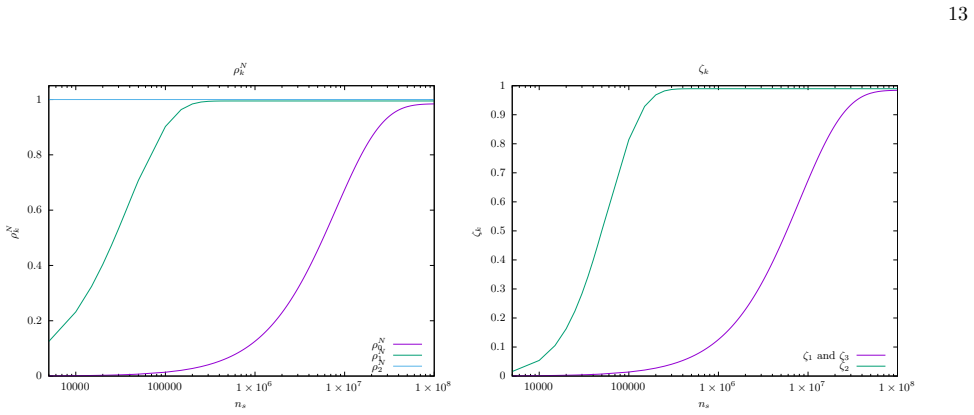
- Nucleon correlators can be estimated with $n_s = 5\times 10^4$ samples with sampling noise below gauge noise; Delta and $N\pi\to\Delta$ correlators need $n_s = 8\times 10^5$ and remain noisier, with phase cancellations hurting the cross-channel case.
- The sparse contraction algorithm preserves the $O(n_D^{d+1})$ sequential-contraction scaling in the large-sample limit, with the central temporary tensors as the dominant cost.
- Using the measured nucleon occupancies, a compact tetraquark calculation is estimated to need roughly $8\times 10^5$ samples and to run about ten times faster than full distillation.
- Increasing the physical volume at fixed grid spacing should improve the sparsity and hence the speed-up, because the number of coarse sites grows while the overlapping large entries do not.
- The construction generalises to arbitrary tensor contractions with quark-line permutations through the marginal indicator functions of the paper's Eq. (38).
Reading between the lines
- A cheap pre-production diagnostic, not reported in the paper, would be to measure the same-site weight fraction of baryon elementals on ensembles with different lattice spacing, volume, and boundary conditions; the whole cost argument depends on that fraction staying high.
- The factorised probabilities drop the perambulator's index dependence, so a natural extension is a two-stage sampler that first draws large elemental entries and then corrects for large perambulator entries; the paper's estimator would then be closer to the variance-optimal Hansen-Hurwitz choice.
- The phase noise seen in $N\pi\to\Delta$ suggests that variance reduction should target complex-phase cancellations, for example by splitting the sum into real and imaginary parts or using a dense control variate.
- If the locality holds at finer lattice spacings, the same basis could make larger distillation spaces affordable, which would help scattering and multi-hadron calculations that currently run at small $n_D$.
Editorial analysis
A structured set of objections, weighed in public.
Referee Report
Summary. This paper proposes a new orthonormal basis for distillation space in lattice QCD, constructed by applying the distillation projection to a coarse grid of point sources and then orthogonalising via a flow equation whose fixed points are unitary matrices. The authors argue that this basis preserves the locality of the point sources, making hadronic operators (elementals) sparse in distillation-space index structure. They introduce a Hansen-Hurwitz importance-sampling scheme that exploits this sparsity to estimate two-point correlation functions, with algorithms for sparse tensor contractions, and they test the method on nucleon, Delta, and N-pi-Delta correlators on a single lattice ensemble, comparing stochastic estimates with exact distillation contractions. The paper also analyses the expected cost scaling of the method and extrapolates to a hypothetical tetraquark calculation.
Significance. If the locality of the new basis holds generally, the method has the potential to reduce the computational cost of multi-quark correlation functions (baryons, tetraquarks), which currently limit the reach of distillation-based spectroscopy. The mathematical foundation is sound: the Hansen-Hurwitz estimator is unbiased by construction, the algorithms are clearly specified, and the numerical tests show agreement with exact distillation contractions. The paper is also commendably honest about its limitations and distinguishes measured results from extrapolations. However, the practical efficiency gain is not directly measured, and the locality argument rests on a single ensemble, so the significance of the work is conditional on broader validation.
major comments (3)
- [II, Eqs. (8)-(10), Fig. 1] The claim that the flow preserves locality is demonstrated only on a single 32^3 lattice with a 4^3 source grid. As the stress-test note correctly observes, writing A = U H shows that the flow changes only the Hermitian factor (dU/ds = 0), so the final basis W = V U is local only to the extent that A0^dagger A0 is close to the identity. No bound on ||A0^dagger A0 - I|| and no tests at other volumes, lattice spacings, or grid densities are provided. Since the sparsity of the elementals in Figs. 2-3 and the occupancy/cost estimates in Sec. V (Eqs. 50-52, Figs. 9-10) rely on this locality, this is a load-bearing assumption that requires broader evidence.
- [V, Sec. IV] The paper's stated goal is to optimise the computation, but no wall-clock timings or total-cost comparison are reported. The cost coefficients zeta_k count only the sparse-matrix multiply operations in the contraction; the overhead of drawing samples, building the index sets, and generating the perambulators is not included. The predicted one-order-of-magnitude speedup for tetraquarks (Sec. V B, Fig. 10) relies on the untested scaling assumption M ≈ sqrt(ns/nD) and on extrapolating the nucleon marginal probabilities to tetraquark operators. To substantiate the efficiency claim, the authors should report either timings or a complete cost model that accounts for all algorithmic components.
- [III A, Eq. (26)] The factorisation of the sampling probabilities assumes that the perambulator entries depend weakly on the distillation-space indices, stated as "dense structure is observed approximately for large time-separations" but with no supporting data shown. This assumption is load-bearing because the whole scheme separates source and sink sampling. The N-pi-Delta results in Fig. 7 show substantial sampling noise even at early time separations, suggesting that this assumption can fail in practice. A quantitative test of the assumption (for example, the distribution of |tau_ab| across index pairs, or a comparison of the factorised probabilities with the optimal ones of Eq. (25)) is needed to justify the general applicability of the method.
minor comments (4)
- [II, Fig. 1] The Gaussian fit in the right panel is presented without any stated purpose; since the fit parameters are not used in the construction of the basis, it would be helpful to state explicitly that the fit is illustrative only.
- [IV, Fig. 6] The middle panels of Fig. 6 show ratios of standard errors, but the vertical axis labels are missing from the figure as displayed; adding explicit axis labels or a legend would improve readability.
- [V, Eq. (50)] The expected-occupancy formula assumes sampling with replacement; this is stated in Algorithm 1, but it would be helpful to repeat the assumption in Sec. V when defining the occupancy expressions.
- [II, Eq. (15), IV] The symbol Phi is used both for the meson elemental matrices (Eq. 15) and for the baryon operator projections (Eq. 17); the text distinguishes them, but a casual reader may be confused. Consider using separate symbols for the two types of objects.
Circularity Check
No significant circularity: the localised-basis construction and Hansen–Hurwitz sampling derivation are self-contained, and the single-ensemble locality demonstration is an empirical robustness concern rather than a definitional or fitted circularity.
full rationale
The paper's derivation chain is self-contained. The localised basis W = V U is defined by taking U as the fixed point of the flow equation dA/ds = (I - A A^†)A in Eq. (8), and the equivariance property of Eq. (9) is a mathematical symmetry of that flow; locality itself is not asserted to follow from the flow by construction but is tested empirically in Fig. 1 and exhibited through sparse elementals in Figs. 2-3. The stochastic evaluation uses the Hansen-Hurwitz estimator of Eq. (20), whose unbiasedness holds for any normalised probabilities, so the choice of sampling probabilities from elemental magnitudes in Eq. (26) is standard importance sampling rather than a fitted parameter disguised as a prediction. In Section IV the sampled correlators are compared against exact contractions computed with full distillation, and the reported agreement is an external check, not a consequence of the construction. The cost estimates in Eqs. (50)-(52) and Figs. 9-10 follow from the sample-occupancy formulas and the measured probability weights; they are predictions, not inputs. Self-citations such as Refs. [1] and [15] supply the standard distillation framework and baryon operator construction, but the central flow-orthogonalisation and sampling scheme is not justified by those citations. The skeptical concern that locality has been demonstrated on only one ensemble at one volume and one lattice spacing is a legitimate robustness and generalisation risk, and the paper itself acknowledges that further studies will be required; however it is not a circularity, because no load-bearing step reduces by construction to its own input.
Assumptions & free parameters
free parameters (3)
- Coarse grid spacing (4^3 source grid)
- Sample sizes (n_s = 5e4 for nucleon, 8e5 for delta and N-pi-delta)
- Gaussian fit parameters for locality profile =
0.041, 0.031
assumptions (4)
- domain assumption The distillation projection applied to n_D point sources on a coarse grid spans Omega_D (i.e., A0 = V^dagger Q is invertible).
- domain assumption The gradient flow (Eq. 8) converges to a unitary fixed point and preserves locality of the basis vectors.
- domain assumption The perambulator entries have weak dependence on their distillation-space indices, so factorised, time-independent sampling probabilities (Eq. 26) are near-optimal.
- standard math Hansen-Hurwitz estimator unbiasedness and variance formula (Eqs. 20-23).
Cite this review
Pith. "Pith review of Optimising stochastic algorithms for hadron correlation function computations in lattice QCD using a localised distillation basis." pith.science (2026). https://pith.science/paper/OO7JJWFL
@misc{pith2026241110395,
  author       = {Pith},
  title        = {Pith review of: Optimising stochastic algorithms for hadron correlation function computations in lattice QCD using a localised distillation basis},
  year         = {2026},
  howpublished = {\url{https://pith.science/paper/OO7JJWFL}},
  note         = {Machine review of arXiv:2411.10395}
}
read the original abstract
Distillation is a quark-smearing method for the construction of a broad class of hadron operators useful in lattice QCD computations and defined via a projection operator into a vector space of smooth gauge-covariant fields. A new orthonormal basis for this space is constructed which builds in locality. This basis is useful for the construction of stochastic methods to estimate the correlation functions computed in Monte Carlo calculations relevant for hadronic physics.
Figures


Figures from the paper (7 more)



Forward citations
Cited by 1 Pith paper
-
Distillation and position-space sampling for local multiquark interpolators
Randomly displaced sparse grids inside distillation produce an unbiased estimator that makes local tetraquark operators affordable, with sampling noise already negligible at every-eighth-point spacing.
Reference graph
Works this paper leans on
-
[1]
M. Peardon, J. Bulava, J. Foley, C. Morningstar, J. Dudek, R. G. Edwards, B. Joo, H.-W. Lin, D. G. Richards, and K. J. Juge (Hadron Spectrum), Phys. Rev. D80, 054506 (2009), arXiv:0905.2160 [hep-lat]
arXiv 2009
-
[2]
J. J. Dudek, R. G. Edwards, M. J. Peardon, D. G. Richards, and C. E. Thomas, Phys. Rev. Lett.103, 262001 (2009), arXiv:0909.0200 [hep-ph]
arXiv 2009
-
[3]
J. J. Dudek, R. G. Edwards, B. Joo, M. J. Peardon, D. G. Richards, and C. E. Thomas, Phys. Rev. D 83, 111502 (2011), arXiv:1102.4299 [hep-lat]
arXiv 2011
-
[4]
L. Liu, G. Moir, M. Peardon, S. M. Ryan, C. E. Thomas, P. Vilaseca, J. J. Dudek, R. G. Edwards, B. Joo, and D. G. Richards (Hadron Spectrum), JHEP 07, 126, arXiv:1204.5425 [hep-ph]
-
[5]
N. Lang and D. J. Wilson (Hadron Spectrum), Phys. Rev. Lett. 129, 252001 (2022), arXiv:2205.05026 [hep-ph]
arXiv 2022
-
[6]
D. J. Wilson, C. E. Thomas, J. J. Dudek, and R. G. Ed- wards (Hadron Spectrum), Phys. Rev. Lett. 132, 241901 (2024), arXiv:2309.14070 [hep-lat]
arXiv 2024
-
[7]
H. Yan, M. Garofalo, M. Mai, U.-G. Meißner, and C. Ur- bach, (2024), arXiv:2407.16659 [hep-lat]
arXiv 2024
-
[8]
H. Li, C. Shi, Y. Chen, M. Gong, J. Liang, Z. Liu, and W. Sun, (2024), arXiv:2402.14541 [hep-lat]
arXiv 2024
Show all 30 references
-
[9]
Boyle, F
P. Boyle, F. Erben, V. G¨ ulpers, M. T. Hansen, F. Joswig, N. P. Lachini, M. Marshall, and A. Portelli, arXiv:2406.19194 [hep-lat]
-
[10]
Knechtli, T
F. Knechtli, T. Korzec, M. Peardon, and J. A. Urrea- Ni˜ no, Phys. Rev. D106, 034501 (2022), arXiv:2205.11564 [hep-lat]
2022 arXiv
-
[11]
Luscher, Nucl
M. Luscher, Nucl. Phys. B 354, 531 (1991)
1991
-
[12]
Luscher and U
M. Luscher and U. Wolff, Nucl. Phys. B 339, 222 (1990)
1990
-
[13]
R. A. Briceno, J. J. Dudek, and R. D. Young, Rev. Mod. Phys. 90, 025001 (2018), arXiv:1706.06223 [hep-lat]
2018 arXiv
-
[14]
Basak, R
S. Basak, R. G. Edwards, G. T. Fleming, U. M. Heller, C. Morningstar, D. Richards, I. Sato, and S. Wallace, Phys. Rev. D 72, 094506 (2005), arXiv:hep-lat/0506029
2005 arXiv
-
[15]
R. G. Edwards, J. J. Dudek, D. G. Richards, and S. J. Wallace, Phys. Rev. D 84, 074508 (2011), arXiv:1104.5152 [hep-ph]
2011 arXiv
-
[16]
J. R. Green, A. D. Hanlon, P. M. Junnarkar, and H. Wit- tig, Phys. Rev. Lett.127, 242003 (2021), arXiv:2103.01054 [hep-lat]
2021 arXiv
-
[17]
G. K. C. Cheung, C. E. Thomas, J. J. Dudek, and R. G. Edwards (Hadron Spectrum), JHEP 11, 033, arXiv:1709.01417 [hep-lat]
-
[18]
Collins, A
S. Collins, A. Nefediev, M. Padmanath, and S. Prelovsek, Phys. Rev. D 109, 094509 (2024), arXiv:2402.14715 [hep- lat]
2024 arXiv
-
[19]
Morningstar, J
C. Morningstar, J. Bulava, J. Foley, K. J. Juge, D. Lenkner, M. Peardon, and C. H. Wong, Phys. Rev. D 83, 114505 (2011), arXiv:1104.3870 [hep-lat]
2011 arXiv
-
[20]
Lattice QCD on Blue Waters
and effectiveness of the combination has been demon- strated in a range of calculations. These remain expensive so it is worth pursuing alternatives. In this paper, a new basis for distillation space is con- structed as a potential starting point in the design of ∗ nicolas.lan...
2024 arXiv
-
[21]
Foley, K
J. Foley, K. Jimmy Juge, A. O’Cais, M. Peardon, S. M. Ryan, and J.-I. Skullerud, Comput. Phys. Commun. 172, 145 (2005), arXiv:hep-lat/0505023
2005 arXiv
-
[22]
M. H. Hansen and W. N. Hurwitz, The Annals of Mathe- matical Statistics 14, 333 (1943)
1943
-
[23]
Morningstar and M
C. Morningstar and M. Peardon, Physical Review D 69, 10.1103/physrevd.69.054501 (2004)
2004 doi
-
[24]
R. G. Edwards and B. Joo (SciDAC, LHPC, UKQCD), Nucl. Phys. B Proc. Suppl. 140, 832 (2005), arXiv:hep- 16 lat/0409003
2005
-
[25]
M. A. Clark, R. Babich, K. Barros, R. C. Brower, and C. Rebbi (QUDA), Comput. Phys. Commun. 181, 1517 (2010), arXiv:0911.3191 [hep-lat]
2010 arXiv
-
[26]
Babich, M
R. Babich, M. A. Clark, and B. Joo, in SC 10 (Supercom- puting 2010) (2010) arXiv:1011.0024 [hep-lat]
2010 arXiv
-
[27]
Jo´ o, D
B. Jo´ o, D. D. Kalamkar, K. Vaidyanathan, M. Smelyan- skiy, K. Pamnany, V. W. Lee, P. Dubey, and W. Watson, Lect. Notes Comput. Sci. 7905, 40 (2013)
2013
-
[28]
J. C. Osborn, R. Babich, J. Brannick, R. C. Brower, M. A. Clark, S. D. Cohen, and C. Rebbi, PoS LA TTICE2010, 037 (2010), arXiv:1011.2775 [hep-lat]
2010 arXiv
-
[29]
Babich, J
R. Babich, J. Brannick, R. C. Brower, M. A. Clark, T. A. Manteuffel, S. F. McCormick, J. C. Osborn, and C. Rebbi, Phys. Rev. Lett. 105, 201602 (2010), arXiv:1005.3043 [hep-lat]
2010 arXiv
-
[30]
J. Chen, R. G. Edwards, and W. Mao, in Platform for Advanced Scientific Computing (2023)
2023
Reviewed August 12, 2026 · model on record in the stance chip above.
Discussion (0). Continue with ORCID to comment.