REVIEW 2 major objections 4 minor 2 cited by
70 Years of Hyperon Spectroscopy: A review of strange $\Xi$, $\Omega$ baryons, and the spectrum of charmed and bottom baryons
T0 review · 2 major / 4 minor · reviewed 2026-08-07 · deepseek-v4-flash
Pith's one-line read The paper claims that strange, charmed, and bottom baryon spectra are coherent under one heavy-quark, light-diquark machinery, with multistrange hyperons bridging the light and heavy flavour sectors.
desk verdict A candid, useful map of hyperon and heavy-baryon spectroscopy, though the abstract oversells the heavy-quark symmetry comparison. read the letter →
The pith
A machine-rendered reading of the paper's core claim, the machinery that carries it, and where it could break.
The reading
What carries the argument
The load-bearing object is the heavy-quark, light-diquark decomposition of a baryon, expressed through the Jacobi coordinates ρ and λ: ρ measures the separation inside the light quark–quark pair and λ measures the separation between that pair and the third quark. In a doubly strange Ξ, the ρ mode excites the |ss⟩ pair and the λ mode excites the light quark against the |ss⟩ system, and because the two reduced masses differ, the degeneracy between the two modes is lifted. This machinery explains why the lightest excited Ξ states are narrow (the ρ-mode excitations decouple from Ξπ decay), why the charm and bottom spectra should look alike (heavy-quark symmetry), and why the observable mass splittings scale as they do. The paper uses the supermultiplet classification of SU(6) ⊗ O(3) to place each state and the standard resonance listings' star ratings to separate established states from candidates.
What would settle it
A decisive test would be a direct measurement of the spin-parity of the Ξ(1320) ground state, for example from the angular distribution in K−p → ΞK or in photoproduction, returning something other than 1/2+. A second decisive check: if high-statistics data show the five excited Ωc states with production cross-sections that do not follow the multiplet pattern, with the supposedly small highest-mass state becoming the largest, the heavy-quark, light-diquark assignment of that quintuplet would be falsified.
Extended reading notes
Core claim
On the paper's own terms, the central claim is that the spectra of the doubly strange Ξ baryons, the triply strange Ω baryons, and the charmed and bottom baryons are all described by the same heavy-quark, light-diquark picture. In that picture the light quark–quark pair can be in a spin-0 or spin-1 configuration, the orbital excitations separate into ρ modes (excitation within the light pair) and λ modes (excitation between the heavy object and the light pair), and the excitation energies and splittings follow from the reduced masses. The comparison between the charmed and bottom sectors shows the pattern predicted by heavy-quark symmetry—the same multiplets appear with hyperfine splittings that shrink as the heavy-quark mass grows—together with mass differences that potential models explain. The multistrange hyperons occupy the gap between these heavy sectors and the light nucleon and Δ resonances, and the paper argues that they are the under-explored territory where the transition from a heavy-quark-plus-diquark system to a strange-pair-plus-light-quark system can be tested.
Load-bearing premise
The load-bearing premise is that quark-model spin-parity assignments—not direct measurements—are correct for most excited Ξ and Ω states, including the ground-state Ξ(1320); if one of those assignments is wrong, the multiplet comparisons must be re-drawn.
Editorial extensions
If this is right
- If the map is right, the next round of K-beam and high-luminosity collider data should confirm the one- and two-star Ξ and Ω states or reassign them, while the four-star ground states Ξ(1320), Ξ(1530), and Ω(1672) anchor the whole system.
- The measured Λc(2595)/Λc(2625) doublet splitting, scaled inversely with heavy-quark mass, implies the corresponding Λb doublet should appear with a smaller splitting—a direct prediction the paper draws from heavy-quark symmetry.
- The five narrow excited Ωc states near 3.0–3.2 GeV are interpreted as the lλ = 1 quintuplet; the paper notes that the smallest signal (the highest-mass state) and the missing fifth member are questions that new data on ΞcK and ΞcKπ final states are expected to resolve.
- For the Ξ sector, the selection rule that ρ-mode excitations decouple from Ξπ and decay instead to KΛ or KΣ predicts where new narrow states should appear in photoproduction and K-beam data.
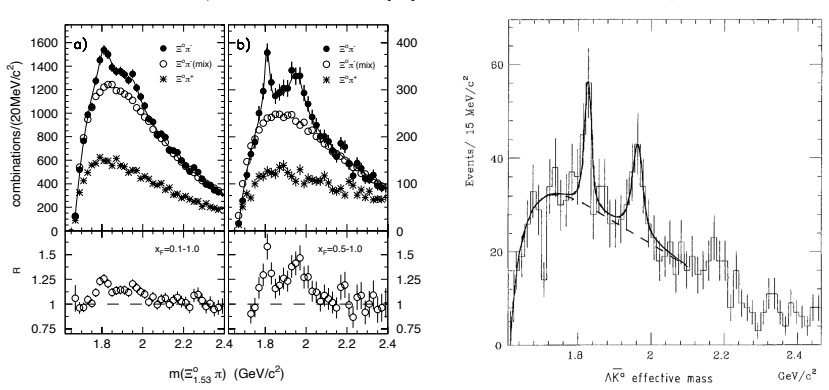
- A correct taxonomy implies that some apparent 'states' in crowded mass spectra are kinematic feed-down from higher resonances, so future analyses must treat reflected peaks before claiming new particles.
Reading between the lines
- A testable extension the authors leave implicit: if the diquark picture is correct, the mass splitting between the spin-0 and spin-1 light-diquark configurations should track the diquark's internal reduced mass across Ξ, Ξc, and Ξb, so a precise measurement of the strange-sector analogue could be used to predict the still-unmeasured Ξb counterpart.
- The review's coherence argument also predicts that any genuinely exotic state—for example a molecular interpretation of the highest Ωc state—should break the multiplet cross-section pattern; measuring the production rates of the five Ωc states relative to each other in a single experiment would distinguish the quark-model assignment from the molecular one.
- One could extrapolate the λ-excitation energy curve from charm and bottom down to the strange sector; the paper's figure of λ excitation versus heavy-quark mass implies a quantitative prediction for the first λ-mode Ξ excitation that the planned K-beam experiments can check.
- If the J^P of the Ξ(1320) ground state turns out not to be 1/2+, the comparisons in this review would need to be re-drawn, but the data on the heavier sectors would still stand on their own—so the review's map is a hypothesis about classification, not about the existence of the states.
Editorial analysis
A structured set of objections, weighed in public.
Referee Report
Summary. This review article compiles the current experimental knowledge of doubly strange Ξ and triply strange Ω baryons together with charmed and bottom baryons, and places them in the context of quark-model and heavy-quark-symmetry classifications. It traces the historical discovery of hyperons, surveys the experimental methods (K− beams, hyperon beams, photoproduction, colliders) and planned facilities, and evaluates the PDG evidence ratings of each state. The central interpretive claim is that the spectra of the strange and heavy baryon sectors exhibit coherent multiplet structure consistent with heavy-quark symmetries, with mass splittings accounted for by potential models. The paper is explicit that most J^P assignments for Ξ and many for beauty baryons are quark-model expectations rather than measurements.
Significance. The review is valuable as an up-to-date, critical map of a fragmented literature. Its strongest feature is its systematic use of PDG star ratings and its explicit separation of measured quantum numbers from model-based assignments, most clearly in Sections 4.1 and 5. The compilation of production mechanisms and decay modes, the historical record, and the survey of future experiments (JLab KL, J-PARC, PANDA) make it a useful reference. If the interpretive comparisons are read as a classification-level consistency check rather than as an independent test of heavy-quark symmetry, the paper is sound. The main significance of the review is therefore taxonomic and programmatic rather than as new evidence.
major comments (2)
- [Abstract; Sections 4.1 and 5] The abstract's conclusion that the comparison of the heavy sectors 'reveals many similarities as predicted by heavy-quark symmetries' is stronger than the evidence compiled in the body. Section 4.1 states that, apart from the Ξ(1530) 3/2+ and Ξ(1820) 3/2−, all Ξ J^P assignments 'are based on quark-model predictions,' and Section 5 states that for beauty baryons 'many of the I, J, or P quantum numbers have not been measured, particularly parities, but are merely based on quark model expectations.' The multiplet comparison therefore uses the quark model to supply the very quantum numbers that are then compared with quark-model predictions; the result is a consistency check under a common classification, not an independent confirmation of heavy-quark symmetry. I recommend that the Abstract and the closing synthesis explicitly frame the similarities as a classification-level consistency check and state which measurements (for example, a measured bottom doublet J^P and a measured Ξ(1320) parity) would turn the comparison into an experimental test.
- [Section 5.4.2 and Figure 20] The discussion of the Ξ_c^* → Λ_c^+ K^- and Ω_c^* → Ξ_c^+ K^- spectra says that the mirrored mass splittings 'clearly indicate the likelihood that the spin-parity of the states are similarly aligned.' This overstates the evidential weight, since the text immediately notes that the spin-parity determination in the second LHCb analysis 'is not sufficient to produce unambiguous results' for the quantum numbers of several states. Please soften this sentence and mark the spin-parity labels in Figure 20 as tentative rather than established.
minor comments (4)
- [Section 4.2.1] The text contains a typo: 'various production mchanisms' should read 'various production mechanisms.'
- [Section 5.5] The quoted doubly charmed baryon mass is written as '(3621±0.23±0.30) MeV/c^2'; this should be given at consistent precision, e.g. '(3621.55 ± 0.23 ± 0.30) MeV/c^2' or '3621.6 ± 0.4 MeV/c^2' if the last digit is not significant.
- [Section 2.1] The statement that the (70,1^-_1) multiplet contains 'a total of seven Ξ states' is ambiguous: it appears to count spin-orbit J values per isospin doublet rather than the number of physical charge states. Please clarify the counting convention.
- [Section 4.3.2] The word 'permissable' should be spelled 'permissible' in the sentence discussing the Ω(2012) decay into Ξ(1530)^0 K^-.
Circularity Check
Review is a compilation with no circular derivation; the only self-citation is minor and not load-bearing.
full rationale
This is a review/compilation, not a derivation: no parameters are fitted and no quantity is derived from an input to be "predicted" later. The only self-citation is to the authors' earlier review [41] (Crede & Roberts 2013), used for Figures 1-2 and as one of several literature guides; it is not load-bearing. The closest thing to a circularity concern is the abstract's claim that the two heavy sectors show "many similarities as predicted by heavy-quark symmetries"; the paper itself discloses (Sec. 4.1: "All other J^P assignments, including the J^P for the Xi(1320) ground state, are based on quark-model predictions"; Sec. 5: "Many of the I, J, or P quantum numbers have not been measured, particularly parities, but are merely based on quark model expectations") that the multiplet labels used to organize the comparison are largely model-assigned rather than measured. This makes the claimed similarity a consistency check under the model's own assignments, and a real weakness in the abstract's strength, but it is not circular in the technical sense: the masses, widths, decay modes, and state counts are external data compiled from many independent experiments, and no equation in the review reduces to its own input. The review is therefore self-contained as a survey; the classification caveat is a correctness risk, not a circularity. Score 2 for the minor non-load-bearing self-citation.
Assumptions & free parameters
assumptions (5)
- domain assumption SU(3) flavor symmetry is an approximate symmetry of the strong interaction, broken by the heavier strange quark.
- domain assumption The quark model with three constituent quarks and SU(6) x O(3) supermultiplets organizes the baryon spectrum.
- domain assumption PDG listings and star ratings are reliable summaries of the experimental evidence.
- domain assumption Heavy-quark symmetry and potential models give valid mass-splitting relations for charmed and bottom baryons.
- domain assumption The reduced-mass ordering mu_rho < mu_lambda for Xi baryons implies the lightest excitations are rho-mode.
Cite this review
Pith. "Pith review of 70 Years of Hyperon Spectroscopy: A review of strange $\Xi$, $\Omega$ baryons, and the spectrum of charmed and bottom baryons." pith.science (2026). https://pith.science/paper/OS2C5TWA
@misc{pith2026250208815,
  author       = {Pith},
  title        = {Pith review of: 70 Years of Hyperon Spectroscopy: A review of strange $\Xi$, $\Omega$ baryons, and the spectrum of charmed and bottom baryons},
  year         = {2026},
  howpublished = {\url{https://pith.science/paper/OS2C5TWA}},
  note         = {Machine review of arXiv:2502.08815}
}
abstract
The first hyperon was discovered about 70 years ago, but the nature of these particles, particularly with regard to multistrange hyperons, and many of their properties can still be considered to be literally strange. A dedicated and successful global spectroscopy program in the 1960s and 1970s using $K^-$ beams revealed many multistrange candidates, but the available evidence of their existence is statistically limited. For this reason, there is still much to learn about the systematics of the spectrum of excited hyperon states and what they have in common with their non-strange companions, or how they differ from the nucleon and $\Delta$ resonances. Recent years have also seen a great deal of progress in the field of charmed and bottom baryon spectroscopy. Unprecedented data from the Large Hadron Collider in particular indicate continued rapid progress in the field of bottom baryons. On the theoretical side, baryons with one heavy quark $Q$ and a light $qq$ system serve as an ideal laboratory for studying light $qq$ (diquark) correlations and the dynamics of the light quarks in the colour environment of a heavy quark. In this review, we discuss the status of doubly and triply strange $\Xi$ as well as $\Omega$ baryons, and the properties of all the known charmed and bottom states. The comparison of the two heavy sectors reveals many similarities as predicted by heavy-quark symmetries, together with differences in mass splittings easily understood by potential models. The multi-strange hyperons bridge the under-explored gap between the light- and the heavy-flavour baryons. How do the properties of a singly charmed $Q$-$qq$ system change with decreasing mass of the heavy quark in the transition to a doubly strange $q$-$QQ$ system with a heavier quark-quark system relative to one light quark?
Figures


Figures from the paper (27 more)




Forward citations
Cited by 2 Pith papers
-
Quantum numbers of excited $\Xi_c^\prime$ and $\Omega_c$ baryons and the $P$-wave $\Sigma_c$ spectrum
The excited Ξ_c and Ω_c baryons share successive J^P = 1/2^-, 3/2^-, 3/2^-, 5/2^- λ-mode assignments, with Ω_c(3119) as a ρ-mode 3/2^- state and four P-wave Σ_c states predicted inside existing structures.
-
Hadron Spectroscopy: Experimental Overview
Hadron spectroscopy's experimental status is reviewed from PDG listings: the conventional and exotic meson and baryon spectrum through 2025-2026, with no new results reported.
Reference graph
Works this paper leans on
-
[1]
Rutherford E 1911 Phil. Mag. Ser. 6 21 669
1911
-
[2]
(CDF Collaboration) 1995 Phys
Abe F et al. (CDF Collaboration) 1995 Phys. Rev. Lett. 74 2626
1995
-
[3]
(D0 Collaboration) 1995 Phys
Abachi S et al. (D0 Collaboration) 1995 Phys. Rev. Lett. 74 2632
1995
-
[4]
https://www.nobelprize.org/prizes/physics/1990/
1990
-
[5]
2023 Eur
Gross F et al. 2023 Eur. Phys. J. C 83 1125
2023
-
[6]
Capstick S and Isgur N 1986 Phys. Rev. D 34 2809
1986
-
[7]
Loring U, Kretzschmar K, Metsch B C and Petry H R 2001 Eur. Phys. J. A 10 309
2001
-
[8]
Loring U, Metsch B C and Petry H R 2001 Eur. Phys. J. A 10 395
2001
Show all 291 references
-
[9]
Loring U, Metsch B C and Petry H R 2001 Eur. Phys. J. A 10 447
2001
-
[10]
Shimizu K 1984 Phys. Lett. B 148 418
1984
-
[11]
Fernandez F, Valcarce A, Straub U and Faessler A 1993 J. Phys. G 19 2013
1993
-
[12]
Valcarce A, Fernandez F, Gonzalez P and Vento V 1996 Phys. Lett. B 367 35
1996
-
[13]
Glozman L Y, Papp Z and Plessas W 1996 Phys. Lett. B 381 311
1996
-
[14]
Dziembowski Z, Fabre de la Ripelle M and Miller G A 1996 Phys. Rev. C 53 R2038
1996
-
[15]
Valcarce A, Garcilazo H and Vijande J 2005 Phys. Rev. C 72 025206
2005
-
[16]
(European Muon Collaboration) 1988 Phys
Ashman J et al. (European Muon Collaboration) 1988 Phys. Lett. B 206 364
1988
-
[17]
Deur A, Brodsky S J and De T´ eramond G F 2019 Rep. Prog. Phys. 82 076201
2019
-
[18]
Diehl S 2023 Prog. Part. Nucl. Phys. In press, available online
2023
-
[19]
(CLAS Collaboration) 2003 Nucl
Mecking B A et al. (CLAS Collaboration) 2003 Nucl. Instrum. Meth. A 503 513
2003
-
[20]
Hillert W 2006 Eur. Phys. J. A 28S1 139
2006
-
[21]
Mecking B A 2006 Eur. Phys. J. A 28S1 209
2006
-
[22]
(GRAAL Collaboration) 2005 Eur
Bartalini O et al. (GRAAL Collaboration) 2005 Eur. Phys. J. A 26 399 A Review of Hyperon Spectroscopy 82
2005
-
[23]
(LEPS Collaboration) 2014 Nucl
Muramatsu N et al. (LEPS Collaboration) 2014 Nucl. Instrum. Meth. A 737 184
2014
-
[24]
(Particle Data Group) 2022 PTEP 2022 083C01
Workman R L et al. (Particle Data Group) 2022 PTEP 2022 083C01
2022
-
[25]
Anisovich A V, Klempt E, Nikonov V A, Sarantsev A V and Thoma U 2012 Phys. Lett. B 711 167
2012
-
[26]
(CBELSA/TAPS Collaboration) 2015 Eur
Sokhoyan V et al. (CBELSA/TAPS Collaboration) 2015 Eur. Phys. J. A 51 95 [Erratum: 2015 Eur. Phys. J. A51 187]
2015
-
[27]
(CBELSA/TAPS Collaboration) 2015 Phys
Thiel A et al. (CBELSA/TAPS Collaboration) 2015 Phys. Rev. Lett. 114 091803
2015
-
[28]
Ferretti J, Vassallo A and Santopinto E 2011 Phys. Rev. C 83 065204
2011
-
[29]
Ireland D G, Pasyuk E and Strakovsky I 2020 Prog. Part. Nucl. Phys. 111 103752
2020
-
[30]
Evans L and Bryant P 2008 JINST 3 S08001
2008
-
[31]
Kurokawa S and Kikutani E 2003 Nucl. Instrum. Meth. A 499 1
2003
-
[32]
(LHCb Collaboration) 2017 Phys
Aaij R et al. (LHCb Collaboration) 2017 Phys. Rev. Lett. 119 112001
2017
-
[33]
Edwards R G, Mathur N, Richards D G and Wallace S J (Hadron Spectrum Collaboration) 2013 Phys. Rev. D 87 054506
2013
-
[34]
Hey A J G and Kelly R L 1983 Phys. Rept. 96 71
1983
-
[35]
Klempt E and Richard J M 2010 Rev. Mod. Phys. 82 1095
2010
-
[36]
Capstick S and Roberts W 2000 Prog. Part. Nucl. Phys. 45 S241
2000
-
[37]
Krusche B and Schadmand S 2003 Prog. Part. Nucl. Phys. 51 399
2003
-
[38]
Drechsel D and Walcher T 2008 Rev. Mod. Phys. 80 731
2008
-
[39]
Tiator L, Drechsel D, Kamalov S S and Vanderhaeghen M 2011 Eur. Phys. J. ST 198 141
2011
-
[40]
Aznauryan I G and Burkert V D 2012 Prog. Part. Nucl. Phys. 67 1
2012
-
[41]
Crede V and Roberts W 2013 Rep. Prog. Phys. 76 076301
2013
-
[42]
Thiel A, Afzal F and Wunderlich Y 2022 Prog. Part. Nucl. Phys. 125 103949
2022
-
[43]
Copley L A, Isgur N and Karl G 1979 Phys. Rev. D 20 768 [Erratum: Phys.Rev.D 23, 817 (1981)]
1981
-
[44]
Silvestre-Brac B 1996 Few Body Syst. 20 1
1996
-
[45]
Garcia-Recio C, Nieves J, Romanets O, Salcedo L L and Tolos L 2013 Phys. Rev. D 87 034032
2013
-
[46]
Cheng H Y 2009 Int. J. Mod. Phys. A 24S1 593
2009
-
[47]
Cheng H Y 2015 Front. Phys. (Beijing) 10 101406
2015
-
[48]
Cheng H Y 2022 Chin. J. Phys. 78 324
2022
-
[49]
Chen H X, Chen W, Liu X, Liu Y R and Zhu S L 2017 Rept. Prog. Phys. 80 076201
2017
-
[50]
Chen H X, Chen W, Liu X, Liu Y R and Zhu S L 2023 Rept. Prog. Phys. 86 026201
2023
-
[51]
Yoshida T, Hiyama E, Hosaka A, Oka M and Sadato K 2015 Phys. Rev. D 92 114029
2015
-
[52]
(LHCb Collaboration) 2015 Phys
Aaij R et al. (LHCb Collaboration) 2015 Phys. Rev. Lett. 115 072001
2015
-
[53]
(LHCb Collaboration) 2019 Phys
Aaij R et al. (LHCb Collaboration) 2019 Phys. Rev. Lett. 122 222001
2019
-
[54]
Gell-Mann M 1961 CTSL-20, TID-12608
1961
-
[55]
Okubo S 1962 Prog. Theor. Phys. 27 949
1962
-
[56]
Okubo S 1962 Prog. Theor. Phys. 28 24
1962
-
[57]
Richard J M 2012 Ferrara International School Niccol` o Cabeo 2012: Hadronic spectroscopy (Preprint 1205.4326)
2012 arXiv
-
[58]
Chao K T, Isgur N and Karl G 1981 Phys. Rev. D 23 155
1981
-
[59]
Zenczykowski P 1986 Annals Phys. 169 453
1986
-
[60]
Eichmann G, Sanchis-Alepuz H, Williams R, Alkofer R and Fischer C S 2016 Prog. Part. Nucl. Phys. 91 1
2016
-
[61]
Eichmann G and Fischer C S 2019 Few Body Syst. 60 2
2019
-
[62]
Bashir A, Chang L, Cloet I C, El-Bennich B, Liu Y X, Roberts C D and Tandy P C 2012Commun. Theor. Phys. 58 79
-
[63]
Roberts C D 2015 IRMA Lect. Math. Theor. Phys. 21 355
2015
-
[64]
Eichmann G, Fischer C S and Sanchis-Alepuz H 2016 Phys. Rev. D 94 094033
2016
-
[65]
Fischer C S and Eichmann G 201817th International Conference on Hadron Spectroscopy and Structure p 007
-
[66]
Dudek J J, Edwards R G, Peardon M J, Richards D G and Thomas C E 2009 Phys. Rev. Lett. A Review of Hyperon Spectroscopy 83 103 262001
2009
-
[67]
Dudek J J, Edwards R G, Peardon M J, Richards D G and Thomas C E 2010 Phys. Rev. D 82 034508
2010
-
[68]
Edwards R G, Dudek J J, Richards D G and Wallace S J 2011 Phys. Rev. D 84 074508
2011
-
[69]
Engel G P, Lang C B, Mohler D and Sch¨ afer A (BGR Collaboration) 2013 Phys. Rev. D 87 074504
2013
-
[70]
Karliner M and Rosner J L 2018 Phys. Rev. D 98 074026
2018
-
[71]
(Flavour Lattice Averaging Group (FLAG)) 2022 Eur
Aoki Y et al. (Flavour Lattice Averaging Group (FLAG)) 2022 Eur. Phys. J. C 82 869
2022
-
[72]
Padmanath M 2019 Heavy baryon spectroscopy from lattice QCD ( Preprint 1905.10168)
2019 arXiv
-
[73]
(SELEX Collaboration) 2002 Phys
Mattson M et al. (SELEX Collaboration) 2002 Phys. Rev. Lett. 89 112001
2002
-
[74]
(SELEX Collaboration) 2005 Phys
Ocherashvili A et al. (SELEX Collaboration) 2005 Phys. Lett. B 628 18
2005
-
[75]
1996 Particle physics: One hundred years of discoveries
Ezhela V V et al. 1996 Particle physics: One hundred years of discoveries
1996
-
[76]
Bonetti A, Levi Setti R, Panetti M and Tomasini G 1953 Nuovo Cim. A 10 1
1953
-
[77]
York C M, Leighton R B and Bjornerud E K 1953 Phys. Rev. 90 167
1953
-
[78]
Cowan E W 1954 Phys. Rev. 94 161
1954
-
[79]
Alvarez L W, Eberhard P, Good M L, Graziano W, Ticho H K and Wojcicki S G 1959 Phys. Rev. Lett. 2 215
1959
-
[80]
Pjerrou G M, Prowse D J, Schlein P, Slater W E, Stork D H and Ticho H K 1962 Phys. Rev. Lett. 9 114
1962
-
[81]
1962 Phys
Bertanza L et al. 1962 Phys. Rev. Lett. 9 180
1962
-
[82]
1964 Phys
Barnes V E et al. 1964 Phys. Rev. Lett. 12 204
1964
-
[83]
Aleksandrov Y A, Clement M, Dropmann F, Fournier A, Grafstrom P, Hubbard E, Paul S, Siebert H W, Trombini A and Zavertyaev M 1998 Nucl. Instrum. Meth. A 408 359
1998
-
[84]
Bourquin M and Repellin J P 1984 Phys. Rept. 114 99
1984
-
[85]
(Bristol-Geneva-Heidelberg-Orsay-Rutherford-Strasbourg Collaboration) 1979 Nucl
Bourquin M et al. (Bristol-Geneva-Heidelberg-Orsay-Rutherford-Strasbourg Collaboration) 1979 Nucl. Phys. B 153 13 [Erratum: 1979 Nucl. Phys. B161 548]
1979
-
[86]
Biagi S F et al. 1981 Z. Phys. C 9 305
1981
-
[87]
Biagi S F et al. 1986 Z. Phys. C 31 33
1986
-
[88]
Biagi S F et al. 1987 Z. Phys. C 34 15
1987
-
[89]
Biagi S F et al. 1987 Z. Phys. C 34 175
1987
-
[90]
(W A89 Collaboration) 1998 Eur
Adamovich M I et al. (W A89 Collaboration) 1998 Eur. Phys. J. C 5 621
1998
-
[91]
(W A89 Collaboration) 1999 Eur
Adamovich M I et al. (W A89 Collaboration) 1999 Eur. Phys. J. C 11 271
1999
-
[92]
(SELEX Collaboration) 1987 FERMILAB-PROPOSAL-0781
Russ J et al. (SELEX Collaboration) 1987 FERMILAB-PROPOSAL-0781
1987
-
[93]
(HyperCP Collaboration) 2004 Phys
Holmstrom T et al. (HyperCP Collaboration) 2004 Phys. Rev. Lett. 93 262001
2004
-
[94]
(HyperCP Collaboration) 2004 Phys
Huang M et al. (HyperCP Collaboration) 2004 Phys. Rev. Lett. 93 011802
2004
-
[95]
(HyperCP Collaboration) 2005 Phys
Rajaram D et al. (HyperCP Collaboration) 2005 Phys. Rev. Lett. 94 181801
2005
-
[96]
(E761 Collaboration) 1994 Phys
Dubbs T et al. (E761 Collaboration) 1994 Phys. Rev. Lett. 72 808
1994
-
[97]
(E756 Collaboration) 2003 Phys
Chakravorty A et al. (E756 Collaboration) 2003 Phys. Rev. Lett. 91 031601
2003
-
[98]
(E756 Collaboration) 2000 Phys
Luk K B et al. (E756 Collaboration) 2000 Phys. Rev. Lett. 85 4860
2000
-
[99]
Wallace N B, Border P M, Ciampa D P, Guglielmo G, Heller K J, Woods D M, Johns K A, Gao Y T, Longo M J and Rameika R 1995 Phys. Rev. Lett. 74 3732
1995
-
[100]
1988 Phys
Aston D et al. 1988 Phys. Lett. B 215 799
1988
-
[101]
Smith G A, Lindsey J S, Button-Shafer J and Murray J J 1965 Phys. Rev. Lett. 14 25
1965
-
[102]
Berge J P, Eberhard P, Hubbard J R, Merrill D W, Button-Shafer J, Solmitz F T and Stevenson M L 1966 Phys. Rev. 147 945
1966
-
[103]
Goldwasser E L and Schultz P F 1970 Phys. Rev. D 1 1960
1970
-
[104]
1968 Phys
Alitti J et al. 1968 Phys. Rev. Lett. 21 1119
1968
-
[105]
1969 Phys
Alitti J et al. 1969 Phys. Rev. Lett. 22 79
1969
-
[106]
1970 Phys
Apsell S et al. 1970 Phys. Rev. Lett. 24 777
1970
-
[107]
Borenstein S R, Danburg J S, Kalbfleisch G R, Strand R C, Vanderburg V, Chapman J W, Kiang R K and Lys J 1972 Phys. Rev. D 5 1559 A Review of Hyperon Spectroscopy 84
1972
-
[108]
1983 Phys
Jenkins C M et al. 1983 Phys. Rev. Lett. 51 951
1983
-
[109]
1985 Phys
Aston D et al. 1985 Phys. Rev. D 32 2270
1985
-
[110]
1973 Phys
Brandenburg G W et al. 1973 Phys. Rev. D 7 708
1973
-
[111]
1974 Nuovo Cim
Berthon A et al. 1974 Nuovo Cim. A 21 146
1974
-
[112]
A 28 289
Bellefon A d, Berthon A and Billoir P 1975 Nuovo Cim. A 28 289
1975
-
[113]
(Amsterdam-CERN-Nijmegen-Oxford Collaboration) 1976 Phys
Gay J B et al. (Amsterdam-CERN-Nijmegen-Oxford Collaboration) 1976 Phys. Lett. B 62 477
1976
-
[114]
(Belle Collaboration) 2002 Phys
Abe K et al. (Belle Collaboration) 2002 Phys. Lett. B 524 33
2002
-
[115]
(BaBar Collaboration) 2008 Phys
Aubert B et al. (BaBar Collaboration) 2008 Phys. Rev. D 78 034008
2008
-
[116]
(BaBar Collaboration) 2006 Phys
Aubert B et al. (BaBar Collaboration) 2006 Phys. Rev. Lett. 97 112001
2006
-
[117]
1967 Nucl
Tripp R D et al. 1967 Nucl. Phys. B 3 10
1967
-
[118]
1968 Nucl
Burgun G et al. 1968 Nucl. Phys. B 8 447
1968
-
[119]
1971 Nucl
Litchfield P J et al. 1971 Nucl. Phys. B 30 125
1971
-
[120]
(CLAS Collaboration) 2007 Phys
Guo L et al. (CLAS Collaboration) 2007 Phys. Rev. C 76 025208
2007
-
[121]
(CLAS Collaboration) 2018 Phys
Goetz J T et al. (CLAS Collaboration) 2018 Phys. Rev. C 98 062201
2018
-
[122]
(GlueX Collaboration) 2021 Nucl
Adhikari S et al. (GlueX Collaboration) 2021 Nucl. Instrum. Meth. A 987 164807
2021
-
[123]
(GlueX Collaboration) 2012 ( Preprint arXiv:1210.4508[hep-ex])
Dugger M et al. (GlueX Collaboration) 2012 ( Preprint arXiv:1210.4508[hep-ex])
2012 arXiv
-
[124]
(GlueX Collaboration) 2013 ( Preprint arXiv:1305.1523[nucl-ex])
AlekSejevs A et al. (GlueX Collaboration) 2013 ( Preprint arXiv:1305.1523[nucl-ex])
2013 arXiv
-
[125]
2012 https://www.jlab.org/exp_prog/proposals/12/PR12-12-008.pdf
Afanasev A et al. 2012 https://www.jlab.org/exp_prog/proposals/12/PR12-12-008.pdf
2012
-
[126]
2020 Nucl
Burkert V D et al. 2020 Nucl. Instrum. Meth. A 959 163419
2020
-
[127]
Yamartino R, Brandenburg G W, Johnson W B, Leith D W G S, Loos J S, Luste G, Matthews J A J, Moriyasu K, Smart W M and Winkelmann F C 1974 Phys. Rev. D 10 9
1974
-
[128]
2020 Nucl
Day D et al. 2020 Nucl. Instrum. Meth. A 957 163429
2020
-
[129]
(KLF Collaboration) 2020 ( Preprint 2008.08215)
Amaryan M et al. (KLF Collaboration) 2020 ( Preprint 2008.08215)
2020 arXiv
-
[130]
Nagae T 2008 Nucl. Phys. A 805 486
2008
-
[131]
http://j-parc.jp/researcher/Hadron/en/pac_2301/pdf/P97_2023-4.pdf
-
[132]
http://j-parc.jp/researcher/Hadron/en/pac_2107/pdf/P85_2021-10.pdf
-
[133]
http://j-parc.jp/researcher/Hadron/en/pac_1301/pdf/P50_2012-19.pdf
-
[134]
2007 Conf
Toelle R et al. 2007 Conf. Proc. C 070625 1442
2007
-
[135]
Musgrave B and Petmezas G 1965 Nuovo Cim. 35 735
1965
-
[136]
(PANDA Collaboration) 2009 ( Preprint 0903.3905)
Lutz M F M et al. (PANDA Collaboration) 2009 ( Preprint 0903.3905)
2009
-
[137]
Crede V (GlueX Collaboration) 2023 Few Body Syst. 64 32
2023
-
[138]
(NA48 Collaboration) 2000 Eur
Fanti V et al. (NA48 Collaboration) 2000 Eur. Phys. J. C 12 69
2000
-
[139]
Kalbfleisch G R, Strand R C and Chapman J W 1975 Phys. Rev. D 11 987
1975
-
[140]
(CLAS Collaboration) 2005 Phys
Price J W et al. (CLAS Collaboration) 2005 Phys. Rev. C 71 058201
2005
-
[141]
Schlein P E, Carmony D D, Pjerrou G M, Slater W E, Stork D H and Ticho H K 1963 Phys. Rev. Lett. 11 167
1963
-
[142]
Button-Shafer J, Lindsey J S, Murray J J and Smith G A 1966 Phys. Rev. 142 883
1966
-
[143]
(Particle Data Group) 1988 Phys
Yost G P et al. (Particle Data Group) 1988 Phys. Lett. B 204 1
1988
-
[144]
(Amsterdam-CERN-Nijmegen-Oxford Collaboration) 1978 Phys
Dionisi C et al. (Amsterdam-CERN-Nijmegen-Oxford Collaboration) 1978 Phys. Lett. B 80 145
1978
-
[145]
(CLEO Collaboration) 1993 Phys
Avery P et al. (CLEO Collaboration) 1993 Phys. Rev. Lett. 71 2391
1993
-
[146]
(Belle Collaboration) 2019 Phys
Sumihama M et al. (Belle Collaboration) 2019 Phys. Rev. Lett. 122 072501
2019
-
[147]
(BESIII Collaboration) 2024 Phys
Ablikim M et al. (BESIII Collaboration) 2024 Phys. Rev. D 109 072008 (Preprint 2308.15206)
2024
-
[148]
Ross R T, Buran T, Lloyd J L, Mulvey J H and Radojicic D 1972 Phys. Lett. B 38 177
1972
-
[149]
1977 Phys
Briefel E et al. 1977 Phys. Rev. D 16 2706
1977
-
[150]
Hassall J K, Ansorge R E, Carter J R, Neale W W, Rushbrooke J G, Ward D R, Oh B Y, Pratap M, Smith G A and Whitmore J 1981 Nucl. Phys. B 189 397
1981
-
[151]
Badier J, Barrelet E, Charlton G R and Videau I 1972 Nucl. Phys. B 37 429
1972
-
[152]
Crennell D J, Karshon U, Lai K W, O’ Neall J S, Scarr J M and Schumann T G 1970 Phys. Rev. D 1 847
1970
-
[153]
DiBianca F A and Endorf R J 1975 Nucl. Phys. B 98 137
1975
-
[154]
1978 Phys
Teodoro D et al. 1978 Phys. Lett. B 77 451 A Review of Hyperon Spectroscopy 85
1978
-
[155]
(Amsterdam-CERN-Nijmegen-Oxford Collaboration) 1977 Phys
Hemingway R J et al. (Amsterdam-CERN-Nijmegen-Oxford Collaboration) 1977 Phys. Lett. B 68 197
1977
-
[156]
(Aachen-Berlin-CERN-London-Vienna Collaboration) 1969 Phys
Bartsch J et al. (Aachen-Berlin-CERN-London-Vienna Collaboration) 1969 Phys. Lett. B 28 439
1969
-
[157]
(Birmingham-CERN-Glasgow-Michigan State-Paris Collaboration) 1980Phys
Amirzadeh J et al. (Birmingham-CERN-Glasgow-Michigan State-Paris Collaboration) 1980Phys. Lett. B 90 324
-
[158]
Ne’eman Y 1961 Nucl. Phys. 26 222
1961
-
[159]
1991 Phys
Diehl H T et al. 1991 Phys. Rev. Lett. 67 804
1991
-
[160]
(Aachen-Berlin-CERN-Innsbruck-London-Vienna Collaboration) 1978 Phys
Deutschmann M et al. (Aachen-Berlin-CERN-Innsbruck-London-Vienna Collaboration) 1978 Phys. Lett. B 73 96
1978
-
[161]
(Birmingham-CERN-Glasgow-Michigan State-Paris Collaboration) 1978 Phys
Baubillier M et al. (Birmingham-CERN-Glasgow-Michigan State-Paris Collaboration) 1978 Phys. Lett. B 78 342
1978
-
[162]
(Particle Data Group) 2018 Phys
Tanabashi M et al. (Particle Data Group) 2018 Phys. Rev. D 98 030001
2018
-
[163]
(Belle Collaboration) 2018 Phys
Yelton J et al. (Belle Collaboration) 2018 Phys. Rev. Lett. 121 052003
2018
-
[164]
Faustov R N and Galkin V O 2015 Phys. Rev. D 92 054005
2015
-
[165]
Belle Collaboration 2022 ( Preprint arXiv:2207.03090[hep-ex])
2022 arXiv
-
[166]
(Belle Collaboration) 2019 Phys
Jia S et al. (Belle Collaboration) 2019 Phys. Rev. D 100 032006
2019
-
[167]
Ikeno N, Toledo G, Liang W H and Oset E 2023 Few Body Syst. 64 55
2023
-
[168]
1987 Phys
Aston D et al. 1987 Phys. Lett. B 194 579
1987
-
[169]
(BESIII Collaboration) 2021 Phys
Ablikim M et al. (BESIII Collaboration) 2021 Phys. Rev. D 103 L091101
2021
-
[170]
1976 Phys
Knapp B et al. 1976 Phys. Rev. Lett. 37 882
1976
-
[171]
(LHCb Collaboration) 2023 Phys
Aaij R et al. (LHCb Collaboration) 2023 Phys. Rev. D 108 012023
2023
-
[172]
(Belle Collaboration) 2014 Phys
Zupanc A et al. (Belle Collaboration) 2014 Phys. Rev. Lett. 113 042002
2014
-
[173]
(BESIII Collaboration) 2016 Phys
Ablikim M et al. (BESIII Collaboration) 2016 Phys. Rev. Lett. 116 052001
2016
-
[174]
(BaBar Collaboration) 2005 Phys
Aubert B et al. (BaBar Collaboration) 2005 Phys. Rev. D 72 052006
2005
-
[175]
(ARGUS Collaboration) 1993 Phys
Albrecht H et al. (ARGUS Collaboration) 1993 Phys. Lett. B 317 227
1993
-
[176]
(CLEO Collaboration) 1995 Phys
Edwards K W et al. (CLEO Collaboration) 1995 Phys. Rev. Lett. 74 3331
1995
-
[177]
(Belle Collaboration) 2023 Phys
Wang D et al. (Belle Collaboration) 2023 Phys. Rev. D 107 032008
2023
-
[178]
(LHCb Collaboration) 2017 Phys
Aaij R et al. (LHCb Collaboration) 2017 Phys. Rev. D 96 112005
2017
-
[179]
Blechman A E, Falk A F, Pirjol D and Yelton J M 2003 Phys. Rev. D 67 074033
2003
-
[180]
(CDF Collaboration) 2011 Phys
Aaltonen T et al. (CDF Collaboration) 2011 Phys. Rev. D 84 012003
2011
-
[181]
Rosner J L 1995 Comments Nucl. Part. Phys. 21 369 (Preprint hep-ph/9501291)
1995 arXiv
-
[182]
(Particle Data Group) 2010 J
Nakamura K et al. (Particle Data Group) 2010 J. Phys. G 37 075021
2010
-
[183]
Nieves J and Pavao R 2020 Phys. Rev. D 101 014018
2020
-
[184]
(CLEO Collaboration) 2001 Phys
Artuso M et al. (CLEO Collaboration) 2001 Phys. Rev. Lett. 86 4479
2001
-
[185]
Tanida K et al. (Belle Collaboration) 2020 Experimental determination of the isospin of Λc(2765)+/Σc(2765)+ 18th International Conference on Hadron Spectroscopy and Structure p 183 ( Preprint 1908.06235)
2020
-
[186]
(Belle Collaboration) 2007 Phys
Abe K et al. (Belle Collaboration) 2007 Phys. Rev. Lett. 98 262001
2007
-
[187]
thesis Seoul Natl
Joo C 2015 The spin-parity study of the Λ c(2765)+ in Belle Ph.D. thesis Seoul Natl. U., Dept. Phys. Astron
2015
-
[188]
(LHCb Collaboration) 2017 JHEP 05 030
Aaij R et al. (LHCb Collaboration) 2017 JHEP 05 030
2017
-
[189]
(BaBar Collaboration) 2007 Phys
Aubert B et al. (BaBar Collaboration) 2007 Phys. Rev. Lett. 98 012001
2007
-
[190]
Wang B, Meng L and Zhu S L 2020 Phys. Rev. D 101 094035
2020
-
[191]
Luo S Q, Chen B, Liu Z W and Liu X 2020 Eur. Phys. J. C 80 301
2020
-
[192]
(Belle Collaboration) 2023 Phys
Li Y B et al. (Belle Collaboration) 2023 Phys. Rev. Lett. 130 031901
2023
-
[193]
(Belle Collaboration) 2014 Phys
Lee S H et al. (Belle Collaboration) 2014 Phys. Rev. D 89 091102
2014
-
[194]
(Belle Collaboration) 2021 Phys
Yelton J et al. (Belle Collaboration) 2021 Phys. Rev. D 104 052003
2021
-
[195]
Franklin J 1975 Phys. Rev. D 12 2077
1975
-
[196]
(Belle Collaboration) 2005 Phys
Mizuk R et al. (Belle Collaboration) 2005 Phys. Rev. Lett. 94 122002
2005
-
[197]
Wang K L and Zhong X H 2022 Chin. Phys. C 46 023103
2022
-
[198]
(BaBar Collaboration) 2008 Phys
Aubert B et al. (BaBar Collaboration) 2008 Phys. Rev. D 78 112003 A Review of Hyperon Spectroscopy 86
2008
-
[199]
1983 Phys
Biagi S F et al. 1983 Phys. Lett. B 122 455
1983
-
[200]
(CLEO Collaboration) 1989 Phys
Alam M S et al. (CLEO Collaboration) 1989 Phys. Lett. B 226 401
1989
-
[201]
(ACCMOR Collaboration) 1989 Phys
Barlag S et al. (ACCMOR Collaboration) 1989 Phys. Lett. B 233 522
1989
-
[202]
(CLEO Collaboration) 1995 Phys
Avery P et al. (CLEO Collaboration) 1995 Phys. Rev. Lett. 75 4364
1995
-
[203]
(CLEO Collaboration) 1996 Phys
Gibbons L et al. (CLEO Collaboration) 1996 Phys. Rev. Lett. 77 810
1996
-
[204]
(CLEO Collaboration) 1999 Phys
Jessop C P et al. (CLEO Collaboration) 1999 Phys. Rev. Lett. 82 492
1999
-
[205]
Maltman K and Isgur N 1980 Phys. Rev. D 22 1701
1980
-
[206]
(Belle Collaboration) 2016 Phys
Yelton J et al. (Belle Collaboration) 2016 Phys. Rev. D 94 052011
2016
-
[207]
(CLEO Collaboration) 2001 Phys
Csorna S E et al. (CLEO Collaboration) 2001 Phys. Rev. Lett. 86 4243
2001
-
[208]
(CLEO Collaboration) 1999 Phys
Alexander J P et al. (CLEO Collaboration) 1999 Phys. Rev. Lett. 83 3390
1999
-
[209]
(Belle Collaboration) 2020 Phys
Yelton J et al. (Belle Collaboration) 2020 Phys. Rev. D 102 071103
2020
-
[210]
Wang K L, Yao Y X, Zhong X H and Zhao Q 2017 Phys. Rev. D 96 116016
2017
-
[211]
(Belle Collaboration) 2006 Phys
Chistov R et al. (Belle Collaboration) 2006 Phys. Rev. Lett. 97 162001
2006
-
[212]
(BaBar Collaboration) 2008 Phys
Aubert B et al. (BaBar Collaboration) 2008 Phys. Rev. D 77 012002
2008
-
[213]
(Belle Collaboration) 2008 Phys
Lesiak T et al. (Belle Collaboration) 2008 Phys. Lett. B 665 9
2008
-
[214]
(Belle Collaboration) 2014 Phys
Kato Y et al. (Belle Collaboration) 2014 Phys. Rev. D 89 052003
2014
-
[215]
(LHCb Collaboration) 2020 Phys
Aaij R et al. (LHCb Collaboration) 2020 Phys. Rev. Lett. 124 222001
2020
-
[216]
(Belle Collaboration) 2021 Phys
Moon T J et al. (Belle Collaboration) 2021 Phys. Rev. D 103 L111101
2021
-
[217]
(BaBar Collaboration) 2007 Phys
Aubert B et al. (BaBar Collaboration) 2007 Phys. Rev. D 76 031101
2007
-
[218]
(Belle Collaboration) 2018 Eur
Li Y B et al. (Belle Collaboration) 2018 Eur. Phys. J. C 78 252
2018
-
[219]
(Belle Collaboration) 2018 Eur
Li Y B et al. (Belle Collaboration) 2018 Eur. Phys. J. C 78 928
2018
-
[220]
(LHCb Collaboration) 2023 Phys
Aaij R et al. (LHCb Collaboration) 2023 Phys. Rev. D 108 012020
2023
-
[221]
Biagi S F et al. 1985 Z. Phys. C 28 175
1985
-
[222]
(ARGUS Collaboration) 1992 Phys
Albrecht H et al. (ARGUS Collaboration) 1992 Phys. Lett. B 288 367
1992
-
[223]
(W A89 Collaboration) 1995 Phys
Adamovich M I et al. (W A89 Collaboration) 1995 Phys. Lett. B 358 151
1995
-
[224]
(E687 Collaboration) 1995 Phys
Frabetti P L et al. (E687 Collaboration) 1995 Phys. Lett. B 357 678
1995
-
[225]
(CLEO Collaboration) 2001 Phys
Cronin-Hennessy D et al. (CLEO Collaboration) 2001 Phys. Rev. Lett. 86 3730
2001
-
[226]
(BaBar Collaboration) 2007 Phys
Aubert B et al. (BaBar Collaboration) 2007 Phys. Rev. Lett. 99 062001
2007
-
[227]
(Belle Collaboration) 2009 Phys
Solovieva E et al. (Belle Collaboration) 2009 Phys. Lett. B 672 1
2009
-
[228]
(BaBar Collaboration) 2006 Phys
Aubert B et al. (BaBar Collaboration) 2006 Phys. Rev. Lett. 97 232001
2006
-
[229]
(LHCb Collaboration) 2017 Phys
Aaij R et al. (LHCb Collaboration) 2017 Phys. Rev. Lett. 118 182001
2017
-
[230]
(Belle Collaboration) 2018 Phys
Yelton J et al. (Belle Collaboration) 2018 Phys. Rev. D 97 051102
2018
-
[231]
(Belle Collaboration) 2018 Phys
Niiyama M et al. (Belle Collaboration) 2018 Phys. Rev. D 97 072005
2018
-
[232]
Ikeno N, Liang W H and Oset E 2024 Phys. Rev. D 109 054023
2024
-
[233]
(LHCb Collaboration) 2023 Phys
Aaij R et al. (LHCb Collaboration) 2023 Phys. Rev. Lett. 131 131902
2023
-
[234]
An C S and Chen H 2017 Phys. Rev. D 96 034012
2017
-
[235]
Wang K L, Xiao L Y and Zhong X H 2020 Phys. Rev. D 102 034029
2020
-
[236]
(LHCb Collaboration) 2020 JHEP 02 049 (Preprint 1911.08594)
Aaij R et al. (LHCb Collaboration) 2020 JHEP 02 049 (Preprint 1911.08594)
2020
-
[237]
Ebert D, Faustov R N, Galkin V O and Martynenko A P 2002 Phys. Rev. D 66 014008
2002
-
[238]
Karliner M and Rosner J L 2014 Phys. Rev. D 90 094007
2014
-
[239]
P´ erez-Rubio P, Collins S and Bali G S 2015 Phys. Rev. D 92 034504
2015
-
[240]
Hwang C W and Chung C H 2008 Phys. Rev. D 78 073013
2008
-
[241]
Brodsky S J, Guo F K, Hanhart C and Meissner U G 2011 Phys. Lett. B 698 251
2011
-
[242]
Karliner M and Rosner J L 2017 Phys. Rev. D 96 033004
2017
-
[243]
(LHCb Collaboration) 2021 JHEP 12 107 (Preprint 2109.07292)
Aaij R et al. (LHCb Collaboration) 2021 JHEP 12 107 (Preprint 2109.07292)
2021
-
[244]
(CDF Collaboration) 1997 Phys
Abe F et al. (CDF Collaboration) 1997 Phys. Rev. D 55 1142
1997
-
[245]
(CDF Collaboration) 2006 Phys
Acosta D et al. (CDF Collaboration) 2006 Phys. Rev. Lett. 96 202001
2006
-
[246]
(D0 Collaboration) 2008 Phys
Abazov V M et al. (D0 Collaboration) 2008 Phys. Rev. Lett. 101 232002
2008
-
[247]
Karliner M, Keren-Zur B, Lipkin H J and Rosner J L 2009 Annals Phys. 324 2
2009
-
[248]
(CDF Collaboration) 2009 Phys
Aaltonen T et al. (CDF Collaboration) 2009 Phys. Rev. D 80 072003
2009
-
[249]
(LHCb Collaboration) 2013 Phys
Aaij R et al. (LHCb Collaboration) 2013 Phys. Rev. Lett. 110 182001 A Review of Hyperon Spectroscopy 87
2013
-
[250]
(CDF Collaboration) 2007 Phys
Aaltonen T et al. (CDF Collaboration) 2007 Phys. Rev. Lett. 99 202001
2007
-
[251]
(LHCb Collaboration) 2019 Phys
Aaij R et al. (LHCb Collaboration) 2019 Phys. Rev. Lett. 122 012001
2019
-
[252]
Pirjol D and Yan T M 1997 Phys. Rev. D 56 5483
1997
-
[253]
(LHCb Collaboration) 2020 JHEP 06 136
Aaij R et al. (LHCb Collaboration) 2020 JHEP 06 136
2020
-
[254]
(CMS Collaboration) 2020 Phys
Sirunyan A M et al. (CMS Collaboration) 2020 Phys. Lett. B 803 135345
2020
-
[255]
(LHCb Collaboration) 2019 Phys
Aaij R et al. (LHCb Collaboration) 2019 Phys. Rev. Lett. 123 152001
2019
-
[256]
(LHCb Collaboration) 2015 Phys
Aaij R et al. (LHCb Collaboration) 2015 Phys. Rev. Lett. 114 062004
2015
-
[257]
(CMS Collaboration) 2012 Phys
Chatrchyan S et al. (CMS Collaboration) 2012 Phys. Rev. Lett. 108 252002
2012
-
[258]
(LHCb Collaboration) 2016 JHEP 05 161
Aaij R et al. (LHCb Collaboration) 2016 JHEP 05 161
2016
-
[259]
(CMS Collaboration) 2021 Phys
Sirunyan A M et al. (CMS Collaboration) 2021 Phys. Rev. Lett. 126 252003
2021
-
[260]
(LHCb Collaboration) 2023 Phys
Aaij R et al. (LHCb Collaboration) 2023 Phys. Rev. Lett. 131 171901
2023
-
[261]
(LHCb Collaboration) 2018 Phys
Aaij R et al. (LHCb Collaboration) 2018 Phys. Rev. Lett. 121 072002
2018
-
[262]
(LHCb Collaboration) 2021 Phys
Aaij R et al. (LHCb Collaboration) 2021 Phys. Rev. D 103 012004
2021
-
[263]
(LHCb Collaboration) 2020 Phys
Aaij R et al. (LHCb Collaboration) 2020 Phys. Rev. Lett. 124 082002
2020
-
[264]
Aidala C A, Bass S D, Hasch D and Mallot G K 2013 Rev. Mod. Phys. 85 655
2013
-
[265]
Granados C, Leupold S and Perotti E 2017 Eur. Phys. J. A 53 117
2017
-
[266]
(NA48 Collaboration) 2007 Phys
Batley J R et al. (NA48 Collaboration) 2007 Phys. Lett. B 650 1
2007
-
[267]
Ramos A, Oset E and Bennhold C 2002 Phys. Rev. Lett. 89 252001
2002
-
[268]
Miyahara K, Hyodo T, Oka M, Nieves J and Oset E 2017 Phys. Rev. C 95 035212
2017
-
[269]
Xiao L Y and Zhong X H 2013 Phys. Rev. D 87 094002
2013
-
[270]
Pervin M and Roberts W 2008 Phys. Rev. C 77 025202
2008
-
[271]
Aliev T M, Azizi K and Sundu H 2018 Eur. Phys. J. C 78 396
2018
-
[272]
Oh Y 2007 Phys. Rev. D 75 074002
2007
-
[273]
Kolomeitsev E E and Lutz M F M 2004 Phys. Lett. B 585 243
2004
-
[274]
Garcia-Recio C, Lutz M F M and Nieves J 2004 Phys. Lett. B 582 49
2004
-
[275]
Sarkar S, Oset E and Vicente Vacas M J 2005 Nucl. Phys. A 750 294 [Erratum: 2006 Nucl. Phys. A 780 90]
2005
-
[276]
Lee F X and Liu X 2002 Phys. Rev. D 66 014014
2002
-
[277]
Melde T, Plessas W and Sengl B 2008 Phys. Rev. D 77 114002
2008
-
[278]
Samios N P, Goldberg M and Meadows B T 1974 Rev. Mod. Phys. 46 49
1974
-
[279]
Pavon Valderrama M, Xie J J and Nieves J 2012 Phys. Rev. D 85 017502
2012
-
[280]
Arifi A J, Suenaga D, Hosaka A and Oh Y 2022 Phys. Rev. D 105 094006
2022
-
[281]
Thiel A and Klempt E 2020 ( Preprint arXiv:2005.06971[nucl-ex])
2020 arXiv
-
[282]
Lonardoni D, Lovato A, Gandolfi S and Pederiva F 2015 Phys. Rev. Lett. 114 092301
2015
-
[283]
Minnaert P 1977 Phys. Lett. B 66 157
1977
-
[284]
Nakayama K, Oh Y and Haberzettl H 2012 Phys. Rev. C 85 042201
2012
-
[285]
Nakayama K, Oh Y and Haberzettl H 2006 Phys. Rev. C 74 035205
2006
-
[286]
Man J K S, Oh Y and Nakayama K 2011 Phys. Rev. C 83 055201
2011
-
[287]
Sharov D A, Korotkikh V L and Lanskoy D E 2011 Eur. Phys. J. A 47 109
2011
-
[288]
Shyam R, Scholten O and Thomas A W 2011 Phys. Rev. C 84 042201
2011
-
[289]
Duncan A, Eichten E and Thacker H 1997 Nucl. Phys. B Proc. Suppl. 53 299
1997
-
[290]
Delbourgo R, Liu D and Scadron M D 1999 Phys. Rev. D 59 113006
1999
-
[291]
Jaffe R L 2005 Phys. Rept. 409 1
2005
Reviewed August 7, 2026 · model on record in the stance chip above.
Discussion (0). Continue with ORCID to comment.